COMPARISON OF COST FOR MANUAL AND DIGITISATION OPERATION OF RETAIL LOANS IN
BANK IN CONTEXT TO GEOGRAPHICAL STUDY
Chetan Business School of Management &
ARTICLE INFO ABSTRACT
Banking system occupies an important place in nation’s economy and it plays a pivotal role in the economic development of a country. Digitalization is the integration of digital technologies into everyday life and the digital revolution in banking has only
where most traditional banks offer their customers high
alternate approach is one where digital becomes not merely an additional feature but a fully integrated mobile experien
a new account and making payments to resolving credit foot in a physical branch. Banking
Even post digitalization documentation remained a big hiccup. The wait for a bank representative to verify the documents unnecessarily delayed the loan process. It almost killed the dream of owning a home for many. Then, ca
adding new star to the whole process. Although, currently only a handful of banks accept documents online, the trend is quickly gaining pace and popularity. Once in full force, the service
help speed up the service, will greatly help speed up the loan Digitalization minimizes the errors,
Opening and maintaining bank accounts would n
eliminated by automation, Rural and urban gap will be eliminated, With the increasing cashless transactions fake currency threat will be reduced, Productivity will be increased etc. The main objective of this
in the Bank for processing of Retail Loans. The cost of Transaction, Process, Employee, Fixed and Variable for manual and digitalization has being provided by the bank
bank situated in Urban, Semi
in different demographic. The data required for an empirical comparison by using the specific format of questionnaire for stud
sources: primary sources and secondary sources. It is proved by hypothesis testing that both operation is requisite for efficient operating cost and digitization alone would not b
costlier for operating bank services.
Copyright©2017, Veda D. Malagatti. This is an open access article distributed under the Creative Commons Att distribution, and reproduction in any medium, provided the original work is properly cited.
INTRODUCTION
The earliest forms of digital banking traced back to the advent of ATM machine and cards launched in 1960s and with early broadband, digital networks began to connect retailers with suppliers and consumers emerged in the 1980s. By the 1990s the internet emerged and online banking started becoming the norms to develop needs. Banks are not just a part of our lives, but have a significant role in our daily lives. For many, day will not end without at least a single financial transaction. banks always try to adopt latest technologies to enhance
*Corresponding author:Dr. Veda D. Malagatti,
Chetan Business School of Management & Research, Karnataka, India
ISSN: 0975-833X
Article History:
Received 14th July, 2017
Received in revised form
10th August, 2017
Accepted 25th September, 2017
Published online 31st October, 2017
Citation: Veda D. Malagatti, 2017. “Comparison of cost for manual and digitisation operation of retail loans in bank in context to geographical study
International Journal of Current Research, 9, (10), 594
Key words: Banking, Manual, Digitalization, Cost, Compare.
RESEARCH ARTICLE
COMPARISON OF COST FOR MANUAL AND DIGITISATION OPERATION OF RETAIL LOANS IN
BANK IN CONTEXT TO GEOGRAPHICAL STUDY
*Dr. Veda D. Malagatti
Chetan Business School of Management & Research, Karnataka, India
ABSTRACT
Banking system occupies an important place in nation’s economy and it plays a pivotal role in the economic development of a country. Digitalization is the integration of digital technologies into everyday life and the digital revolution in banking has only just begun. Today we are in phase one, where most traditional banks offer their customers high-quality web and mobile sites or apps. An alternate approach is one where digital becomes not merely an additional feature but a fully integrated mobile experience in which customers use their smart phones or tablets to do everything from opening a new account and making payments to resolving credit-card billing disputes, all without ever setting foot in a physical branch. Banking- related documentation work has b
Even post digitalization documentation remained a big hiccup. The wait for a bank representative to verify the documents unnecessarily delayed the loan process. It almost killed the dream of owning a home for many. Then, came the paperless transaction phenomenon which made banking easier, adding new star to the whole process. Although, currently only a handful of banks accept documents online, the trend is quickly gaining pace and popularity. Once in full force, the service
help speed up the service, will greatly help speed up the loan-disbursal process and reduce the cost. Digitalization minimizes the errors, quantum of handling large amounts of cash will be reduced, Opening and maintaining bank accounts would never been this easier, Repetitive tasks will be eliminated by automation, Rural and urban gap will be eliminated, With the increasing cashless transactions fake currency threat will be reduced, Productivity will be increased etc. The main objective of this study is to estimate the average cost for manual and digitalization operations incurred in the Bank for processing of Retail Loans. The cost of Transaction, Process, Employee, Fixed and Variable for manual and digitalization has being provided by the bank
bank situated in Urban, Semi-Urban, Rural and SBM, to analyse whether the cost incurred is the same in different demographic. The data required for an empirical comparison by using the specific format of questionnaire for study of manual and digitalization operation on cost has been collected from two sources: primary sources and secondary sources. It is proved by hypothesis testing that both operation is requisite for efficient operating cost and digitization alone would not b
costlier for operating bank services.
is an open access article distributed under the Creative Commons Attribution License, which distribution, and reproduction in any medium, provided the original work is properly cited.
The earliest forms of digital banking traced back to the advent of ATM machine and cards launched in 1960s and with early broadband, digital networks began to connect retailers with suppliers and consumers emerged in the 1980s. By the 1990s the internet emerged and online banking started becoming the Banks are not just a part of our lives, ignificant role in our daily lives. For many, day will not end without at least a single financial transaction. Thus banks always try to adopt latest technologies to enhance
,
Business School of Management & Research, Karnataka, India
customer experience. Digitalization is not an option for banking industry, rather it is inevitable because every industry is being digitalized and banking sector is no exception. Mobile banking is increasing at a fast pace more than online banking. Manual paper processing and data entry leads to errors and rework. Manual processing is costly and slow, and it can lead to inconsistent result and a high error rate. It is highly important for banks to get digitalized. It will give for automation as banking transaction rapidly increasing bank should serve existing customer and also at the same time improve their plans for new customer. For all these problem digitalization and atomization will give bett
cost of implementing these entire digital channels might be high but in the long run it will increase the bank revenue and International Journal of Current Research
Vol. 9, Issue, 10, pp.59450-59457, October, 2017
Comparison of cost for manual and digitisation operation of retail loans in bank in context to geographical study 59450-59457.
COMPARISON OF COST FOR MANUAL AND DIGITISATION OPERATION OF RETAIL LOANS IN
Research, Karnataka, India
Banking system occupies an important place in nation’s economy and it plays a pivotal role in the economic development of a country. Digitalization is the integration of digital technologies into just begun. Today we are in phase one, quality web and mobile sites or apps. An alternate approach is one where digital becomes not merely an additional feature but a fully integrated ce in which customers use their smart phones or tablets to do everything from opening card billing disputes, all without ever setting related documentation work has been the bane of everyone’s life. Even post digitalization documentation remained a big hiccup. The wait for a bank representative to verify the documents unnecessarily delayed the loan process. It almost killed the dream of owning a me the paperless transaction phenomenon which made banking easier, adding new star to the whole process. Although, currently only a handful of banks accept documents online, the trend is quickly gaining pace and popularity. Once in full force, the service will greatly disbursal process and reduce the cost. of handling large amounts of cash will be reduced, ever been this easier, Repetitive tasks will be eliminated by automation, Rural and urban gap will be eliminated, With the increasing cashless transactions fake currency threat will be reduced, Productivity will be increased etc. The main study is to estimate the average cost for manual and digitalization operations incurred in the Bank for processing of Retail Loans. The cost of Transaction, Process, Employee, Fixed and Variable for manual and digitalization has being provided by the bankers. This study was about SBI Urban, Rural and SBM, to analyse whether the cost incurred is the same in different demographic. The data required for an empirical comparison by using the specific format y of manual and digitalization operation on cost has been collected from two sources: primary sources and secondary sources. It is proved by hypothesis testing that both operation is requisite for efficient operating cost and digitization alone would not be fruitful as it may turn
ribution License, which permits unrestricted use,
customer experience. Digitalization is not an option for banking industry, rather it is inevitable because every industry is being digitalized and banking sector is no exception. Mobile
is increasing at a fast pace more than online banking. Manual paper processing and data entry leads to errors and rework. Manual processing is costly and slow, and it can lead to inconsistent result and a high error rate. It is highly o get digitalized. It will give for automation as banking transaction rapidly increasing bank should serve existing customer and also at the same time improve their plans for new customer. For all these problem digitalization and atomization will give better solution. The cost of implementing these entire digital channels might be high but in the long run it will increase the bank revenue and INTERNATIONAL JOURNAL
OF CURRENT RESEARCH
also attract more new customer. The digital revolution in banking has only just begun. Today we are in phase one, where most traditional banks offer their customers high-quality web and mobile sites or apps. An alternate approach is one where digital becomes not merely an additional feature but a fully integrated mobile experience in which customers use their smart phones or tablets to do everything from opening a new account and making payments to resolving credit-card billing disputes, all without ever setting foot in a physical branch. Banking- related documentation work has been the bane of everyone’s life. Even post digitalization, documentation remained a big hiccup. The wait for a bank representative to verify the documents unnecessarily delayed the loan process. It almost killed the dream of owning a home for many. Then came the paperless transaction phenomenon- that made banking easier, adding new star to the whole process system. Although, currently only a handful of banks accept documents online, the trend is quickly gaining pace and popularity. Once in full force, the service will greatly help speed up the service, speed up the loan-disbursal process and reduce the cost. The process of Manual to digital aids in Reducing paper, Automating process, Adding and connecting digital channel (mobile and online), Reducing cost, Time saving, Minimum errors etc. In fact, you can get approval for your loan application a day and the disbursal of the loan amount takes about a week.
One facet of digitization is big data analytics. Loan approval involves analysis of many factors- income, job, brand value of the company, age etc of the applicant. If you think bankers ponder over these metrics to determine your eligibility then you couldn’t be more wrong. All the data is fed into sophisticated Software Systems which helps to determine your eligibility. Tech- based calculations are impressively accurate and they reduce the possibility of human errors, bank can plan their strategy ahead of time. Banking- related documentation work has been the bane of everyone’s life. Even post digitalization documentation remained a big hiccup. The wait for a bank representative to verify the documents unnecessarily delayed the loan process. Paperless transactions made banking easier, adding new star to the whole process. Although, currently only a handful of banks accept documents online, the trend is quickly gaining pace and popularity. Once in full force, the service will greatly help speed up the service will greatly help speed up the loan-disbursal process and reduce the cost. The internet banking and mobile banking for doing NEFT (National Electronic Fund Transfer) and RTGS (Real Time Gross Settlement) transaction for transfer of funds reduces its charges. SBI had 3.27 crores internet banking customers and nearly 2 crores mobile banking customer. SBI is one of the top 50 global banks and the largest commercial bank in India in terms of asset, deposits, profits, branches, customers and employees. Mobile banking is usually available on a 24-hrs basis institution that allows its customers to conduct financial transactions remotely using a mobile device such as a Smartphone or tablet. Transactions through mobile banking may include obtaining account balances and lists of latest transactions, funds transfer between a customer and another accounts. Some apps also enable copies of statements to be downloaded and sometimes printed at the customer’s premises and some banks charges a free for mailing hardcopies of bank mobile banking reduce the cost of handling transactions by reducing the need for customers to visit a bank branch for non-cash withdrawal and deposit transactions. Then there is mobile banking, OTP, Aadhaar based eKYC and the old and simple
text messages to keep a person informed about what’s happening and what they need to consider before they take their next financial step. Digitalization has increased transparency in the banking system. Digitalized account opening will be able to save time and enjoy more convenience. This paperless process aims to make banking simple, fast and convenient for customers. It is a boon for small businesses that may not have ample resources and appreciate the time saving, quick and valid documentation that technology can bring.
Objective of the Study
To analyse the cost expenditure of process of Retail
Loan managed manually
To analyse the cost expenditure of process of Retail
Loan managed by digitalization
To study the maintenance on geographical terms-Urban,
Semi-urban, and Rural
To compare between cost involved in manual and
digitalization
To study efficiency of cost between manual and
digitalization
Need for the study
State Bank of India is a strong proponent of leveraging information technology to improve efficiency and deliver convenience to its customers. Bank has been offering innovative and cutting edge products to its customers, with the objective of enabling banking transactions at any time and from anywhere. Digitization and excellence in operations has been core to your Bank’s strategy in providing convenience to customers. It has resulted in a reduction in turnaround time and extended benefits to your Bank’s customers. With over 28 crore State Bank Debit Cards as on 31st March 2017, it continues to lead in Debit Card issuance in the country. A concerted effort to empower the customers to enjoy ‘Anytime Anywhere Banking’ through Debit Cards has resulted in improvement in its market share in Debit Cards spends from 26.29% in March 2016 to 29.23% in March 2017, which is far ahead of any other bank. Various innovations like introduction of sbiINTOUCH contactless Debit Cards, Mumbai Metro Debit Card among others, aggressive marketing campaigns and Debit Card awareness programme, have placed the Bank in the top slot in terms of Debit Card spends. State Bank of India, along with its Associate Banks has one of the largest ATM networks in the world with more than 59,200 ATMs including Kiosks, Cash Deposit Machines and Recyclers as on 31st March 2017. Nearly 77% of the financial transactions of the Bank are routed through Anytime Channels. On an average, over 1 crore transactions per day are routed through our ATM network and ` 3,485 crores cash is being dispensed by the Group ATMs on a daily basis.
users. Bank is using analytics extensively to maximise operational efficiency. Risk Analytics is used both for appraisal of fresh applications and for ongoing monitoring of the loan portfolio. Analytics-driven, pre-qualified lending programs launched in 2016 have generated significant business, while reducing cost of acquisition. Improved and
timely intelligence delivery to branches/ operating
functionaries has resulted in quantifiable growth in customer retention. For such activity the knowledge about the operating cost of processing in context to manual and digital is very crucial for its futuristic decision.
Limitations for the study
Thefigures provided are not accurate as in integration
system the percentage for allocation of cost separately for maual and digital operations is still unknown.
These figures are provided by the Bank Branch
Manager and its accuracy is constraint till the extent of their knowledge.
It’s not that banks are going to have less work, but it’s
just that the role of retail banking sector changes.
Loss of jobs will be compensated through creation of
new jobs such as cyber security, research team for innovation in technology, etc
Research methodology
The data required for the “A comparison study of manual and digitalization on cost” has been collected from two sources: primary sources and secondary sources.
Primary sources: Primary data is collected personally, by
visiting with specific format mentioning different types of cost and collected information from the banker handling the Retail Loan Section.
Secondary sources: Secondary data is collected from
Journals, Newspapers, and Company Magazines etc.
Sample Size: 2 SBI banks from Urban area, 2 SBI from
Semi-Urban area, 2 from Rural area, Non-SBI bank namely SBM 2 branches, 1 branch of SBI- fully digitalized.
Statement of the Problem
One can open your account in around 10 minutes using the ‘Account Opening Kiosk’, the smart interactive machines enabled to do all necessary works be it taking the photograph or scanning the documents. The main idea behind this initiative is to generate leads and cross sell various banking products offered by the bank along with providing quicker and more efficient services to attract the rising users of such facilities among the younger generation in the country. The organization wants to capitalize on the increasing use of technology. Internet banking, both as a medium of delivery of banking services and as a strategic tool for business development, has already gained wide. The ‘Digital India’ Initiative by Govt. of India also helps in promoting the digitization of various services in the country by ensuring that every Indian has a Smartphone in the next five years. This clearly gives an indication to the banking companies to come up with strategies to align their businesses to take maximum advantage of technology in rural areas. In a country like India where banking still has a lot of scope to grow and develop, the
operating cost are few of the financial constraints for many beneficiaries. This Study would help to highlight the actual performance of processing of Retail Loan done manually and digitally. The cost involved in both type of processing would prove to be beneficial to take valid decision. Digital may prove to be overall cost saver but the Fixed Cost for the same is pretty high.
Literature review
The bank with the latest technology and techniques are more successful in the competitive financial market.
Kamesam (2001): Studied the changes that Technology has
helped in centralized data storage with decentralized processing which has helped in reduction of cost.
Joseph and stone (2003): explored that Technology plays a
vital role in delivery of banking services to reduce the cost of providing services, and to increase the customer loyalty. The study highlighted that accessibility, utility and security appears to be the most important component for customer for the adoption of e-banking.
Ramani (2007): Studied the impact of e-payment system of
Indian banking sector for handling large volume of business which would be hassle free, quicker and faster payment at low cost, and for paperless transactions. Digitalization would reduce fraud and reduce the cost system.
H.J. Wheldon: Study of Cost is estimated for determination of
Cost- effectiveness deriving maximum benefits for a given level of expenditure when limited resources are available for meeting the goals of the organization.
Saloni Shukta, Joel Rebello: In Coming years would see even
the position of the Teller, who is fast being replaced by sophisticated automated teller machines, and much more jobs going away as computing makes it possible to do more with less heads at the branches. Traditional jobs like passbook updating, cash deposit, verification of know-your-customer details, salary uploads are also going digital increasing the job redundancies.
Gurumurthy K: The bank system can be accessed through a
computer or a laptop, with user-ID and password. There is also a shift happening towards accessing banks through the mobile phone or mobile banking. Net banking is useful for paying your electricity or credit card bills. For instance, if you pay your power bill with credit card, a transaction fee of 1 to 2 percent of the bill amount is levied but this charge is not levied if you pay through net banking. The biggest advantage of utility of Digititalization is saving in operating overheads like Administration (Salary) cost.
But further the question of Employability arises.
Analysis and Interpretations
Comparison of Different Costs by Manual and Digital Operations
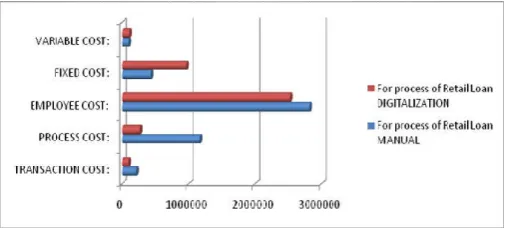
Interpretation: As per the data, the Weighted Average Cost of
in manual is 24.29% and digitalization is 6.71%, Employee cost is 58.94% in manual and digitalization is 63.52%, process cost is less in digitalization due to more work efficiency but maintenance/ related charges are higher. Comparatively fixed cost is lower for manual than digitalization, which is 9.14% and 24.26% respectively, but its vice-versa in case of variable cost. Variable cost incurred in manual is 2.21% and digitalization is 2.89% though paper work is less in the process of digitalization.
Figure 1. Different costs by Manual and Digital operations
[image:4.595.38.295.169.283.2]Comparison of Different Cost in context to Geographical Sector namely Urban, Semi-Urban, Rural, Bank SBM before merger with SBI
Figure 2. Comparison of Different Cost in context to Geographical Sector of Manual & Digital Operations
Interpretation: As per the data, the Transaction cost for
Manual operation of Retail Loan in urban sector is less than the semi-urban sector but it is higher in rural area by 12% and 20% respectively. Usually all cost incurred in urban sector except the variable cost are least that of semi-urban sector and its higher for rural areas. The Process Cost is less by 12% compared to semi-urban areas and 20% more in rural areas. Similarly, Employee cost and Fixed cost incurred in urban area is less by 37% and 16% respectively and its vice-versa by 66% and 56% respectively. The Variable Cost behaves opposite of previous trend of cost. This cost in urban area is higher than semi-urban area and further slopes downward @22%. As per the data, the Transaction cost for Digital operation of Retail Loan in urban sector is less for Process cost, Employee cost and Variable cost than the semi-urban sector which is @ 28%, 40%, and 43% respectively. But it is higher for Transaction Cost and Fixed Cost which is @ 54% and 15% respectively. As one moves further, all type of cost except the Transaction cost are ascending for operations in rural areas. All process cost enhances @31%, Employee cost @62%, Fixed cost @ 54% , Variable cost @31% but Transaction cost descends
@53% due to least number of recovery from customer opting for this Retail Loan schemes in Rural area.
Comparison of various Transaction Costs incurred between Urban bank, Semi-urban bank, Rural bank and SBM by Manual and Digitalisation operations
[image:4.595.304.561.299.436.2]Figure 3. Transaction costs of operations by Manual
Figure 4. Transaction costs of operations by Digitisation operations
Interpretation: In above graph, in the Manual Operations
fund transfer between customer linked account and paying third parties fund transfer in urban bank is 38.82%, semi-urban bank is 19.41%, rural bank is 29.24% and SBM is 12.52%. Amount deposit in urban bank is 21.45%, semi-urban bank is 15.57%, rural bank is 42.21% and SBM is 20.76%. Amount withdraw in urban bank is 44.44%, semi-urban bank is 24.69%, rural bank is 0 and SBM is 30.86%. No costs for the amount withdraw in rural bank. From the above graph, under Digital operations, fund transfer in urban is 23.17%, semi-urban is 23.84%, rural is 39.73%and SBM is 13.24%. Amount deposit high in urban bank is 36.28% and amount deposit high in rural bank is 47.58%.Computer usage in urban bank is 24.79%, semi-urban is 28.20%, rural bank is 0 and SBM is 47%. SBM computer usage high because work is more.
Comparison of various Process Costs incurred between Urban bank, Semi-urban bank, Rural bank and SBM by Manual and Digitalisation operations:
Interpretation
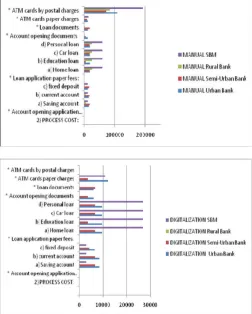
[image:4.595.38.292.353.516.2]and loan document high in semi-urban is 57.69%. ATM card high in SBM is 38.75% and ATM postal charges high in SBM is 42.10%. SBM has more number of account opening in this bank. From above graph, Digital operating system indicates expenditures for saving and current account in urban bank is 46.82%, semi-urban is 36.12%%, rural bank is 1.003% and SBM is 16.05%. Fixed deposit highest in urban bank is 47.11%. Loan application in urban home loan and car loan high in SBM is 66.76% and lowest in rural bank is 0.41%. Education loan always cost low is 0.44% in rural bank low number of rural people using education loan. In digitalization no postal charges when account open on the spot debit card print. ATM card paper charge high in urban bank 45.41%because more account open in the urban bank.
Figure 5 and Figure 6. Different costs of Process Cost by Manual and Digitisation operations
Comparison of various Employee Costs incurred between Urban bank, Semi-urban bank, Rural bank and SBM by Manual and Digitalisation operations
[image:5.595.38.291.228.543.2]Figure 7. Different Employees costs by Manual operations
Figure 8. Different Employees costs by Digitisation operations
Interpretation: The above graph by Manual operations, high
salaries in rural bank is 38.38% because more number of employees in this bank, so cost automatically increases. No incentives is provided in urban bank and SBM. In rural bank it is 88.88%. The above graph by Digitisation operations, salary high in rural bank is 32.46% and semi-urban ban is 14.71% it is too low. In rural bank more employee then salary cost is increase and semi-urban bank low number of employee the salary cost decrease. No incentive in urban and semi-urban bank. High incentive in rural bank 88.88%.
[image:5.595.307.562.412.533.2]Comparison of various Fixed Costs incurred between Urban bank, Semi-urban bank, Rural bank and SBM by Manual and Digitalisation operations
Figure 9. Different costs of Fixed Cost by Manual operations
Figure 10. Various Fixed costs by Digitisation operations
Interpretation: The above graph, Manual operations incurrs
[image:5.595.309.562.567.670.2] [image:5.595.38.291.626.781.2]bank is 81.30% because more using digital account opining machine and debit card machine the cost is increase.
[image:6.595.38.291.131.269.2]Comparison of various Variable Costs incurred between Urban bank, Semi-urban bank, Rural bank and SBM by Manual and Digitalisation operations
[image:6.595.37.292.299.454.2]Figure 11. Various Variable costs by Manual operations
Figure 12. Various Variable costs by Digitisation operations
Interpretation: The above graph, by Manual operation, urban
and rural bank paper cost more is 28.26% because more number of people opens an account for loan in urban and rural and bank cost automatically increases. Ink usage high in urban bank is 55.26%. Repairs and maintenance is high in urban bank @ 48.78%. The above graph, by Digital operation, low in semi-urban bank is 7.42% because digitalization paper work is low. High usage of ink of cartilage for printers in urban banks @83.60% because of more work process in the urban bank. Paper usage too is high in urban bank @ 53.21% as more work process in urban bank.
HYPOTHESIS AND ITS TESTING
H0: All types of cost cannot be reduced by using Digital
Operations
H1: All types of cost can be reduced by using Digital
Operations
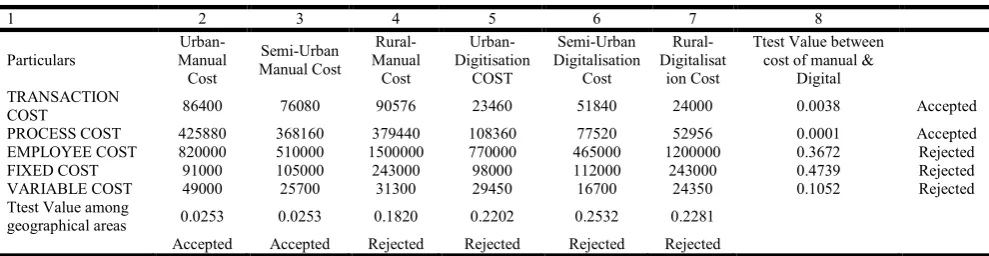
From the above table, Total Manual operation for Retail Loan Process indicates total of column 2+3+4 and Total Digitisation operation for Retail Loan Process is the total of columns 5+6+7. The TTest Value for Transaction Cost, Process Cost, Employee cost, Fixed cost and Variable cost compared between Manual and Digital operation is shown in column number 8 and the status of its acceptance is shown in the adjacent column of 8. From above, we can observe that TTest value for variance at equal means for one tail is accepted for only Transaction cost and Process cost which proves that there is not much significant difference between these operations. Employee cost, Fixed cost and Variable cost are above the level of significance but within the critical value of T Test which means that these costs have variances but can be controlled. Henceforth, we accept the Null hypothesis proving the assertiveness that at this stage, all type of cost like Fixed cost and Variable cost cannot be reduced by using Digital operations.
H0: Only Digital Operations cannot be implemented in all
geographical sectors
H1: Only Digital Operations can be implemented in all
geographical sectors
In above table, the value for column 2 is TTest of Means between column 2 and column 4 cost of all types incurred in Urban and Rural by Manual operations only for Retail loan process. Similarly column 3, it’s the TTest value between Urban and Semi-Urban by manual operations. Column 4 is between Semi-Urban and Rural areas by Manual operations. Same is the pattern of analysis for Digital Operations where TTest value for Urban and Rural is in column 5, TTest value for Urban and semi-Urban in column 6 and lastly between Semi-urban and Rural is in column 7. This proves that there is not much difference between operations by Manual in Urban and Semi-Urban areas but there is lot of cost incurred in Rural areas, according to the level of significance. This stand opposite for Digital operations in all the three sectors where Semi-Urban and Rural are the costliest of all due to least number of beneficiaries where obviously the cost of operating becomes higher.
Table 1. Analysis of t-test value for testing of Hypothesis 1 & 2
1 2 3 4 5 6 7 8
Particulars
Urban- Manual Cost
Semi-Urban Manual Cost
Rural- Manual
Cost
Urban-Digitisation
COST
Semi-Urban Digitalisation
Cost
Rural-Digitalisat
ion Cost
Ttest Value between cost of manual &
Digital TRANSACTION
COST 86400 76080 90576 23460 51840 24000 0.0038 Accepted
PROCESS COST 425880 368160 379440 108360 77520 52956 0.0001 Accepted
EMPLOYEE COST 820000 510000 1500000 770000 465000 1200000 0.3672 Rejected
FIXED COST 91000 105000 243000 98000 112000 243000 0.4739 Rejected
VARIABLE COST 49000 25700 31300 29450 16700 24350 0.1052 Rejected
Ttest Value among
geographical areas 0.0253 0.0253 0.1820 0.2202 0.2532 0.2281
Accepted Accepted Rejected Rejected Rejected Rejected
[image:6.595.50.545.646.774.2]The T Test is within the Critical value, it shows that Digital operations can be implemented if costs are pruned down but the study accept the Null hypothesis as per the level of significance illustrating the difficulty of using Digitisation in different geographical areas.
H0: Operating cost cannot be effective without using Digital
Operations
H1: Operating cost cannot be effective without using Digital
[image:7.595.40.285.220.311.2]Operations
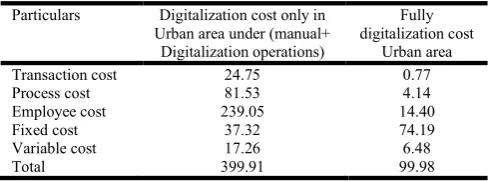
Table 2. Illustrating Various Cost for only Digitalization cost in Urban Areas
Particulars Digitalization cost only in
Urban area under (manual+ Digitalization operations)
Fully digitalization cost
Urban area
Transaction cost 24.75 0.77
Process cost 81.53 4.14
Employee cost 239.05 14.40
Fixed cost 37.32 74.19
Variable cost 17.26 6.48
Total 399.91 99.98
In urban branch both where the operation are integrated the total amounts to the rate of 399.91 by using weighted average method and urban area where the operation are integrated the total to the rate of 99.98 by using weighted average method.
Interpretation: As per the data transaction cost in manual is
24.75% and digitalization is 0.77%, process cost in manual is 81.53% and digitalization is 4.14%, employee cost in manual is 239.05% and digitalization is 14.40%, fixed cost in manual is 37.30% and digitalization is 74.19% , variable cost in manual is 17.26% and digitalization is 6.48%. The Correlation is definitely negative as the Employee cost is higher for integrated cost of Manual and Digitisation operations and Fixed cost is higher for Digital operation. TTest Value = 0.3731. It impacts cost effectiveness of operating cost. We accept the Null hypothesis proving that if Fixed cost and variable cost are controlled, than services provided using Digitalization would be opted for better cost-effectiveness of operations.
FINDINGS
According to weighted average cost, urban bank
branch1 the employee cost in manual is 65.40% and digitalization is 81.63% due to higher work efficiency, and fixed cost is lower for manual than digitalization, which is 7.78% and 10.30% respectively because
lighting and infrastructure cost incurred for
digitalization is more but its vice-versa for Variable cost. Urban bank branch 2 is fully digitalized where the transaction cost is 0.77%, process cost is 4.14%, and employee cost is 14.40% where employees in this bank are less. Fixed cost is high which accounts @ 74.19% because lighting and infrastructure cost is more costly and variable cost is low @ 6.48% because paper work is less. This bank is fully digitalized hence no manual cost. In this branch only two employees works so employee cost is low but the maintenance/other relative cost is higher. Urban bank branch 3 Fixed cost is higher for manual than digitalization, which is 5.95% and
13.29% but the overall operating cost for digitalization is high.
Semi-urban branch1 the fixed cost in manual is 27.34%
and digitalization is 38.87%. Cost is more in digitalization because lighting and infrastructure cost is
more. Compare to other branches the process cost in
manual is 27.79% and 6.04% in digitalization because the account opening and loan application cost is less in digitalization. Employee cost in manual is 72.44% and 69.2% in digitalization. The employee cost reduce in digitalization because less number of employee in this branch. Process cost in manual is 23.38% and compare to other branch digitalization cost is 0% in rural branch 2 due to absence of network of digitalization. SBM branch1 the variable cost in manual is 1.23% and digitalization is 0.85%, cost less in the digitalization because savings in paper and other stationary. Transaction cost in manual is 10.42% and digitalization is 16.45% because system cost is more.SBM branch2, fixed cost in manual is 4.86% and digitalization is 7.49% because lighting and infrastructure cost is more.
Rural bank is 0% and SBM is 30.86%, the amount
withdraws no cost in rural bank. Computer usage in urban bank is 24.79%, semi-urban is 28.20%, rural bank is 0% and SBM is 47%. SBM computer usage more because staff in this branch. ATM card high in SBM is 38.75% and ATM postal charges high in SBM is 42.10%.SBM number of account opening in this bank. Education loan always cost is low is 0.44% in rural bank as low number of rural people are using education loan. A high salary in rural bank is 38.38% because more number of employees in this bank cost is automatically increase. No incentive in urban bank and SBM but in rural bank it is 88.88%. Among fixed cost, Rent in urban bank is 32.65% because this is developed areas where this cost is high. Infrastructure is high in urban bank for digitalization because more usage for digital account opening and debit card is high. Repairs and maintenance for digitalization too is high in urban bank which accounts @ 48.78%. Variable cost for manual is too costly due to high usage of ink in urban bank which is 83.60% and it influences other stationeries also.
By Hypothesis Testing, the study proved that Process
Cost and Transaction cost are reduced by integrating the digitization operations and the other remaining cost need to be prioritized for reducing its impact for processing system of Retail Loan. Digitisation is costlier if number of beneficiaries are not in large numbers though it aids in reducing the operating cost.
Conclusion
Cost of employee in digital environment is more than
compared to manual mode, this is mainly due to skilled employees and higher incentives.
Fixed cost is also higher in digital environment due to
investment in high coast machines like Account opening Kiosk, Debit card printing Kiosk, ATMs, Recycles etc.
Transaction cost is too low in digital environment as
has to intervine for every transaction which adds to cost. Thus digitalization in banking helps in reduction of operating cost.
Process cost is also affected by digitalization. It is lower
at digital branches as most of the process in online and performed by customer themselves.
Variable cost is too low at 0.85% in digitalization
branches which is much lower than other regular branches.
In out shell, the overall cost if taken into considerations,
the cost due to digitalization has reduced in banks. Thus on migration from manual to digital, banks are saving on overall cost, the improving on profitability.
REFERENCES
Bhat.Hamlata Jankinath, 2009. “E-banking implementation in Indian Banks a study of Banks”
Pillai Deepa, 2012. “A Study on the Impact of Business Practices on Profitability and Cost Effectiveness of Selected Banks”.
Prasad, G.Siva Rama, 2009. “Role of ATM in Modern banking.
Shah, Vipinchandra Damodardas, 1983. “Factors affecting Costs and Efficiency of banking services at branch level”. Subbaraju H.M. 2005. “An Appraisal of Cost Effectiveness
and Profitability in Commercial Bank – A Case study of SBI.”
Yajnik Nilay, 2009. “Internet Banking in India- A Model for user Acceptance”.