Morphological Inflection Generation with Multi-space Variational
Encoder-Decoders
Chunting Zhou and Graham Neubig Language Technologies Institute
Carnegie Mellon University ctzhou,[email protected]
Abstract
This paper describes the CMU submis-sion to shared task 1 of SIGMORPHON 2017. The system is based on the multi-space variational encoder-decoder (MSVED) method of Zhou and Neubig
(2017), which employs both continuous and discrete latent variables for the vari-ational encoder-decoder and is trained in a semi-supervised fashion. We discuss some language-specific errors and present result analysis.
1 Introduction
In morphologically rich languages, different af-fixes (i.e. preaf-fixes, inaf-fixes, sufaf-fixes) can be com-bined with the lemma to reflect various syntactic and semantic features of a word. In many areas of natural language processing (NLP) it is impor-tant that systems are able to correctly analyze and generate different morphological forms, including previously unseen forms. The ability to accurately analyze and generate morphological forms is cru-cial to creating applications such as machine trans-lation (Chahuneau et al., 2013) and information retrieval (Darwish and Oard,2007). Accordingly, learning morphological reinflection patterns from labeled data is an important challenge.
The Universal Morphological Reinflection task at SIGMORPHON 2017 (Cotterell and Sch¨utze,
2017) is an evaluation campaign aimed at systems that tackle the task of morphological inflection. It extends the SIGMORPHON 2016 Morphological Reinflection by conducting tasks in 52 languages instead of 10Cotterell et al.(2016).
In our system submission, we utilize multi-space variational encoder-decoders (MSVEDs), which are a varitional encoder-decoder with both continuous and discrete latent variables (Zhou and
Neubig, 2017). The continuous latent variable is expected to reflect the lemma form of a word and the discrete variables are used to induce the desired labels of the inflected word. The whole model is trained in a semi-supervised fashion. For the supervised part we are reducing the recon-struction error of generating the inflected word given the lemma and corresponding tags. For the unsupervised part, we introduce the discrete la-tent variables representing the morphological tags, and train an auto-encoder over unlabeled corpora. Thus, the training objective includes both the vari-ational lower bound on the marginal log likeli-hood of the observed parallel training data and the monolingual data.
There are two tasks in SIGMORPHON 2017, which are morphology inflection (task 1) and paradigm completion (task 2) respectively. We participated in task 1, inflection generation, in which the goal is to output the inflected form of a lemma given a set of desired morphological tags.1
Experimental results found that our model works relatively well on the shared task 1 without ex-tensive tuning of hyper-parameters and language-specific features.
2 Methods
In this section we will detail the multi-space vari-ational encoder-decoder model.
Notation: In morphological reinflection, the source sequencex(s) consists of the characters in
an inflected word (e.g., “played”), while the as-sociated labelsy(t) describe some linguistic
fea-tures (e.g.,ypos(t) =Verb,ytense(t) = Past) that we
1We considered participation in task 2, but while the
train-ing data in the second task provides all inflection forms for each lemma, the number of different lemmas is rather smaller, which resulted in our model quickly overfitting to the training data when training the neural model. Therefore, we only took part in the first task this time.
hope to realize in the target. The target sequence x(t) is therefore the characters of the re-inflected form of the source word (e.g., “played”) that sat-isfy the linguistic features specified by y(t). For
this task, each discrete variable yk(t) has a set of
possible labels (e.g. pos=V, pos=ADJ, etc) and follows a multinomial distribution.
2.1 Preliminaries: Variational Autoencoder
The variational autoencoder (Kingma and Welling, 2014) is an efficient way to handle (continuous) latent variables in neural models. We describe it briefly here, and interested readers can refer to Doersch (2016) for details. The VAE learns a generative model of the probability
p(x)of observed data x. The generative process consists of first generating a continuous latent variable z conditioned on the observed data x, which is termed as the recognition model
q(z|x) (encoder) and then use this latent variable to reconstruct the observation x known as the reconstruction (decoder) model p(x|z). VAE uses the variational inference to approximate the intractable posterior by learning a parametric posterior distribution for all observations.Th learning objective function is the variational lower bound on the marginal log likelihood of data:
logpθ(x)≥Ez∼qφ(z|x)[logpθ(x|z)]−
KL(qφ(z|x)||p(z)) (1)
To optimize the parameters with gradient descent,
Kingma and Welling(2014) introduce a reparam-eterization trick that allows for training using sim-ple backpropagation w.r.t. the Gaussian latent vari-ablesz.
2.2 Multi-space Variational Encoder-Decoders
There are two cases to discuss when employing the variational encoder-decoder framework for beled sequence transduction. First, when the la-bels of the inflected words are known as is the format of the training data in the shared task, we don’t need to bother introduction the discrete la-tent variables for the inflected labels. We max-imize the variational lower bound on the condi-tional log likelihood of observingx(t)andy(t) as
follows:
logpθ(x(t),y(t)|x(s))
≥Ez∼qφ(z|x(s))log
pθ(x(t),y(t),z|x(s))
qφ(z|x(s))
=Ez∼qφ(z|x(s))[logpθ(x(t)|y(t),z) + logpπ(y(t))]−
KL(qφ(z|x(s))||p(z)) =Ll(x(t),y(t)|x(s)) (2)
which is a simple extension to the vanilla varia-tional auto-enocders.
Second, in the case of unsupervised learning or when the labels of the inflected word is not ob-served, we only observe a word or a pair of words and we would like to maximize the log likelihood of the observed data by marginalizing over possi-ble morphological labels, which is consisted to the supervised case above. In this scenario, we can introduce the discrete latent variables for the in-flected labels which are used to infer the labels for the target word. Then when decoding the word, we condition both on the continuous and discrete la-tent variables. For the variational encoder-decoder (MSVED), the variational lower bound on the con-ditional log likelihood is affected by the recogni-tion model, and thus is computed as:
logpθ(x(t)|x(s))
≥E(y(t),z)∼qφ(y(t),z|x(s),x(t))log
pθ(x(t),y(t),z|x(s))
qφ(y(t),z|x(s),x(t))
=Ey(t)∼q
φ(y(t)|x(t))[Ez∼qφ(z|x(s))[logpθ(x
(t)|y(t),z)]
−KL(qφ(z|x(s))||p(z)) + logpπ(y(t))
−logqφ(y(t)|x(t))] =Lu(x(t)|x(s)) (3)
While the unsupervised objective is trained by maximizing the following variational lower bound
U(x)on the objective for unlabeled data:
logpθ(x)≥E(y,z)∼qφ(y,z|x)log
pθ(x,y,z)
qφ(y,z|x)
=Ey∼qφ(y|x)[Ez∼qφ(z|x)[logpθ(x|z,y)]
−KL(qφ(z|x)||p(z)) + logpπ(y)
−logqφ(y|x)] =U(x) (4)
Note that when labels are not observed, the in-ference modelqφ(y|x)has the form of a
discrim-inative classifier, thus we can use observed labels as the supervision signal to learn a better classifier. In this case we also minimize the following cross entropy as the classification loss:
wherepl(x,y)is the distribution of labeled data.
To sum up, the semi-supervised model ( Semi-sup) is trained to maximize the variational lower bounds and minimize the classification cross-entropy error of5.
L(x(s),x(t),y(t),x) =α· U(x) +Lu(x(s)|x(t))
+Ll(x(t),y(t)|x(s))− D(x(t),y(t)) (6)
The weightαcontrols the relative weight between the loss from unlabeled data and labeled data.
3 Learning MSVED
3.1 Learning Discrete Latent Variables
One challenge in training our model is that dis-crete random variables in a stochastic computa-tion graph prevent the gradient from being back-propagated due to their non-differentiability, and marginalizing over all label combinations is also infeasible in our case.
To alleviate this problem, we use the recently proposed Gumbel-Softmax trick (Maddison et al.,
2014;Gumbel and Lieblein,1954) to create a dif-ferentiable estimator for categorical variables. In experiments, we start with a relatively large tem-perature and decrease it gradually.
3.2 Learning Continuous Latent Variables
We observe that with the vanilla implementation the KL cost quickly decreases to near zero, setting
qφ(z|x)equal to standard normal distribution. In
this case, the RNN decoder can easily degenerate into an RNN language model. Hence, the latent variables are ignored by the decoder and cannot encode any useful information. The latent vari-ablezlearns an undesirable distribution that coin-cides with the imposed prior distribution but has no contribution to the decoder. To force the de-coder to use the latent variables, we take the fol-lowing two approaches which are similar to Bow-man et al.(2016).
KL-Divergence Annealing: We add a coefficient
λto the KL cost and gradually anneal it from zero
to a predefined thresholdλm. At the early stage
of training, we setλto be zero and let the model
first figure out how to project the representation of the source sequence to a roughly right point in the space and then regularize it with the KL cost. This technique can also be seen in (Koˇcisk`y et al.,2016;
Miao and Blunsom,2016).
Input Dropout in the Decoder: Besides anneal-ing the KL cost, we also randomly drop out the
k a l b
⌃(x)
µ(x)
✏⇠N(0,1)
z
<w> k k ä
+
yT
1 y2T y3T y4T.... ...
k a l b
⌃(x)
µ(x)
✏⇠N(0,1)
z
<w> k k a
Multinomial Sampling
+
...
y12{pos: V, N, ADJ}.. y22{def: DEF, INDEF} y32{num: DU, SG, PL}... ...
...
Source Word Reinflected Form
Source Word Source Word
Supervised Variational Encoder Decoder
Unsupervised Variational Auto-encoder y1
[image:3.595.307.524.60.258.2]y2 y3 y4 · · ·
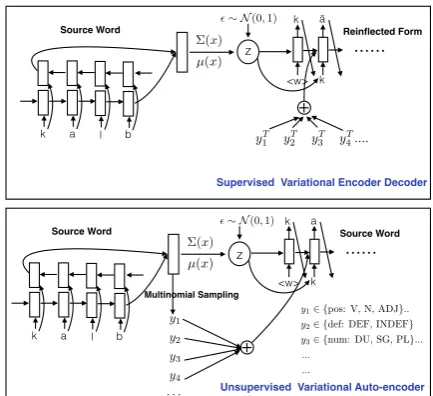
Figure 1: Model architecture for labeled and unla-beled data. For the encoder-decoder model, only one direction from the source to target is given. The classification model is not illustrated in the diagram.
input token with a probability of β at each time
step of the decoder during learning. The previous ground-truth token embedding is replaced with a zero vector when dropped. In this way, the RNN decoder could not fully rely on the ground-truth previous token, which ensures that the decoder uses information encoded in the latent variables.
4 Architecture for Morphological Reinflection
The overall model architecture is shown in Fig.1. Each character and each label is associated with a continuous vector. We employ Gated Recur-rent Units (GRUs) for the encoder and decoder. We use only single directional GRUs as the en-coder for the input wordx(s). uis the hidden rep-resentation of x(s) which is the last hidden state
of GRUs. and is used as the input for the infer-ence model onz. We representµ(u)andσ2(u)as MLPs and samplezfromN(µ(u),diag(σ2(u))),
using z=µ+σ◦, where ∼ N(0,I). Sim-ilarly, we can obtain the hidden representation of x(t)and use this as input to the inference model on
each labelyi(t), which is also an MLP following a softmax layer to generate the categorical probabil-ities of target labels.
Language Dev Test Language Dev Test Language Dev Test
Latin 66.2 66.2 Navajo 84.9 84.2 English 93.3 94.6 Icelandic 71.7 68.1 French 84.9 82.4 Lower-Sorbian 93.9 91.3 Irish 72.7 71.9 Armenian 85.3 82.3 Italian 94.2 92.6 Finnish 73.4 74.9 Latvian 85.6 87.5 Basque 95.0 97.0 Hungarian 74.5 73.6 Scottish-Gaelic 86.0 68.0 Estonian 95.1 93.7 Faroese 74.8 74.5 Bulgarian 86.3 86.7 Quechua 95.5 95.5 Russian 75.8 76.4 Macedonian 86.6 86.1 Khaling 96.2 94.8 Norwegian-Nynorsk 77.8 73.8 Northern-Sami 86.7 85.8 Hebrew 96.3 97.5 Polish 78.3 78.1 Slovene 87.3 87.8 Portuguese 96.4 96.4 German 79.3 78.7 Danish 88.1 85.4 Catalan 96.9 96.5 Swedish 80.2 80.6 Arabic 88.6 85.9 Urdu 98.4 97.9 Romanian 80.3 78.6 Sorani 89.6 87.8 Persian 98.6 98.7 Lithuanian 80.6 81.6 Slovak 89.6 87.9 Bengali 99.0 99.0 Serbo-Croatian 81.1 79.6 Turkish 90.4 90.3 Welsh 99.0 99.0 Norwegian-Bokmal 81.2 82 Dutch 91.2 88.9 Haida 99.0 97.0 Czech 83.1 81.9 Albanian 91.9 91.3 Hindi 99.9 99.6 Kurmanji 83.4 83.8 Georgian 92.5 92.3
[image:4.595.78.526.64.327.2]Ukrainian 84.5 84.0 Spanish 92.5 92.8 Average 87.18 86.21
Table 1: Results of the ensemble system on the development ang test sets of 52 languages.
Language Src Word Tgt Labels Gold Tgt Ours
Latin trygonlargio Mood=SBJV;Num=PL;Per=2;Tense=PST;Asp=PRF;Pos=VPos=N;Case=ABL;Num=PL larg¯iviss˜etistr¯yg¯onibus tryg˜onibuslargiss¯etis compenso Mood=SBJV;Num=SG;Per=3;Tense=PST;Asp=PFV;Pos=V compens¯averit compenserit Icelandic h´aspilgallabuxur Pos=N;Def=INDF;Case=GEN;Num=SGPos=N;Def=DEF;Case=GEN;Num=PL gallabuxnah´aspilanna gallab¨olurh´asplanna
[image:4.595.74.525.364.451.2]lest Pos=N;Def=DEF;Case=GEN;Num=SG L lestarinnar lestsins
Table 2: Examples of incorrect inflection generation words on the dev data.
Language Settings Dev Acc. (Single Model.)
Icelandic vanilla Encoder-Decoder + attention, w/o data augmentationour model w/o data augmentation and Wiki 81.078.6
our model (full) 71.7
Latin vanilla Encoder-Decoder + attention, w/o data augmentationour model w/o data augmentation and Wiki 74.666.6
our model (full) 66.2
Persian vanilla Encoder-Decoder + attention, w/o data augmentationour model w/o data augmentation and Wiki 99.699.6
our model (full) 98.6
Arabic vanilla Encoder-Decoder + attention, w/o data augmentationour model w/o data augmentation and Wiki 90.791.3
our model (full) 88.6
Table 3: Ablation experiments on the effects of data augmentation and WikiData.
that our model is not sensitive to the temperature in this task. All hyperparameters are tuned on the validation set, and include the following: For KL cost annealing,λmis set to be 0.2 for all language
settings. For character drop-out at the decoder, we
empirically setβ to be 0.4 for all languages. We
[image:4.595.104.493.487.645.2]loss to be 0.8. We train the model with Adadelta (Zeiler,2012) and use early-stop with a patience of 5. Our system is an ensemble of five models and the probability vector at each time step is ob-tained by averaging the output probabilities from each model
5 Experiments
5.1 Data pre-processing
Creating morphosyntactic tag maps: In our model, we treat the inference model on discrete la-bels in the form of discriminator, thus we need to know which label belongs to which morphosyn-tactic dimension. For example, V is a label of
Part-of-speech-tagging. To obtain such mapping from a specific label to the morphosyntactic di-mension, we leverage the Universal Morpholog-ical Feature Schema (Sylak-Glassman,2016) and also add the missing schema from the training data to create the key-value pairs of morphosysntactic dimension and label. Then we reformat the labels provided in the data set into the key-value pairs to train a classifier for each morphosyntactic dimen-sion.
Data Augmentation: We augment the data set in the similar way asKann and Sch¨utze (2016). By doing so, the training data is not limited to the form of lemma to inflected word but can also be any word pairs that share the same lemma. This helps our model generalize better and learn the la-tent continuous representations more effectively. The size of training data set after augmentation scales with a factor of 2 to 20 times compared with the original one.
Monolingual WikiData: We process the Wikipedia corpus provided by the shared task or-ganizer as our unsupervised training data together with words in the training data. For each language, we first get the character vocabulary of the cor-responding training data and only keep words in the Wiki corpus for which characters are all in the character set we obtained. All words that occur less than 20 times are eliminated. We also limit the number of words used during training to be the 50000 most frequent words.
5.2 Results and Analysis
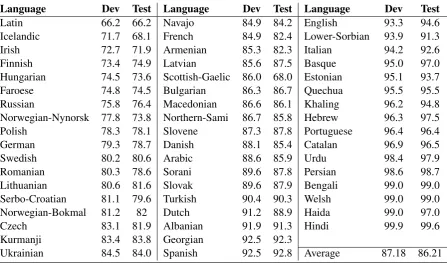
The results on the dev and test data of the 52 lan-guages are presented in 1. We obtain a gener-ation accuracy above 80% over more than 25% languages and an average of 87.2% for both dev
and test data. The generation accuracy is almost consistent on the dev and test data except that the test data accuracy of Scottish-Gaelic drops by near 21%. We find that only a medium volume of train-ing data is provided for Scottish-Gaelic. This may be the reason why the model trained for Scottish-Gaelic can not generalize as well as other lan-guages.
We do not tune the hyper-parameters for each language manually. However, we test on dif-ferent dimensions for the continuous latent vari-ables. The dimension size we have used included 100 and 150. And we observe significant im-provement by using a larger dimension size of la-tent variables over a portion of languages includ-ing Faroese, Lithuanian, Navajo, Scottish-gaelic, Northern-sami, Slovene, Sorani, Slovak. How-ever, we also observe that for some languages in-cluding Finnish, German, French, etc, the perfor-mance drops signficantly after increasing the size of continuous latent variable dimension. This in-dicates that for different languages, the continuous space required to encode the lemma and inflected information varies from language to language. We will further investigate this in the future work.
5.3 Effect of Data Augmentation and Using Wiki Data
While our performance was reasonable, it was not as good as that presented in our previous work (Zhou and Neubig, 2017), nor was it competi-tive with the highest-scoring models on the shared task. In order to examine the reason for this, we performed several ablations, the results of which are presented in Tab.3
First, we first examined the effects of data augmentation and Wiki Data for semi-supervised learning on the performance of our model. By re-moving the augmented data from the training set, we observe a large gain in the generation accu-racy. Besides, we find that Wiki Data for semi-supervised learning doesn’t help much to increase the model’s performance. The reasons for this will be examined further in the following section.
Dimension Label Train Data WikiData Difference
Case
None 0.58 0.35 -0.22
ACC 0.14 0.51 0.38
NOM 0.14 0.12 -0.02
GEN 0.14 0.01 -0.13
Possession NonePSSD 0.860.14 0.310.69 -0.550.55 Language-Specific-Features NoneLGSPEC1 0.900.10 0.420.58 -0.480.48
Mood
None 0.68 0.10 -0.58
IND 0.20 0.62 0.42
IMP 0.02 0.03 0.01
SBJV 0.10 0.25 0.15
Definiteness NoneDEF 0.570.22 0.600.34 0.030.12
NDEF 0.21 0.06 -0.15
Gender NoneFEM 0.530.23 0.520.27 -0.010.04
MASC 0.23 0.20 -0.03
Politeness NoneINFM 0.850.14 0.580.42 -0.280.28
Number
None 0.01 0.16 0.15
DU 0.22 0.34 0.12
SG 0.47 0.31 -0.15
PL 0.30 0.18 -0.11
Person
None 0.58 0.74 0.15
1 0.06 0.02 -0.05
3 0.18 0.17 -0.01
2 0.17 0.08 -0.09
Tense NonePST 0.900.10 0.510.49 -0.400.40
Aspect NonePRF 0.800.10 0.210.41 -0.590.31
IPFV 0.10 0.38 0.28
Part-of-Speech
None 0.00 0.03 0.03
V+V.PTCP 0.01 0.29 0.28
V+V.MSDR 0.00 0.15 0.14
N 0.43 0.36 -0.07
ADJ 0.14 0.14 -0.00
V 0.42 0.03 -0.39
Voice NonePASS 0.570.16 0.400.39 -0.180.22
ACT 0.27 0.22 -0.05
Table 4: The distribution of morphosyntactic tags for Arabic on Wikipedia and the shared task training data respectively. The linguistic tag classifier has an average accuracy of 93.36% on the Dev data.
model in some cases. We suspect that since task 1 is purely an inflection task and because semi-supervised learning did not provide a partic-ularly large benefit, a simpler model that utilizes attention may be sufficient. This is in contrast to our previous findings, where semi-supervised learning was highly effective, and the proposed model out-performed the simpler attention-based baseline.
5.4 Analysis on the Distribution of Linguistic Tags of Wiki Data and Training Data
One potential reason for the lack of effective-ness of supervised training is that the
Dimension Label Train Data WikiData Difference
Mood NoneIMP 0.790.03 0.130.69 -0.660.66
SBJV 0.18 0.18 -0.00
Politeness NoneCOL 0.520.48 0.300.70 -0.220.22 Number NoneSG 0.040.48 0.670.19 -0.300.62
PL 0.47 0.15 -0.32
Person
None 0.04 0.28 0.24
1 0.31 0.23 -0.08
3 0.31 0.22 -0.09
2 0.34 0.27 -0.07
Finiteness NoneNFIN 0.980.02 0.330.67 -0.660.66
Tense
None 0.13 0.07 -0.07
FUT 0.04 0.42 0.38
PST 0.46 0.14 -0.32
PRS 0.36 0.37 0.01
Aspect
None 0.39 0.37 -0.01
PROG 0.18 0.07 -0.11
PRF 0.17 0.03 -0.14
IPFV 0.18 0.09 -0.08
PFV 0.09 0.44 0.35
Part-of-Speech NoneV+V.PTCP 0.000.03 0.440.18 0.440.15
[image:7.595.162.436.63.348.2]V 0.97 0.38 -0.59
Table 5: The distribution of morphosyntactic tags for Persian on Wikipedia and the shared task training data respectively. The linguistic tag classifier has an average accuracy of 95.26% on the Dev data.
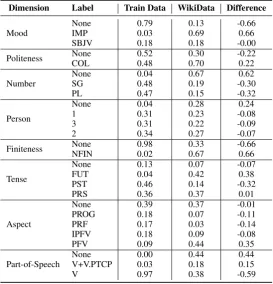
The percentages of each label within each mor-phosyntactic dimension for Arabic and Persian are listed in Tab. 4 and Tab. 5. We found that the distribution of the linguistic tags for the Wiki Data and the training data in the shared task are not always consistent. For example, in Arabic, the distributions of predicted tags with respect to case, possession, part-of-speech, and several other classes differ significantly from the original train-ing data. Such difference suggests that either the words in the unlabeled Wiki Data have very dif-ferent characteristics than our training set, or our tag classifier is not functioning properly to iden-tify the tags. Either case would be detrimental to semi-supervised learning. The problem is even more stark for Persian: in Persian the only labeled words in the training data are verbs, so all non-verb words in the Wiki Data will receive an incor-rect analysis, which is obviously not conducive to learning anything useful. As a recommendation for the future, when performing semi-supervised learning for morphology where the labeled data only represents a subset of the phenomena in the language, it is likely necessary to first identify which of the available unlabeled data is appropri-ate for semi-supervised learning before applying
such methods.
5.5 Case Study on Inflected Words
In Tab. 1, we notice that the performance on Latin is relatively poor compared with other lan-guages. Latin is a highly inflected languages with three distinct genders, seven noun cases, four verb conjugations, four verb principal parts, six tenses, three persons, three moods, two voices, two as-pects and two numbers. In addition to this, we found that the data set size after augmentation was only enlarged 2 times. We examine some errors made by our system on two worst performed lan-guages Latin and Icelandic in Tab. 2. As shown in the table, we found that the inflections of Latin and Icelandic have more suffix variations from the lemma. We guess our model still lacks the ability to capture more complicated inflections for such languages. We might consider adding the depen-dencies between different inflections for multiple target labels in our future work.
6 Conclusion and Future Work
demonstrate the effectiveness of this approach. We will further improve our model’s sophistication by investigating strategies for choosing appropriate semi-supervised data, and examining the model’s performance on languages with a high inflection level.
Acknowledgments
This work has been supported in part by an Amazon Academic Research Award. We thank Matthew Honnibal for pointing out that the data distribution of Wikipedia corpus might be biased.
References
Samuel R Bowman, Luke Vilnis, Oriol Vinyals, An-drew M Dai, Rafal Jozefowicz, and Samy Ben-gio. 2016. Generating sentences from a continuous
space. Proceedings of CoNLL.
Victor Chahuneau, Eva Schlinger, Noah A Smith, and Chris Dyer. 2013. Translating into morphologically rich languages with synthetic phrases. Association for Computational Linguistics.
Ryan Cotterell, Christo Kirov, John Sylak-Glassman, David Yarowsky, Jason Eisner, and Mans Hulden.
2016. The sigmorphon 2016 shared task—
morphological reinflection. In Proceedings of the
2016 Meeting of SIGMORPHON. Association for Computational Linguistics, Berlin, Germany.
Ryan Cotterell and Hinrich Sch¨utze. 2017. Joint se-mantic synthesis and morphological analysis of the
derived word. arXiv preprint arXiv:1701.00946.
Kareem Darwish and Douglas W Oard. 2007. Adapt-ing morphology for arabic information retrieval. In
Arabic Computational Morphology, Springer, pages 245–262.
Carl Doersch. 2016. Tutorial on variational autoen-coders.arXiv preprint arXiv:1606.05908.
Emil Julius Gumbel and Julius Lieblein. 1954. Sta-tistical theory of extreme values and some practical
applications: a series of lectures. US Government
Printing Office Washington.
Katharina Kann and Hinrich Sch¨utze. 2016. Med: The lmu system for the sigmorphon 2016 shared task on morphological reinflection. InIn Proceedings of the 14th SIGMORPHON Workshop on Computational Research in Phonetics, Phonology, and Morphol-ogy. Berlin, Germany.
D.P. Kingma and M. Welling. 2014. Auto-encoding
variational bayes. InThe International Conference
on Learning Representations.
Tom´aˇs Koˇcisk`y, G´abor Melis, Edward Grefenstette, Chris Dyer, Wang Ling, Phil Blunsom, and Karl Moritz Hermann. 2016. Semantic parsing with
semi-supervised sequential autoencoders. the 2016
Conference on Empirical Methods in Natural Lan-guage Processing (EMNLP).
Chris J Maddison, Daniel Tarlow, and Tom Minka.
2014. A* sampling. In Advances in Neural
Infor-mation Processing Systems. pages 3086–3094.
Yishu Miao and Phil Blunsom. 2016. Language as a latent variable: Discrete generative models for
sen-tence compression. the 2016 Conference on
Em-pirical Methods in Natural Language Processing (EMNLP).
John Sylak-Glassman. 2016. The composition and use of the universal morphological feature schema (uni-morph schema) .
Matthew D Zeiler. 2012. Adadelta: an adaptive learn-ing rate method.arXiv preprint arXiv:1212.5701.
Chunting Zhou and Graham Neubig. 2017.
Multi-space variational encoder-decoders for semi-supervised labeled sequence transduction. In The 55th Annual Meeting of the Association for Com-putational Linguistics (ACL). Vancouver, Canada.