Modeling the Usage of Discourse Connectives as Rational Speech Acts
Frances Yung
Nara Institute of Science and Technology 8916-5 Takayama, Ikoma,
Nara, 630-0192, Japan
Kevin Duh John Hopkins University
810 Wyman Park Drive, Baltimore, MD 21211-2840, USA
Taku Komura University of Edinburgh
10 Crichton Street,
Edinburgh, EH8 9AB, United Kingdom [email protected]
Yuji Matsumoto
Nara Institute of Science and Technology 8916-5 Takayama, Ikoma,
Nara, 630-0192, Japan [email protected]
Abstract
Discourse relations can either be implicit or explicitly expressed by markers, such as ’therefore’ and ’but’. How a speaker makes this choice is a question that is not well understood. We propose a psy-cholinguistic model that predicts whether a speaker will produce an explicit marker given the discourse relation s/he wishes to express. Based on the framework of the Rational Speech Acts model, we quantify the utility of producing a marker based on the information-theoretic measure of surprisal, the cost of production, and a bias to maintain uniform information den-sity throughout the utterance. Experiments based on the Penn Discourse Treebank show that our approach outperforms state-of-the-art approaches, while giving an ex-planatory account of the speaker’s choice. 1 Introduction
Speakers or authors1 produce informative
utter-ances, such that the listeners or readers can under-stand his/her message. Grice’sMaxim of Quantity states that human speakers communicate by being as informative as required, but no more (Grice, 1975). If a speaker always tries to provide as much information as possible, the resulting utter-ance could become excessively long and tedious. Such utterance is not only effort consuming for the speaker to produce, but also contains redundant in-formation that is not necessary for the listener.
1‘Speakers’and‘listeners’are interchangeably used with
‘authors’and‘readers’in this article
In this work, we model how speakers plan the presentation of discourse structure optimally in terms of informativeness. Specifically, we propose a model that predicts whether the speaker will use or omit a discourse connective, given the sense of discourse relation s/he wants to convey.
Discourse relations are relations between unit of texts (known asarguments) that make a document coherent. These relations can be marked in the sur-face text or inferred by the readers, as shown in the below examples.
1. It was a great movie,butI did not like it. 2. It was a great movie,thereforeI liked it. 3. It was a great movie. I liked it.
The word‘but’ indicates aConcessionrelation in Example (1), and‘therefore’indicates aResult re-lation in Example (2). We call ‘but’ and ‘there-fore’explicitdiscourse connectives (DCs). In Ex-ample (3), DCs are absent but aResultrelation can be inferred. We say the DC is implicit in this case. Explicit DCs are highly informative cues to identify discourse relations (Pitler et al., 2008) while implicit DCs are more ambiguous. For ex-ample,‘I liked it’can also be read as aJustification for the first sentence in Example (3).
Marking a discourse relation or not is subject to ambiguity and redundancy. On one hand, using an explicit DC avoids ambiguity. For example, if the DC ‘but’ is omitted in Example (1), readers may have problems in inferring theConcession sense. On the other hand, if the intended discourse sense is highly predictable, it is verbose or redundant to insert an explicit DC in the utterance, such as the DC‘therefore’in Example (2).
A model that predicts the markedness of dis-course relations not only contributes to a better understanding of the human language production mechanism, but is also important in generating natural, humanlike texts and dialogues. In partic-ular, the degree of markedness in discourse rela-tions differs cross-lingually. Yung et al. (2015) analyze the manual alignments of explicit and im-plicit DCs in a Chinese-English translation cor-pus and find that30%of implicit DCs in Chinese are translated to explicit DCs in English. It re-mains a challenge for machine translation systems to explicitate or implicitate discourse relations in the source texts as human translators do (Becher, 2011; Meyer and Webber, 2013; Zuffery and Car-toni, 2014; Hoek and Zufferey, 2015; Hoek et al., 2015), since the markedness of the translation is subject to the discourse planning of the target text. In order to explain how human speakers choose the optimal level of markedness in his utterance, we model how speakers rationally balance be-tween ambiguity and redundancy. In particular, we use the Rational Speech Acts (RSA) model (Frank and Goodman, 2012) to predict how speak-ers reason about the ambiguity of an utterance. In addition, we model how speakers adjust the re-dundancy of the utterance following the Uniform Information Density (UID) principle (Levy and Jaeger, 2006).
We apply the framework to predict whether an explicit or implicit DC is used in corpus data, given the two arguments of the discourse rela-tions and the discourse sense to be conveyed. Our model not only achieves higher accuracy com-paring with previous work (Patterson and Kehler, 2013), but also provides an interpretable account of various cognitive factors behind the predicted decision.
We start by a review of related work in Section 2, followed by the descriptions of our model in Section 3 and experiments in Section 4.
2 Related work
We first provide background information on RSA and UID, which are used in our proposed method. It is followed by introduction of previous work about prediction of DC markedness in corpus data.
2.1 Rational Speech Acts model
The RSA model (Frank and Goodman, 2012) is a variation of the game-theoretic approach in
prag-matics (J¨ager, 2012). It explains the communica-tive reasoning of a speaker and a listener in terms of Bayesian probabilities.
A rational listener assumes the utterance s/he hears contains the optimal amount of information. S/he predicts the intended message of a speaker by Bayesian inference (Equation 1).
Plistener(s|w, C)∝Pspeaker(w|s, C)P(s) (1)
wherewis theutteranceproduced by the speaker;
s is the message of an utterance; and C is the context.Pspeaker(w|s, C)represents thelistener’s
predicted speaker’s model, and P(s) represents the salience of the message, which is shared knowledge between the speaker and listener.
A rational speaker chooses an utterance by soft-max optimizing the expected utility(U(w;s, C)) of the utterance (Equation 2).
Pspeaker(w|s, C)∝eα·U(w;s,C) (2)
α is the decision noise parameter, which is set to 1 to represent a rational speaker 2. S/He
emu-lates the listener’s interpretation and chooses an utterance s/he believes to be informative. Also, an utterance that is easy to produce is preferred. Utility is thus defined as the informativeness (I(s;w, C)) of the utterance, deducted by the cost (D(w)) to produce it (Equation 3).
U(w;s, C) =I(s;w, C)−D(w) (3) Since utterances that are unconventional and sur-prising are less useful,Informativenessis quanti-fied as thenegative surprisalof the utterance with respect to the message to be conveyed (Equation 4).
I(s;w, C) = lnP(s|w, C) (4) The RSA model has successfully simulated re-sults of psycholinguistic experiments concerning different aspects of human communication, such as scalar implicature, referential expressions and language acquisition (Frank and Goodman, 2012; Goodman and Stuhlm¨uller, 2013; Smith et al., 2013; Bergen et al., 2014; Kao et al., 2014; Potts et al., 2015). Besides experimental data, Orita et al.(2015) applies RSA model to predict the choice of referring expressions in corpus data and Mon-roe and Potts (2015) optimizes a classifier based
on RSA by inducing the semantic lexicon from a training corpus. These works focus on the prag-matic use of language, where the informativeness and lexicon of an utterance largely depends on the context (e.g. ‘Red’is notvalidto be used to refer to ablueball).
In this work, we apply RSA to predict the usage of DCs, which is more universal across different contexts (i.e. A DC can be used or dropped given various discourse senses and contexts). Our model is built upon the speaker’s modelof RSA to pre-dict speaker’s choice of explicit or implicit DCs. 2.2 Uniform Information Density
The UID principle views language communication as a form of information transmission through a noisy channel and a constant rate of information flow is optimal according to Shannon’s Informa-tion Theory (Levy and Jaeger, 2006; Genzel and Charniak, 2002; Shannon, 1948). It states that speakers structure utterances by optimizing infor-mation density, which is the quantity of informa-tion (measured bysurprisal3) transmitted per unit
of utterance, such as word.
Information density rises when the utterance is ‘surprising’ and drops when an utterance is highly predictable. To smooth the peaks and troughs, speakers adjust the ambiguity of an utterance by including or reducing linguistic markers.
Following the UID principle, linguistic choices made by speakers are predicted more accurately by incorporating aninformation density predictor on top of other constraints. The predictor mea-sures how easily a candidate utterance can be pre-dicted and the speaker adjusts information density based on the expected predictability.
UID is applied to explain a variety of speaker’s options, such as phonetic (Aylett and Turk, 2004), morphological (Frank and Jaeger, 2008) and syn-tactic (Jaeger, 2010) reductions, and also referring expressions (Tily and Piantadosi, 2009).
2.3 Explicit vs. Implicit DCs
The choice of discourse marking strategies has been studied in earlier works as a subtask for natu-ral language generation (Scott and de Souza, 1990; Moser and Moore, 1995; Grote and Stede, 1998; Soria and Ferrari, 1998; Allbritton and Moore, 1999). In the absence of large-scale resources, in-vestigations are based on manually derived rules
3This is opposite to‘informativeness’in RSA, which is defined bynegative surprisal(Equation 4).
and lexicons or psycholinguistic experiments. More recently, Asr and Demberg (2012) presents an analysis of the PDTB, showing that ‘causal’ and ‘continuous’ senses are more often implicit, or marked by less specific DCs. Indeed these senses are presupposed by listeners accord-ing to laccord-inguistics theories (Segal et al., 1991; Mur-ray, 1997; Levinson, 2000; Sanders, 2005; Kuper-berg et al., 2011). On the other hand, Asr and Demberg (2015) finds that DCs are more often dropped for the discourse relation Chosen Alter-native(the relation typically signalled by the DC ‘instead’), if the context contains negation words, which are identified cues for this relation. Simi-larly, contextual difference in explicit and implicit discourse relations are reported in attempts to train implicit DC classifiers based on explicit DC in-stances (Sporleder and Lascarides, 2008; Webber, 2009).
Asr and Demberg (2012; 2015) attribute the corpus statistics to the UID hypothesis, which ex-plains that expected, predictable relations are more likely to be conveyed implicitly, and thus more ambiguously, to maintain steady information flow. However, there are explicit ‘causal’ and ‘contin-uous’ relations and some Chosen Alternativeare marked even argument 1 is negated. Although markedness measures are proposed to rate the im-plicitness of a relation sense (Asr and Demberg, 2013; Jin and de Marneffe, 2015), these measures only quantify the general markedness of the sense in the data, but not the speaker’s choice for each particular instance. In contrast, this work specif-ically measures the predictability of a given re-lation; generalizes the approach to all discourse senses instead of particular senses or cues; and combines the markedness preference with other language production factors, in order to model each instance of relation.
em-bedded or shared, the previous discourse relation, argument lengths, and content word ratios. The classifier is trained and tested on a subset of re-lations from the PDTB, after screening away in-frequent senses and DCs. An overall high classi-fication accuracy is achieved. Relation-level and discourse-level features are found to be more use-ful than argument-level features.
However, this work does not target at explaining why an utterance is preferred by the speaker. The focus is a data-driven approach that replicates the occurrence of DCs in the corpus data. Our work differs in that we model the option of markedness from the viewpoint of human language produc-tion, explaining the factors behind the speaker’s choice. For example, we do not make use of the candidate DCas a feature, since it is the result of the speaker’s choice, if an explicit DC is preferred. Nonetheless, our model achieves higher accuracy when evaluated on the same test set.
3 The markedness model
Our model is based on the speaker’s model of RSA. We first explain how we adapt the RSA model to discourse presentation, followed by the details of each component.
3.1 RSA for discourse relation presentation According to Equation (2), the probability for a speaker to use utterancewto convey his intended messagesin contextCis:
P(w|s, C) = P eU(w;s,C)
w0∈W eU(w0;s,C) (5)
In the case of discourse connectives, the ut-terance w comes from the set W = {(exp)licit, (imp)licit}, if both explicit and implicit DCs are grammatically valid to conveys, the sense of dis-course relation. Our model thus predicts speaker’s choice of DCs based on the following two proba-bilities:
P(exp|s, C) = eU(exp;s,C)
eU(exp;s,C)+eU(imp;s,C)
P(imp|s, C) = eU(imp;s,C)
eU(exp;s,C)+eU(imp;s,C)
(6)
According to Equation (3), the utility U of an explicit DC equals to its informativeness I de-ducted by production costD.
U(exp;s, C) =I(s;exp, C)−D(exp) (7)
I(s;exp, C) is the informativeness of using an explicit DC to present the sense s in discourse-level context C. Each discourse sense has its salience within the discourse context. It means
C is also informative, but we want to quantify the informativeness of the DC only. Therefore, we defineI(s;exp, C) by the difference between the informativess of ‘the explicit DC in contextC’ and the informativeness of ‘contextC’, which are quantified by negativesurprisal.
I(s;exp, C) = lnP(s|exp, C)−lnP(s|C) (8)
HighI(s;exp, C)means it is informative and not surprising to use an explicit DC for this sense.
P(s|exp, C)andP(s|C)are extracted from cor-pus data. Details are explained in Subsection 3.2.
The principle of UID is incorporated into the RSA model as a bias on the utility of the DCs. A discourse relation is presented not only by the DCs but also the arguments, and the amount of discourse information of the whole utterance (DC + arguments) is fixed. According to UID, infor-mation should be transmitted uniformly across the utterance. If the arguments has much information about the sense, the sense is predictable from the arguments and thus the surprisal is small. The in-formation density drops and has to be smoothed by using a more ambiguous, less predictable utter-ance, which can be achieved by reduction of a DC (Asr and Demberg, 2015).
Therefore, according to UID, an implicit DC is preferred if the arguments are informative. We thus raise the utility of an implicit DC by defining the probability for a speaker to choose an implicit DC to be proportional to thesum of the the utilities of anullDC and the arguments (args)4.
eU(imp;s,C)=eU(null;s,C)+eU(args;s,C) (9)
U(null;s, C) =I(s;null, C)−D(null) (10)
U(args;s, C) =I(s;arg, C)−D(args) (11) The amount of information that the null DC pro-vides for the discourse relation is defined similarly as in Equation (8):
I(s;null, C) = lnP(s|null, C)−lnP(s|C) (12)
On the other hand, the informativeness of argu-ments,I(s;arg, C)is quantified bynegative sur-prisal in RSA. However, arguments are clauses and sentences. It is not applicable to extract
P(s|args, C)from the corpus. We thus approxi-mateI(s;arg, C)bythe confidence of a discourse parser in predicting discourse senses from the ar-guments. Details will be explained in Section 3.3. Lastly, various psycholinguistically motivated measures are explored to approximate the prod-cution cost D(exp) in Subsection 3.4. In con-trast, no effort is required to produce anull DC. Also, we assume that the arguments have been produced to convey other information irrespective of their discourse informativeness, so no extra ef-fort is needed. Therefore, D(null)andD(args) both equal0.
To summarize, the model predicts that the speaker will use an explicit DC if:
eU(exp;s,C)> eU(null;s,C)+eU(args;s,C) (13)
and that s/he will use an implicit DC otherwise. 3.2 Informativeness of DCs
This section explains how we estimate the infor-mativeness in Equations (8) and (12). In dis-course production, the utterance lexicon, W =
{exp, imp} in Equation (5), and the set of speaker’s intended messages (all possible dis-course relation senses) are always valid5. Thus
P(s|C), P(s|exp, C), andP(s|null, C) are uni-versal distributions and can be extracted from cor-pus data based on the co-occurrences of senses, DCs, and contexts. We extract these empirical dis-tributions from the training portion of the corpus.
We define context C as the surrounding dis-course relations. Specifically, the disdis-course con-texts (and their abbreviation in Table 2) are: the full discourse sense annotated in PDTB (S), the 4-way top level sense (TS), the form of discourse presentation (F) such as ‘explicit’ or ‘implicit’6,
and the pair of sense and form (SF or TSF). The contexts are taken from window sizes of 1 to 2: previous one (10) , next one (01), previous two (20), next two (02), previous one paired with next one (11). We hypothesize that the speaker also
5In case of referring expressions, for example, the lists of referents and grammatically correct pronouns differ case by case, e.g.‘she’is not avalidpronoun for a male.
6We use the 5 forms of discourse presentation defined in the PDTB: explicit DC, implicit DC, alternative lexicaliza-tion, entity relation and ‘no relation’.
thinks ahead the coming discourse structures when planning the current ones. Various discourse con-texts are compared in the experiment.
3.3 Informativeness of arguments
I(s;arg, C)in Equation (11) refers to the amount of information in the arguments that contributes to the interpretation of the discourse sense. Accord-ing to UID, information density drops when the discourse sense is predictable from the arguments alone, and an implicit DC is preferred.
Presence of features in the arguments that sig-nal a particular sense makes the sense more pre-dictable, and thus promote the reduction of a DC. For example, the DC ‘instead’ is less used to present theChosen Alternativesense if the first ar-gument is negated (Asr and Demberg, 2015).
Generalizing this idea to capture various cues in the arguments for various senses, we approx-imate I(s;arg, C) by the confidence of an auto-matic discourse parser in predicting the discourse sense. An implicit relation parser uses various fea-tures in the arguments to identify the implicit rela-tion sense (Pitler et al., 2009; Lin et al., 2009; Park and Cardi, 2012; Rutherford and Xue, 2014). If the arguments contain much informative features, the parser will predict the sense more confidently. We propose two methods, for comparison, to measure the confidence of the parser prediction. A confident prediction means the parser will assign a high probability to the one output sense. There-fore, we use thenegative surprisalof the estimated probability Pp of the parser output sense soutput
(Equation 14) to approximateI(s;arg, C).
I(s;arg, C)≈wa·lnPp(soutput) (14)
At the same time, the probability distribution of all senses is less uniform if one sense is as-signed a high probability. We thus alternatively approximateI(s;arg, C)by thenegative entropy of the probability distribution estimated by the parser (Equation 15)7.
I(s;arg, C)≈wa X
sp∈O
Pp(sp) logPp(sp) (15)
We measure thegeneral informativenessof the ar-guments to implyanydiscourse senses, sosoutput
does not necessarily equals.
We employ the implicit sense classifier from the winning parser of shared task 2015 (Wang and Lan, 2015), which is designed to identify a subset of 14 implicit senses plus theentity relation. The two arguments of a relation instance, which can actually be explicit or implicit, are passed to the implicit DC classifier andI(s;arg, C)is approx-imated based on the output probabilities 8.
Al-though the performance of this state-of-the-art im-plicit DC classifier is still unsatisfactory (34.45% on PDTB Section 239) , our method only makes
use of the probability estimation of the predic-tion10.
Our motivation of using the implicit DC clas-sifier is based on the hypothesis that the clasclas-sifier can better predict the sense of relations that are ac-tually implicit, than those that are acac-tually explicit, since more features in the arguments are identi-fiable. In fact, it is the case. The classification accuracy of the originally explicit relations is sig-nificantly lower. This supports our motivation to use the parser estimation as an information den-sity predictor.
3.4 Cost function
The cost function D(exp) models speaker’s effort required to produce an explicit DC for the intended discourse sense. We propose 5 versions of the cost function that are inspired by existing psycholinguistic findings.
Mean DC length: Production cost intuitively increases with word length. We define the mean DC length of a discourse relation as the mean word length of all valid DCs for that sense, normalized by the average word length of all DCs. A lexicon of possible DC per each discourse sense is derived from the whole corpus. For multi-word DCs, a white space is simply counted
8The implicit DC classifier is trained by Na¨ıve Bayes based on features including syntactic features, polarity, im-mediately preceding DC, and Brown cluster pairs. Syntac-tic features are based on automaSyntac-tic parsing using Stanford CoreNLP (Manning et al., 2014). The parser is trained on the same sections of the PDTB as the training set used in our experiment.
9http://www.cs.brandeis.edu/˜clp/
conll15st/results.html
10We use the parser’s probability estimates as is; conceiv-ably it may be improved by an additional probabilistic cali-bration step (Nguyen and O’Connor, 2015).
as one character. We do not use the length of the candidate DC (refer to Section 2.3), because we view that speakers first decide to use an explicit DC or not, then decide which DC best expresses the relation.
DC/arg2 ratio: Similarly, we use the mean word count normalized by the word count of argument 2as another version of cost function.
Prime frequency: Structural priming refers to the tendency for human to process a linguistic construction (the target) more easily if the con-struction is used before. In terms of language production, a speaker tends to repeat a previous construction (the prime) since it consumes less effort than to generate an alternative construction. We use the reciprocal of the count of primes (any explicit DC occurring before the current position) as the production cost, since the strength of priming effect is known to be increasing with the frequency of the primes (Levelt and Kelter, 1982; Bock, 1986; Smith and Wheeldon, 2001).
Prime distance: We also use the prime-target distance, normalized by the length of the article, as another version of the production cost. Psy-cholinguistic findings suggest that the priming effect is more subtly affected by the prime-target distance (Gries, 2005; Bock et al., 2007; Jaeger and Snider, 2008).
Distance from start: We use the relative position of the relation within the article as the production cost. We hypothesize that more effort is needed as the production proceeds.
The range of values of the cost function depends on the cost definition. We thus adjust the values with a constant weightwcthat is tuned on the dev
set in the experiments:
D(exp) =wc·cost(exp) (16)
4 Experiment
contribute to the prediction accuracy. (2) How does the prediction performance compare with the state-of-the-art, i.e. Patterson and Kelher (2013)?
We first describe the details of the data we use in the experiments.
4.1 Data: The Penn Discourse Treebank The Penn Discourse Treebank (PDTB) is the largest available discourse-annotated corpus in English (Prasad et al., 2008). The text are news ar-ticles collected from the Wall Street Journals. Be-low are 3 examples of the annotation.
1. The OTC market has only a hand-ful of takeover-related stocks. But (Explicit;Comparison-Contrast) they fell sharply.(WSJ2379)
2. Japan’s Finance Ministry had set up mecha-nisms ... to give market operators the author-ity to suspend trading in futures at any time. (Implicit:but;Comparison) Maybe it wasn’t enough.(WSJ0097)
3. Before (Explicit; Temporal-Asynchronous-Precedence) becoming a consultant in 1974, Mr. Achenbaum was a senior executive at J. Walter Thompson Co..(WSJ0295)
Explicit DCs are labelled with relation senses (Example 1). If an explicit DC is absentbetween two sentences within the same paragraph and an implicit relation can be inferred, a candidate DC and the relation sense are annotated (Example 2).
Our model is based on the assumption thatW =
{explicit, implicit}for all relations, yet it is no-table thatintra-sentential implicitDCs arenot an-notated in the PDTB (Prasad et al., 2014). We thus exclude intra-sentential samples, such that
W ={explicit, implicit}is always true and free of grammatical constraints. Also, as a result of the annotation procedure, implicit DCs always occur in between 2 argumentsin their original order, i.e. Arg1-DC-Arg2. To preserve the original order of the discourse arguments, which is also part of the communicative structure intended by the speaker but out of the scope of this model, we only use samples in the Arg1-DC-Arg2 order. For example, Example (3) is excluded from our training data. Finally, annotations of other forms of discourse relations, such as entity relations and attributions, are also excluded.
The screened data set contains 5,201 explicit
and 16,049 implicit relations11. Sections 2-22 are
used as the training set, from which probability distributions are extracted. For easier comparison with previous work, we select the dev set (sections 0-1) and test set (sections 23-24) in the same way as in Patterson and Kehler (2013), where only re-lations of infrequent DCs and senses are removed. The resulting dev and test sets contain1720 and 1878relations respectively. Samples not included in our screened dataset are classified asexplicitby default.
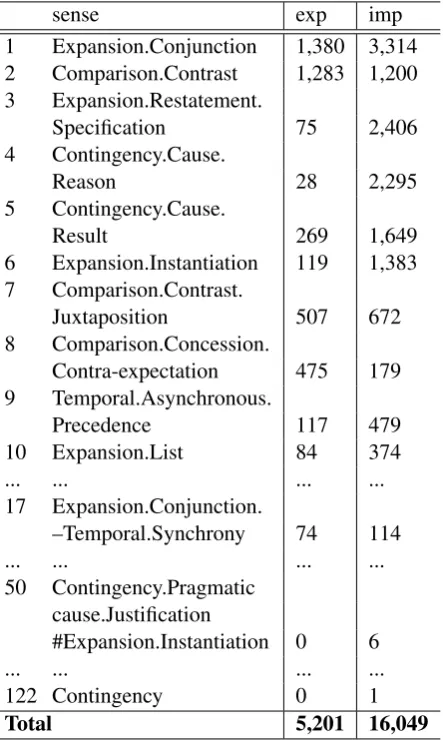
sense exp imp
1 Expansion.Conjunction 1,380 3,314 2 Comparison.Contrast 1,283 1,200 3 Expansion.Restatement.
Specification 75 2,406
4 Contingency.Cause.
Reason 28 2,295
5 Contingency.Cause.
Result 269 1,649
6 Expansion.Instantiation 119 1,383 7 Comparison.Contrast.
Juxtaposition 507 672
8 Comparison.Concession.
Contra-expectation 475 179 9 Temporal.Asynchronous.
Precedence 117 479
10 Expansion.List 84 374
... ... ... ...
17 Expansion.Conjunction.
–Temporal.Synchrony 74 114
... ... ... ...
50 Contingency.Pragmatic cause.Justification
#Expansion.Instantiation 0 6
... ... ... ...
122 Contingency 0 1
[image:7.595.311.533.222.595.2]Total 5,201 16,049
Table 1: Sense distribution of explicit and implicit DCs in screened data set.
Senses in the PDTB are defined in a hierarchy of 2 to 3 levels. Some relations have multiple senses. Up to 2 DCs can be annotated to an implicit re-lation and in turn each (implicit or explicit) DC can be labelled with up to 2 senses. Most exist-ing works split a multi-sense sample into separated
discourse arg. info. cost function Dev: Sections 0-1 Test: Sections 23-24 contextC eU(args;s,C) D(exp) accuracy F1
exp F1imp accuracy F1exp F1imp
BL constant 0 0 .849 .872 .817 .854 .875 .823
SOA (Patterson and Kehler, 2013) – – – .866 – –
(a) F10 0 0 .855 .876 .826 .855 .876 .826
SF10 0 0 .859 .877 .835 .855 .874 .829
F20 0 0 .854 .875 .825 .854 .875 .825
F11 0 0 .851 .872 .822 .854 .875 .825
TS10 0 0 .852 .872 .822 .854 .875 .824
(b) constant surprisal 0 .895++ .901 .887 .870 .881 .857
constant entropy 0 .895++ .902 .888 .870 .881 .856
(c) constant 0 mean DC length .894++ .897 .890 .876+ .886 .865
constant 0 DC/arg2 ratio .895++ .900 .889 .873 .882 .863
constant 0 prime frequency .886+ .888 .885 .873 .882 .862
constant 0 prime distance .892++ .902 .881 .875 .886 .862
constant 0 distance from start .893++ .894 .892 .877+ .879 .875
(d) F10 entropy DC/arg2 ratio .902++ .903 .901 .882+ .883 .881
TSF01 surprisal prime frequency .895++ .898 .892 .889++* .893 .885
[image:8.595.71.539.67.330.2]TS01 entropy prime distance .895++ .900 .889 .890++* .892 .888
Table 2: Accuracies and F1 scores of predicted DC markedness. The best values are bolded.
+/++:significant improvement over baseline (BL) accuracy atp <0.05andp <0.001respectively; *:significant improvement over state-of-the-art (SOA) accuracy atp <0.03(by Pearson’sχ2 test)
(refer to Section 3.2 for abbreviations of discourse contextC.)
samples, each labelled with one of the senses. However, it is notable that the individual senses of a multi-sense relation are not disjoint12andhaving
multiple sensesispart of the sense(Asr and Dem-berg, 2013; Prasad et al., 2014). Multi-sense is an important factor of our DC production model: a speaker could have chosen an explicit DC for each sense, but if s/he has to express two senses at the same time, an implicit DC could be more us-able. Therefore, we treat all combination of senses asindividual senses, each containing 1 to 3 joint sense labels13This results in a total of 122 senses.
Table 1 is a summary of the distribution in de-scending order of frequency. In fact, joint multi-senses are not rare: the most frequent multi-sense is the 17th most frequent sense.
4.2 Results
We apply the markedness model to predict the speaker’s choice of DC markedness on the dev and test sets. Table 2 shows the results under
12Similarly, certain level 2 senses, as in Example (2), are backoffed from level 3 senses due to annotator disagreement. This is also a kind of multi-sense.
13There is only 1 sample of 3 joint labels in our screened dataset.
various settings, evaluated by accuracy and the harmonic mean of precision and recall for explicit and implicit relations respectively.
Row BL shows the results of the markedness model without the cost function and argument informativeness component, and with constant context C. We consider this setting as the base-line, in which the prediction is solely based on the distributions ofP(s|exp)andP(s|imp). Consid-erably high accuracy is achieved, suggesting that the speaker’s choice of markedness is strongly related to the intended discourse sense.
Row (a) shows the prediction results based on the distributions of P(s|exp, C) and
P(s|imp, C), where C is the discourse con-text. The 5 best combinations of contexts and window sizes are shown. Refining the utility of DCs by these contextual constraints, in particular previous contexts, improves the classification accuracy, but the improvement is not significant. This suggests that speaker’s choice of markedness not only depends on surrounding discourse rela-tions but also other contextual factors.
dis-course context and production cost. Classification accuracy increases (significantly for the dev set) when the usability of explicit DC is deducted by the estimated informativeness of the arguments, supporting the UID principle. Predictions based on the surprisal of the parser output sense and the entropy of the parser output distribution are similar. We also experiment by adjusting with the estimated argument informativeness only if the parser output sense is correct (matching at the top level sense). Similar improvement is observed.
Row (c) shows the contribution of the cost function, when discourse context is set as constant and argument informativeness is not considered. Adjusting the utility of explicit DCs by their pro-duction cost increases the classification accuracy most significantly. Among the various features to model production cost, ‘DC length’ and ‘distance from start’ features give the best results.
Row (d) shows the performance of predictions based on the 3 best combinations of components. The highest accuracies andF1scores are achieved
for both explicit and implicit relations.
These results answer the first question of the experiment purpose: the proposed model explains the speaker’s choice of DC markedness in terms of DC and argument informativeness, and production cost, while contextual discourse structure is a moderate constraint to the choice.
The answer to the second question is also positive. Significant improvement above the state-of-the-art (Row SOA) is achieved by the 2 best combinations (89.0%,88.9%vs.86.6%).
Lastly, we compare the results with a linear classifier trained on the features specified in the model, i.e. the discrete values of the intended sense and various discourse context definitions, and real values of various cost functions and argu-ment informativeness estimates. Note that in the proposed model, the training data is used to derive the P(s|exp, C) and P(s|null, C) distributions only, while the linear classifier learns from the features and DC markedness of the training set14.
The classifier achieves accuracy of 88.3%on the test set, which does not significantly outperform previous work. This suggests the advantage of the
14When extracting the argument informativeness features from the training set, using the automatic discourse parser, we penalize the parser estimates of theimplicitsamples by a con-stant ratio, since the discourse parser is also trained on these samples. We use LIBLINEAR (Fan et al., 2008) to build the classifiers.
information-theoretic configuration of our model. 5 Conclusion
We present a language production model that pre-dicts a speaker’s choice of using an explicit DC or not given the discourse relation s/he wants to express. Our model gives an cognitive account of the speaker’s choice and also outperforms previ-ous work on the same task.
Our study shows that a speaker organizes the discourse structure by balancing the pro (infor-mativeness) and con (production cost and re-dundancy) of using an explicit marker, although the option is a subtle preference in the ab-sence of other grammatical constraints. Using an information-theoretic approach, our model tackles the option as a rational preference by the speaker, who wants to contribute to an informative speech act. Furthermore, we take a logical step forward to formalize the idea of the UID theory, that redun-dant explicit markers are avoided if the discourse relation is clear enough from the context.
As future work, we plan to improve the marked-ness model by making fuller use of the training data, such as learning a more expressive formu-lation of the context governing the choice of ex-plicit or imex-plicit DCs. We also plan to evaluate the effectiveness of the model in applications, such as natural language generation or machine trans-lation tasks. On the other hand, as discourse pre-sentation differs across genres (Webber, 2009) and mediums (Tonelli et al., 2010), the model can be applied to predict the explicitation of discourse re-lations from, for example, news articles to spoken dialogues. Another direction is to apply the RSA framework in the opposite direction - to build a listener’s modelthat simulates a listener’s recog-nition of a discourse sense given an utterance, as proposed in Yung et al.(2016).
Acknowledgments
We thank the anonymous reviewers for their valu-able feedback on the previous versions of this pa-per.
References
Fatemeh Torabi Asr and Vera Demberg. 2012. Im-plicitness of discourse relations. InCOLING, pages 2669–2684. Citeseer.
Fatemeh Torabi Asr and Vera Demberg. 2013. On the information conveyed by discourse markers. In Pro-ceedings of the Fourth Annual Workshop on Cogni-tive Modeling and Computational Linguistics, pages 84–93.
Fatemeh Torabi Asr and Vera Demberg. 2015. Uni-form inUni-formation density at the level of discourse re-lations: Negation markers and discourse connective omission. Proceedings of the International Confer-ence on Computation Semantics, pages 118–128. Matthew Aylett and Alice Turk. 2004. The smooth
sig-nal redundancy hypothesis: A functiosig-nal explana-tion for relaexplana-tionships between redundancy, prosodic prominence, and duration in spontaneous speech.
Language and Speech, 47(1):31–56.
Viktor Becher. 2011. When and why do translators add connectives? a corpus-based study. Target, 23(1). Leon Bergen, Roger Levy, and Noah D. Goodman.
2014. Pragmatic reasoning through semantic infer-ence.
Kathryn Bock, Gary S Dell, Franklin Chang, and Kris-tine H Onishi. 2007. Persistent structural priming from language comprehension to language produc-tion. Cognition, 104(3):437–458.
J Kathryn Bock. 1986. Syntactic persistence in language production. Cognitive psychology, 18(3):355–387.
Rong-En Fan, Kai-Wei Chang, Cho-Jui Hsieh, Xiang-Rui Wang, and Chih-Jen Lin. 2008. Liblinear: A library for large linear classification. The Journal of Machine Learning Research, 9:1871–1874.
Michael C. Frank and Noah D. Goodman. 2012. Pre-dicting pragmatic reasoning in lanugage games. Sci-ence, 336(6084):998.
Austin Frank and T Florian Jaeger. 2008. Speaking rationally: Uniform information density as an opti-mal strategy for language production. Proceedings of the Annual Meeting of the Cognitive Science So-ciety, pages 933–938.
Dmitriy Genzel and Eugene Charniak. 2002. Entropy rage constancy in text. Proceedings of the Annual Meeting of the Association for Computational Lin-guistics, pages 199–206.
Noah D Goodman and Andreas Stuhlm¨uller. 2013. Knowledge and implicature: modeling language un-derstanding as social cognition. Topics in cognitive science, 5(1):173–184.
H Paul Grice. 1975. Logic and conversation. Syntax and Semantics, 3:41–58.
Stefan Th Gries. 2005. Syntactic priming: A corpus-based approach. Journal of psycholinguistic re-search, 34(4):365–399.
Brigitte Grote and Manfred Stede. 1998. Discourse marker choice in sentence planning. InProceedings of the Ninth International Workshop on Natural Lan-guage Generation, pages 128–137.
Jet Hoek and Sandrine Zufferey. 2015. Factors in-fluencing the implicitation of discourse relations across languages. In Proceedings 11th Joint ACL-ISO Workshop on Interoperable Semantic Annota-tion (isa-11), pages 39–45. TiCC, Tilburg center for Cognition and Communication.
Jet Hoek, Jacqueline Evers-Vermeul, and Ted JM Sanders. 2015. The role of expectedness in the im-plicitation and exim-plicitation of discourse relations. In Proceedings of the Second Workshop on Dis-course in Machine Translation (DiscoMT), pages 41–46. Association for Computational Linguistics. T Florian Jaeger and Neal Snider. 2008. Implicit
learn-ing and syntactic persistence: Surprisal and cumula-tivity. InThe 30th Annual Meeting of the Cognitive Science Society (CogSci08), page 827.
T Florian Jaeger. 2010. Redundancy and reduc-tion: Speakers manage syntactic information den-sity. Cognitive psychology, 61(1):23–62.
Gerhard J¨ager. 2012. Game theory in semantics and pragmatics. In Claudia Maienborn, Klaus von Heusinger, and Paul Portner, editors, Semantics: An International Handbook of Natural Language Meaning, volume 3, pages 2487–2425. Mouton de Gruyter.
Lifeng Jin and Marie-Catherine de Marneffe. 2015. The overall markedness of discourse relations. Pro-ceedings of the Conference on Empirical Methods on Natural Language Processing.
Justine T Kao, Jean Y Wu, Leon Bergen, and Noah D Goodman. 2014. Nonliteral understanding of num-ber words. Proceedings of the National Academy of Sciences, 111(33):12002–12007.
Gina R Kuperberg, Martin Paczynski, and Tali Dit-man. 2011. Establishing causal coherence across sentences: An erp study. Journal of Cognitive Neu-roscience, 23(5):1230–1246.
Willem JM Levelt and Stephanie Kelter. 1982. Surface form and memory in question answering. Cognitive psychology, 14(1):78–106.
Stephen C Levinson. 2000. Presumptive meanings: The theory of generalized conversational implica-ture. MIT Press.
Ziheng Lin, Minyen Kan, and Hwee Tou Ng. 2009. Recognizing implicit discourse relations in the penn discourse treebank. Proceedings of the Conference on Empirical Methods on Natural Language Pro-cessing.
Christopher Manning, Mihai Surdeanu, John Bauer, Jenny Finkey, Steven J. Bethard, and David Mc-Closky. 2014. The standord corenlp natural lan-guage processing toolkit. Proceedings of the Annual Meeting of the Association for Computational Lin-guistics: System Demonstrations, pages 55–60. Thomas Meyer and Bonnie Webber. 2013.
Implicita-tion of discourse connectives in (machine) transla-tion. InProceedings of the 1st DiscoMT Workshop at ACL 2013 (51st Annual Meeting of the Associa-tion for ComputaAssocia-tional Linguistics), number EPFL-CONF-192528.
Will Monroe and Christopher Potts. 2015. Learning in the rational speech acts model. arXiv preprint arXiv:1510.06807.
Megan Moser and Johanna D Moore. 1995. Investigat-ing cue selection and placement in tutorial discourse. InProceedings of the 33rd annual meeting on Asso-ciation for Computational Linguistics, pages 130– 135. Association for Computational Linguistics. John D Murray. 1997. Connectives and narrative
text: The role of continuity. Memory & Cognition, 25(2):227–236.
Khanh Nguyen and Brendan O’Connor. 2015. Pos-terior calibration and exploratory analysis for natu-ral language processing models. InProceedings of Conference on Empirical Methods in Natural Lan-guage Processing.
Naho Orita, Eliana Vornov, Naomi H. Feldman, and Hal Daum´e III. 2015. Why discourse affects speak-ers’ choice of referring expressions. Proceedings of the Annual Meeting of the Association for Computa-tional Linguistics.
Joonsuk Park and Claire Cardi. 2012. Improving im-plicit discourse relation recognition through feature set optimization. Proceedings of Annual Meeting on Discourse and Dialogue.
Gary Patterson and Andrew Kehler. 2013. Predicting the presence of discourse connectives. In Proceed-ings of Conference on Empirical Methods in Natural Language Processing, pages 914–923.
Emily Pitler, Mridhula Raghupathy, Hena Mehta, Ani Nenkova, Alan Lee, and Aravind Joshi. 2008. Eas-ily identifiable discourse relations. Technical report, University of Pennsylvania.
Emily Pitler, Annie Louis, and Ani Nenkova. 2009. Automatic sense prediction for implicit discourse re-lations in text. Proceedings of the Annual Meeting of the Association for Computational Linguistics and the International Joint Conference on Natural Lan-guage Processing.
Christopher Potts, Daniel Lassiter, Roger Levy, and Michael C. Frank. 2015. Embedded implicatures as pragmatic inferences under compositional lexical uncertainty. Manuscript.
Rashmi Prasad, Nikhit Dinesh, Alan Lee, Eleni Milt-sakaki, Livio Robaldo, Aravind Joshi, and Bonnie Webber. 2008. The penn discourse treebank 2.0.
Proceedings of the Language Resource and Evalua-tion Conference.
Rashmi Prasad, Bonnie Webber, and Aravind Joshi. 2014. Reflections on the penn discourse treebank, comparable corpora, and complementary annota-tion. Computational Linguistics.
Attapol Rutherford and Nianwen Xue. 2014. Dis-covering implicit discourse relations through brown cluster pair representation and coreference patterns.
Proceedings of the Conference of the European Chapter of the Association for Computational Lin-guistics.
Ted Sanders. 2005. Coherence, causality and cognitive complexity in discourse. InProceedings of the Sym-posium on the Exploration and Modelling of Mean-ing.
Donia Scott and Clarisse Sieckenius de Souza. 1990. Getting the message across in rst-based text genera-tion. Current research in natural language genera-tion, 4:47–73.
Erwin M Segal, Judith F Duchan, and Paula J Scott. 1991. The role of interclausal connectives in nar-rative structuring: Evidence from adults’ interpre-tations of simple stories. Discourse processes, 14(1):27–54.
C.E. Shannon. 1948. A mathematical theory of com-munication. The Bell System Technical Journal, 27(379-423; 623-656).
Mark Smith and Linda Wheeldon. 2001. Syntac-tic priming in spoken sentence production–an online study. Cognition, 78(2):123–164.
Nathaniel J Smith, Noah Goodman, and Michael Frank. 2013. Learning and using language via re-cursive pragmatic reasoning about other agents. In
Advances in neural information processing systems, pages 3039–3047.
Claudia Soria and Giacomo Ferrari. 1998. Lexical marking of discourse relations-some experimental findings. InProceedings of the ACL-98 Workshop on Discourse Relations and Discourse Markers. Caroline Sporleder and Alex Lascarides. 2008. Using
automatically labelled examples to classify rhetori-cal relations: An assessment. Natural Language En-gineering, 14(3):369–416.
Sara Tonelli, Giuseppe Riccardi, Rashmi Prasad, and Aravind K Joshi. 2010. Annotation of discourse relations for conversational spoken dialogs. In Pro-ceedings of the Language Resource and Evaluation Conference.
Jianxiang Wang and Man Lan. 2015. A refined end-to-end discourse parser. CoNLL 2015, page 17. Bonnie Webber. 2009. Genre distinctions for
dis-course in the penn treebank. InProceedings of the Joint Conference of the 47th Annual Meeting of the ACL and the 4th International Joint Conference on Natural Language Processing of the AFNLP: Vol-ume 2-VolVol-ume 2, pages 674–682. Association for Computational Linguistics.
Frances Yung, Kevin Duh, and Yuji Matsumoto. 2015. Crosslingual annotation and analysis of im-plicit discourse connectives for machine translation. In Workshop of Discourse in machine translation, EMNLP, page 142.
Frances Yung, Taku Komura, Kevin Duh, and Yuji Matsumoto. 2016. Modeling the interpretation of discourse connectives by bayesian pragmatics. In
Proceedings of the Annual Meeting of the Associa-tion for ComputaAssocia-tional Linguistics.