Abstract— This paper elaborates the development of intelligent system to diagnose and suggest remedial measures for learning disorders in children. The system is built with the modules namely the knowledge base, the inference engine and users interface. Some of the common learning disorders like Dyslexia, Dysgraphia, Dyscalculia and Dyspraxia have been addressed. The user of the system can interact by responding to the queries in yes or no format on a sequential basis. The data for the system has been garnered through references, books and through series of discussions with psychiatrists. It is felt that the system is useful in the hands of parents, teachers, and researchers in psychiatry and novice psychiatrist. The system has been provided with the flexibility for updating as and when new knowledge about these problems is available.
Index Terms—Dyscalculia, Dysgraphia, Dyslexia, Dyspraxia, Intelligent System.
I. INTRODUCTION
Expert Systems (ES) are a branch of artificial intelligence (AI), and were developed by the AI community in the mid-1960s. An expert system can be defined as "an intelligent computer program that uses knowledge and inference procedures to solve problems that are difficult enough to require significant human expertise for their solutions [1]". We can infer from this definition that expertise can be transferred from a human to a computer and then stored in the computer in a suitable form that users can call upon the computer for specific advice as needed. Then the system can make inferences and arrive at a specific conclusion to give advices and explains, if necessary, the logic behind the advice.
ES provide powerful and flexible means for obtaining solutions to a variety of problems that often cannot be dealt with by other, ore traditional and orthodox methods [2]. The terms expert system and knowledge-based system (KBS) are often used ynonymously. The four main components of KBS are: a nowledge base, an inference engine, a knowledge engineering tool, and a specific user interface. Some of KBS important applications include the following: medical treatment, engineering failure analysis, decision support,
Manuscript received June 23, 2010.
Dr. M.A.Jayaram, Member IAENG , is the Director, Department of Master of Computer Applications, Siddaganga Institute of Technology, TUMKUR-572103, INDIA (phone: 0816-22149048;e-mail: [email protected]).
Shilpa.B, is a Postgraduate Student, in the department of Master of Computer Applications, Siddaganga Institute of Technology, TUMKUR-572103, INDIA (e-mail: [email protected]).
knowledge representation, climate forecasting, decision making and learning, and chemical process controlling [2]. There are a lot of related expert systems in the literature concerned with diagnostic problems. Daoliang et al. [3] presents a web-based expert system for fish disease diagnosis. The system is now is used by fish farmers in the North China region. Yu Qian et al. [4] proposed an expert system for realtime failure diagnosis of complex chemical processes. Other diagnosis systems are described in [5-8].
II. BACKGROUND
Learning disorder is a classification including several disorders in which a child has difficulty learning in a typical manner, usually caused by an unknown factor or factors. The unknown factor is the disorder that affects the brain's ability to receive and process information. This disorder can make it problematic for a child to learn as quickly or in the same way as someone who isn't affected by a learning disability.
A learning disability cannot be cured or fixed. With the right support and intervention, however, child with learning disabilities can succeed in school and go on to be successful later in life.
There are four types of learning disorders are considered in children and they are Dyslexia, Dysgraphia, Dyscalculia and Dyspraxia.
A. Dyslexia:
Dyslexia is characterized by an unexpected difficulty in reading in children otherwise possess the intelligence, motivation, and schooling considered necessary for accurate and fluent reading. Dyslexia (or specific reading disability) is the most common and most carefully studied of the learning disabilities, affecting 80 percent of all those identified as learning- disabled[9] [10].
Some typical symptoms include:
• Difficulty decoding single words
• Particular difficulty reading nonsense or unfamiliar words
• Inaccurate and labored oral reading • slow reading
• Poor spelling
• Difficulty with tests assessing knowledge of the names of letters, disability to associate sounds with letters.
B. Dysgraphia:
Dysgraphia is a neurological disorder characterized by writing disabilities. Specifically, the disorder causes a
Intelligent System for Diagnosing Learning
Disorders in Children
person's writing to be distorted or incorrect. In children, the disorder generally emerges when they are first introduced to writing. They make inappropriately sized and spaced letters, or write wrong or misspelled words, despite thorough instruction. Children with the disorder may have other learning disabilities; however, they usually have no social or other academic problems. Cases of dysgraphia in adults generally occur after some trauma. In addition to poor handwriting, dysgraphia is characterized by wrong or odd spelling, and production of words that are not correct. The cause of the disorder is unknown, but in adults, it is usually associated with damage to the parietal lobe of the brain. Some typical symptoms include [11]:
• Child will have very messy handwriting • Child holds a pencil awkwardly
• Child struggles to express ideas in writing
• Child’s copying is tedious and takes time to develop cursive writing
• Child will have ignorance with the margin • Child's writing is slow and labored
• Child shows unusual starting and ending points of the letters
• Letters normally do not sit on the horizontal lines • Words may be tightly spaced or widely pushed apart
C. Dyscalculia:
Dyscalculia exists in a number of different varieties, each involving a specific difficulty in solving mathematical tasks. It corresponds with mathematical performance to dyslexia in the area of reading.
Difficulties with mathematics generally are associated with the child having general problems with learning, in the area of mathematics as well as others, learning tending to take longer than normal. A child of this category is usually best helped by being allowedto work at a slow pace and by being given simplified learning material. On intelligence or aptitude tests such children tend to score on the low side but the results are all at about the same normalised level. There is thus a kind of consistency in their level of performance, also on a day-to-day basis. General consensus agrees that these children simply need a bit longer to learn [12][13].
Some typical symptoms include:
• Child will have difficulties in understanding arithmetic, signs: +, -, ÷ and ×, and often confusing their operational need.
• Difficulty in learning and understanding the basics of arithmetic like multiplication, subtraction, addition and division tables, as well as mental arithmetic, etc. • Child will have difficulty in concepts like distance and
its measurement.
• Child will have very poor sense of mathematical concepts, rules, formulas and sequences.
• Child will find difficulty in playing games where a score needs to record.
• Child will have difficulties in counting backwards (10, 9, 8, and so on), and/or transposing numbers (12 to 21, 43 to 34, etc)
• Child makes more Errors.
D. Dyspraxia:
A person with dyspraxia has problems with movement and coordination. It is also known as "motor learning disability". Somebody with dyspraxia finds it hard to carry out smooth and coordinated movements. Dyspraxia often comes with language problems, and sometimes a degree of difficulty with perception and thought. Dyspraxia does not affect a person's intelligence, but it can cause learning difficulties, especially for children. Dyspraxia is also known as Developmental Co-ordination Disorder (DCD), Perceptuo-Motor Dysfunction, and Motor Learning Difficulties. The terms Clumsy Child Syndrome or Minimal Brain Damage are no longer used [14][15].
Some typical symptoms include:
• Problems performing subtle movements, such as tying shoelaces, doing up buttons and zips, using cutlery, handwriting.
• Many will have difficulties getting dressed.
• Writing can be much more challenging for a child with dyspraxia, as can copying from a blackboard.
• Does not follow instructions. • Does not remember instructions.
III. INTELLIGENT SYSTEM
A. General
This System is developed for diagnosing academic learning disorders in children. Based on the input provided by the parents about child’s behavior this system diagnoses the disorders and suggests the remedial measure for the parents. The System is coded in C#. This system is highly user friendly so that even a novice will be able to participate in diagnosing the disorder.
The system is of modular form. The modules are interfaced through intermediate text file (*.txt). The components of the system are elaborated in the following paragraphs.
1) Inference Engine
The inference engine performs forward chaining to arrive at expedition inferences depending on the context. Simple segments of inference engine are given below.
Example1.
IF: reading problem
AND: problem when reading aloud
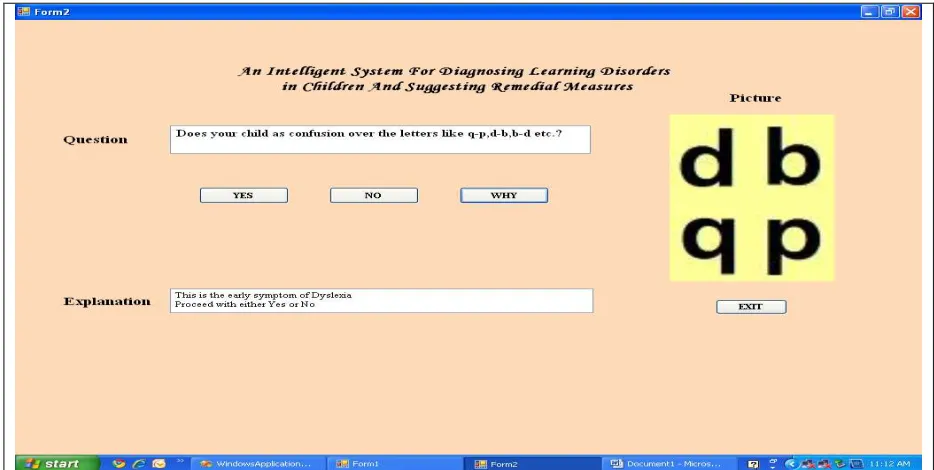
AND: confusion over letters q-p, d-b, b-d etc during reading
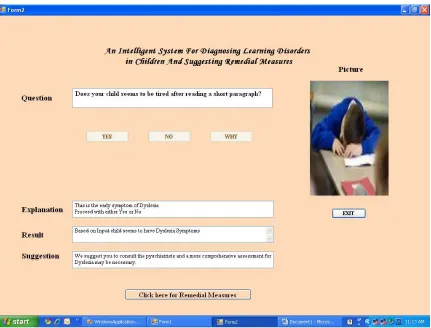
AND: difficulties with spellings AND: miss out words while reading AND: sometimes skip lines when reading AND: tired after reading a short paragraph THEN: The disorder might be DYSLEXIA.
Example2.
IF: writing problem AND: very messy handwriting AND: holds pencil awkwardly
AND: ignorance with the margin AND: writing is slow and labored AND: letters do not sit on horizontal lines THEN: The disorder might be DYSGRAPHIA.
2) User Interface:
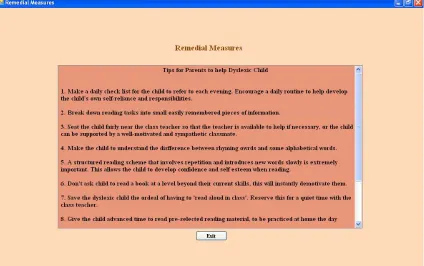
The user interface very user friendly. Novice can handle this tool without any difficulties. It suggests the remedial measures in the form of tips to the parents for a particular disorder.
3) The configuration module garners all the pertinent information from other users an interactive mode. All the queries are in the “yes” or “no” format.
B. Knowledge base and knowledge nets.
The development of expert system was done after acquiring the knowledge from different sources such as text books, publications in journals and series of discussions held with psychiatrist. The acquired knowledge is later evolved in the form of knowledge nets. This type of an organization of the knowledge makes it easier to group and verify the knowledge. The knowledge nets are shown in figure 1.
IV. A SESSION WITH EXPERT SYSTEM
The system starts with query session. The questions posed to the user will appear on the screen. Depending on the observation user would choose either yes or no. User can also query the system with why. As a response, the system would justify or explain as to why a particular question was posed. User can further continue by answering in yes/no mode. Figures 2-5 shows typical query sessions for the four disorders considered. Figure 6 shows the remedial measures for Dyslexia disorder.
V. CONCLUSION
The ability of intelligent system technology to implement systems not viable with conventional computer programs must be tampered with appropriate methodology. This paper presented an intelligent system which can detect learning disorders in growing children.
• This system has capability to arrive pin pointedly at a particular disorder depending solely on user response.
• The system considers all the possible symptoms that would lead to a particular disorder.
• This system has well known advantages including consistency, easy transfer and update of expertise. • Preliminary testing of the system in the presence of
psychiatrists as given satisfactory results.
• However this system may not give complete solutions by provide prescriptions but it would certainly guide to help the concerned to facilitate the child to pick up learning.
• The outcome of this paper is useful for parents, teachers, researchers and probably the novice psychiatrists.
REFERENCES
[1] Joseph Giarratano, Gary Riley, Expert Systems: Principles and Programming, Fourth Edition
[2] Shu-Hsien Liao, Expert system methodologies and applications a decade review from 1995to 2004, Expert Systems with applications, 28, 2005, pp. 93-103,.
[3] Daoliang Lia, Zetian Fua, Yanqing Duanb , Fish-Expert: A
Web based expert system for fish disease diagnosis, Expert Systems with Applications, 23, 2002, pp. 311-320.
[4] Yu Qian, Xiuxi Li, Yanrong Jiang, Yanqin Wen ,. An expert system for real-time failure diagnosis of complex chemical processes, Expert Systems with Applications, 24, 2003, pp. 425-432.
[5] Deschamps, D., & Fernandes, A. M. , An expert system to diagnosis periodontal disease. Proceedings of Sixth Internet World
Congress for Biomedical Sciences in Ciudad Real, Spain, 2000. [6] Guvenir, H. A., & Emeksiz, N. , An expert system for the
differential diagnosis of erythemato-seuamous diseases. Expert Systems with Applications, 18, 2000, pp.43–49.
[7] Huang, Q. M., Li, X. X., Jiang, Y. R., & Qian, Y., A fault
diagnosis expert system based on fault tree analysis for lubricating dewaxing process. Computers and Applied Chemistry, 18, 2001, pp. 129–133.
[8] Cho, H. J., & Park, J. K. (1997). An expert system for fault section diagnosis of power systems using fuzzy relations. IEEE Transactions on Power Systems, 12, 1997, pp. 342–348.
[9] David Perlstein, Melissa Conrad Stoppler, Dyslexia-Causes, Symptoms. Available: http://www.medicinenet.com/dyslexia/article.htm.
[10] Ronald D.Davis, 37 common characteristics of Dyslexia, Available: http://www.dyslexia.com/library/symptoms.htm.
[11] Renee M.Newman, Dysgraphia: Causes and treatment. Available : http://www.dyscalculia.org/Edu563.html.
[12] Butterworth, Brain, Dyscalculia Guidance: Helping pupils with Specific learning difficulties in maths, David Fulton Publication, 2004. [13] Bjorn Adler, What is Dyscalculia? , Report, Cognitive centre, Sweden, Available :http://www.dyscalculiainfo.org
[14] Jenny Barret, Kate Ripley, Bob Daines, Dyspraxia: A Guide for teachers and parents, David Fulton Publishers,1985.
Dysgraphia
• Messy Handwriting • Holds a pencil
awkwardly • Struggle to express
ideas in writing • Ignorance with the
margin
• Writing is slow and labored
• Letters normally do not sit on the horizontal lines Dyslexia
• Reading aloud • Confusion over
the letters like q-p, d-b etc. • Difficulties with
spelling • Miss out words • Skip lines • Tired after
reading
a short paragraph
Dyscalculia • Confusion over sign
+,-,x and % • Learning and
understanding the basics of arithmetic operations.
• Poor sense of mathematical concepts, rules, formulas and sequences • Difficulties in
counting backwards (10, 9, 8, and so on)
Dyspraxia • Reports of migraine,
headaches, feeling sick • Become easily
distressed and emotional • Barely legible
handwriting
• Unable to tie shoe laces • Limited concentration
and poor listening skills • Difficulties in adapting to a structured school routine
[image:4.595.52.514.53.283.2]LEARNING DISORDERS
Figure 1. The knowledge net used for the building the system
[image:4.595.59.526.350.585.2]Figure 3. Typical query pertaining to Dyscalculia disorder symptom
[image:5.595.81.512.360.688.2]Figure 5. Typical query session
[image:6.595.97.521.351.617.2]