874
©IJRASET: All Rights are Reserved
Plain Woven Fabric Defect Detection using GLCM
based Feature Extraction
Mrs. S. Sahaya Tamil Selvi1, Dr. G. M. Nasira2
1
Mrs. S. Sahaya Tamil Selvi, Head/Asst. Professor, Department of Computer Science, St. Joseph’s College for women, Tirupur, India
2
Dr. G. M. Nasira , Head and Professor of Computer Applications, Chikkanna Govt. Arts College, Tirupur , India
Abstract: An accurate fabric defect detection is done in based on extraction of features from Gray level co –occurrence matrix(GLCM). The process of extracting salient features plays a crucial role in Automatic fabric defect detection. The proposed system makes a fabric analysis to classify whether the fabric is defect free or defected using several Digital image processing techniques. This paper presents the application of gray level co-occurrence matrix (GLCM) to extract second order statistical texture features for classification of various defects in plain woven fabric images. The salient features namely area, entropy, standard deviation, smoothness, skewness, max intensity, min intensity, mean, standard deviation and energy are calculated from GLCM. The results show that these texture features have high discrimination accuracy in classification of various defects in Automatic fabric defect detection where a support vector machine (SVM ) is being used as the classifier.
Keywords: GLCM, Automatic fabric defect detection, texture features, Standard deviation, Entropy, Mean, SVM
I. INTRODUCTION
Producing highest quality goods is highly desirable in the Garment industry. Fabric faults or defects are responsible for nearly 85% of the defects found by the garment industry [4]. Automatic fabric inspection plays vital role in maintaining the quality of fabric. It is imperative, therefore, to detect, to identify, and to prevent these defects from reoccurring. The Automatic fabric inspection system does not suffer the drawbacks of human visual inspection.
The proposed system makes a fabric analysis to classify whether the fabric is defect free or defected using several Digital image processing techniques. The process is done based on extraction of features from Gray level co –occurrence matrix(GLCM). In this paper the gray level co-occurrence matrix (GLCM) is used to extract second order statistical texture features for classification of various defects in plain woven fabric images. The salient features namely area, entropy, standard deviation, smoothness, skewness, maximum intensity, minimum intensity, mean, standard deviation and energy are calculated from GLCM. The results show that these texture features have high discrimination accuracy in classification of various defects. Automatic fabric defect detection where a support vector machine (SVM ) is being used as the classifier. These features are calculated and implemented using MATLAB. In [1] it has been stated that Feature extraction process reduces the original MRI data set into a set of features . and these feature vectors are the basic inputs for any classification algorithm . In [2] it has been assessed that Support Vector Machine is a machine learning algorithm which has the ability to distinguish among different types of patterns fed to it and SVM tries to compute optimal hyperplanes and maps the points belonging to different categories or classes into distinct spatial regions separated by optimal hyperplanes. In [11] it has been concluded that in thework the accuracy of 96% is achieved using saliency map characterization and gray level co-occurrence matrix(GLCM) method is adapted which is very useful in differentiation of Neuro degeneration diseases with better accuracy. In [5] discusses that Texture analysis aims in finding a unique way of representing the underlying characteristics of textures and represent them in some simpler but unique form, so that they can be used for robust, accurate classification and segmentation of objects.
The proposed methodology for feature extraction is described in section II. The result obtained in various stages in the proposed system is discussed in section III. Finally conclusion is provided in section IV.
II. PROPOSEDAPPROACH
875
©IJRASET: All Rights are Reserved
occur due to: machine faults, yarn problems, poor finishing, excessive stretching, etc. There are a large number of types of fabric defects available out of which the following are some of the Common Weaving Defects:
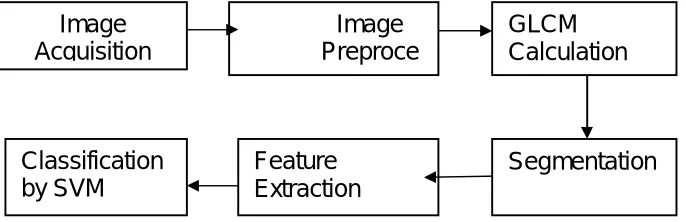
The development of an automated, i.e. computer vision based system for plain woven fabric defect inspection involves several steps as shown in Fig.2.
[image:2.612.88.431.135.246.2]
Fig. 1 Block diagram of the proposed Automated Fabric defect detection system
A. Image Acquisition
The first stage of any vision system is Image acquisition. There are different types of camera used for this application such as Digital camera, CCD (Charged Coupled Device) camera, CMOS (Complementary Metal Oxide Semiconductor) camera, etc. The fabric images database is created using images collected from various fabric producing companies in Tirupur, Tamilnadu, India. These images are converted to gray scale images and stored as having size of 256x256.
B. Image Preprocessing
Image preprocessing stage consist of collection of techniques that are used to improve the visual appearance of an image or used to convert the image to a form, which can be better suited for further analysis in the subsequent stages by a human or a machine[7].Here in the proposed system the noise in the image is removed by applying PSO based median filter[8]. The acquired image must be converted into gray scale image in order to calculate GLCM matrix.
C. GLCM calculation
The converted Gray image is then used to Graylevel co-occurrence matrix (GLCM). For this calculation, the following method is being employed to get the GLCM.
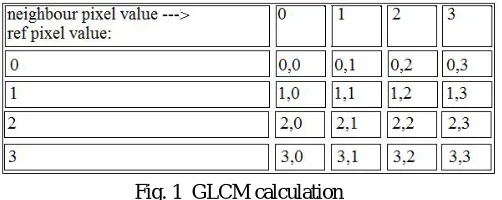
The Gray Level Co-ocurrence Matrix (GLCM) method is a used for extracting second order statistical texture features. The approach can be used in a number of applications [2]. Third and higher order textures consider the relationships among three or more pixels. A GLCM matrix can be defined to have the number of rows and columns is equal to the number of distinct gray levels or pixel values in the image. The matrix describes the frequency of one gray level appearing in a specified spatial linear relationship with another gray level within the area of investigation. Given an image, the GLCM gives the statistical tabulation of how frequently different combinations of gray levels co-occur in an image or image section [1]. GLCM matrix building is explained with the example illustrated in fig 2 for four different gray levels. Here one pixel offset is used (a reference pixel and its immediate neighbor. The top left cell will be filled with the number of times the combination 0,0 occurs, i.e. how many time within the image area a pixel with grey level 0 (neighbour pixel) falls to the right of another pixel with grey level 0(reference pixel).
D. Segmentation
876
[image:3.612.187.438.76.176.2]©IJRASET: All Rights are Reserved
Fig. 1 GLCM calculation
E. GLCM based Feature extraction
Feature Extraction is a stage in which various methods can be employed for capturing visual content of images for indexing & retrieval purpose[5]. The textural features which are extracted in this proposed method are area, entropy, standard deviation, smoothness, skewness, maximum intensity, minimum intensity, mean, standard deviation and energy are calculated from GLCM. The formula of various features which are calculated from the GLCM is given in the fig 3.
Fig. 3 Formula for various features calculated from GLCM
The sample MATLAB code to calculate GLCM and the various features is given as follows. new_defect = graycomatrix(I2,'GrayLimits',[],'Offset',[1 0]);
877
©IJRASET: All Rights are Reserved
sa=std(std(new_defect));% Smoothness sm_a=1-(1/(1+sa).^2); %sm_a=1-(1./(1+sa));
% Skewness - 3rd order moment aa=new_defect(:);
[m, n]=size(aa); for i=1:m for j=1:n
sk_a(i,j)=((aa(i,j)-mea)/sa).^3; end
end
skew_a=mean(sk_a); e_a=entropy(new_defect); M=new/sum(new_defect(:)); f_1=M.^2;
ene_a=sum(f_1(:)); I2=double(I2);
MaxIntensity=max(max(I2)); MinIntensity=min(min(I2));
[image:4.612.206.417.367.719.2]new_nby=[ma_defect mea sa sm_a skew_a e_a ene_a MaxIntensity MinIntensity b]
878
©IJRASET: All Rights are Reserved
F. Classification
Support vector machines (SVMs) are supervised learning models with associated learning algorithms that analyze data and recognize patterns, used for classification and regression analysis [2]. This classifier classifies the input image to be one of the defected type . SVM has the advantage of classifying the defected fabric images with a high degree of accuracy value.
III.RESULTANDDISCUSSION
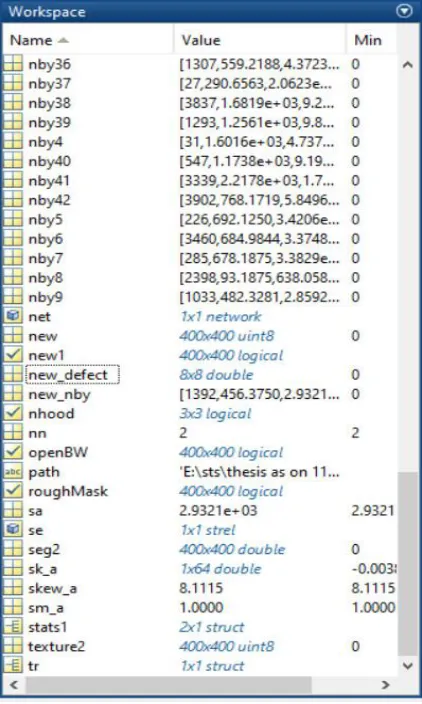
In this paper ,Grey Level Co-occurrence Matrix (GLCM) and Connected Regions are used for feature extraction. The result of each process of Automatic fabric defect detection method namely capturing , Preprocessing, Converting to gray scale image and segmentation is shown in the fig 5 . Each image is segmented and the Grey Level Co-occurrence Matrix (GLCM) is created. From the GLCM, texture features are calculated and connected regions are used to extract shape features. The sample feature values which are obtained from the images are shown in fig . 4. The result of classification of fabric image to be one of the defects is shown in fig 6. and in fig 7. Around 200 fabric images has been used in this work and the accuracy of classification of the fabric image is 97.4359.
Defects Missed thread Missed thread Greece Ink Tear
Original images
Filtered images
Segmented images
Defected area
879
©IJRASET: All Rights are Reserved
Fig. 6 The result after loading the fabric image into the system from the database
Fig. 7 The result after applying Pre-process and GLCM stages and the result of SVM classifier
IV.CONCLUSIONS
The proposed feature extraction method for the Automatic fabric defect detection is faster and less complex . The accuracy of the classification is high and the obtained features are authentic. Texture features are extracted using GLCM and shape features are extracted using connected regions. The shape features are extracted directly from the segmented image. It is the simplest and less complex method for the calculation of texture and shape features. These features can be used for training the classification algorithm. The accuracy of classification can be increased by using larger dataset.
REFERENCES
[1] Shijin Kumar P.S and Dharun V. S ,” Extraction of Texture Features using GLCM and shape Features using connected Regions”, International Journal of Engineering and Technology (IJET), Vol 8 No 6 Dec 2016-Jan 2017
[2] J. Hemraj, Raikwar Himanshu Jain , Amit Baghel , “Calorie Estimation from Fast Food Images Using Support Vector Machine “, International journal on future revolution in Computer Science & Communication Engineering ,ISSN: 2454-4248 Volume: 4 Issue: 4 98- 102 April 2018
[3] Dr.G.M.Nasira and P.Banumathi, , “A Plain Woven Fabric Defect Detection Based on Image Processing and Artificial Neural Networks”, International Journal of Computer Trends and Technology(IJCTT) volume 6 number 4–Dec 2013 ISSN: 2231-2803 www.internationaljournalssrg.org Page 226
[4] Semiyya E and Jyothi R.L, ”Automatic Fabric Defect Detection using Spatial and Spectral Features”, International Journal of Engineering Research & Technology (IJERT), ISSN: 2278-0181,Vol. 3 Issue 12, December-2014
[5] RP. Mohanaiah, P. Sathyanarayana and , L. GuruKumar, , “Image Texture Feature Extraction Using GLCM Approach”, International Journal of Scientific and Research Publications, Volume 3, Issue 5, May 2013 1 ISSN 2250-3153
[6] Namita Aggarwal and R. K. Agrawal, “First and Second Order Statistics Features for Classification of Magnetic Resonance Brain Images”, Journal of Signal and Information Processing, 2012, 3, 146-153http://dx.doi.org/10.4236/jsip.2012.32019 Published Online May 2012 (http://www.SciRP.org/journal/jsip) [7] S.Sahaya Tamil Selvi and Dr.G.M.Nasira, “Noise removal of Fabric images in Automated Fabric Inspection System using Digital Image Processing
Techniques”, International Journal of Applied Engineering Research(IJAER),ISSN:0973-4562,Vol 10 No.69(2015).
[8] S.Sahaya Tamil Selvi, “Particle Swarm Optimization enabled Filtering for Fabric Images in Automated Fabric Inspection System”, IEEE Xplore, INSPEC Accession Number:16426564
ell. (2002) IEEEtran homepage on CTAN. [Online]. Available: http://www.ctan.org/tex-archive/macros/latex/contrib/supported/IEEEtran/ [9] R.Gonzales and R. Woods – Digital Image Processing; Prentice Hall of India, 2008.
[10] S.E. Umbough – Computer Vision and Image Processing; Englewood Cliffs, Nj: Prentice- Hall, 1998.