AND APPLICATIONS IN QUANTUM MECHANICS
A thesis presented for the degree of Doctor of Philosophy
in the University of Canterbury, Christchurch, New Zealand
by
P.H. BUTLER �
S-functions, as developed by D.E. Littlewood, are reviewed and their properties developed and extended. A computer programme has been written to perform most s
function operations. In particular, S-function division is defined, which produces many simplifications, and general methods for calculating both inner and outer plethysm are derived.
The properties of matrix groups are similarly discussed using the theory of S-functions and programmes written to produce branching rules and Kronecker products. This
required some new work on spin characters and on the differ ence characters of even dimensional rotation groups.
Generalized Racah tensors are used to study the group properties of general mixed configurations of electrons.
Some properties of factorized general coupling and re coupling coefficients are also derived. These properties are used to calculate part of general two body fractional parentage coefficients.
I would like to thank:
Professor B.G. Wybourne for his supervision, help and many fruitful discussions.
J.D. Brown and J.G. Cleary for discussions and assistance with several computing problems.
Other fellow research students for various interesting discussions.
Mrs M.A. Sewell for the typing of this thesis.
Royal Society of N. Z. for travel awards to the "NATO
and NATO Science Institute Advanced Study Institute", Izrnir, Turkey, August 1969.
Financial assistance was received from the United States Air Force Office of Scientific Research, Grant No.
INTRODUCTION
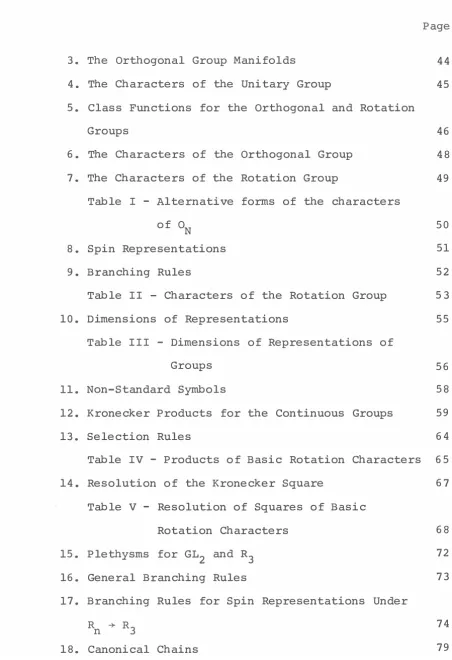
CHAPTER 1: THE ALGEBRA OF S-FUNCTIONS
1. Fundamental Notions
2. S -functions
3. Expansion of S-functions in terms of the
1
7
7 10
variables 12
4. Outer Multiplication of S-functions 13
5. S-Function Division 17
6. Expression of S-functions in Symmetric Parts 20
7. Inner Multiplication of S-Functions 21
8. The Outer Plethysms of S-Functions 23
9. Inner Plethysm 28
CHAPTER 2: GENERATING FUNCTIONS AND SPECIAL SERIES 35
1. Introduction
2. Generalized Definition of an S-Function
3. Special Series of S-Functions
35 36 38
CHAPTER 3: CHARACTER THEORY OF THE CONTINUOUS GROUPS 41
1. Extension of Finite Group Properties to Unitary
Groups 41
3. The Orthogonal Group Manifolds
4. The Characters of the Unitary Group
5. Class Functions for the Orthogonal and Rotation Groups
6. The Characters of the Orthogonal Group 7. The Characters of the Rotation Group
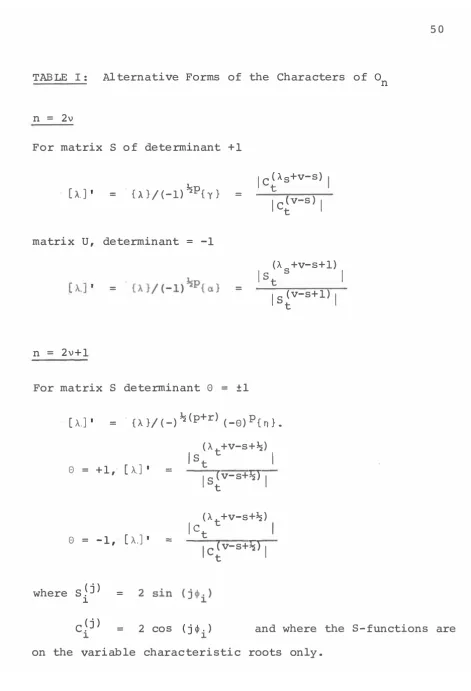
Table I - Alternative forms of the characters
44 45
46
48
49
of ON 50
8. Spin Representations 51
9. Branching Rules 52
Table II - Characters of the Rotation Group 53
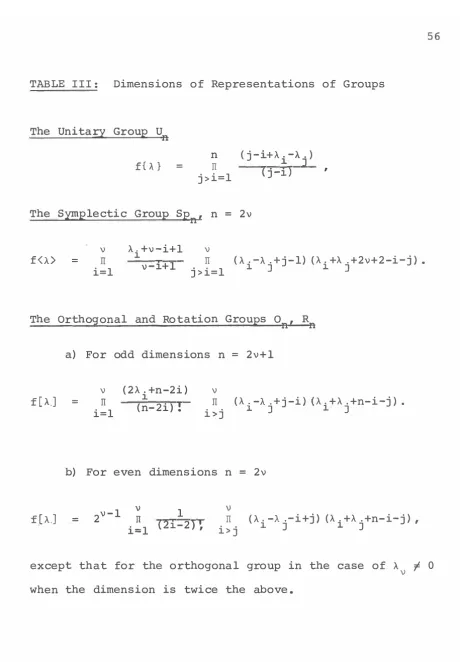
10. Dimensions of Representations 55
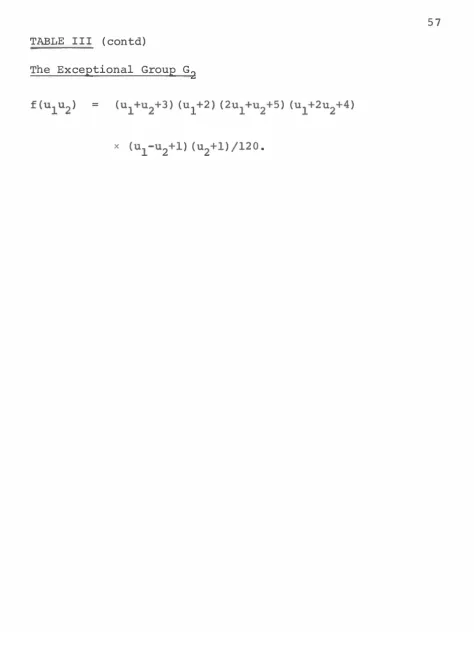
Table III - Dimensions of Representations of
Groups 56
11. Non-Standard Symbols 58
12. Kronecker Products for the Continuous Groups 59
13. Selection Rules 64
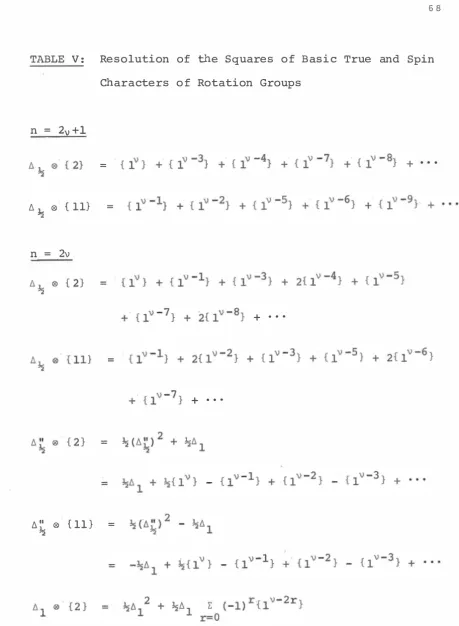
Table IV - Products of Basic Rotation Characters 65 14. Resolution of the Kronecker Square 67
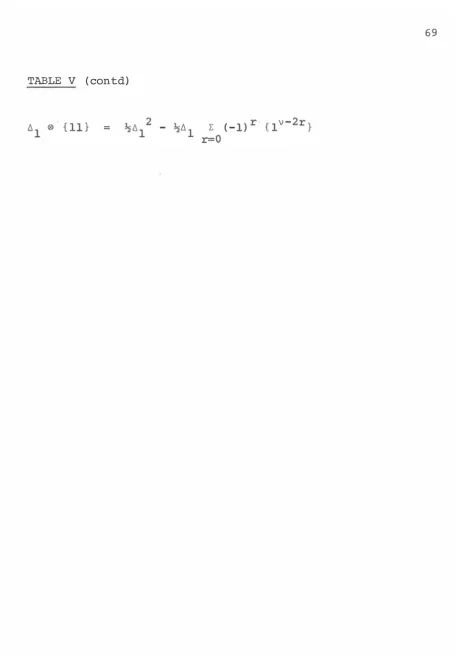
Table V - Resolution of Squares of Basic Rotation Characters
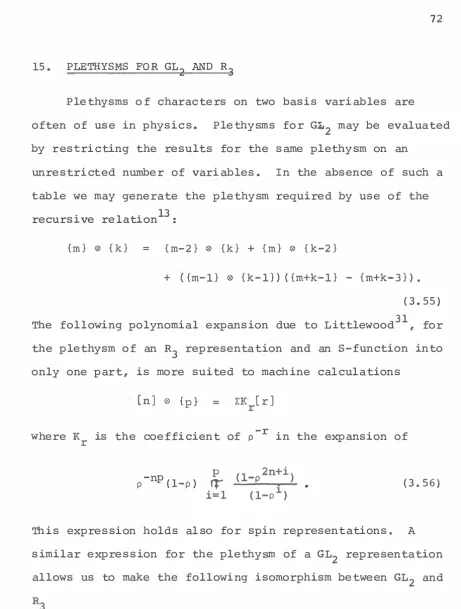
15. Plethysms for GL2 and R3 16. General Branching Rules
17. Branching Rules for Spin Representations Under Rn + R3
18. Canonical Chains
68 72 73
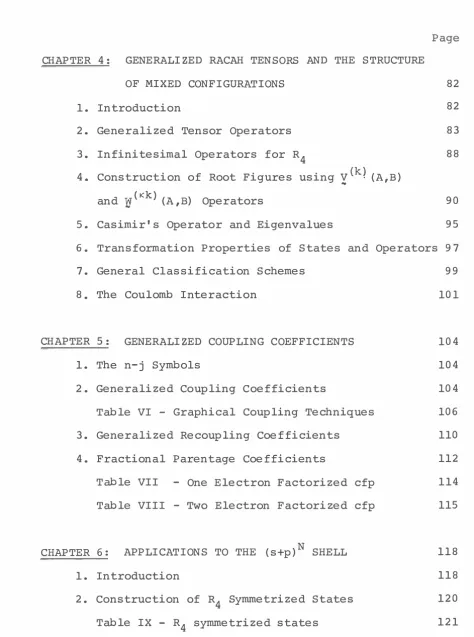
[image:6.595.65.518.92.752.2]OF MIXED CONFIGURATIONS 82
1. Introduction 82
2. Generalized Tensor Operators 83
3. Infinitesimal Operators for R4 88
4. Construction of Root Figures using
y<k)
(A,B)and � ( Kk) (A ,B) Operators 90
5. Casimir's Operator and Eigenvalues 95
6. Transformation Properties of States and Operators 97
7. General Classification Schemes 8. The Coulomb Interaction
CHAPTER 5: GENERALIZED COUPLING COEFFICIENTS
1. The n-j Symbols
2. Generalized Coupling Coefficients
Table VI - Graphical Coupling Techniques 3. Generalized Recoupling Coefficients
4. Fractional Parentage Coefficients
Table VII - One Electron Factorized cfp Table VIII - Two Electron Factorized cfp
CHAPTER 6: APPLICATIONS TO THE (s+p)N SHELL 1. Introduction
2. Construction of R4 Symmetrized States Table IX - R4 symmetrized states
99 10 1
10 4 10 4 10 4 106 110 112 114 115
[image:7.595.56.531.92.730.2]3. R4 Symmetrization of the Coulomb Interaction
Table X - Symmetrization of One Particle Tensor N
Operators for (s+p)
4. Matrix Elements for (2s+2p)2
Table Xi - R3 Symmetrized Operators
Table XII - R4 Symmetrized Operators
125 126 127 128
Table XIII - Radial Coefficients for R4 Symmetry 129
Table XIV - Matrix Elements of (s+p) 2 130
Table XV - Radial Integrals
5. Inclusion of Closed Shell Effects
6. Conclusions
CHAPTER 7: PROGRAMMING CONSIDERATIONS
1. Handli�g Partitions
2. Input - Output
3. Basic Operations
4. Other Special Programmes
5. Phase Overlay
References
APPENDICES:
I Corregenda to "Group Characters and Matrix Representations of Groups"
II Hydrogen Radial Integrals
132 134 137
138
138 139
140
140 141
143
[image:8.595.65.519.77.726.2]Branching
Branching Kronecker
Rules: u1a -+ su2 X R9 Rules: R9 -+ 04
Products of Spin Representation of Ra
155 156 157 The Expansion of S-Functions as Mononomials 159 The Outer Plethysm of S-Functions of One Part 161 The Outer Plethysm of S-Functions 164
INTRODUCTION
In the past decade theoretical physicists have shown great interest in the theory of continuous groups for
application to a wide range of physical problems. Notable,
among the many uses, has been that of the compact continuous groups, to describe the transformation properties of
N-particle atomic and nuclear wave-functions. This use
was pioneered by Racah112 and physicists have tended to
concentrate on an approach, in the tradition of Elie
Cartan3 and Sophus Lie4, of considering the properties of
infinitesimal transformations. Hermann Weyl's book, "The Classical Groups115, has undoubtably exercised a considerable
influence on these developments.
For much of this thesis I intend to use an alternative approach to the theory of continuous groups. This approach complements the earlier work of Cartan and Lie, and has been developed by D.E. Littlewood as a consequence of Schur's original thesis6 on the properties of invariant
matrices. Littlewood's treatment718 circumvents the study
of infinitesimal transformations by considering the
properties of special functions of the roots of the matrices that characterize the elements of the continuous groups.
simply S-functions, have been used by Littlewood to find relatively simple formulae connecting the characters of representation of the unitary symplectic, orthogonal and rotation groups.
The first half of this thesis is concerned with a systemization of Littlewood's methods, with the aim of writing computer programmes that perform all required
operations with characters of the symmetric and the contin uous groups. Unlike other authors, I prefer to introduce S-functions as simple algebraic entities, which we may
combine together in several ways. From the well-known9110
outer multiplication of S-functions, I am led to a concept
of division of S-functions. This new operation not only
considerably simplifies calculations, but leads to a new insight into many of the relations (e.g. the canonical chain for rotation groups).
Using these two operations and a theorem by Littlewood it is a simple matter to write a programme for the system atic evaluation of inner products of S-functions, without the use of character tables. The operations of inner and outer plethysm have presented even more difficulties in the past. A little known recursion relation due to Murnaghan provides the key to the machine calculation of outer
plethysm. I prefer to regard this operation as a
. f . 8
immanant o an immanant • In order to calculate inner
plethysms I develop the algebra to the stage where it will be a simple matter to write a programme remarkably similar to the outer plethysm programme.
Chapter two briefly outlines some of the properties of the generating functions that may be used to prove the
results of Chapter one. Using these methods two new special series required in the following chapter are derived. The S-functions generated by such special series are basic to the treatment in Chapter three of the matrix representation theory of the continuous groups.
The beginning of this next chapter is a brief outline of how to obtain integration formulae and class functions for the continuous groups. Littlewood uses the theory of immanants to obtain the group characters, but since this requires much knowledge of matrix theory, I use an approach
. 12-14
more akin to that of Murnaghan , although, of course,
the use of S-functions is based on Littlewood's text7• In the course of deriving the spin characters of the rotation groups, I have noted several corrections to Littlewood's text (appendix I}. The large part of this chapter is, however, concerned with systematizing the algebra of
that I resolve the various products of the basic spin and difference characters of the rotation groups. The resolut ion of the Kronecker squares of these characters is also derived including the dimension check, since these are required for selection rules. I finish the chapter by re deriving the canonical chain for all characters of rotation groups, to show how trivial an otherwise complicated problem becomes when using the algebra of S-functions.
Almost all of the algebra of S-functions and of
character theory discussed here has been programmed. The important exception is the inner plethysm, but the method derived here is now directly amenable. The seventh chapter discusses some of the computing problems. A large number
(200 pages) of tables are being published32 and Appendix
III gives only representative output of programmes written since then.
The other three chapters are more in the approach
commonly used by physicists. Chapter four generalizes work done by Feneuille and others on mixed configurations, using the methods of Racah tensors, but in choosing subgroups we bear in mind the fact that R4 is an exact symmetry for the bound states of the non-relativistic hydrogen atom. I study various choices for the linear combinations of y(k) (t
a,tb) and v(k) (tb,t ) required to form these subgroups. After
� a
relations and hence construct all non-exceptional root figures. The transformation properties of states and operators under the rotation and symplectic groups follow easily, but I also derive the transformation properties of the operators under unitary operations. General Casimir
operators and eigenvalues are given in terms of these Racah
tensors. A general expression for the inter-electronic
coulomb interaction is also given.
Much work is being done at the present on the calcul ation of generalized coupling coefficients. Various papers
have been published on the symmetry properties of the
coupling coefficients
< wlml ;w2m2h �
where the ket I wrn> is the mth ket spanning the representat
ion w, y being an additional label required if w appears more than once in the Kronecker product w1 x w2• However, physicists are usually interested in a group chain and
write a ket as lwuLM> (multiplicity labels suppressed). The resultant coupling coefficients may be factored by the
Wigner-Eckart theorem. In Chapter fiv,e I derive several new results concerning these coefficients, and am thus able to obtain, quite generally, the square of the two-body
coefficients of fractional parentage for the part of the
In Chapter six all these various ideas are used to decide how much the R4 symmetry is broken by inter-electron ic coulornbic forces in a non-hydrogenic atom. The inter action is symmetrized under R4 operations and the effect of various radial functions observed. With either hydrogenic or Hartree Fock wave-functions it is found that, contrary
C H A P T E R I
S-FUNCTIONAL ANALYSIS
The S-function may be defined without reference to group theory, and few basic tools of combinatorial analysis are required. In the main this approach is that of Little wood7 and most results may be proved using generating
functions (see Chapter II) , but we shall not attempt a rigorous development here.
Our approach has the advantage that theorems do not require use of group properties for their proof, and more importantly, we do not require the use of symmetric group characters, which would otherwise be essential. While these characters have been evaluated for symmetric groups up to s16, they are very difficult to use except in simple cases.
1. FUNDAM ENTAL NOTIONS
Partitions: A set of r positive integers whose sum is n is said to form a partition of n. An ordered partition is one where the integers are ordered from largest to smallest (or vice versa) . All partitions henceforth, will be so ordered with the notation that a Greek letter will denote a general partition so: (>, ) or (A 1 '" 2, · • • "r) , and this will be
a partition into one part only. A Young diagram is
associated with each partition. It is the graph of r rows, Ai dots (or squares) in the ith row, with each row left
justified. A conjugate partition is formed by interchanging the rows and columns of the graph, and will be denoted by
(�)
0 0 0 0 0 0
e. g. (322) ... o 0 (331) ... o 0 0
0 0 0
We see that (322) = (331).
Some partitions are self-conjugates, e. g. (332). Partitions
with repeated parts arec£ten written with a superscript
denoting the number of times the part occurs, thus
(332 21) = (32221).
0 0
0 0
0 0
0
0
4 1
0 0 0 0 0 0 0 0 0 4 3 1
N. B. The zeros are significant.
0 0 1 0 0 0 1 0
Young Tableaux: The term Young tableau is used to refer to a Young diagram which has its cells labelled in some
fashion.
If we label a diagram corresponding to a partition of n by the numbers 1, 2,···,n without restricting the ways, there will be n! possible tableaux.
Symmetric Functions: A symmetric function on k variables a. is one that is unchanged by any permutation of the J. variables. Two such functions are of interest in this
chapter.
1) Mononomial Symmetric functions - if (p} is a partition we define the mononomial SP such that
M p
=
( 1.1)2 )H __ o_m_o_.g._e_n_e_o_u_s_P_r_o_d_u_c_t_S_urn_ s....L., _h_n - The homogeneous
product sum h n is defined to be the sum over all of the
mononomials M , p being a partition of n. p
= E Mp.
p (1.2)
2 . S-FUNCTIONS
If (A) is a partition of n, the S-function {A} is the determinant of the hi's defined as follows:
{A} = ih A -s+t
I
s (1.3)
the s and t being subscripts for the row and column res pectively. We extend the definition of the homogeneous
product sums to include h0 = 1 and hi = O if i <
o.
Thus
{31 1 } =
0
also {n} = jh n
I
=h .n=
The Symmetric Group: Under the operations of the group the symmetric group S n with n! elements is split into classes p
conjugates of a given element. The irreducible representat ions of the group may be placed into a one to one corres pondence with the partitions on n. Because conjugate
matrices have the same characteristic {i. e. spur or trace)
there exists a unique number x {A); the characteristic forp
a particular class of a representation. The set of charac-teristics of a representation is known as the character of the representation. If we define a function
=
P E nT h p xP {A) M P (1.4)we may prove that it is in complete correspondence with the representations of the symmetric group.
Littlewood7 has shown that this definition is entirely
equivalent to the definition of the S-function given
earlier, to give us a complete isomorphism between operations on S- functions and operations on representations of the
symmetric groups.
The D egree of an S-function: The degree (or dimension) of a representation of the symmetric group has been derived a number of ways by different workers. Because of the close correspondence between S and the S- functions correspondingn to a partition of n we often talk of the degree of the
S-function.
r
f{A}
=
n! 1.'<1t_1. (), .-). .+j-i)J- l. J
r (1. 5)
i!l (Ai +r-i) !
where{).} is a partition of n into r parts. A formula more suited to hand calculation, given in terms of a concept of "hook lengths", is derived by Robinson10•
3. EXPANSION OF ANS-FUNCTION IN TERMS OF THE VARIABLES
It is of interest to reverse the procedure for defining an S-function and to be able to write down the expression of the S-function in terms of the basic
variables. Littlewood. gives us a graphical method of doing this:
Firstly we draw the graph of the partition A and then we label the cells in all possible ways such that
1) reading across the graph the labels are non decreasing,
2) reading down the graph the labels are strictly increasing,
3) when we write down how many labels we have of each kind, then we must have an ordered partition.
permutations of the variables suffices.
For example, to obtain the expansion of {31} we obtain
a. a. a.
13
a. a. 13 13
a. a. 13 y
a. 13 o y
a. a. y 13
a. y 0
13
a. 13 y 0
giving {31} = (31) + (22) + 2 (211) + 3 (.1111).
If the S-function is on the three variables x1 x2 x3 the mononomials (1111) are null and the others give rise to
the terms
4. OUTER MULTIPLICATION S-FUNCTIONS
An S-function {A}, {A) a partition on m, is a function of degree m on the variables x1
,···,¾t,
with particular symmetry properties. We may multiply together two such functions {A} and{µ}, being functions of degree m and nrespectively, to produce a function of degree m+n. This
{v}with the appropriate S-functional symmetries. The resolution of such a product - corresponding to a product of the representations {A} and {µ} of symmetric groups S m
and S to form representations {v} of S n m+n - is known as
the outer or ordinary multiplication of S-functions. It is
of key importance in the algebra. The rules for performing the operation using the Young diagram representation have
b een given many times · · 7,9 a t oug , so ar as it is nown,1 h h f . . k it has not suggested how to systematically cover all possibilities for the graphs.
The S-functions appearing in the product {A}{µ} = t{v}
are those which can be built by adding to the graph of· {A}
µ1 symbols a, µ2 symbols 8, µ3 symbols y, etc. , in this
order and in the ways specified by the following:
1) No two identical symbols appear in the same column of the graph.
2) If we count the a's, S's, y's etc. from right to left, starting at the top, then at all times while the count is being made, the number of a's must be not less than the number of S's which must not be less than the number of y's and so on.
The Principal Part of the product is the term obtained when the partitions are simply added, i. e. the partition
0.1+l-11'"2+µ2,· • • ,"1+µ1 ,···}. It corresponds graphically to putting all the a's in the first row, the S's in the second and so on. The other terms in the product may be system atically produced by removing the last element and trying it on the next lower line, then the next etc. When it will fit nowhere else remove the second to last element also. Try to fit this in the same fashion, if no place is found remove the third to last element, when one is found to fit try to replace the elements in their highest positions. Note also that, for example, for the third y we may place it on the same line, or below, the second y but not above it.
This operation is checked dimensionally by use of the equation
f{)df{ µ n!m! }Cn+m)!
=
Ef{v}, (1. 5)where (A) is a partition of n, and (µ) of m. For example
0 0 0 0
0 0
0
0 0 0 a. a. 0 0 0 a. · a.
0
X +
o 13
0 0 0 � 0 0 0 a. 0 0 0 a. 0 0 0
+ + + +
0 a. 13 0 a. 0 13 0
13 a. a.
13
0 0 0 0 0 0 0 0 0
+ + +
0 a. a. 0 a. 0 a.
13 a. 13 a.
13
note that the graphs
0 0 0 0 0 0 0 0 0 0 0 0
0 a. 13 0 0 a. a. 13 0 13 a.
a. a. a.
a.
13
all break the rules given above. Thus we obtain the
expansion
{ 31}{ 21}
=
{52} + {512} + {43} + 2{421} + {413} + {321}+ {322} + {3212},
dimensionally
3.2 7!4TIT = 14 + 15 + 14 + 2.35 + 20 + 21 + 21 + 35.
5. S-FUNCTION DIVISION
Frequently the algebra requires the evaluation of the
sum of S-functions {v} which when multiplied by a particular
S-function {µ} give a particular S-function {A} , the
coefficient of {v} being the coefficient of {A} in the
outer product. Hence I define the ( outer) division of
s
functions {A}/{µ} to be:
rr , {v}
V µVA
where r , is the same as the coefficient in the outer µVA
product
(1.6}
(1. 7)
The evaluation of the division is somewhat easier than each product, thus considerably simplifying the calculation.
We have the graph of{µ} and wish to know all possible ways of adding elements to form the graph of {A} given the rules for the product. To evaluate the division, draw the graph for {A} with squares instead of dots, and fill up
the left hand top corner with the graph corresponding to
{µ}. Graph{µ} must fit entirely inside {A} or the result
a's, S's, y's etc. by rows, starting in the top left, as given by rules 1 and 2 of the product and also with:
3) The symbols must not decrease when reading left to right across a row, i.e. there must not be an a to the
right of a S etc.
4) The resultant S-function must be ordered.
For example {4211}/{211}
0 0 o o a a
I
o = o ao o a a + o a
o o a a
+ 0 $
0
a
0 0
a
o o a a
+
0 $0
note that the graphs
o o a S
o a
0
a
o o a a
I O Y
0
s
are not allowed by the rules.
0
o o a a
+
0 $0
Thus
{4211}/{211} = {4} + 2{31} + {2 2} + {211} . S -function division may also be performed by use of
the properties of isobaric determinantal forms7
o.}/{µ} =
lh
;\ -µ -s+t Is t
where .Xs is the s-th part of the partition (.:\) and µ t is the t-th part of the partition ( µ) and thus s labels the rows and t the columns of the determinant. In the case of the preceding example we have
{4211}/{211} =
=
0
0
0
0
0
= 1
0
= {4} + 2{31} + {22} + {211}
as before. In practice the preceding method is to be preferred for machine calculation. The notation{.:\}/{µ} is to be preferred over {A/ µ} since we may easily show:
0.}/({µ} + {v}) = {)..}/{µ} + Od/{v}
{A}/{µ}/{v}
=
{A}/({µ}{v})6. EXPRES SION OF AN S-FUNCTION IN SYMMETRIC PARTS
(1.11)
(1.12)
When an S-function is defined from character theory
the problem of expressing it in terms of sums and differences
of symmetric functions is a little difficult. However, the
equivalence between that definition and our definition
renders the problem trivial since our defining determinant
is in terms of the h 's r •
o.J = lh
A -s+t 'I
s
h
r=
{r}. (1.13) Sometimes it is useful to know the expansion of {A} in termsof products of the antisymmetric representations {lr} .
Because hr
=
{l} we may take conjugates of the aboverelation. Alternatively we define the elementary symmetric
function a as the mononomial corresponding to the partition (1 ) r
=
leading to the result9
{A}
=
la,.,
I
A -s+t •
. s
(1.14)
In practice however, such a determinant is difficult
to write down except in simple cases, owing to the very large number of terms (r!}. The majority of these terms is zero and many others cancel. Instead one can systematically write
{A A •••A } 1 2 r
=
{A }{A A •••A }1 2 3 rnearly symmetric representations.
7. INNER MULTIPLICATION OF S -FUNCTIONS
- terms of more
The inner multiplication of S -functions is defined as the product of two S -functions on the different variables
(x1···xk}, (y1 ···yi). It corresponds to a product of two
representations of the same symmetric group. Its evaluat
ion is considerably more complex than the outer product
and cannot be done directly by a diagrammatic method. The
S -functions {A} and{µ} must be of the same degree n in
the variables (x.}, 1 (y.} and the product functions will be J
of degree n in the variables (x1 ,··· ,xk,y1,···yi>·
Numerous attempts have been made to simplify the problem of resolving the product, with varying degrees of success. Most of these attempts have used the character table for the corresponding symmetric group, however, Littlewood15
·c {;\} { µ } ) o{ \)} = P ,cr PO\/ E r {{)do{p}) {{µ}o{cr}) {1.16)
where r p<:5\/ has the usual meaning for the outer product. The symmtric representation is the identity element for this operation:
{A}O{n} = {A}, {1.17)
{A) a partition on n. Inner multiplication is distributive with respect to addition, hence all that is required for the evaluation of any inner product is for one S-function to be expressed in tenns of symmetric parts, and the
appropriate outer multiplications perfonned. To evaluate
0.}o{ µ} the steps are
= E g, /\ µ \) {"}
{A} = E {a}{b} •••{c} ({a}{b}•••{c})o{µ} =
(1. 18)
(1. 19)
(1. 20)
where {v.) is a partition of i, the sum is over all such l.
partitions and r is the coefficient of µ in the
"a"b0 0 0"cµ outer product {v a }{vb}•••{v C }.
We may check our result by noting: f{A}f{µ} = E g, f{V}
/\µ\/
=
=
=
(1. 21a)
(1.21b)
The conjugate relations are of importance in listing
tables of inner products, reducing the number by a factor
of four. Relations (1. 21b) express not only that the
relation is Abelian, but that if we were to define inner
division analogous to outer division, we would merely have
the operation of inner multiplication:
i.e. O.} f {µ} = {),}o{µ} (1. 22)
Trivial consequences of this are that the identity
{n} is contained only in products of the type {A }O{A } and
the antisymmetric representation {ln} is contained only in
those of the type {A }o{A }•
8. THE OUTER PLETHYSM OF S-FUNCTIONS
An S-function {A 1 (A ) a partition of m is a function
of degree m in the variables x1· •• xk.
independent terms
a. 1 a. 2 a.k xl x2 ••• xk ) as
in the function (of
basic variables and
If we take the the form
substitute them in as
variables for an S-function { µ} , degree n, we will have a
function of degree mn in the original variables. Little
wood1611 7 has shown that this function can be resolved into
a sum of S-functions {v }.
We write this operation of (outer) plethysm as
0.} ® {µ}
=
EG, {v}/\ µ" (1.23)
If we take an n-fold pr oduct of {>- } with itself then
we will also get a sum of S-functions {v}' of degr ee mn.
The plethysm {>- } ® {µ} can be r egarded as separating the
n-fold pr oduct into a sum of "symmetrized outer products". We have in fact:
{>-}.{>-}•••n times = E (f{v}).{>-} ® {v }
(v) (1. 24)
10
The coefficient in the expansion can be shown , using
Schur's lemma, to be the dimension of the representation
{µ} of Sn. The operation may be checked dimensionally by
use of the equation
(1.26)
From its definition it follows that the operation is distributive on the right for addition and multiplication
{A}
®
(A±B)=
{A}® A
± {A}®
B{ A }
® ( A.
B)= (
{A }® A) ({
A }®
B)Plethysm may be carried out in any order
({A}®
{µ})®
{v } = {>- }®
({µ}®
{v} )For operations on the left, cross terms appear in the
(1.27 )
(1.28)
substitution and we obtain the rules
(A+B) ® Pd
=
E (A@{µ}) (B® ( {;\ }/{µ}))( A-B) ® 0, } = E ( A® 0. } / { µ } ) • ( -) p • ( B® { µ } )
(A.B) ® {;\} = E(A®{µ}). (B®({>.}o{µ}))
(1.30)
(1. 31)
(1.32)
where the sums are over (µ ) a partition of p. The inner product in eqn (1.3 2) restricts the sum to the partitions
with p = n. A conjugate relation is useful:
�
{A}® {µ} = {A'.} ® {µ} n even
=
{A} ® {µ} n odd(µ ) a partition of n.
(1.33a)
(1. 33 b)
The theory of plethysm was approached by Littlewood from the theory of induced matrices and of immanants of matrices. A review of this approach may be found in P.R. Smith's thesis18
• The approach given above is more akin to combinatorial analysis.
Much work in the 1950's went into.finding a systematic
method of calculating plethysms. Ibrahim19 calculated
tables of plethysms for mn � l8p by the use of the theorem:
( { A } ® { µ } ) / { 1 }
= [
{.>. } ® ( { µ } / { 1 } ) ]( {.A } / { 1 } ] (1.34)To use t hi s recursi ve met hod the ri ght hand si de of
eqn { 1 .• 34 ) i s calculat ed fi rst and t hen vari ous { v } are
t ri ed, unti l a consi st ent set i s f ound. The choi ce i s rat her diffi cult and an array of " pri nci ple part" t heorems
are used20-22 •
Sp eci al Cases: From t he defi niti on of plet hysm we have t hat
{m} ® {n} ::::> {mn}
{ m } ® { µ } ;zS { mn }
(1. 36 )
{µ }
1
{n} and {µ ) a partiti on of nGenerally
(1 . 3 6 a)
and t hi s t erm , bei ng t he pri nci pal part of the n-f old
product , does not occur i n any ot her plet hysm {A } ® {µ }.
Li kewi se, i n t he n-f old product no S-f uncti on on great er t han nr part s wi ll occur.
Cert ai n ot her speci al result s can be obt ai ned:
{A } ® {O }
=
{O }{n} ® {2}
=
{2 n}+
{2n-2,2}+
{2n-4 , 4 }+ • • •
{n} ® {11 }
=
{2n- l, l}+
{2n-3, 3}+ • • •
{O } ® {A }
=
{O } f or {A }=
{n}=
0 ot herwi se{2} ® {n} = all S-functions corresponding to
partitions of 2n into even parts only.
2 3 2 4
Two theorems due to F.D. Murnaghan ' lead to a
systematic evaluation of any plethysm. The method is still recursive, but does not lead to any arbitrary choices like the method above.
We 11se ({.11._ }]
k to denote the result of subtracting one node from each row of the corresponding diagram (11.) of k
parts, all other diagrams contribute nothing.
e.g.· [{�} + { 5 1} + {42} + {222} ] 2 = { 4} + { 3 1}
The theorems state:
[ {m }®{ n} ] k = n-k E (-l)r-l ({m}®{lr}) [{m}®{n-r}]k r=l
n-k
E {-l)r-l {{m}®{r}) [{m}®{ln-r } ] k r=l
n-k
+ { -1) ({m-l}®{n}) {n-k}
( 1 . 3 8 )
( 1 . 39 )
Where we omit all terms in the products that have more than k parts.
{ 1 .27-1 . 32) , any plethysm { >.. )® { µ}required. It will be noted
that if { >..} is on a relatively small number of variables, many S-functions that would otherwise occur, will be null. In this process of building up a plethysm it is easy to omit such terms when they first make their appearance.
It is by using this method that the table of plethysms in Appendix III was machine calculated.
9. INNER PLETHYSMS
At this point it is natural to introduce the concept of the symmetrized inner product10 12 5 1 26 { >..} 0{µ} where
{ >.. } o{ �} o• • • n times = E { f{µ}}.{ >..}0{ µ}
This operation has its similarities with outer plethysm
{ >..} 0 {A±B} = { >..} GA ± { >..} @B
{ A } (i) {A. B} = { { >.. }<i>A} o { { >.. lci>B}
{A+B} 0 {A} = E {A<!>{ µ} } o [ B © { { >..}/{ µ } ) ]
{A-B} © { >..} = E {-l} P[ A @ ( { >..}/{µ} } ] 0 (B©{ µ} }
( µ } a partition of p
(AoB} ® { >..} = E (A@{µ} } o· [ B @ ({µ}o{ >..}) ]
{1. 40}
(1. 41}
{1. 42}
{ 1. 4 3 }
{ 1 . 44 }
( 1 . 45}
the right , in particular
( { >d ® { µ } ) ® { v }
=
L\ } ® ( { µ } ® { v } )We have the dimension check
f ( LU
® {
µ } ) = f�! } G { µ } ( f ( { >, } ) ) whereG{ µ } ( d) r
µ .
= 7f 7f (d
+
j-
i)i=l j=l
Littlewood2 6 gives the special result that
k
=
{m-k ,l }( 1. 46}
(1.4 7)
(1. 4 7a)
(1.4 8)
Several other special results follow from eqs (1.40) and
(1.47).
Since { rn} o { rn} o • • · o { m} = { m}
which by eqn (1.40)
=
E f ( { µ } ) { m } <i { µ }we have {m}
®
{ µ } 0 unless { µ } = {n} or { 1 }nbut G{ l } (1) n = 0 n > 1
{m} @ { n} = { m } (1.49a}
and { m } <i> { µ } = 0 { µ } =f {n } (1.49 b)
Similarly {l } m <i { n} = {m} n even (1.50a)
=
{lm} n oddAnd using eqn (1.45)
=
{)t } @ {µ } = {;\ } (j {µ }
n even
n odd
( 1 . 5 1 a)
(1.5 1 b)
S ince we know {m-1 , 1 } @ {lk} (eqn (1.4 8)) we m ay
evaluate {m-1 , 1 } @ {µ } by expressing {µ } in term s of t he
ar _ {lr} . Using also eq.(1.46 ) we have
= {m-1 , 1 } ® ({lk} ® {µ }). ( 1 . 52)
k To evaluate {A} ® {µ } , {A} not of the form {m-k, l }
presents a more difficult problem. A procedure sim ilar to
that for outer plethysms presents itself. We need only
write a given S-function in terms of m inner product of
functions of the form {m-k, lk}.
e.g. {321 }
=
{411 } o {5 1 } - {3111 } - {411 } - {42 } - {5 1 }{42 }
=
{5 1 } o { 5 1 } - {411} - {5 1 } - {6 }.
{32 1 }=
{411 } o {5 1 } - {51 } o {5 1 } - {3111 } + {6 }. .
and {33}
=
{42 } 0 {5 1 } - {32 1 } - {4 11 } -t 42 } - {5 1 }.
{33}=
{5 1 } 0 {51 } o {5 1 } - 2 {411 } o {5 1 } - {5 1 } o {5 1 }.
.
Theorem: It is always possible to write an S- function {A } in terms of d- fold inner pr oducts
( 1 . 5 3 )
To prove this, w e d efine a new ordering among the S- functions {A }, {µ }, partitions of m, that differs from the usual
order ing. We say { A} preceeds { µ } if,
( i) A 1 > µ1
or if their first rows ar e equal, by the length of the first column:
(ii) (X ) 1 > (ii > 1
If both first row and first column ar e eq ual we order with
respect to the smallness of their lowest rows. A < µr r
e. g. { 4 21} > { 4 3 } > { 3 211 } > { 3 31} > { 3 2 2 } > { 2213 } > { 2 3 1}
We may r eplace {A }, {A } not of the form {m-k , l� }, by the set of S- functions given by
{ A "} o { µ } - E { v } (1 . 5 4)
w here { A "} o { µ } = { ;\ } + E { v} and we ar e to prove that
all the terms { A "} , { µ } and { v } preceed {A} in the above
ordering.
If {;\ } =
and
we take { A" }
=
{ µ }
=
{ m-a, a }It is clear that both { A" } and { µ } preceed { A } in the ordering.
We may write
{ µ }
=
{ m-a} { a} - { m-a+l} { a-1}and by Eqn (1. 20)
( 1 . 55)
{ A"} o { µ }
=
({ A"}/{ t a }) { t } - (a { A"}/{ t a-1 }) { t 1 } (1.56)a-where { t } is summed over aa ll partitions of a. Al l terms
{ A" }/{ t } a ,0."}/{ � a-1} will have at least A1+1 cells in the first row except one term of' { A"}/{a}. This one term of { A" }/{ a} is { A1, A2, · · · Ar-l'ln+l}. All the { v } arising from the products of the other terms with their respective { f}
must preceed { A } in our ordering on account of condition 1. One term in { A1, A2, · · ·, Ar-l'ln+ l} { a }
=
E { v } is { A }, all other terms wil l have v r < a+l, i. e. v r < A r (condition 3) . This proves that by use of eqn (1. 52) we may systematically replace the lowest { A } in an inner product expression by terms "higher" in this ordering.This method I have derived al lows the systematic
evaluation of any symmetrized inner product. It is clear
that, like outer plethysms, there is much manipulation to be
e. g. {3 21} @ {11 }
=
({412} o {5 1} - {5 1} o {5 1 } - {313} + {6 } ) ® { 11}by eqn (1 . 43-1 .44)
=
({412} o {5 1 } )®
{11 } + {5 1 } o {5 1 } © {2}+ {313}
®{
2} + {6 }®
{ 11 } - { 412} 00 {5 1 } 0 {5 1 } - { 411} o {5 1 } o {313}
+ {412} o {51 } + {5 1 } o {5 1 } o {313}
- {5 1 } o {5 1 } - {313}
but we ha ve a lso by eqn (1 .45 )
({412} o {51 } ) Ii> {11 }
=
{412} G {2} o· {5 1 } © {11 }+ {4li © {11 } o {5 1 } � {2 }
a nd ({5 1 } o {5 1 } )
®
{2}=
({5 1 }©
{2 } )2 + ({5 1 } G {11 } )2U se of eqs (1 .41 - 1 .42) and eqn (1 .48) gives
{5 1 } @ {11 }
=
{412}{5 1 } @ {2} = {5 1 } o {5 1 } - {412}
U sing a lso eqn (1 . 52) we a lso obta in {313} ® {2}
a nd {412}
®
{11 }{412} Q {2}
=
=
=
{412} o {412} - {5 1 } o {4 12} + {5 1 }
{5 1 } o {313} - {214}
{412} o {412} - {5 1 } o {313} + {2 14}
a nd fina lly using {6 } o {11 } = 0 lea ds to the result:
{3 21} � {11 } = 3{41 } + {3 } + 2{3 21 } + 3{31 } + 2{2 1 }
+ {214}
C H A P T E R 2
GENERATING FUNCTIONS AND SPECIAL SERIES
1. INTRODUCTION
In Chapter 1 we defined S-functions in terms of
variables x1,x2, · · · ,xn and we stated graphical and combin
atorial methods of analysing various "products" of such
functions. If we work with generating functions it is a
straightforward matter to prove the various expansions,
and Littlewood7 in fact de
rives many of the results from
this approach.
It is clear, by actually doing the multiplication ,
that the a ' s defined by: r
f (x) = n 1f (1- a . x)
i=l 1
=
n
z: (-l) r a xr
r=O r
=
0 ( 2 . 1 )are the elementary symmetric functions {lr} defined earlier.
Likewise:
1/f (x)
and where hr
=
{r}.n -1
=
1f (1-a x) . 1 r=
1=
z: h xr
r=O r
{ 2 . 2 )
(2. 3)
Much work in the last century was put into discovering
the properties of these and other symmetric functions.
results of such analysis. The S-function itself was not defined until much later but the properties of the
bialternant
{ A } = ( 2. 4)
were also extensively studied, and the result obtained
O. } = =
where { µ } = {A}.
It is usual to write
ll (a , • • • a ) 1 n = 'IT i. < j
=
I
aµ -s+tI
s
( a , - a . )
l. J
( 2 . 5 )
(2 . 6 )
Various other relations may be derived. In particular
al ar .
we may show that any symmetric function E a • • • a 1 r with
a + · • · +a 1 p = p may be re-expressed in the form EK(A){ A }, ( A)
a partition of p.
2 . GENERALIZED DEFINITION OF THE S-FUNCTION
When we defined the S-function in Chapter I we wrote
{ A } = l h A -s+t
I
s
not of this form may be expressed as such by simply inter changing adjacent rows of the determinant , leading to
=
{ 2 . 7}The generating functions of ar and hr may be re expressed
f {x) =
F {x)
=
l/1r {1-a r x}=
=
1 + {l} x + {2}x2r
+ • • • + { r}x + · · ·
( 2 . la)
{ 2 . 2 a)
and these generating relations may be generalized to give the generating function for S-functions on p variables
1r F {x ) � {x x · · · x )
r=l r l ' 2 p
=
x2>.. 2+p-2>..
X pp
( 2 . 8)
where F {xr) are p functions with the roots a1· · · an� and the sum is over all { >.. } and all permutations of the suffixes , the minus sign being taken for an odd permutation.
The S-function { >.. } is on the roots a of F (x)
=
O .Denoting an S-function on the variables x • • • x by 1 n {x' ·>.. } we have , analogous to the expansion of eqn {2.5 ) that
Eqn (2.8 ) leads to
.
. .
i. e.
1r F (x ) t. r (x 1 • • • x p )
=
=
I: { >, } { x ; A }1rF (x ) r s =
3. SPECIAL SERIES OF S-FUNCTIONS
( 2 . 10 )
For the calculation of group characters in the next chapter, we shall require expansions of certain symmetric
functions of the variables a1· · · an, in terms of the S-functions associated with these variables. We shall need
1r (l-a . a . ) J. J
l/1r (l-a . a . )
J. J
=
=
2
1r (l-a . ) 1r (l-a . a . ) J. J. J 2
l/1r (l-a . ) 1r (l-a . a . ) J. l. J
1r (l-8a . ) 1r (l-a . a .) J. l. J
l/1r (l-8a . } 1r (l-a . a . ) l. J. J
(i)
I: { $ } (ii)
=
(iii)=
H o } (iv)=
(v) & (vii)=
(vi) & (viii)( 2 . 11) where the S-functions are partitions of p into r parts. The sequences are as follows:
form ( a+la > ' ( a+l b+la b > ' ( a+l b+l c+1a b c > ' • • •
{ S } : all partitions which have an even number of parts of any given magnitude.
{ y} : the conjugate series to { � } , i . e. those of the form
{ o } :
the conjugate series tos
,
i . e. partitions into evenparts only
{ s } : all self-conjugate partitions.
{ n } : all S-functions.
When we include the phase factors the series are
{ O } - {2} + { 31} - {411} - {32} + { 513} + { 431}
+ • • • (ii)
(iii)
{ O } + {2} + { 4} + {2 2} + { 6} + { 42} + {2 2 2} + • • • (iv)
{ O } - { l} + {21} - {2 2} - { 312} + {321} + { 413} - {322}
- {4212} (v}
{ O } + { 1} + {2} + { 11} + {3} + {21} + { 111} + { 4} +• • • (vi }
{ O } + { l} - {21} - {2 2} + {312} + {321} - {413} - {322}
{ 0 } - { l} + { 2 } + { 11} - { 3} - { 2 1} - { 111} + { 4} +• • {viii)
It is readily verified that the four pairs, {i) & {ii) , {iii) & {iv) , etc . , when multiplied together, give {O }, as is required by their definition.
Littlewood7 derives these expansions, except {vi) and
C H A P T E R 3
CHARACTER THEORY OF THE CONTINUOUS GROUPS
This chapter is devoted to an analysis of the properties of characters of the continuous groups. I first rederive the expression of these characters in terms of S-functions
correcting some errors in previous works (sections 1-8) . 7
Most of these results , altho�gh well known , are not general-ly used by physicists. The remainder of the chapter uses the powerful tools of S-functional analysis to give systematic prescriptions for the calculation of all branching rules, Kronecker products and selection rules for compact represen
tations of the Cartan classes of groups A , B , C and D , alson n n n
for the exceptional group G2• Given the expression of the other exceptional group characters , in terms of S-functions , their properties would also follow immediately by these
methods.
1. EXTENSION OF FINITE GROUP PROPERTIES TO UNITARY MATRICES
The set of all n x n matrices with non-zero determinant satisfy the group axioms. To extend the orthogonal
If we require that the group manifold be a closed finite space, we are led to the condition that the charac teristic roots of the matrices have unit modulus . Such a compact group, is most generally, the group of unitary matrices of order n x n. That is, U .n
Each element a . . of a unitary matrix is algebraically l.J
independent of its complex conjugate a� . • l. J The n elements2
2
of the matrix have n orthonormality relations between them :
E a a* r . r . = cS . .
l. J r i. J
( 3 . 1)
and thus the n2 elements are linearly independent. Thus7
every algebraic invariant of the group of unitary matrices is also an invariant of the group of all non-singular real matrices GL (n). But in the previous chapter we showed that all such invariants can be expressed as S-functions.
Hence we may show that the complete set of characters of Un are the S-functions of the characteristic roots. It is worth remarking that since each characteristic root has modulus unity , the n complex numbers which are the roots, require only one parameter, and thus the S-functions are on
2. INTEGRA TION OVER THE UNITARY GROUP MANIF OLD
A matrix of an infinitesimal transformation may be written I + � where � is a skew-H erm itian matrix with in
finitesimal elements 4> . . • l. J
We have
=
if' pp ( 3 . 2 a)= 4> ' + i4> "
pq pq p � q
When eac h real parame ter 4>11 , 4> ' , 4>11 , p < q varies
pp pq pq
(3.2 b)
independently and c ontinuously between the limits O and
,1.n ,i, ' ,1.n respec tiv ely, w e define a volum e c ontent of
"' pp' "' pq' "' pq
this subspac e of the group manifold as
, � , =
l n <1>" pp n 4> ' 4>"1 .
f<'i
pq pq ( 3 . 3 )When � is transformed by a unitary matrix the v olume c on tent will be unaltered
(3. 4)
Thus volume c ontent of the spac e desc ribed by S+ dS is
(3 . 5 )
sinc e l s1ds l is the volume content of l � I in the neighbour
hood of the identity. This leads to the v olume c ontent of the c omplete group manifold as
and for any function of the group elements
fx (S} dS
=
Jx (TS} dS=
fx (TSU} dS where T and U are any matrices of the group.From the definition of a class of conjugate elements we have for a class function x that
x (S}
=
and we may thus choose A such that A-1SA
=
D( 3 . 7 }
i <1>1
=
diag (e , i<P2 i<Pne , · · · , e } • The class function becomes x (S}
=
x (D}=
f ( A. 'fl' 'f2 'fn A. • • • .i. }By a similar change of parameters of
as
we are led toI f ( <j>} dS
=
K • • • f ( <j>} Li (e r} Li (e r} d<P · · · d<P f2n J2n i<P -i<P0 0 1 n
( 3 . 7 a}
( 3. 8}
where the Li (ar} is the antisymmetric function (2.6) and K
may be evaluated by putting f (<P}
=
1.3. THE ORTHOGONAL GROUP MANIFOLDS
Real orthogonal matrices have determinant ±1 and form a real subgroup of the unitary group. The canonical fonn of S can be of four types, depending on the sign of the determin ant and depending on whether n is even or odd.
n = 2v
a}
=
b}
=
diag (� � • • • � } l ' 2 V ( 3 . 9 a}
n
=
2v + lc)
d)
where � r
D3
D
4
-=
=
d iag ( l ,� l '� 2· • • � v )diag ( - 1 � - - · � )
,
\)
( cos
4> sin
-sin 4>
r
cos
r
4> r } 4> r
( 3 . 9 c)
( 3 . 9d)
( 3 . 10 )
By m et hod s sim ilar t o t he pre vious section , we obt ain the respect ive
a) I f (<f, ) dS
b) J f (<f, ) d S
c) I f (<f, ) d S
d) I f(<f, ) d S
int egrat ion form ulae for class funct ions, f(<f, ):
=
=
=
=
K
af
. . .
f
f ( 4> ) t:. 2 ( cos 4> r) d<f, • • • d<f, 1 \)K bf· · ·J f(<f,)
Kcf
· · ·
f f(<f, )Kaf
· · ·f
f(<f, )1r ( sin 2 4> ) r t:. 2 ( cos 4> ) r d<f, • • • d<f, 1 v - 1
1r (1- cos 4> ) r t:. ( cos 2 4> r) d<f, • • • d<f, 1 \)
1r ( l+cos 4> r) t:. ( cos 2 4> ) r d<f, • • • d<f, 1 v
( 3 . 1 1 )
4 . THE CHARACTERS OF THE UNITARY GROUP
At t he beginning of t his chapt er we showed t hat the i<f,
S-funct ions on t he charact erist ic root s � r = e r of the
matrices were charact ers of t he unit ary group. For t hese t o be sim ple (irred ucible) characters we m ust have
¼ J {>. } {µ } *dS = o {),.) (µ ) ( 3 . 12 )
and thus
Now
a * = r ar -1
=
f
• • •f
{ AH
µ } * t. ( a r ) t. ( a * ) r 1 .dqi • • • dqi n=
=
0 (>..) � (µ)n
= n! (21r) (>..) = (µ )
(2 . 4)
( 3 . 13 )
by expanding out the determinants as sums and products. By
setting { >.. } = { µ } = 1 we note that g = n! (21r)n, and thus all S-functions { a ; >.. } are the simple characters of U .n
5 . CLASS FUNCTIONS OF THE ORTHOGONAL AND ROTATION GROUPS
D' •
We denote the group On of orthogonal matrices T by The subgroup R of matrices S of positive determin nant we denote by D. The set of remaining matrices U we denote
by D1• They do not form a group .
For integration over the On manifold we have