ISSN Print: 2161-7554
DOI: 10.4236/njgc.2018.81002 Jan. 29, 2018 12 New Journal of Glass and Ceramics
More Insight on Structure of New Binary
Cerium Borate Glasses
Gomaa El-Damrawi
1, Fawzeya Gharghar
1, Rawya Ramadan
21Glass Research Group, Physics Department, Faculty of Science, Mansoura University, Mansoura, Egypt 2Microwave and Dielectric Department, Physics Division, National Research Centre, Giza, Egypt
Abstract
The structure of glasses in the system of xCeO2(100 − x)B2O3, x = 30, 40, 50 mol% CeO2 has been explored for the first time by correlation between data obtained from XRD, FTIR and 11B NMR analyses. NMR spectroscopy and FTIR spectroscopy have confirmed that transformation rate of BO3 to BO4 groups is reduced by CeO2 addition. The concentration of Ce4-O-Ce4 is in-creased at the expense of both B4-O-Ce4 and B3-O-B4 linkages. Boron atoms are mainly coordinated with Ce4 sites as second neighbors due to increasing CeO4 species with further increase of CeO2 concentration. Increasing B4 frac-tion is considered due to forming of CeO4 with rate higher than that of BO4 units. The change of chemical shift of 11B nuclei upon exchanging B2O3 with CeO2 confirms that the central boron atoms would be coordinated with tetra-hedral cerium atoms as second neighbors. The X-ray diffraction of cerium rich glass is clearly indicated that the formation of crystalline phases refers to CeO4, CeBO3 and Ce(BO2)3 species.
Keywords
Borate, Cerium, Former Units, NMR Analysis
1. Introduction
Borate glasses have attracted a great interest [1][2][3][4] due to their desirable properties such as low melting temperature, high transparency, and good ther-mal stability. In addition, these glasses are promising host network to incorpo-rate high concentrations from rare earth elements such as CeO2 [5]-[12]. The great importance of cerium ions is known [13]-[19] to come from their interest-ing characteristics such as physical, optical, catalytic and as well as magnetic properties. Particular technological applications including gamma ray shielding, How to cite this paper: El-Damrawi, G.,
Gharghar, F. and Ramadan, R. (2018) More Insight on Structure of New Binary Cerium Borate Glasses. New Journal of Glass and Ceramics, 8, 12-21.
https://doi.org/10.4236/njgc.2018.81002
Received: December 7, 2017 Accepted: January 26, 2018 Published: January 29, 2018
Copyright © 2018 by authors and Scientific Research Publishing Inc. This work is licensed under the Creative Commons Attribution-NonCommercial International License (CC BY-NC 4.0). http://creativecommons.org/licenses/by-nc/4.0/
DOI:10.4236/njgc.2018.81002 13 New Journal of Glass and Ceramics luminescent, scintillators and dielectric, optical and electronic device are highly related to structural role of CeO2 in glasses.
Addition of a network modifier to B2O3 is reported [20][21][22][23][24] to break the B-O bonds and induce the transformation of BO3 triangles to BO4 te-trahedral units. On the other hand, CeO2 plays different role when it is added to B2O3 since CeO2 enters to the glass network as an intermediate oxide. The mod-ification part of CeO2 produces the conversion from BO3 to BO4 groups while the rest of CeO2 can participate in the glass network to form CeO4 tetrahedral groups.
In this regard, few structural studies on binary cerium borate glasses have been done [5] [9] [12] [25]. Changing in cerium environment around boron central atoms explains the dominant role of cerium oxide when it enters to the glass matrix as a glass former. Cerium thus behaves more as a glass modifier in low cerium content and plays the dual role at higher CeO2 concentration.
It is aimed in the present study to determine the structural role of CeO2 in ce-rium rich glasses by using the advantage of NMR spectroscopy, since to our knowledge, no studies in this regard have been carried out.
2. Experimental Details
2.1. Sample Preparation
The glass samples have been prepared by the normal melting method using ce-rium oxide (CeO2) and boric oxide (H3BO3) as starting materials. The appropri-ate amount of high purity chemical compounds were well mixed together to ob-tain fine powder. The batch mixture was then transferred to an alumina crucible and fused in an electric furnace. The melting process was carried out at different temperatures ranging between 900˚C and 1450˚C depending on the glass com-positions. The melt was stirred several times until a complete homogenization was obtained. Each melt was then poured on stainless steel plate and pressed by another plate to take the final shape.
2.2. Measurement Tools
2.2.1. X-Ray Diffraction (XRD)
XRD measurements were carried out on powdered samples at (Metallurgical In-stitute, El-Tebbeen-Helwan) using a BrukerAxs-D8 Advance powder XRD sys-tem with a Cu Kα radiation (λCuKα = 0.1540600 nm).
The range of the diffraction angle (2θ) is changed from 4˚ to 70˚ using a dwell time of 0.4 seconds.
2.2.2. 11B NMR Measurements
DOI: 10.4236/njgc.2018.81002 14 New Journal of Glass and Ceramics used of 0.5 - 1.0 ms with a pulse delay of 2.5 s, and an accumulation of 200 - −300 scans. All Samples were grinded to fine powders then filled into standard 4 mm NMR sample tubes.
2.2.3. Fourier Transform Infrared Spectra (FTIR)
FTIR Spectra of powdered glasses were obtained in the wavenumber range of 400 to 4000 cm−1 using a Fourier transform IR spectrometer (Mattson 5000, Fine Measurements Laboratory, Mansura University, Egypt) with a resolution of 2 cm−1. Each sample was mixed with KBr by the ratio 1:100 in weight and then subjected to a pressure of load of 5 tons/cm2 to produce a homogeneous pellet. The infrared absorbance measurements were carried out at room temperature immediately after preparing.
The spectra were corrected for the background and the dark current noises using two points baseline corrections then were normalized by making the ab-sorption of every spectrum varying from zero to one reported in arbitrary units.
3. Results and Discussion
[image:3.595.257.486.414.703.2]3.1. X-Ray Analysis
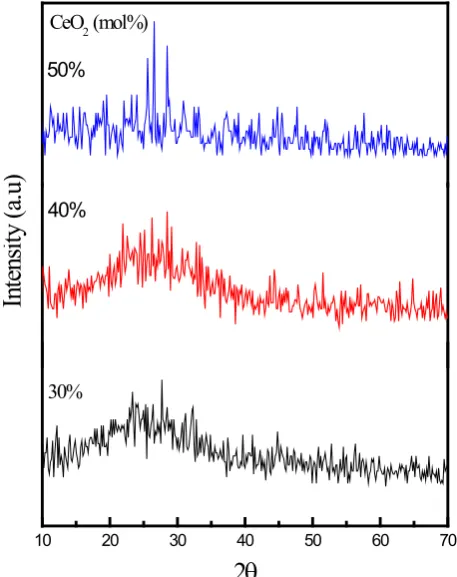
Figure 1 presents XRD diffraction patterns for xCeO2(100 − x)B2O3 with x = 30,
40, 50 mol% CeO2. The compositions of 30 and 40 mol% CeO2 were mainly amorphous, whereas composition containing 50 mol% CeO2 was partially crys-tallized. As it can be a notable, the amorphous structure of the glass network
10 20 30 40 50 60 70
2
θ
30%
Int
ens
ity (
a.u)
40%50%
CeO2 (mol%)
DOI:10.4236/njgc.2018.81002 15 New Journal of Glass and Ceramics containing 30 and 40 mol% CeO2 is clearly evidenced, since a broad hump cha-racterizing this feature is indicated in the XRD spectra of the glasses. On the other hand, sharper XRD peaks are developed on the spectra of glass contains 50 mol% CeO2. The discrete sharp lines observed at ~25.7, 28.6, 30.8, 37.6, 47.49˚ are mainly assigned to crystalline CeO4[PDF nr.810792], CeBO3[PDF nr.210177] and Ce(BO2)3[PDFnr.230877] species. The strong tendency to crystallization may attributed to increasing in network connectivity as result of further concen-tration of tetrahedral CeO4 as former species [9][10][12]. The tetrahedral CeO4 groups have the priority to combine together with B atoms and form an ordered structural chain in Ce-O-B linkages causing an increment in crystallization.
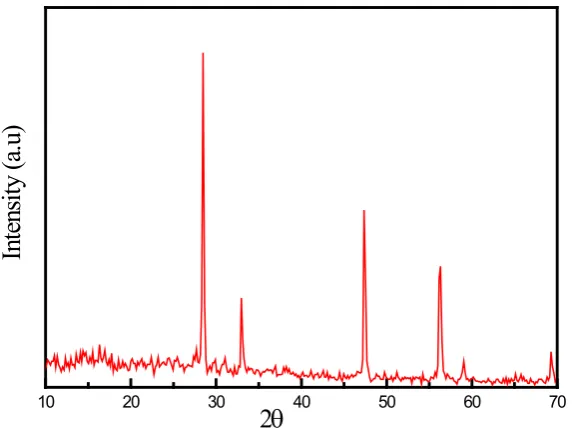
These considerations are further supported through comparison between XRD pattern of pure CeO2 as shown in Figure 2 and that of cerium borate glass containing 50 mol% CeO2. Both spectra offer sharp diffraction lines ranged be-tween 25˚ and 35˚. On other hand, the intensities of diffraction patterns of ce-rium borate glass are appeared to be lower than that of pure CeO2. In such a case, the distribution of the accumulated CeO4 units within the amorphous bo-rate structure units may play the role of lowering the crystallinty.
3.2.
11B NMR Spectroscopy
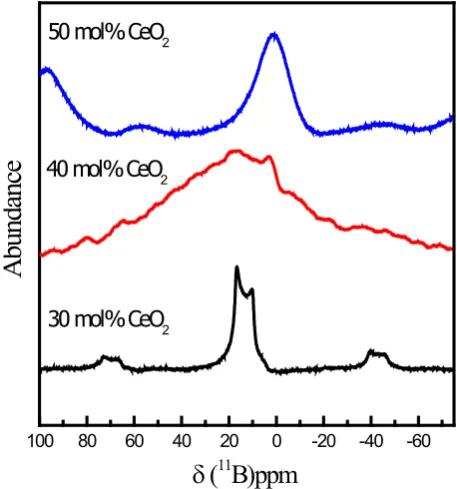
11B NMR spectra of alkali modified borate glasses were generally possessed two
well separated peaks [10] [26][27][28][29]. One is corresponding to BO3 and the other is related to BO4 sites. The broad 11B NMR resonance with peak cen-tered at about ~12 ppm is assigned to different trigonal boron species distributed as boroxol and non-ring BO3 units. While the more intensive and sharper peak located around 0 ppm is due to resonance of four-coordinate boron species.
It worthy to note that features of 11BNMR spectra of cerium borate glasses
[10] are quite different from that of—alkali and alkaline earth binary borate
10 20 30 40 50 60 70
Int
ens
ity (
a.u)
[image:4.595.230.520.488.707.2]2
θ
DOI: 10.4236/njgc.2018.81002 16 New Journal of Glass and Ceramics glasses. In glasses modified by CeO2, the BO4 and BO3 peaks are being broader and totally overlapped, as presented in Figure 3. This was especially true for the glass containing 40 mol% CeO2 which displayed asymmetrically broadened peak. The more pronounce broadening leads one to strongly suggest that presence of a BO4 site with 2BO3 and 2CeO4 in next nearest neighbor environments. The dif-ference in bond length and bond angle between B3-O-Ce4 and Ce4-O-B4 linkages is considered as the main reason for spectral broadening in glass containing 40 mol% CeO2. On the other hand, glass containing 50 mol% CeO2 showed more symmetric and less broadening behavior than that of glass containing 40 mol% CeO2. This can be discussed on the bases of presence a BO4 site coordinated with more CeO4 units in next nearest neighbor environment. In this regard, BO4 site with three or four CeO4 sites may efficiently be formed. Enhancement of CeO4 species around central B atom will result in increasing the symmetry elements in the whole glass network, since the majority of bonds are of Ce4-O-Ce4 type and limited bonds are formed with borate units. The symmetric of bonds around boron units will consequently change the value of chemical shift to become nearer to BO4 surrounding with 4BO3, since the observed chemical shift is ap-peared around 0 ppm. In such a case, we can suggest that, chemical shielding of BO4 coordinated with 4BO3 is similar to BO4 coordinated with 4CeO4, since both possess the same value of chemical shift.
As shown in Figure 3, the lower value of CeO2 (30 mol%) will affect the spec-tral feature, since two distinguished peaks are resolved. One characterizing BO3 units and the other can be argued to be due to BO4 site with 3BO3 and one CeO4 sites. Presence of CeO4 with lower site around BO4 results in changing the
100 80 60 40 20 0 -20 -40 -60
δ
(
11B)ppm
Abunda
nc
e
[image:5.595.257.486.445.690.2]30 mol% CeO
240 mol% CeO
250 mol% CeO
2DOI:10.4236/njgc.2018.81002 17 New Journal of Glass and Ceramics position of spectral peak to more positive value since shielding of BO4 atoms from BO3 sites differs from that with CeO4. Thus, chemical shifts of the studied system have obviously been varied from 12 ppm for glass containing 30 mol% CeO2 to 0 ppm in glass enriched with CeO2.
3.3. FTIR Analysis
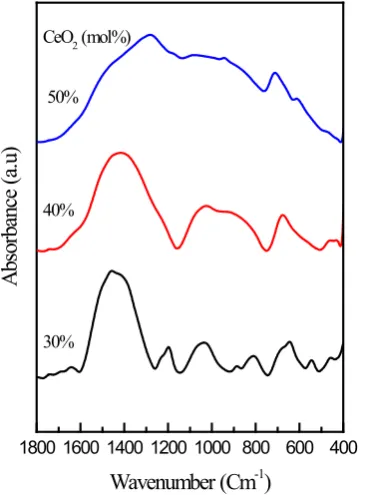
FT-IR spectra of samples with x = 30, 40, 50 mol% CeO2 are displayed in Figure 4. Three fundamental absorption bands [23][30] [31][32] have been observed in the borate glass system. The first band located between 600 - 800 cm−1 is as-signed to symmetric bending vibrations of BO3 bonds. The second band from 800 - 1200 cm−1 can be attributed to BO4 stretching vibrations, while the third band from 1200 - 1600 cm−1 is assigned to B-O stretching vibrations of triangu-lar BO3 units.
As noted from Figure 4, structural changes appeared in a wide and asymme-tric broadening, with increasing CeO2 content. Particularly, these changes are notable in the intensity of band ranged between 800 to 1200 cm−1. Such tendency is possible to the main role played by CeO2 through presenting more CeO4 units in the glass structure and their abilities to shield and coordinate with BO4 units. As a consequence, increasing of CeO2 at the expense of B2O3 results in increasing of Ce4-O-Ce4 bonds at expense of B4-O-B3. In such a case, the glass structure is mainly consisting of Ce4-O bond in CeO4 groups. Moreover, formation of some mixed vibrations from Ce4-O with B4-O and B3-O may also be suggested. The results of these measurements are quite in good agreement with those obtained from NMR of the same glasses.
1800 1600 1400 1200 1000 800 600 400
Abs
or
ba
nc
e (
a.u)
Wavenumber (Cm
-1)
[image:6.595.283.466.445.693.2]30% 40% 50% CeO2 (mol%)
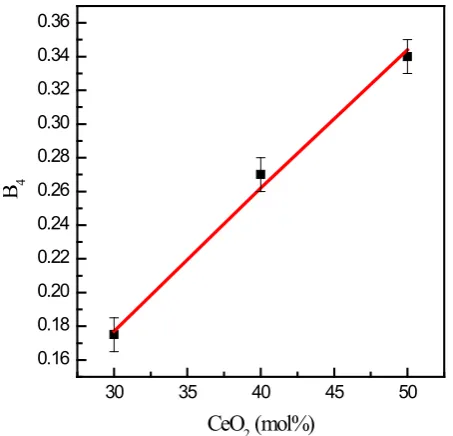
DOI: 10.4236/njgc.2018.81002 18 New Journal of Glass and Ceramics The total fraction of four-coordinated units, B4, could be calculated for the three samples using a deconvolution procedure [5][25] [31] [32]. This can be done by obtaining the relative area of each band corresponding to the structural units of both triangular BO3 and tetrahedral BO4 & CeO4 units.
[image:7.595.254.494.220.432.2]As a result, the value of B4 is then defined as the ratio of the area related to the sum of structural groups containing BO4 and CeO4 four coordinated units to the area related to total units (BO3 + BO4 + CeO4). Figure 5 represents an example for the deconvolution in Gaussian band of 50CeO2·50B2O3 glass sample.
Figure 6 illustrates the change in the total fraction B4 versus CeO2 content of
[image:7.595.260.487.475.693.2]1800 1600 1400 1200 1000 800 600 400
Figure 5. Deconvolution of infrared spectrum of the composition 50CeO2·50B2O3 as an example for the analysis.
30 35 40 45 50
0.16 0.18 0.20 0.22 0.24 0.26 0.28 0.30 0.32 0.34 0.36
B
4CeO
2(mol%)
DOI:10.4236/njgc.2018.81002 19 New Journal of Glass and Ceramics the studied glass samples. It can be observed from this figure, there is a linear dependence between B4 and the change of CeO2 composition. The role of CeO2 in increasing B4 may be attributed to the considerable frequent increasing in te-trahedral units in glass network at expense of BO3 units. This reveals that the former role of cerium may become more dominant in glass riches with cerium oxide (50 mol%). In such a case, the linkage between CeO4 and both BO3 and BO4 groups is being the most abundant within glass network. Such argument becomes clearly visible from FTIR spectra, particularly in glass of 50 mol% CeO2, where the shoulder at about 1600 cm−1 is assigned to Ce-O vibration in phase rich with cerium borate mixed units.
4. Conclusions
The structural features of cerium borate glasses correlated with CeO2 role have been investigated via different tools. The following conclusions can summarize the observed new features.
• XRD results revealed that, crystallization would take place in glasses with 50
mol% CeO2. In such a glass, the principal crystalline phase is assigned to crystalline CeO4, CeBO3 and Ce(BO2)3 species which is mainly referred to both CeO4 and BO4 as dominated units.
• FTIR spectroscopy and NMR spectroscopy have confirmed that CeO2 in
bi-nary borate glasses plays mainly the role of glass former in the form of CeO4 units. The formation of expected ordered Ce4-B-Ce4 linkage impairs the con-version of triangular BO3 units into BO4 tetrahedra and causes a wide broa-dening in the spectrum.
• Increasing of the total fraction of all four coordinated units (B4) is highly
as-sociated with increasing in CeO4 concentration and this would consequently result in formation of more ordered structures.
• The change in chemical shifts of 11B nuclei from 12 ppm to 0 ppm with in-creasing CeO2 content from 30 to 50 mol% is considered due to formation of more shielded borate units via B-O-Ce bonds. Each born atom can be coor-dinated with 3 or 4 Ce atoms in the second coordination sphere.
References
[1] Pye, L., Fréchette, V. and Kreidl, N. (2012) Borate Glasses: Structure, Properties, Applications. Volume 12, Springer Science & Business Media, Part of the Materials Science Research Book Series, MSR.
[2] Bengisu, M. (2016) Borate Glasses for Scientific and Industrial Applications: A Re-view. Journal of Materials Science, 51, 2199-2242.
[3] Oprea, I. (2005) Optical Properties of Borate Glass-Ceramics. PhD Diss., Osnabruck University, Germany.
[4] Minakova, N., Zaichuk, A. and Belyi, Y. (2008) The Structure of Borate Glass. Glass and Ceramics, 65, 70-73.
DOI: 10.4236/njgc.2018.81002 20 New Journal of Glass and Ceramics
[6] Singh, G., Kaur, P., Kaur, S. and Singh, D. (2012) Investigation of Structural, Physi-cal and OptiPhysi-cal Properties of CeO2-Bi2O3-B2O3 Glasses. Physica B: Condensed
Mat-ter, 407, 4168-4172.
[7] Kelly, T., Petrosky, J., McClory, J., Adamiv, V., Burak, Y., Padlyak, B., Teslyuk, I., Lu, N., Wang, L., Mei, W. and Dowben, P. (2014) Rare Earth Dopant (Nd, Gd, Dy, and Er) Hybridization in Lithium Tetraborate. Frontiers in Physics, 2, 31.
[8] Pisarski, W., Pisarska, J., Lisiecki, R., Dominiak-Dzik, G. and Ryba-Romanowski, W. (2010) Laser Spectroscopy of Rare Earth Ions in Lead Borate Glasses and Transparent Glass-Ceramics. Laser Physics, 20, 649-655.
[9] Mansour, E., El-Egili, K. and El-Damrawi, G. (2007) Mechanism of Hopping Con-duction in New CeO2-B2O3 Semiconducting Glasses. Physica B: Condensed Matter, 389, 355-361.
[10] El-Damrawi, G., Gharghar, F., Ramadan, R. and Aboelez, M. (2016) 11B NMR Spec-troscopy of Lead Borate Glasses: Additive Effect of Cerium Oxide. New Journal of Glass and Ceramics, 6, 57.
[11] Trégouët, H., Caurant, D., Majérus, O., Charpentier, T., Cormier, L. and Pytalev, D. (2014) Spectroscopic Investigation and Crystallization Study of Rare Earth Metabo-rate Glasses. Procedia Materials Science, 7, 131-137.
https://doi.org/10.1016/j.mspro.2014.10.018
[12] Mansour, E., El-Egili, K. and El-Damrawi, G. (2007) Ionic-Polaronic Behavior in CeO2-PbO-B2O3 Glasses. Physica B: Condensed Matter, 392, 221-228.
https://doi.org/10.1016/j.physb.2006.11.022
[13] Liu, H., Huang, J., Zhao, D., Yang, H. and Zhang, T. (2016) Improving the Electrical Property of CeO2-Containing Sealing Glass-Ceramics for Solid Oxide Fuel Cell Ap-plications: Effect of HfO2. Journal of the European Ceramic Society, 36, 917-923.
https://doi.org/10.1016/j.jeurceramsoc.2015.10.004
[14] Zu, C., Chen, J., Zhao, H., Han, B., Liu, Y. and Wang, Y. (2009) Effect of Cerium on Luminescence and Irradiation Resistance of Tb3+ Doped Silicate Glasses. Journal of
Alloys and Compounds, 479, 294-298.https://doi.org/10.1016/j.jallcom.2008.12.037
[15] Girija, D., Naik, H., Sudhamani, C. and Kumar, B. (2011) Cerium Oxide Nanopar-ticles—A Green, Reusable, and Highly Efficient Heterogeneous Catalyst for the Synthesis of Polyhydroquinolines under Solvent-Free Conditions. Archives of Ap-plied Science Research, 3, 373-382.
[16] Culea, E., Neumann, M., Takacs, A., Pop, L., Culea, M., Bosca, M. and Marcean, R. (2005) Structural and Magnetic Behavior of Some Oxide Glasses Containing Ce-rium Ions. Annals of the West University of Timisoara, Physics Series, 46, 117-120. [17] Deshpande, V. and Taikar, R. (2010) Effect of Cerium Oxide Addition on Electrical
and Physical Properties of Alkali Borosilicate Glasses. Materials Science and Engi-neering, 172, 6-8.https://doi.org/10.1016/j.mseb.2010.04.003
[18] Jha, A. (2014) Rare Earth Materials: Properties and Applications. CRC Press, Boca Raton. https://doi.org/10.1201/b17045
[19] Kielty, M. (2016) Cerium Doped Glasses: Search for a New Scintillator. PhD, Clem-son University, ClemClem-son.
[20] Mansour, E., Doweidar, H., El-Damrawi, G. and Moustafa, Y. (2004) Mixed Alkali Effect in Polaronic Conducting Iron Borate Glasses. Journal of Materials Science, 39, 4325-4329.https://doi.org/10.1023/B:JMSC.0000033418.94760.70
DOI:10.4236/njgc.2018.81002 21 New Journal of Glass and Ceramics
https://doi.org/10.1016/S0921-5093(00)01786-X
[22] Doweidar, H., El-Damrawi, G. and Al-Zaibani, M. (2013) Distribution of Species in Na2O-CaO-B2O3 Glasses as Probed by FTIR. Vibrational Spectroscopy, 68, 91-95.
https://doi.org/10.1016/j.vibspec.2013.05.015
[23] Gautam, C., Yadav, A. and Singh, A. (2012) A Review on Infrared Spectroscopy of Borate Glasses with Effects of Different Additives.
[24] Othman, H., Elkholy, H. and Hager, I. (2016) FTIR of Binary Lead Borate Glass: Structural Investigation. Journal of Molecular Structure, 1106, 286-290.
https://doi.org/10.1016/j.molstruc.2015.10.076
[25] El-Damrawi, G., Gharghar, F. and Ramadan, R. (2016) Structural Studies on New xCeO2 ·(50−x)PbO·50B2O3 Glasses and Glass Ceramics. Journal of Non-Crystalline
Solid, 452, 291-296.https://doi.org/10.1016/j.jnoncrysol.2016.09.011
[26] Zhou, B., Sun, Z., Yao, Y. and Pan, Y. (2012) Correlations between 11B NMR Para-meters and Structural Characters in Borate and Borosilicate Minerals Investigated by High-Resolution MAS NMR and ab initio Calculations. Physics and Chemistry of Minerals, 39, 363-372.https://doi.org/10.1007/s00269-012-0482-3
[27] Michaelis, V., Aguiar, P. and Kroeker, S. (2007) Probing Alkali Coordination Envi-ronments in Alkali Borate Glasses by Multinuclear Magnetic Resonance. Journal of Non-Crystalline Solids, 353, 2582-2590.
https://doi.org/10.1016/j.jnoncrysol.2007.04.029
[28] Clarida, W., Berryman, J., Affatigato, M., Feller, S., Kroeker, S., Zwanziger, W., Meyer, B., Borsa, F. and Martin, S. (2003) Dependence of N4 upon Alkali Modifier in Binary Borate Glasses. Physics and Chemistry of Glasses, 44, 215-217.
[29] Takaishi, T., Jin, J., Uchino, T. and Yoko, T. (2000) Structural Study of PbO-B2O3 Glasses by X-Ray Diffraction and 11B MAS NMR Techniques. Journal of the
Ameri-can Ceramic Society, 83, 2543-2548.
https://doi.org/10.1111/j.1151-2916.2000.tb01588.x
[30] Ibrahim, S., Gomaa, M. and Darwish, H.H. (2014) Influence of Fe2O3 on the Physi-cal, Structural and Electrical Properties of Sodium Lead Borate Glasses. Journal of Advanced Ceramics, 3, 155-164.https://doi.org/10.1007/s40145-014-0107-z
[31] Verhoef, A. and Den Hartog, H. (1995) Infrared Spectroscopy of Network and Ca-tion Dynamics in Binary and Mixed Alkali Borate Glasses. Journal of Non-Crystalline Solids, 182, 221-234.
https://doi.org/10.1016/0022-3093(94)00555-9