Proceedings of the 2019 Conference on Empirical Methods in Natural Language Processing 2922
Modeling Frames in Argumentation
Yamen Ajjour Bauhaus-Universität Weimar Faculty of Media, Webis Group [email protected]
Milad Alshomary Paderborn University Department of Computer Science
Henning Wachsmuth Paderborn University Department of Computer Science
Benno Stein
Bauhaus-Universität Weimar Faculty of Media, Webis Group [email protected]
Abstract
In argumentation, framing is used to empha-size a specific aspect of a controversial topic while concealing others. When discussing the legalization of drugs, for instance, its econom-ical aspect may be emphasized. In general, we call a set of arguments that focus on the same aspect aframe. An argumentative text has to serve the “right” frame(s) to convince the au-dience to adopt the author’s stance (e.g., be-ing pro or con legalizbe-ing drugs). More specif-ically, an author has to choose frames that fit the audience’s interests and cultural back-ground. This paper introducesframe identifi-cation, which is the task of splitting a set of ar-guments into a set of non-overlapping frames. We present a fully unsupervised approach to this task, which first removes topical informa-tion from the arguments and then identifies frames using clustering. For evaluation pur-poses, we provide a corpus with 12 326 debate-portal arguments, organized along the frames of the debates’ topics. On this corpus, our ap-proach outperforms different strong baselines, achieving an F1-score of 0.28.
1 Introduction
Different interests, cultural backgrounds, and so-cializations make people disagree on taking a cer-tain course of action. Adebateis a means for the involved parties to resolve their disagreement. A debate is characterized by atopic, e.g., “Should one legalize abortion?”. Upon the topic, the disagreeing parties have a pro or constancerespectively, say, “Abortion should be legalized” or “Abortion should not be legalized”. A stance is supported by argu-ments; a pro argument could be “Abortion is good for a free society because it gives women their basic right of controlling their bodies.” while a con argu-ment could be “Abortion is against human rights because it is a systematic murder of innocent life.” One part of an argument (here: the part before the
word “because”) is called aconclusion, the other part consists of one or morepremises. A debate can be considered as set of pro and con arguments.
Typically, numerous arguments exist for a topic. The parties involved in a debate have to choose among the arguments, therebyframingthe topic by emphasizing a specific aspect while concealing oth-ers. We call the set of the arguments which share an aspect aframe. More specifically, a frame F
is subset of a set of argumentsA,F ⊆ A. Like-wise, a set of frames,{F1, . . . , Fk}covers a set of
arguments iff.A⊆Sk
jFj.
For instance, the following arguments target dif-ferent topics but concentrate on the same frame, namely, theeconomicalaspect.
Argument 1“I support legalization of marijuana since it can be taxed for revenue gain.”
Topic:Marijuana
Argument 2 “Legalizing prostitution would in-crease government revenue. A tax on the fee charged by a prostitute, and the imposition of in-come tax on the earnings of prostitutes would gen-erate revenue.”
Topic:Prostitution
Framing is a decisive step in the construction of arguments, which affects the outcome of a debate (Eemeren and Houtlosser,1999). To achieve per-suasion, an author of an argumentative text should choose frames that resonate with the target audi-ence. As a simple example, an argument appealing to Christianity might not be acceptable to an atheist. Knowing the arguments for a topic along with their frames enables authors to choose those arguments that best address their audience.
clas-sifiers to mine arguments for a given topic from a relevant document (Levy et al.,2014;Stab et al.,
2018;Wachsmuth et al.,2017a). The mentioned approaches ignore identifying the frames of argu-ments during mining and retrieval, this way omit-ting extremely valuable information.
The paper in hand starts by reviewing related work to framing (Section2). In Section3, we intro-duce the first argument dataset that has been anno-tated with frames and topics, and we provide sta-tistical insights into the dataset. Section4presents a new unsupervised approach to identify frames in a set of arguments. Our approach first removes topical features from the arguments and then clus-ters the arguments into frames. In Section5, we describe the experiments that we conducted to eval-uate our approach. We apply the approach to all arguments fromdebatepedia.organd evaluate the returned frames against the ground-truth frames in our dataset. Section6shows and discusses the effectiveness of our approach. In Section7, we analyze the errors made by the approach in the experiments.
The main contributions of this paper are:
• A formal view of frames in argumentation.
• An unsupervised approach to identifying frames in a set of argumentative texts.
• An argument framing dataset with 465 topics, 1 623 frames, and 12 326 arguments.
We freely provide the complete dataset to the re-search community.1
2 Related Work
Research on framing is scattered across different fields such as media, social, and cognitive studies.
Entman(1993) was the first to introduce a formal definition of framing as a way to select and make specific aspects of a topic salient. Subsequent re-search on framing is concentrated on the effect of using frames in news on a specific audience. One of the open questions is whether frames are topic-specific or generic concepts, or both.Vreese
(2005) studied framing in news articles and consid-ered frames to be both of the two. Johnson et al.
(2017) andCard et al.(2015), on the other hand, defined frames to be independent of the topic and investigated their usage across different topics.
1Argument framing dataset: https://webis.de/ data/webis-argument-framing-19.html or
https://doi.org/10.5281/zenodo.3373355
Recently, framing caught some attention in the NLP community. Different computational models have been developed for modeling frames in nat-ural language text. Tsur et al.(2015) used topic models on statements released by congress mem-bers of the two major parties in the US, Repub-licans and Democrats. The learned topics were then aggregated into clusters, such as health and economy, and interpreted as being generic frames. On this basis, the authors studied the frequency of the frames in the released statements for the two parties as well as their distribution over time. A related work was conducted byMenini et al.(2017) to model frames in political manifestos released by the parties (texts declaring a stance) as clusters of key phrases. The developed method was shown to outperform standard topic models in capturing frames.
Card et al.(2015) annotated around 16k news ar-ticles on three topics (same-sex marriage, immigra-tion, and smoking), along with a list of 15 generic frames. While the annotations had to cover con-tinuous spans of text, their granularity was left un-specified. The inter-annotator agreement on frames for the different frames ranged between 0.08 and 0.23 in terms of Krippendorff’sα. By comparison, our dataset covers both generic and topic-specific frames and are annotated on the argument level.
Naderi and Hirst(2017) extended this line of work by training a neural network to classify the frames in the constructed corpus. The authors modeled frames on the sentence level and reached an ac-curacy of 53.7% in multi-class classification and 89.3% for one-against-others classification. Using the same corpus, (Field et al.,2018) created a lex-icon for each one of the 15 frames and analyzed which frames are used mainly to talk about the United States in Russian news.
A related line of research is the mining of argu-ments from natural language text (Al-Khatib et al.,
2016). Most approaches uses supervised classifiers to extract the structure of arguments (conclusion
2017a;Levy et al.,2018;Stab et al.,2018) with the goal of retrieving relevant arguments for an input claim. Use cases for argument search include writ-ing and debatwrit-ing support. In comparison to user queries in conventional search that can often be sat-isfied by one or a few retrieved documents, these use cases require a broader consideration of the re-trieved arguments. Hence, the user of an argument search engine will often investigate both stances and multiple frames on a given topic. While sev-eral studies tackled the task of ranking arguments according to their quality (Habernal and Gurevych,
2016;Wachsmuth et al.,2017b), how to aggregate arguments into frames is largely unstudied.
The relation between arguments and frames was introduced briefly in some works (Boydstun et al.,
2013;Gabrielsen et al.,2011). Still, recent research on computational argumentation largely ignores frames, and a model for aggregating arguments into frames is still missing.Naderi(2016) considered a frame to be an argument and classified sentences in parliamentary speeches into one of seven frames. (Reimers et al.,2019) created a dataset of argument pairs that are labeled according to their similarity. Based on the dataset, they introduced the task of argument clustering which aims at classifying an argument pair with the same topic into similar or dissimilar. The main difference to this work is that no explicit aspect are assigned to the arguments during annotation.
3 Data
Debate portals are websites where people debate or collect arguments for or against controversial topics. Some debate portals are dialogical, such asdebate.org, allowing two opponents to debate one topic in rounds. Other debate portals such as
debatepedia.orgare wiki-like where arguments are listed according to their stance on the topic. Debate portals keep a canonical structure of the arguments considered for each topic (usually a conclusion and a premise). The structure and the wide topic coverage offered by debate portals has made them a suitable resource for research on computational argumentation (Cabrio and Villata;Al-Khatib et al.,
2016;Wachsmuth et al.,2017a).
3.1 Argument Frames from Debatepedia.org
For the given work, we crawled all arguments from debatepedia.org in order to construct a dataset for the evaluation of frame identification.
Debatepe-# Topics # Frames # Merged Frames # Arguments
[image:3.595.316.518.143.275.2]465 1 645 1 623 12 326
Table 1: Counts of topics, frames, merged frames, and arguments in the webis-argument-framing-19 dataset.
#Topics
Safety Public Opinion
Security Crime Politics Democracy Rights Feasibility Environment
Economics 119
20 40 60 80 100
Frames
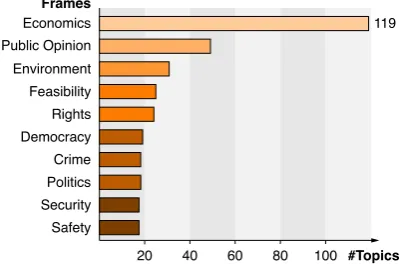
Figure 1: The number of topics in which each of the 10 most frequent frame labels in our dataset occurs.
dia.org organizes a debate into sets of arguments that address a topical aspect of the debate. A label that describes the topical aspect is attached to some of the sets, such aseconomics. An argument on de-batepedia.org is listed as a conclusion on the topic along with a premise that supports it.
Arguments which are not labeled might intro-duce noise to the dataset, since the true knowledge regarding their frames is unavailable. To exclude possible noise in the planned experiments, we fil-tered out all arguments without labels (about 1800). Next, we analyzed the extracted labels and found that some labels have a similar meaning but are worded differently. In particular, we noticed the presence of the following cases:
1. Labels with hierarchical relations, such as
businessandUS business.
2. Opposite labels, such ashealthandunhealthy, or, protecting smokers and protecting non-smokers.
3. Labels that are equal when being lemmatized, such aseconomicsandeconomic, democratiz-inganddemocratic, etc.
100
Count of Topics 200
300 400 500 1000 1100
Count of Frames
1 2 3 4 >4
3% 80%
11%
4%
100
Count of Arguments 150
200 250 300
Count of T
opic-Specific Frames
50
1% 2% 5% 92%
1-5 6-10 11-15 16-20 350
1-50 51-100 101-150 151-200 300
Count of Arguments 450
600 750 900
Count of Generic Frames 100 5% 1% 25%
69% 1050
(a) (b) (c)
[image:4.595.75.523.64.207.2]2%
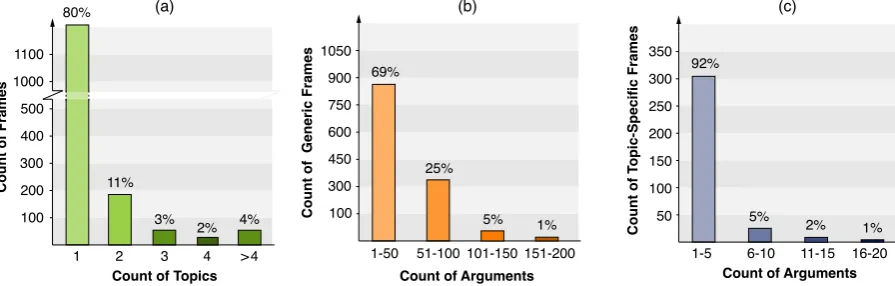
Figure 2: General statistics of frames from debatepedia.org in the webis-argument-framing-19 dataset. (a): His-togram of frames over the count of topics in which they are used. (b): HisHis-togram of generic frames over the count of arguments they contain. (c): Histogram of topic-specific frames over the count of arguments they contain.
3.2 Webis-Argument-Framing-19 Dataset
Table1shows general statistics of the final dataset after crawling and preprocessing, called webis-argument-framing-19. As visualized in Figure1, the ten most frequent labels in our dataset are: eco-nomics, public opinion, environment, feasibility,
rights, democracy, crime, politics, security and,
safety. These labels largely overlap with those introduced byCard et al.(2015); hence, we consid-ered each set of arguments to be a frame.
The count of topics in which a frame occurs in-dicates whether a frame is generic or topic-specific. To distinguish between these two types of frames, we grouped all frame labels in our dataset accord-ing to how many topics they occur in. Figure2(a) shows a histogram of the frames in our dataset over the count of topics in which they are used. As de-picted, 80% (1293) of the frames are used in one topic and, hence, we labeled them astopic-specific. Frames that are used in more than one topic add up to 20% (330) frames and are labeled asgeneric. Generic frames in the dataset cover 7052 arguments while topic specific frames cover 5274 arguments. Figure2(b) and (c) show a histogram of generic and of topic-specific frames over the count of ar-guments they contain respectively. The histograms reveal that generic frames cover an order of mag-nitude more as many arguments as topic-specific frames.
4 Approach
In this section, we introduce our unsupervised ap-proach to modeling frames formally. We assume frames to be exclusive and non-overlapping. Given a set of argumentsA={a1, a2, . . . , an}, our goal
is to find a set of frames, which constitutes a cover ofA. A cover ofAis a set of sets{F1, F2, . . . , Fk}
whose union containsA, i.e.,A⊆Sk
j Fj. Table2
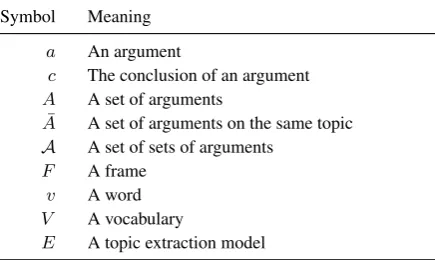
lists the symbols used in this section along with their meaning.
The main idea of our approach is to first remove topical features from arguments and then to cluster the arguments into frames. Following known topic modeling approaches, we represent the content of an argumentaas a bag of words and propose two models to find topic-specific words. Both models utilize the frequency of the words in an argument and the argument’s structure. The structure ofais represented by its conclusioncand its premise(s)
p. Our approach includes three main steps:
(a) Topic clustering.Cluster the arguments inA
intomtopicsA¯={A¯0,A¯1, . . . ,A¯m}.
(b) Topic removal.Given the produced clusters, develop an extraction modelE that extracts topical features from an argumentai and its cluster.Eis applied to eachAj¯ ∈A¯to remove topic-specific features. As a result, we obtain “topic-free” arguments a0i = ai−E(a,Aj¯ ). We denote the set of all “topic-free“ arguments withA0whereA0 ={a0
1, a02,. . ., a0n}.
(c) Frame clustering.Cluster the argumentsA0
intokclusters, each respresenting one frame.
Figure3sketches the general idea of the three steps of our approach. We detail our concrete realization of each step in the following.
4.1 Topic Clustering
T F T F
T F T F T F
T F T F
T F T F
A set of arguments Arg‘s with topic 1
Arg‘s with topic m
...
Topic-free arg‘s 1
Topic-free arg‘s m
...
Arg‘s with frame 1
F F F F
Generic frames
F
F F
Topic-specific frames
(from multiple topics)
(from one topic)
Input (a) Topic clustering (b) Topic removal (c) Frame clustering Output
Legend:
T topicsT
F F F F frames argumentT F
F F
F T F T F
T F T F
T F
F T F
T F T F
F F
F F T
F F
F F
F
Arg‘s with frame 3 Arg‘s with frame 2
F F
Arg‘s with frame 4
[image:5.595.73.528.62.195.2]F
Figure 3: Sketch of the proposed unsupervised approach to argument frame identification. An argument is modeled as a topic and a frame. The input is a sets of arguments. The output is representations of two types of found frames.
Symbol Meaning
a An argument
c The conclusion of an argument
A A set of arguments
¯
A A set of arguments on the same topic
A A set of sets of arguments
F A frame
v A word
V A vocabulary
E A topic extraction model
Table 2: Notation of the symbols used in the approach
represents its semantics. We usek-means ( Harti-gan and Wong,1979) with Euclidean distance as a clustering algorithm. For semantic spaces, we consider two alternatives:Term Frequency-Inverse Document Frequency(TF-IDF), andLatent Seman-tic Analysis(LSA).
TF-IDF TF-IDF defines a vector space whose dimensions are words in the dataset. An argument is mapped to this space according to the frequency of each of its words, normalized by the word’s frequency in all considered arguments. TF-IDF is a sparse vector space since all words in a set of arguments are considered. To reduce sparsity, we construct a vocabularyV which comprises the 5000 most frequent words in the arguments after stopword removal. Words that occur in more than half of the arguments are ignored as well. The main reason for reducing the vocabulary is to increase the computational efficiency of the approach.
LSA Latent Semantic analysis (Deerwester et al.,
1990) infers from a term-document frequency ma-trix a linear transformation that project documents into a topic space. We construct two different se-mantic spaces using LSA. The first, simply called
LSA, considers each argument to be a document. The second,LSA Debate, considers a whole debate to be a document. Since LSA Debate works on the debate level, it can better capture the topic context of an argument. The reason is that arguments cap-ture the topic differently and may have few words in common. Using all arguments in a debate en-sures a broader context of the topic. To compare both LSA models systematically, we use the same number of dimension for both models: 1000.
4.2 Topic Removal
The goal of this step is to remove topic-specific fea-tures in the topic clustersA¯={A¯0,A¯2, . . . ,A¯m}.
To achieve this goal, we develop two models to extract topic-specific features,E1qand andE2.Eq1
utilizes the content of the arguments in one clus-ter, whereasE2utilizes the argument structure, i.e.,
conclusion and premise information.
E1qutilizes the term-frequency inverse document frequency measure TF-IDF for every word v in each cluster. We calculateidf as follows:
idf(v) =
A¯
A¯j ∈A¯:v ∈A¯j
Then, E1q(a)returns those words that best dis-criminates a specific topic as follows based on a thresholdq, which can be understood as the aggres-siveness of the model:2
E1q(a,Aj¯ ) ={v∈Aj¯ :tf.idf(v)> q}
E2 utilizes the structure of an argument on a local level. The hypothesis here is that the con-clusion of an argument contains more words that target the topic than its premise. Hence, we remove the conclusion in an argument. Formally:
E2(a,A¯j) ={v∈c}
[image:5.595.72.290.248.378.2]4.3 Frame clustering
This step aims at grouping arguments that share a common aspect after removing topical features. For clustering, we usek-means again and experiment with different values of k. Below, we choose k
based on an experiment that evaluates the output of the cluster against the ground-truth. We also use Euclidean distance to estimate the similarity between the arguments in the two semantic spaces.
5 Experiments
Based on the dataset we introduced in Section3, we conduct experiments to evaluate and analyze our approach to modeling frames in argumentation. As discussed above, the approach consists of three steps: topic clustering, topic removal, and frame clustering. We evaluate the three steps and their in-teraction with each other in different experiments.
Topic Clustering Experiment The goal of this experiment is to find the best method to group ar-guments into topics. The produced clusters for each semantic space are evaluated against the ar-guments’ topics in the ground-truth dataset. An external measure is then used to evaluate the output of the clustering algorithm for each semantic space. In particular, we useBcubed F1-score(Bagga and Baldwin,1998) to evaluate the effectiveness of our approach in modeling topics in the dataset. Bcubed F1-score rewards only the instance pairs that
ex-ist in the output of the clustering algorithm and in the ground-truth together in the same cluster. The reason for choosing Bcubed F1-score is that it is
proven to satisfy desired constraints in the output of clustering algorithms (Amigó et al.,2009).
Topic Removal Experiment This experiment
aims at evaluating our models E1q and E2 at
re-moving topical features from the arguments inA¯. The evaluation criterion here is the effectiveness drop of the topic clustering algorithm after remov-ing the topical features inA¯. We rerun the topic clustering algorithm with the samekafter remov-ing the output of both modelsEq1andE2. To have
a consistent comparison, we setkto the best count of topics we found in the previous experiment.
Frame Clustering Experiment The last experi-ment evaluates clustering arguexperi-ments into frames af-ter topic removal. To test our hypothesis that topic removal benefits frame identification, we also clus-ter arguments in the same semantic space without
200 400 600 800 1000
0.1 0.2 0.3 0.4
k
Bcubed F1-score
0
TF-IDF LSA 0.5
[image:6.595.308.521.63.244.2]LSA Debate
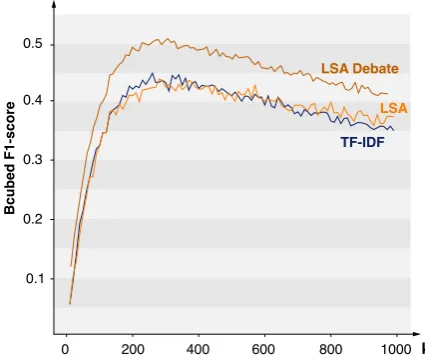
Figure 4: Bcubed F1-score of the topic clustering
algo-rithms for the semantic spaces TF-IDF, LSA and LSA Debate for eachk.
topic removal. For both semantic spaces, we con-duct three experiments: main experiment, generic frame experiment, and topic-specific frame exper-iment. In the topic-specific and generic frame ex-periment, we use the frames in our dataset that are labeled as topic specific and generic frame sep-arately. In the main experiment, we test our ap-proach on the whole dataset without distinguish-ing the type of frames. The different experiments should show us the performance of our approach at identifying generic and topic-specific frames. Similar to topic clustering, we use Bcubed F1
-score (Bagga and Baldwin,1998) to evaluate the frame clustering algorithm in the three experiment. Since our dataset contains 1623 frames, we evalu-ate the output of the clustering algorithm for each
k∈ {1000, . . . ,1600}.
6 Results and Discussion
In the following, we report on the results of the three experiments explained above separately. At the end, we discuss the findings of the experiments and draw final conclusions on the performance of our approach at identifying frames.
6.1 Topic Clustering
Figure4shows the effectiveness of topic clustering using the different semantic spaces. We visual-ize for eachkthe Bcubed F1-score of the
cluster-ing algorithms for the three semantic spaces. As shown, TF-IDF and LSA perform similarly for all
Semantic Space # Topics F1
LSA Debate 310 0.52
TF-IDF 260 0.45
LSA 280 0.44
Table 3: Bcubed F1-score of the topic clustering
algo-rithm for each semantic space and the corresponding count of topics found.
TF-IDF. This shows the importance of considering the context of an argument for modeling their top-ics. All the three depicted plots, however, show a clear elbow between topic counts 200 and 400. Table3shows the highest corresponding F1-score
and the count of topic clusters for each semantic space. The best topic clustering achieved by the algorithms comprises 310 clusters. Given its high effectiveness in modeling topics, we decided to pro-ceed with the topic clusters produced by the LSA Debate in the next experiment.
6.2 Topic Removal
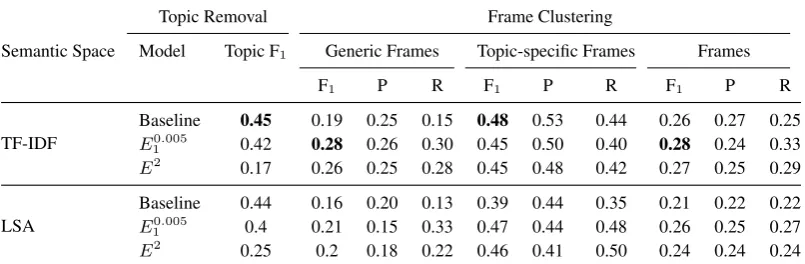
Table4shows the results of the topic removal exper-iment and frame clustering experexper-iment. For both semantic spaces, the effectiveness of topic cluster-ing algorithm is reported after uscluster-ing the modelsE1q
andE2to remove topic-specific words. To evaluate the topic extraction models, we re-list the effective-ness achieved by the topic clustering algorithm for both spaces. We show the results ofE1q only for
q= 0.005since higher values ofqshowed similar or lower results in all experiments.
As shown, E2 decreases the effectiveness of topic clustering algorithm to around the half. The modelE0.005
1 achieves a smaller drop of 0.03-0.04
in the two semantic spaces. Despite its simplic-ity,E2is more effective at removing topic-specific
features thanE0.005
1 .
6.3 Frame Clustering
Table4shows the results of the frame clustering al-gorithm in the experiments: generic, topic-specific, and main. In each experiment, the clustering al-gorithm is run after using the two topic extraction models to remove topic-specific features and with-out applying them (baseline). In the main and the generic experiment, using the topic extraction mod-els outperforms not using them in both semantic spaces. In the topic-specific experiment, our ap-proach’s effectiveness outperformed the baseline only in LSA space. The comparison between the
re-sults in the generic and topic-specific experiments shows that identifying generic frames is harder. The reason can also be the small size of topic-specific frames in the ground-truth. Our approach, however, is only effective at identifying generic frames and fails at outperforming the baseline in the topic-specific experiments. A reason to justify this is that removing topic-specific features nega-tively affects identifying topic-specific frames.
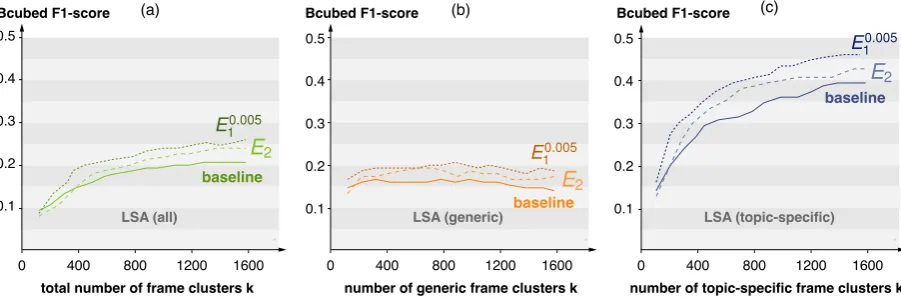
To better analyze our approach, we plot the achieved Bcubed F1-score for each semantic space
and each experiment for different values ofk. Fig-ure5(a,b,c) shows the effectiveness achieved in the three experiments main, topic-specific and generic respectively in TF-IDF space. As shown, both mod-elsE10.005andE2 start to outperform the baseline atk = 1200in the main experiment. All the ap-proaches converge starting from this value and not much effectiveness is achieved for higher values of
k. In the generic experiment, both models achieve their first peaks at k = 800. The performance of both models oscillates but keeps at the same rate of for larger values ofk. In the topic-specific experiments, the performance of our approach in-creases significantly while approaching the value ofk= 400. The gain achieved by for more clusters decreases slowly for larger values ofk.
Figure6(a,b,c) shows the effectiveness achieved in the three experiments main, topic-specific and generic respectively in LSA space. As depicted in the three figures, the modelE10.005outperformsE2
in all cases which shows that content-based topic-removal of arguments is more effective than using its structure. In the generic experiment, all models in LSA space shows subpar effectiveness to their counterpart in TF-IDF space and lack clear peaks. In the topic-specific experiment, our approach out-performs the LSA baseline and their counterpart in TF-IDF space. Nevertheless, like in the generic experiment, no clear peak is reached by any model.
6.4 Discussion
Topic Removal Frame Clustering
Semantic Space Model Topic F1 Generic Frames Topic-specific Frames Frames
F1 P R F1 P R F1 P R
TF-IDF
Baseline 0.45 0.19 0.25 0.15 0.48 0.53 0.44 0.26 0.27 0.25
E10.005 0.42 0.28 0.26 0.30 0.45 0.50 0.40 0.28 0.24 0.33
E2 0.17 0.26 0.25 0.28 0.45 0.48 0.42 0.27 0.25 0.29
LSA
Baseline 0.44 0.16 0.20 0.13 0.39 0.44 0.35 0.21 0.22 0.22
E10.005 0.4 0.21 0.15 0.33 0.47 0.44 0.48 0.26 0.25 0.27
[image:8.595.98.501.64.196.2]E2 0.25 0.2 0.18 0.22 0.46 0.41 0.50 0.24 0.24 0.24
Table 4: Best bcubed F1-score, precision, and recall for the topic extraction modelsE1q, E2 and without topic
removal (baseline) in the generic, topic-specific and main frame experiments together with the corresponding bcubed F1-score in topic clustering.
baseline. A justification can be that a conclusion is more likely to carry stance-taking words toward the topic. In general,E10.005 achieved higher results thanE2, which shows that using the content of an
argument is more effective than using its structure to model frames. A possible justification for this can be thatE2is more aggressive than needed at
removing topic-specific features.
7 Error Analysis
We analyze the topic and frame clusters produced by our approach to convey to the reader a sense of its performance. For topic clusters, we focus on the semantic space LSA Debate since our approach per-formed the best in this semantic space. For Frame clusters, we analyze the output of our approach in the semantic space TF-IDF after applyingE20.005
since our approach performed the best in this se-mantic space. Our goal is to identify the topics and frames in the dataset which our approach com-pletely confused or correctly identified. To identify these cases, we sort the topics and frames in the ground-truth dataset according to the maximum F1-score achieved in the aforementioned semantic
spaces respectively. We manually analyze the topic and frames labels and the count of arguments they comprise and report the most interesting cases.
For topic clustering, examples of topics that our approach correctly identified (with an F1-score of
1) are:ZoosandCompulsory vaccination. On the other hand, our approach struggled at identifying topics likeIs Pluto a planet? andImmunity from prosecution for politicians(with an F1-score lower
than 0.1). A reason for this might be that these topics are too specific and not covered well in our dataset.
In frame clustering, the hardest cases for our
ap-proach in TF-IDF space were topic-specific frames that contain few arguments, e.g., child disabil-ity. Generic frames such as rights and feasibil-ity were also hard to identify (with an F1-score
lower than 0.1). A possible explanation is that these frames can be confused with generic frames like human rights and economics. Examples of generic frames that were effectively identified are
freedom of speechandpublic health(with an F1
-score equals to 0.5).
8 Conclusion
A disagreement between people on a topic can lead to a lively debate where the opposing parties exchange arguments on the topic to enforce their stance. In favor of a particular stance, an argument emphasizes a certain aspect of the topic, thereby hiding other aspects. This phenomenon is called framing and has been introduced in social science (Entman,1993). Knowing the frame of an argu-ment helps users to choose arguargu-ments that better address the audience’s cultural background.
Research on framing in natural languages is still lacking. In this paper, we tried to close this gap by introducing a formal view on framing that defines a frame as a set of arguments that share an aspect. Starting from this view, we introduced an approach to remove the topic’s features from the arguments and then to cluster them. We operationalized our approach by using two different models. While the first removes an argument’s topic features using its content, the second utilizes its structure (conclusion and premise).
sensi-(a) (b) (c)
baseline
0.1 0.2 0.3 0.4
baseline
total number of frame clusters k 0.5
baseline
number of generic frame clusters k number of topic-specific frame clusters k Bcubed F1-score
Bcubed F1-score Bcubed F1-score
0.1 0.2 0.3 0.4 0.5
0.1 0.2 0.3 0.4 0.5
400 800 1200 1600
0 0 400 800 1200 1600 0 400 800 1200 1600
TF-IDF (topic-specific) TF-IDF (generic)
[image:9.595.74.527.63.212.2]TF-IDF (all)
Figure 5: Effectiveness of frame clustering with TF-IDF without topic removal (baseline) and after applyingE0.005 1
andE2in (a) the main frame experiment, (b) the generic frame experiment, and (c) the topic-specific experiment.
baseline
baseline
baseline
(a) (b) (c)
0.1 0.2 0.3 0.4 0.5
Bcubed F1-score
Bcubed F1-score Bcubed F1-score
0.1 0.2 0.3 0.4 0.5
0.1 0.2 0.3 0.4 0.5
400 800 1200 1600 0
total number of frame clusters k
400 800 1200 1600 0
number of generic frame clusters k
400 800 1200 1600 0
number of topic-specific frame clusters k LSA (topic-specific)
LSA (generic) LSA (all)
Figure 6: Effectiveness of frame clustering with LSA without topic removal (baseline) and after applyingE10.005
andE2in (a) the main frame experiment, (b) the generic frame experiment, and (c) the topic-specific experiment.
ble baselines that utilize the same semantic spaces without deleting topic information. We conducted three types of experiments that evaluate our ap-proach in identifying generic (those which are used in multiple topics), topic-specific and both.
Our experiments clearly show the benefit of re-moving topic’s features for identifying an argu-ment’s frame. In particular, we find that identifying generic frames benefits from removing topic fea-tures, which are actually the hardest case. On the other hand, removing topic features cannot help in identifying topic-specific frames. We also observed that removing an argument’s conclusion helps iden-tifying its frame, although it is more likely to carry the stance and the topic of an argument.
Having set a lacking methodology for model-ing frames in argumentation, our next step is to develop better approaches for modeling and remov-ing the topic of an argument. Neural networks such as auto-encoders and attention-based models are likely to perform better at modeling frames in argu-mentation than LSA and TF-IDF. Regarding topic
removal, potential research directions will investi-gate using external knowledge such as Wikipedia to find topic-specific features.
Future work on framing will focus on its applica-tion to down-stream argument mining tasks such as analyzing argument quality. Especially interesting is whether specific frames are expected to persuade an audience. A follow-up question will be whether frames in an argumentative text should be delivered in a specific sequence to achieve the persuasion of an audience.
[image:9.595.74.525.260.410.2]References
Khalid Al-Khatib, Henning Wachsmuth, Matthias Ha-gen, Jonas Köhler, and Benno Stein. 2016. Cross-Domain Mining of Argumentative Text through Dis-tant Supervision. InProceedings of the 2016 Con-ference of the North American Chapter of the As-sociation for Computational Linguistics: Human Language Technologies (NAACL 2016), pages 1395– 1404. Association for Computational Linguistics.
Enrique Amigó, Julio Gonzalo, Javier Artiles, and Fleisa Verdejo. 2009. A comparison of extrinsic clustering evaluation metrics based on formal con-straints. 12:461–486.
Amit Bagga and Breck Baldwin. 1998. Algorithms for Scoring Coreference Chains. InThe 1st Interna-tional Conference on Language Resources and Eval-uation Workshop on Linguistics Coreference, pages 563–566.
Roy Bar-Haim, Indrajit Bhattacharya, Francesco Din-uzzo, Amrita Saha, and Noam Slonim. 2017. Stance Classification of Context-Dependent Claims. In Pro-ceedings of the 15th Conference of the European Chapter of the Association for Computational Lin-guistics, pages 251–261. Association for Computa-tional Linguistics.
Amber E. Boydstun, Dallas Card, Justin H. Gross, Philip Resnik, and Noah A. Smith. 2013. Identify-ing media frames and frame dynamics within and across policy issues. In Proceedings of the Work-shop on New Directions in Analyzing Text as Data.
Elena Cabrio and Serena Villata.Natural Language Ar-guments: A Combined Approach. InProceedings of the 20th European Conference on Artificial Intel-ligence (ECAI 12), pages 205–210, Amsterdam, The Netherlands. IOS Press.
Dallas Card, Amber E Boydstun, Justin H. Gross, Philip Resnik, and Noah A. Smith. 2015. The Media Frames Corpus: Annotations of Frames Across Is-sues. InProceedings of the 53rd Annual Meeting of the Association for Computational Linguistics and the 7th International Joint Conference on Natural Language Processing (ACL 2015), pages 438–444. Association for Computational Linguistics.
Scott Deerwester, Susan T. Dumals, George W. Fur-nasand, Thomas K Landauer, and Richard Harsh-man. 1990. Indexing by Latent Semantic Analysis. 41(6):391–407.
Frans Van Eemeren and Peter Houtlosser. 1999. Strate-gic Manoeuvring in Argumentative Discourse. Dis-course Studies, 1(4):479–497.
Robert M. Entman. 1993. Framing: Toward clarifica-tion of a fractured paradigm. Journal of Communi-cation, 43(4):51–58.
Anjalie Field, Doron Kliger, Shuly Wintner, Jinnifer Pan, Dan Jurafsky, and Yulia Tesvetkov. 2018.
Framing and Agenda-setting in Russian News: a Computational Analysis of Intricate Political Strate-gies.
Jonas Gabrielsen, Sine NØrholm Just, and Mette Bengtsson. 2011. Concepts and Contexts – Argu-mentative Forms of Framing. Proceedings of the 7th Conference of the International Society for the Study of Argumentation, pages 533–543.
Ivan Habernal and Iryna Gurevych. 2016. Which ar-gument is more convincing? Analyzing and predict-ing convincpredict-ingnessof Web arguments uspredict-ing bidirec-tional LSTM. In Proceedings of the 54th Annual Meeting of the Association for Computational Lin-guistics (ACL 2016), pages 1589–1599. Association for Computational Linguistics.
J. A. Hartigan and M. A. Wong. 1979. A k-means clustering algorithm. JSTOR: Applied Statistics, 28:100–108.
Kirsten Johnson, Di Jin, and Dan Goldwasser. 2017. Modeling of Political Discourse Framing on Twitter. InProceedings of the 11th International AAAI Con-ference on Web and Social Media (ICWSM 2017), pages 556–559. Association for the Advancement of Artificial Intelligence.
John Lawerence and Chris Reed. 2017. Mining Argu-mentative Structure from natural language text using Automatically Generated Premise-Conclusion Topic Models. InProceedings of the 4th Workshop on Ar-gumant Mining (ArgMining 2017), pages 118–128. Association for Computational Linguistics.
Ran Levy, Yonatan Bilu, Daniel Hershcovich, Ehud Aharoni, and Noam Slonim. 2014. Context Depen-dent Claim Detection. InProceedings of the 25th International Conference on Computational Linguis-tics: Technical Papers (COLING 2015), pages 1489– 1500. Dublin City University and Association for Computational Linguistics.
Ran Levy, Ben Boginand Shai Gretz, Ranit Aharonov, and Noam Slonim. 2018. Towards an argumentative content search engine using weak supervision. In Proceedings of the 27th International Conference on Computational Linguistics (COLING 2018), pages 2066–2081.
Stefano Menini, Federico Nanni, Simone Paolo Ponzetto, and Sara Tonelli. 2017. Topic-Based Agreement and Disagreement in US Electoral Man-ifestos. InProceedings of the 2017 Conference of Empirical Methods in Natural Language Processing (EMNLP 2017), pages 2938–2944.
Nona Naderi. 2016. Argumentation Mining in Parli-mentary Discourse. InProceedings of the 11th In-ternational Conference of the Ontario Society for the Study of Argumentation, pages 1–9.
Proceedings of Recent Advances in Natural Lan-guage Processing 2017 (RANLP 2017), pages 536– 542.
Nils Reimers, Benjamin Schiller, Tilman Beck, Jo-hannes Daxenberger, Christian Stab, and Iryna Gurevych. 2019. Classification and Clustering of Arguments with Contextualized Word Embeddings. InProceedings of the 57th Annual Meeting of the As-sociation for Computational Linguistics (ACL 2019), pages 567–578. Association for Computational Lin-guistics.
Swapna Somasundaran and Janyce Wiebe. 2010. Rec-ognizing Stances in Ideological On-Line Debates. InProceedings of the NAACL HLT 2010 Workshop on Computational Approaches to Analysis and Gen-eration of Emotion in Text, pages 116–124.
Christian Stab, Johannes Daxenberger, Chris Stahlhut, Tristan Miller, Benjamin Schiller, Christopher Tauchmann, Steffen Eger, and Iryna Gurevych. 2018. ArgumenText: Searching for Arguments in Hetero-geneous Sources. InProceedings of the 2018 Con-ference of the North American Chapter of the As-sociation for Computational Linguistics: System Demonstrations (NAACL 2018), pages 21–25. Asso-ciation for Computational Linguistics.
Christian Stab and Iryna Gurevych. 2014. Identifying Argumentative Discourse Structures in Persuasive Essays. In Proceedings of the 2014 Conference on Empirical Methods in Natural Language Processing (EMNLP 2014), pages 46–56. Association for Com-putational Linguistics.
Oren Tsur, Dan Calacci, and David Lazer. 2015. A Frame of Mind: Using Statistical Models for Detec-tion of Framing and Agenda Setting Campaigns. In Proceedings of the 53rd Annual Meeting of the Asso-ciation for Computational Linguistics (ACL 2015), pages 1629–1638.
Claes H. De Vreese. 2005. News Framing: Theory and typology. Information Design Journal and Doc-ument Design, 13(1).
Henning Wachsmuth, Martin Potthast, Khalid Al-Khatib, Yamen Ajjour, Jana Puschmann, Jiani Qu, Jonas Dorsch, Viorel Morari, Janek Bevendorff, and Benno Stein. 2017a. Building an Argument Search Engine for the Web. InProceedings of the Fourth Workshop on Argument Mining (ArgMining 2017), pages 49–59. Association for Computational Lin-guistics.