© 2014, IJCSMC All Rights Reserved 832 Available Online atwww.ijcsmc.com
International Journal of Computer Science and Mobile Computing
A Monthly Journal of Computer Science and Information Technology
ISSN 2320–088X
IJCSMC, Vol. 3, Issue. 7, July 2014, pg.832 – 840
RESEARCH ARTICLE
Generative Topic Modeling in Taxonomic
Structure of Genomic Data using LDA
Dnyati.S.Randhave
1, S.N.Deshmukh
2¹Department of Computer Science and IT & Dr. Babasaheb Ambedkar Marathwada University, Aurangabad, India ²Department of Computer Science and IT & Dr. Babasaheb Ambedkar Marathwada University, Aurangabad, India
1
[email protected]; 2 [email protected]
Abstract- Probabilistic topic models have been developed for applications in various domains such as text mining,
information retrieval. In this work, we focus on developing probabilistic topic models for LDA and specifically, a
probabilistic topic model is proposed for data analysis and function analysis using homogenous approach and
composite approach. In this paper, we aim to develop a new method that is able to analyze the genome-level
composition of DNA sequences, in order to characterize a set of common genomic features shared by the same
species and tell their functional roles. To achieve this end, we firstly apply a We firstly show that generative topic
model can be used to model the taxon abundance information obtained by homology based approach and study
the microbial core. The model considers each sample as a ‘document’, which has a mixture of functional groups, while each functional group (also known as a ‘latent topic’) is a weight mixture of species. Therefore, estimating
the generative topic model for taxon abundance data will uncover the distribution over latent functions (latent
topic) in each sample. Secondly composition-based approach to break down DNA sequences into sub-reads called the ‘N-mer’ and represents the sequences by N-mer frequencies. Then, we introduce the Latent
DirichletAllocation (LDA) model to study the genome-level statistic patterns (a.k.a. latent topics) of the ‘N-mer’
features. Each estimated latent topic represents a certain component of the whole genome.
© 2014, IJCSMC All Rights Reserved 833
I. INTRODUCTION
The developed sequencing techniques and meta-genomics has dramatically changed the way of genomics data acquiring and analyzing. Next generation methods (such as Roche/454 Sequencing and Illumina Sequencing) are able to extract very large amount (100 ~ 1000 MB) of DNA fragment sequences from an environmental sample (like the ocean, soil and human body) in only a single run (the acquired data is also known a „meta-genomic data‟). The next generation sequencing methods not only provides efficient ways to generate genomic data, but also enable bioinformatics researchers to exploit genomic data [1]from very large amount of uncultured microbial samples instead of from isolated organism and culture. In analysis meta-genomics data both, taxonomic categorization and functional explanation are difficult because the obtained large amount of DNA remains are always relatively short and may from mixture of very large amount it‟s usually difficult and to laborites to assemble and annotate the meta-genomic reads. Microbial genome sequencing started in the late 1990s, and now, one decade later, we researchers have access to hundreds of genome sequences.[2] This advance has revolutionized the way research is conducted, and microbial biology has solidly transitioned into the era of post-genomics. Researchers routinely have access to the full catalog of the genes within a genome, thereby eliminating any misperception that genes function in isolation, and thus facilitating the discovery and characterization of genes as parts of genetic networks. This paradigm shift, inspired by DNA sequencing, has led to the development of other high-throughput genomic techniques such as the DNA microarray. The major challenge of the post-genomic era is to interpret the overwhelming amount of data that is now available to all microbial life scientists. Functional genomics and systems biology seek to address this challenge by utilizing enormous genome-scale datasets to predict functional interactions between genes, both within a genetic network and within a genome. Many of the most advanced techniques and algorithms used to make these predictions require a large variety of genomic datasets that are currently only available to the most well-studied model organisms; for the majority of prokaryotic model organisms, the only available types of genomic data exist in the form of a genome sequence and a DNA microarray
© 2014, IJCSMC All Rights Reserved 834
functional interactions. From a systems biology perspective, the de facto structure of a functional interaction can be reduced to a binary construct between two proteins or genes. Although this construct is a drastic over simplification, it allows for both sequence-based and experiment-based datasets to be converted and combined into interaction sets. Stripe do fall subtlety that exists in. within a genome, every pair of genes either interacts (1) or does not (0).Because this binary characterization of an interaction bears little resemblance to reality, any interaction predict educing functional genomics data set must be experimentally verified and characterized with respect to spatial and temporal variables; at present, this process still occurs one interaction at a time. Further complicating this process is a lack of consensus regarding the definition of the term “functional interaction”. The problem lies in the literal interpretation of the word “interaction” and, by extension, the purpose of its modifier, “functional”.
A functional interaction can be narrowly defined as only those proteins that engage in direct physical contact or it can be broadly defined to include all of the proteins that are involved in a response or pathway. Both of these definitions represent extremes and, as such, contradictory examples abound. This lack of consensus does not represent a failure of the scientific community; it is possible that no rigorous definition exists. The difficulty in constructing a universally accepted definition for „functional interaction‟ is similar to the current controversy in finding a definition for a bacterial species or a planetary body Rather than commit to specific pair wise functional interactions, ontologies have been developed to categorize proteins into functional groups including Clusters of Orthologous Groups (COGs) Gene Ontology (GO), the Kyoto Encyclopedia of Genes and Genomes (KEGG), and Protein Families (Pfam). Although every ontology uses an independent schema for their classifications, the fact that a computer script can convert data from one ontology to another, is a strong indication of convergence. Ontological analysis provides insight into the relationship that exists between a gene and its genome by reducing the set of possible interaction partners from the whole genome to a subset.
In the following section, we characterize the most common types of sequence-based and experiment based functional.
II.
Homology – Based Approaches
The critical first step in homology modeling is the identification of the best structure, if indeed any are available. The simplest method of identification relies on serial pair wise sequence alignments aided by database search techniques such as FASTA and BLAST.[2] More sensitive methods based on multiple sequence alignment – of which PSI-BLAST is the most common example – iteratively update their position-specific scoring matrix to successively identify more distantly related homolog‟s. This family of methods has been shown to produce a larger number of potential and to identify better for sequences that have only distant relationships to any solved structure. Protein threading, also known as fold recognition or 3D-1D alignment, can also be used as a search technique for identifying templates to be used in traditional homology modeling methods. . When performing a
BLAST search, a reliable first approach is to identify hits with a sufficiently low E-value, which are considered
sufficiently close in evolution to make a reliable homology model. Other factors may tip the balance in marginal
cases; A better approach is to submit the primary sequence to fold-recognition servers or, better still, consensus
© 2014, IJCSMC All Rights Reserved 835
independent predictions. Often several candidate template structures are identified by these approaches. Although
some methods can generate hybrid models with better accuracy from multiple. most methods rely on a single
template. Therefore, choosing the best template from among the candidates is a key step, and can affect the final
accuracy of the structure significantly. This choice is guided by several factors, such as the similarity of the query
and template sequences, of their functions, and of the predicted query and observed template secondary structures.
Perhaps most importantly, the coverageof the aligned regions: the fraction of the query sequence structure that can
be predicted from the template, and the plausibility of the resulting model. Thus, sometimes several homology
models are produced for a single query sequence, with the most likely candidate chosen only in the final step. It is
possible to use the sequence alignment generated by the database search technique as the basis for the subsequent
model production; however, more sophisticated approaches have also been explored. One proposal generates an
ensemble of stochastically defined pair wise alignments between the target sequence and a single identified template
as a means of exploring "alignment space" in regions of sequence with low local similarity. "Profile-profile"
alignments that first generate a sequence profile of the target and systematically compare it to the sequence profiles
of solved structures; the coarse-graining inherent in the profile construction is thought to reduce noise introduced
© 2014, IJCSMC All Rights Reserved 836
III. GENERATIVE TOPIC MODEL FOR TAXONOMIC DATA ANALYSIS
In this modeling work on functional groups in microbial communities. The approach is based on taxon large quantity data acquired from homology based approaches. In this paper the generative topic modeling is an unsupervised probabilistic learning method that is able to extract useful information from unlabeled data. Various domain using a text mining has been developed for generative topic models. The bioinformatics or computational biology various domain generative topic model has been previously used to protein- protein relation from MEDLINE abstract of biomedical literature [2] [5]; we use LDA (Latent Dirichlet Allocation) Model [3]
Latent Dirichlet allocation (LDA) is a generative probabilistic model. The basic idea is that documents are represented as random mixtures over latent topics, where each topic is characterized by a distribution over words LDA assumes the following generative process for each document
1. Choose NPoisson () 2. Choose Dir (α).
3. for each of the N words :
(a) Choose a topic Multinomial ().
(b) Choose a word from p( ,β), a multinomial probability conditioned of the topic . Several simplifying assumptions are made in this basic model, some of which we remove in subsequent sections. First, the dimensionality D of the Dirichlet distribution (and thus the dimensionality of the topic variable z) is assumed known and fixed. Second, the word probabilities are parameterized by a k X V matrix β,
Where =p ( =1 = 1) which for now we treat as a fixed quantity that is to be estimated.
Finally, the Poisson assumption is not critical to anything that follows and more realistic document length distributions can be used as needed. Furthermore, note that N is independent of all the other data generating variables (q and z). It is thus an ancillary variable and we will generally ignore its randomness in the subsequent development.
IV.
Results
By conducting a generative topic modeling experiment for taxonomic analysis, following the methods as shown in above section 2.4, we apply the LDA topic model to the taxon abundance data of human gut microbial samples. The human gut microbial community taxon abundance data is generated by [14], the Illumina GA reads from human gut microbial samples are firstly assembled into longer contigs.
General Concept for Original BLAST Program • Sequence (query) is broken into words of length W • Align all words with sequences in the database
• Calculate score T for each word that aligns with a sequence in the database using a substitution matrix • Discard words whose T value is below a neighborhood score threshold
• Extend words in both directions until score falls by drop-off value X when compared to previous best
© 2014, IJCSMC All Rights Reserved 837
BLAST is one of the most widely used bioinformatics programs, because it addresses a fundamental problem and the heuristic algorithm it uses is much faster than calculating an optimal alignment. This emphasis on speed is vital to making the algorithm practical on the huge genome databases currently available, although subsequent algorithms can be even faster.
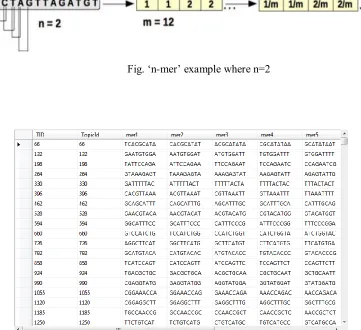
Fig. „n-mer‟ example where n=2
© 2014, IJCSMC All Rights Reserved 838
Above Table illustrates the top-ranked latent topics of different samples, in which the ID of latent topics are sorted by the probability with respect to different samples.
After this, illustrations of top-ranked latent topics with respect to different microbial samples will be done.
Commonly shared top-ranked latent topics for three different sample categories will be shown.
Gene functional Analysis
V.
Feature Work: Online Generative Topic Modeling
© 2014, IJCSMC All Rights Reserved 839
the past improved the quality of the document modeling. We also found that the role of history varies according to the domain and nature of text data.
VI. CONCLUSIONS
In this paper, a set of novel probabilistic topic models have been proposed to address challenging issues text mining and bioinformatics studies. The contributions are as follows. In this section, we conduct a generative topic modeling experiment for taxonomic analysis. Following the methods in Section, we apply the LDA topic model to the taxon abundance data of human gut microbial samples. The human gut microbial community taxon abundance data is generated by [4], which is openly accessible via: http://gutmeta.genomics.org.cn/. According to [4], the Illumina GA reads from human gut microbial samples are firstly assembled into longer contigs. After that, the MetaGene program was used to predict open reading frames (ORFs) from those contigs. The predicted ORFs were then aligned to each other and grouped to a non-redundant gene set. The gene taxonomic assignment is achieved by carrying out BLASTP alignment against the NR database. The taxonomical level of each gene is determined by the lowest common ancestor (LCA). As a result of gene taxonomic assignment, the taxon abundance data for each sample can be produced.
ACKNOWLEDGEMENTS
I wish to thank Dr S.N.Deshmukh (Dept of computer science and IT.Dr.B.A.M.University Aurangabad) for suggesting this area of research to me and guiding me throughout this work. I am indebted for many helpful suggestions.
REFERENCES
[1] Xin Chen, Xiaohua Hu, Y. Lim, Xiajiong Shen, E.K. Park and Gail L. Rosen, Member
Exploiting the Functional and Taxonomic Structure of Genomic Data by Probabilistic Topic
Modeling pp. 980-99 Issue Date: July 2012
[2] Huson D., Auch A., Qi J., Schuster S., MEGAN analysis of metagenomic data, Genome
research 2007
[3] Blei D., Ng A.. and Jordan M.. Latent dirichlet allocation. Journal of Machine Learning
Research, 3:993 1022, 2003
[4] Qin J et al. A human gut microbial gene catalogue established by met genomic sequencing
Nature. 2010 Mar 4; 464(7285):59-65
[5] Zheng B., Mclean D. C., and Lu X., Identifying biological concepts from a protein-related
© 2014, IJCSMC All Rights Reserved 840