Linguistic features in data-driven dependency parsing
Lilja Øvrelid NLP-unit, Dept. of Swedish
University of Gothenburg Sweden
Abstract
This article investigates the effect of a set of linguistically motivated features on ar-gument disambiguation in data-driven de-pendency parsing of Swedish. We present results from experiments with gold stan-dard features, such as animacy, definite-ness and finitedefinite-ness, as well as correspond-ing experiments where these features have been acquired automatically and show significant improvements both in overall parse results and in the analysis of specific argument relations, such as subjects, ob-jects and predicatives.
1 Introduction
Data-driven dependency parsing has recently re-ceived extensive attention in the parsing commu-nity and impressive results have been obtained for a range of languages (Nivre et al., 2007). Even with high overall parsing accuracy, however, data-driven parsers often make errors in the assign-ment of arguassign-ment relations such as subject and object and the exact influence of data-derived fea-tures on the parsing accuracy for specific linguistic constructions is still relatively poorly understood. There are a number of studies that investigate the influence of different features or representational choices on overall parsing accuracy, (Bod, 1998; Klein and Manning, 2003). There are also attempts at a more fine-grained analysis of accuracy, target-ing specific ltarget-inguistic constructions or grammati-cal functions (Carroll and Briscoe, 2002; K ¨ubler and Proki´c, 2006; McDonald and Nivre, 2007).
c
2008. Licensed under the Creative Commons
Attribution-Noncommercial-Share Alike 3.0 Unported
li-cense (http://creativecommons.org/licenses/by-nc-sa/3.0/). Some rights reserved.
But there are few studies that combine the two per-spectives and try to tease apart the influence of dif-ferent features on the analysis of specific construc-tions, let alone motivated by a thorough linguistic analysis.
In this paper, we investigate the influence of a set of linguistically motivated features on parse re-sults for Swedish, and in particular on the analysis of argument relations such as subjects, objects and subject predicatives. Motivated by an error anal-ysis of the best performing parser for Swedish in the CoNLL-X shared task, we extend the feature model employed by the parser with a set of lin-guistically motivated features and go on to show how these features may be acquired automatically. We then present results from corresponding parse experiments with automatic features.
The rest of the paper is structured as follows. In section 2 we present relevant properties of Swedish morphosyntax, as well as the treebank and parser employed in the experiments. Section 3 presents an error analysis of the baseline parser and we go on to motivate a set of linguistic features in sec-tion 4, which are employed in a set of experiments with gold standard features, discussed in section 5. Section 6 presents the automatic acquisition of these features, with a particular focus on animacy classification and in section 7 we report parse ex-periments with automatic features.
2 Parsing Swedish
Before we turn to a description of the treebank and the parser used in the experiments, we want to point to a few grammatical properties of Swedish that will be important in the following:
Verb second (V2) Swedish is, like the majority of
declarative main clauses.
Word order variation Pretty much any
con-stituent may occupy the sentence-initial po-sition, but subjects are most common.
Limited case marking Nouns are only inflected
for genitive case. Personal pronouns dis-tinguish nominative and accusative case, but demonstratives and quantifying pronouns are case ambiguous (like nouns).
2.1 Treebank: Talbanken05
Talbanken05 is a Swedish treebank converted to dependency format, containing both written and spoken language (Nivre et al., 2006a).1 For each token, Talbanken05 contains information on word form, part of speech, head and dependency rela-tion, as well as various morphosyntactic and/or lexical semantic features. The nature of this ad-ditional information varies depending on part of speech:
NOUN: definiteness, animacy, case (Ø/GEN)
PRO: animacy, case (Ø/ACC)
VERB: tense, voice (Ø/PA)
2.2 Parser: MaltParser
We use the freely available MaltParser,2 which is a language-independent system for data-driven dependency parsing. MaltParser is based on a deterministic parsing strategy, first proposed by Nivre (2003), in combination with treebank-induced classifiers for predicting the next parsing action. Classifiers can be trained using any ma-chine learning approach, but the best results have so far been obtained with support vector machines, using LIBSVM (Chang and Lin, 2001). Malt-Parser has a wide range of parameters that need to be optimized when parsing a new language. As our baseline, we use the settings optimized for Swedish in the CoNLL-X shared task (Nivre et al., 2006b), where this parser was the best perform-ing parser for Swedish. The only parameter that will be varied in the later experiments is the fea-ture model used for the prediction of the next pars-ing action. Hence, we need to describe the feature model in a little more detail.
MaltParser uses two main data structures, a stack (S) and an input queue (I), and builds a de-pendency graph (G) incrementally in a single
left-1The written sections of the treebank consist of
profes-sional prose and student essays and amount to 197,123 run-ning tokens, spread over 11,431 sentences.
2
http://w3.msi.vxu.se/users/nivre/research/MaltParser.html
FORM POS DEP FEATS
S:top + + + +
S:top+1 +
I:next + + +
I:next−1 + +
I:next+1 + + +
I:next+2 +
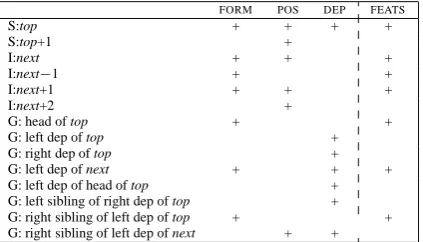
[image:2.595.312.524.43.164.2]G: head of top + + G: left dep of top + G: right dep of top + G: left dep of next + + + G: left dep of head of top + G: left sibling of right dep of top + G: right sibling of left dep of top + + G: right sibling of left dep of next + +
Table 1: Baseline and extended (FEATS) feature model for Swedish; S: stack, I: input, G: graph;
±n=npositions to the left(−) or right (+)
to-right pass over the input. The decision that needs to be made at any point during this deriva-tion is (a) whether to add a dependency arc (with some label) between the token on top of the stack (top) and the next token in the input queue (next), and (b) whether to pop top from the stack or push
next onto the stack. The features fed to the
classi-fier for making these decisions naturally focus on attributes of top, next and neighbouring tokens in S, I or G. In the baseline feature model, these at-tributes are limited to the word form (FORM), part
of speech (POS), and dependency relation (DEP) of a given token, but in later experiments we will add other linguistic features (FEATS). The baseline
fea-ture model is depicted as a matrix in Table 1, where rows denote tokens in the parser configuration (de-fined relative to S, I and G) and columns denote attributes. Each cell containing a+corresponds to a feature of the model.
3 Baseline and Error Analysis
The written part of Talbanken05 was parsed em-ploying the baseline feature model detailed above, using 10-fold cross validation for training and test-ing. The overall result for unlabeled and labeled dependency accuracy is 89.87 and 84.92 respec-tively.3
Error analysis shows that the overall most fre-quent errors in terms of dependency relations in-volve either various adverbial relations, due to PP-attachment ambiguities and a large number of
ad-3Note that these results are slightly better than the official
Gold Sys before after Total
SS OO 103 (23.1%) 343 (76.9%) 446 (100%)
OO SS 103 (33.3%) 206 (66.7%) 309 (100%)
Table 2: Position relative to verb for confused sub-jects and obsub-jects
verbial labels, or the argument relations, such as subjects, direct objects, formal subjects and sub-ject predicatives. In particular, confusion of argu-ment relations are among the most frequent error types with respect to dependency assignment.4
Swedish exhibits some ambiguities in word or-der and morphology which follow from the proper-ties discussed above. We will exemplify these fac-tors through an analysis of the errors where sub-jects are assigned object status (SS OO) and vice versa (OO SS). The confusion of subjects and ob-jects follows from lack of sufficient formal disam-biguation, i.e., simple clues such as word order, part-of-speech and word form do not clearly indi-cate syntactic function.
With respect to word order, subjects and objects may both precede or follow their verbal head. Sub-jects, however, are more likely to occur prever-bally (77%), whereas objects typically occupy a postverbal position (94%). We would therefore ex-pect postverbal subjects and preverbal objects to be more dominant among the errors than in the tree-bank as a whole (23% and 6% respectively). Table 2 shows a breakdown of the errors for confused subjects and objects and their position with respect to the verbal head. We find that postverbal subjects (after) are in clear majority among the subjects er-roneously assigned the object relation. Due to the V2 property of Swedish, the subject must reside in the position directly following the finite verb whenever another constituent occupies the prever-bal position, as in (1) where a direct object resides sentence-initially:
(1) Samma
same
erfarenhet
experience
gjorde
made
engelsm¨annen englishmen-DEF
‘The same experience, the Englishmen had’
For the confused objects we find a larger propor-tion of preverbal elements than for subjects, which
4
We define argument relations as dependency relations which obtain between a verb and a dependent which is subcategorized for and/or thematically entailed by the verb. Note that arguments are not distinguished structurally from non-arguments, like adverbials, in dependency grammar, but through dependency label.
is the mirror image of the normal distribution of syntactic functions among preverbal elements. As Table 2 shows, the proportion of preverbal ele-ments among the subject-assigned objects (33.3%) is notably higher than in the corpus as a whole, where preverbal objects account for a miniscule 6% of all objects.
In addition to the word order variation dis-cussed above, Swedish also has limited morpho-logical marking of syntactic function. Nouns are marked only for genitive case and only pronouns are marked for accusative case. There is also syn-cretism in the pronominal paradigm where the pro-noun is invariant for case, e.g. det, den ‘it’,
in-gen/inga ‘no’, and may, in fact, also function as
a determiner. This means that, with respect to word form, only the set of unambiguous pronouns clearly indicate syntactic function. In the errors, we find that nouns and functionally ambiguous pronouns dominate the errors where subjects and objects are confused, accounting for 84.5% of the
SS OOand 93.5% of theOO SSerrors.
The initial error analysis shows that the confu-sion of argument relations constitutes a frequent and consistent error during parsing. Ambiguities in word order and morphological marking consti-tute a complicating factor and we find cases that deviate from the most frequent word order pat-terns and are not formally disambiguated by part-of-speech information. It is clear that we in order to resolve these ambiguities have to examine fea-tures beyond syntactic category and linear word or-der.
4 Linguistic features for argument disambiguation
Talbanken05 – subjects are more often pronominal (49.2%), whereas objects and subject predicatives are typically realized by an indefinite noun (67.6% and 89.6%, respectively). As mentioned in section 2, there are categorical constraints which are char-acteristic for Swedish morphosyntax. Even if the morphological marking of arguments in Scandina-vian is not extensive or unambiguous, case may distinguish arguments. Only subjects may follow a finite verb and precede a non-finite verb and only complements may follow a non-finite verb. Infor-mation on tense or the related finiteness is there-fore something that one might assume to be ben-eficial for argument analysis. Another property of the verb which clearly influences the assignment of core argument functions is the voice of the verb, i.e., whether it is passive or active.5
5 Experiments with gold standard features
We perform a set of experiments with an extended feature model and added, gold standard informa-tion on animacy, definiteness, case, finiteness and voice, where the features were employed individu-ally as well as in combination.
5.1 Experimental methodology
All parsing experiments are performed using 10-fold cross-validation for training and testing on the entire written part of Talbanken05. The ture model used throughout is the extended fea-ture model depicted in Table 1, including all four columns.6 Hence, what is varied in the exper-iments is only the information contained in the
FEATSfeatures (animacy, definiteness, etc.), while the tokens for which these features are defined re-mains constant. Overall parsing accuracy will be reported using the standard metrics of labeled
at-tachment score (LAS) and unlabeled atat-tachment score (UAS).7 Statistical significance is checked using Dan Bikel’s randomized parsing evaluation
5
We experimented with the use of tense as well as finite-ness, a binary feature which was obtained by a mapping from tense to finite/non-finite. Finiteness gave significantly better results (p<.03) and was therefore employed in the following, see (Øvrelid, 2008b) for details.
6
Preliminary experiments showed that it was better to tie
FEATSfeatures to the same tokens asFORMfeatures (rather than POS or DEP features). Backward selection from this model was tried for several different instantiations ofFEATS
but with no significant improvement. 7
LAS and UAS report the percentage of tokens that are as-signed the correct head with (labeled) or without (unlabeled) the correct dependency label, calculated using eval.pl with de-fault settings (http://nextens.uvt.nl/∼conll/software.html)
comparator.8 Since the main focus of this article is on the disambiguation of grammatical functions, we report accuracy for specific dependency rela-tions, measured as a balanced F-score.
5.2 Results
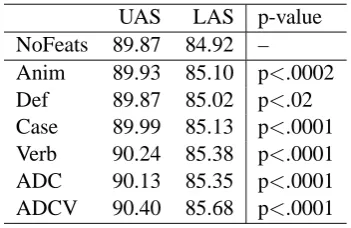
The overall results for these experiments are pre-sented in table 3, along with p-scores. The exper-iments show that each feature individually causes a significant improvement in terms of overall la-beled accuracy as well as performance for argu-ment relations. Error analysis comparing the base-line parser (NoFeats) with new parsers trained with individual features reveal the influence of these features on argument disambiguation. We find that animacy influences the disambiguation of sub-jects from obsub-jects, obsub-jects from indirect obsub-jects as well as the general distinction of arguments from non-arguments. Definiteness has a notable effect on the disambiguation of subjects and sub-ject predicatives. Information on morphological case shows a clear effect in distinguishing between arguments and non-arguments, and in particular, in distinguishing nominal modifiers with genitive case. The added verbal features, finiteness and voice, have a positive effect on the verbal depen-dency relations, as well as an overall effect on the assignment of the SS and OO argument relations. Information on voice also benefits the relation ex-pressing the demoted agent (AG) in passive con-structions, headed by the preposition av ‘by’, as in English.
The ADCV experiment which combines infor-mation on animacy, definiteness, case and verbal features shows a cumulative effect of the added features with results which differ significantly from the baseline, as well as from each of the in-dividual experiments (p<.0001). We observe clear improvements for the analysis of all argument re-lations, as shown by the third column in table 4 which presents F-scores for the various argument relations.
6 Acquiring features
A possible objection to the general applicability of the results presented above is that the added information consists of gold standard annotation from a treebank. However, the morphosyntactic features examined here (definiteness, case, tense, voice) represent standard output from most part-of-speech taggers. In the following we will also
8
UAS LAS p-value NoFeats 89.87 84.92 – Anim 89.93 85.10 p<.0002 Def 89.87 85.02 p<.02 Case 89.99 85.13 p<.0001 Verb 90.24 85.38 p<.0001 ADC 90.13 85.35 p<.0001 ADCV 90.40 85.68 p<.0001
Table 3: Overall results in gold standard ex-periments expressed as unlabeled and labeled attachment scores.
NoFeats Gold Auto
SS subject 90.25 91.80 91.32
OO object 84.53 86.27 86.10 SP subj.pred. 84.82 85.87 85.80
AG pass. agent 73.56 81.34 81.02
ES logical subj. 71.82 73.44 72.60 FO formal obj. 56.68 65.64 65.38
VO obj. small clause 72.10 83.40 83.12
VS subj. small clause 58.75 65.56 68.75 FS formal subj. 71.31 72.10 71.31
[image:5.595.83.259.56.170.2]IO indir. obj. 76.14 77.76 76.29
Table 4: F-scores for argument relations with combined features (ADCV).
Feature Application
Definiteness POS-tagger
Case POS-tagger
Animacy -NN Animacy classifier Animacy -PN Named Entity Tagger Animacy -PO Majority class Tense (finiteness), voice POS-tagger
Table 5: Overview of applications employed for automatic feature acquisition.
show that the property of animacy can be fairly robustly acquired for common nouns by means of distributional features from an automatically parsed corpus.
Table 5 shows an overview of the applications employed for the automatic acquisition of our lin-guistic features. For part-of-speech tagging, we employ MaltTagger – a HMM part-of-speech tag-ger for Swedish (Hall, 2003). The POS-tagtag-ger dis-tinguishes tense and voice for verbs, nominative and accusative case for pronouns, as well as defi-niteness and genitive case for nouns.
6.1 Animacy
The feature of animacy is clearly the most chal-lenging feature to acquire automatically. Recall that Talbanken05 distinguishes animacy for all nominal constituents. In the following we describe the automatic acquisition of animacy information for common nouns, proper nouns and pronouns.
Common nouns Table 6 presents an overview of the animacy data for common nouns in Tal-banken05. It is clear that the data is highly skewed
Class Types Tokens covered
Animate 644 6010
Inanimate 6910 34822
[image:5.595.325.505.247.304.2]Total 7554 40832
Table 6: The animacy data set from Talbanken05; number of noun lemmas (Types) and tokens in each class.
towards the non-person class, which accounts for 91.5% of the data instances. Due to the small size of the treebank we classify common noun
lem-mas based on their morphosyntactic distribution
in a considerably larger corpus. For the animacy classification of common nouns, we construct a general feature space for animacy classification, which makes use of distributional data regarding syntactic properties of the noun, as well as various morphological properties. The syntactic and mor-phological features in the general feature space are presented below:
Syntactic features A feature for each dependency
relation with nominal potential: (transitive) subject (SUBJ), object (OBJ), prepositional
complement (PA), root (ROOT)9, apposition (APP), conjunct (CC), determiner (DET), pred-icative (PRD), complement of comparative
subjunction (UK). We also include a feature for the complement of a genitive modifier, the so-called ‘possessee’, (GENHD).
Morphological features A feature for each
mor-9
phological distinction relevant for a noun: gender (NEU/UTR), number (SIN/PLU), defi-niteness (DEF/IND), case (NOM/GEN). Also,
the part-of-speech tags distinguish dates (DAT) and quantifying nouns (SET), e.g. del,
rad ‘part, row’, so these are also included as
features.
For extraction of distributional data for the Tal-banken05 nouns we make use of the Swedish Pa-role corpus of 21.5M tokens.10 To facilitate feature extraction, we part-of-speech tag the corpus and parse it with MaltParser, which assigns a depen-dency analysis.11 For classification, we make use of the Tilburg Memory-Based Learner (TiMBL) (Daelemans et al., 2004).12 and optimize the TiMBL parameters on a subset of the full data set.13
We obtain results for animacy classification of noun lemmas, ranging from 97.3% accuracy to 94.0% depending on the sparsity of the data. With an absolute frequency threshold of 10, we obtain an accuracy of 95.4%, which constitutes a 50% reduction of error rate over a majority baseline. We find that classification of the inanimate class is quite stable throughout the experiments, whereas the classification of the minority class of animate nouns suffers from sparse data. We obtain a F-score of 71.8% F-F-score for the animate class and 97.5% for the inanimate class with a threshold of 10. The common nouns in Talbanken05 are classi-fied for animacy following a leave-one-out training and testing scheme where each of then nouns in Talbanken05 are classified with a classifier trained onn−1instances. This ensures that the training and test instances are disjoint at all times. More-over, the fact that the distributional data is taken from a separate data set ensures non-circularity
10Parole is available at http://spraakbanken.gu.se 11
For part-of-speech tagging, we employ the MaltTagger – a HMM part-of-speech tagger for Swedish (Hall, 2003). For parsing, we employ MaltParser with a pretrained model for Swedish, which has been trained on the tags output by the tagger. It makes use of a smaller set of dependency relations than those found in Talbanken05.
12
TiMBL is freely available at
http://ilk.uvt.nl/software.html 13
For parameter optimization we employ the paramsearch tool, supplied with TiMBL, see http://ilk.uvt.nl/software.html. Paramsearch implements a hill climbing search for the optimal settings on iteratively larger parts of the supplied data. We performed parameter optimization on 20% of the total >0 data set, where we balanced the data with respect to frequency. The resulting settings arek= 11, GainRatio feature weighting and Inverse Linear (IL) class voting weights.
since we are not basing the classification on gold standard parses.
Proper nouns In the task of named entity recog-nition (NER), proper nouns are classified accord-ing to a set of semantic categories. For the annota-tion of proper nouns, we make use of a named en-tity tagger for Swedish (Kokkinakis, 2004), which is a rule-based tagger based on finite-state rules, supplied with name lists, so-called “gazetteers”. The tagger distinguishes the category ‘Person’ for human referring proper nouns and we extract in-formation on this category.
Pronouns A subset of the personal pronouns in Scandinavian, as in English, clearly distinguish their referent with regard to animacy, e.g. han,
det ‘he, it’. There is, however, a quite large group
of third person plural pronouns which are ambigu-ous with regards to the animacy of their referent, e.g., de, dem, deras ‘they, them, theirs’. Pronom-inal reference resolution is a complex task which we will not attempt to solve in the present context. The pronominal of-speech tags from the part-of-speech tagger distinguish number and gender and in the animacy classification of the personal pronouns we classify based on these tags only. We employ a simple heuristic where the pronominal tags which had more than 85% human instances in the gold standard are annotated as human.14 The pronouns which are ambiguous with respect to an-imacy are not annotated as animate.
In table 7 we see an overview of the accuracy of the acquired features, i.e., the percentage of correct instances out of all instances. Note that we adhere to the general annotation strategy in Talbanken05, where each dimension (definiteness, case etc.) contains a null category Ø, which ex-presses the lack of a certain property. The acqui-sition of the morphological features (definiteness, case, finiteness and voice) are very reliable, with accuracies from 96.9% for voice to 98.5% for the case feature.
It is not surprising that we observe the largest discrepancies from the gold standard annotation in the automatic animacy annotation. In general, the annotation of animate nominals exhibits a de-cent precision (95.7) and a lower recall (61.3). The automatic classification of human common nouns
14
Dimension Features Instances Correct Accuracy Definiteness DD,Ø 40832 40010 98.0
Case GG,AA,Ø 68313 67289 98.5
AnimacyNNP NP O HH,Ø 68313 61295 89.7 AnimacyNN HH,Ø 40832 37952 92.9
AnimacyP N HH,Ø 2078 1902 91.5
AnimacyP O HH,Ø 25403 21441 84.4
Finiteness FV,Ø 30767 30035 97.6
[image:7.595.87.276.207.334.2]Voice PA,Ø 30767 29805 96.9
Table 7: Accuracy for automatically acquired linguistic features.
Gold Automatic
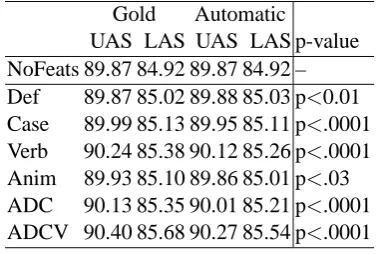
UAS LAS UAS LAS p-value NoFeats 89.87 84.92 89.87 84.92 – Def 89.87 85.02 89.88 85.03 p<0.01 Case 89.99 85.13 89.95 85.11 p<.0001 Verb 90.24 85.38 90.12 85.26 p<.0001 Anim 89.93 85.10 89.86 85.01 p<.03 ADC 90.13 85.35 90.01 85.21 p<.0001 ADCV 90.40 85.68 90.27 85.54 p<.0001
Table 8: Overall results in experiments with auto-matic features compared to gold standard features.
(AnimacyNN) also has a quite high precision (94.2) in combination with a lower recall (55.5). The named-entity recognizer (AnimacyP N) shows more balanced results with a precision of 97.8 and a recall of 85.2 and the heuristic classification of the pronominal part-of-speech tags (AnimacyP O) gives us high precision (96.3) combined with lower recall (62.0) for the animate class.
7 Experiments with acquired features
The experimental methodology is identical to the one described in 5.1 above, the only difference be-ing that the lbe-inguistic features are acquired auto-matically, rather than being gold standard. In order to enable a direct comparison with the results from the earlier experiments, we employ the gold stan-dard part-of-speech tags, as before. This means that the set for which the various linguistic features are defined is identical, whereas the feature values may differ.
Table 8 presents the overall results with auto-matic features, compared to the gold standard re-sults and p-scores for the difference of the auto-matic results from the NoFeats baseline. As
ex-pected, we find that the effect of the automatic fea-tures is generally lower than their gold standard counterparts. However, all automatic features im-prove significantly on the NoFeats baseline. In the error analysis we find the same tendencies in terms of improvement for specific dependency relations. The morphological argument features from the POS-tagger are reliable, as we saw above, and we observe almost identical results to the gold standard results. The addition of information on definiteness causes a significant improvement (p<.01), and so does the addition of information on case (p<.0001). The addition of the automat-ically acquired animacy information results in a smaller, but significant improvement of overall re-sults even though the annotation is less reliable (p<.03). An interesting result is that the automat-ically acquired information on animacy for com-mon nouns actually has a significantly better effect than the gold standard counterparts due to captur-ing distributional tendencies (Øvrelid, 2008a). As in the gold standard experiments, we find that the features which have the most notable effect on per-formance are the verbal features (p<.0001).
8 Conclusion
An error analysis of the best performing data-driven dependency parser for Swedish revealed consistent errors in dependency assignment, namely the confusion of argument functions. We established a set of features expressing distinguish-ing semantic and structural properties of argu-ments such as animacy, definiteness and finiteness and performed a set of experiments with gold stan-dard features taken from a treebank of Swedish. The experiments showed that each feature individ-ually caused an improvement in terms of overall la-beled accuracy and performance for the argument relations. We furthermore found that the results may largely be replicated with automatic features and a generic part-of-speech tagger. The features were acquired automatically employing a part-of-speech tagger, a named-entity recognizer and an animacy classifier of common noun lemmas em-ploying morphosyntactic distributional features. A set of corresponding experiments with automatic features gave significant improvement from the ad-dition of individual features and a cumulative ef-fect of the same features in combination. In partic-ular, we show that the very same tendencies in im-provement for specific argument relations such as subjects, objects and predicatives may be obtained using automatically acquired features.
Properties of the Scandinavian languages con-nected with errors in argument assignment are not isolated phenomena. A range of other languages exhibit similar properties, for instance, Italian ex-hibits word order variation, little case, syncretism in agreement morphology, as well as pro-drop; German exhibits a larger degree of word order variation in combination with quite a bit of syn-cretism in case morphology; Dutch has word order variation, little case and syncretism in agreement morphology. These are all examples of other lan-guages for which the results described here are rel-evant.
References
Bod, Rens. 1998. Beyond Grammar: An experience-based
theory of language. CSLI Publications, Stanford, CA.
Carroll, John and Edward Briscoe. 2002. High precision ex-traction of grammatical relations. In Proceedings of the
19th International Conference on Computational Linguis-tics (COLING), pages 134–140.
Chang, Chih-Chung and Chih-Jen Lin. 2001. LIBSVM: A library for support vector machines. Software available at http://www.csie.ntu.edu.tw/∼cjlin/libsvm.
Daelemans, Walter, Jakub Zavrel, Ko Van der Sloot, and An-tal Van den Bosch. 2004. TiMBL: Tilburg Memory Based Learner, version 5.1, Reference Guide. Technical report, ILK Technical Report Series 04-02.
de Swart, Peter, Monique Lamers, and Sander Lestrade. 2008. Animacy, argument structure and argument encod-ing: Introduction to the special issue on animacy. Lingua, 118(2):131–140.
Hall, Johan. 2003. A probabilistic part-of-speech tagger with suffix probabilities. Master’s thesis, V¨axj¨o Univer-sity, Sweden.
Klein, Dan and Christopher D. Manning. 2003. Accurate unlexicalized parsing. In Proceedings of the 41st Annual
Meeting of the Association for Computational Linguistics (ACL), pages 423–430.
Kokkinakis, Dimitrios. 2004. Reducing the effect of name explosion. In Proceedings of the LREC Workshop:
Be-yond Named Entity Recognition, Semantic labelling for NLP tasks.
K¨ubler, Sandra and Jelena Proki´c. 2006. Why is German de-pendency parsing more reliable than constituent parsing? In Proceedings of the Fifth Workshop on Treebanks and
Linguistic Theories (TLT), pages 7–18.
McDonald, Ryan and Joakim Nivre. 2007. Characterizing the errors of data-driven dependency parsing. In
Proceed-ings of the Eleventh Conference on Computational Natural Language Learning (CoNLL), pages 122–131.
Nivre, Joakim, Jens Nilsson, and Johan Hall. 2006a. Tal-banken05: A Swedish treebank with phrase structure and dependency annotation. In Proceedings of the fifth
Inter-national Conference on Language Resources and Evalua-tion (LREC), pages 1392–1395.
Nivre, Joakim, Jens Nilsson, Johan Hall, G¨uls¸en Eryiˇgit, and Svetoslav Marinov. 2006b. Labeled pseudo-projective dependency parsing with Support Vector Machines. In
Proceedings of the Conference on Computational Natural Language Learning (CoNLL).
Nivre, Joakim, Johan Hall, Sandra K¨ubler, Ryan McDon-ald, Jens Nilsson, Sebastian Riedel, and Deniz Yuret. 2007. CoNLL 2007 Shared Task on Dependency Pars-ing. In Proceedings of the CoNLL Shared Task Session of
EMNLP-CoNLL 2007, pages 915–932.
Øvrelid, Lilja. 2008a. Argument Differentiation. Soft
con-straints and data-driven models. Ph.D. thesis, University
of Gothenburg.
Øvrelid, Lilja. 2008b. Finite matters: Verbal features in data-driven parsing of Swedish. In Proceedings of the
Interna-tional Conference on NLP, GoTAL 2008.
Weber, Andrea and Karin M¨uller. 2004. Word order varia-tion in German main clauses: A corpus analysis. In