576
Improving Dialogue State Tracking by Discerning the Relevant Context
Sanuj Sharma, Prafulla Kumar Choubey, Ruihong Huang Department of Computer Science and Engineering
Texas A&M University
(sanuj, prafulla.choubey, huangrh)@tamu.edu
Abstract
A typical conversation comprises of multi-ple turns between participants where they go back-and-forth between different topics. At each user turn, dialogue state tracking (DST) aims to estimate user’s goal by processing the current utterance. However, in many turns, users implicitly refer to the previous goal, ne-cessitating the use of relevant dialogue history. Nonetheless, distinguishing relevant history is challenging and a popular method of using dia-logue recency for that is inefficient. We, there-fore, propose a novel framework for DST that identifies relevant historical context by refer-ring to the past utterances where a particular slot-value changes and uses that together with weighted system utterance to identify the rel-evant context. Specifically, we use the cur-rent user utterance and the most recent sys-tem utterance to determine the relevance of a system utterance. Empirical analyses show that our method improves joint goal accuracy by 2.75% and 2.36% on WoZ 2.0 and Mul-tiWoZ 2.0 restaurant domain datasets respec-tively over the previous state-of-the-art GLAD model.
1 Introduction
Dialog state tracking (DST) is a vital component in the task-oriented dialog systems which is used to estimate user’s goals and requests in order to plan next action and respond accordingly. At each turn, DST aims to identify the set of goals that a user aims to achieve and requests that are repre-sented as slot-value pairs. Typically, this decision is made by considering user utterance in the cur-rent turn or system actions in the previous turn. However, in many cases, the considered user ut-terance or system actions do not present enough information and refers to a previous utterance.
As shown through an example in Figure 1, while exploring different available options, user
User: hello, i'm looking for a restaurant with fair prices
System: There are 31 places with moderate price range. Can you please tell me what kind of food you would like?
Sys Act: food
Turn Label: price range = moderate
User: well I want to eat in the North, what's up that way?
System: I have two options that fit that description, Golden Wok chinese restaurant and Nirala which serves Indian food. Do you have a preference?
Sys Act: food
Turn Label: area = north
User: Can I have the address and phone number for the Golden Wok chinese restaurant?
System: The phone number is 01223 350688.
Turn Label: request = address, phone; food = chinese
User: thank you. what is the address?
System: The address is 191 Histon Road Chesterton.
Turn Label: request = address
User: Okay, what about Nirala, what's the address and phone of that?
System: 7 Milton Road Chesterton and the number is 01223 360966
Turn Label: request = address, phone; food = indian
Figure 1: An example dialog from WoZ 2.0 dataset. A turn contains user utterance (blue), system utterance (red), system actions (yellow) and turn label (green). Each turn is separated by a line.
can go back-and-forth between the currently and previously discussed facts. For instance, when offered with two different restaurant options
namely Nirala (food=indian) and Golden
Wok(food=chinese)in the second turn, user first inquires about the details ofGolden Wok. And after getting relevant details about theGolden Wok
in the following two turns, user refers back to the second option provided in second turn and asks about Nirala restaurant. To predict the correct slot-value pairfood=indianin the dialog state of the fifth turn, the system is required to refer back to the second turn again to find information aboutNirala, as the context obtained from the cur-rent dialog turn is insufficient.
not local and most recent turns are often not in-formative. Therefore, the traditional approach of modeling dialogue recency (El Asri et al., 2017) may not suffice. Instead, we propose to model im-plicit references by storing links to the past turn where each of the slots was modified. Then at each turn, we look up though the stored links to find the previous turn which may provide additional cues for predicting the appropriate slot-value.
Moreover, the dialogue system often asks polar questions with yes-no answers. For instance, the DST system should update the dialogue state with food=indianwhen a user repliesYesto a sys-tem utteranceDo you want Indian food?. In such cases, neither the user utterance nor system acts (food in this example) contain any information about the actual slot-value. This makes utilization of both system and user utterance eminent for dia-log state tracking. However, utilizing the previous system utterance together with the current user ut-terance always at each turn may add noise. There-fore, we use a gating mechanism based on both utterances to determine the relevance of the previ-ous system utterance in the current turn.
The evaluation shows that identifying the rele-vant context is essential for dialogue state track-ing. Our novel model that discerns important details in non-adjacent dialogue turns and the previous system utterance from a dialog history is able to improve the previous state-of-the-art GLAD (Zhong et al., 2018) model on all evalua-tion metrics for both WoZ and MultiWoZ (restau-rant) datasets. Furthermore, we empirically show that a simple self-attention based biLSTM model, using only one-third of the number of parameters as GLAD, outperforms GLAD by identifying and incorporating the relevant context.
2 Related Work
Early work for DST relied on separate Spoken Language Understanding (SLU) module ( Hender-son et al., 2012) to extract relevant information from user utterances in a pipelined approach. Such systems are prone to error accumulation from a separate SLU module, in absence of necessary dia-log context required to interpret the user utterance. Thus, later work on DST moved away from sepa-rate SLU modules and inferred the dialog state di-rectly from user utterance and dialog history ( Hen-derson et al.,2014b,c;Zilka and Jurcicek,2015). These models depend on delexicalization, using
generic tags to replace specific slot types and val-ues, and handcrafted semantic dictionaries. In practice, it is difficult to scale these models for every slot type and recent state-of-the-art mod-els for DST use deep learning based methods to learn general representations for user and system utterances and previous system actions, and pre-dict the turn state (Henderson et al.,2013,2014b;
Mrkˇsi´c et al., 2015, 2017; Hori et al., 2016; Liu and Lane, 2017; Dernoncourt et al., 2017; Chen et al., 2016). However, these systems are found to perform poorly on rare and unknown slot-value pairs which was recently addressed through lo-cal slot-specific encoders (Zhong et al.,2018) and pointer network (Xu and Hu,2018).
A crucial limitation to all these approaches lies in the modeling of appropriate historical context, which is simply ignored in most of the works. Since user’s goal may change back-and-forth be-tween previous values, incorporating relevant his-torical context is useful in monitoring implicit goal references. In a recent work,El Asri et al.(2017) discussed on similar limitations of current DST task and introduced a new task of frame tracking that explicitly tracks every slot-values that were introduced during the dialogue. However, that significantly complicates the task by maintaining multiple redundant frames that are often left un-referenced. Our proposed model, that explicitly track relevant historical user and system utter-ances, can be easily incorporated into any known DST or frame tracking systems such as Schulz et al.(2017) to replace the recency encoding.
3 Discerning Relevant Context for DST
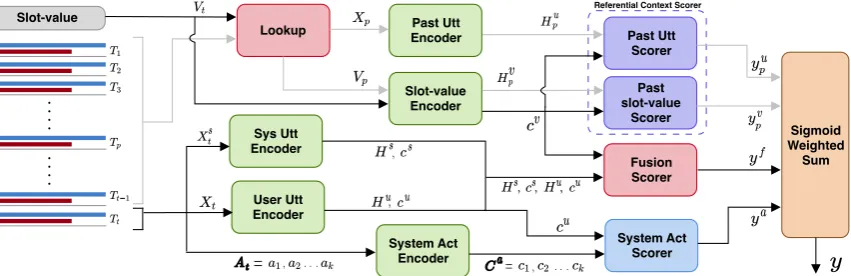
Similar to previous works, we decompose the multi-label classification problem to binary clas-sification where we score each slot-value pair and select the ones that receive a score above a thresh-old to be included in the current dialog state. To predict the score for a candidate slot-value pair, the model uses the relevant past user utterance (refer-ential utterance), a fused utterance composed us-ing the current user utterance and the system ut-terance of the previous turn, as well as previous system actions as evidence. Shown in Figure 2, our model comprises of:
Slot-value Encoder Slot-value
Lookup
Sigmoid Weighted
Sum
User Utt Encoder Sys Utt Encoder
Past Utt Encoder
System Act Encoder
Fusion Scorer
System Act Scorer Past Utt
Scorer
Past slot-value
Scorer
[image:3.595.89.515.62.200.2]Referential Context Scorer
Figure 2: The Architecture of Context Aware Dialogue State Tracker.
where the candidate slot-type was modified as well as outputs the previous slot-value.
GLE modules: Each of the five green modules in Figure2is a global-locally self-attentive encoder (GLE module) (Zhong et al.,2018) that encodes each type of evidence into a vector representation (c). Each input is represented as a sequence of words which is encoded to a vector representa-tion via global-local self-attentive encoder (GLE) module (Zhong et al., 2018). Specifically, GLE employs local slot-specific bidirectional LSTMs and a global bidirectional LSTM (Hochreiter and Schmidhuber,1997) that is shared across all slots for encoding the input sequence into a sequence of hidden states (H), followed by a self-attention layer (Lin et al.,2016) to obtain a fixed dimension vector representation (c).
The GLE modules are used to encode the an-tecedent user utterance (Hpu, cup), the current user utterance (Hu, cu), the previous system utterance
(Hs, cs), each of the system acts (Hai, cai), as well as the previous slot-value (Hpv, cvp) and the candidate (Hv, cv) slot-value.
Referential Context Scorer: uses the candidate slot value (cv), the antecedent user utterance as well as the previous slot-value to determine if the candidate slot value was referenced in the an-tecedent utterance. Specifically, the scorer uses the representation of the candidate slot value cv to attend over hidden states of the antecedent user utterance and the previous slot-value,HpuandHpv, and then computes attention weights for each of the hidden states. Next, the scorer sums up the hidden states weighed with the calculated atten-tions to get the summary context (Equation1). Fi-nally, the scorer applies a linear neural layer to calculate the scores ypv and ypu representing the likelihoods that the candidate slot-value is
differ-ent from the previous slot-value and the candidate slot-value was unreferenced in the antecedent ut-terance (Equation2).
Q(H, c) : aj = (Hj)>c; p=sof tmax(a)
Q(H, c) =X
i
piHi (1)
yup =WpuQ(Hpu, cv) +bup
yvp =Wpv Q(Hpv, cv) +bvp (2)
Fusion Scorer: leverages necessary details in the previous system utterance to enrich the current user utterance. First, we use a gating mechanism based oncsandcuthat determines the relevance of the previous system utterance in the current turn. We concatenatecs and cu and use a linear layer with sigmoid activation to calculate the score α (Equation3). Then, we use attention fromcv over HsandHuto calculate context summaries (ls, lu), and combine the summary vectors by taking their normalized weighted sum based onα. We finally apply a single linear layer to calculate the score yf that determines the likelihood of the candidate slot-value based on both the current user utterance and the previous system utterance (Equation4).
fc=Wf c(cs⊕cu) +bf c
α=σ(Wαtanh(fc) +bα)
(3)
ls=Q(Hs, cv) ; lu =Q(Hu, cv)
lf =αls+ (1−α)lu; yf =Wlflf +blf
(4)
slot-value based on the previous system actions (Equation5).
la=Q(Ca, cu) ; ya = (la)>cv (5)
It then calculates the final score of the candidate slot-value by taking weighted sum of the four scores (ypu, ypv, yf, ya) followed by a sigmoid layer, where weights are learned in the network.
4 Evaluations
4.1 Experimental Setup
We primarily use WoZ 2.0 (Wen et al., 2017) restaurant reservation task dataset that consists of 1200 dialogues for training and evaluation. Each dialogue has an average of eight turns, where each turn containssystem utterance transcript,user ut-terance transcript,turn labelandbelief state. All the dialogue states and actions are based on a task ontology that supports three different informable slot-types namelyprice rangewith 4 values,food
with 72 values,areawith 7 values, andrequestsof 7 different types likeaddressandphone. Follow-ing the standard settFollow-ings, we use 600 dialogues for training, 200 for validation and the remaining 400 for testing.
We also use dialogues from restaurant domain in MultiWoZ 2.0 dataset (Budzianowski et al.,
2018) for secondary evaluation. It banks on a significantly complex ontology covering seven informable slot types with 276 different values (food, price range, restaurant name, area, book time, book dayandbook peoplewith 97, 6, 105, 8, 43, 8 and 9 values respectively). We use standard training, validation and test splits of 1199, 50 and 61 dialogues respectively.
All the models on WoZ 2.0 are evaluated on the two standard metrics introduced inHenderson et al.(2014a). First, Joint Goal Accuracyis the percentage of turns in a dialogue where the user’s informed joint goals are identified correctly. Joint goals are accumulated turn goals up to the current dialog turn. Second,Turn Request Accuracy cal-culates the percentage of turns in a dialogue where the user’s requests were correctly identified. Mod-els on MultiWoZ 2.0 dataset are evaluated using joint goal and turn inform accuracies, as used by
Nouri and Hosseini-Asl(2018).
4.2 Implementation Details
We use pretrained GloVe word embeddings ( Pen-nington et al., 2014) concatenated with
charac-WoZ 2.0
Model Joint Goal Turn Request
Delexalisation-Based Model + SD 83.7% 87.6%
NBT - DNN 84.4% 91.2%
NBT - CNN 84.2% 91.6%
GLAD† 86.4% 97.1%
Global biLSTM based GLE 85.0% 96.8%
Global biLSTM based GLE + RC 87.4% 97.0%
Global biLSTM based GLE + RC + FS 88.4% 97.0%
GLAD + RC + FS 89.2% 97.4%
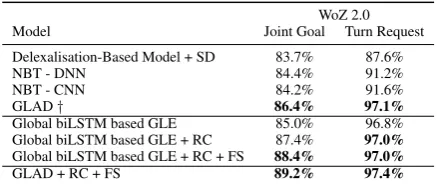
Table 1: Test accuracy of baselines and proposed models on WoZ 2.0 restaurant reservation dataset.
†Retrained using docker container provided by the au-thors with exactly same hyper-parameters. We also experimented with different versions of PyTorch and cuDNN and found that results had high variance. Therefore, we report the average performance over 5 runs with different initializations for GLAD and all our models.
MultiWoZ 2.0 (Restaurant)
Model Joint Goal Turn Inform
GLAD 43.95% 76.99%
GLAD + RC 45.72% 77.87%
[image:4.595.308.527.62.155.2]GLAD + RC + FS 46.31% 78.76%
Table 2: Test accuracy of GLAD and proposed models on MultiWoZ 2.0 restaurant domain dataset. Note that we considered all 276 slot-values for evaluating mod-els. Budzianowski et al.(2018) reported joint goal ac-curacy of 80.9 on MultiWoZ 2.0 (restaurant) dataset. We believe they didn’t includerestaurant nameslot in their evaluation and only considered presence of three slot-types—book time, book dayandbook people—and not their values.
ter n-gram embeddings (Hashimoto et al., 2017) which are kept fixed during the training. Each of bi-LSTMs use 200 hidden dimensions. All the models are trained using ADAM optimizer (Kingma and Ba, 2014) with the initial learning rate of 0.001. Dropout rate (Srivastava et al.,2014) is set to 0.2 for all biLSTM modules and the em-bedding layer. The models are trained for a max-imum of 100 epochs with a batch size of 50. The validation data was used for early stopping and hy-perparameter tuning.
4.3 Results
Table 1 compares the performance of our pro-posed models with different baselines, including
delexalisation-based model + SD (Wen et al.,
2017), DNN and CNN variants of neural be-lief tracker (Mrkˇsi´c et al., 2017) and the previ-ous state-of-the-art GLAD systems (Zhong et al.,
[image:4.595.309.524.288.342.2]Model Approx. # of parameters
Global biLSTM based GLE 1.2 million
Global biLSTM based GLE + RC + FS 6 million
GLAD 17 million
[image:5.595.75.290.63.119.2]GLAD + RC + FS 28 million
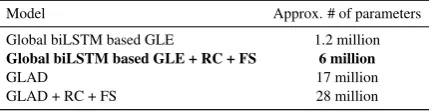
Table 3: Number of learnable parameters for different models on WoZ 2.0 dataset
based GLE, by removing slot-specific local biL-STMs from the GLE encoder. We then succes-sively combine it with referential context (Global biLSTM based GLE + RC) and the fused pre-vious system utterance (Global biLSTM based GLE + RC + FS). Finally, we directly incorpo-rate the referential context and gate selected sys-tem utterance into the GLAD syssys-tem (GLAD + RC + FS).
Irrespective of the underlying system, utilizing appropriate context from the previous turns im-proves the overall performance of a dialogue state tracker on both joint goal and turn request ac-curacies on WoZ 2.0 dataset. First, incorporat-ing relevant referential utterances to identify im-plicitly mentioned slot-value improves the accu-racy of global biLSTM based GLE model on joint goal task by 2.4%. Then, gating based mecha-nism to augment user utterance with relevant in-formation from the previous system utterance fur-ther improves the joint goal accuracy by 1.0%. To-gether, they improve joint goal and request accu-racy of the global biLSTM based GLE model by 3.4% and 0.2% respectively. Furthermore, as ev-ident from the results in Table2, both referential context and fused system utterance proportionally improve performance on MultiWoZ 2.0 dataset as well with overall improvement of 2.36% and 1.77% on joint goal and turn inform accuracies re-spectively. Performances of all models on Mul-tiWoZ 2.0 are significantly inferior compared to WoZ 2.0 owing to higher complexity, with richer and longer utterances and considerably more slot-values in the former dataset.
5 Analysis
The utilization of relevant context results in sig-nificant reduction in the number of learnable pa-rameters in the model as shown in Table3. Rel-evant context with the baseline model is able to outperform GLAD while using only one third of the number of learnable parameters. The param-eters added due to using relevant context are the
parameters for encoding the antecedent referential user utterance and the previous system utterance as well as the past utterance and past slot-value scorers. However, we also observe high variance in the joint goal accuracy. Since joint goal is calcu-lated by accumulating turn goals, an error in pre-dicting a turn goal is propagated to all the down-stream turns.
6 Conclusion
We have presented a novel method for identify-ing the relevant historical user utterance as well as determining the relevance of the system utter-ance from the last turn to enrich the current user utterance and improve goal tracking in dialogue systems. The experimental results show that dis-cerning relevant context from the dialog history is crucial for tracking dialog states.
Acknowledgments
We want to thank our anonymous reviewers for providing insightful review comments.
References
Paweł Budzianowski, Tsung-Hsien Wen, Bo-Hsiang Tseng, I˜nigo Casanueva, Stefan Ultes, Osman Ra-madan, and Milica Gasic. 2018. Multiwoz-a large-scale multi-domain wizard-of-oz dataset for task-oriented dialogue modelling. InProceedings of the 2018 Conference on Empirical Methods in Natural Language Processing, pages 5016–5026.
Yun-Nung Chen, Dilek Hakkani-T¨ur, G¨okhan T¨ur, Jianfeng Gao, and Li Deng. 2016. End-to-end mem-ory networks with knowledge carryover for multi-turn spoken language understanding. InInterspeech, pages 3245–3249.
Franck Dernoncourt, Ji Young Lee, Trung H Bui, and Hung H Bui. 2017. Robust dialog state tracking for large ontologies. InDialogues with Social Robots, pages 475–485. Springer.
Layla El Asri, Hannes Schulz, Shikhar Sharma, Jeremie Zumer, Justin Harris, Emery Fine, Rahul Mehrotra, and Kaheer Suleman. 2017. Frames: a corpus for adding memory to goal-oriented dialogue systems. InProceedings of the 18th Annual SIGdial Meeting on Discourse and Dialogue, pages 207– 219. Association for Computational Linguistics.
Matthew Henderson, Milica Gaˇsi´c, Blaise Thomson, Pirros Tsiakoulis, Kai Yu, and Steve Young. 2012. Discriminative spoken language understanding us-ing word confusion networks. In Spoken Lan-guage Technology Workshop (SLT), 2012 IEEE, pages 176–181. IEEE.
Matthew Henderson, Blaise Thomson, and Jason D Williams. 2014a. The third dialog state tracking challenge. InSpoken Language Technology Work-shop (SLT), 2014 IEEE, pages 324–329. IEEE.
Matthew Henderson, Blaise Thomson, and Steve Young. 2013. Deep neural network approach for the dialog state tracking challenge. InProceedings of the SIGDIAL 2013 Conference, pages 467–471. As-sociation for Computational Linguistics.
Matthew Henderson, Blaise Thomson, and Steve Young. 2014b. Word-based dialog state tracking with recurrent neural networks. In Proceedings of the 15th Annual Meeting of the Special Inter-est Group on Discourse and Dialogue (SIGDIAL), pages 292–299. Association for Computational Lin-guistics.
Matthew Henderson, Blaise Thomson, and Steve Young. 2014c. Word-based dialog state tracking with recurrent neural networks. In Proceedings of the 15th Annual Meeting of the Special Inter-est Group on Discourse and Dialogue (SIGDIAL), pages 292–299.
Sepp Hochreiter and J¨urgen Schmidhuber. 1997. Long short-term memory. Neural Comput., 9(8):1735– 1780.
Takaaki Hori, Hai Wang, Chiori Hori, Shinji Watanabe, Bret Harsham, Jonathan Le Roux, John R Hershey, Yusuke Koji, Yi Jing, Zhaocheng Zhu, et al. 2016. Dialog state tracking with attention-based sequence-to-sequence learning. In 2016 IEEE Spoken Lan-guage Technology Workshop (SLT), pages 552–558. IEEE.
Diederik P. Kingma and Jimmy Ba. 2014. Adam: A method for stochastic optimization. CoRR, abs/1412.6980.
Zhouhan Lin, Minwei Feng, Cicero Nogueira dos San-tos, Mo Yu, Bing Xiang, Bowen Zhou, and Yoshua Bengio. 2016. A structured self-attentive sentence embedding.
Bing Liu and Ian Lane. 2017. An end-to-end trainable neural network model with belief tracking for task-oriented dialog. arXiv preprint arXiv:1708.05956.
Nikola Mrkˇsi´c, Diarmuid ´O S´eaghdha, Blaise Thom-son, Milica Gasic, Pei-Hao Su, David Vandyke, Tsung-Hsien Wen, and Steve Young. 2015. Multi-domain dialog state tracking using recurrent neural networks. InProceedings of the 53rd Annual Meet-ing of the Association for Computational LMeet-inguistics and the 7th International Joint Conference on Natu-ral Language Processing (Volume 2: Short Papers),
pages 794–799. Association for Computational Lin-guistics.
Nikola Mrkˇsi´c, Diarmuid ´O S´eaghdha, Tsung-Hsien Wen, Blaise Thomson, and Steve Young. 2017. Neural belief tracker: Data-driven dialogue state tracking. InProceedings of the 55th Annual Meet-ing of the Association for Computational LMeet-inguistics (Volume 1: Long Papers), pages 1777–1788. Asso-ciation for Computational Linguistics.
Elnaz Nouri and Ehsan Hosseini-Asl. 2018. Toward scalable neural dialogue state tracking model. arXiv preprint arXiv:1812.00899.
Jeffrey Pennington, Richard Socher, and Christopher Manning. 2014. Glove: Global vectors for word representation. In Proceedings of the 2014 Con-ference on Empirical Methods in Natural Language Processing (EMNLP), pages 1532–1543. Associa-tion for ComputaAssocia-tional Linguistics.
Hannes Schulz, Jeremie Zumer, Layla El Asri, and Shikhar Sharma. 2017. A frame tracking model for memory-enhanced dialogue systems.arXiv preprint arXiv:1706.01690.
Nitish Srivastava, Geoffrey Hinton, Alex Krizhevsky, Ilya Sutskever, and Ruslan Salakhutdinov. 2014. Dropout: A simple way to prevent neural networks from overfitting. Journal of Machine Learning Re-search, 15:1929–1958.
Tsung-Hsien Wen, David Vandyke, Nikola Mrkˇsi´c, Milica Gasic, Lina M. Rojas Barahona, Pei-Hao Su, Stefan Ultes, and Steve Young. 2017. A network-based end-to-end trainable task-oriented dialogue system. InProceedings of the 15th Conference of the European Chapter of the Association for Compu-tational Linguistics: Volume 1, Long Papers, pages 438–449. Association for Computational Linguis-tics.
Puyang Xu and Qi Hu. 2018. An end-to-end approach for handling unknown slot values in dialogue state tracking. InProceedings of the 56th Annual Meet-ing of the Association for Computational LMeet-inguistics (Volume 1: Long Papers), pages 1448–1457. Asso-ciation for Computational Linguistics.
Victor Zhong, Caiming Xiong, and Richard Socher. 2018. Global-locally self-attentive encoder for dia-logue state tracking. InProceedings of the 56th An-nual Meeting of the Association for Computational Linguistics (Volume 1: Long Papers), pages 1458– 1467. Association for Computational Linguistics.