Does String-Based Neural MT Learn Source Syntax?
Xing Shi, Inkit Padhi, and Kevin Knight
Information Sciences Institute & Computer Science Department University of Southern California
[email protected], [email protected], [email protected]
Abstract
We investigate whether a neural, encoder-decoder translation system learns syntactic in-formation on the source side as a by-product of training. We propose two methods to de-tect whether the encoder has learned local and global source syntax. A fine-grained analy-sis of the syntactic structure learned by the encoder reveals which kinds of syntax are learned and which are missing.
1 Introduction
The sequence to sequence model (seq2seq) has been successfully applied to neural machine translation (NMT) (Sutskever et al., 2014; Cho et al., 2014) and can match or surpass MT state-of-art. Non-neural machine translation systems consist chiefly of phrase-based systems (Koehn et al., 2003) and syntax-based systems (Galley et al., 2004; Galley et al., 2006; DeNeefe et al., 2007; Liu et al., 2011; Cowan et al., 2006), the latter of which adds syntac-tic information to source side (tree-to-string), target side (string-to-tree) or both sides (tree-to-tree). As the seq2seq model first encodes the source sentence into a high-dimensional vector, then decodes into a target sentence, it is hard to understand and interpret what is going on inside such a procedure. Consider-ing the evolution of non-neural translation systems, it is natural to ask:
1. Does the encoder learn syntactic information about the source sentence?
2. What kind of syntactic information is learned, and how much?
3. Is it useful to augment the encoder with addi-tional syntactic information?
In this work, we focus on the first two questions and propose two methods:
• We create various syntactic labels of the source sentence and try to predict these syntactic la-bels with logistic regression, using the learned sentence encoding vectors (for sentence-level labels) or learned word-by-word hidden vectors (for word-level label). We find that the encoder captures both global and local syntactic infor-mation of the source sentence, and different in-formation tends to be stored at different layers.
• We extract the whole constituency tree of
source sentence from the NMT encoding vec-tors using a retrained linearized-tree decoder. A deep analysis on these parse trees indicates that much syntactic information is learned, while various types of syntactic information are still missing.
2 Example
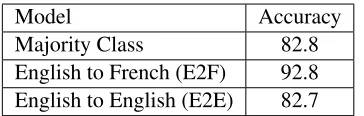
As a simple example, we train an English-French NMT system on 110M tokens of bilingual data (En-glish side). We then take 10K separate En(En-glish sen-tences and label theirvoiceas active or passive. We use the learned NMT encoder to convert these stences into 10k corresponding 1000-dimension en-coding vectors. We use 9000 sentences to train a logistic regression model to predict voice using the encoding cell states, and test on the other 1000 sen-tences. We achieve 92.8% accuracy (Table 2), far above the majority class baseline (82.8%). This means that in reducing the source sentence to a
Model Accuracy
Majority Class 82.8
[image:2.612.95.277.56.114.2]English to French (E2F) 92.8 English to English (E2E) 82.7
Table 1: Voice (active/passive) prediction accuracy using the encoding vector of an NMT system. The majority class baseline always chooses active.
fixed-length vector, the NMT system has decided to store the voice of English sentences in an easily ac-cessible way.
When we carry out the same experiment on an English-English (auto-encoder) system, we find that English voice information is no longer easily ac-cessed from the encoding vector. We can only pre-dict it with 82.7% accuracy, no better than chance. Thus, in learning to reproduce input English sen-tences, the seq2seq model decides to use the fixed-length encoding vector for other purposes.
3 Related work
Interpreting Recurrent Neural Networks. The
most popular method to visualize high-dimensional vectors, such as word embeddings, is to project them into two-dimensional space using t-SNE (van der Maaten and Hinton, 2008). Very few works try to interpret recurrent neural networks in NLP. Karpa-thy et al. (2016) use a character-level LSTM lan-guage model as a test-bed and find several activation cells that track long-distance dependencies, such as line lengths and quotes. They also conduct an er-ror analysis of the predictions. Li et al. (2016) ex-plore the syntactic behavior of an RNN-based sen-timent analyzer, including the compositionality of negation, intensification, and concessive clauses, by plotting a 60-dimensional heat map of hidden unit values. They also introduce a first-order derivative based method to measure each unit’s contribution to the final decision.
Verifying syntactic/semantic properties. Several
works try to build a good distributional representa-tion of sentences or paragraph (Socher et al., 2013; Kalchbrenner et al., 2014; Kim, 2014; Zhao et al., 2015; Le and Mikolov, 2014; Kiros et al., 2015). They implicitly verify the claimed syntac-tic/semantic properties of learned representations by applying them to downstream classification tasks
such as sentiment analysis, sentence classification, semantic relatedness, paraphrase detection, image-sentence ranking, question-type classification, etc.
Novel contributions of our work include:
• We locate a subset of activation cells that are responsible for certain syntactic labels. We ex-plore the concentration and layer distribution of different syntactic labels.
• We extract whole parse trees from NMT
encod-ing vectors in order to analyze syntactic prop-erties directly and thoroughly.
• Our methods are suitable for large scale
mod-els. The models in this work are 2-layer 1000-dimensional LSTM seq2seq models.
4 Datasets and models
We train two NMT models, English-French (E2F) and English-German (E2G). To answer whether these translation models’ encoders to learn store syntactic information, and how much, we employ two benchmark models:
• An upper-bound model, in which the encoder learns quite a lot of syntactic information. For the upper bound, we train a neural parser that learns to “translate” an English sentence to its linearized constitutional tree (E2P), following Vinyals et al. (2015).
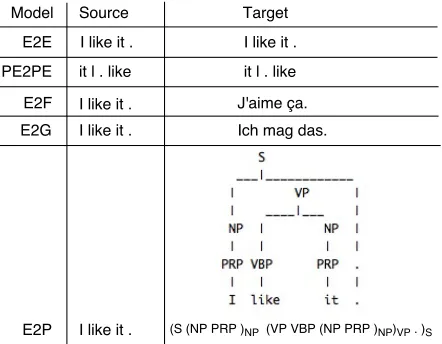
• An lower-bound model, in which the encoder learns much less syntactic information. For the lower bound, we train two sentence auto-encoders: one translates an English sentence to itself (E2E), while the other translates a per-muted English sentence to itself (PE2PE). We already had an indication above (Section 2) that a copying model does not necessarily need to remember a sentence’s syntactic structure. Figure 1 shows sample inputs and outputs of the E2E, PE2PE, E2F, E2G, and E2P models.
Model Target Language
Input vocabulary
size
Output vocabulary
size
Train/Dev/Test Corpora Sizes
(sentence pairs) BLEU
E2E English 200K 40K 4M/3000/2737 89.11
PE2PE Permuted English 200K 40K 4M/3000/2737 88.84
E2F French 200K 40K 4M/6003/3003 24.59
E2G German 200K 40K 4M/3000/2737 12.60
[image:3.612.109.502.55.182.2]E2P constituency treeLinearized 200K 121 8162K/1700/2416 n/a
Table 2:Model settings and test-set BLEU-n4r1 scores (Papineni et al., 2002).
Figure 1:Sample inputs and outputs of the E2E, PE2PE, E2F, E2G, and E2P models.
(Pradhan and Xue, 2009) and the English Web Tree-bank (Petrov and McDonald, 2012). In addition to these gold treebanks, we take 4M English sentences from English-German data and 4M English sen-tences from English-French data, and we parse these 8M sentences with the Charniak-Johnson parser1
(Charniak and Johnson, 2005). We call these 8,162K pairs the CJ corpus. We use WSJ Section 22 as our development set and section 23 as the test set, where we obtain an F1-score of 89.6, competitive with the previously-published 90.5 (Table 4).
Model Architecture. For all experiments2,
we use a two-layer encoder-decoder with long short-term memory (LSTM) units (Hochreiter and Schmidhuber, 1997). We use a minibatch of 128, a hidden state size of 1000, and a dropout rate of 0.2.
1The CJ parser is here
https://github.com/BLLIP/bllip-parser and we used the pretrained model ”WSJ+Gigaword-v2”.
2We use the toolkit: https://github.com/isi-nlp/Zoph RNN
Parser F1-scoreWSJ 23 (out of 2416)# valid trees
CJ Parser 92.1 2416
E2P 89.6 2362
(Vinyals et al., 2015) 90.5 unk
Table 3:Labeled F1-scores of different parsers on WSJ Section 23. The F1-score is calculated on valid trees only.
For auto-encoders and translation models, we train 8 epochs. The learning rate is initially set as 0.35 and starts to halve after 6 epochs. For E2P model, we train 15 epochs. The learning rate is initialized as 0.35 and starts to decay by 0.7 once the perplexity on a development set starts to increase. All parame-ters are re-scaled when the global norm is larger than 5. All models are non-attentional, because we want the encoding vector to summarize the whole source sentence. Table 4 shows the settings of each model and reports the BLEU scores.
5 Syntactic Label Prediction 5.1 Experimental Setup
In this section, we test whether different seq2seq systems learn to encode syntactic information about the source (English) sentence.
[image:3.612.74.295.214.386.2]Label Train Test
Number of classes
Most frequent
label
Voice 9000 1000 2 Active
Tense 9000 1000 2 Non-past
TSS 9000 1000 20 NP-VP
POS 87366 9317 45 NN
[image:4.612.78.294.55.173.2]SPC 81292 8706 24 NP
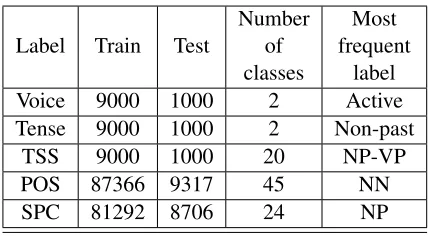
[image:4.612.77.291.194.375.2]Table 4:Corpus statistics for five syntactic labels.
Figure 2:The five syntactic labels for sentence “This time , the firms were ready”.
all 1000 hidden states, after which we recursively prune those units whose weights’ absolute values are smallest.
We extract three sentence-level syntactic labels: 1. Voice: active or passive.
2. Tense: past or non-past.
3. TSS: Top level syntactic sequence of the con-stituent tree. We use the most frequent 19 se-quences (“NP-VP”, “PP-NP-VP”, etc.) and la-bel the remainder as “Other”.
and two word-level syntactic labels:
1. POS: Part-of-speech tags for each word. 2. SPC: The smallest phrase constituent that
above each word.
Both voice and tense labels are generated using rule-based systems based on the constituent tree of the sentence.
Figure 2 provides examples of our five syntactic labels. When predicting these syntactic labels using corresponding cell states, we split the dataset into
training and test sets. Table 4 shows statistics of each labels.
For a source sentences,
s= [w1, ..., wi, ..., wn]
the two-layer encoder will generate an array of cell vectorscduring encoding,
c= [(c1,0, c1,1), ...,(ci,0, ci,1), ...,(cn,0, cn,1)]
We extract a sentence-level syntactic labelLs, and
predict it using the encoding cell states that will be fed into the decoder:
Ls=g(cn,0)orLs=g(cn,1)
whereg(·)is the logistic regression.
Similarly, for extracting word-level syntactic la-bels:
Lw= [Lw1, ..., Lwi, ..., Lwn]
we predict each labelLwi using the cell states
im-mediately after encoding the wordwi:
Lwi=g(ci,0)orLW i=g(ci,1)
5.2 Result Analysis
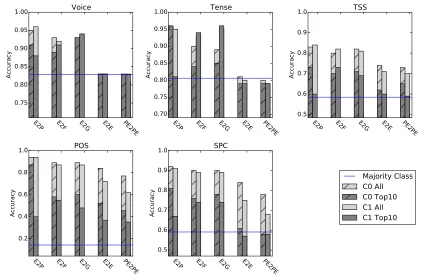
Test-set prediction accuracy is shown in Figure 3. For voice and tense, the prediction accuracy of two auto-encoders is almost same as the accuracy of ma-jority class, indicating that their encoders do not learn to record this information. By contrast, both the neural parser and the NMT systems achieve ap-proximately 95% accuracy. When predicting the top-level syntactic sequence (TSS) of the whole sen-tence, the Part-of-Speech tags (POS), and small-est phrase constituent (SPC) for each word, all five models achieve an accuracy higher than that of ma-jority class, but there is still a large gap between the accuracy of NMT systems and auto-encoders. These observations indicate that the NMT encoder learns significant sentence-level syntactic information—it can distinguish voice and tense of the source sen-tence, and it knows the sentence’s structure to some extent. At the word level, the NMT’s encoder also tends to cluster together the words that have similar POS and SPC labels.
Different syntactic information tends to be stored at different layers in the NMT models. For word-level syntactic labels, POS and SPC, the accuracy of the lower layer’s cell states (C0) is higher than
E2P E2F E2G E2E PE2PE
0.75 0.80 0.85 0.90 0.95 1.00
Accuracy
Voice
E2P E2F E2G E2E PE2PE
0.70 0.75 0.80 0.85 0.90 0.95 1.00
Accuracy
Tense
E2P E2F E2G E2E PE2PE
0.5 0.6 0.7 0.8 0.9 1.0
Accuracy
TSS
E2P E2F E2G E2E PE2PE
0.2 0.4 0.6 0.8 1.0
Accuracy
POS
E2P E2F E2G E2E PE2PE
0.5 0.6 0.7 0.8 0.9 1.0
Accuracy
SPC
[image:5.612.94.521.60.338.2]Majority Class C0 All C0 Top10 C1 All C1 Top10
Figure 3:Prediction accuracy of five syntactic labels on test. Each syntactic label is predicted using both the lower-layer cell states (C0) and higher-layer cell states (C1). For each cell state, we predict each syntactic label using all 1000 units (All), as well as the top 10 units (Top10) selected by recursive feature elimination. The horizontal blue line is the majority class accuracy.
labels, especially tense, the accuracy ofC1is larger
than C0. This suggests that the local features are
somehow preserved in the lower layer whereas more global, abstract information tends to be stored in the upper layer.
For two-classes labels, such as voice and tense, the accuracy gap between all units and top-10 units is small. For other labels, where we use a one-versus-rest strategy, the gap between all units and top-10 units is large. However, when predicting POS, the gap of neural parser (E2P) on the lower layer (C0) is much smaller. This comparison
in-dicates that a small subset of units explicitly takes charge of POS tags in the neural parser, whereas for NMT, the POS info is more distributed and implicit.
There are no large differences between encoders of E2F and E2G regarding syntactic information.
[image:5.612.314.535.465.587.2]6 Extract Syntactic Trees from Encoder 6.1 Experimental Setup
We now turn to whether NMT systems capture deeper syntactic structure as a by-product of learn-ing to translate from English to another language. We do this by predicting full parse trees from the in-formation stored in encoding vectors. Since this is a structured prediction problem, we can no longer use logistic regression. Instead, we extract a con-stituency parse tree from the encoding vector of a model E2X by using a new neural parser E2X2P with the following steps:
1. Take the E2X encoder as the encoder of the new model E2X2P.
2. Initialize the E2X2P decoder parameters with a uniform distribution.
3. Fine-tune the E2X2P decoder (while keeping its encoder parameters fixed), using the CJ cor-pus, the same corpus used to trainE2P. Figure 4 shows how we construct model E2F2P from model E2F. For fine-tuning, we use the same dropout rate and learning rate updating configura-tion for E2P as described in Secconfigura-tion 4.
6.2 Evaluation
We train four new neural parsers using the encoders of the two auto-encoders and the two NMT models respectively. We use three tools to evaluate and ana-lyze:
1. The EVALB tool3 to calculate the labeled
bracketing F1-score.
2. The zxx package4 to calculate Tree edit
dis-tance (TED) (Zhang and Shasha, 1989). 3. The Berkeley Parser Analyser5(Kummerfeld et
al., 2012) to analyze parsing error types. The linearized parse trees generated by these neu-ral parsers are not always well-formed. They can be split into the following categories:
• Malformed trees: The linearized sequence can not be converted back into a tree, due to miss-ing or mismatched brackets.
• Well-formed trees: The sequence can be con-verted back into a tree. Tree edit distance can be calculated on this category.
3http://nlp.cs.nyu.edu/evalb/
4https://github.com/timtadh/zhang-shasha
5https://github.com/jkkummerfeld/berkeley-parser-analyser
– Wrong length trees: The number of tree leaves does not match the number of source-sentence tokens.
– Correct length trees: The number of tree leaves doesmatch the number of source-sentence tokens.
Before we move to results, we emphasize the fol-lowing points:
First, compared to the linear classifier used in Sec-tion 5, the retrained decoder for predicting a lin-earized parse tree is a highly non-linear method. The syntactic prediction/parsing performance will increase due to such non-linearity. Thus, we do not make conclusions based only on absolute per-formance values, but also on a comparison against the designed baseline models. An improvement over the lower bound models indicates that the encoder learns syntactic information, whereas a decline from the upper bound model shows that the encoder loses certain syntactic information.
Second, the NMT’s encoder maps a plain English sentence into a high-dimensional vector, and our goal is to test whether the projected vectors form a more syntactically-related manifold in the high-dimensional space. In practice, one could also pre-dict parse structure for the E2E in two steps: (1) use E2E’s decoder to recover the original English sen-tence, and (2) parse that sentence with the CJ parser. But in this way, the manifold structure in the high-dimensional space is destroyed during the mapping.
6.2.1 Result Analysis
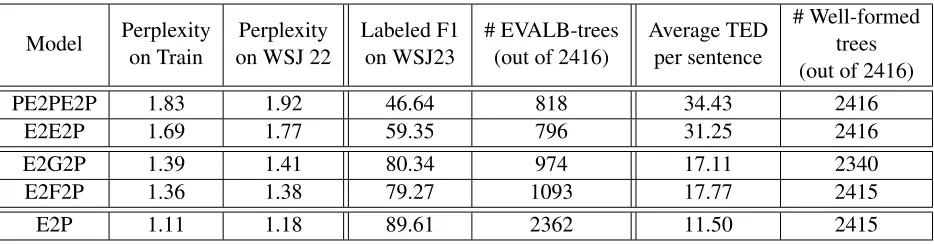
Table 5 reports perplexity on training and devel-opment sets, the labeled F1-score on WSJ Section 23, and the Tree Edit Distance (TED) of various sys-tems.
Model Perplexityon Train on WSJ 22Perplexity Labeled F1on WSJ23 # EVALB-trees(out of 2416) Average TEDper sentence
# Well-formed trees (out of 2416)
PE2PE2P 1.83 1.92 46.64 818 34.43 2416
E2E2P 1.69 1.77 59.35 796 31.25 2416
E2G2P 1.39 1.41 80.34 974 17.11 2340
E2F2P 1.36 1.38 79.27 1093 17.77 2415
[image:7.612.73.540.56.178.2]E2P 1.11 1.18 89.61 2362 11.50 2415
Table 5: Perplexity, labeled F1-score, and Tree Edit Distance (TED) of various systems. Labeled F1-scores are calculated on EVALB-trees only. Tree edit distances are calculated on the well-formed trees only. EVALB-trees are those whose number of leaves match the number of words in the source sentence, and are otherwise accepted by standard Treebank evaluation software.
approximately 17 TED.
Among the well-formed trees, around half have a mismatch between number of leaves and number of tokens in the source sentence. The labeled F1-score is reported over the rest of the sentences only. Though biased, this still reflects the overall perfor-mance: we achieve around 80 F1 with NMT en-coding vectors, much higher than with the E2E and PE2PE encoding vectors (below 60).
6.2.2 Fine-grained Analysis
Besides answering whether the NMT encoders learn syntactic information, it is interesting to know what kind of syntactic information is extracted and what is not.
As Table 5 shows, different parsers generate dif-ferent numbers of trees that are acceptable to Tree-bank evaluation software (“EVALB-trees”), having the correct number of leaves and so forth. We se-lect the intersection set of different models’ EVALB-trees. We get a total of 569 shared EVALB-EVALB-trees. The average length of the corresponding sentence is 12.54 and the longest sentence has 40 tokens. The average length of all 2416 sentences in WSJ section 23 is 23.46, and the longest is 67. As we do not ap-ply an attention model for these neural parsers, it is difficult to handle longer sentences. While the in-tersection set may be biased, it allows us to explore how different encoders decide to capture syntax on short sentences.
Table 6 shows the labeled F1-scores and Part-of-Speech tagging accuracy on the intersection set. The NMT encoder extraction achieves around 86 per-cent tagging accuracy, far beyond that of the auto-encoder based parser.
Model Labeled F1 Tagging AccuracyPOS
PE2PE2P 58.67 54.32
E2E2P 70.91 68.03
E2G2P 85.36 85.30
E2F2P 86.62 87.09
[image:7.612.321.534.233.338.2]E2P 93.76 96.00
Table 6: Labeled F1-scores and POS tagging accuracy on the intersection set of EVALB-trees of different parsers. There are 569 trees in the intersection, and the average length of corre-sponding English sentence is 12.54.
Besides the tagging accuracy, we also utilize the Berkeley Parser Analyzer (Kummerfeld et al., 2012) to gain a more linguistic understanding of predicted parses. Like TED, the Berkeley Parser Analyzer is based on tree transformation. It repairs the parse tree via a sequence of sub-tree movements, node inser-tions and deleinser-tions. During this process, multiple bracket errors are fixed, and it associates this group of node errors with a linguistically meaningful error type.
Sense Confusion Single Word PhraseDifferent label Noun boundary errorNP Internal Unary Modifier Attach Verb taking wrong argumentsPP Attach VP Attach Co-ordination
0.057 0.150 0.137 0.022 0.053 0.123 0.205 0.035 0.242 0.024 0.081
E2P (Ave. Bracket Err)
16.582.74 2.52 2.20 2.17 1.98 1.46 1.44 1.44 1.36 1.14
E2F2P (Ratio)
17.773.31 2.42 3.20 1.83 2.25 2.03 2.75 1.27 1.271.05
E2G2P (Ratio)
23.775.01 5.00 3.10 3.17 3.21 1.69 3.501.82 4.55 1.78
E2E2P (Ratio)
32.195.12 5.26 5.10 3.58 3.711.82 2.44 2.27 5.64 0.22
[image:8.612.95.520.58.197.2]PE2PE2P (Ratio)
Figure 5:For modelE2P(the red bar), we show the average number of bracket errors per sentence due to the top 11 error types. For other models, we show the ratio of each model’s average number of bracket errors to that of modelE2P. Errors analyzed on the intersection set. The table is sorted based on the ratios of theE2F2P model.
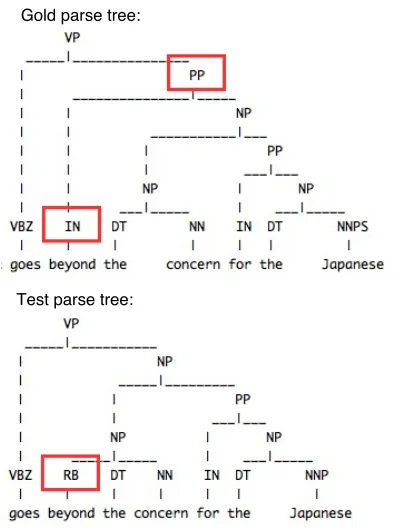
resulting in an attachment error. Figure 6 shows an example.
Even though we can predict 86 percent of parts-of-speech correctly from NMT encoding vectors, the other 14 percent introduce quite a few attachment errors. NMT sentence vectors encode a lot of syntax, but they still cannot grasp these subtle details.
7 Conclusion
We investigate whether NMT systems learn source-language syntax as a by-product of training on string pairs. We find that both local and global syntactic in-formation about source sentences is captured by the encoder. Different types of syntax is stored in dif-ferent layers, with difdif-ferent concentration degrees. We also carry out a fine-grained analysis of the con-stituency trees extracted from the encoder, highlight-ing what syntactic information is still misshighlight-ing.
Acknowledgments
This work was supported by ARL/ARO (W911NF-10-1-0533) and DARPA (HR0011-15-C-0115).
References
Ondrej Bojar, Christian Buck, Christian Federmann, Barry Haddow, Philipp Koehn, Matous Machacek, Christof Monz, Pavel Pecina, Matt Post, Herv Saint-Amand, Radu Soricut, and Lucia Specia, editors. 2014. Proc. Ninth Workshop on Statistical Machine Translation.
[image:8.612.327.524.328.592.2]Eugene Charniak and Mark Johnson. 2005. Coarse-to-fine n-best parsing and MaxEnt discriminative rerank-ing. InProc. ACL.
Kyunghyun Cho, Bart van Merrienboer, Caglar Gulcehre, Dzmitry Bahdanau, Fethi Bougares, Holger Schwenk, and Yoshua Bengio. 2014. Learning phrase represen-tations using RNN encoder-decoder for statistical ma-chine translation. InProc. EMNLP.
Brooke Cowan, Ivona Kuˇcerov´a, and Michael Collins. 2006. A discriminative model for tree-to-tree trans-lation. InProc. EMNLP.
Steve DeNeefe, Kevin Knight, Wei Wang, and Daniel Marcu. 2007. What can syntax-based MT learn from phrase-based MT? InProc. EMNLP-CoNLL.
Michel Galley, Mark Hopkins, Kevin Knight, and Daniel Marcu. 2004. What ’ s in a translation rule ? Infor-mation Sciences, 2004.
Michel Galley, Jonathan Graehl, Kevin Knight, Daniel Marcu, Steve DeNeefe, Wei Wang, and Ignacio Thayer. 2006. Scalable inference and training of context-rich syntactic translation models. In Proc. ACL.
Sepp Hochreiter and J¨urgen Schmidhuber. 1997. Long short-term memory.Neural Computation, 9(8). Nal Kalchbrenner, Edward Grefenstette, and Phil
Blun-som. 2014. A convolutional neural network for mod-elling sentences. InProc. ACL.
Andrej Karpathy, Justin Johnson, and Li Fei-Fei. 2016. Visualizing and understanding recurrent networks. In
Proc. ICLR.
Yoon Kim. 2014. Convolutional neural networks for sen-tence classification. InProc. EMNLP.
Ryan Kiros, Yukun Zhu, Ruslan R Salakhutdinov, Richard Zemel, Raquel Urtasun, Antonio Torralba, and Sanja Fidler. 2015. Skip-thought vectors. In
Proc. NIPS.
Philipp Koehn, Franz Josef Och, and Daniel Marcu. 2003. Statistical phrase-based translation. In Proc. NAACL.
Jonathan K. Kummerfeld, David Hall, James R. Curran, and Dan Klein. 2012. Parser showdown at the Wall Street Corral: An empirical investigation of error types in parser output. InProc. EMNLP-CoNLL.
Jonathan K. Kummerfeld, Daniel Tse, James R Curran, and Dan Klein. 2013. An empirical examination of challenges in Chinese parsing. InProc. ACL.
Qv Le and Tomas Mikolov. 2014. Distributed represen-tations of sentences and documents. InProc. ICML. Jiwei Li, Xinlei Chen, Eduard Hovy, and Dan Jurafsky.
2016. Visualizing and understanding neural models in nlp. InProc. NAACL.
Yang Liu, Qun Liu, and Yajuan L¨u. 2011. Adjoining tree-to-string translation. InProc. ACL.
Mitchell P Marcus, Beatrice Santorini, and Mary Ann Marcinkiewicz. 1993. Building a large annotated cor-pus of English: The Penn Treebank. Computational Linguistics, 19(2).
Kishore Papineni, Salim Roukos, Todd Ward, and Wei-Jing Zhu. 2002. BLEU: a method for automatic eval-uation of machine translation. InProc. ACL.
Slav Petrov and Ryan McDonald. 2012. Overview of the 2012 shared task on Parsing the Web. In Notes of the First Workshop on Syntactic Analysis of Non-Canonical Language (SANCL).
Sameer S Pradhan and Nianwen Xue. 2009. Ontonotes: the 90% solution. InProc. NAACL.
Richard Socher, Alex Perelygin, Jean Y Wu, Jason Chuang, Christopher D Manning, Andrew Y Ng, and Christopher Potts. 2013. Recursive deep models for semantic compositionality over a sentiment treebank. InProc. EMNLP.
Ilya Sutskever, Oriol Vinyals, and Quoc V Le. 2014. Se-quence to seSe-quence learning with neural networks. In
Proc. NIPS.
Laurens van der Maaten and Geoffrey Hinton. 2008. Visualizing data using t-SNE. Journal of Machine Learning Research, 9.
Oriol Vinyals, Łukasz Kaiser, Terry Koo, Slav Petrov, Ilya Sutskever, and Geoffrey Hinton. 2015. Grammar as a foreign language. InProc. NIPS.