Learning to refine text based recommendations
Youyang Gu and Tao Lei and Regina Barzilay and Tommi Jaakkola
Computer Science and Artificial Intelligence Laboratory Massachusetts Institute of Technology
{yygu,taolei,regina,tommi}@csail.mit.edu
Abstract
We propose a text-based recommendation en-gine that utilizes recurrent neural networks to flexibly map textual input into continuous vec-tor representations tailored to the recommen-dation task. Here, the text objects are doc-uments such as Wikipedia articles or ques-tion and answer pairs. As neural models re-quire substantial training time, we introduce a sequential component so as to quickly ad-just the learned metric over objects as addi-tional evidence accrues. We evaluate the ap-proach on recommending Wikipedia descrip-tions of ingredients to their associated product categories. We also exemplify the sequential metric adjustment on retrieving similar Stack Exchange AskUbuntu questions.1
1 Introduction
Modern recommender problems involve complex objects, often described in textual form. In order to learn to predict how disparate objects may go to-gether, it is helpful to first map them into a common representation where they are easily compared, re-gardless of their origin. Neural models are partic-ularly well-suited for this task as continuous vec-tor representations of objects can be tailored in a flexible way to the desired task. While these mod-els have been shown to be effective across NLP tasks (Sutskever et al., 2014; Andreas et al., 2016; Hermann et al., 2015), they take considerable time to learn and are therefore ill-suited to be adjusted rapidly as additional evidence accumulates.
1The code/data is available athttps://github.com/
youyanggu/rcnn.
We cast our text-to-text recommendation problem in two phases. In the first phase, flexible neural text-to-vector mappings are learned from currently avail-able data. Such mappings are optimized to function well in a collaborative filtering setting. For exam-ple, in the context of recommending food product categories for ingredients based on their Wikipedia pages, the continuous vectors are adjusted so that their inner product directly reflects the degree of as-sociation between the objects. Once learned, the mapping can be applied to any previously unseen text to yield the corresponding vector representation, and therefore also used for predicting associations. In the second phase, we no longer adjust text-to-vector mappings but rather parameterize and learn how the vectors are compared. For example, we can optimize the metric separately for each new ingredi-ent based on a few category observations for that in-gredient. The goal of this second phase is to specif-ically boost the accuracy when the neural baseline (unaware of the new evidence) would otherwise not perform well.
Our approach builds on the recent work on recur-rent convolutional models to obtain text-to-vector mappings (Lei et al., 2015; Lei et al., 2016). This architecture is particularly well suited for noisy Wikipedia pages as it can learn to omit and high-light different parts of the text, as needed. The ad-ditional sequential component is a regularized logis-tic regression model (for ingredient-product predic-tion) or a ranking model (for question retrieval). We demonstrate the accuracy of the baseline neural rec-ommender and the gains from the second sequential phase in both of these tasks.
2 Related Work
A great deal of recent effort has gone into devel-oping flexible neural models for text and their use across variety of NLP tasks. This includes build-ing vector representations for sentences and docu-ments (Le and Mikolov, 2014), convolutional neu-ral network models of text (Collobert and Weston, 2008; Zhang and LeCun, 2015), non-consecutive variants of CNNs (Lei et al., 2015), and compo-sitional architectures (Socher et al., 2013), among many others. Our work is most closely related to the use of such models for question retrieval (Lei et al., 2016) but differs, in particular, in terms of our two-phase collaborative filtering formulation and the ingredient mapping task from Wikipedia pages (cf.(Sutskever et al., 2011; Song and Roth, 2015)).
3 Recommender Problems
We explore two recommender problems in this work. In the first problem, we are given a food in-gredient, and our goal is to predict which product categories it could appear in. Both ingredients and product categories are provided in terms of natural language descriptions via their associated Wikipedia pages. For example, if given “tomato”, we would predict “canned foods” as one likely category for the ingredient. A small number of categories appear as targets for each ingredient.
We also consider the task of predicting questions that are similar to the one provided as a query. The purpose is to facilitate effective question answer-ing by retrievanswer-ing related past questions (and the as-sociated answers that are available). For this we use Stack Exchange’s AskUbuntu question retrieval dataset used in recent work (dos Santos et al., 2015; Lei et al., 2016)
4 Approach
We explain our approach in terms of the first task: predicting product categories from ingredients. Col-laborative predictions are made by mapping each in-gredient into a vector representation and comparing that representation with an analogous one for prod-uct categories. We train these vectors in an end-to-end manner to function well as part of the collab-orative task. The vector representations are based
on Wikipedia pages that are available for most in-gredients and categories in our problem. Rather than derive the vector from the entire article (which can be long), we only use the top summary section. For the AskUbuntu question-answering dataset, we make use of both the title and the question body.
We use a recurrent neural network (RNN) model to map each text description into a vector represen-tation. Our model builds on the recurrent convo-lutional neural network model of (Lei et al., 2016) used to train the AskUbuntu question representa-tions. We describe below a modified version used for ingredient-product category prediction.
Letv✓(x) 2 Rdbe the parameterized RNN map-ping of textxinto a vector representation, whered
is the dimension of the hidden representation. Letxi andzp be the Wikipedia pages for ingredienti 2 I and product category p 2 P, respectively. We use
the same parameters ✓ to generate the
representa-tions for both ingredients and product categories due to their overall similarity. Thusv✓(xi)is the vector representation for ingredientiandv✓(zp)is the vec-tor representation for product categorypfor an RNN model with parameters✓. We train the RNN model
to predict each associationYip = 1as a binary pre-diction task, i.e.,
P(Yip= 1|✓) = (v✓(zp)·v✓(xi)), (1)
where is the sigmoid function (t) = (1 + exp( t)) 1. The formulation is akin to a binary
collaborative filtering task where user/item feature vectors are produced by the RNN. The parameters
✓can be learned by back-propagating log-likelihood
of the binary 0/1 predictions back to✓.
4.1 Sequential learning
a specific new ingredient will impact predictions for other ingredients. We propose a sequential approach that is instead local, tailored to the new ingredient.
In order to sequentially adjust the model predic-tions with new evidence, we introduce parameters
w = [w1, . . . , wd], wj 2 R+ that modify the com-parison of ingredient and category vectors. Specifi-cally, the association is predicted by
P(Yip= 1|✓, w) = {v✓(zp)Tdiag(w)v✓(xi)}, (2) where diag(w)is a diagonal matrix with the entries
specified by w. We assume that, at this stage, the RNN parameters ✓ and therefore the vector
repre-sentationsv✓(zp)andv✓(xi)are nonadjustable. We will only update weightswin response to each new observation, separately for each ingredient. The ob-servations can both be positive (Y = 1) and negative
(Y = 0).
Because we expect a new input may only have a small number of observations, it is important to properly regularize the weights as to avoid over-fitting. We append the log-likelihood objective with a regularizer
reg(w) = 2
d
X
j=1
(wj 1)2 (3)
where is the overall regularization parameter. Note that for large values of , the regularizer keeps the parameters at the default valueswj = 1 correspond-ing to the baseline RNN collaborative predictions, unmodified by the new evidence.
In the context of predicting similar questions, we use a modified binary formulation where the goal is to classify each triplet of questions(x, z1, z2)in
terms of whetherz1is closer to the query thanz2. In
this ranking model, the probability thatz1 is closer
is given by
⇣
(v✓(z1) v✓(z2))Tdiag(w)v✓(x)
⌘
, (4)
The parameters w are again trained from
ob-served additional triplet relations in the AskUbuntu dataset. The parametersware regularized as in the ingredient-product category setup.
The sequential part can therefore be viewed as a content recommendation task which is tailored to
the specific query (e.g., ingredient) using features from previously trained RNNs. It assumes addi-tional feedback in order to adjust the feature com-parison using the introduced weightsw.
5 Experimental Setup and Results
Ingredients: We use theFoodEssentials LabelAPI2
andRapid Alert System for Food and Feed (RASFF)3
databases to extract 5439 ingredients and the prod-uct categories they appear in. On average, each in-gredient appears in 16.3 product categories (out of 131 categories). We leverage Mechanical Turk to link each ingredient to the appropriate Wikipedia ar-ticle. From the 5439 ingredients, there are 1680 unique Wikipedia articles. Each ingredient sum-mary description has a median of 169 tokens.
AskUbuntu: The dataset consists of 167k questions and 16k user-marked similar question pairs taking from a 2014 dump of AskUbuntu website.
5.1 Training, development, and test sets
Ingredients: We take the set of unique Wikipedia articles and randomly split them into training, de-velopment, and test sets (60/20/20). We then assign the ingredients to the appropriate data set based on their Wikipedia articles. This is to ensure that the ar-ticles of the ingredients used in the development and test sets are not seen in training.
AskUbuntu: We take 8000 human annotated ques-tion pairs as our development and test sets. There are 200 query questions in each set. Each query ques-tion is paired with 20 candidate quesques-tions which are annotated as similar or non-similar. We evaluate by ranking these candidate questions.
5.2 Sequential scenario
Ingredients: Letn be the total number of labeled
positive categories for the ingredient. We provide
min(20, n/2)positive categories for the sequential
model to train. We also include k negative
cat-egories, where k is selected using the validation
set. We evaluate the performance on the remaining
n min(20, n/2)positive categories as well as on
the negative categories not included in training.
2http://developer.foodessentials.com/
Ingredient Wikipedia article Prediction 1 Prediction 2 Prediction 3 oatmeal Oatmeal cereal (0.564) snack, energy & granola bars (0.196) breads & buns (0.039) watermelon juice Watermelon fruit & vegetable juice (0.352) ice cream & frozen yogurt (0.205) yogurt (0.064) jasmine rice Jasmine rice flavored rice dishes (0.294) rice (0.237) herbs & spices (0.062) shrimp extract Shrimp (food) fish & seafood (0.491) frozen dinners (0.128) frozen appetizers (0.113) meatball Meatball pizza (0.180) breakfast sandwiches (0.128) frozen dinners (0.120) polysorbate 80 Polysorbate 80 chewing gum & mints (0.531) candy (0.092) baking decorations (0.049) ketchup Ketchup ketchup (0.461) salad dressing & mayonnaise (0.049) other cooking sauces (0.044) benzoic acid Benzoic acid powdered drinks (0.062) fruit & vegetable juice (0.051) candy (0.045)
Table 1:The three most likely food product category predictions generated by the baseline RNN model on eight unseen ingredients. The number in parenthesis represents the probability provided by the model.
AskUbuntu: We use the difference vectors in Equa-tion 4 to compute the loss and sequentially update the feature weightsw. Letnbe the total number of
labeled positive examples (similar questions). We select up to n/2 positive and negative examples. From then2/4possible pairs, we select the 20 most
informative pairs for training.
While we use the loss function commonly used for binary classification during training, we ulti-mately want to frame our question as a ranking prob-lem. Therefore, after iterating through the initial observations, we compute the mean average preci-sion (MAP) over the remaining (unseen) ingredi-ents/questions and compare it to the MAP of the baseline RNN model on the same unseen examples.
5.3 Hyperparameters
RNN: We use Adam (Kingma and Ba, 2015) as the optimization method with the default setting sug-gested by the authors. We use a hidden dimension ofd = 50for the ingredients andd = 400for the
AskUbuntu questions. Additional parameters such as dropout (Hinton et al., 2012), hidden layers, regu-larization, stopping criteria, batch size, and learning rate is tuned on the development set.
Word Vectors: For the ingredient/product pre-diction task, we used the GloVe pre-trained vec-tors (Common Crawl, 42 billion tokens, 300-dimensional) (Pennington et al., 2014). The word vectors for the AskUbuntu vectors are pre-trained using the AskUbuntu and Wikipedia corpora.
Sequential: We utilize the bounded limited-memory BFGS algorithm (L-BFGS-B) (Byrd et al., 1995) to solve for the optimal feature weights with boundswj 2 [0.01,2]. We tuned the the constraint bounds and the regularization parameter on the de-velopment set.
[image:4.612.319.520.208.532.2]Ing / Dev Ing / Test AskUbuntu / Dev AskUbuntu / Test Mean MAP gain (percent) 0.0525 (30.9%) 0.0492 (26.5%) 0.0246 (8.2%) 0.0224 (7.5%)
[image:5.612.75.550.58.103.2]Mean # positive observations 8.6 9.1 3.2 2.9
Table 2:We show the mean absolute improvement in the mean average precision (MAP) over the unobserved data points for each ingredient/question. The percent improvement shown is an average percent improvement across the ingredients/questions. They are the average of 100 runs per ingredient and 20 runs per AskUbuntu question.
Model Validation set Test set Random 0.150 / 0.120 0.158 / 0.129 Baseline 0.320 / 0.291 0.331 / 0.300 MLP 0.432 / 0.390 0.459 / 0.416
RNN 0.476 / 0.422 0.478 / 0.426
Table 3: Results of the RNN model on the ingredient dataset, averaged across 5 runs. The two metrics shown are the mean average precision (MAP) and precision atN (P@N), whereN
is the total number of positive examples. The random model generates a random ranking of food categories for each ingredi-ent. The baseline model uses the mean occurrence distribution of the food categories for all ingredients to rank the predictions. The multilayer perceptron model (MLP) is a three-layer neural network trained on the hierarchical properties of the input in-gredients (extracted from the UMLS Metathesaurus). The RNN model outperforms all other baselines.
[image:5.612.89.279.166.238.2]5.4 Results
Table 1 and 3 shows our results from using RNN to predict likely food product categories from Wikipedia text descriptions of ingredients.
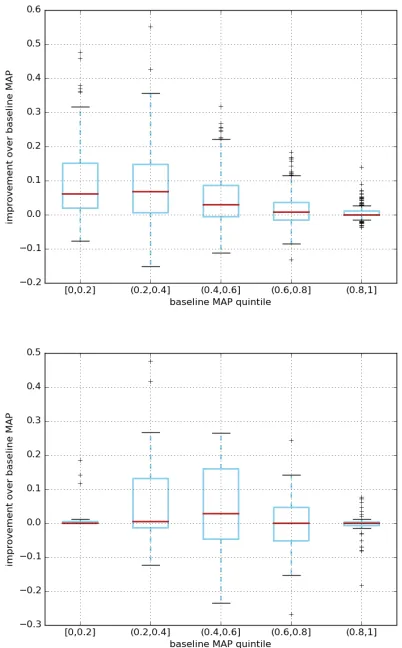
We show the gains of the sequential update model in Table 2. We are able to generate consistent im-provements in the MAP after seeing half of the ob-servations. Box plots of the test set MAP improve-ments can be seen in Figure 1. For the ingredi-ents prediction task, the sequential model offers the greatest improvements when the baseline RNN has low MAP. In the AskUbuntu questions, on the other hand, the positive effect is greatest when the base-line MAP is around 0.5.
There are three possible reasons for the difference in performance between the two tasks:
• The mean number of positive observations in the AskUbuntu task is 2.9, compared to 9.1 observations in the ingredients task (Table 2). This is a key factor in determining the sequen-tial model’s ability to tune for the optimal
pa-rameters. Having access to more annotated data would likely result in an increase in per-formance.
• Owing to the complexity of information en-coded, the vectors for the AskUbuntu task are of dimension of 400 as opposed to 50 in the in-gredients task. As a result, the sequential model would require more feedback to find near opti-mal weightsw.
• We hypothesize that the sequential model leads to the most increased performance when the baseline model is mediocre. This is espe-cially highlighted in the AskUbuntu task, as ex-tremely poor performance indicate a complete mismatch of questions, while an exceptional performance leaves little room for additional improvement.
6 Conclusion
We demonstrated a text-based neural recommender approach to predict likely food products from a given ingredient as well as other similar questions from a given AskUbuntu question. We then ex-tended this model to an online stream of new data, which improves over the off-line trained version for both of the two tasks tested. This sequential process improves model performance while requiring mini-mal additional training time and resources.
7 Acknowledgments
References
Jacob Andreas, Marcus Rohrbach, Trevor Darrell, and Dan Klein. 2016. Learning to compose neural net-works for question answering. Proceedings of the North American Chapter of the Association for Com-putational Linguistics (NAACL 2016).
Richard H. Byrd, Peihuang Lu, Jorge Nocedal, and Ciyou Zhu. 1995. A limited memory algorithm for bound constrained optimization. SIAM Journal on Scientific and Statistical Computing, 16(5):1190–1208.
Ronan Collobert and Jason Weston. 2008. A unified ar-chitecture for natural language processing: Deep neu-ral networks with multitask learning. International Conference on Machine Learning (ICML 2008). Cicero dos Santos, Luciano Barbosa, Dasha Bogdanova,
and Bianca Zadrozny. 2015. Learning hybrid rep-resentations to retrieve semantically equivalent ques-tions. In Proceedings of the 53rd Annual Meeting of the Association for Computational Linguistics and the 7th International Joint Conference on Natural Lan-guage Processing (Volume 2: Short Papers), pages 694–699, Beijing, China, July. Association for Com-putational Linguistics.
Karl Moritz Hermann, Tomas Kocisky, Edward Gren-fenstette, Lasse Espeholt, Will Kay, Mustafa Suley-man, and Phil Blunsom. 2015. Teaching machines to read and comprehend. Advances in Neural Infor-mation Processing Systems (NIPS 2015).
Geoffrey E. Hinton, Nitish Srivastava, Alex Krizhevsky, Ilya Sutskever, and Ruslan R. Salakhutdinov. 2012. Improving neural networks by preventing co-adaptation of feature detectors. arXiv preprint arXiv:1207.0580.
Diederik P Kingma and Jimmy Lei Ba. 2015. Adam: A method for stochastic optimization. International Conference on Learning Representation (ICLR 2015). Quoc V. Le and Tomas Mikolov. 2014. Distributed repre-sentations of sentences and documents. International Conference on Machine Learning (ICML 2014). Tao Lei, Regina Barzilay, and Tommi Jaakkola. 2015.
Molding cnns for text: non-linear, non-consecutive convolutions. Proceedings of the Empiricial Methods in Natural Language Processing (EMNLP 2015). Tao Lei, Hrishikesh Joshi, Regina Barzilay, Tommi
Jaakkola, Katerina Tymoshenko, Alessandro Mos-chitti, and Lluis Marquez. 2016. Semi-supervised question retrieval with recurrent convolutions. Pro-ceedings of the North American Chapter of the Asso-ciation for Computational Linguistics (NAACL 2016). Jeffrey Pennington, Richard Socher, and Christopher D. Manning. 2014. Glove: Global vectors for word rep-resentation. Proceedings of the Empiricial Methods in Natural Language Processing (EMNLP 2014).
Richard Socher, Alex Perelygin, Jean Y. Wu, Jason Chuang, Christopher D. Manning, Andrew Y. Ng, and Christopher Potts. 2013. Recursive deep models for semantic compositionality over a sentiment treebank.
Empirical Methods in Natural Language Processing (EMNLP 2013).
Yangqiu Song and Dan Roth. 2015. Unsupervised sparse vector densification for short text similarity. Proceed-ings of the North American Chapter of the Association for Computational Linguistics (NAACL 2015). Ilya Sutskever, James Martens, and Geoffrey Hinton.
2011. Generating text with recurrent neural network.
Proceedings of the International Conference on Ma-chine Learning (ICML 2011).
Ilya Sutskever, Oriol Vinyals, and Quoc V. Le. 2014. Sequence to sequence learning with neural networks.
Advances in Neural Information Processing Systems (NIPS 2014).