Verb Phrase Ellipsis Resolution Using Discriminative and Margin-Infused
Algorithms
Kian Kenyon-Dean Jackie Chi Kit Cheung Doina Precup School of Computer Science
McGill University
[email protected],{jcheung,dprecup}@cs.mcgill.ca
Abstract
Verb Phrase Ellipsis (VPE) is an anaphoric construction in which a verb phrase has been elided. It occurs frequently in dialogue and informal conversational settings, but despite its evident impact on event coreference reso-lution and extraction, there has been relatively little work on computational methods for iden-tifying and resolving VPE. Here, we present a novel approach to detecting and resolving VPE by using supervised discriminative ma-chine learning techniques trained on features extracted from an automatically parsed, pub-licly available dataset. Our approach yields state-of-the-art results for VPE detection by improving F1 score by over 11%; additionally, we explore an approach to antecedent identifi-cation that uses the Margin-Infused-Relaxed-Algorithm, which shows promising results.
1 Introduction
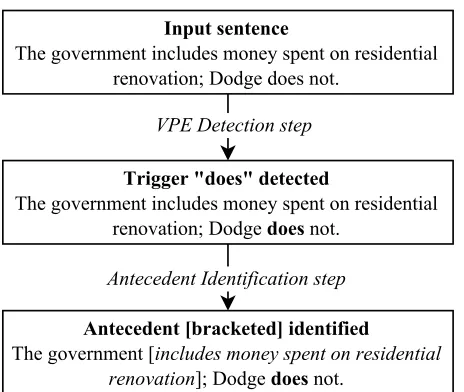
Verb Phrase Ellipsis (VPE) is an anaphoric construc-tion in which a verbal constituent has been omitted. In English, an instance of VPE consists of two parts: atrigger, typically an auxiliary or modal verb, that indicates the presence of a VPE; and anantecedent, which is the verb phrase to which the elided element resolves (Bos and Spenader, 2011; Dalrymple et al., 1991). For example, in the sentence,“The govern-ment includes money spent on residential renova-tion; Dodge does not”, the trigger “does”resolves to the antecedent“includes money spent on residen-tial renovation”.
The ability to perform VPE resolution is impor-tant for tasks involving event extraction, especially
in conversational genres such as informal dialogue where VPE occurs more frequently (Nielsen, 2005). Most current event extraction systems ignore VPE and derive some structured semantic representation by reading information from a shallow dependency parse of a sentence. Such an approach would not only miss many valid links between an elided verb and its arguments, it could also produce nonsensi-cal extractions if applied directly on an auxiliary trigger. In the example above, a naive approach might produce an unhelpful semantic triple such as
(Dodge,agent,do).
There have been several previous empirical stud-ies of VPE (Hardt, 1997; Nielsen, 2005; Bos and Spenader, 2011; Bos, 2012; Liu et al., 2016). Many previous approaches were restricted to solving spe-cific subclasses of VPE (e.g., VPE triggered by do
(Bos, 2012)), or have relied on simple heuristics for some or all of the steps in VPE resolution, such as by picking the most recent previous clause as the an-tecedent.
In this paper, we develop a VPE resolution pipeline which encompasses a broad class of VPEs (Figure 1), decomposed into the following two steps. In theVPE detection step, the goal is to determine whether or not a word triggers VPE. The second step,antecedent identification, requires selecting the clause containing the verbal antecedent, as well as determining the exact boundaries of the antecedent, which are often difficult to define.
Our contribution is to combine the rich linguis-tic analysis of earlier work with modern statislinguis-tical approaches adapted to the structure of the VPE res-olution problem. First, inspired by earlier work,
Figure 1:Example of the VPE resolution pipeline on an exam-ple found in WSJ file wsj 0036.
our system exploits linguistically informed features specific to VPE in addition to standard features such as lexical features or POS tags. Second, we adapt the Margin-Infused-Relaxed-Algorithm (MIRA) (Crammer et al., 2006), which has been popular in other tasks, such as machine translation (Watanabe et al., 2007) and parsing (McDonald et al., 2005), to antecedent identification. This algo-rithm admits a partial loss function which allows candidate solutions to overlap to a large degree. This makes it well suited to antecedent identification, as candidate antecedents can overlap greatly as well.
OnVPE detection, we show that our approach sig-nificantly improves upon a deterministic rule-based baseline and outperforms the state-of-the-art system of Liu et al. (2016) by 11%, from 69.52% to 80.78%. Forantecedent identificationwe present results that are competitive with the state-of-the-art (Liu et al., 2016). We also present state-of-the-art results with our end-to-end VPE resolution pipeline. Finally, we perform feature ablation experiments to analyze the impact of various categories of features.
2 Related Work
VPE has been the subject of much work in the-oretical linguistics (Sag, 1976; Dalrymple et al., 1991,inter alia). VPE resolution could have a
sig-nificant impact on related problems such as event coreference resolution (Lee et al., 2012; Bejan and Harabagiu, 2010; Liu et al., 2014) and event ex-traction (Ahn, 2006; Kim et al., 2009; Ritter et al., 2012). It has, however, received relatively little at-tention in the computational literature.
Hardt (1992) engaged in the first study of compu-tational and algorithmic approaches for VPE detec-tion and antecedent identificadetec-tion by using heuris-tic, linguistically motivated rules. Hardt (1997) ex-tracted a dataset of 260 examples from the WSJ cor-pus by using an algorithm that exploited null ele-ments in the PTB parse trees. Nielsen (2005) built a dataset that combined sections of the WSJ and BNC; he showed that the more informal settings captured in the BNC corpora show significantly more fre-quent occurrences of VPE, especially in dialogue ex-cerpts from interviews and plays. Using this dataset, he created a full VPE pipeline from raw input text to a full resolution by replacing the trigger with the intended antecedent1.
Bos and Spenader (2011) annotated the WSJ for occurrences of VPE. They found over 480 instances of VPE, and 67 instances of the similar phenomenon ofdo-soanaphora. Bos (2012) studied do-VPE by testing algorithmic approaches to VPE detection and antecedent identification that utilize Discourse Rep-resentation Theory.
Concurrently with the present work, Liu et al. (2016) explored various decompositions of VPE res-olution into detection and antecedent identification subtasks, and they corrected the BNC annotations created by Nielsen (2005), which were difficult to use because they depended on a particular set of preprocessing tools. Our work follows a similar pipelined statistical approach. However, we explore an expanded set of linguistically motivated features and machine learning algorithms adapted for each subtask. Additionally, we consider all forms of VPE, includingto-VPE, whereas Liu et al. only con-sider modal or light verbs (be, do, have) as candi-dates for triggering VPE. This represented about 7% 1e.g., the resolution of the example in Figure 1 would be
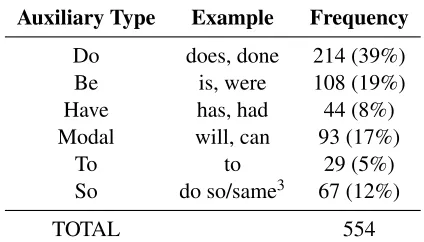
Auxiliary Type Example Frequency
Do does, done 214 (39%)
Be is, were 108 (19%)
Have has, had 44 (8%)
Modal will, can 93 (17%)
To to 29 (5%)
So do so/same3 67 (12%)
[image:3.612.79.291.59.180.2]TOTAL 554
Table 1:Auxiliary categories for VPE and their frequencies in all 25 sections of the WSJ.
of the dataset that they examined.
3 Approach and Data
We divide the problem into two separate tasks: VPE detection (Section 4), and antecedent identification (Section 5). Our experiments use the entire dataset presented in (Bos and Spenader, 2011). For prepro-cessing, we used CoreNLP (Manning et al., 2014) to automatically parse the raw text of WSJ for fea-ture extraction. We also ran experiments using gold-standard parses; however, we did not find significant differences in our results2. Thus, we only report
re-sults on automatically generated parses.
We divide auxiliaries into the six different cate-gories shown in Table 1, which will be relevant for our feature extraction and model training process, as we will describe. This division is motivated by the fact that different auxiliaries exhibit different be-haviours (Bos and Spenader, 2011). The results we present on the different auxiliary categories (see Ta-bles 2 and 4) are obtained from training a single clas-sifier over the entire dataset and then testing on aux-iliaries from each category, with theALLresult be-ing the accuracy obtained over all of the test data.
2An anonymous reviewer recommended that further
exper-iments could be performed by using the more informative NPs created with NML nodes (Vadas and Curran, 2007) on the gold-standard parsed WSJ.
3For example, “John willgo to the storeand Mary willdo
the same/likewise/the opposite”.Do Xanaphora and modals are not technically auxiliary verbs, as noted by the annotators of our dataset (Bos and Spenader, 2011), but for the purposes of this study we generalize them all as auxiliaries while simultaneously dividing them into their correct lexical categories.
4 VPE Detection
The task of VPE detection is structured as a binary classification problem. Given an auxiliary, a, we extract a feature vectorf, which is used to predict whether or not the auxiliary is a trigger for VPE. In Figure 1, for example, there is only one auxiliary present, “does”, and it is a trigger for VPE. In our experiments, we used a logistic regression classifier.
4.1 Feature Extraction
We created three different sets of features related to the auxiliary and its surrounding context.
Auxiliary. Auxiliary features describe the charac-teristics of the specific auxiliary, including the fol-lowing:
word identity of the auxiliary
lemma of the auxiliary
auxiliary type (as shown in Table 1)
Lexical. These features represent:
the three words before and after the trigger their part-of-speech (POS) tags
their POS bigrams
Syntactic. We devise these features to encode the relationship between the candidate auxiliary and its local syntactic context. These features were deter-mined to be useful through heuristic analysis of VPE instances in a development set. The feature set in-cludes the following binary indicator features (a = the auxiliary):
ac-commands4a verb
ac-commands a verb that comes after it
a verb c-commandsa
a verblocally5c-commandsa
alocally c-commands a verb
ais c-commanded by “than”, “as”, or “so”
ais preceded by “than”, “as”, or “so”
ais next to punctuation
the word “to” precedesa
a verb immediately followsa
ais followed by “too” or “the same”
4A word A c-commands another word B if A’s nearest
branching ancestor in the parse tree is an ancestor of B, fol-lowing the definition of Carnie (2013). We use this term purely to define a syntactic relation between two points in a parse tree.
5A wordAand wordBshare a local structure if they have
4.2 Baseline
As a baseline, we created a rule-based system in-spired by Nielsen’s (2005) approach to solving VPE detection. The baseline algorithm required signifi-cant experimental tuning on the development set be-cause different linguistically hand-crafted rules were needed for each of the six trigger forms. For exam-ple, the following rule formodalsachieved 80% F1-accuracy (see Table 2): “assume VPE is occurring if the modal does not c-command a verb that follows it”. The other trigger forms, however, required sev-eral layers of linguistic rules. The rules forbe and
havetriggers were the most difficult to formulate.
4.3 Experiments
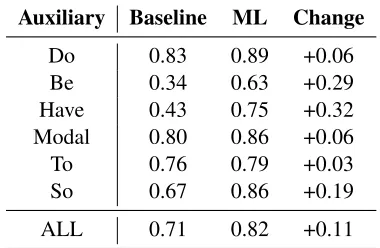
We evaluate our models as usual using precision, re-call and F1 metric for binary classification. The pri-mary results we present in this section are obtained through 5-fold cross validation over all 25 sections of the automatically-parsed dataset. We use cross validation because the train-test split suggested by Bos and Spenader (2011) could result in highly var-ied results due to the small size of the dataset (see Table 1). Because the vast majority of auxiliaries do not trigger VPE, we over-sample the positive cases during training. Table 2 shows a comparison be-tween the machine learning technique and a rule-based baseline for the six auxiliary forms. Table 3 shows results obtained from using the same train-test split used by Liu et al. (2016) in order to provide a direct comparison.
Results. Using a standard logistic regression clas-sifier, we achieve an 11% improvement in accuracy over the baseline approach, as can be seen in Table 2. The rule-based approach was insufficient forbeand
have VPE, where logistic regression provides the largest improvements. Although we improve upon the baseline by 29%, the accuracy achieved forbe -VPE is still low; this occurs mainly because: (i)be
is the most commonly used auxiliary, so the number of negative examples is high compared to the num-ber of positive examples; and, (ii) the analysis of the some of the false positives showed that there may have been genuine cases of VPE that were missed by the annotators of the dataset (Bos and Spenader, 2011). For example, this sentence (in filewsj 2057) was missed by the annotators (trigger in bold,
an-Auxiliary Baseline ML Change
Do 0.83 0.89 +0.06
Be 0.34 0.63 +0.29
Have 0.43 0.75 +0.32
Modal 0.80 0.86 +0.06
To 0.76 0.79 +0.03
So 0.67 0.86 +0.19
[image:4.612.331.521.59.183.2]ALL 0.71 0.82 +0.11
Table 2:VPE detection results (baseline F1, Machine Learning F1, ML F1 improvement) obtained with 5-fold cross validation.
Test Set Results P R F1
Liu et al. (2016) 0.8022 0.6134 0.6952
This work 0.7574 0.8655 0.8078
Table 3:Results (precision, recall, F1) for VPE detection using the train-test split proposed by Bos and Spenader (2011).
tecedent italicized) “Some people tend to ignore that a 50-point move isless in percentage termsthan it
was when the stock market was lower.”; here it is clear thatwasis a trigger for VPE.
In Table 3, we compare our results to those achieved by Liu et al. (2016) when using WSJ sets 0-14 for training and sets 20-24 for testing. We im-prove on their overall accuracy by over 11%, due to the 25% improvement in recall achieved by our method. Our results show that oversampling the pos-itive examples in the dataset and incorporating lin-guistically motivated syntactic features provide sub-stantial gains for VPE detection. Additionally, we consider every instance of the wordtoas a potential trigger, while they do not - this lowers their recall be-cause they miss every gold-standard instance ofto -VPE. Thus, not only do we improve upon the state-of-the-art accuracy, but we also expand the scope of VPE-detection to includeto-VPE without causing a significant decrease in accuracy.
5 Antecedent Identification
res-idential renovation” as the correct antecedent. Our approach to this problem begins with generating a list of candidate antecedents. Next, we build a fea-ture vector for each candidate by extracting feafea-tures from the context surrounding the trigger and an-tecedent. Lastly, we use these features to learn a weight vector by using the Margin-Infused-Relaxed-Algorithm.
5.1 Candidate Generation
We generate a list of candidate antecedents by first extracting all VPs and ADJPs (and all contiguous combinations of their constituents) from the current sentence and the prior one. We then filter these cdidates by predefining possible POS tags that an an-tecedent can start or end with according to the train-ing set’s gold standard antecedents. This method generates an average of 55 candidate antecedents per trigger, where triggers in longer sentences cause the creation of a larger number of candidate antecedents due to the larger number of VPs. This strategy ac-counts for 92% of the gold antecedents on the val-idation set by head match. We experimented with a less restrictive generation filter, but performance was not improved due to the much larger number of candidate antecedents.
5.2 Feature Extraction
We construct a feature vector representation for each candidate antecedent; in the example in Figure 1, for example, we would need feature vectors that differ-entiate between the two potential antecedents “in-cludes money” and “in“in-cludes money spent on resi-dential renovation”.
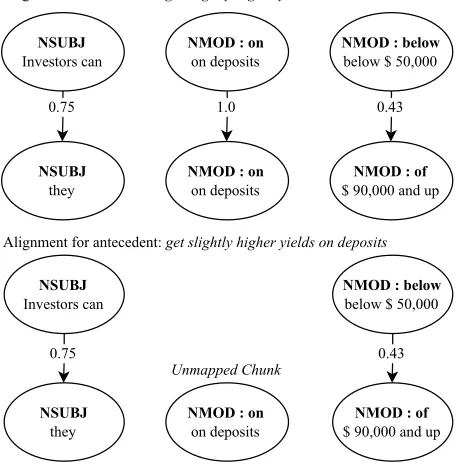
[image:5.612.313.542.115.347.2]Alignment. This feature set results from an align-ment algorithm that creates a mapping between the S-clause nearest to the trigger, St, and the S-clause nearest to the potential antecedent,Sa. The purpose of these features is to represent the parallelism (or lack thereof) between an antecedent’s local vicinity with that of the trigger. The creation of this align-ment algorithm was motivated by our intuition that the clause surrounding the trigger will have a par-allel structure to that of the antecedent, and that an alignment between the two would best capture this parallelism. In the example sentence in Figure 2 (trigger in bold, antecedent italicized) “Investors can
Figure 2:Alignment algorithm example with simplified depen-dencies.
get slightly higher yieldson deposits below $50,000 than theycanon deposits of $90,000 and up” a sim-ple observation of parallelism is that both the trig-ger and the correct antecedent are followed by the phrase “on deposits”.
In the example in Figure 2 we can see that the correct antecedent, “get slightly higher yields”, has a stronger alignment than the incorrect one, “get slightly higher yields on deposits”. This occurs be-cause we remove the candidate antecedent from its S-clause before creating the chunks; this leaves three nodes for the correct antecedent which map to the three nodes of the trigger’s S-clause. However, this process only leaves two nodes for the incorrect can-didate antecedent, thus causing one chunk to be un-mapped, thus creating a weaker alignment.
We then use this mapping to generate a feature vector for the antecedent, which contains: the mini-mum, maximini-mum, average, and standard deviation of the scores between chunks in the mapping; the num-ber and percentage of unmapped chunks; the depen-dencies that have (and have not) been mapped to; the dependency pairs that were mapped together; and the minimum, maximum, average, and standard de-viation of the cosine-similarity between the average word embedding of the words in a chunk between eachdi, dj pair in the mapping.
NP Relation. These features compare the Noun Phrase (NP) closest to the antecedent to the NP clos-est to the trigger. This is motivated by an obser-vation of many instances of VPE where it is often the case that the entity preceding the trigger is either repeated, similar, or corefers to the entity preced-ing the antecedent. The relationship between each
NPis most significantly represented by features cre-ated with pre-trained word2vec word embeddings (Mikolov et al., 2013). For each NP, and for each word in the NP, we extract its pre-trained word em-bedding and then average them all together. We then use the cosine similarity between these two vectors as a feature.
Syntactic. Syntactic features are based on the re-lationship between the candidate antecedent’s parse tree with that of the trigger. This feature set includes the following features, with the last three being in-fluenced by Hardt’s (1997) “preference factors” (a= candidate antecedent,t= trigger):
ifa’s first word is an auxiliary
ifa’s head (i.e., first main verb) is an auxiliary
the POS tag ofa’s first and last words
the frequency of each POS tag in the antecedent
the frequency of each phrase (i.e., NP, VP, ADJP, etc.) ina’s sentence andt’s sentence
if “than”, “as”, or “so” is betweenaandt
if the word beforeahas the same POS-tag or lemma ast
if a word inac-commands a word int
ifa’s first or last word c-commands the trigger
Be-Do Form:if the lemma of the token
preced-ingaisbeand thet’s lemma isdo
Recency:distance betweenaandtand the dis-tance between thet’s nearest VP anda
Quotation:iftis between quotation marks and similarly fora
Matching. This last feature set was influenced by the features described by Liu et al. (2016). We only use the “Match” features described by them; namely: whether the POS-tags, lemmas, or words in a two-token window before the start of the an-tecedent exactly match the two before the trigger; and whether the POS-tag, lemma, or word of theith token before the antecedent equals that of thei-1th token before the trigger (for i ∈ {1,2,3}, where i= 1considers the trigger itself).
5.3 Training Algorithm - MIRA
Since many potential antecedents share relatively similar characteristics, and since we have many fea-tures and few examples, we use the Margin-Infused-Relaxed-Algorithm (MIRA) in order to identify the most likely potential antecedent. MIRA maximizes the margin between the best candidate and the rest of the potential antecedents according to a loss function. It has been used for tasks with similar characteristics, such as statistical machine transla-tion (Watanabe et al., 2007).
The training algorithm begins with a random ini-tialization of the weight vector w. The training set contains triggers, each trigger’s candidate an-tecedents, and their gold standard antecedents; it is reshuffled after each training epoch. We find the Khighest-scoring potential antecedents,a1, . . . , ak, according to the current weight value. A learn-ing rate parameter determines how much we retain the new weight update with respect to the previous weight vector values.
vector that, when multiplied with a feature vectorfi, gives the highest score to the antecedent that is most similar to the gold standard antecedent,a∗. This is posed as an optimization problem:
minimize
wi k
wi−wi−1k+C
K
X
k ξk
subject to wi·a∗−wi·ak+ξk≥L(a∗, ak), k= 1, . . . , K
(1) Here,Lis the loss function that controls the mar-gin between candidates and the gold standard; it is defined as the evaluation metric proposed by Bos and Spenader (2011) (described in Section 5.5).
The ξ are slack variables andC ≥ 0is a hyper-parameter that controls the acceptable margin. This problem is solved by converting it to its Lagrange dual form6.
5.4 Baseline Algorithm
The baseline we created was motivated by Bos’s (2012) baseline algorithm: given a trigger, return as the antecedent the nearest VP that does not include the trigger. This is a na¨ıve approach to antecedent identification because it does not consider the re-lationship between the context surrounding the an-tecedent and the context surrounding the trigger.
5.5 Experiments
We evaluate our results following the proposed met-rics of Bos and Spenader (2011), as do Liu et al. (2016). Accuracy for antecedent identification is computed according ton= the number of correctly identified tokens between the candidate antecedent and the gold standard antecedent. Precision is n divided by the length of the candidate antecedent, recall is ndivided by the length of the correct an-tecedent, and accuracy is the harmonic mean of pre-cision and recall. For MIRA, final results are deter-mined by choosing the weight vector that achieved the best performance on a validation set that is split off from part of the training set, as calculated after each update step.
6In this study, the dual form was implemented by hand using
Gurobi’s python API (Gurobi Optimization Inc., 2015).
Auxiliary Baseline MIRA Change
do 0.42 0.71 +0.29
be 0.37 0.63 +0.26
modal 0.42 0.67 +0.25
so 0.15 0.53 +0.38
have 0.39 0.61 +0.22
to 0.03 0.58 +0.55
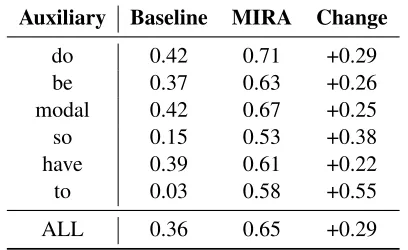
[image:7.612.325.529.59.184.2]ALL 0.36 0.65 +0.29
Table 4:Results (baseline accuracy, MIRA accuracy, accuracy improvement) for antecedent identification; obtained with 5-fold cross validation.
End-to-end Results P R F1
Liu et al. (2016) 0.5482 0.4192 0.4751
This work 0.4871 0.5567 0.5196
Table 5: End-to-end results (precision, recall, F1) using the train-test split proposed by Bos and Spenader (2011).
MIRA has several hyper-parameters that were tuned through a grid search over the validation set. The most crucial parameters were the learning rate α, andC, while the value ofKdid not cause signif-icant changes in accuracy.
Results. In Table 4, we see that MIRA improves upon the baseline with a 29% increase in overall ac-curacy. MIRA provides significant gains for each form of VPE, although there is room for improve-ment, especially when identifying the antecedents of
do-sotriggers.
Excluded P R F1
Auxiliary 0.7982 0.7611 0.7781
Lexical 0.6937 0.8408 0.7582
Syntactic 0.7404 0.7330 0.7343
[image:8.612.348.505.58.155.2]NONE 0.8242 0.8120 0.8170
Table 6: Feature ablation results (feature set excluded, preci-sion, recall, F1) on VPE detection; obtained with 5-fold cross validation.
In Table 5 we present end-to-end results obtained from our system when using the triggers detected by our VPE detection model (see Section 4). We com-pare these results to the end-to-end results of the best model of Liu et al. (2016). Following Liu et al., we assign partial credit during end-to-end evaluation in the following way: for each correctly detected (true positive) trigger, the Bos and Spenader (2011) an-tecedent evaluation score between the trigger’s pre-dicted antecedent and its gold antecedent is used (as opposed to a value of 1). As can be seen from Table 5, we trade about 6 points of precision for 14 points of recall, thus improving state-of-the-art end-to-end accuracy from 47.51% to 51.96%.
6 Feature Ablation Studies
We performed feature ablation experiments in order to determine the impact that the different feature sets had on performance.
Trigger Detection. In Table 6 we can see that the syntactic features were essential for obtaining the best results, as can be seen by the 8.3% improve-ment, from 73.4% to 81.7%, obtained from includ-ing these features. This shows that notions from the-oretical linguistics can prove to be invaluable when approaching the problem of VPE detection and that extracting these features in related problems may improve performance.
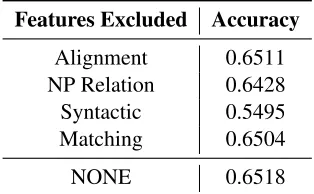
Antecedent Identification. Table 7 presents the results from a feature ablation study on antecedent identification. The most striking observation is that the alignment features do not add any significant im-provement in the results. This is either because there simply is not an inherent parallelism between the
Features Excluded Accuracy
Alignment 0.6511
NP Relation 0.6428
Syntactic 0.5495
Matching 0.6504
[image:8.612.94.279.59.141.2]NONE 0.6518
Table 7: Feature ablation results (feature set excluded, preci-sion, recall, F1) on antecedent identification; obtained with 5-fold cross validation.
trigger site and the antecedent site, or because the other features represent the parallelism adequately without necessitating the addition of the alignment features. The heuristic syntactic features provide a large (10%) accuracy improvement when included. These results show that a dependency-based align-ment approach to feature extraction does not rep-resent the parallelism between the trigger and an-tecedent as well as features based on the lexical and syntactic properties of the two.
7 Conclusion and Future Work
We presented an approach for the tasks of Verb Phrase Ellipsis detection and antecedent identifica-tion that leverages features informed both by the-oretical linguistics and NLP, and employs machine learning methods to build VPE detection and an-tecedent identification tools using these features. Our results show the importance of distinguishing VPE triggers from each other, and highlight the im-portance of using the notion of c-command for both tasks.
For VPE detection, we improve upon the accu-racy of the state-of-the-art system by over 11%, from 69.52% to 80.78%. For antecedent identification, our results significantly improve upon a baseline al-gorithm and we present results that are competitive with the state-of-the-art, as well as state-of-the-art results for an end-to-end system. We also expand the scope of previous state-of-the-art by including the detection and resolution ofto-VPE, thus building a system that encompasses the entirety of the Bos and Spenader (2011) VPE dataset.
inves-tigate other margin-based optimizations similar to MIRA, but perhaps even more resilient to over-fitting. We also seek to improve the antecedent iden-tification approach by extracting stronger features.
Acknowledgments
This work was funded by McGill University and the Natural Sciences and Engineering Research Council of Canada via a Summer Undergraduate Research Project award granted to the first author. We thank the anonymous reviewers for their helpful sugges-tions, and we thank Nielsen, Hector Liu, and Edgar Gonz`alez for their clarifying remarks over email.
References
David Ahn. 2006. The stages of event extraction. In
Proceedings of the Workshop on Annotating and Rea-soning about Time and Events, pages 1–8. Association for Computational Linguistics.
Cosmin Adrian Bejan and Sanda Harabagiu. 2010. Un-supervised event coreference resolution with rich lin-guistic features. In Proceedings of the 48th Annual Meeting of the Association for Computational Linguis-tics, pages 1412–1422. Association for Computational Linguistics.
Johan Bos and Jennifer Spenader. 2011. An annotated corpus for the analysis of VP ellipsis. Language Re-sources and Evaluation, 45(4):463–494.
Johan Bos. 2012. Robust VP ellipsis resolution in DR theory. In Staffan Larsson and Lars Borin, editors,
From Quantification to Conversation, volume 19 of
Tributes, pages 145–159. College Publications. Andrew Carnie. 2013. Syntax: A generative
introduc-tion. John Wiley & Sons.
Koby Crammer, Ofer Dekel, Joseph Keshet, Shai Shalev-Shwartz, and Yoram Singer. 2006. Online passive-aggressive algorithms. The Journal of Machine Learn-ing Research, 7:551–585.
Mary Dalrymple, Stuart M Shieber, and Fernando CN Pereira. 1991. Ellipsis and higher-order unification.
Linguistics and Philosophy, 14(4):399–452.
Gurobi Optimization Inc. 2015. Gurobi optimizer refer-ence manual.
Daniel Hardt. 1992. An algorithm for VP ellipsis. In
Proceedings of the 30th Annual Meeting on Associa-tion for ComputaAssocia-tional Linguistics, pages 9–14. Asso-ciation for Computational Linguistics.
Daniel Hardt. 1997. An empirical approach to VP ellip-sis.Computational Linguistics, 23(4):525–541.
Jin-Dong Kim, Tomoko Ohta, Sampo Pyysalo, Yoshi-nobu Kano, and Jun’ichi Tsujii. 2009. Overview of BioNLP ’09 shared task on event extraction. In
Proceedings of the Workshop on Current Trends in Biomedical Natural Language Processing: Shared Task, pages 1–9. Association for Computational Lin-guistics.
Heeyoung Lee, Marta Recasens, Angel Chang, Mihai Surdeanu, and Dan Jurafsky. 2012. Joint entity and event coreference resolution across documents. In
Proceedings of the 2012 Joint Conference on Empir-ical Methods in Natural Language Processing and Computational Natural Language Learning, pages 489–500. Association for Computational Linguistics. Zhengzhong Liu, Jun Araki, Eduard H Hovy, and Teruko
Mitamura. 2014. Supervised within-document event coreference using information propagation. InLREC, pages 4539–4544.
Zhengzhong Liu, Edgar Gonzalez, and Dan Gillick. 2016. Exploring the steps of verb phrase ellipsis. In
Proceedings of the Workshop on Coreference Resolu-tion Beyond OntoNotes (CORBON 2016), co-located with NAACL 2016, pages 32–40.
Christopher D. Manning, Mihai Surdeanu, John Bauer, Jenny Finkel, Steven J. Bethard, and David McClosky. 2014. The Stanford CoreNLP natural language pro-cessing toolkit. InAssociation for Computational Lin-guistics (ACL) System Demonstrations, pages 55–60. Ryan McDonald, Koby Crammer, and Fernando Pereira.
2005. Online large-margin training of dependency parsers. InProceedings of the 43rd Annual Meeting on Association for Computational Linguistics, pages 91–98. Association for Computational Linguistics. Tomas Mikolov, Ilya Sutskever, Kai Chen, Greg S
Cor-rado, and Jeff Dean. 2013. Distributed representa-tions of words and phrases and their compositionality. InAdvances in neural information processing systems, pages 3111–3119.
Leif Arda Nielsen. 2005.A Corpus-Based Study of Verb Phrase Ellipsis Identification and Resolution. Ph.D. thesis, King’s College London.
Alan Ritter, Oren Etzioni, Sam Clark, et al. 2012. Open domain event extraction from twitter. InProceedings of the 18th ACM SIGKDD international conference on Knowledge discovery and data mining, pages 1104– 1112. ACM.
Ivan A Sag. 1976. Deletion and logical form. Ph.D. thesis, Massachusetts Institute of Technology. David Vadas and James Curran. 2007. Adding noun