Iranian journal of educational Sociology
(Interdisciplinary Journal of Education)Available online at: http://www.iase-idje.ir/ Volume 2, Number 2, July2019
Design and validation of a model for improvement of in-service
training evaluation system
Forogh Peymanfard1, Alireza assare2, Gholamhossein barekat3, Mohammad Hosseinpour4
1. PhD student, Department of Educational Management, Ahvaz Branch, Islamic Azad University, Ahvaz, Iran
2. Invited associate Professor, Department of Educational Management, Ahvaz Branch, Islamic Azad University, Ahvaz, Iran. Department of Curriculum Planning, Shahid Rajaee Tarbiat Dabir University, Tehran, Iran
3. Associate Professor Associate Professor, Department of Educational Management, Ahvaz Branch, Islamic Azad University, Ahvaz, Iran 4. Associate Professor Associate Professor, Department of Educational Management, Ahvaz Branch, Islamic Azad University, Ahvaz, Iran
Article history:
Received date: 5 January 2019 Review date: 20 March 2019 Accepted date: 22 March 2019
Abstract
Purpose: The purpose of this study was to design and validate a model for improving in-service training of medical university staff.
Methodology: This research is an applied type of qualitative-quantitative research. The study population consisted of 15 elites who were selected through purposive sampling and in the quantitative section of 380 persons by stratified random sampling with proportional allocation among staff of Khuzestan University of Medical Sciences. The data were collected through structured interviews and a researcher-made questionnaire that was implemented in qualitative and quantitative sections, respectively. The findings showed that organizational development, role of instructor, assigned tasks, professional skill, training facilities, content, attitude to training, trust building, knowledge of elites and experts were among the influential components in in-service training.
Findings: Findings related to Structural Equation Technique using pls software also showed that all the above-mentioned components were significantly higher than the value of 1.96 at the significant level of 0.95. In other words, these components are highly influential in evaluating in-service education from the perspective of course learners.
Conclusion: The findings also showed that the improvement of in-service training evaluation system plays an important role in the effectiveness of the workforce as well as the proper training of human resources in the direction of achieving the goals of the system of managers in the Medical Sciences University.
Keywords:
Model Validation, Improving Evaluation System, In-Service Training, Staff,
Please cite this article: Peymanfard F, Assare A R, barekat Gh, Hoseinpour M. (2019). Design and validation of a model for improvement of in-service training evaluation system, Iranian journal of educational Sociology. 2(2):163-173.
Corresponding Author Email: [email protected]
1. Introduction
Training is aimed at inclusive development to enhance the competence of employees and to organize their performance as an approach to enhance learning and develop individual skills in how to improve the performance of the staff in future responsibilities (Snell & Jahanzeb, 2017). Successful training programs emphasize the increased knowledge, expertise, and ability of the workforce in the organization (Jenabzadeh and Ahmed Bashir, 2017). According to Selter, Grsel, Reinold, & Trempler (2015), one should not merely restrict proper behavior during training, but also appropriate behavior after training and in the workplace. Therefore, in-service training is one of the most effective tools recently "fully obsessed". The reason is that the organization will never be prepared to deal with environmental changes that require capacity building and capacity building to It can provide the right services for survival and sustainability in its business environment (Kyule, 2017).
A positive view of human resources training and improvement programs depends on adopting a targeted educational approach and paying attention to the evaluation of in-service education as one of the important steps in education decision making. Assessment of educational effectiveness is also of great importance and sensitivity, which, if applied in appropriate ways, will provide a more objective basis for planning (Jafarian, Samieian & Azari, 2016). Managers look at how and how the in-service education system is valued to guide forces on the path to excellence. Evaluating and monitoring in-service training courses provides useful information for designing and reviewing any training system (Hojati et al., 2013).
However, the effectiveness of evaluation depends to a large extent on its validation because validation is the only way to achieve quality assurance (Mojtaba Zadeh et al., 2016). According to the American Psychological Association (2016), validation is a validation by which the performance of an educational program or system can be assessed. From the perspective of the Western Association of School and College Accreditation, the Accreditation Commission for Colleges and Universities of Higher Education, accreditation means that all requirements regarding institutional capacity and educational effectiveness have been met (WASC-ACSCU 2013). As such, accreditation is the concession granted to any higher education institution for the purpose of meeting or exceeding the stated criteria of educational quality (Everest College 2016). Considering the many areas of medical careers in the universities and the need for skilled, creative and committed individuals, it is important to improve the monitoring system and evaluate the quality of in-service training and its validity. In the absence of such an achievement, achieving the educational and organizational goals of medical universities will be problematic. This will not be very welcoming to the Higher Education Organization space and will make its survival challenging. For this reason, evaluating the quality of in-service training of staff will shape the conditions to place the institution in a purposeful and efficient way. Although different models of in-service training such as SIP, Kirk Patrick, etc. have been developed by researchers such as Dehghani et all (2015), Hame Moradi, Khorasani, and Fathi Wajaragah (2014), Jahan Tigh (2012), Peirovian et all (2011), Rivera and Paradise (2006), Kerzner (2006), Winkel et all (2002), Comer (2002), Hosseini and Rivera (2001) have been done, but given the vastness of organizations, the sheer volume of specialized and specialized information, skills In particular, the improvement of the in-service training system has become more and more significant. In addition, identifying strengths and weaknesses, identifying threats and opportunities, and trying to improve the status quo and achieve a higher status than the tasks of organizations, including universities and medical systems, requires improvement of the quality of ongoing evaluation.
Ojiemhenkele (2014), using evaluation as a medication, evaluates it for in-service training, job effectiveness and employee productivity, updating and upgrading skills and knowledge, enhancing competence, confidence, and fostering a spirit of creativity in the workforce. It was important. Uysal (2012), in spite of the positive attitude of the staff towards in-service training, identified specific limitations in the planning conditions and evaluation stages and its impact on the working style of staff from future consequences in the field of in-service training.
Based on research conducted by Shoja et al. (2017), Abbasian, Salimi, Azin. (2008), Kyule (2017) evaluation of staff training courses is very important. Kyule (2017), found that training helps employees improve their job skills and have the capacity to accept new responsibilities. Training also helps employees improve problem-solving skills, while promoting staff training courses. Deros et al. (2012) stated that the implemented training programs have a positive effect on the organization and that the training programs are appropriate in terms of the length of the courses and the appropriate course design (appropriate evaluation). In addition, educational programs are appropriate for clear, clear and understandable educational pamphlets. Broman & Karlsson (2014) stated in their findings that most in-service training respondents believed that topics or topics covered in in-service training are useful, but that any training materials developed for the course In-service training needs to be given more attention. In addition, the lack of professional trainers is another issue for effective program execution. This demonstrates the effectiveness of instructors in in-service training. Jahangir et al. (2012) found that there were significant changes in learners' perceptions between pre-training and post-training. Okae-Anti (2007) found that in-service training affects staff performance in terms of skills and knowledge. Rostami, Nasr Esfahani, Neyestani (2017) concluded that the quality of training courses had a positive effect on enhancing acquired skills and increasing job knowledge and improving employees' job behavior. Farhadi and Doshman ziari (2017) concluded that in-service training courses were consistent with the educational content. Rahmatzehi et al. (2015) found that if in-service training is based on staff pre-knowledge, attitude will be higher.
Nave Ebrahim and Majidi (2015) found that in-service training courses had a positive role in enhancing the professional performance of employees and improving their job behavior. Yousefian and Alikhani (2015) conclude that in-service education designers and designers should strive to tailor the course to its volume and use new tools in its presentation. Mohammadi et al. (2014) found that in-service training should focus on job performance and staff skills. Hojati et al (2013), concluded that in-service training courses increase knowledge skills and make behavioral changes in learners. Danai and Ajili (2012) found that there is a positive and significant relationship between the effectiveness of in-service training courses with content, clear goals and topics, methods and means of training. Khorasani and Dosti (2011), found that designing and developing training programs can solve employees' functional problems. Reza Zadeh Bahadoran et al. (2011) concluded that in-service training is effective on staff performance. Hatami (2009) concluded that in-service training has a positive effect on job behavior, skills, knowledge, and attitudes. Noor Alizadeh and Afrasiabi (2018) found that in-service training leads to skills upgrading, service delivery, and improved accountability and increased employee knowledge.
Based on the above, it is very important to improve the in-service training system of today's staff, considering the organizational complexity of universities and the competitive and customer-oriented environment. In-service training based on past patterns is done in a simple, sometimes "irregular" way, with serious inefficiencies in the organizational performance of university staff that affects its competence. On the other hand, since the improvement of in-service education evaluation system has not been carried out in Khuzestan medical sciences universities, so this study aims to design and validate a model to improve the in-service education evaluation system of Khuzestan medical sciences universities. An effective step in capturing the minds of executives and practitioners working in these institutions. To become more aware of organizational and environmental realities in order to understand them more, they will in turn be able to develop their organizations' smart programs to achieve their goals as set out in the country's 20-year development plan. At the end of the present study, we are investigating questions such as how to improve the in-service training evaluation system for staff of Khuzestan University of Medical Sciences and the validity of in-service training evaluation system.
2. Methodology
The present study was an applied one and its method was based on the type and nature of this research on designing and validating a model for improving the evaluation system of in-service training of medical university staffs in a qualitative-quantitative approach. Therefore, as the research design is mixed, so the research method is in two stages, in two stages; qualitatively, in content analysis, for designing the model, and quantitatively in the field, using a questionnaire and surveying The comments and staff were studied. According to the method of the present study, the study population was divided into two qualitative and quantitative sections. Accordingly, the study population in the qualitative section consisted of 15 managers and specialists with management and training experience in Khuzestan University of Medical Sciences who had relatively long and long experience in Khuzestan University of Medical Sciences using sampling method.
Table 1. Characteristics of the interviewees in the qualitative section
In the quantitative section, the statistical population of the study included 380 employees of Khuzestan University of Medical Sciences using proportional stratified random sampling. The criterion for selecting these people was their participation in in-service training classes at least once. The qualitative data gathering tool consisted of structured interviews which consisted of 15 questions and were conducted in 45 to 60 minutes (duration of each interview). The researcher formulated the interview based on theoretical literature, research findings, objective observations, and the views of experts and professors. Therefore, the overall content of the interview has been in the field of concept and evaluation of in-service training, targeted training implementation, training feedback, understanding of failure factors, environmental and content context of training, staff selection, coaching skills and budget allocation. Also in the quantitative section, the data collection tool included a questionnaire based on the findings of the interview in 57 questions and in a 7-point range (completely "agree" - completely disagree). In the qualitative part of the research, the method used for analyzing the interview was coded in three stages: 1. open coding, 2. axial coding, 3. selective coding.
Validation or review by the interviewees was used to validate and determine the terms used in the in-service training focus and to improve its evaluation system. Accordingly, a number of interviewers were asked to review the interview and express their views on the terms used (focus group). Given this, the validity of the interview form was assured. The reliability between the two transition codes was also used to
Raw sex Field of
Study
Resume current job
1 Male medical Head of Medical School - Head of Hospital
Presidency of Medical Sciences University
2 Male medical Head of Health Center Deputy of Education and Research
3 Male Education Hospital and medical emergencies Director of Education and Postgraduate Affairs
4 Male medical The head of the hospital Head of Medical School
5 Male medical Head of University Health Staff University Human Resources Assistant
6 Male medical The head of the hospital Deputy of Medicine and Treatment
7 Female medical Head of Health Centers Vice chancellor for health, University of Medical Sciences
8 Female Doctor of Histology
Head of School Head of Piraeus School of Medicine
9 Male Histology Assistant Professor Assistant Professor of Piraeus School of Medicine
10 Male medical Assistant to the hospital Deputy of Education, Faculty of Medicine
11 Male Doctor of Histology
Head of Training Vice President of Clinical Medical Education
12 Male medical University Management Assistant Head of Department of Medicine
13 Male medical Deputy Director of the Hospital Vice Chancellor for Food and Drug Administration
14 Male medical The head of the hospital Vice President of University Development
15 Male Doctor of
Histology faculty member Sciences Director General of EDC Center of Medical
determine the reliability and norm of the interview. Accordingly, 5 interviews were selected from the total number of available interviews, and then the code was collected in two stages, with the number of agreeing codes and the number of non-agreeing codes being calculated and finally the percentages were calculated. The total score was 0.84 and indicated high reliability of the interview.
In the quantitative section, after determining the validity and reliability of the questionnaire by a panel of experts (supervisors and other faculty members), 5 individuals were selected for reliability. To do so, 30 legal questionnaires were reproduced and administered to the study population, who were staffed by Khuzestan University of Medical Sciences, through direct referral. Then, to obtain the reliability of the data obtained from the questionnaire, Cronbach's alpha coefficient was used using spss22 software. Based on this, the value of 0.863 was determined and the reliability and completeness of the questionnaire was confirmed.
3. Findings
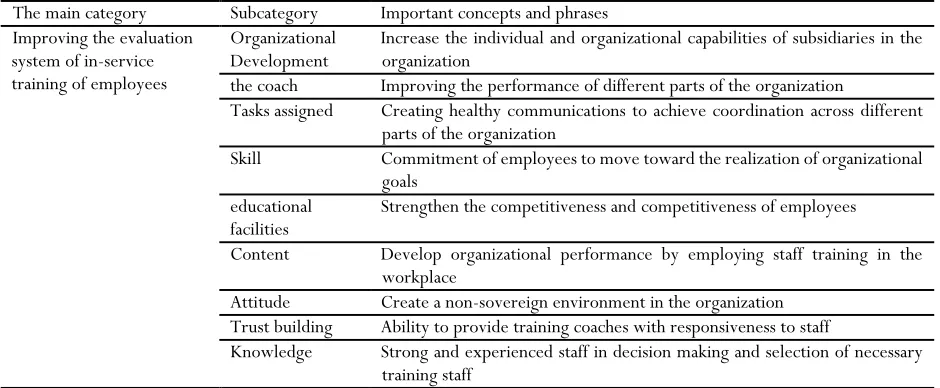
In order to investigate the proposed model for improving the in-service training system evaluation of the staff of Khuzestan University of Medical Sciences, the data obtained from the interviews were coded using three open, axial, selective coding methods to identify the main concepts and important components of the generalization. Extract and discover the interviews. Based on the open coding, the key points and key concepts were coded from the contents of the final interview file. On the basis of axial coding, those concepts that were consistent with each other were arranged and communicated to each other, and other extraneous content was removed and systematically coded, its components and concepts based on selective coding. The samples were identified and prepared as a whole. Accordingly, the concepts derived from the researchers' studies and the final results of the qualitative data analysis (Table 3) are presented:
Table 2. Results of qualitative data analysis The main category Subcategory Important concepts and phrases Improving the evaluation
system of in-service training of employees
Organizational
Development Increase the individual and organizational capabilities of subsidiaries in the organization the coach Improving the performance of different parts of the organization
Tasks assigned Creating healthy communications to achieve coordination across different parts of the organization
Skill Commitment of employees to move toward the realization of organizational goals
educational
facilities Strengthen the competitiveness and competitiveness of employees Content Develop organizational performance by employing staff training in the
workplace
Attitude Create a non-sovereign environment in the organization Trust building Ability to provide training coaches with responsiveness to staff
Knowledge Strong and experienced staff in decision making and selection of necessary training staff
According to Table 2, it is observed that, after deletion and deletion of additional data by experts, a total of 9 main components (organization maturity, coach, assigned tasks, skills, educational facilities, content, attitude, confidence building, knowledge) And 56 attributes were determined. Accordingly, organizational development (7 attributes), coach (10 attributes), assigned tasks (8 attributes), skills (2 attributes), training facilities (10 attributes), content (10 attributes), attitude (2 attributes), Confidence building (5 traits), knowledge (2 traits), were finally identified and based on this, the improvement model of the in-service training evaluation system is presented as follows:
Improving the in-service training evaluation system نانکراک Organizatio nal Developme nt Skill Tasks assigned educational facilities Content the coach Confidence Knowledge Attention
- Increase the individual and organizational capabilities of subsidiaries in the organization
- Improving the
performance of different parts of the organization - Creating healthy communications to achieve coordination across different parts of the organization
- Commitment of
employees to move toward the realization of organizational goals - Enhance employee competitiveness and competitiveness
- The ability of instructors to respond to staff
- Strong and experienced staff in decision making and selection of necessary training staff - Expert, experienced, experienced and expert trainers - Full academic mastery of instructors - Student-centered teaching
- Ability of coaches to influence staff in training
- Using high quality instructional and leadership coaches - Using experienced and experienced in-service trainers - Selection of expert trainers with the right ability to hold training classes
- High expression and transfer power of instructors - Employees' ability
to modify
organizational performance barriers - Increase the effectiveness of employees across multiple
organizational units - Strengthening the critical spirit of staff in performing their assigned tasks - Updating staff information on assigned tasks - Becoming more knowledgeable about the process of doing staff work
- Change the behavior of employees in performing assigned tasks
- Staff readiness to take on assigned tasks - High capacity
building of staff in the area of organizational skills
- Enhance employee creativity and innovation - Correct editing of
training programs - Identification of the components needed by the trainers for staff training
- Consider the individual abilities of staff in training courses - Use of equipped workshops
- Using the most efficient teaching tools - Using advanced in-service training evaluation systems - Controlling the teaching hours according to the volume of materials provided
- Applying modern teaching methods - Adapt the learning environment to the needs and attitudes of the staff
- Analyze the results of - Effectiveness of
educational content tailored to organizational needs - Effectiveness of educational content tailored to staff tasks
- Enjoy educational content from headings, sections and more
- Developing educational content according to the skills required of the staff - Fit between educational content and staff education level
- The content of the training is consistent with the in-service training objectives of the organization - Adjust training content to improve employee performance
- Provide educational content that can solve employee problems in the organization
- Develop targeted views of trained staff on the path to organizational growth
- Change the attitude of employees based on the training they have received
- Scoring staff in the training process - Involvement of staff in educational discussions - Using a variety of methods to encourage staff in the training process
- Using staff
suggestions and criticisms in the training process - Providing training certification to staff
- Enhance applied knowledge to enhance employee motivation - Upgrading the knowledge and science capacity of the staff
Figure 1. reposed Model for Improving In-Service Training Evaluation System
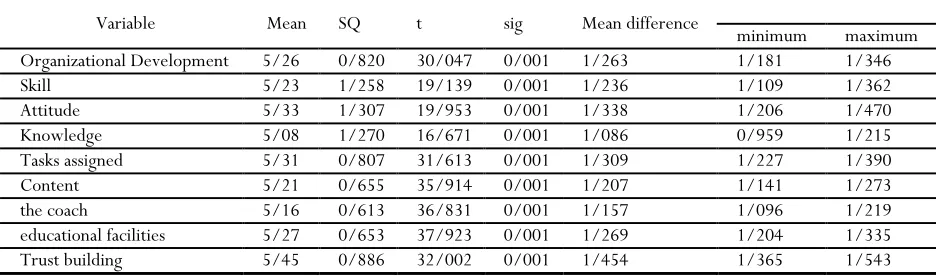
To answer the question of improving the in-service training evaluation system, quantitative data was used by a researcher-made questionnaire that measures the components of organizational development, skill, attitude, knowledge, assigned tasks, facilities, content, coaching and trust building. puts. Accordingly, the characteristics of the mentioned components using the t-student test are presented in Table 3:
Table 3. Results of the t-student test for examining the status of factors affecting the model of in-service training evaluation
Variable Mean SQ t sig Mean difference minimum maximum Organizational Development 5/26 0/820 30/047 0/001 1/263 1/181 1/346
Skill 5/23 1/258 19/139 0/001 1/236 1/109 1/362
Attitude 5/33 1/307 19/953 0/001 1/338 1/206 1/470
Knowledge 5/08 1/270 16/671 0/001 1/086 0/959 1/215
Tasks assigned 5/31 0/807 31/613 0/001 1/309 1/227 1/390
Content 5/21 0/655 35/914 0/001 1/207 1/141 1/273
the coach 5/16 0/613 36/831 0/001 1/157 1/096 1/219
educational facilities 5/27 0/653 37/923 0/001 1/269 1/204 1/335 Trust building 5/45 0/886 32/002 0/001 1/454 1/365 1/543
As can be seen in Table 3, the significance level of the test for all the variables is less than 0.05 and the confidence interval is in the range of positive numbers. Therefore, the condition of these variables is desirable. Considering the desirability of the research variables status, in this section, using pls software, the factors affecting the improvement of in-service education system evaluation of staff of Khuzestan University of Medical Sciences were investigated.
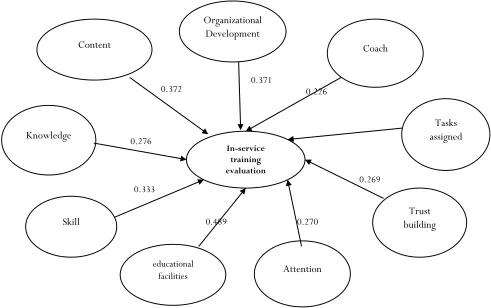
Figure 2. Standard Path Coefficients of the Conceptual Research Model
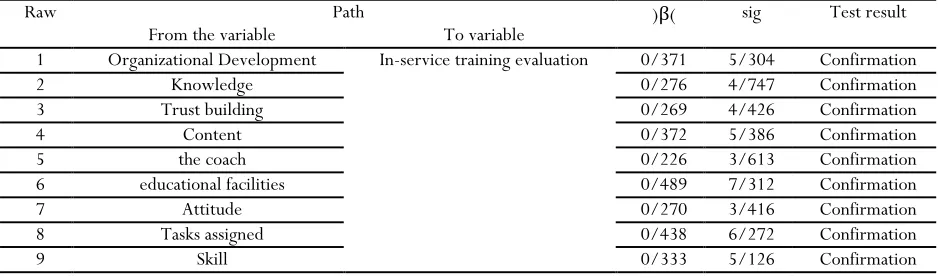
Numbers written on paths display path coefficients. The significance of the path coefficients was calculated using bootstrap method. If the t-student test values are greater than 1.96, the path coefficient is significant at 0.05 level. According to the above figure, several criteria were used to evaluate the quality of the model. The criterion relates to hidden endogenous (dependent) variables of the model. It is a criterion indicating the effect of an exogenous variable on a prospective variable and three values of 0.19, 0.33 and 0.67 are considered as the criterion value for weak, medium and strong values. . According to Figure 3, the value for the in-service construct of in-service training evaluation was calculated to be 0.899 which confirms the suitability of the structural model with respect to the criterion value. The next criterion is the criterion that specifies the model's projected power and, if it has three values of 0.02, 0.15, and 0.35 for an endogenous structure, respectively, indicating power. Predicts weak, medium, and strong progeny or related exogenous structures. The value for the endogenous construct of in-service training evaluation was calculated to be 0.224 which indicates the average predictive power of the model for endogenous research structures and confirms the appropriate fit of the structural model. The last criterion used is the GOF criterion introduced for fitting, the general fitting criterion (GOF), which is calculated and calculated by calculating the geometric mean of the mean: The index ranges between zero and one and values close to a quality marker. They are suitable for the model and examine the ability to predict the overall model and whether the tested model has been successful in predicting endogenous variables. The GOF value for the research model in accordance with Table 6 was calculated to be 0.514 indicating the average power of the model in predicting the endogenous variable of the model. However, software output was used to test the significance of the path coefficients between variables. The path coefficients and their significant results are given in Table 4.
Attention
Tasks assigned
educational facilities
Coach Content
Trust building Skill
Knowledge
In-service training evaluation
Organizational Development
0.276
0.269
0.372 0.371 0.226
0.270 0.333
0.489
Table 4. Results of structural model evaluation
Raw Path (β) sig Test result
From the variable To variable
1 Organizational Development In-service training evaluation 0/371 5/304 Confirmation
2 Knowledge 0/276 4/747 Confirmation
3 Trust building 0/269 4/426 Confirmation
4 Content 0/372 5/386 Confirmation
5 the coach 0/226 3/613 Confirmation
6 educational facilities 0/489 7/312 Confirmation
7 Attitude 0/270 3/416 Confirmation
8 Tasks assigned 0/438 6/272 Confirmation
9 Skill 0/333 5/126 Confirmation
4. Conclusion
Qualification of education is required, utilizing performance measures and training effectiveness in medical university forces. Therefore, evaluation programs are based on strategic components to make it possible to evaluate the performance of in-service training and to optimize it in such circumstances. In this way, the strengths and weaknesses are screened and based on such precise categories, their accuracy can be etched and modified in the form of strategic suggestions to further enhance these courses. According to the results of this careful study, the proposed design pattern shows high reliability and all the components have sufficient operational load. Results of Structural Equation Assessment with respect to each of the discovered components showed that organizational development with 5.304 significant and 0.371 path coefficients; knowledge with 4.747 significant and path coefficient 276. Reliability with meaningful statistic of 4.426 and path coefficient of 0.269; Content with meaningful statistic of 5.386 and path coefficient of 0.372; Instructor with meaningful statistic of 3.613 and path coefficient of 0.222; Educational facilities with statistic 731/7 meaningfulness with path coefficient of 0.489; attitude with meaningful statistic of 3.416 and path coefficient of 0.207; tasks assigned with meaningful statistic of 6.272 and path coefficient of 0.384; skill with meaningful statistic of 5.126 and path coefficient. It was 0.438. Accordingly, among the aforementioned components, educational facilities with path coefficient of 0.489 had the most impact on improving in-service training evaluation system in Khuzestan University of Medical Sciences and instructor with path coefficient of 0.222 had the least effect for Improvement of in-service education evaluation system in Khuzestan University of Medical Sciences. Results obtained with the findings of Kyule (2017), Deros et al. (2012), Broman & Karlsson (2014), Jahangir et al. (2012), Okae-Anti (2007), Rahmat Zehi et al. (2018), Rostami et al. Et al (2017), Farhadi and Doshman ziari (2017), Nave Ebrahim and Majidi (2015), Yousefian and Alikhani (2015), Mohammadi et al (2014), Hojati et al (2013), Danai and Ajili (2012), Khorasani and Dosti (2011), Hatami (2009), Noor Alizadeh and Afrasiabi (2018), have been consistent. Therefore, the above mentioned components in order of priority (educational facilities, assigned tasks, content, organizational development, skills, knowledge, confidence building, attitude, coach) have been involved in the improvement of in-service training evaluation system in Khuzestan University of Medical Sciences. Considering the coefficients of significant statistical statistics higher than 1.96, it can be concluded with 95% confidence that the components of direct marketing have a direct impact on improving in-service education evaluation system and have higher than average validity.
The human resources as one of the decisive and influential elements in the dynamics and growth of the service complex that requires their intelligent management in the path of personal and organizational growth and excellence. Under these circumstances, the organization will lead the organization in a competitive position and gain agile, agile and propelling advantages in a way that enhances its interactive capabilities and capabilities with the surrounding environment. Since medical universities are working in the demanding conditions of a post-modernist, diverse society, they must employ skilled and skilled forces to carry out their
assigned tasks. Therefore, the need for effective and efficient management is to place knowledge-based organizations such as medical sciences on the path of growth and excellence, their competitive advantage, robustness, dynamism and flexibility against environmental changes, which, if minimized by their destructive and deteriorating power, are destiny. Shades the collections as a whole. But updating and equipping knowledge-based institutions such as medical sciences with tools to adapt and adapt to challenging business environments through the talent and capacity building of active forces in micro-systems using agile trainers is increasingly essential and it is inevitable.
These requirements are reminiscent of the macroeconomic managers concerned, as required by the conditions governing the activities of the institutions, budgetary priorities, and risk-taking. Hence, the nature of business environment diversification and demanding requires organizations that are always ready to pay attention to organizational development, skills, attitudes, knowledge, assigned tasks, training facilities, educational content, specialized and trained coaches, Trust and so on, are subject to continuous and systematic evaluation. The analysis of the findings of this study calls for a rigorous look at the following topics that can be used as research suggestions to enhance competitiveness and competitiveness of employees; optimally and effectively utilize the space and educational facilities to make staff learning more meaningful; Employee Organizational Commitment cited all of the university's organizational tasks, particularly the tasks assigned and the most effective curriculum development, taking into account the individual needs and abilities of the staff in their field of work.
References
Abbasian A, Salimi Q, Azin R. (2008). Evaluation of Quality of Engineering Training Case Study Evaluating the Effectiveness of Resistance Welding Courses Based on Kirk Patrick Model. Iranian Journal of Engineering Education, 39(3): 2-37.
Broman A, Karlsson P. (2014). In- service training programs for school’s teachers in Afghanistan teacher’s views about effectiveness of the in- service training. Faculty of arts and social science, 1-36.
Comer M. M. (2002). jul 17. Food Safety for healthy Missouri families: evaluation of program effectiveness. Retrieved from at: http://www.joe.org/joe/2002august/rb3.shtml, Accessed April 30 2007.
Danai M, Ajili A. (2012). Evaluation of in-service training (word processing skills) from the staff's point of view. State Management, 4(9): pp. 26-15.
Dehghani A, Daghighi Asli AR, Pourvali F, V. (2015). The effect of in-service training on employee empowerment and job performance in an insurance company. Insurance Research Journal, Thirty-30(2): 60-35.
Deros B. M, Saibani Nizaroyani Y, Bahrim R, Nizam Ab, Et all. (2012). Evaluation of training effectiveness on advanced quality management practices. social and behavioral sciences, (56): 67-73.
Everest College. (2016). jul 17. How our accreditation benefits you? Retrieved from at: http://www.everestonline.edu Farhadi A, Doshman ziari E. (2017). The Relationship between the Content of General In-Service Training Courses with National
Iranian Oil Distribution Company Employees and their Performance Evaluation Measures. Quarterly Scientific Journal, New Process,12(57): 98-107
Hame Moradi M, Khorasani A, Fathi Wajaragah K (2014). Evaluating the effectiveness of in-service training courses of National Iranian Gas Company based on three models: Patrick, Philips and SIP. Journal of Human Resource Management in the Oil Industry, 6(19): 103-130.
Hatami H. (2009). Evaluation and Evaluation of the Effectiveness of In-Service Training of Human Resources Studies Office in Improving the Performance of Managers, Academic Staff and Staff of Academic Units in Area One of Islamic Azad University. New Approach to Educational Management, 2(5): 100-75.
Hojati H, Mehr Alizadeh Y, Farhadi H, Alvestani S, Et all. (2013). Effective evaluation of in-service training courses based on Patrick's model. Journal of Nursing Management, Second Year, 2(1): 42-35.
Hosseini J, Rivera W. (2001). Effectiveness of Maryland nutrient management program in reducing crop nutrient use by livestock farmers in Maryland. Journal of extension systems, 17(2): 28-40.
Jafarian H, Samieian M, Azari A. (2016). Evaluation of the effectiveness of in-service training courses for police officers of Chaharmahal va Bakhtiari province in 2015 based on Kirk Patrick Evaluation Model. Management Studies in Law Education, 3(1): 1-15
Jahan tigh E. (2012). Evaluation of the Status and Effectiveness of In-Service Training in Public Libraries of Golestan Province. End of master's letter. Mashhad Ferdowsi University.
Jahangir S F, Saheen N, and Kazim S F. (2012). In Service Training: A Contributory Factor Influencing Teachers’ Performance. International Journal of Academic Research in Progressive Education and Development, 1(1): 31-38.
Jenabzadeh Kh, Ahmed Bashir N. (2017). Training and Development Program and its Benefits to Employee and Organization: A Conceptual Study. European Journal of Business and Management, 5(2): 243-253.
Kerzner R A. (2006). jul 17. Are we training for success? Limra's Market facts quarterly. Retrieved from at: http://proquest.umi.com/pqdweb.
Khorasani A, Dosti H. (2011). Evaluating the effectiveness of in-service engineering courses based on the model of return on capital. Iranian Journal of Engineering Education, Thirteenth Year, 50(1): 122-103.
Kyule Ph. (2017). An Assessment on the Effect of In-Service Training on Employees Performance: A Case of Secretaries in Baringo County, Kenya. International journal of innovative research & development, 6(9): 195-225.
Mohammadi Sh, Jalilian S, Mashhadi Abas F, Rigi N. (2014). The Effectiveness of In-Service Training of Zahedan University of Medical Sciences Personnel on Job Performance. Presented at the First International Conference on Economics, Management, Accounting and the Social Sciences.
Mojtaba zadeh M, Abbaspour A, Maleki H, Farostkhah M, Et all. (2016). Designing and validating scales for quality assessment of Iranian universities. Journal of Medical Education Strategies, 9(1): 62-42.
Nave Ebrahim R, Majidi D. (2015). Evaluating the Effectiveness of In-Service Training Courses in Promoting the Job Performance of Police Officers. Journal of Resource Management Research in Law Enforcement, 2(3): 118-95.
Noor Alizadeh R, Afrasiabi A. (2018). Evaluating the Effectiveness of In-Service Training Courses in Khuzestan Police Command Based on Halton Model (Case Study: Khuzestan Police Command Staff in 2016). Presented at the 6th Iranian Scientific Conference on Educational and Psychological Sciences, Social and Cultural Injuries.
Ojiemhenkele A E. (2014). In-Service Training: A Panacea For Teachers’ Job Effectiveness and Productivity. Department of Educational Foundations and Management, Faculty of Education, Ambrose Alli University, Ekpoma.
Okae- Anti C. (2007). Assessing the Impact of In-Service Training on Staff Performance at University of Education, Winneba Campus, Ghana. International Journal of Educational Research, 3(2): 217-224.
Peirovian F, Shirali H, Najafi M, Bahramkhani F. (2011). Evaluation of the effectiveness of in-service training courses of staff of Qazvin University of Medical Sciences in 2011 based on Kirk Patrick Evaluation Model. Journal of Qazvin University of Medical Sciences
Rahmatzehi Kh, Azar Noush O, Akhwa M, Yaghoubi M. (2018). Evaluating the effectiveness of in-service training courses for education teachers. Presented at the 11th International Conference on Psychology and Educational Sciences.
Reza Zadeh Bahadoran, H R, Khosravi Babadi A A, Tonabat Haghighi S. (2011). The Influence of In-Service Training on Staff Performance of Islamic Azad University of South Tehran Branch Based on Kirk Patrick Model. Journal of Economics and Business, 11(3): 22-41.
Rivera R J, Paradise A. (2006). State of the industry in leading enterprises. ASTD annual review of trends in workplace learning and performance. Alexandria, VA: ASTD press.
Rostami H, Nasr Esfahani AR Neyestani MR. (2017). Evaluation of Knowledge and Skills Acquisition of Employees and Empowerment of In-Service Training Courses in Central Province Jihad Organization. Agricultural Extension and Education Research, 2(1): 31-39.
Selter C, Grsel C, Reinold M, Trempler K. (2015). Variations of in-service training for primary mathematicsteachers: an empirical study. ZDM Mathematics Education, 47 (1): 65–77.
Shoja K, Karami M, Ahanchian MR, Nadi M. (2017). Evaluation of the effectiveness of in-service training programs for staff of Ferdowsi University of Mashhad. Journal of Human Resource Education & Development,12(2): 126-105.
Snell S A, Jahanzeb Kh. (2017) Sep 20. Managing Human Resource. Retrieved from at: https://www.amazon.com
Uysal H.H. (2012). Check-service training program for Elementary school language teachers in Turkey. Australian Journal of Teacher Education, 37(7): 14-29.
WASC-ACSCU. WASC. (2013). jul 17. handbook of accreditation. Retrieved from at: http://www.wascsenior.org
Winkel R V, Busler S, Bowman S, Manooglan M. (2002). jul 17. Adult volunteer development: addressing the effectiveness of training new4-H leaders. Retrieved from at: http: //www.joe.org /Joe/2002december/a4.shtml.
Yousefian A, Alikhani M H. (2015). Internal and External Evaluation of In-Service Teachings of Shahin Shahr Elementary School Teachers in 2014-2014. Presented at the Third National Conference on Sustainable Development in Educational Sciences and Psychology, Social and Cultural Studies.