3999
Positional Encoding to Control Output Sequence Length
Sho Takase Naoaki Okazaki
Tokyo Institute of Technology
{[email protected], okazaki@c}.titech.ac.jp
Abstract
Neural encoder-decoder models have been suc-cessful in natural language generation tasks. However, real applications of abstractive sum-marization must consider additional constraint that a generated summary should not exceed a desired length. In this paper, we propose a simple but effective extension of a sinusoidal positional encoding (Vaswani et al.,2017) to enable neural encoder-decoder model to pre-serves the length constraint. Unlike in previ-ous studies where that learn embeddings repre-senting each length, the proposed method can generate a text of any length even if the tar-get length is not present in training data. The experimental results show that the proposed method can not only control the generation length but also improve the ROUGE scores.
1 Introduction
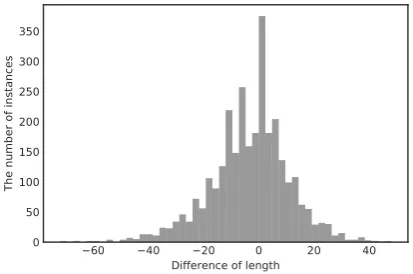
Neural encoder-decoder models have been success-fully applied to various natural language genera-tion tasks including machine translagenera-tion (Sutskever et al., 2014), summarization (Rush et al.,2015), and caption generation (Vinyals et al.,2015). Still, it is necessary to control the output length for ab-stractive summarization, which generates a sum-mary for a given text while satisfying a space con-straint. In fact, Figure 1 shows a large variance in output sequences produced by a widely used encoder-decoder model (Luong et al.,2015), which has no mechanism for controlling the length of the output sequences.
[image:1.595.314.521.225.362.2]Fan et al.(2018) trained embeddings that corre-spond to each output length to control the output sequence length. Since the embeddings for differ-ent lengths are independdiffer-ent, it is hard to generate a sequence of the length that is infrequent in training data. Thus, a method that can model any lengths continuously is required.
Figure 1: Difference in number of characters between correct headlines and outputs of a widely used LSTM encoder-decoder (Luong et al.,2015) which is trained on sentence-headline pairs created byRush et al.(2015) from the annotated English Gigaword corpus. The dif-ference was investigated for 3,000 sentence-headline pairs randomly sampled from the test splits.
Kikuchi et al. (2016) proposed two learning based methods for an LSTM encoder-decoder: LenEmb and LenInit. LenEmb inputs an embed-ding representing the remaining length in each de-coding step. Since this approach also prepares em-beddings for each length independently, it suffers from the same problem as that inFan et al.(2018).
On the other hand, LenInit can handle arbitrary lengths because it combines the scalar value of a desired length with a trainable embedding. LenInit initializes the LSTM cell of the decoder with the embedding depending on the scalar value of the desired length.Liu et al.(2018) incorporated such scalar values into the initial state of the decoder in a CNN encoder-decoder. These approaches deal with any length but it is reasonable to incorporate the distance to the desired terminal position into each decoding step such as in LenEmb.
In this study, we focused on
translation task. We extend the sinusoidal posi-tional encoding, which represents a position of each token in Transformer (Vaswani et al.,2017), to represent a distance from a terminal position on the decoder side. In this way, the proposed method considers the remaining length explicitly at each decoding step. Moreover, the proposed method can handle any desired length regardless of its appearance in a training corpus because it uses the same continuous space for any length.
We conduct experiments on the headline gen-eration task. The experimental results show that our proposed method is able to not only control the output length but also improve the ROUGE scores from the baselines. Our code and constructed test data are publicly available at:
https://github.com/takase/control-length.
2 Positional Encoding
Transformer (Vaswani et al., 2017) uses a sinu-soidal positional encoding to represent the position of an input. Transformer feeds the sum of the posi-tional encoding and token embedding to the input layer of its encoder and decoder. Letposbe the position anddbe the embedding size. Then, thei -th dimension of -the sinusoidal positional encoding P E(pos,i)is as follows:
P E(pos,2i)= sin
pos
100002di
, (1)
P E(pos,2i+1)= cos
pos
100002di
. (2)
In short, each dimension of the positional encod-ing corresponds to a sinusoid whose period is 100002i/d ×2π. Since this function returns an identical value at the same positionpos, the above positional encoding can be interpreted as represent-ing the absolute position of each input token.
In this paper, we extend Equations (1) and (2) to depend on the given output length and the dis-tance from the terminal position. We propose two extensions: length-difference positional encod-ing (LDP E) and length-ratio positional encoding (LRP E). Then we replace Equations (1) and (2) with (3) and (4) (or (5) and (6)) on the decoder side to control the output sequence length. We define
LDP EandLRP Eas follows:
LDP E(pos,len,2i) = sin
len−pos
100002di
, (3)
LDP E(pos,len,2i+1) = cos
len−pos
100002di
, (4)
LRP E(pos,len,2i) = sin
pos
len2di
, (5)
LRP E(pos,len,2i+1) = cos
pos
len2di
, (6)
where len presents the given length constraint. LDP E returns an identical value at the position where the remaining length to the terminal posi-tion is the same. LRP Ereturns a similar value at the positions where the ratio of the remaining length to the terminal position is similar. Let us con-sider thed-th dimension as the simplest example. Since we obtainsin(pos/len)(orcos(pos/len)) at this dimension, the equations yield the same value when the remaining length ratio is the same, e.g., pos= 5,len= 10andpos= 10,len= 20.
We addLDP E(orLRP E) to the input layer of Transformer in the same manner as inVaswani et al.
(2017). In the training step, we assign the length of the correct output tolen. In the test phase, we control the output length by assigning the desired length tolen.
3 Experiments
3.1 Datasets
We conduct experiments on the headline genera-tion task on Japanese and English datasets. The purpose of the experiments is to evaluate the ability of the proposed method to generate a summary of good quality within a specified length. We used JAMUL corpus as the Japanese test set (Hitomi et al.,2019). This test set contains three kinds of headlines for 1,1811news articles written by
pro-fessional editors under the different upper bounds of headline lengths. The upper bounds are 10, 13, and 26 characters (len= 10,13,26). This test set is suitable for simulating the real process of news production because it is constructed by a Japanese media company.
In contrast, we have no English test sets that contain headlines of multiple lengths. Thus, we randomly extracted 3,000 sentence-headline
pairs that satisfy a length constraint from the test set constructed from annotated English Gi-gaword (Napoles et al.,2012) by pre-processing scripts ofRush et al.(2015)2. We set three configu-rations for the number of characters as the length constraint: 0 to 30 characters (len = 30), 30 to 50 characters (len = 50), and 50 to 75 charac-ters (len = 75). Moreover, we also evaluate the proposed method on the DUC-2004 task 1 (Over et al.,2007) for comparison with published scores in previous studies.
Unfortunately, we have no large supervision data with multiple headlines of different lengths asso-ciated with each news article in both languages. Thus, we trained the proposed method on pairs with a one-to-one correspondences between the source articles and headlines. In the training step, we regarded the length of the target headline as the desired lengthlen. For Japanese, we used the JNC corpus, which contains a pair of the lead three sentences of a news article and its headline (Hitomi et al.,2019). The training set contains about 1.6M pairs3. For English, we used sentence-headline pairs extracted from the annotated English Giga-word with the same pre-processing script used in the construction of the test set. The training set contains about 3.8M pairs.
In this paper, we used a character-level decoder to control the number of characters. On the encoder side, we used subword units to construct the vo-cabulary (Sennrich et al.,2016;Kudo,2018). We set the hyper-parameter to fit the vocabulary size to about 8k for Japanese and 16k for English.
3.2 Baselines
We implemented two methods proposed by previ-ous studies to control the output length and handle arbitrary lengths. We employed them and Trans-former as baselines.
LenInit Kikuchi et al.(2016) proposed LenInit, which controls the output length by initializing the LSTM cellmof the decoder as follows:
m=len×b, (7)
where b is a trainable vector. We incorporated this method with a widely used LSTM encoder-decoder model (Luong et al., 2015)4. For a fair
2
https://github.com/facebookarchive/NAMAS
3
We obtained this training set by applying the pre-processing script athttps://github.com/asahi-research/Gingo.
4We used an implementation at
https://github.com/mlpnlp/mlpnlp-nmt.
comparison, we set the same hyper-parameters as inTakase et al.(2018) because they indicated that the LSTM encoder-decoder model trained with the hyper-parameters achieved a similar performance to the state-of-the-art on the headline generation.
Length Control (LC) Liu et al.(2018) proposed a length control method that multiplies the desired length by input token embeddings. We trained the model with their hyper-parameters.
Transformer Our proposed method is based on Transformer (Vaswani et al., 2017)5. We trained Transformer with the equal hyper-parameters as in the base model inVaswani et al.(2017).
3.3 Results
Table 1 shows the recall-oriented ROUGE-1 (R-1), 2 (R-2), and L (R-L) scores of each method on the Japanese test set6. This table indi-cates that Transformer with the proposed method (Transformer+LDP E and Transformer+LRP E) outperformed the baselines for all given constraints (len = 10,13,26). Transformer+LRP E per-formed slightly better than Transformer+LDP E. Moreover, we improved the performance by incor-porating the standard sinusoidal positional encod-ing (+P E) onlen= 10and26. The results imply that the absolute position also helps to generate bet-ter headlines while controlling the output length.
Table2shows the recall-oriented ROUGE scores on the English Gigaword test set. This table in-dicates thatLDP EandLRP E significantly im-proved the performance onlen = 75. Moreover, the absolute position (P E) also improved the per-formance in this test set. In particular, P E was very effective in the setting of very short head-lines (len= 30). However, the proposed method slightly lowered ROUGE-2 scores from the bare Transformer on len = 30,50. We infer that the bare Transformer can generate headlines whose lengths are close to 30 and 50 because the major-ity of the training set consists of headlines whose lengths are less than or equal to 50. However, most of the generated headlines breached the length con-straints, as explained in Section3.4.
To investigate whether the proposed method can generate good headlines for unseen lengths, we excluded headlines whose lengths are equal to the
5
We used an implementation at
https://github.com/pytorch/fairseq.
len= 10 len= 13 len= 26
Model R-1 R-2 R-L R-1 R-2 R-L R-1 R-2 R-L Baselines
LenInit 38.08 17.72 36.84 41.83 19.53 39.22 47.07 22.02 38.36 LC 35.88 15.73 34.80 40.28 18.86 38.16 42.62 19.38 35.61 Transformer 34.63 15.48 33.02 43.94 21.35 40.77 46.43 23.03 38.10 Proposed method
Transformer+LDP E 42.84 21.07 41.31 46.51 22.83 43.76 50.89 24.18 40.82 +P E 42.85 20.67 41.47 46.72 22.70 43.75 51.32 25.15 41.48 Transformer+LRP E 42.70 21.62 41.35 47.05 23.70 44.13 50.68 24.70 41.23
+P E 43.36 21.63 41.93 46.39 23.09 43.49 51.21 25.03 41.43
Proposed method trained on the dataset without headlines consisting of target lengths
[image:4.595.110.488.60.226.2]Transformer+LDP E 41.91 20.01 40.69 45.88 22.61 43.16 50.90 24.37 40.48 +P E 42.33 20.46 40.88 44.78 22.33 42.27 50.87 24.54 40.89 Transformer+LRP E 41.91 20.10 40.52 46.01 22.87 43.47 50.33 24.37 41.00 +P E 42.59 20.76 41.16 46.52 23.65 43.81 50.73 24.64 41.01
Table 1: Recall-oriented ROUGE scores for each length on Japanese test set. This test set contains three kinds of headlines, i.e.,len= 10,13,26, tied to a single article.
len= 30 len= 50 len= 75
Model R-1 R-2 R-L R-1 R-2 R-L R-1 R-2 R-L Baselines
LenInit 44.58 25.90 43.34 48.42 25.47 45.56 50.78 25.74 46.42 LC 45.17 26.73 44.09 46.56 24.55 44.10 48.67 24.83 44.98 Transformer 47.48 29.77 46.17 50.02 28.04 47.29 47.31 24.83 43.75 Proposed method
Transformer+LDP E 47.26 26.98 45.77 50.21 26.13 47.15 53.99 27.78 49.24 +P E 48.13 27.18 46.43 50.29 25.97 47.17 53.65 27.65 49.06 Transformer+LRP E 48.79 28.77 47.17 50.09 26.08 46.91 53.91 27.82 49.15
+P E 49.23 29.26 47.68 50.41 26.37 47.39 54.21 27.84 49.38
Proposed method trained on the dataset without headlines consisting of the target lengths
[image:4.595.109.489.269.436.2]Transformer+LDP E 47.35 26.76 45.70 50.46 25.96 47.30 53.69 27.61 49.04 +P E 47.44 27.42 45.99 50.67 26.07 47.57 53.76 27.53 49.03 Transformer+LRP E 48.54 28.89 47.06 50.65 26.19 47.34 53.94 27.88 49.11 +P E 49.08 29.09 47.58 50.78 26.64 47.60 53.77 27.68 48.93
Table 2: Recall-oriented ROUGE scores for each length on test data extracted from annotated English Gigaword.
Model R-1 R-2 R-L Baselines
LenInit 29.78 11.05 26.49 LC 28.68 10.79 25.72 Transformer 26.15 9.14 23.19 Proposed method
Transformer+LDP E 30.95 10.53 26.79 +P E 31.00 10.78 27.02 +Re-ranking 31.65 11.25 27.46 Transformer+LRP E 30.74 10.83 26.69 +P E 31.10 11.05 27.25 +Re-ranking 32.29 11.49 28.03 Previous studies for controlling output length
Kikuchi et al.(2016) 26.73 8.39 23.88
Fan et al.(2018) 30.00 10.27 26.43 Other previous studies
Rush et al.(2015) 28.18 8.49 23.81
Suzuki and Nagata(2017) 32.28 10.54 27.80
Zhou et al.(2017) 29.21 9.56 25.51
Li et al.(2017) 31.79 10.75 27.48
Li et al.(2018) 29.33 10.24 25.24
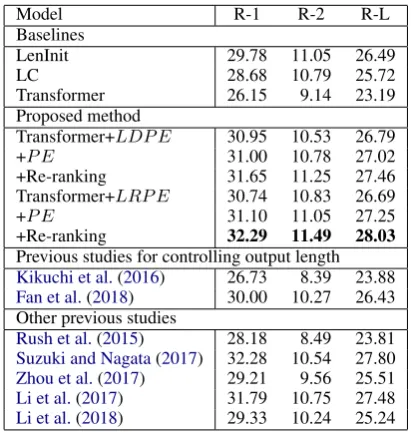
Table 3: Recall-oriented ROUGE scores in DUC-2004.
desired length (len) from the training data. The lower parts of Table1and2show ROUGE scores
of the proposed method trained on the modified training data. These parts show that the proposed method achieved comparable scores to ones trained on whole training dataset. These results indicate that the proposed method can generate high-quality headlines even if the length does not appear in the training data.
Table3shows the recall-oriented ROUGE scores on the DUC-2004 test set. Following the evalu-ation protocol (Over et al., 2007), we truncated characters over 75 bytes. The table indicates that LDP EandLRP Esignificantly improved the per-formance compared to the bare Transformer, and achieved better performance than the baselines ex-cept for R-2 of LenInit. This table also shows the scores reported in the previous studies. The pro-posed method outperformed the previous methods that control the output length and achieved the com-petitive score to the state-of-the-art scores.
[image:4.595.78.284.474.691.2]Variance
Japanese dataset English Gigaword Model len= 10 len= 13 len= 26 len= 30 len= 50 len= 75
Baselines
LenInit 0.047 0.144 0.058 0.114 0.112 0.091 LC 0.021 0.028 0.040 0.445 0.521 0.871 Transformer 181.261 115.431 38.169 193.119 138.566 620.887 Proposed method
Transformer+LDP E 0.000 0.000 0.000 0.015 0.012 0.013 +P E 0.003 0.001 0.001 0.016 0.009 0.007 Transformer+LRP E 0.121 0.210 0.047 0.082 0.071 0.187 +P E 0.119 0.144 0.058 0.142 0.110 0.173 Proposed method trained on the dataset without headlines consisting of the target lengths
[image:5.595.115.484.61.238.2]Transformer+LDP E 0.000 0.002 0.000 0.018 0.009 0.009 +P E 0.021 0.001 0.003 0.021 0.013 0.010 Transformer+LRP E 0.191 0.362 0.043 0.120 0.058 0.133 +P E 0.183 0.406 0.052 0.138 0.081 0.154
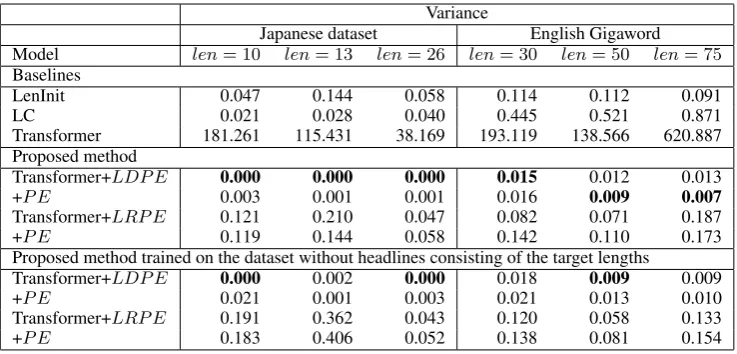
Table 4: Variances of generated headlines.
words unrelated to a source sentence. Thus, we applied a simple re-ranking to each n-best head-lines generated by the proposed method (n= 20 in this experiment) based on the contained words. Our re-ranking strategy selects a headline that contains source-side words the most. Table 3
shows that Transformer+LRP E+P Ewith this re-ranking (+Re-re-ranking) achieved better scores than the state-of-the-art (Suzuki and Nagata,2017).
3.4 Analysis of Output Length
FollowingLiu et al.(2018), we used the variance of the generated summary lengths against the desired lengths as an indicator of the preciseness of the output lengths. We calculated variance (var) forn generated summaries as follows7:
var= 1
n n
X
i=1
|li−len|2, (8)
wherelenis the desired length andliis the length of the generated summary.
Table4shows the values of Equation (8) com-puted for each method and the desired lengths. This table indicates thatLDP Ecould control the length of headlines precisely. In particular,LDP Ecould generate headlines with the identical length to the desired one in comparison with LenInit and LC. LRP E also generated headlines with a precise length but its variance is larger than those of previ-ous studies in very short lengths, i.e.,len= 10and 13in Japanese. However, we considerLRP Eis enough for real applications because the averaged difference between its output and the desired length is small, e.g.,0.1forlen= 10.
7Liu et al.(2018) multiplies Equation (8) by0.001.
The lower part of Table4shows the variances of the proposed method trained on the modified training data that does not contain headlines whose lengths are equal to the desired length, similar to the lower parts of Table1and2. The variances for this part are comparable to the ones obtained when we trained the proposed method with whole train-ing dataset. This fact indicates that the proposed method can generate an output that satisfies the constraint of the desired length even if the training data does not contain instances of such a length.
4 Conclusion
In this paper, we proposed length-dependent po-sitional encodings,LDP E andLRP E, that can control the output sequence length in Transformer. The experimental results demonstrate that the pro-posed method can generate a headline with the desired length even if the desired length is not present in the training data. Moreover, the pro-posed method significantly improved the quality of headlines on the Japanese headline generation task while preserving the given length constraint. For English, the proposed method also generated head-lines with the desired length precisely and achieved the top ROUGE scores on the DUC-2004 test set.
Acknowledgments
References
Angela Fan, David Grangier, and Michael Auli. 2018. Controllable abstractive summarization. In Proceed-ings of the 2nd Workshop on Neural Machine Trans-lation and Generation (WMT 2018), pages 45–54.
Yuta Hitomi, Yuya Taguchi, Hideaki Tamori, Ko Kikuta, Jiro Nishitoba, Naoaki Okazaki, Inui Kentaro, and Manabu Okumura. 2019. A large-scale multi-length headline corpus for improv-ing length-constrained headline generation model evaluation. CoRR.
Yuta Kikuchi, Graham Neubig, Ryohei Sasano, Hiroya Takamura, and Manabu Okumura. 2016. Control-ling output length in neural encoder-decoders. In
Proceedings of the 2016 Conference on Empirical Methods in Natural Language Processing (EMNLP 2016), pages 1328–1338.
Taku Kudo. 2018. Subword regularization: Improving neural network translation models with multiple sub-word candidates. InProceedings of the 56th Annual Meeting of the Association for Computational Lin-guistics (ACL 2018), pages 66–75.
Haoran Li, Junnan Zhu, Jiajun Zhang, and Chengqing Zong. 2018. Ensure the correctness of the summary: Incorporate entailment knowledge into abstractive sentence summarization. InProceedings of the 27th International Conference on Computational Linguis-tics (COLING 2018), pages 1430–1441.
Piji Li, Wai Lam, Lidong Bing, and Zihao Wang. 2017. Deep recurrent generative decoder for abstractive text summarization. InProceedings of the 2017 Con-ference on Empirical Methods in Natural Language Processing (EMNLP 2017), pages 2091–2100.
Yizhu Liu, Zhiyi Luo, and Kenny Zhu. 2018. Con-trolling length in abstractive summarization using a convolutional neural network. InProceedings of the 2018 Conference on Empirical Methods in Natural Language Processing (EMNLP 2018), pages 4110– 4119.
Thang Luong, Hieu Pham, and Christopher D. Man-ning. 2015. Effective approaches to attention-based neural machine translation. In Proceedings of the 2015 Conference on Empirical Methods in Natural Language Processing (EMNLP 2015), pages 1412– 1421.
Courtney Napoles, Matthew Gormley, and Benjamin Van Durme. 2012. Annotated Gigaword. In Pro-ceedings of the Joint Workshop on Automatic Knowl-edge Base Construction and Web-scale KnowlKnowl-edge Extraction, AKBC-WEKEX ’12, pages 95–100.
Paul Over, Hoa Dang, and Donna Harman. 2007. Duc in context. Information Processing & Management, 43(6):1506–1520.
Alexander M. Rush, Sumit Chopra, and Jason Weston. 2015. A Neural Attention Model for Abstractive
Sentence Summarization. In Proceedings of the 2015 Conference on Empirical Methods in Natural Language Processing (EMNLP 2015), pages 379– 389.
Rico Sennrich, Barry Haddow, and Alexandra Birch. 2016. Neural machine translation of rare words with subword units. InProceedings of the 54th Annual Meeting of the Association for Computational Lin-guistics (ACL 2016), pages 1715–1725.
Ilya Sutskever, Oriol Vinyals, and Quoc V. Le. 2014. Sequence to Sequence Learning with Neural Net-works. InAdvances in Neural Information Process-ing Systems 27 (NIPS 2014), pages 3104–3112.
Jun Suzuki and Masaaki Nagata. 2017. Cutting-off re-dundant repeating generations for neural abstractive summarization. InProceedings of the 15th Confer-ence of the European Chapter of the Association for Computational Linguistics (EACL 2017), pages 291– 297.
Sho Takase, Jun Suzuki, and Masaaki Nagata. 2018. Direct output connection for a high-rank language model. In Proceedings of the 2018 Conference on Empirical Methods in Natural Language Processing (EMNLP 2018), pages 4599–4609.
Ashish Vaswani, Noam Shazeer, Niki Parmar, Jakob Uszkoreit, Llion Jones, Aidan N Gomez, Ł ukasz Kaiser, and Illia Polosukhin. 2017. Attention is all you need. InAdvances in Neural Information Pro-cessing Systems 30 (NIPS 2017), pages 5998–6008.
Oriol Vinyals, Alexander Toshev, Samy Bengio, and Dumitru Erhan. 2015. Show and tell: A neural im-age caption generator. InProceedings of the IEEE Conference on Computer Vision and Pattern Recog-nition (CVPR 2015), pages 3156–3164.