• No results found

Performance Analysis of Nelder-Mead and A Hybrid Simulated Annealing for Multiple Response Quality Characteristic Optimization

N/A
N/A
Protected

Academic year: 2020

Share "Performance Analysis of Nelder-Mead and A Hybrid Simulated Annealing for Multiple Response Quality Characteristic Optimization"

Copied!
5
0
0

Loading.... (view fulltext now)

Full text

(1)

Abstract— In many real world industrial situations, quality

of a product is considered to be a composite of a family of properties or multiple responses, which can often be interacting or correlated with one another, and nearly always measured in a variety of units. Optimal combination of properties rarely results from individual optimal condition of each response, and there is always a trade off between these responses. Optimization of multiple responses is always a challenge for researchers and practitioners. In this research paper, comparative study of the performance of two optimization techniques, Nelder-Mead simplex (NM) and hybrid Nelder-Mead simplex with simulated annealing (SIMSA) is discussed. The results indicate superiority of SIMSA as compared to NM in varied case situations.

Index Terms— Multiple Response, Nelder-Mead simplex,

Optimization, Quality, Simulated annealing

I. INTRODUCTION

A common interest in process parameter design involves meeting specifications and also to determine optimal trade-off among several response characteristics having linear or nonlinear interaction(s). In case of any process parameter optimization problem, two types of variables need to be identified first, viz. the independent or input variables and the dependent or response variables (so called quality characteristics of the process). The desired values of the dependent variable(s) need to be controlled by the independent variables. Simultaneous optimization of more than one response is generally referred to as multiple response optimization problem. Process modeling and thereby optimization using conventional or heuristics is generally recommended by researchers for such situations. In this context, few important modeling and optimization approaches, which is relevant for multiple response optimization problem are discussed in the following section.

Manuscript received December 8, 2009.

Sasadhar Bera is an institute research scholar at Shailesh J. Mehta School of Management, Indian Institute of Technology Bombay, Powai 400076, INDIA (e-mail: [email protected]).

Indrajit Mukherjee, is working as Assistant Professor with Shailesh J Mehta School of Management, Indian Institute of Technology Bombay, Powai 400076, INDIA. (corresponding author’s phone: +91-22-2576 7742; fax: +91-22-2572 2872; e-mail: [email protected]).

A. Regression-based Modeling

Multiple regression modeling [1] is one of the important tool used for predicting single response variable by more than one independent input variable. In case of multiple responses, if the same set of input variable and same modelling degree and form is used for all responses, then we can have different multiple regression model for individual responses [2]. In case of multivariate regression model [3] several dependents, y’s, are measured corresponding to each set of

x’s. Each ofy1,y2, . . . ,yr is to be predicted by all of x1, 2

x , . . . , xp. The underlying expression is

Y = X

B + E (1) where,

B is the regression coefficient matrix and E is error matrix.

B is also expressed as,

B = (X/X)−1X/Y (2)

The assumption of multivariate regressions is that the non-diagonal terms of error correlation matrix should be zero. Regression (conventional or unconventional) is found to be an excellent tool for process modeling in industrial situations. Based on the underlying process models, various optimization approaches are recommended by researchers. The following section discusses some of these multiple response optimization approaches.

B. Overlaid contour plot

Overlaying contour plot is a common approach for handling multiple response optimization problem, when there is two independent input variables. Models of each individually response are determined and then graphically superimposed in a contour plot. From the superimposed graph it is easy to determine optimal solution(s). This was first illustrated by Lind, Goldin and Hickman [4] and later popularized by various other scholars. However, as mentioned earlier, this approach can only handle problems, where the number of input (independent) variables is limited to maximum two.

Performance Analysis of Nelder-Mead and A

Hybrid Simulated Annealing for Multiple

Response Quality Characteristic Optimization

(2)

C. Desirability approach

Desirability function approach is one of the most popularly approach used for multiple response optimization problems. By this technique, a multiple response problem is converted to a single objective optimization problem using mathematical transformations. Harington [5] first proposed desirability functions for multiple response optimization problem. Derringer and Suich [6] extended and proposed a generalized transformation scheme to convert individual desirability

d

j from predicted

j

Y

response. For nominal the better type of quality characteristics, desirability function is expressed as,

j

d

= ⎪ ⎪ ⎪ ⎪ ⎪ ⎪ ⎩ ⎪⎪ ⎪ ⎪ ⎪ ⎪ ⎨ ⎧ ≤ < ⎥ ⎥ ⎥ ⎦ ⎤ ⎢ ⎢ ⎢ ⎣ ⎡ − − ≤ ≤ ⎥ ⎥ ⎥ ⎦ ⎤ ⎢ ⎢ ⎢ ⎣ ⎡ − − > < ∧ ∧ ∧ ∧ ∧ ∧ max max max min min min max min 1 1 0 j j j t j j j j j j j s j j j j j j j j Y Y if Y Y Y Y Y if Y Y Y Y Y or Y Y if τ τ τ τ (3)

where

d

j is the desirability function of the

j

thresponse, min

j

Y

and

Y

jmaxare respectively lower and upper bound of

th

j

response, s1and t1are the exponential parameters that determine the desirability function and shape, and

τ

j is the target value of

j

thresponse. The functions are on same scale and are first order derivative discontinuous at the points

min

j

Y

,

Y

jmax and

τ

j .

Within desirability functions approach, there exist many options for dimension reduction of objective functions. One of such option is to maximize the minimum of all individual desirability. This is also expressed as degree of customer satisfaction by Kim and Lin [7]. The concept uses a ‘minimum operator’ for aggregating the individual desirability [

d

j s( ) ] to a single objective function and expressed as

s

λ

=

minimum{

d

1( )s

,

d

2( )s

,....,

d

r s( )

}

, (4) for

0

λ

s

1

, and for r responses at any

th

s process stage.

D. Generalized distance approach

Khuri and Conlon [8] developed a generalized distance based optimization approach for multiple response problem. The proposed approach assumes same set of input variables which adequately represents the same order of polynomial regression models for all y’s. They developed a function that measures the distance of the vector of estimated responses from the estimated "ideal" optimum. The “ideal”

optimal is said to be achieve, if all the individual optima is achieved over the experimental region. Suitable operating conditions for the simultaneous optimization of the responses are specified by minimizing the prescribed distance function over the experimental region.

E. Fuzzy-based Approach

Kim and Lin [7] proposes an maximin approach, which first specifies practically allowable ranges to each of the responses, and then maximize the minimum value of degree of satisfaction with respect to all responses. It can also be viewed as a fuzzy logic approach, and desirability function as a special case of membership function as considered in fuzzy set approach. The maximin approach is equivalent to intersection of the corresponding membership function using logical “and” operator.

F. Dual response approach

In this mathematical approach, the primary response is maximized or minimized subject to appropriate constraints for all other responses as secondary objective. Myers and Carter [9] propose dual response systems (DRS) in the context of two responses optimization problem. The objective was to find the optimal operating conditions, which consider one response as the primary objective or most important response

p

Y to optimize, subject to the constrained condition that others are secondary

s

Y response with target value or bounds.

II. OPTIMIZATION TECHNIQUES

The desirability functions are discontinuous for their first order derivatives. Therefore, direct search algorithm can be used to determine the optimality condition of input parameters using a direct search Nelder-Mead simplex search (1965), which is discussed below.

A. Nelder-Mead simplex method

The Nelder-Mead [10] is a direct search method that attempts to minimize a non-linear unconstrained optimization and does not use the gradient information. This derivative free optimization technique can handle discontinuous or non-smooth functions. The Nelder-Mead method (NM) attempts to minimize nonlinear function of real variables using only function values, without any derivative information (explicit or implicit). The NM thus falls in the general class of direct search methods.

(3)

B. Hybrid Simulated Annealing with Nelder-Mead Simplex

Simulated Annealing (SA) is a meta-heuristic that performs a randomized search to reach near-optimal or optimal solutions of combinatorial or continuous optimization problems. In the early 1980s, Kirkpatrick et al. [11] introduced the concept of annealing behaviour in combinatorial optimization problem. The SIMSA approach [12], a hybrid metaheuristic method, which is used for continuous non-linear optimization, is based on the combination of the non-linear simplex method and simulated annealing algorithm. The non-linear simplex [10] is used to generate system configurations i. e. hyper-geometric figure by joining (N+1) point in the N-dimensional space.

The major steps to construct and implement SIMPSA method are:

a) Setting annealing control parameters b) Constructing initial simplex

c) Running full metropolis cycle at current temperature d) Simplex iteration steps

e) Stopping criteria

The following section discusses and compares the performance of NM and SIMSA for varied multiple response problem situations. This is an attempt to understand which will be most relevant and suitable for a multiple response optimization cases.

III. CASES

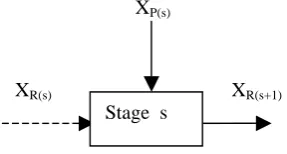
A solution methodology, as proposed by Mukherjee [13] is selected for this study, in which an integrated approach of regression based process modeling (e.g. multiple or multivariate), desirability functions for dimension reduction (e.g maximin), and a suitable optimization approach (NM or SIMSA) is considered for multiple response problems reported in literatures. The performance of NM and SIMSA for different modeling approaches is discussed below. The symbols and notations as used for problem formulation are:

s: sth stage of operation )

(s p

X : In-process input parameters at sth stage of operation.

) (s R

X : Input variables at sth stage )

1 (s+ R

X : Output responses at sth stage, which is input variable for (s+1)th stage of operation.

) (s j

d : Individual desirability measure of jth response at

th

s stage of operation.

s

q : Functional relationship to convert into overall desirability

s

λ

: Overall desirability at sth stage using qs function

A typical single stage process is first shown in Fig 1.

Fig 1 A Typical Single Stage Multiple Response Process

Without loss of generality, the underlying mathematical problem can be formulated as,

X s

Maximize

λ

(5) subject to

s

j X

d ( ) ≥

λ

∀ j = 1, 2, . . .r where r = number of response variables,

i

α

x

i

β

i

i

= 1, 2, . . . ., p

and p is the number of input variables.

X is a p elements input variables vector, and

α

i,

β

i are

lower bound and upper bound of input variable

x

i

respectively. dj(X) is the desirability of jth response variable.

For each case, specific process modeling approaches are taken as mentioned in the literature. The “maximin” desirability index approach was selected to reduce problem dimensionality, and NM and SIMPSA are used to determine near optimal solutions and then compared. The detailed information of the selected cases is provided in the Table 1. The selected responses and their domain (as given in literatures) are provided in Table-2.

Table 1 Data Set Information

Literature Source Data type Khuri, A. and Conlon, M.

(1981), Example1 [say KC1]

Central composite design (CCD) with axial distance

1.414

**

Kim and Lin (2000) [say KL]

Manufacturing process data, not experimental data Mukherjee, I (2006) [say

MI]

Manufacturing process data, not experimental data XP(s)

XR(s+1) XR(s)

[image:3.595.319.463.144.221.2]
(4)

0 50 100 150 200 250 300 350 400 450 0.2

0.25 0.3 0.35 0.4 0.45 0.5 0.55 0.6 0.65

Iteration No. Be

st v alu e o f Ov er all De sir a bilit y ( D)

[image:4.595.45.296.115.326.2]

Movement of the best point in SIMPSA

Table 2 Domain of Response Variables for Each Case Data Set Response

variables

Domain y1 0.37 ≤ y1≤ 2.67 y2 0.33 ≤ y2≤ 0.66 y3 1.11 ≤ y3≤ 1.88 KC1

y4 0.23 ≤ y4≤ 0.71

y1 43.1 ≤ y1≤ 52 Target = 47.55 y2 26.3 ≤ y2≤ 48.08

KL

y3 20 ≤ y3≤ 43.67 y1 1.41421 ≤ y1≤ 1.87083

Target = 1.64252 y2 0.00028 ≤ y2≤ 0.00049

Target = 0.00039

y3 97 ≤ y3≤ 97.02 Target = 97.01 y4 0 ≤ y4≤ 0.01

MI

y5 0 ≤ y5≤ 0.01

[image:4.595.354.553.128.242.2]

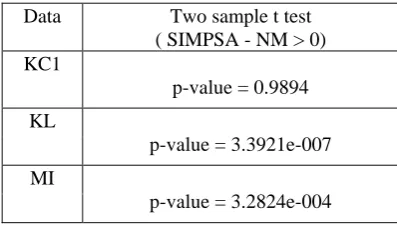
To compare the success rate of the individual optimization techniques, average value of the objective function and sample standard deviation are summarized in Table 3, based on 100 trial runs. Two sample t-test (Table 4) verifies whether SIMPSA solution quality is significantly different from NM. Figure 1 illustrates how SIMPSA searches the best solution point, using simplex movement, at different values of control temperature. Success rate is defined as number of times the techniques can provide objective function values other than zero’s.

Table 3 Output Performance Comparison for SIMPSA and NM

Data Optimization algorithm

Success Rate (%)

Average value of Objective

function

Standard deviation Objective function

SIMPSA 100 0.5659 0.0201

KC1

NM 90 0.5708 0.0002

SIMPSA 99 0.5571 0.0692

KL

NM 83 0.5039 0.0697

SIMPSA 90 0.8112 0.0622

MI

NM 53 0.7739 0.0612

It is a clear indication from Table-3 that the success rate of SIMPSA to determine near optimal solution is higher as compared to NM for every data set selected for the analysis. The standard deviation of objective function values by NM is almost always less than the SIMPSA in all the situations. These may be attributed for two possible reasons as given below,

(a) NM cannot escape from local optima and usually stuck to the same solution point.

(b) SIMPSA can escape from local optima, and thereby provides multiple near optimal solutions.

Table-4: Statistical Test for Average Value of objective function

[image:4.595.314.545.340.509.2]

Statistical t-test in Table 4 reveals that for KL and MI case, p-value for difference in average value of composite desirability is significant. However, generalizing this claim in more complex problem needs to be verified.

Fig 1: Best Point Solution vs. No. of Iteration in SIMSA

IV. CONCLUSIONS

The summary of the research findings are given below. 1. SIMPSA clearly shows higher success rate to

determine near optimal solutions as compared to NM.

2. NM shows the same solution results for multiple independent trial runs. It seems that the algorithm is sensitive to local optimal points or cannot escape local optima.

3. SIMPSA is expected to provide significantly higher objective function value(s) for single stage optimization problems.

The authors are presently working on the comparative performance of NM and SIMSA and other metaheuristics for

Data Two sample t test ( SIMPSA - NM > 0)

KC1 p-value = 0.9894

KL p-value = 3.3921e-007

[image:4.595.41.296.513.634.2]
(5)

higher order multivariate nonlinear models with varied process constraints.

REFERENCES

[1] D. C. Montgomery, and E. A. Peck, “Introduction to Linear Regression Analysis”. (2’nd Ed). New York: John Wiley and Sons, Inc, 1992.

[2] A. I. Khuri and J. A. Cornell, “Response surface designs and analysis”, 2nd edition, Marcel Dekker, New York, 1996.

[3] A. C. Rencher, “Method of multivariate analysis”, John Wiley and Sons, Inc, USA, 1995.

[4] E. E. Lind, J. Goldin, and J. B. Hickman, “Fitting yield and cost response surfaces”, Chemical engineering progress, Vol. 56( 11), 1960, pp. 62– 68.

[5] E. C. Harrington, “The desirability function”, Industrial Quality Control, Vol 21(10), 1965, pp. 494 - 498. [6] G. Derringer, and R.Suich, “Simultaneous optimization

of several response variables”. Journal of Quality Technology, Vol 12(4), 1980, pp. 214-219.

[7] K. Kim, D. Lin, “Simultaneous optimization of mechanical properties of steel by maximizing exponential desirability functions”. Applied Statistics, Journal of the Royal Statistical Society: Series C, Vol 49 (3), 2000, pp. 311–325.

[8] A.I. Khuri, and M. Conlon, “Simultaneous optimization of multiple responses represented by polynomial regression functions”, Technometrics, Vol 23( 4), 1981, pp. 363-375.

[9] R. H. Myers, and W. H. Carter, “Response surface techniques for dual response systems”, Technometrics, Vol. 2 ( 15), 1973, pp. 301-317.

[10] J. A. Nelder, and R. Mead, “A Simplex Method for Function Minimization”. Computer Journal , Vol 7,1965, pp. 308-313.

[11] K. Kirkpatrick, C.D. Jr Gelett , and M.P. Vecchi, “Optimization by Simulated Annealing”. Sciences, Vol 220, 1983, pp. 671-680.

[12] M. F Cardoso, R. L. Salcedo, and S. F. De Azeveoo, “The Simplex-Simulated Annealing Approach to Continuous Non-Linear Optimization”, Computers Chem. Engg., Vol. 20 ( 9), 1996, pp. 1065-1080. [13] I. Mukherjee, “Modeling and Optimization of Abrasive

Figure

Fig 1 A Typical Single Stage Multiple Response Process
Table-4: Statistical Test for Average Value of objective function

References

Related documents

Finally, the paper looks at the rarely-considered, distinct treatment accorded to life insurance and savings under existing rules, and then recommends a “full-subrogation” approach

METHODS: This descriptive study includes 133 pediatric patients with osteoarticular brucellosis who were treated at the University Clinic for Infectious Diseases

In this paper we compare the SPOT with two other spam zombie detection algorithms based on the number and percentage of spam messages originated or forwarded by internal

 All relevant sciences, including that of nutrition, should be mainly concerned with the cultivation, conservation and sustenance of human, living and physical resources

The objectives were to (i) compare species composition and variability of secondary forests in abandoned villages with ancient forests; (ii) detect main environmental

Aside from this principal role of the tillandsioid trichome in water and mineral absorption, the dry, upright trichome wings of atmospheric species (i.e., succulent epiphytes

Survivin level was increased in the women with complex endometrial hyperplasia and adenocarcinoma compared with other women, but significant differences between

5 This study furthermore extends the analysis of the national South African transformation process in higher education by linking it with developments in