Abstract— We studied mathematical modeling of lipid peroxidation using a biochemical model system of iron (II)-ascorbate-dependent lipid peroxidation of rat hepatocyte mitochondrial fractions. We found that antioxidants extracted from plants demonstrate a high intensity of peroxidation inhibition. We simplified the system of differential equations that describes the kinetics of the mathematical model to a first order equation, which can be solved analytically. Moreover, we endeavor to algorithmically and heuristically recreate the processes and construct an environment that closely resembles the corresponding natural system. Our results demonstrate that it is possible to theoretically predict both the kinetics of oxidation and the intensity of inhibition without resorting to analytical and biochemical research, which is important for cost-effective discovery and development of medical agents with antioxidant action from the medicinal plants.
Index Terms—kinetics, peroxidation, modeling, antioxidants.
I. INTRODUCTION
A large number of human diseases develop due to activation of free-lipid peroxidation or an oxidative stress. Therapies that include medical administration of natural and synthetic antioxidants (pharmacological correction) are a growing trend in the treatment of such diseases. Consequently, quantitative assessment of antioxidant activity of these complex products and determination of their effective concentrations has become an issue of key importance.
In this paper, we study a model system that allows us to understand the characteristics of these active substances and the mechanisms of their action under various conditions during the processes of lipid peroxidation, including theoretical predictions of their antioxidant activity using algorithmic and heuristic simulation in a computer environment.
Modeling is one of the important methods of contemporary biochemistry. Using biochemical models, it is possible to conduct experimental investigations of biochemical processes in complex biosystems in vivo. Mathematical
Manuscript received June 9, 2009.
A. D. Ruslanov is with the Department of Computer and Information Sciences, State University of New York at Fredonia, Fredonia, NY 14063, USA (716-673-4820; fax: 716-673-4821; e-mail: [email protected]).
A. V. Bashylau is with the Department of Computer and Information Sciences, State University of New York at Fredonia, Fredonia, NY 14063, USA (e-mail: [email protected]).
models are also widely used. As a rule, such models describe the biochemical processes in the natural object as a system of differential equations. These mathematical models can be algorithmically simulated in a computer environment, i.e., the model can be computationally evaluated in real time. Such “computer experiments” allow for easy manipulation of the parameters of the biochemical system parameters or alteration of the time scale of the experiments. For example, the process or one of its components can be accelerated or slowed down; a stationary mode can be considered; new coefficients or new members can be introduced to the differential equation(s). That is we can algorithmically study various properties of the object. Moreover, we can create theoretic objects with new properties and study the mechanisms therein and characteristics thereof. [1]
Studies of free radical processes in recent years have continued to attract greater attention from specialists in the field of biochemistry and biophysics. The high reactivity of radical particles in physiological environment leads to acceleration of the oxidation processes that destroy the molecular structure of cells, thereby causing numerous pathological conditions. The compounds that can bind these radicals and the products of their reactions are known as antioxidants. They play an important role in the regulation of the free-radical reactions in biosystems, significantly affecting their state. For this reason, studies of antioxidants as well as investigations of antioxidant properties of the compounds with diverse molecular nature have gained wide regard in recent times. To date, the most promising sources of antioxidants are non-synthetic compounds of plant origin. [2 - 13]
The main problem with studying the free-radical processes and their inhibition by antioxidants is the high reactivity of the radical particles and their short life. This substantially complicates examining these processes in vivo. Using the biological and mathematical modeling systems as well as appropriate information structures, which algorithmically and heuristically recreate the processes, we can construct an environment that closely resembles the corresponding natural system. Moreover, we can facilitate or simplify mechanisms of the detection of free radicals and products of their interaction. [3]
According to the method of detection of antioxidant activity (AOA), all model systems can be divided into volumetric, photometric, chemiluminescent, fluorescent, electrochemical, etc. The most common model system is that of the oxidation reaction of a particular compound, where we can assess antioxidant potency of an individual antioxidant or a blend of antioxidant compounds. Kinetic control occurs either by absorbing oxygen or by changing the characteristics Anatole D. Ruslanov and Anton V. Bashylau, Members, IAENG
Algorithmic Simulation and Mathematical
Modeling in Studying the Kinetics of
of the reaction mixture, such as a change in absorption of electromagnetic radiation, fluorescence, luminescence, etc. In many cases, the environment for the free radical generation is created as follows: at a constant rate, with the addition of initiators, or with a chemical generation of radicals as the result of the controlled chemical process itself. [14]
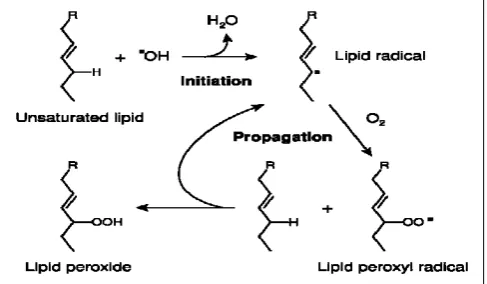
[image:2.595.47.291.308.450.2]Radicals formed in the cell can initiate secondary free radical reactions, engaging in interactions with different cellular components: proteins, nucleic acids, and lipids. As a result of these free radical reactions there begins degradation of target molecules forming more or less stable reaction products, identification and quantification of which can be a parameter or a marker in determining the rate of lipid peroxidation. The most frequently used marker for the commencement of free radical oxidation is the detection of the peroxidation degradation products of phospholipids in cell membranes and plasma lipoproteins: conjugated dienes and unsaturated fatty acid hydroperoxides, aldehydes, and particularly malondialdehydes. For the main phases of lipid peroxidation seeFig. 1.
Figure 1. The main phases of LPO.
II. METHODS
In exploration of the properties of antioxidants of vegetable origin we used a biochemical model system for the iron(II)-ascorbate-dependent oxidation of phospholipids of mitochondrial fractions of rat hepatocytes. The intensity of lipid peroxidation has been proportional to the concentration of thiobarbituric acid-active products. Quercetin was used as a standard of comparison (Fig. 2).
Figure 2. The dependence of antioxidant activity on the concentration of F. ulmaria extract.
The determination of antioxidant activity in the ascorbate-dependent peroxidation of phospholipids were performed using mature male albino rats (weight 200-220 g).
The rat liver tissue (2 g) was washed in a chilled saline solution (+4 º C), chopped up with scissors, and placed in a homogenizer. Homogenizing was conducted in an extractant (10 ml) containing sucrose (0.25 M) and ethylenediaminetetraacetic acid (EDTA) (1 mM). The resulting homogenate was centrifuged (Sigma 3-18 K) at 1200g for 10 minutes to remove the broken cells and nuclear fractions. The resulting supernatant was further centrifuged for 20 minutes at 10,000g. The residue was re-suspended in a buffer containing sucrose (0.25 M) and again centrifuged for 20 minutes at 10,000g. This operation was repeated once more, after which the mitochondria residue was reconstituted in a 3 mL sucrose solution (0.25 M).
Ascorbate-dependent peroxidation reaction was conducted to initiate the processes of lipid peroxidation reaction. The process is based on the interaction reaction of iron (II) cations with hydroxyl groups of ascorbic acid oxidizing into the iron (III) cations leading to the release of active forms of oxygen, while the iron (III) ions again turns to the iron (II) cations. During the process, ascorbic acid is transformed into the ascorbate anion radicals and then into dehydroascorbic acid (DHA)—as a result of a single electron transfer.
The standard incubation medium contained potassium chloride (0.02 M), iron sulfate (II) (0.1 mM), ascorbic acid (1 mM), and rat hepatocyte mitochondrial proteins (1 mg/ml). The reaction proceeded in sodium phosphate buffer (0.05 M, pH 7.4) at room temperature. It was initiated by injecting mitochondria suspension into the medium and aborted after 20 minutes by ethylenediaminetetraacetic acid (EDTA).
The determination of lipid peroxidation products was performed by detecting malondialdehyde using thiobarbituric acid (ТВА). The method is based on the interaction reaction between malondialdehyde with TBA in the acid environment, the result of which is formation of a colored trimetin complex, the maximum absorption of which is equal to 532 nm.
The reaction mixture that contained the sample (1 ml) with the concentration of the rat hepatocyte mitochondria protein of 1 mg/ml, phosphate buffer (1 ml of 50 mM, pH 7.4), trichloroacetic acid (90.5 ml, 30%), and TBA (2 ml, 0.8%) was placed in a boiling water bath for 15 minutes. The denatured protein was separated by centrifugation for 5 minutes at 8000 g. The supernatant was analyzed by spectrophotometer at 532 nm. The quantity of the TBA-positive products was calculated taking into account the molar extinction coefficient of the complex, equal at λ = 532 nm, ε = 1.56•105 cm-1•M-1 and expressed in nmoles per 1 mg of protein. The content of the TBA-positive products was calculated by the following equation:
Ak
C
l
ε
=
where
C – the concentration of TBA-positive products, nM/mg;
A – the absorbance (optical density), AU;
k – the dilution coefficient;
ε – the molar extinction coefficient, cm-1·M-1;
l – the optical path length (OPL), cm [15, 16]. 0
8 16
Сoncentration of flavonoids, М Basal level
Iron(II)-ascorbate-dependent oxidation of phospholipids Quercetin
Extract inflorescence F. ulmaria
10-9
10-8
10-7
10-6
10-5
10-4
10-3
10-2 10-10
С
oncentration
Т
[image:2.595.48.287.599.742.2]All tests were done in quadruplicate. The data was considered reliable if the standard deviation was less than 5% of the average. The average was used in comparisons.
III. THE MODEL
The biochemical model we use is a set of chain reactions of lipid peroxidation, thus being a complex system of chemical interactions that includes the following stages:
1. Chain initiation. During the interaction of a strong
oxidizer with an unsaturated fatty acid, specifically with the -СН2-group in the α-position relative to the double bond, a hydrogen atom detaches from the bond, forming a free radical (mostly alkyl radicals) of a fatty acid (L· ). The free radicals such as hydroxyl radical HO· are the most frequent reagents capable of the separation of the hydrogen atom: HO· + -СН2-СН=СН-СН2-СН=СН-СН2- →
→Н2О + -СН2-СН=СН-·СН2-СН=СН-СН2-
2. Chain prolongation. In an environment that contains
oxygen, the oxygen molecule rapidly bonds to one of the carbon atoms with unpaired electrons, usually to the outermost carbon atom. Thus, the lipid peroxide radical (LO2·) is formed. The radical LO2·readily takes the hydrogen atom from a neighboring unsaturated fatty acid forming a new lipid alkyl radical and, thereby, forming a chain reaction.
3. Chain breaking. The development of free-radical chain
reactions is stopped by the reactions of chain breaking. This happens due to the disappearance of free radicals L· and LO2·, which directly contribute to the oxidation chain. In lipid-containing systems, the length of these chains can be tens or hundreds of links.
For the cells, the development of the oxidation chains is an undesirable phenomenon both because it leads to useless burning of valuable cell components and because some products of lipid peroxidation are toxic. In this regard, cells have a whole system of protection against peroxidation, in particular the antioxidants, which impede the oxidation chain reaction by breakage of chains:
L·+ InH → LH + In·
4. Chain branching. In most cases, Fe2+ cations have prooxidant properties, i.e., they do not suppress but rather reinforce the process of lipid peroxidation. This is because iron cations react with the peroxidation products—lipid hydroperoxides:
Fe2+ + LOOH → Fe3+ + LO·+ OH
As a result, a new free lipid alkoxyl radical LO· appears, which initiates the formation of a new oxidation chain:
LO· + LH → LOH + L· L· + O2 → LO2·
LO2·+ LH → LOOH + L·.
The combination of chemical kinetics equations of the
chain oxidation of lipids in the system iron (II)-ascorbate-dependent lipid peroxidation is as follows:
HO· + LH → HOH + L· (1) L· + O2 → LO2· (2)
LO2·+ LH → LOOH + L· (3) L· + L·→ LL (4)
L· + LO2 → LOOL (5)
LO2·+ LO2 → L=O + LOH + photon (6) L· + InH → LH + In· (7)
In· + In·→ In-In (8)
Fe2+ + L· + H+→ Fe3+ + LH (9) Fe2+ + LO2· + H+→ Fe3+ + LOOH (9a) Fe2+ + LOOH → Fe3+ + LO· + OH- (10) LO· + LH → LOH + L· (11)
IV. MODEL SYMPLIFICATION
The system of differential equations that describes the process of lipid peroxidation is complex and the speed constants of most of these reactions are unknown. The system of chemical and, therefore, differential equations can be significantly simplified if we assume the following:
1: The speed of several consecutive reactions is equal to the speed of the slowest one. This allows replacing the sequential reaction with one generalized reaction, taking the speed constant of this reaction to be equal to the speed constant of the slowest of the successive reactions. In our case, the reactions 2 and 3 are sequential reactions. For our purposes, it is not important to consider which of the reactions should be considered the slowest. In an environment that contains oxygen, the rate of reaction 3 is many times lower than the speed of reaction 2, so the equation for the continuation of the chain reaction can be written as follows:
3
2
LOO
•+
LH O
+
⎯⎯→
kLOOH LOO
+
• (3+2)The rate constant of this reaction will be equal to the rate constant of reaction 3, which we denote as k3.
2: Among the several parallel reactions, the fastest one of the greatest importance. This permits us to simplify the above system of the eleven events. In the presence of molecular oxygen, the concentrations of radicals LO· and L· are much less than that of the radicals LOO·; therefore reactions 4 and 5 can be neglected, leaving only the radical interaction reaction—the reaction 6. In the presence of ions Fe2+ in the environment and at low concentrations of other antioxidants, the reaction 7 can also be often ignored, leaving only the reaction 9. In addition, we shall not yet take into account the reaction 9a.
the radical HO· does not exit. After all these simplifications, we obtain a system of chemical equations for LPO that contains a total of only four reactions:
2+ 3+
-Fe +LO O H+LH⎯ ⎯→kp Fe +LO H+O H +L• (10)
3 2
LO O•+LH+O ⎯ ⎯→k LO O H +LO O• (3+2) 9
2 + 3
F e + + L• + H ⎯ ⎯→k F e + + L H (9)
6
L O O• •+ L O O• ⎯ ⎯→k L = O +L O H (6)
The reactions 9 and 10 appear as trimolecular or as third order reactions. In the water environment, however, the concentration of H+ is constant, and this value can be included in the constant for speed of k9. Therefore, we shall consider the reaction 9 as a bimolecular reaction with the second order rate constant k9. In addition, the concentration of oxidation substrate for LH within the membrane is sufficiently large and changes little over time; thus, the reaction 10 can also be assumed bimolecular (second order).
After this introduction, we write the kinetic differential equations that describe the speed for the particular lipid peroxidation chain reactions described above as follows:
v3 - k3[LH][LOO· ] (11) v6 - k6[LOO· ]2 (12) v9 - k9[Fe3+][LOO· ] (13) vp - kp[Fe2+][LOOH] (14)
The differential equations that describe the changes in the concentrations of the major participants in the above reactions, while taking into account the equations described above, can be written as follows:
3
[LOOH]
p
v
v
dt
= −
(15)6 9
[LOO ]
pd
v
v
v
dt
•
=
− −
(16)9 2
[Fe ]
p
d
v
v
dt
+
= − −
(17)This final system of third order equations cannot be solved analytically, even after the simplifications made above. However, if the velocity constants and the initial concentrations of the reaction reagents are known, the changes in time for the concentrations of all participants in the reactions can be computed numerically using these equations, i.e., modeled algorithmically in a computational environment.
The easiest method for such modeling is of Euler and Cauchy, in which infinitesimal increments are replaced by sufficiently small increments and thus the integration is replaced by summation. The algorithm for computation is as follows:
1. The system of differential equations is reduced to its algebraic form, using infinitely small increments for the reagent concentrations and for time:
3
[LOOH] ( - )
v v
pt
Δ
=
Δ
(18)6 9
[LOO ] ( -
•v v v
p- )
t
Δ
=
Δ
(19)2
9
[Fe ] (- - )
+v v
pt
Δ
=
Δ
(20)2. The initial values for [LOOH], [LOO·], and [Fe2+] are substituted into the right side of the equations. Specifying an infinitely small value for t, we compute the values D1[LOOH], D1[LOO·], and D1[Fe2+].
3. We find the values for the time t1 = 0 + t: [LOOH]1 = [LOOH]0 + D1[LOOH] (21) [LOO· ]1 = [LOO·]0 + D1[LOO· ] (22) [Fe2+]1 = [Fe2+]0 + D1[Fe2+] (23)
4. Based on the new values of the current concentrations of [LOOH], [LOO·] и [Fe2+], we compute the new values for concentrations increments D2[LOOH], D2[LOO·], and D2[Fe2+].
5. We find values for the time t2 = t1 + Dt: [LOOH]2 = [LOOH]1 + k2[LOOH] (24) [LOO· ]2 = [LOO· ]1 + D2[LOO· ] (25) [Fe2+]2 = [Fe2+]1 + D2[Fe2+] (26)
6. Repeating the steps 4 and 5, we compute concentrations for the reagents in the lipid peroxidation reaction for any given time.
7. Finally, we compare the kinetic curves that are computed with the experimental data.
With some additional simplification of the system it is possible to reduce the system of differential equations to equations of the first order, which can be solved analytically. These simplifications, however, may deny the opportunity to construct a complete curve for the kinetics of the process, but may allow computation for small segments of the process, and more importantly may allow for better understanding of some features of these reactions.
The first simplification is based on the assumption that the speed of the particular reaction significantly exceeds the rate of the chain oxidation as a whole. The meaning of this assumption can be explained by analyzing the equation that describes the rate of change of the radical LOO· concentration:
2+ 2+
9
[LOO ] [Fe ][LOOH] [Fe ][LOO ] p
d k k
dt
•
•
= − (27)
2+ 2+ 9
[Fe ][LOOH] [Fe ][LOO ]
p
k =k • (28)
The order of the system of equations is, thus, reduced by one unit. Such simplification, called the Bodenshteyn-Semionov stationary approximation, assumes long oxidation chains. It should be noted, however, that the main conclusion remains without the Bodenshteyn-Semionov approximation but requires a more complex mathematical computation.
Let us rewrite the expanded form of the equation using the Bodenshteyn-Semionov approximation:
2+ 2+
9
[Fe ][LOOH] [Fe ][LOO ]
p
k =k • (29)
2+ 3
[LOOH]
[LH][LOO ] p[Fe ][LOOH]
d
k k
dt
•
= − (30)
In addition to the concentrations of hydroperoxides and radicals, the equations include another variable, the concentration of Fe2+. Therefore, in order to solve the system of equations, it is necessary to use very small time intervals in which the value of [Fe2+] does not change much and can be assumed to be constant with a known value in that segment of time. With this additional assumption, we can substitute the values [LOO· ] from the first equation into the second and divide the variables:
3
2
9 [LOOH] [LOOH]
[LH] p [Fe ][LOOH]
p
k d
k k
dt k
+
= −
[LOOH]
[LOOH] d
dt =
γ
[LOOH] [LOOH]
d
dt γ
=
where 3 2
9
[LH]
[Fe ]
p
k
k
k
γ
=
⎛
−
+⎞
⎜
⎟
⎝
⎠
(31)Integratingthe last equations we get:
0
[LOOH]
[LOOH] 0
[LOOH]
[LOOH]
t
d
dt
γ
=
∫
∫
0
[LOOH]
ln
[LOOH]
=
γ
t
(33)The equations 31-33 imply that:
0
[LOOH] [LOOH]
=
e
γt0
[LOO ] [LOO ]
•=
•e
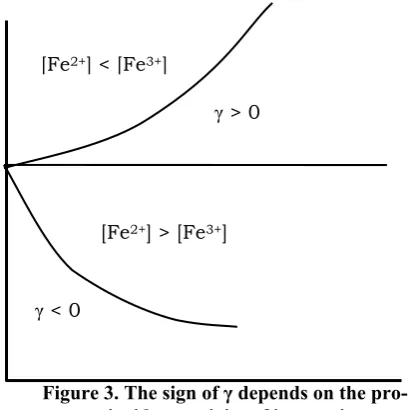
γt (34) [image:5.595.313.520.58.263.2]The last equation demonstrates that the hydroperoxide concentration in the system and the concentration of oxidation chains (which is equal to the concentration of the radicals that lead the chain) varies in time exponentially. Acceleration or deceleration of the reaction depends on the sign of the degree, see Fig. 3.
Figure 3. The sign of γ depends on the pro- or antioxidant activity of iron cations
V. CONCLUSION
Existence of many antioxidant types with different mechanisms of action complicates determination of the antioxidant activity in biological systems. In this work, we used mathematical modeling for achieving algorithmic simulation to study the kinetics of iron (II)-ascorbate-dependent lipid peroxidation. We selected the minimum number of reactions, the combination of which allowed us to reproduce the phenomenology of the experiments. We then explored the mechanisms and characteristics of these active substances under various conditions, including theoretical predictions of their antioxidant behavior. Pursuing an understanding of antioxidant activity of medicinal substances of plant origin is important as many known diseases are associated with an oxidative stress, i.e., an impairment of antioxidant activity.
REFERENCES
[1] V. F. Antonov, Biophysics, Moscow, 2003, pp. 163–167.
[2] V.V. Khasanov, G.L. Ryzhova, E.V. Mal'tseva, Chemistry of plant raw material, 2004, No. 3, pp. 63–75.
[3] I.F. Benzie, Int. J. Food Sci. Nutr., 1996, Vol. 47, No. 3, рр. 233–261. [4] J.A. Berliner, J.W. Heinecke, Free Radic. Biol. Med. 1996, Vol. 20,
No. 5, рр. 707–727.
[5] C.C. Winterbourn, Clin. Exp. Pharmacol. Physiol., 1995, Vol. 22, No. 11, рр. 877– 880.
[6] C.A. Rice-Evans, A.T. Diplock, Free Radic. Biol. Med., 1993, Vol. 15,
рр. 77–96.
[7] S. Batzri, E.D. Korn, Single bilayer liposomes prepared without sonication, Biochim.Biophys. Acta., 1973, Vol. 298, рр. 1015–1019. [8] V.G. Zaitsev, V.M. Zakrevski, Modeling of peroxide oxidation of
lipids in vitro: Application dinitrophenylhydrazine for an intensity estimation peroxide oxidation phosphatidylcholinic liposomes, Proceedings of the Volgograd medical academy, 2000, No. 6, Vol. 56,
рр. 130–133.
[9] B. Halliwell, J.M.C. Gutteridge, Role of free radicals and catalytic metal ions in human disease: An overview, Methods Enzymol., 1990, Vol. 186, рр. 1–85.
[10] D. Bonnefont-Rousselot, C. Segaud, D. Jore., J. Delattre, M. Gardes-Albert, Antioxidant effect of probucol on RO2•/O2•-induced
peroxidation of human low-density lipoproteins, Radiat. Res., 1999, Vol. 151, No. 3, рр. 343–353.
[11] D.C. Liebler, T.D. McClure, Antioxidant reactions of carotene: Identification of carotenoid-radical adducts, Chem. Res. Toxicol., 1996, Vol. 9, No. 1., рр. 8–11.
[Fe2+] > [Fe3+]
γ < 0
[Fe2+] < [Fe3+]
[12] C.A. Rice-Evans, A.T. Diplock, Current status of antioxidant therapy, Free Radical Biol. Med., 1993, Vol. 15, рр. 77–96.
[13] J.A. Olson, Benefits and liabilities of vitamin A and carotenoids, J. Nutr., 1996, Vol. 126, No. 4, рр. 1208S–1212S.
[14] I. Fridovich, Free radicals in biology, Moscow, 1979, pp. 272–314. [15] V.A. Kostyuk, E.F. Lunets, Biochemistry, 1983, No. 48, pp.
1491–1495.