Wronging a Right: Generating Better Errors to Improve
Grammatical Error Detection
Sudhanshu Kasewa and Pontus Stenetorp and Sebastian Riedel
{sudhanshu.kasewa.16, p.stenetorp, s.riedel}@ucl.ac.uk University College London
Abstract
Grammatical error correction, like other ma-chine learning tasks, greatly benefits from large quantities of high quality training data, which is typically expensive to produce. While writing a program to automatically generate realistic grammatical errors would be difficult, one could learn the distribution of naturally-occurring errors and attempt to introduce them into other datasets. Initial work on induc-ing errors in this way usinduc-ing statistical machine translation has shown promise; we investigate cheaply constructing synthetic samples, given a small corpus of human-annotated data, using an off-the-rack attentive sequence-to-sequence model and a straight-forward post-processing procedure. Our approach yields error-filled ar-tificial data that helps a vanilla bi-directional LSTM to outperform the previous state of the art at grammatical error detection, and a pre-viously introduced model to gain further im-provements of over 5%F0.5 score. When
at-tempting to determine if a given sentence is synthetic, a human annotator at best achieves 39.39F1score, indicating that our model
gen-erates mostly human-like instances.
1 Introduction
There is an ever-growing number of people learn-ing English as a second language; providlearn-ing them with quick feedback to facilitate their learning is a crucial, labour-intensive endeavour. Part of this process is identifying and correcting grammati-cal errors, and several computational techniques have been developed to automate it (Rozovskaya and Roth, 2014; Junczys-Dowmunt and Grund-kiewicz, 2016). For example, given an erroneous sentence “I wanted to goes to the beach”, the grammatical error correction task is to output the valid sentence “I wanted to go to the beach”. The task can be cast as a two-stage process, de-tection and correction, which can either be
per-formed sequentially (Yannakoudakis et al.,2017), or jointly (Napoles and Callison-Burch,2017).
Automated error correction performance is ar-guably still too low for practical considera-tion, perhaps limited by the amount of training data (Rei et al., 2017). High quality annotations are expensive to procure, and foreign language learners and commercial entities may feel uncom-fortable granting access to their data. Instead, one could attempt to supplement existing manual an-notations with synthetic instances. Such artificial samples are beneficial only when they share struc-ture with the true distribution from which human errors are generated. Generative Adversarial Net-works (Goodfellow et al.,2014) could be used for this purpose, but they are difficult to train, and re-quire a large collection of sentences that are incor-rect. One might attempt self-training (McClosky et al., 2006), where new instances are generated by applying a trained model to unannotated data, using high-confidence predictions as ground truth labels. However, in such a scheme, the expectation is that the unlabelled text already contains errors, which is not usually the case for most freely avail-able text such as Wikipedia articles as they strive towards correctness.
soft-ware such as a phrase-table generator, decoder, and part-of-speech tagger. We created multi-ple synthetic datasets from in-domain and out-of-domain sources, and found that stochastic to-ken sampling, and pruning redundant and low-likelihood sentences, were helpful in generating meaningful corruptions. Using the artificial sam-ples thus generated, we improved upon detec-tion results with simply a vanilla bi-direcdetec-tional LSTM (Hochreiter and Schmidhuber,1997). Us-ing a more powerful model, we established new state-of-the-art results, that improve on previously published F0.5 scores by over 5%. Addition-ally, we confirm that our generated instances are human-like, as an annotator identifying generated sentences achieved a maximumF1score of 39.39.
2 Related work
In computer vision, images are blurred, rotated, or otherwise deformed inexpensively to create new training instances (Wang and Perez, 2017), be-cause such manipulation does not significantly alter the image semantics. Similar coarse pro-cesses do not work in NLP since mutating even a single letter or a word can change a sentence’s meaning, or render it nonsensical. Nonetheless, Vinyals et al. (2015) employed a kind of self-training where they use noisy predictions for un-labelled instances output by existing state-of-the-art parsers as ground-truth labels, and improved syntactic parsing performance. Sennrich et al. (2016) synthesised training instances by round-trip-translating a monolingual corpus with weaker versions of an NMT learner, and used them to im-prove the translation. Bouchard et al.(2016) de-veloped an efficient algorithm to blend generated and true data for improving generalisation.
Grammar correction is a well-studied task in NLP, and early systems were rule-based pattern recognisers (Macdonald, 1983) and dictionary-based linguistic analysis engines (Richardson and Braden-Harder, 1988). Later systems used sta-tistical approaches, addressing specific kinds of errors such as article insertion (Knight et al., 1994) and spelling correction (Golding and Roth, 1996). Most recently, architectural innovations in neural sequence labelling (Rei et al., 2016; Rei, 2017) raised error detection performance through improved ability to process unknown words and jointly learning a language model.
Early efforts for artificial error generation
in-cluded generating specific types of errors, such as mass noun errors (Brockett et al.,2006) and arti-cle errors (Rozovskaya and Roth,2010), and lever-aging linguistic information to identify error pat-terns and transfer them onto grammatically correct text (Foster and Andersen,2009;Yuan and Felice, 2013). Imamura et al. (2012) investigated meth-ods to generate pseudo-erroneous sentences for er-ror correction in Japanese. Recently, Rei et al. (2017) corrupted error-free text using SMT to cre-ate training instances for error detection.
3 Neural error generation
To learn to introduce errors, we use an off-the-shelf attentive sequence-to-sequence neural net-work (Bahdanau et al.,2014). Given an input se-quence, theencodergenerates context vectors for each token. Then, the attention mechanism and thedecoderwork in tandem to emit a distribution over the target vocabulary. At every decoder time-step, the encoder context vectors are scored by the attention mechanism, and a weighted sum is sup-plied to the decoder, along with its propagated in-ternal state and last output symbol.
Corruption: Tokens from this distribution are sampled at every decoder time-step, either by
argmax(AM), which emits the most likely word, or by a stochastic alternative such astemperature sampling (TS) as argmax cannot be relied on to generate rare words. A temperature parameter
τ >0sharpens or softens the distribution:
˜
pi =fτ(p)i =
p
1
τ
i
P
jp 1
τ
j
whereiare the components of the probability dis-tribution corresponding to words in the vocabu-lary. As one interpolates τ from 0 to 1, the be-haviour ofp˜transitions fromargmaxtop, control-ling the diversity of the generated tokens.
Original Corruption
[image:3.595.68.526.136.325.2]She promised to turn over a new leaf. She promissed to turn over a new leaf. At the moment I’m in Spain. During the moment I’m in Spain.
Table 1: Example sentences generated by our NMT pipeline.
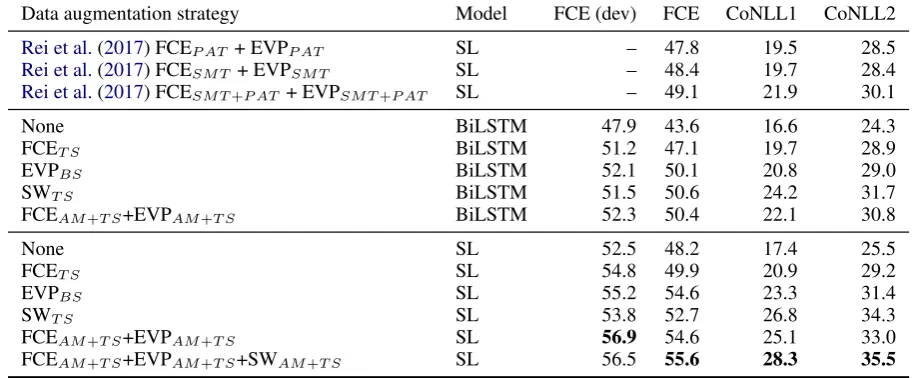
Data augmentation strategy Model FCE (dev) FCE CoNLL1 CoNLL2
Rei et al.(2017) FCEP AT + EVPP AT SL – 47.8 19.5 28.5
Rei et al.(2017) FCESM T + EVPSM T SL – 48.4 19.7 28.4
Rei et al.(2017) FCESM T+P AT + EVPSM T+P AT SL – 49.1 21.9 30.1
None BiLSTM 47.9 43.6 16.6 24.3
FCET S BiLSTM 51.2 47.1 19.7 28.9
EVPBS BiLSTM 52.1 50.1 20.8 29.0
SWT S BiLSTM 51.5 50.6 24.2 31.7
FCEAM+T S+EVPAM+T S BiLSTM 52.3 50.4 22.1 30.8
None SL 52.5 48.2 17.4 25.5
FCET S SL 54.8 49.9 20.9 29.2
EVPBS SL 55.2 54.6 23.3 31.4
SWT S SL 53.8 52.7 26.8 34.3
FCEAM+T S+EVPAM+T S SL 56.9 54.6 25.1 33.0
FCEAM+T S+EVPAM+T S+SWAM+T S SL 56.5 55.6 28.3 35.5
Table 2:F0.5scores on various tests contrasted with published results and unaugmented baseline models.
the additional computations were helpful in creat-ing high-quality synthetic instances.
Post-processing: Original and corrupted sen-tences are aligned at a word-level using Leven-shtein distance. Using the minimal alignment, words in the corrupted sentence are labelled cor-rect, ‘c’, orincorrect, ‘i’, as follows:
If the word is not aligned with itself, then ‘i’.
Else, if following a gap, then ‘i’, as at this point a human reader would notice that there is a word missing in the sentence.Else, if it is the last word, but it is not aligned to the last word of the source sentence, then ‘i’, as a human would realise that this sentence ends abruptly,Else, ‘c’.
These token-labelled corrupted sentences now form an artificial dataset for training an error de-tector. Duplicate instances and corrupted sen-tences with more than 5 errors were dropped to remove noise from the downstream training.
4 Experiments
We evaluated our approach on the First Certificate of English (FCE) error detection dataset (Rei and Yannakoudakis,2016), as well as on two human-annotated test sets (CoNLL1, CoNLL2) from the CoNLL 2014 shared task (Ng et al., 2014). The CoNLL data sets pose a unique challenge; as they are different in style and domain from FCE, we
have no matching training data. We compared the effect of different neural generation proce-dures (AM, TS, BS) and contrasted the down-stream performance of a bidirectional LSTM with an elaborate sequence labeller.
4.1 Implementation details
NMT training and corruption: We minimally
modified the open source implementation1ofBritz et al.(2017) to implement TS and BS.2We trained our NMT with a single-layered encoder and de-coder with cell size 256, on the parallel cor-pus version of FCE (Yannakoudakis et al.,2011), with early stopping after the FCE development set score dropped consistently for 20 epochs. We introduced errors into three datasets: FCE it-self (450K tokens), the English Vocabulary Pro-file or EVP (270K tokens) and a subset of Simple Wikipedia or SW (8.4M tokens); of these, FCE and EVP were both used in artificial error genera-tion via SMT and pattern extracgenera-tion (PAT) byRei et al. (2017), enabling us to make a fair experi-mental comparison. Ten corrupted versions using each of AM, TS (τ = 0.05) and BS were sam-pled for FCE and EVP corruptions, while one suf-ficed for SW. The theoretical time complexity of BS is O(bn) for each sentence, where b is
num-1
https://github.com/google/seq2seq
FCE (dev) FCE CoNLL1 CoNLL2 0
5 10
Absolute
increase
in
F0
.
5
score
Baseline EVP+AM
[image:4.595.74.271.61.221.2]EVP+TS EVP+BS
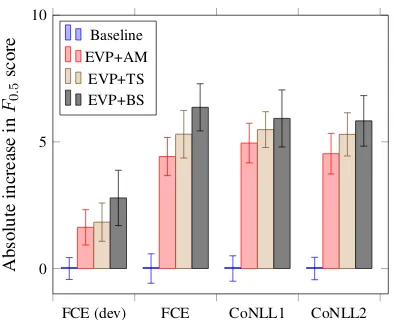
Figure 1: Improvements using three different meth-ods of generation.
ber of candidates, and nis the maximum length of a sentence. Empirically, BS withb = 11took a factor of 11.3 more time than AM. Examples of generated errors are provided in Table1.
Error detection: We compare two error detec-tion models: a vanilla bi-direcdetec-tional LSTM (BiL-STM) (Schuster and Paliwal,1997), and the state-of-the-art sequence labeller (SL) neural network used by Rei et al. (2017). These models were trained on the binary-labelled FCE training set augmented with the corrupted instances. Wher-ever no model is explicitly stated, the SL model was used. During training, we alternate between the annotated FCE dataset and the synthetic col-lection. This alternating protocol prevents over-fitting on FCE; once it shifts back, it reinforces connections made from the helpful synthetic cor-ruptions while forgetting about the noisy ones.
4.2 Results
The results for our baselines and data augmenta-tion strategies can be found in Table2. Augmented with our NMT generated data, even our vanilla downstream BiLSTM outperforms the SMT+PAT artificial error augmentation approach ofRei et al. (2017), indicating that our process better gener-alises the error information in the source dataset. Using the more powerful SL network bests the previous state of the art by over 5% on the FCE test. Most intriguingly, we note a significant im-provement for the CoNLL tests using corruptions from out-of-domain SW. Figure2 illustrates how we gain performance on these tests with increas-ing amounts of corrupted SW, which does not hold true for corrupted FCE. This shows that we were
1x 2x 3x 4x 5x 6x 7x 8x 9x 10x 15
20 25 30 35
Amount of augmented data
F0
.
5
score
FCE SW
[image:4.595.325.507.62.219.2]CoNLL1 CoNLL2
Figure 2: Training with increasing amounts of cor-rupted data from FCE and SW.
able to induce useful errors into a corpus with a large unseen vocabulary and different syntactic bi-ases, and this in turn proved valuable for detect-ing errors in a third domain, suggestdetect-ing that our method can transfer learned distributions across stylistic genres.
Using EVP as a standard source, Figure1 illus-trates the variance of the different sampling meth-ods. All generation methods yield corruptions that significantly improve test performance, with in-stances sampled by beam-search consistently out-performing the alternatives.
5 Discussion
5.1 Error distribution
The original FCE dataset was annotated using the error taxonomy specified inNicholls (2003), and contains 75 unique error codes. We annotated samples of EVP corrupted by all three sampling methods, at a reduced resolution, to compare the distribution of errors across FCE and the synthetic corpora. These are presented in Table3.
At a high level, NMT generates errors more of-ten among more common parts-of-speech, favour-ing errors in verbs and nouns, rather than in ad-verbs and conjunctions. It did not make spelling errors as often as in the source dataset; this is likely because it only observed the specific spelling errors present in FCE, and as the vocab-ulary is restricted to that dataset, it does not en-counter those words as frequently in EVP, and thus rarely makes the same spelling mistakes.
Spelling FCE AM TS BS
Spelling errors 11 1 1 4
Part-of-speech FCE AM TS BS
Verb 34 16 26 16
Preposition 18 16 10 14
Determiner 16 7 6 10
Noun 13 36 35 43
Pronoun 7 3 3 1
Adverb 5 5 3 5
Adjective 3 15 16 12
Conjunction 2 2 2 1
Quantifier 1 0 0 0
Remedy Type FCE AM TS BS
Replacement 49 35 34 32
Inclusion 23 30 27 35
Removal 14 33 36 32
Word form 9 2 2 1
[image:5.595.92.269.61.330.2]Word order 5 0 0 0
Table 3: Error distribution across FCE and manu-ally annotated samples of artificial data. Spelling errors are a % of all errors, while Part-of-speech, and Remedy Type are compared within their own categories to sum to 100%.
5.2 Comparison with human errors
To check if the synthetic instances passed for human-like, we mixed 50 generated sentences among an equal number of actual ungrammatical instances from FCE-dev and tasked a human eval-uator to identify the artificial statements, in a sim-ple Turing-style test. We created three such sets, one for each of our sampling techniques, and the test subject aimed to identify synthetic samples with high confidence. Results of this test are pre-sented in Table4.
The high precision but low recall scores suggest that while it is still possible to spot some corrup-tions that are quite clearly artificial, the bulk of our samples do not betray their synthetic nature and are indistinguishable from naturally occurring er-roneous sentences. In order to fairly compare our work with earlier results, we intended to conduct such a test for sentences generated by the SMT ofRei et al.(2017). Unfortunately, we were only able to source corruptions of FCE-train via this method; therefore, we decided not to perform this test as its results cannot be compared to ours.
AM TS BS
Precision 81.25 63.63 50.00
Recall 26.00 28.00 14.00
F1 39.39 38.89 22.22
Table 4: Results of a Turing-style test, where a sub-ject was asked to distinguish between real and fake sentences, sampled from each of the different gen-erated corpora.
6 Conclusions and future work
We presented a novel data augmentation tech-nique for grammatical error detection using neu-ral machine translation to learn the distribution of language-learner errors, and induce such er-rors into grammatically correct text. We explored several different variants of sampling to improve the quality of our synthetic errors. After creat-ing artificial traincreat-ing instances with an off-the-shelf NMT, we bettered previous state-of-the-art results on the canonical test with even a basic BiL-STM, and established a new state of the art using a stronger model. Additionally, we demonstrated that we were able to leverage corruptions of an out-of-domain dataset to set new benchmarks on separate, also out-of-domain tests, without specif-ically optimising for either.
Our work indicates that neural error genera-tion warrants further investigagenera-tion with different datasets and architectures, both for error detec-tion and error correcdetec-tion. Among possible fu-ture work is using generative adversarial networks as corruption engines, and developing better se-quence alignment methods. Some preliminary re-sults with simple corruptions using word substitu-tion and word dropout (Iyyer et al.,2015) appear to be promising, and may feature as components of a future corruption system. Finally, one could use such artificial error-prone corpora as source text for self-training an error detection system.
Acknowledgements
[image:5.595.339.491.62.120.2]References
Dzmitry Bahdanau, Kyunghyun Cho, and Yoshua Bengio. 2014. Neural machine translation by jointly learning to align and translate. CoRR, abs/1409.0473.
Guillaume Bouchard, Pontus Stenetorp, and Sebastian Riedel. 2016. Learning to generate textual data. In Proceedings of the 2016 Conference on Empiri-cal Methods in Natural Language Processing, pages 1608–1616, Austin, Texas. Association for Compu-tational Linguistics.
Denny Britz, Anna Goldie, Thang Luong, and Quoc Le. 2017. Massive Exploration of Neural Machine Translation Architectures.ArXiv e-prints.
Chris Brockett, William B. Dolan, and Michael Ga-mon. 2006. Correcting esl errors using phrasal smt techniques. In Proceedings of the 21st Interna-tional Conference on ComputaInterna-tional Linguistics and 44th Annual Meeting of the Association for Compu-tational Linguistics, pages 249–256, Sydney, Aus-tralia. Association for Computational Linguistics.
Mariano Felice and Zheng Yuan. 2014. Generat-ing artificial errors for grammatical error correction. In Proceedings of the Student Research Workshop at the 14th Conference of the European Chapter of the Association for Computational Linguistics, pages 116–126, Gothenburg, Sweden. Association for Computational Linguistics.
Jennifer Foster and Øistein E Andersen. 2009. Gen-errate: generating errors for use in grammatical error detection. InProceedings of the fourth workshop on innovative use of nlp for building educational ap-plications, pages 82–90. Association for Computa-tional Linguistics.
Andrew R Golding and Dan Roth. 1996. Apply-ing winnow to context-sensitive spellApply-ing correction. arXiv preprint cmp-lg/9607024.
Ian Goodfellow, Jean Pouget-Abadie, Mehdi Mirza, Bing Xu, David Warde-Farley, Sherjil Ozair, Aaron Courville, and Yoshua Bengio. 2014. Generative ad-versarial nets. In Advances in neural information processing systems, pages 2672–2680.
Sepp Hochreiter and J¨urgen Schmidhuber. 1997. Long short-term memory. Neural Comput., 9(8):1735– 1780.
Kenji Imamura, Kuniko Saito, Kugatsu Sadamitsu, and Hitoshi Nishikawa. 2012. Grammar error correc-tion using pseudo-error sentences and domain adap-tation. InProceedings of the 50th Annual Meeting of the Association for Computational Linguistics: Short Papers-Volume 2, pages 388–392. Association for Computational Linguistics.
Mohit Iyyer, Varun Manjunatha, Jordan Boyd-Graber, and Hal Daum´e III. 2015. Deep unordered com-position rivals syntactic methods for text classifica-tion. InProceedings of the 53rd Annual Meeting of
the Association for Computational Linguistics and the 7th International Joint Conference on Natural Language Processing (Volume 1: Long Papers), vol-ume 1, pages 1681–1691.
Marcin Junczys-Dowmunt and Roman Grundkiewicz. 2014. The amu system in the conll-2014 shared task: Grammatical error correction by data-intensive and feature-rich statistical machine translation. In Proceedings of the Eighteenth Conference on Com-putational Natural Language Learning: Shared Task, pages 25–33, Baltimore, Maryland. Associa-tion for ComputaAssocia-tional Linguistics.
Marcin Junczys-Dowmunt and Roman Grundkiewicz. 2016. Phrase-based machine translation is state-of-the-art for automatic grammatical error correction. In Proceedings of the 2016 Conference on Empiri-cal Methods in Natural Language Processing, pages 1546–1556, Austin, Texas. Association for Compu-tational Linguistics.
Kevin Knight, Ishwar Chander, Matthew Haines, Vasileios Hatzivassiloglou, Eduard Hovy, Masayo Iida, Steve K Luk, Akitoshi Okumura, Richard Whitney, and Kenji Yamada. 1994. Integrating knowledge bases and statistics in mt. arXiv preprint cmp-lg/9409001.
Nina H Macdonald. 1983. Human factors and behav-ioral science: The unix writer’s workbench soft-ware: Rationale and design. Bell Labs Technical Journal, 62(6):1891–1908.
David McClosky, Eugene Charniak, and Mark John-son. 2006. Effective self-training for parsing. In Proceedings of the Human Language Technology Conference of the NAACL, Main Conference, pages 152–159, New York City, USA. Association for Computational Linguistics.
Courtney Napoles and Chris Callison-Burch. 2017. Systematically adapting machine translation for grammatical error correction. In Proceedings of the 12th Workshop on Innovative Use of NLP for Building Educational Applications, pages 345–356, Copenhagen, Denmark. Association for Computa-tional Linguistics.
Hwee Tou Ng, Siew Mei Wu, Ted Briscoe, Christian Hadiwinoto, Raymond Hendy Susanto, and Christo-pher Bryant. 2014. The conll-2014 shared task on grammatical error correction. InProceedings of the Eighteenth Conference on Computational Natural Language Learning: Shared Task, pages 1–14, Bal-timore, Maryland. Association for Computational Linguistics.
Diane Nicholls. 2003. The cambridge learner corpus: Error coding and analysis for lexicography and elt. InProceedings of the Corpus Linguistics 2003 con-ference, volume 16, pages 572–581.
55th Annual Meeting of the Association for Com-putational Linguistics (Volume 1: Long Papers), pages 2121–2130, Vancouver, Canada. Association for Computational Linguistics.
Marek Rei, Gamal Crichton, and Sampo Pyysalo. 2016. Attending to characters in neural sequence label-ing models. In Proceedings of COLING 2016, the 26th International Conference on Computational Linguistics: Technical Papers, pages 309–318, Os-aka, Japan. The COLING 2016 Organizing Commit-tee.
Marek Rei, Mariano Felice, Zheng Yuan, and Ted Briscoe. 2017. Artificial error generation with ma-chine translation and syntactic patterns. In Proceed-ings of the 12th Workshop on Innovative Use of NLP for Building Educational Applications, pages 287– 292, Copenhagen, Denmark. Association for Com-putational Linguistics.
Marek Rei and Helen Yannakoudakis. 2016. Composi-tional sequence labeling models for error detection in learner writing. In Proceedings of the 54th An-nual Meeting of the Association for Computational Linguistics (Volume 1: Long Papers), pages 1181– 1191, Berlin, Germany. Association for Computa-tional Linguistics.
Stephen D. Richardson and Lisa C. Braden-Harder. 1988. The experience of developing a large-scale natural language text processing system: Critique. InSecond Conference on Applied Natural Language Processing.
Alla Rozovskaya and Dan Roth. 2010. Training paradigms for correcting errors in grammar and us-age. In Human language technologies: The 2010 annual conference of the north american chapter of the association for computational linguistics, pages 154–162. Association for Computational Linguis-tics.
Alla Rozovskaya and Dan Roth. 2014. Building a state-of-the-art grammatical error correction system. Transactions of the Association for Computational Linguistics, 2:419–434.
Mike Schuster and Kuldip K Paliwal. 1997. Bidirec-tional recurrent neural networks. IEEE Transactions on Signal Processing, 45(11):2673–2681.
Rico Sennrich, Barry Haddow, and Alexandra Birch. 2016. Improving neural machine translation mod-els with monolingual data. In Proceedings of the 54th Annual Meeting of the Association for Compu-tational Linguistics (Volume 1: Long Papers), pages 86–96, Berlin, Germany. Association for Computa-tional Linguistics.
Oriol Vinyals, Łukasz Kaiser, Terry Koo, Slav Petrov, Ilya Sutskever, and Geoffrey Hinton. 2015. Gram-mar as a foreign language. InAdvances in Neural Information Processing Systems, pages 2773–2781.
Jason Wang and Luis Perez. 2017. The effectiveness of data augmentation in image classification using deep learning. Technical report, Technical report.
Helen Yannakoudakis, Ted Briscoe, and Ben Medlock. 2011. A new dataset and method for automatically grading esol texts. InProceedings of the 49th An-nual Meeting of the Association for Computational Linguistics: Human Language Technologies, pages 180–189, Portland, Oregon, USA. Association for Computational Linguistics.
Helen Yannakoudakis, Marek Rei, Øistein E. Ander-sen, and Zheng Yuan. 2017. Neural sequence-labelling models for grammatical error correction. In Proceedings of the 2017 Conference on Empiri-cal Methods in Natural Language Processing, pages 2795–2806, Copenhagen, Denmark. Association for Computational Linguistics.
Zheng Yuan and Ted Briscoe. 2016. Grammatical er-ror correction using neural machine translation. In Proceedings of the 2016 Conference of the North American Chapter of the Association for Computa-tional Linguistics: Human Language Technologies, pages 380–386, San Diego, California. Association for Computational Linguistics.