Proceedings of the 2018 Conference on Empirical Methods in Natural Language Processing (System Demonstrations), pages 13–18 13
Data2Text Studio: Automated Text Generation from Structured Data
Longxu Dou1∗, Guanghui Qin2∗, Jinpeng Wang3, Jin-Ge Yao3, and Chin-Yew Lin3
1 Harbin Institute of Technology,[email protected]
2Peking University,[email protected]
3 Microsoft Research Asia,{jinpwa, jinge.yao, cyl}@microsoft.com
Abstract
Data2Text Studio is a platform for automated text generation from structured data. It is equipped with a Semi-HMMs model to ex-tract high-quality templates and corresponding trigger conditions from parallel data automati-cally, which improves the interactivity and in-terpretability of the generated text. In addition, several easy-to-use tools are provided for de-velopers to edit templates of pre-trained mod-els, and APIs are released for developers to call the pre-trained model to generate texts in third-party applications. We conduct experi-ments on ROTOWIREdatasets for template ex-traction and text generation. The results show that our model achieves improvements on both tasks.
1 Introduction
Data-to-text generation, i.e., a technology which takes structured data as input and produces text that adequately and fluently describes this data as output, has various applications on the generation of sports news (Chen and Mooney,2008;Kim and Mooney, 2010;Mei et al., 2016;Wiseman et al., 2017), product descriptions (Wang et al., 2017), weather reports (Liang et al.,2009;Angeli et al., 2010;Mei et al.,2016) and short biographies ( Le-bret et al.,2016;Chisholm et al.,2017). In another scenario, it is possible albeit a little awkward for a virtual assistant like Microsoft Cortana to read out structured data when responding to users’ queries. it is more user friendly for a virtual assistant to identify and read out the essential part of the struc-tured data in natural language to make it easier to understand. In these cases, it is inefficient and expensive to generate texts using human writers,
∗
Contribution during the internship at Microsoft Re-search Asia.
while an automatic text generation system would be helpful.
There are two main challenges for data-to-text generation systems: 1) Interactivity: For a devel-oper, it should be able to customize the text gen-eration model and control the generated texts. 2) Interpretability: the generated texts should be con-sistent with the structured data. For example, we can say “with a massive 8 GB of memory” for a laptop computer while “a massive 2 GB” is in-appropriate. Rule-based approaches (Moore and Paris, 1993;Hovy, 1993;Reiter and Dale, 2000; Belz, 2007; Bouayad-Agha et al., 2011) encode domain knowledge into the generation system and then produce high-quality texts, while the con-struction of the system is expensive and heavily depends on domain experts. Statistical approaches are employed to reduce extensive development time by learning rules from historical data ( Langk-ilde and Knight,1998;Liang et al.,2009;Duboue and McKeown,2003;Howald et al.,2013). How-ever, statistical approaches are prone to generating texts with mistakes, because they don’t know how to use specific phrases under various application conditions.
Word-Upload Data
Edit Template
Text Preview Interface
Bulk Generation
Open API
Third-Party Application Models
Model Training
Model Revision
Text Generation Backend
Thomas' last-second shot lifts Kings to a 96-94 win over Wizards
Structured data of a game
[image:2.595.85.518.56.203.2]Text of a game results Parallel Data
Figure 1: The simplified architecture of the Data2Text Studio.
Smith, Arria and Quill1. For example, although WordSmith provides functional tools to help de-velopers create templates and generation rules, it still needs to create rules from scratch manually.
For the first challenge, we demonstrate the Data2Text Studio, a powerful platform equipped with the proposed Semi-HMMs model, to assist developers to generate texts from structured data in their own applications. Currently, this system provides several pre-trained models covering dif-ferent domains: sports headline generation, re-sume generation, product description generation, etc. Developers can also train their own models by uploading parallel data. After model training, developers can revise the model, preview the gen-erated texts or call the APIs to generate texts in third-party applications. All the processes are sim-ple and friendly.
We conduct experiments on the ROTOWIRE
dataset (Wiseman et al., 2017) to evaluate the performance of template extraction and overall text generation. The results show that our model achieves improvements on both tasks. The rest of this paper is organized as follows: Section 2 de-scribes the architecture of Data2Text Studio. Sec-tion 3 proposes the main algorithm. Section 4 shows the experiment results.
2 Architecture
Fig. 1 shows the simplified architecture of the Data2Text Studio. It mainly consists of three com-ponents: 1) model training, 2) model revision and 3) text generation. For typical usages, develop-ers can directly choose the pre-trained model to generate high-quality texts. To develop a cus-tomized text generation model: First, develop-1http://automatedinsights.com, http://
[image:2.595.308.525.240.386.2]arria.comandhttp://narrativescience.com
Figure 2: Extracted templates of NBA headlines. Bracket indicates the slot, and words in it indicates the corresponding attribute of structured data.
ers need to upload parallel data which consists of texts and corresponding structured data to train the model, and then training components will extract the templates and corresponding trigger conditions from training data automatically; secondly, devel-opers could leverage the built-in tools to further revise the extracted templates and trigger condi-tions manually; finally, developers could preview the generated texts of the customized model, and the APIs are provided to generate texts in bulk or generate texts in third-party applications. In the following, we will introduce these modules in de-tail.
2.1 Model Training
(a) Template revision. The center part shows the template with slots, and the bottom part shows the trigger conditions.
[image:3.595.75.521.55.292.2](b) Generated texts preview. Multiple headlines are gener-ated for the same game to ensure variety.
Figure 3: Data2Text Studio Interface
Semi-HMMs model to extract templates and cor-responding trigger conditions from parallel data (see Section3.1for the algorithm). Fig.2presents an example of the extracted templates from NBA Headline parallel data, which consists of the score-board and the corresponding news.
2.2 Model Revision
The trained model provides a better starting point for developers to avoid creating a model from scratch. If necessary, developers can revise the trained model by editing the extracted templates and their corresponding trigger conditions. Fig.3a shows the interface of template editing. Three mechanisms are designed to manage templates and corresponding trigger conditions: 1) Data slot: the input structured data will be filled into the slot to generate texts. 2) Synonyms: it is constructed by a list of phrases, and one of them will be cho-sen randomly during the generation process. 3) Branch: the trigger condition to define usage sce-nario for the specific phrase. Our Semi-HMMs model in Section3.1can learn such data slots and trigger conditions automatically. Meanwhile, de-velopers can also revise them if necessary.
2.3 Text Generation
Given the structured data, the system will gen-erate corresponding texts with the trained model. Fig.3bshows an example for NBA headline gen-eration. The left-hand side shows the input
struc-tured data which contains the attributes of the game. The right-hand side shows multiple gen-erated texts for this game to help developers check the quality of the generated texts.
2.4 API for Third-Party Applications
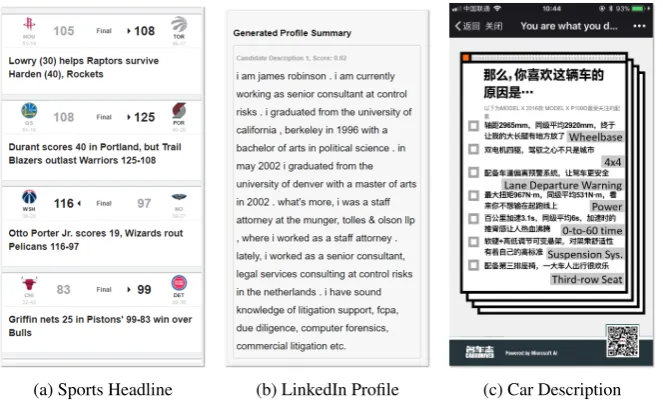
To use the text generation service in third-party applications, an API is created for each trained model. Once the structured data is posted through the API, the system will deliver the generated text back to third-party applications automatically. In this way, developers can leave the development work for a text generation model in the Data2Text Studio. Fig. 4shows three application scenarios: sports headline generation, user profile generation based on LinkedIn data and car insight generation.
3 The Proposed Algorithm
In this section, we introduce the proposed algo-rithm for templates extraction and corresponding trigger conditions mining.
3.1 Template Extraction
(a) Sports Headline (b) LinkedIn Profile (c) Car Description
Figure 4: Example applications by using the Data2Text API.
The Boston Celtics ( 7 - 5 ) blew out the Brooklyn Nets ( 2 - 11 ) 120 - 95 on Friday . null
-Team_Name.at
(0)
-Team_P
oints.delta
-null - null
-Team_P
oints.at(
0) null null
-Team_W
ins.at(0
)
-Team_Name.at
(1) - null - null
null -Team_City
.at(0)
-Team_L
osses.at
(0) null
-Team_City
.at(1)
null -Team_W
ins.at(1
) -Team_L
osses.at
(1)
-Team_P
oints.at(
1) - Date
-Figure 5: Example of Trigger Mechanism. Words in blue dashed boxes are particular phrases generated by our model under the specific rules. For example,“blew out”will be generated when“Team Points.delta” overs 17 under the automatically extracted rules.
Another challenge is the lexical choice, which refers to choosing contextually-appropriate words to express non-linguistic data. For example, in a basketball game report, the author tends to use blow out only when the score difference is very large. Lexical choice is very subtle and differs from author to author, thus we enrich the align-ment model with a Gaussian emission probability from words to numbers in the data.
The garbage collection problem is severe in the original model ofLiang et al.(2009), which means that most of the words are wrongly aligned to in-frequent fields that should remain unaligned (i.e, aligned tonull). Here we incorporate the Posterior Regularization proposed by Grac¸a et al. (2010), which could add constraints into models with la-tent variables while keeping the model tractable at the same time. In practice, we set a lower bound on the number of unaligned words, which could significantly alleviate the garbage collection prob-lem.
In a nutshell, we propose a generative model, Ps(w, π|l), where s is the world state, namely,
the structured data,wis the observed words,πis the segmentation of words, andlrepresents tags,
which could be the fields of the structured data (e.g. Team Name) or simple operations on spe-cific fields (e.g. score difference). Let c be the segments of sentencewsegmented byπ. We fur-ther make a Markov assumption and factorize it into:
P(c|l) =Y
t
P(lt|lt−1)·Ps(ct|lt), (1)
where ct represents the segment at time stamp t, which is annotated with tag lt. For different
types of fields, we use different methods to model Ps(ct|lt).
During the training process, our goal is to max-imize the complete data likelihood:
L(θ) = Y
(s,w)∈ D X
l,π
Ps(l, π,w;θ),
whereDrepresents the whole training data. Once the model has been trained, we use Viterbi-like dynamic programming to perform the MAP infer-ence to segment the texts and to assign the most likely tags for each span.
esti-mation, and introduce a soft statistical regulariza-tion to guide the model towards a better soluregulariza-tion. Specifically, we design a specialNULLtag for un-aligned words, and we “encourage” it to annotate at least half of the words. For more details, please refer toQin et al.(2018).
3.2 Trigger Mechanism
As proposed in3.1, we use Gaussian distribution to model the probability of alignment between nu-merical values and phrases. Hence our model can tell us not only where the word comes from, but also the distribution of numbers it is aligned to. For example, after training, our model success-fully aligns “blow out” to the score difference, and shows that the mean value of score difference is 17 when this phrase is used. With this informa-tion, we could set a “trigger” on the aligned words. Trigger is a scheme which determines under what conditions a template could be used. For example, templates with “blow out” aligned to score differ-ence can only be used when the score differdiffer-ence is around 17, whereblew outwould have a higher probability than defeated. So we could obtain a rule like this:
i f t e a m p o i n t s d e l t a > 1 7 : u s e ( b l e w o u t )
e l s e :
u s e ( d e f e a t e d )
With such rules, our model will be able to use dif-ferent words under various conditions.
Now that the templates and triggers are ready for use, for text generation, we fill the templates with structured data under corresponding applica-ble trigger conditions.
4 Experiments
In this section, we will report the performance of the proposed model on template extraction and on overall text generation, both evaluated on the ROTOWIRE subset of the Wiseman et al. (2017) dataset.
Precision Recall F1
Liang09 0.319 0.643 0.426
Liang09+PR 0.397 0.640 0.490
Semi-HMMs 0.254 0.765 0.381
Semi-HMMs+PR 0.504 0.786 0.614
Table 1: Word-level tag assignment results.
4.1 Template Extraction Evaluation
We conduct an experiment and compare with Liang et al.(2009)’s system as the baseline. It is difficult to evaluate the accuracy of tag assignment for the whole dataset, since the executable tags are not annotated in the original data. We recruit three human annotators which are familiar with basket-ball games to label a random sample consisting of 300 sentences from the test set. The annotators were told to judge whether each word span is re-lated to the table, and which label they are rere-lated to. Finally, we calculate the precision and recall for non-NULLtag assignments at word-level.
The results are shown at Table 1. We can ob-serve that our initial model indeed outperforms the baseline system in recall, while posterior regular-ization helps a lot to avoid distraction from irrel-evant information that should be tagged asNULL without sacrificing the recall performance.
4.2 Overall Text Generation Evaluation
We also test the performance of extracted tem-plates in overall text generation, by comparing with the baseline using the same heuristics de-scribed in Section3.2. To generate document-level texts, we first generate a sentence describing the scoreline result for every game, followed by three sentences describing other information about team performance. While maintaining that no template is repeatedly used, we then choose the template with the highest score for the top ten players sorted by their game points. We report automatic met-rics including BLEU scores and those based on relation extraction as proposed byWiseman et al. (2017): precision & number of unique relations in generation (RG), precision & recall for content se-lection (CS), and content ordering (CO) score. Be-sides these automatic metrics for various aspects in NLG, we also conduct human evaluation on in-formation correctness (1-5 scale ratings, the higher the better). We ask four human raters who are flu-ent in English and familiar with basketball to rate outputs for 30 random games. Results are shown in Table 2 with Kendall’s W measuring the inter annotator agreement. We can observe that tem-plates derived from our model indeed outperform those from the baseline system.
5 Conclusion and Future Work
Model RG(P%) RG(#) CS(P%) CS(R%) CO BLEU Correctness
Liang09+PR 85.83 33.29 14.33 31.09 6.25 8.34 2.60
SemiHMM+PR 90.47 41.79 21.63 50.17 9.63 9.45 3.58
Gold-standard 91.77 12.84 100 100 100 100 4.88
Table 2: Results for text generation. (Kendall’s W=0.83 from correctness raters.)
It not only provides several pre-trained models which could generate high-quality texts from data but also is very easy to train new models by up-loading parallel data. In addition, this system is equipped with the proposed Semi-HMMs model which could extract templates and corresponding trigger conditions from parallel data automatically and supports learning how to use specific phrases under the particular condition. Experiment results on the ROTOWIREdataset show that the proposed model outperforms the baseline for template ex-traction and text generation.
In the future, we will integrate more power-ful pre-trained models into this system in terms of data domain and text fidelity. For the tem-plate extraction model, we will learn more com-plex grounding rules to enhance the model power.
References
Gabor Angeli, Percy Liang, and Dan Klein. 2010. A simple domain-independent probabilistic approach to generation. InEMNLP, pages 502–512.
Anja Belz. 2007. Probabilistic generation of weather forecast texts. InHLT-NAACL, pages 164–171.
Nadjet Bouayad-Agha, Gerard Casamayor, and Leo Wanner. 2011. Content selection from an ontology-based knowledge base for the generation of football summaries. InENLG, pages 72–81.
David L. Chen and Raymond J. Mooney. 2008. Learn-ing to sportscast: a test of grounded language acqui-sition. InICML, pages 128–135.
Andrew Chisholm, Will Radford, and Ben Hachey. 2017. Learning to generate one-sentence biogra-phies from wikidata. CoRR, abs/1702.06235.
Pablo A. Duboue and Kathleen R. McKeown. 2003. Statistical acquisition of content selection rules for natural language generation. In EMNLP, pages 121–128.
J. V. Grac¸a, K. Ganchev, and B. Taskar. 2010. Learning tractable word alignment models with complex con-straints. Computational Linguistics, 36(3):481–504.
Eduard H. Hovy. 1993. Automated discourse gener-ation using discourse structure relgener-ations. Artificial Intelligence, 63(1-2):341–385.
Blake Howald, Ravikumar Kondadadi, and Frank Schilder. 2013. Domain adaptable semantic cluster-ing in statistical NLG. InProceedings IWCS, pages 143–154.
Joohyun Kim and Raymond J. Mooney. 2010. Gen-erative alignment and semantic parsing for learning from ambiguous supervision. In COLING, pages 543–551.
Ravi Kondadadi, Blake Howald, and Frank Schilder. 2013. A statistical NLG framework for aggregated planning and realization. InACL, pages 1406–1415.
Irene Langkilde and Kevin Knight. 1998. Generation that exploits corpus-based statistical knowledge. In
ACL, pages 704–710.
Rmi Lebret, David Grangier, and Michael Auli. 2016. Neural text generation from structured data with application to the biography domain. In EMNLP, pages 1203–1213.
P. Liang, M. I. Jordan, and D. Klein. 2009. Learning semantic correspondences with less supervision. In
IJCNLP, pages 91–99.
Hongyuan Mei, Mohit Bansal, and Matthew R. Walter. 2016. What to talk about and how? selective gener-ation using lstms with coarse-to-fine alignment. In
HLT-NAACL, pages 720–730.
Johanna D. Moore and C´ecile L. Paris. 1993. Planning text for advisory dialogues: Capturing intentional and rhetorical information. Computational Linguis-tics, 19(4):651–694.
Guanghui Qin, Jin-Ge Yao, Xuening Wang, Jinpeng Wang, and Chin-Yew Lin. 2018. Learning Latent Semantic Annotations for Grounding Natural Lan-guage to Structured Data. InEmpirical Methods in Natural Language Processing (EMNLP).
Ehud Reiter and Robert Dale. 2000. Building Natural Language Generation Systems. Cambridge Univer-sity Press.
Jinpeng Wang, Yutai Hou, Jing Liu, Yunbo Cao, and Chin-Yew Lin. 2017. A statistical framework for product description generation. In IJCNLP, pages 187–192.
S. Wiseman, S. M. Shieber, and A. M. Rush. 2017. Challenges in data-to-document generation. In