Review Article
The therapeutic effect of Chaihu-Shugan-San
in fatty liver disease: a meta-analysis
randomized controlled trials
Yong-Yong Zhang1, San-Qiang Li1, Ying Song1, Wei-Qiang Qiao2, Ping Wang1, Xin-Juan Pan1, Dong-Mei Wang1,
Rui-Fang Li1, Yi-Xiang Chen1
1The Molecular Medicine Key Laboratory of Liver Injury and Repair, Medical College, Henan University of Science
and Technology, Luoyang 471003, Henan, China; 2Department of Breast Surgery, The First Affiliated Hospital, and
College of Clinical Medicine of Henan University of Science and Technology, Luoyang 471003, Henan, China
Received January 23, 2018; Accepted October 8, 2018; Epub December 15, 2018; Published December 30, 2018
Abstract: Subject: To assess the effect of Chaihu-Shugan-San (CSS) in the treatment of fatty liver disease. Method: A meta-analysis was conducted to examine the effect of CSS treating on fatty liver. Comprehensive literature searches were performed to search for randomized controlled trials up to August 2017. Result: 12 randomized controlled
trials involving 1,049 patients were included in this study. The results showed that CSS had significant effect for
the treatment of fatty liver patients in comparison with control groups (Cure OR = 2.47, 95% CI 1.77 to 3.45, P <
0.00001; Significant effect OR = 1.57, 95% CI 1.16 to 2.12, P = 0.004; Effective OR = 0.65, 95% CI 0.47 to 0.89, P = 0.008; Invalid OR = 0.23, 95% CI 0.15 to 0.36, P < 0.00001), and also revealed that CSS could significantly
reduce the levels of TG, TC, AST and ALT in fatty liver patients group (TG mmol/L MD = -0.88, 95% CI -1.23 to -0.54: P < 0.00001; TC mmol/L MD = -1.29, 95% CI -1.92 to -0.66: P < 0.00001; AST U/L MD = -10.89, 95% CI -12.70 to
-9.09: P < 0.00001; ALT U/L MD = -13.46, 95% CI -18.25 to -8.67: P < 0.00001), but no significant effect on HDL and LDL (HDL mmol/L MD = 0.07, 95% CI -0.12 to 0.27: P = 0.46; LDL mmol/L MD = -0.48, 95% CI -1.02 to -0.06:
P = 0.08). Conclusion: CSS has positive effect on blood lipids, liver function and fatty liver condition of fatty liver
patients. However, due to the limitation of number and quality of trials included, more clinical randomized controlled trials with high quality are needed for further verification.
Keywords: Chaihu-Shugan-San, meta-analysis, fatty liver
Introduction
Liver, as a vital organ of the human body, plays important roles in digestive and excretory func-tions, nutrient storage, metabolic funcfunc-tions, synthesis of new molecules, and purification of toxic chemicals [1]. The fatty liver disease is currently one of the world’s major public health problems, and its pathologic processes include fatty liver, steatohepatitis and cirrhosis. Fatty liver is a clinical syndrome caused by various factors such as environmental, genetic and metabolic stress [2], and it contains alcoholic and nonalcoholic liver diseases. Around the world, the morbidity of nonalcoholic fatty liver disease (NAFLD) is 6.3%-33%, but in Europe and other western countries, the average prev-alence rate in adults ranging from 20-33% [3],
and a previous study showed a trend toward a gradual increase in the younger generations [4]. In particular, it should be considered that simple NAFLD can progress to non-alcoholic steatohepatitis (NASH) in about 20-25% of cases and nearly 20% of patients with NASH can develop fibrosis and cirrhosis [9]. How-ever, its pathogenesis is not clear, and hepatic fibrosis may be a pathological pathway throu-gh which steatohepatitis develops toward cir-rhosis [5, 6].
Chaihu-Shugan-San in fatty liver disease
many diseases. Chaihu-Shugan-San (CSS), an ancient classical formula from “Jingyue Qu- anshu”, is composed of seven Chinese herbs: Bupleurum Chinese DC (also known as Chaihu in Chinese), Pericarpium Citri Reticulatae, Ligusticum chuanxiong Hort, Rhizoma Cyperi, Fructus Aurantii, Radix Paeonia Alba, and Glycyrrhiza uralensis Fisch with a traditional dose ratio of 6:6:5:5:5:5:3 [7]. Many studi- es have demonstrated that CSS protected against lipid peroxidation [8], liver fibrosis [9, 10] and insulin resistance. The major com-pounds from CSS such as saikosaponins [11] and total glucosides of peony have been demonstrated their potential protection on the liver. From the point of TCM theory, the basic pathogenesis of fatty liver was closely correlated to liver stagnation and spleen defi -ciency [12, 13], and evidence showed CSS could be used for the treatment of liver qi stag -nation [7].
Liver stagnation is one of the major syndromes for fatty liver patients, and the application of CSS addition and subtraction treatment has proved to be effective. However, there is no published evidence based on randomized controlled trials (RCTs) to demonstrate that applying CSS is an effective treatment for fa- tty liver development. Based on the RCTs of
powders” and “randomized controlled trial or randomized controlled trials”. The reference lists of full-text articles were also screened to avoid omitted studies.
Inclusion and exclusion criteria
Literatures were considered eligible if they met the following criteria: (1) randomized con-trolled trials; (2) the participants are older than 18 years of age; (3) providing sufficient data to estimate the odds ratio (OR) and 95% confidence intervals (CIs). Studies were exclud -ed if one of the following exist-ed: (1) duplicate publications; (2) case reports, reviews, confer-ence abstracts, letters and animal trials; (3) treatment time of the studies less than 1 month.
Data extraction
[image:2.612.91.375.71.330.2]Included articles are searched by two authors (Yongyong Zhang and Ying Song) according to the inclusion and exclusion criteria listed above. The disagreement was resolved by discussion until consensus was reached. The extracted information contains the following: the first author’s surname, publication year, country, size of sample, age and sex of subjects, inter-vention, treatment.
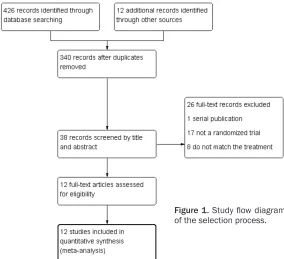
Figure 1. Study flow diagram
of the selection process.
CSS for the treatment of fa- tty liver, the quality and effi -cacy of these RCTs were sys-tematically evaluated, and this could provide a basis for the treatment of fatty liver by CSS.
Materials and methods
Search strategy
Outcome indicators
Effective, aspartate transaminase (AST), ala-nine transaminase (ALT), triglyceride (TG), total cholesterol (TC), high-density lipoprotein (HDL) and low-density lipoprotein (LDL).
Quality assessment
The RCT methodology was evaluated according to the Cochrane Handbook for systematic review of interventions. Risk of bias for assess-ing the methodological quality of RCTs mainly included six items: random sequence genera -tion (selec-tion bias), alloca-tion concealment (selection bias), blind subjects and test person-nel (implementation bias), blindness Outcome evaluation (measurement bias), incomplete data (reporting bias), selection of publication (publication bias), and other bias.
Statistical analysis
We estimate the mean difference (MD) with 95% CIs for continuous outcomes and ORs with 95% CIs for dichotomous outcomes. He-terogeneities were estimated using the I2
sta-tistics. When I2 < 50% and P > 0.10, the results were considered homogeneous and the fixed-effect model was used; when 50% ≤ I2 < 75%,
the results were considered heterogeneous and the random-effect model was used. Subgroup analysis was conducted to identify the causes of the heterogeneity if I2 ≥ 75%.
[image:3.612.91.523.74.245.2]Sensitivity analysis was carried out to evaluate the effect of each individual study on the pooled ORs by excluding studies one-by-one and recal-Figure 2. Risk of bias in included studies.
[image:3.612.93.286.287.709.2]Chaihu-Shugan-San in fatty liver disease
used to evaluate publication bias. All statistical analysis was performed using Review Manager Version 5.3 (The Cochrane Collaboration, Software Update, Oxford, UK). All P values were two-sided, and a P < 0.05 was considered as statistically significant.
Result
Study characteristics
The detailed manuscript screening processes are shown in Figure 1. Using the search terms described above, a total of 426 published records were identified and checking the refer -ence lists, we identified 12 additional publica -tions. After screening the title and abstracts, 38 publications met the crude inclusion criteria and were selected for further assessment. Among them, 1 was excluded for serial publica-tions, 17 not randomized trials and 8 do not match the treatment. Ultimately, 12 studies [14-25] were included in the quantitative synthesis.
All trials had two parallel groups and were described as randomized, and allocation con-cealment was not reported in any of the Chinese studies. The blinding process was described in only 1 study. The risk of bias, as assessed using the tool from the Cochrane Collaboration, is shown in Figures 2 and 3.
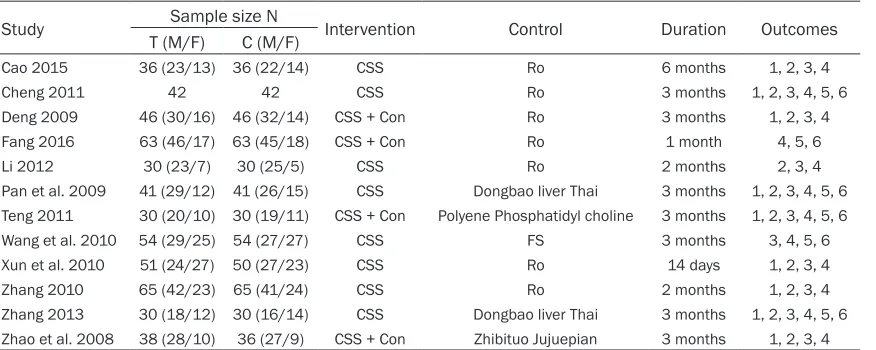
Among the 12 studies, the total number of patients is 1,049 with 526 patients in the
treatment group and 523 patients in the con-trol group. The maximum amount of a single RCT sample is 130 cases, and a minimum of 60 cases. The characteristics of studies included are shown in Table 1. For all the st- udies included, there was no difference between control and treatment groups before these patients were randomly divided into two groups.
Many of the RCT test groups and control gro- ups included routine treatment, which included health education, alcohol consumption, diet control, sports and other basic treatment, and only 1 RCT reported adverse outcomes, includ-ing skin itchinclud-ing, nausea, dizziness.
Meta-analysis results
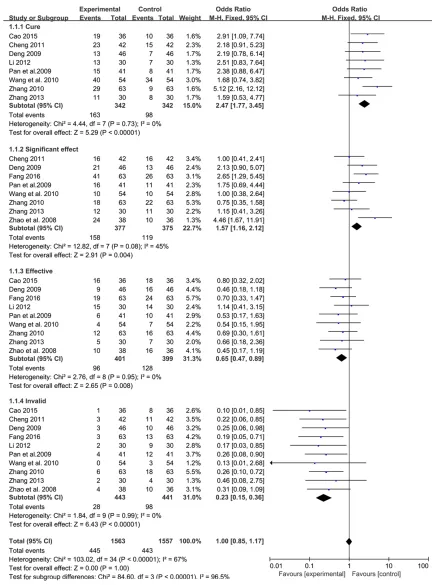
Ten trials reported the data to be effective. We chose a fixed-effects model for the an-alysis of effective, because of the heteroge- neity (Cure I2 = 0%, Marked effect I2 = 45%,
effective I2 = 0%, Invalid I2 = 0%). The results showed that CSS has a significant effect for fatty liver patients compare with control groups (Cure OR = 2.47, 95% CI 1.77 to 3.45, P < 0.00001; Marked effect OR = 1.57, 95% CI 1.16 to 2.12, P = 0.004; Effect OR = 0.65, 95% CI 0.47 to 0.89, P = 0.008; Invalid OR = 0.23, 95% CI 0.15 to 0.36, P < 0.00001) (Figure 4).
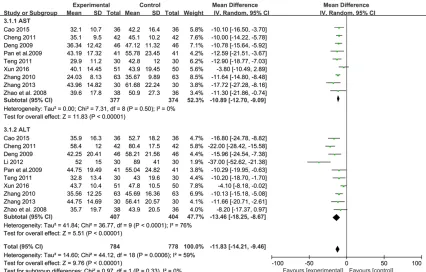
[image:4.612.92.530.84.259.2]Ten trials reported the data on liver function. The heterogeneity of ALT (I2 = 76%) is large, so
Table 1. Characteristics of included studies
Study Sample size N Intervention Control Duration Outcomes
T (M/F) C (M/F)
Cao 2015 36 (23/13) 36 (22/14) CSS Ro 6 months 1, 2, 3, 4 Cheng 2011 42 42 CSS Ro 3 months 1, 2, 3, 4, 5, 6 Deng 2009 46 (30/16) 46 (32/14) CSS +Con Ro 3 months 1, 2, 3, 4 Fang 2016 63 (46/17) 63 (45/18) CSS +Con Ro 1 month 4, 5, 6 Li 2012 30 (23/7) 30 (25/5) CSS Ro 2 months 2, 3, 4 Pan et al. 2009 41 (29/12) 41 (26/15) CSS Dongbao liver Thai 3 months 1, 2, 3, 4, 5, 6 Teng 2011 30 (20/10) 30 (19/11) CSS + Con Polyene Phosphatidyl choline 3 months 1, 2, 3, 4, 5, 6 Wang et al. 2010 54 (29/25) 54 (27/27) CSS FS 3 months 3, 4, 5, 6 Xun et al. 2010 51 (24/27) 50 (27/23) CSS Ro 14 days 1, 2, 3, 4 Zhang 2010 65 (42/23) 65 (41/24) CSS Ro 2 months 1, 2, 3, 4 Zhang 2013 30 (18/12) 30 (16/14) CSS Dongbao liver Thai 3 months 1, 2, 3, 4, 5, 6 Zhao et al. 2008 38 (28/10) 36 (27/9) CSS + Con Zhibituo Jujuepian 3 months 1, 2, 3, 4
we chose a random model for liver function. The results indicated that the levels of AST and ALT reduced in fatty liver patients who were
[image:5.612.89.521.68.653.2]Chaihu-Shugan-San in fatty liver disease
ALT U/L MD = -13.46, 95% CI -18.25 to -8.67: P < 0.00001) (Figure 5).
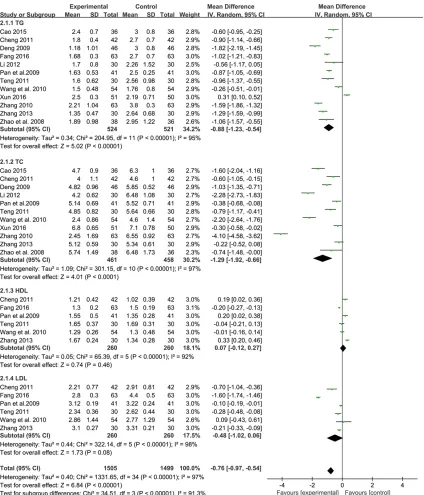
All trials reported the data of blood lipids. There was a large heterogeneity in the studies (TG I2 = 95%, TC I2 = 97%, HDL I2 = 92%, LDL I2 =
98%), so random model was used for liver func-tion. The results showed that CSS significantly reduced the level of TG and TC in fatty liver patients when compared with those who use other drugs (TG mmol/L MD = -0.88, 95% CI -1.23 to -0.54: P < 0.00001; TC mmol/L MD = -1.29, 95% CI -1.92 to -0.66: P < 0.00001). However, there was no statistically significant in the levels of HDL and LDL in the two groups (HDL mmol/L MD = 0.07, 95% CI -0.12 to 0.27: P = 0.46; LDL mmol/L MD = -0.48, 95% CI -1.02 to -0.06: P = 0.08) (Figure 6).
Publication bias
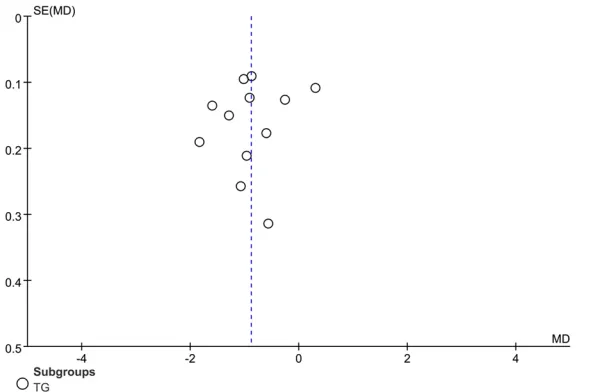
Publication bias was evaluated by funnel plot. It can be seen from the funnel diagram that most of the literature appears at the top of the funnel and is distributed near the mean effect value, which suggests that the bias of the pub-lication used in meta-analysis is very small (Figure 7).
Discussion
[image:6.612.93.519.72.344.2]Fatty liver is a common chronic liver disea- se, and it is one of the important factors in leading to hepatocirrhosis and liver cancer [26, 27]. Modern pharmacological studies have shown that CSS might work as a significant anti-inflammatory effect in Kupffer cells, and it can also scavenge oxygen free radicals, reduce enzymes released by liver injury, in- hibit lipid peroxidation, and have the ability to improve the liver function of damaged he- patocytes [28]. Bupleurum, pericarpium citri reticulatae can decrease the content of TC in hepatocytes and inhibit fiber proliferation and promote fiber absorption [29]; ligusticum wallichii could inhibit TGF-β1 secretion and has the role of anti-hepatic fibrosis [30]; rhi -zoma cyperi anti-inflammatory could enhan-ce blood circulation; fructus aurantii could promote the digestion of fat food and lower blood fat; Chinese herbaceous peony could improve microcirculation, increase liver blood flow, liver and reduce enzymes and promo-te liver cell regeneration [31]; licorice could stabilize the liver cell membrane, antagonize or scavenge free radicals, and prevent HSC activation.
With meta-analysis through 12 studies includ-ing 1,049 patients, it demonstrates that CSS has a positive effect on the treatment of fatty liver patients. CSS could improve blood lipid (TG, TC), liver function (AST, ALT) and decrease the TC, TG, ALT and AST level in patients with fatty liver, and the difference is statistically sig-nificant compared with other drugs. The effec -tive rate of the experimental group increased
[image:7.612.97.521.70.565.2]Chaihu-Shugan-San in fatty liver disease
only 3 months, which cannot respond to the long-term use of Chaihu Shugan Scattered for the treatment of fatty liver. All the RCTs are designed for research, assigning implicit and other aspects of the description of the relevant information are inadequate. There was no uni -form standard in the related components, qual -ity control, dosage and usage of Bupleurum and Radix Recipe in RCT, which affected the comparability between clinical trials. In addi-tion, articles included in this study did not provide the methods of blind and allocation concealment, and the random allocation con-cealments of most studies were not described in detail. So we should be cautious about the results of the analysis.
In conclusion, based on the current meta-anal-ysis, CSS has obvious advantages in reducing fatty liver patients with blood lipid (TC, TG) and improve liver function (AST, ALT). However, as the study included in this meta-analysis are all Chinese literature, and limited by the number and quality of articles, the conclusions need to be further validated by more strictly designed multi-centered RCTs with high quality and large scale.
Acknowledgements
This work was supported by program for Sci- ence & Technology Innovation teams in Uni- versities of Henan Province (#18IRTSTHN026), Outstanding Youth of Science and Technology Innovation in Henan Province
(#1841005100-dicine Key Laboratory of Liver Injury and Repair,
Medical College, Henan University of Science and Technology, Luoyang 471003, Henan, China. Tel:
+86-0379-64820863; Fax: +86-0379-64830346;
E-mail: [email protected]
References
[1] Guerra S, Mamede AC, Carvalho MJ, Laranjo M, Tralhão JG, Abrantes AM, Maia CJ and Botel-ho MF. Liver diseases: what is known so far about the therapy with human amniotic mem-brane? Cell Tissue Bank 2016; 17: 653-663. [2] Chalasani N, Younossi Z, Lavine JE, Diehl AM,
Brunt EM, Cusi K, Charlton M and Sanyal AJ. The diagnosis and management of non-alco-holic fatty liver disease: practice guideline by the American association for the study of liver diseases, American college of gastroenterolo-gy, and the American gastroenterological
asso-ciation. Hepatology 2012; 55: 1592-1609.
[3] Farrell GC and Larter CZ. Nonalcoholic fatty
liver disease: from steatosis to cirrhosis. Hepa -tology 2006; 43: S99-S112.
[4] Fan JG and Farrell GC. Epidemiology of
non-al-coholic fatty liver disease in China. J Hepatol
2009; 50: 204-210.
[5] Teli MR, James OF, Burt AD, Bennett MK and Day CP. The natural history of nonalcoholic
fatty liver: a follow-up study. Hepatology 1995;
22: 1714-1719.
[6] Bertot LC and Adams LA. The natural course of non-alcoholic fatty liver disease. Int J Mol Sci 2016; 17: 774.
[7] Yang QH, Xu YJ, Liu YZ, Liang YJ, Feng GF, Zhang YP, Xing HJ, Yan HZ and Li YY. Effects of
Chaihu-Shugan-San and Shen-Ling-Bai-Zhu-Figure 7. Funnel plot of blood lipids of CSS in patients.
06), the innovation team of Henan University of Science and Technology (#2015XT-D003) and Henan province’s Key Project of tackle key pro- blems of science and techno- logy (#172102310693). The authors thank all the mem-bers in the laboratory when this work was carried out. The experiments comply with the current laws of China.
Disclosure of conflict of inter-est
None.
[image:8.612.89.396.71.267.2]San on p38 MAPK pathway in Kupffer cells of nonalcoholic steatohepatitis. Evid Based Com-plement Alternat Med 2014; 2014: 1-8. [8] Li SQ, Su ZH, Peng JB, Zou ZM and Yu CY. In
vitro and in vivo antioxidant effects and the possible relationship between the
antidepres-sion efficacy of traditional Chinese medicine
formulation Chaihu Shugan San. Chin J Nat Med 2010; 8: 353-361.
[9] Decai F, Shizhong Y, Xiangfu S and Yi X. Effect
of Chaihu Shugan San in treating liver fibrosis.
J Gerontol 2007; 27: 1146-1148.
[10] Feng MP, De XZ and Jiang RH. Effect of Chaihu
Shugan San on B ultrasonic and the index of
liver fibrosis in nonalcoholic fatty liver disease
patient. Journal of Sichuan of Traditional Chi-nese Medicine 2009; 27: 66-67.
[11] Chiang LC, Ng LT, Liu LT, Shieh DE and Lin CC. Cytotoxicity and anti-hepatitis B virus activities of saikosaponins from Bupleurum species. Planta Med 2003; 69: 705-709.
[12] Meng MJ, Yang QH, Wang Q, Chen XM, Wang FZ, Wang YP, Tang HL, Cheng SB, Ling JS and
Wen CY. Effects of different therapeutic meth-ods and typical recipes on activation of ERK1/2 in Kupffer cells of rats with fatty liver. Chinese Journal of Pathophysiology 2007; 23: 1551-1555.
[13] Yang QH, Hu SP, Zhang YP, Ping HH, Yang HW, Chen TY and Liu HT. Effects of different thera -peutic methods and typical recipes of Chinese medicine on activation of c-Jun N-terminal Ki-nase in Kupffer cells of rats with fatty liver dis-ease. Chinese Journal of Integrative Medicine 2012; 18: 769-774.
[14] Fuling C. Observation on therapeutic effect of Chaihu Shugan San in treating nonalcoholic fatty liver disease. Guangming Journal of Chi-nese Medicine 2015; 20: 746-749.
[15] Zehui C. Clinical investigation of Shuganjiang-zhi Fang in the treatment of nonalcohol. China Modern Doctor 2011; 48: 83-84.
[16] Zhihong D. Clinical observation on 46 cases of
fatty liver treated with Chaihu Shugan San. Hu -nan Journal of Traditional Chinese Medicine 2009; 25: 14-15.
[17] Qixiaoxiao F. Clinical observation on treatment of non - alcoholic fatty liver stagnation syn-drome with integrated traditional Chinese and Western medicine. Journal of Practical Tradi-tional Chinese Medicine 2016; 32: 344-345. [18] Yuanming Z and Wenli F. Treatment of 38
cas-es of fatty liver with Chaihu Shugan powder. Strait Pharm J 2008; 20: 82-83.
[19] Lin Z. Clinical observation of Chaihu Shugan powder in treating non-alcoholic fatty liver. Chi-nese Medicine Modern Distance Education of China 2013; 11: 90-91.
[20] Hongbing Z. Clinical observation on treatment
of 65 cases of fatty liver with Chaihu Shugan powder. China Modern Doctor 2010; 48: 45-46.
[21] Lei X and Bingjiu L. Analysis of clinical effect by soothing liver and strengthening spleen com-bined with dissolving turbidity and removing stasis for non-alcoholic fatty liver disease pa-tients. Chin J M od Drug Appl 2016; 10: 12-13. [22] Wang X, Wang D and Wan Z. Clinical investiga-tion of Chaihushugansan on nonalcoholic fatty
liver. Hebei J TCM 2010; 32: 1129-1131.
[23] Xiaosheng T. Efficacy of combined treatment of
traditional Chinese medicine and western
medicine for non-alcoholic fatty Hver disease.
Chinese Journal of Primary Medicine and Phar-macy 2011; 18: 1299-1301.
[24] Fengman P and Jiangrong H. Clinical observa -tion on 82 cases of non-alcoholic fatty liver treated with Chaihu Shugan powder. Lishizhen Medicine and Materia Medica Research 2009; 20: 2010-2011.
[25] Jinghe L. Self-made Chaihu Shugan Jiangzhi soup decoction for treating 50 cases of fatty liver. China’s Naturopathy 2012; 20: 30-31. [26] Cohen JC, Horton JD and Hobbs HH. Human
fatty liver disease: old questions and new in -sights. Science 2011; 332: 1519-1523. [27] Fuchs M. Non-alcoholic fatty liver disease: the
bile acid-activated farnesoid x receptor as an emerging treatment target. J Lipids 2012; 2012: 934396.
[28] Xiaohong Z, Shuyan F and Lei Y. Therapeutic
effect of Chaihu Shugan powder on liver fibro -sis. Acta Chinese Medicine and Pharmacology 2003; 3: 38-39.
[29] Xuemei Y. Research progress on the pharma-cological effects of Ligustrazine. Chin J Bio-chem Pharm 2010; 31: 215-216.
[30] Youqing T and Ping D. Research progress and
developmental prospect on volatile oils from cyperus rotundus. China Pharmaceuticals 2010; 19: 1-2.
[31] Abenavoli L and Beaugrand M. Transient elas-tography in non-alcoholic fatty liver disease.