ISSN 2286-4822 www.euacademic.org
Impact Factor: 3.4546 (UIF) DRJI Value: 5.9 (B+)
Error Analysis: A Study on Grammatical Errors in
the Writings of Iraqi EFL Learners
MOHANAD QASIM MOHAMMED Fan Weiwei Professor at School of Foreign Languages Huazhong University of Science and Technology China
Abstract:
This paper aims at studying the problem area as grammatical errors as well as focussing on the trouble spots by way of identifying and analysing learners’ errors in English writing. The participants in this study are 70 learners (31 males and 39 females) EFL majors, English from 4 class’s grades (2, 3, and 4) in the University of AL-Mustansirih in Iraq. Firstly, the writing errors are identified and classified into categories and sub-categories according to a revised version of James (2001) classification. Moreover, the author analyses the samples in order to attempt to identify the reasons for the errors. The common types of grammatical errors are verb tense and form, subject- verb agreement, articles, prepositions, and pronouns, plurals and auxiliaries. As to the frequency findings of grammatical errors, it was found that the totality of grammatical errors are 456 times, which divide into seven categories. The highest frequency of grammatical (syntax and morphology) errors is verb tense and form errors, which take up 22% of the totality errors.
Key words: Error analysis (EA); grammatical errors; errors; Iraqi EFL learners
1. INTRODUCTION
yields insights into the process of language learning. EA, particularly in second language acquisition, has become popular because it is considered as one of the best kinds of linguistic studies that concerns about the learners’ errors. Linguist Corder states that EA has two objects: one is the theoretical object, which is to understand how, and what learners learn when they study a second language; the other is the applied object, which is to enable the learners to learn more efficiently and to use the knowledge of their dialect for a pedagogical purpose (Corder qtd in Sawalmeh, 2013). The aims of error analysis are to know the learning strategies for learners’ and reasons for causing errors. Learners’ errors have provided the foundation of how to learn an EFL/ESL (Corder qtd in Huan, 2011). Furthermore, in the field of linguistics and non-linguistics, many scholars have stressed the significance of learners’ errors as an essential part in language learning and teaching. For example, Corder (1981) stated that errors are significant in three aspects: (1) for the learner, it is indisputable because we regard the committing of errors as a device the learner uses in order to learn. (2) For the teacher, it shows the teacher what types of errors learners make, and how far towards the goal the learners have progressed, and what skills learner has achieved. (3) For the researcher, it provides the researchers with evidence of what strategies the learners are employing in their learning of a language and how language is acquired.
Sattayatham & Ratanapinyowong, 2008; Abushihab, El-Omari & Tobat, 2011; Reishaan, 2013; Hsu, 2013; Lasaten, 2014; Guo Na, 2009). Causes of errors led researchers to give different interpretations of the reasons of errors. These two parts are considered as an important part in EA and language-learning studies.
EFL writing of Iraqi learners. Furthermore, it also tries to find some suggestions for pedagogical purposes for Iraqi EFL teachers. This study hopes to help to reduce these errors and to adjust curricula according to the results.
Generally speaking, some researchers have attempted to detect learners’ errors and show what types of errors are the common errors appearing in most English as a foreign language learners’ writing. Others were trying to explain the causes of those errors. Actually, the results of the researchers were different from study to study. However, learners’ errors persist despite these studies. EFL learners’ writing errors is a challenging topic which still has many existing problems for researchers to resolve. Consequently, the following questions are seeks in this study: What are the types of grammatical errors Iraqi EFL learners commit in their English writings? What are the frequency types of grammatical errors?
2. METHODOLOGY
2.1 Research subjects
2.2 Instruments
After we had collected the 70 writings, the basic information of the writings was recorded in MS-word 2010 software. This information included basic information about the writers and sum of the words in each composition. Moreover, we used MS-Excel 2010 for data input and data count.
2.3 Data collection and analysis
2.3.1 Data collection 2.3.1.1 Writing task
One writing task was used to collect these Iraqi EFL learners’ writings. This task of writing was designed based on an IELTS writing model test. The reasons for using an IELTS writing assignment were given as follows: (1) it was designed from the perspectives of real English speakers and it can test the one’s authentic English language proficiency; (2) for each IELTS writing assignment, there was elaborate explanation on grading standards. Besides, the model writing can also be downloaded and accessed through the Internet easily.
2.3.2 Data analysis
This research adopts an empirical method which collects argumentative composition writing by Iraqi EFL learners. The aim of this study is to identify grammatical learners’ writing errors when writing in English as a foreign language and then classify those errors into different sub-categories. Furthermore, analyse the causes of those errors by reference to their sources through the mother tongue language and target language. Also each one of these learners was randomly selected. Their writings formed the data to be investigated in the research. The data will be typed into the computer with word format. Each piece of writing will be labelled with a student's name and number. Moreover, the author invited three Iraqi teachers major English to identify learners’ errors. These Iraqi teachers have a rich experience in teaching English as a foreign language and assessing examination papers. They are familiar with structures, rules and patterns in English Writing. To be specific, and for the purpose of this study, the author provided these teachers with a model of errors and explanations.
Furthermore, in identifying errors the teachers committee had a general agreement on the standard sample, the author using abbreviations for each category as follows: (verb= V, articles=Art, prepositions=Pre, plurals=Pl, pronouns=Pro, auxiliaries=Aux, subject-verb agreement=SVA, spelling=S, capitalization=Cap and punctuation=Pun). Besides, these teachers performed this error detection by examining the rules based on their experience and the model explanation. Lastly, the author reviewed and evaluated the final results.
3. RESULTS AND DISCUSSION
3.1 The types of grammatical errors in the writings of Iraqi EFL Learners
subjects’ writing include verb tense and form, subject-verb agreement, articles, prepositions, misuse of pronouns, misuse of plurals and misuse of auxiliaries, as shown in Table.1.
Table.1: Common Types of Grammatical Errors in the Learners’ Writing
NO Grammatical Errors
1. verb tense and form 2. subject-verb agreement 3. Articles
4. Prepositions 5. misuse of pronouns 6. misuse of plurals 7. misuse of auxiliaries
The detailed information of the common errors and the main categories of grammatical errors are as follows:
3.1.1 Verb errors
Verb error is common error in English as a foreign language, especially for learners with Arabic language as a mother tongue. It is obvious that in verb tense error most of these learners have difficulty to select the appropriate tense when they try to convey a particular situation or action. Actually, there is another case when these learners unsystematically shift or unnecessarily shift from tense to tense in the same sentence or paragraph. Moreover, learners commit errors in verb form when they use third person singular with –s or without it in the present verb form or substitution between verb forms.
3.1.1.1 Verb tense
3.1.1.1.1 Present to past shift
Example 1:
Erroneous Form: The internet is very usful and could lead the way to the parson if he or she *knew how to use it well without being harming others.
Standard Form: The internet is very useful and could lead the way to the parson if he or she knows how to use it well without being harming others.
3.1.1.1.2 Past to present shift
In example 2, the student is unable to distinguish between different verb tenses. He or she shifts tense from past to present without knowing when to use each tense.
Example 2:
Erroneous Form: The internet became my first work in my life, when I wake up or before I sleep I use it.
Standard Form: The internet became my first work in my life, when I woke up or before I slept I used it.
3.1.1.2 Verb form
3.1.1.2.1 Present form 3rd “s”
In example 3, the student omits the third person singular –s in the simple present tense. As a matter of fact, some of these students have a difficulty in acquiring and mastery third person singular –s therefore they ignore of rule restrictions. Example 3:
Erroneous Form: For example when I want to talk to someone who travel in any country.
Standard Form: For example when I want to talk to someone who travels in any country.
3.1.1.2.2 Past form “ed”
Example 4:
Erroneous Form: The e-mail and hacker the privicy of the people.
Standard Form: The e-mail and hacked the privacy of the people.
3.1.2 Subject-verb agreement errors
Subject-verb agreement error also is common in the writing of English as foreign language learners. It indicates that subject and verb should agree in number (singular or plural). The most committed errors are that plural subject does not agree with singular verb or singular subject does not agree with plural verb.
3.1.2.1 Plural subject does not agree with singular verb
In example 5, the plural subject pros and cons does not agree with the singular verb is. This shows that the subjects lack knowledge of the agreement between subject and verb.
Example 5:
Erroneous Form: I want to say that there is pros and cons in our life.
Standard Form: I want to say that there are pros and cons in our life.
3.1.2.2 Singular subject does not agree with plural verb
In example 6, the student uses the singular subject the person with the plural verb use which does not agree with.
Example 6:
Erroneous Form: Generally it depend on the person who use the internet.
3.1.3 Articles errors
Most of Iraqi EFL learners have a problem with articles and committed errors in this area. Some of them have a difficulty with indefinite article as “a, an” because the absence of this type in Arabic language. Whereas, others learners also committed errors in definite article “the” in spite of this kind exist in Arabic language. Indeed, the most frequent errors that committed in learners writing are omission of “a, an”, addition of “a, an”, omission of “the” and misuse of “a, an” and “the”.
3.1.3.1 Omission of “a, an”
In example 7, the student omits the indefinite article “a” that supposed to insert, as mention above, this kind of error attributed to the interference of mother tongue language because the Arabic language has no indefinite article “a”. Example 7:
Erroneous Form: We left our activites such as reading book.
Standard Form: We left our activities such as reading a book.
3.1.3.2 Addition of “a, an”
In example 8, the student inserts the indefinite article “a” to the two words have, harmful that supposed to be bared.
Example 8:
Erroneous Form: Beside, The good things of the internet it’s a have a harmful things.
Standard Form: Besides, the good things of the internet it has harmful things.
3.1.3.3 Omission of “the”
In example 9, the student omits the definite article “the” that supposed to inserts before the noun internet, it seems that the student lack of knowledge of this type.
Example 9:
Standard Form: At this time, the internet is very important; it becomes a part of our life.
3.1.3.4 Misuse of “a, an” and “the”
In example 10, the student misuses the article when he or she uses the indefinite article “an” with the word that requires definite article “the”.
Example 10:
Erroneous Form: I like to use an internet because it gives us a lot information about different topics.
Standard Form: I like to use the internet because it gives us a lot of information about different topics.
3.1.4 Preposition errors
Preposition errors are common in EFL learners writing; most of the subjects in this study have difficulties to determine the appropriate usage of the preposition. Actually, in English language there is no specific pattern to use preposition because the usages of preposition depends on the context. Another issue, in some patterns Arabic language has differences in the usage of preposition.
3.1.4.1 Addition
In example11, the student inserts the unnecessary preposition *to to the sentence.
Example 11:
Erroneous Form: Some people haven’t anything to do to they use the internet….
Standard Form: Some people haven’t anything to do, they use the internet….
3.1.4.2 Omission
In example 12, the student omits the preposition, some of the subject’s lack of knowledge.
Erroneous Form: Example you get bullied because you made a facebook account.
Standard Form: For example, you get bullied because you are made a Facebook account.
3.1.4.3 Confusion
In example 13, as we can see in the example the student confusing to determine which preposition fits best the context. Indeed, confusion between prepositions is the most frequent preposition errors.
Example 13:
Erroneous Form: At the end, I grateful to the update of technology.
Standard Form: In the end, I am grateful to the update of technology.
3.1.5 Misuse pronoun errors
In this area also the subjects committed errors, the most frequent errors are that they confuse in choosing the correct pronoun. Other occasions, they omit the pronoun or they insert unnecessary pronoun in the sentence.
3.1.5.1 Omission
In the example 14, the student omits the subject pronoun. Example 14:
Erroneous Form: As well as doesn’t let our sons and daughters to read and study.
Standard Form: As well as it doesn’t let our sons and daughters to read and study.
3.1.5.2 Addition
Example 15:
Erroneous Form: Without it you can’t send emails instead you should your mail in the tredational way.
Standard Form: Without it, you can’t send emails instead you should mail in the traditional way.
3.1.5.3 Confusion
In example 16, the student confuses in choosing the correct pronoun, he or she uses the object pronoun *me instead of the subject pronoun “I”.
Example 16:
Erroneous Form: me can get new studies by Syber colloge.
Standard Form: I can get new studies by cyber college.
3.1.6 Misuse plural errors
Plural error is also most frequent error in the writing of EFL learners. The majority committed errors in this type are the confusion in choosing the right suffix. Other occasions, learners are omission of plural suffix –s or omission of plural suffix –es. Moreover, sometimes learners insert suffix to an uncountable noun that should not be plural.
3.1.6.1 Omission of plural suffix –s
In example 17, the student misuses plural and omits the suffix –s at the end of the word problem. As a matter of fact, this kind of error appears the learner’s lack of knowledge.
Example 17:
Erroneous Form: I sure that the internet can solve so many problem.
Standard Form: I am sure that the internet can solve so many problems.
3.1.6.2 Omission of plural suffix |–es|
word other should takes plural noun, this type of error seems to be related to the incomplete competence of second language grammar.
Example 18:
Erroneous Form: To student who wont to Exchange of information with other students in other country.
Standard Form: To a student who wants to exchange of information with other students in other countries.
3.1.6.3 Addition plural suffix –s to uncountable nouns
In example 19, the student inserts plural suffix –s to the word information, which is uncountable noun.
Example 19:
Erroneous Form: To get informations about every think.
Standard Form: To get information about everything.
3.1.6.4 Confusion
In example 20, the student confuses to distinguish the correct suffix when he or she inserts the suffix –s to the word, which is ends, with the letters ch instead of the suffix –es.
Example 20:
Erroneous Form: I can know the results of the reaserchs.
Standard Form: I can know the results of the researches.
3.1.7 Misuse auxiliary errors
Misuse auxiliary errors are the errors in helping verbs, the subjects also committed errors in this area. The types of these errors include addition of auxiliary verb, omission of auxiliary verbs and confusion in selecting the right auxiliary verb.
3.1.7.1 Addition
students using their mother tongue language to construct the sentence.
Example 21:
Erroneous Form: It’s give us a great advantages.
Standard Form: It gives us great advantages.
3.1.7.2 Omission
In example 22, the student omits the auxiliary verb “am” in the sentence. This kind of error appears related to the mother tongue interference because the construction of the sentence in Arabic lacks the auxiliary verb.
Example 22:
Erroneous Form: When I talking about my personal test with internet.
Standard Form: When I am talking about my personal test with the internet.
3.1.7.3 Confusion
In example 23, the student confuses in choosing the appropriate auxiliary verb, he or she uses the words “were able to” to indicate the ability.
Example 23:
Erroneous Form: We were able to do many things easier than before.
Standard Form: We could do many things easier than before.
3.2 The frequency types of grammatical errors
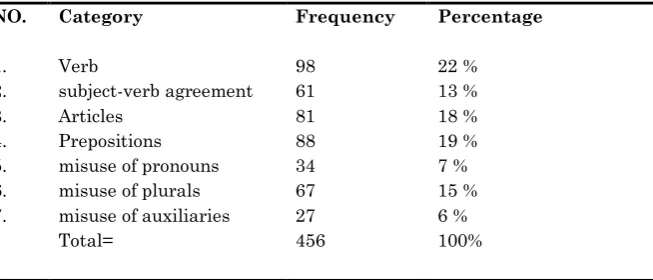
errors, which took up 98 (22%) of the totality errors. Whereas, the second high level errors were prepositions, which were covered 88 (19%). Also articles errors were a high committed errors, which accounted for 81 (18%) of the totality.
Table.2: Frequency of Major Grammatical Categories of Errors
NO. Category Frequency Percentage
1. Verb 98 22 %
2. subject-verb agreement 61 13 %
3. Articles 81 18 %
4. Prepositions 88 19 %
5. misuse of pronouns 34 7 %
6. misuse of plurals 67 15 %
7. misuse of auxiliaries 27 6 %
Total= 456 100%
Furthermore, misuse of plural errors were covered 67 (15%) of the total errors in the subjects writing. In syntax errors subject-verb agreement took up 61 (13%) of the totality errors. Whereas, we can see the frequency and the percentage of misuse of pronouns errors were less frequent, which covered 34 (7%) of the totality errors. Lastly, misuse of auxiliaries errors appeared the least frequently committed errors, which took up 27 (6%) of the totality errors in the subjects writing. Furthermore, Table.3 summarises the frequency and percentage of grammatical sub-categories of errors.
Table 3: Frequency of Sub-Categories of Grammatical Errors
NO. Major-category Total Sub-category Frequency Percentage
1. Verb 98 verb tense-shift 48 49 % 100% verb form 50 51 %
2. subject-verb agreement
61
plural subject does not agreeing with singular verb
18 30 %
As we see in Table.3 the highest frequency of errors relates to verb tense and form, which is divided into two sub-categories as verb tense-shift and verb form. From this table, it appears that the subjects have difficulty in choosing the right verb tense and form. However, in Reishaan’s 2013 study, it was found that Iraqi EFL learners have no mastery over the use of tenses even at advanced level of learning.
singular subject does not agreeing with plural verb
43 70 %
3. Articles 81
omission “a, an” 26 32 %
100% addition “a, an” 10 12 %
omission “the” 39 48 % misuse “a, an”
and “the”
6 8 %
4. prepositions 88
Addition 14 16 %
100% Omission 16 18 %
Confusion 58 66 %
5. misuse of pronouns
34
omission pronouns
7 21 %
100% addition
pronouns
2 6 %
Confusion 25 73 %
6. misuse of plurals
67
omission of plural suffix –s
24 36 %
100% omission of
plural suffix –es
8 12 %
addition plural suffix –s to uncountable nouns
5 7 %
Confusion 30 45 %
7. misuse of auxiliaries
27
addition 11 41 %
100% omission 11 41 %
CONCLUSION
Major findings in this study
After analysis of the writing task, the following findings were made: firstly, the common types of grammar, morphology and syntax errors in the learners’ writings include verb tense and form, subject-verb agreement, articles, prepositions, misuse of pronouns, misuse of plurals and misuse of auxiliaries.
confusion. Moreover, learners were confused in their choice of the correct pronoun. As to the misuse of plural errors, this includes omission of the plural suffix –s, the omission of plural suffix –es, addition plural suffix –s to uncountable nouns and confusion in the using of plural. The majority of the committed errors are the confusion in choosing the right suffix. Finally, misuse of auxiliary errors, we found that some of the learners committed errors with helping verbs. Their errors include the addition of auxiliary verbs, the omission of auxiliary verbs and confusion in selecting the right auxiliary verb.
Turning now to the second question frequency findings of grammatical errors, it was found that the totality of grammatical errors is 456, divided into seven categories. The highest frequency of grammatical (syntax and morphology) errors is verb errors, which take up 22% of the totality of errors. The second highest frequency rates are prepositions and articles errors. Moreover, we found that subject-verb agreement; misuse plural errors, misuse pronoun errors and misuse auxiliary errors are the least committed grammatical errors.
PEDAGOGICAL IMPLICATIONS
writing. Consequently, we can provide treatment for each learner by practice or using some exercises. Actually, it is found in some learner’s writings, they have individual problems in certain areas. Thirdly, understanding the problem area, by asking the learners frequently why they committed such errors, analysing them and giving feedback on learners’ errors within marking their writing assignments. Lastly, we have to instruct our learners to think in target language (English) when they are writing as well as rely on the target system structures, patterns, and rules instead of mother tongue language (Arabic).
REFERENCES
1. AbiSamra, N. (2003). An analysis of errors in Arabic speakers’ English writing. Unpublished doctoral dissertation, American University of Beirut.
2. Abushihab, I, El-Omari, A and Tobat, M. (2011). An Analysis of Written Grammatical Errors of Arab Learners of English as a foreign language at Alzaytoonah Private University of Jordan .European Journal of Social Sciences, (4):20.
3. Ali, S. (2012). An Analysis of Iraqi EFL learners’ Errors in Paragraph writing. University of Baghdad, (200). 4. Al-Qaraghooly, D and Sultan, K. (2008). An Error
Analysis of the Scientific Writing of Iraqi EFL Postgraduates at the University of Technology. Al-Mustansiriyah University.
5. Corder, P. (1981). Error Analysis and Interlanguage. Oxford: CUP.
7. Hsu, C. (2013). Revisiting causes of grammatical errors for ESL teachers. International Research Journals, 4(6):2141-5161.
8. Huan, W. (2011). An Analysis of Errors in College English Writing in China. Harbin: Engeneering University.
9. James, C. (2001). Errors in Language Learning and use: Exploring Error Analysis. China: Pearson Education Limited.
10. Lasaten, R. (2014). Analysis of Errors in the English Writings of Teacher Education. Journal of Arts, Science and Commerce, (4):2231-4172.
11. Reishaan, A. (2013). The use of Tenses in the Iraqi Advanced EFL learners’ Writings: An Error analysis. University of Brasov, (1): 99-116.
12. Ridha, N. (2012) . The effect of EFL learner’ Mother Tongue on their writings in English: An Error Analysis Study. Journal of the College of Arts. University of Basrah, (60).
13. Sattayatham, A. and Ratanapinyowoug, p. (2008). Analysis of Errors in Paragraph Writing in English By First Year Medical Students from the Four Medical Schools at Mahidol University. Silpakorn University International Journal, 8.