In:
Proceedings of CoNLL-2000 and LLL-2000,
pages 73-78, Lisbon, Portugal, 2000.Using Induced Rules as C o m p l e x Features
in M e m o r y - B a s e d Language Learning
A n t a l v a n d e n B o s c h ILK / C o m p u t a t i o n a l Linguistics T i l b u r g University, T h e N e t h e r l a n d s
Ant al. v d n B o s ch@kub, nl
A b s t r a c t
An extension to memory-based learning is de- scribed in which automatically induced rules are used as binary features. These features have an "active" value when the left-hand side of the underlying rule applies to the instance. The RIPPER rule induction algorithm is adopted for the selection of the underlying rules. The similarity of a memory instance to a new in- stance is measured by taking the sum of the weights of the matching rules both instances share. We report on experiments that indicate that (i) the method works equally well or bet- ter than RIPPER on various language learning and other benchmark datasets; (ii) the method does not necessarily perform better than default memory-based learning, but (iii) when multi- valued features are combined with the rule- based features, some slight to significant im- provements are observed.
1 R u l e s a s f e a t u r e s
A common machine-learning solution to classi- fication problems is rule induction (Clark and Niblett, 1989; Quinlan, 1993; Cohen, 1995). The goal of rule induction is generally to induce a set of rules from data, that captures all gener- alisable knowledge within that data, and that is as small as possible at the same time. Classifica- tion in rule-induction classifiers is based on the firing of rules on a new instance, triggered by matching feature values to the left-hand side of the rule. Rules can be of various normal forms, and can furthermore be ordered. The appropri- ate content and ordering of rules can be hard to find, and at the heart of most rule induction systems are strong search algorithms that at- tempt to minimise search through the space of possible rule sets and orderings.
Although rules appear quite different from in-
stances as used in memory-based or instance- based learning (Aha et al., 1991; Daelemans and Van den Bosch, 1992; Daelemans et al., 1997b) there is a continuum between them. Rules can be seen as generalised instances; they represent the set of training instances with the same class that match on the conditions on the left-hand side of the rule. Therefore, classification strate- gies from memory-based learning can naturally be applied to rules. For example, (Domingos, 1996) describes the R I S E system, in which rules are (carefully) generalised from instances, and in which the k-NN classification rule searches for nearest neighbours within these rules when classifying new instances.
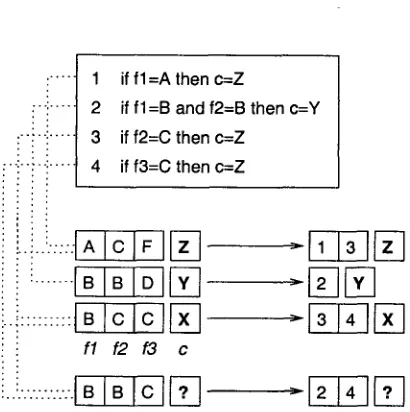
Often, the sets of instances covered by rules overlap. In other words, seen from the instance perspective, a single instance can match more than one rule. Consider the schematic exam- ple displayed in Figure 1. Three instances with three multi-valued features match individually with one or two of the four rules; for example, the first instance matches with rule 1 (if f l = A then c = Z) and with rule 3 (if f 2 = C then c = Z).
Pursuing this reasoning, it is possible to in- dex instances by the rules that apply to them. For example, in Figure 1, the first instance can be indexed by the "active" rule identification numbers 1 and 3. When the left-hand sides of rules are seen as complex features (in which the presence of some combination of feature values is queried) that are strong predictors of a single class, indexing instances by the rules that apply to them is essentially the same as representing instances by a set of complex features.
Note that when a rule matches an instance, this does not guarantee that the class of the instance is identical to the rule's predicted class
1
2
3
" ' " 4
: f l f2 f3
.-.-..Ig Ig I0 I
if f l = A then c=Z
if f l = B and f2=B then c=Y
if f2=C then c=Z
if f3=C then c=Z
c
Figure 1: Schematic visualization of the encod- ing of multi-valued instances via matching rules to rule-indexed instances, characterlsed by the numbers of the rules that m a t c h them. f l , f2, and f 3 represent the three features, c represents the class label.
error. In Figure 1, the third memory instance matches rules 3 and 4 which b o t h predict a Z, while the instance itself has class X.
Now when instances are represented this way, they can be used in k-NN classification. Each complex feature then becomes a binary feature, that can also be assigned some weight (e.g., gain-ratio feature weights, chi-square, or equal weights (Daelemans et al., 2000)); when a mem- ory instance and a new test instance share com- plex features, their similarity becomes the sum of the weights of the matching features. In Fig- ure 1, a new instance (bottom) matches rules 2 and 4, thereby (partially) matching the second and third memory instances. If, for example, rule 4 would have a higher overall weight t h a n rule 2, the third memory instance would become the nearest neighbor. The k-NN rule then says that the class of the nearest neighbour transfers to the new instance, which would mean that class X would be copied - which is a differ- ent class t h a n those predicted either by rule 2 or 4. This is a marked difference with classi- fication in RIPPER, where the class is assigned directly to the new instance by the rule that fires first. It can be expected that many classi- fications in this approach would be identical to
those made by RIPPER, but it is possible that the k-NN approach has some consistent advan- tage in the cases where classification diverges.
In this paper we investigate some effects of recoding instances by complex features induced by an external rule-induction algorithm, and show that the approach is promising for lan- guage learning tasks. We find that the m e t h o d works equally well or better t h a n R I P P E R on various language learning and other benchmark datasets. However, the m e t h o d does not nec- essarily perform better t h a n default memory- based learning. Only when the rule-indexing features are added to the original multi-valued features, improvements are observed.
2 R u l e - B a s e d M e m o r y : a l g o r i t h m A new memory-based learning variant RBM, which stands for Rule-Based Memory, imple- ments the ideas described in the previous sec- tion using the following procedure: given a training set and a test set of a certain classifi- cation task, (1) apply RIPPER (Cohen, 1995) to the training set, and collect the set of induced rules; (2) recode the instances in the training and test set according to these rules; (3) ap- ply the basic memory-based learning algorithm IBi-IG to the recoded training set, and k-NN- classify the recoded test set. We describe each of these steps briefly here.
[image:2.596.81.286.66.272.2]line during classification without much compu- tational overhead. For each language task we experimented on, we performed 10-fold cross validation tests, so ten different train-test par- titions were produced (Weiss and Kulikowski, 1991) that were recoded, and then tested on. Tests were performed with the TiMBL software package (Daelemans et al., 2000), using the soft- ware's dedicated routines for handling binary features. The default IBi-IG algorithm was used (for details, consult (Aha et al., 1991; Daele- mans and Van den Bosch, 1992; Daelemans et al., 1997b), with gain ratio selected as feature weighting metric.
3 R e s u l t s
We performed experiments on the following five language data sets - More details on numbers of features, values per features, number of classes and number of instances are displayed in Ta- ble 1:
D i m i n u t i v e f o r m a t i o n (henceforth DIM): choosing the correct diminutive inflection to Dutch nouns out of five possible: je, tje, pie, kje, and etje, on the basis of phonemic word transcriptions, segmented at the level of syllable onset, nucei and coda of the final three syllables of the word. The data stems from a study described in
(Daelemans et al., 1997a).
G r a p h e m e - p h o n e m e c o n v e r s i o n (GPSM): the conversion of a window of nine letters to the phonemic transcription of the middle letter. From the original data set described in (Van den Bosch, 1997) a 10% subset was drawn.
B a s e - N P c h u n k i n g
(NPSM):
the segmenta- tion of sentences into non-recursive NPs. (Veenstra, 1998) used the Base-NP tag set as presented in (Ramshaw and Marcus, 1995): I for inside a Base-NP, O for out- side a Base-NP, and B for the first word in a Base-NP following another Base-NP. See (Veenstra, 1998) for more details, and (Daelemans et al., 1999) for a series of ex- periments on the original data set from which we have used a randomly-extracted 10%.P a r t - o f - s p e e c h t a g g i n g
(POSSM):
the disam- biguation of syntactic classes of words inP P
particular contexts. We assume a tagger architecture t h a t processes a sentence from a disambiguated left to an ambiguous right c o n t e x t , as described in (Daelemans et al., 1996). T h e original data set for the part- of-speech tagging task, extracted from the LOB corpus, contains 1,046,151 instances; we have used a randomly-extracted 10% of this data.
a t t a c h m e n t (PP): the attachment o f a PP in the sequence VP hip PP (VP = verb phrase, 51P = noun phrase, PP = prepo- sitional phrase). T h e d a t a consists of four- tuples of words, extracted from the Wall Street Journal Treebank. From the origi- nal data set, used by (Ratnaparkhi et al., 1994), (Collins and Brooks, 1995), and (Za- vrel et al., 1997), (Daelemans et al., 1999) took the train and test set together to form the particular data also used here.
Table 2 lists the average (10-fold cross- validation) accuracies, measured in percentages of correctly classified test instances, of IBI-IG, RIPPER, and RBM on these five tasks. The clear- est overall p a t t e r n in this table is the high accu- racy of IBi-IG, surpassed only twice by RBM on the DIM and NPSM tasks (significantly, accord- ing to one-tailed t-tests, with p < 0.05). On the other three tasks, IBI-IG outperforms RBM. RIPPER performs significantly more accurately t h a n IBi-IG only on the DIM task. Once again, evidence is collected for the global finding that forgetting parts of the training material, as ob- viously happens in rule induction, tends to be harmful to generalisation accuracy in language learning (Daelemans et al., 1999).
A surprising result apparent in Table 2 is that RBM never performs worse t h a n RIPPER; in fact, it performs significantly more accurately than RIPPER with the GPSM, NPSM, and POSSM tasks. There appears to be an advantage in the k- NN approach to rule matching and voting, over the RIPPER strategy of ordered rule firing, with these tasks.
Data set DIM GPSM
POS NP PP
# l
Feat. 111
9
5 11 4
# Values of ~ature
1 2 3 4 5 6 7 8 9 10 11 12
3 51 19 40 3 61 20 79 2 64 18 42 42 42 42 41 42 42 42 42
155 157 414 395 384
5961 5 9 1 1 5895 5908 51 50 55 49 3 3 3 3474 4612 68 5780
43
# # Data set Cla~ instances 3950 6i I 67,575 15 104,617 25 114 23,898 Table 1: Specifications of the five investigated language learning tasks: n u m b e r s of features, values per feature, classes, and instances. T h e rightmost column gives t h e total n u m b e r of values times the n u m b e r of classes.
T a s k
DIM GPSM NPSM POSSM PP
% Correct test instances
IBi-IG RIPPER RBM
9 6 . 2 ± 0 . 6 9 6 . 9 ± 0 . 7 . 9 6 . 9 ± 0 . 7 . 8 8 . 9 ± 0 . 6 8 0 . 4 ± 0 . 5 8 3 . 3 ± 0 . 5 + x/ 9 7 . 2 ± 0 . 3 9 6 . 9 ± 0 . 4 9 7 . 5 ± 0 . 4 . 9 6 . 6 ± 0 . 2 9 4 . 3 ± 0 . 2 9 5 . 0 ± 0 . 2 + x / 82.0 :t= 0.5 77.0 ± 0.7 77.0 ± 0.6 + Table 2: Average generalisation accuracies of I B i - I G , R I P P E R , and RBM o n f i v e language learn- ing tasks. '*' denotes significantly b e t t e r accu- racy of RBM or RIPPER over IBi-IG with p 0.05. ' + ' denotes significance in the reverse di- rection, x / d e n o t e s significantly b e t t e r accuracy of RBM over RIPPER with p < 0.05.
average about two to four conditions (feature- value tests). More importantly, as the t h i r d column of Table 3 shows, t h e average n u m b e r of active rules in instances is below two for all tasks. This means t h a t in most instances of any of the five tasks, only one complex feature (bit) is active.
Especially with the smaller rule sets (DIM, NPSM, and PP - which all have few classes, cf. Table 1), RBM's classification is very speedy. It reduces, for example, classification of the NPSM test set from 19 seconds to 1 second 1. Large rule sets (GPSM), however, can have adverse ef- fects - from 8 seconds in m l - I G to 17 seconds in RBM.
In sum, we observe two c a s e s (DIM and NPSM) in which RBM attains a significant general±sa- t±on accuracy improvement over IBi-IG as well as some interesting classification speedup, but for the other tasks, for now unpredictably, geE- 1 Timings are measured on one partition, using a dual- Pentium II 200 Mhz machine running Linux 2.2.
Task DIM GPSM NPSM POSSM PP
RIPPER / RBM # r u l e s c/r f/i
61 2.5 1.3 971 3.9 1.5 72 2.8 1.8 628 2.7 1.0 29 3.0 0.3
Classif. time (s) I B i - I G RBM
1 1
8 17
19 1
32 13
19 1
Table 3: Average n u m b e r of RIPPER rules, con- ditions per rule (c/r), a n d coded features per instance (f/i); and one-partition timings (s) of classification of test m a t e r i a l in IBI-IG and RBM, for five language tasks.
eralisation a c c u r a c y losses and even a slowdown are observed. T h e latter occurs with GPSM, which has been analysed earlier as being ex- t r e m e l y disjunct in class space, and therefore highly sensitive to t h e "forgetting exceptions is harmful" s y n d r o m e (Daelemans et al., 1999; Van den Bosch, 1999a).
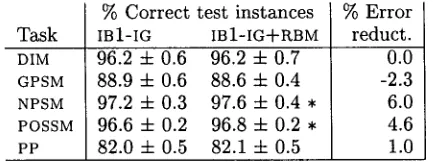
[image:4.596.87.522.89.171.2] [image:4.596.71.552.242.325.2]Task DIM GPSM NPSM POSSM PP
% Correct test instances
IBi-IG IBI-IG-bRBM
96.2 ± 0.6 96.2 ± 0.7 88.9 ± 0.6 88.6 ± 0.4 97.2±0.3 9 7 . 6 ± 0 . 4 . 96.6±0.2 9 6 . 8 ± 0 . 2 . 82.0 ± 0.5 82.1 ± 0.5
% Error reduct. 0.0 -2.3 6.0 4.6 1.0 Table 4: Average general±sat±on accuracies of I B I - I G a n d I B i - I G + RBM, and the percentage of error reduction, on five language learning tasks. ' . ' denotes significantly better accuracy of IB1- IG--~-RBM over IBi-IG with p < 0.05.
GPSM causes a slight drop in performance - and
a slowdown.
4 D i s c u s s i o n
Representing instances by complex features that have been induced by a rule induction al- gorithm appears, in view of the measured ac- curacies, a viable alternative approach to us- ing rules, as compared to standard rule induc- tion. This result is in line with results reported by Domingos on the RISE algorithm (Domingos, 1995; Domingos, 1996). A marked difference is that in RISE, the rules are the i n s t a n c e s in k- NN classification (and due to the careful gen- eral±sat±on strategy of RISE, they can be very instance-specific), while in RBM, the rules are the f e a t u r e s by which the original instances are indexed. When a nearest neighbor is found to a query instance in RBM, it is because the two in- stances share o n e or m o r e matching rules. The actual classification that is transferred from the memory instance to the new instance is just the classification that this memory item is stored with - it may well be another class than any of its matching rules predict.
Second, the method is a p o t e n t i a l l y helpful extension to memory-based learning of language processing tasks. When nothing is known about the characteristics of a language processing data set, it is advisable to add the induced complex features to the original features, and do k-NN classification on the combination; it is not ad- visable to base classification only on the induced complex features. On its own, the method basi- cally inherits a part of the detrimental "forget- ting exceptions is harmful" effect from its rule- induction source (this effect is stronger when
% Correct test instances
Task IBI-IG RBM IBi-IG-bRBM
CAR 93.9 ± 2.1 98.9 ± 0.8 97.2 ± 1.3 NURSERY 94.6 ± 0.6 98.6 ± 0.5 98.7 ± 0.2 SPLICE 91.7 ± 1.1 89.0 ± 2.1 92.7 ± 1.7 Table 5: Average generalisation accuracies of I B i - I G , R I P P E R , and RBM o n three machine- learning benchmark tasks.
a data set is more disjunct (Daelemans et al., 1999)). Although RBM performs equal to or bet- ter than RIPPER, it often does not regain the level of IBi-IG.
High disjunctivity appears to be a typical fea- ture of language tasks (Van den Bosch, 1999b); other non-language tasks generally display less disjunctivity, which opens the possibility that the RBM approach may work well for some of these tasks. We performed pilot tests on three machine learning benchmark classification tasks (taken from the UCI benchmark repos- ±tory (Blake and Merz, 1998)) with symbolic, multi-valued features. Table 5 displays the re- sults of these experiments. Although the data set selection is small, the results of RBM and es- pecially of IBi-IG--~-RBM a r e promising; the lat- ter algorithm is consistently better than IBi-IG. More research and comparisons are needed to arrive at a broader picture.
An immediate point of further research lies in the external rule induction algorithm. First,
RIPPER has options that have not been used
here, but that may be relevant for the current issue, e.g. RIPPER's ability to represent sets of values at left-hand side conditions, and its flexibility in producing larger or smaller num- bers of rules. Second, other rule induction algo- rithms exist that may play RIPPER'S role, such as C4.5RULES (Quinlan, 1993).
[image:5.596.298.532.78.138.2] [image:5.596.61.278.79.160.2]Acknowledgements
The author thanks the m e m b e r s of the Tilburg ILK group and the Antwerp C N T S group for fruitful discussions. This research has been m a d e possible by a fellowship of the Royal Netherlands A c a d e m y of Arts and Sciences (KNAW).
R e f e r e n c e s
D.W. Aha, D. Kibler, and M. Albert. 1991. Instance-based learning algorithms. Machine Learning, 6:37-66.
C.L. Blake and C.J. Merz. 1998. UCI repository of machine learning databases.
Thorsten Brants. 2000. TnT - a statistical part-of- speech tagger. In Proceedings of the Sixth Applied Natural Language Processing (ANLP-2000), Seat- tle, WA.
E. Brill. 1993. A Corpus-Based Approach to Lan- guage Learning. Dissertation, Department of Computer and Information Science, University of Pennsylvania.
P. Clark and T. Niblett. 1989. The CN2 rule induc- tion algorithm. Machine Learning, 3:261-284. W. W. Cohen. 1995. Fast effective rule induction.
In Proceedings of the Twelfth International Con- ference on Machine Learning, Lake Tahoe, Cali- fornia.
M.J Collins and J. Brooks. 1995. Prepositional phrase attachment through a backed-off model. In Proc. of Third Workshop on Very Large Cor- pora, Cambridge.
W. Daelemans and A. Van den Bosch. 1992. Gener- alisation performance of backpropagation learning on a syllabification task. In M. F. J. Drossaers and A. Nijholt, editors, Proc. of TWLT3: Connection- ism and Natural Language Processing, pages 27- 37, Enschede. Twente University.
W. Daelemans, J. Zavrel, P. Berck, and S. Gillis. 1996. MBT: A memory-based part of speech tag- ger generator. In E. Ejerhed and I.Dagan, editors,
Proc. of Fourth Workshop on Very Large Corpora,
pages 14-27. ACL SIGDAT.
W. Daelemans, P. Berck, and S. Gillis. 1997a. Data mining as a method for linguistic analysis: Dutch diminutives. Folia Linguistica, XXXI(1-2). W. Daelemans, A. Van den Bosch, and A. Weijters.
1997b. IGTree: using trees for compression and classification in lazy learning algorithms. Artifi- cial Intelligence Review, 11:407-423.
W. Daelemans, A. Van den Bosch, and J. Zavrel. 1999. Forgetting exceptions is harmful in lan- guage learning. Machine Learning, 34(1-3):11- 43.
W. Daelemans, J. Zavrel, K. Van der Sloot, and A. Van den Bosch. 2000. TiMBL: Tilburg Mem-
ory Based Learner, version 3.0, reference manual. Technical Report ILK-0001, ILK, Tilburg Univer- sity.
P. Domingos. 1995. The rise 2.0 system: A case study in multistrategy learning. Technical Re- port 95-2, University of California at Irvine, De- partment of Information and Computer Science, Irvine, CA.
P. Domingos. 1996. Unifying instance-based and rule-based induction. Machine Learning, 24:141- 168.
J.R. Quinlan. 1993. c4.5: Programs for Machine Learning. Morgan Kaufmann, San Mateo, CA. L.A. Ramshaw and M.P. Marcus. 1995. Text chunk-
ing using transformation-based learning. In Proc. of Third Workshop on Very Large Corpora, pages 82-94, June.
A. Ratnaparkhi, J. Reynar, and S. Roukos. 1994. A maximum entropy model for prepositional phrase attachment. In Workshop on Human Language
Technology, Plainsboro, N J, March. ARPA. A. Ratnaparkhi. 1997. A linear observed time sta-
tistical parser based on maximum entropy models. Technical Report cmp-lg/9706014, Computation and Language, http://xxx.lanl.gov/list/cmp-lg/, June.
D. Roth. 1998. Learning to resolve natural language ambiguities: A unified approach. In Proceedings of the National Conference on Artificial Intelli- gence, pages 898-904.
A. Van den Bosch. 1997. Learning to pronounce written words: A study in inductive language learning. Ph.D. thesis, Universiteit Maastricht. A. Van den Bosch. 1999a. Careful abstraction from
instance families in memory-based language learn- ing. Journal for Experimental and Theoretical Ar- tificial Intelligence, 11(3):339-368.
A. Van den Bosch. 1999b. Instance-family ab- straction in memory-based language learning. In I. Bratko and S. Dzeroski, editors, Machine Learning: Proceedings of the Sixteenth Interna- tional Conference, pages 39-48, Bled, Slovenia. J. Veenstra. 1998. Fast NP chunking using memory-
based learning techniques. In Proceedings of BENELEARN'98, Wageningen, The Netherlands. S. Weiss and C. Kulikowski. 1991. Computer sys- tems that learn. San Mateo, CA: Morgan Kauf- mann.