In: Proceedings of CoNLL-2000 and LLL-2000, pages 19-24, Lisbon, Portugal, 2000.
The Role of A l g o r i t h m Bias vs Information Source in
Learning A l g o r i t h m s for M o r p h o s y n t a c t i c D i s a m b i g u a t i o n
G u y D e P a u w a n d W a l t e r D a e l e m a n s C N T S - L a n g u a g e T e c h n o l o g y G r o u p
U I A - University of A n t w e r p
U n i v e r s i t e i t s p l e i n 1, 2610 A n t w e r p e n , B e l g i u m
{depauw, daelem}~uia.ua,
ac.be
A b s t r a c t
Morphosyntactic Disambiguation (Part of Speech tagging) is a useful benchmark problem for system comparison because it is typical for a large class of Natural Language Process- ing (NLP) problems that can be defined as disambiguation in local context. This paper adds to the literature on the systematic and objective evaluation of different methods to automatically learn this type of disambiguation problem. We systematically compare two inductive learning approaches to tagging: MX-
P O S T (based on m a x i m u m entropy modeling)
and MBT (based on memory-based learning). We investigate the effect of different sources of information on accuracy when comparing the two approaches under the same conditions. Results indicate that earlier observed differ- ences in accuracy can be attributed largely to differences in information sources used, rather than to algorithm bias.
1 C o m p a r i n g T a g g e r s
Morphosyntactic Disambiguation (Part of Speech tagging) is concerned with assigning morpho-syntactic categories (tags) to words in a sentence, typically by employing a complex interaction of contextual and lexical clues to trigger the correct disambiguation. As a con- textual clue, we might for instance assume that it is unlikely that a verb will follow an article. As a lexical (morphological) clue, we might assign a word like better the tag comparative if we notice that its suffix is er.
POS tagging is a useful first step in text anal- ysis, but also a prototypical benchmark task for the type of disambiguation problems which is paramount in natural language processing: as-
signing one of a set of possible labels to a linguis- tic object given different information sources de- rived from the linguistic context. Techniques working well in the area of POS tagging may also work well in a large range of other NLP problems such as word sense disambiguation and discourse segmentation, when reliable an- notated corpora providing good predictive in- formation sources for these problems become available.
Finding the information sources relevant for solving a particular task, a n d optimally inte- grating t h e m with an inductive m o d e l in a dis- a m b i g u a t o r has b e e n the basic idea of m o s t of the recent empirical research on this type of N L P p r o b l e m s a n d part of speech tagging ] in particular.
It is unfortunate, however, that this line of re- search m o s t often refrains f r o m investigating the role of each c o m p o n e n t proper, so that it is not always clear w h e t h e r differences in accuracy are d u e to inherent bias in the learning algorithms used, or to different sources of information used by the algorithms.
This p a p e r e x p a n d s o n an empirical c o m p a r - ison (van Halteren et al., 1998) in w h i c h TRI- G R A M tagging, B R I L L tagging, M A X I M U M E N - T R O P Y a n d M E M O R Y B A S E D tagging were c o m - pared o n the L O B corpus. W e will provide a m o r e detailed a n d systematic c o m p a r i s o n be- t w e e n M A X I M U M E N T R O P Y M O D E L I N G ( a a t n a -
parkhi, 1996) a n d M E M O R Y B A S E D L E A R N I N G ( D a e l e m a n s et al., 1996) for morpho-syntactic disambiguation a n d w e investigate w h e t h e r ear- lier observed differences in tagging accuracy can be attributed to algorithm bias, information source issues or both.
After a brief introduction of the 2 algorithms used in the comparison (Section 2), we will outline the experimental setup in Section 3. Next we compare both algorithms on respec- tively typical MSW-features (Section 4) and typ- ical MXPOSW-features (Section 5), followed by a brief error analysis and some concluding re- marks.
2 A l g o r i t h m s a n d I m p l e m e n t a t i o n In this Section, we provide a short description of the two learning methods we used and their associated implementations.
2.1 M e m o r y - B a s e d L e a r n i n g
Memory-Based Learning is based on the as- sumption that new problems are solved by direct reference to stored experiences of pre- viously solved problems, instead of by refer- ence to rules or other knowledge structures extracted from those experiences (Stanfill and Waltz, 1986). A memory-based (case-based) approach to tagging has been investigated in Cardie (1994) and Daelemans et al. (1996). I m p l e m e n t a t i o n
For our experiments we have used TIMBL 2 (Daelemans et al., 1999a). TIMBL includes a number of algorithmic variants and parameters. The base model (ISl) defines the distance be- tween a test item and each memory item as the number of features for which they have a different value. Information gain can be intro- duced ( I B i - I G ) t o weigh the cost of a feature value mismatch. The heuristic approximation of computationally expensive pure MBL vari- ants, (IGTREE), creates an oblivious decision tree with features as tests, ordered according to information gain of features. The number of nearest neighbors that are taken into account for extrapolation, can be determined with the parameter K.
For typical symbolic (nominal) features, val- ues are not ordered. In the previous variants, mismatches between values are all interpreted as equally important, regardless of how similar (in terms of classification behavior) the values are. We adopted the
modified value difference
metric
(MVDM) to assign a different distance be- tween each pair of values of the same feature.2TIMBL is available from: http://ilk.kub.nl/
For more references and information about these algorithms we refer to Daelemans et al. (1999a).
2.2 M a x i m u m E n t r o p y
In this classification-based approach, diverse sources of information are combined in an expo- nential statistical model that computes weights (parameters) for all features by iteratively max- imizing the likelihood of the training data. The binary features act as constraints for the model. The general idea of maximum entropy model- ing is to construct a model that meets these constraints but is otherwise as uniform as pos- sible. A good introduction to the paradigm of maximum entropy can be found in Berger et al. (1996).
MXPOST (Ratnaparkhi, 1996) applied maxi- mum Entropy learning to the tagging problem. The binary features of the statistical model are defined on the linguistic context of the word to be disambiguated (two positions to the left, two positions to the right) given the tag of the word. Information sources used include the words themselves, the tag of the previous words, and for unknown words: prefix letters, suffix letters, and information about whether a word contains a number, an upcase character, or a hyphen. These are the primitive information sources which are combined during feature gen- eration.
In tagging an unseen sentence, a beam search is used to find the sequence of tags with the highest probability, using binary features ex- tracted from the context to predict the most probable tags for each word.
I m p l e m e n t a t i o n
For our experiments, we used MACCENT, a n implementation of maximum entropy modeling that allows symbolic features as input. 3 The package takes care of the translation of sym- bolic values to binary feature vectors, and im- plements the iterative scaling approach to find the probabilistic model. The only parameters that are available in the current version are the maximum number of iterations and a value fre- quency threshold which is set to 2 by default (values occurring only once are not taken into account).
3 E x p e r i m e n t a l S e t u p
We have set up the experiments in such a way that neither tagger is given an unfair advantage over the other. The o u t p u t of the actual taggers (MBT and MXPOST) is not suitable to s t u d y the proper effect of the relevant issues of informa- tion source and algorithmic parameterisation, since different information sources are used for each tagger. Therefore the taggers need to be emulated using symbolic learners and a prepro- cessing front-end to translate the corpus d a t a into feature value vectors.
The tagging experiments were performed on the LOB-corpus (Johansson et al, 1986). The corpus was divided into 3 partitions: an 80% training partition, consisting of 931.062 words, and two 10% partitions: the VALIDATION SET (114.479 words) and the TEST SET (115.101 words) on which the learning algorithms were evaluated.
The comparison was done in b o t h direc- tions: we compared b o t h systems using infor- mation sources as described in Daelemans et al. (1996) as well as those described in R a t n a p a r k h i (1996).
C o r p u s P r e p r o c e s s i n g
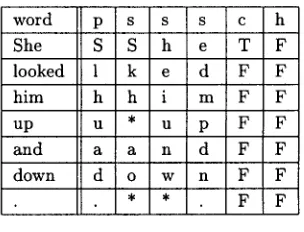
Since the implementations of b o t h learning al- gorithms take propositional d a t a as their input (feature-value pairs), it is necessary to translate the corpora into this format first. This can be done in a fairly straightforward manner, as is il- lustrated in Tables 1 and 2 for the sentence She looked him up and down.
word d
She *
looked PP3A
him VBD
up PP30
and RP down CC RP
f a
PP3A VBD-VBN
VBD-VBN PP30
PP30 RP-IN
RP-IN CC
CC RP
RP SPER
SPER *
value PP3A VBD PP30 RP CC RP SPER Table 1: C o n t e x t u a l features
The disambiguation of known words is usu- ally based on contextual features. A word is considered to be known when it has an ambigu- ous tag (henceforth ambitag) a t t r i b u t e d to it in the LEXICON, which is compiled in the same way
as for the MBT-tagger (Daelemans et al., 1996). A lexicon entry like telephone for example car- ries the a m b i t a g NN-VB, meaning that it was observed in the training d a t a as a noun or a verb and that it has more often been observed as a noun (frequency being expressed by order). Surrounding context for the focus word (fi are disambiguated tags (a 0 on the left-hand side and ambiguous tags (a) on the right-hand side.
In order to avoid the unrealistic situation that all d i s a m b i g u a t e d tags assigned to the left con- text of the target word are correct, we simulated a realistic situation by tagging the validation and test set with a trained m e m o r y - b a s e d or m a x i m u m entropy tagger (trained on the train- ing set), and using the tags predicted by this tagger as left context tags.
word p s s s c h She S S h e T F looked 1 k e d F F him h h i m F F up u * u p F F and a a n d F F down d o w n F F
• * F F
Table 2: Morphological features
U n k n o w n words need more specific word-form information to trigger the correct disambigua- tion. Prefix-letters (p), suffix-letters (s), the oc- currence of a h y p h e n (h) or a capital (c) are all considered to be relevant features for the dis- ambiguation of u n k n o w n words.
4 U s i n g M B T - t y p e f e a t u r e s
This section describes tagging experiments for b o t h algorithms using features as described in Daelemans et al. (1996). A large number of experiments were done to find the most suitable feature selection for each algorithm, the most relevant results of which axe presented here. V a l i d a t i o n P h a s e
[image:3.596.337.489.298.414.2] [image:3.596.58.284.520.628.2]Known Words % f df fa dfa ddfaa dddfaaa
TIMBL IGTREE 92.5 95.1 95.9 97.2 97.2 97.2
TIMBL IB1 92.5 95.1 95.9 97.2 97.4 97.3
TIMBL IBi K----5 92.5 95.1 95.6 93.8 96.4 97.0
TIMBL IB1 K----10 92.5 95.1 95.6 93.4 93.7 96.1
TIMBL MVDM 92.5 95.1 95.9 97.4 97.4 97.2
TIMBL MVDM K=5 92.5 95.1 95.2 97.5 97.5 97.4
TIMBL MVDM K----10 92.5 95.1 94.9 97.5 97.5 97.3
MACCENT 92.5 94.5 95.8 97.5 97.6 97.4
Unknown Words % ddaap ddaas ddaaps ddaapss ddaapsscn ddaapsshcn
TIMBL IGTREE 42.1 65.9 65.2 65.8 68.6 70.0
TIMBL ml 53.8 63.7 66.3 68.3 68.8 70.7
TIMBL IB1 K----5 54.2 61.6 66.7 71.4 72.5 774.3
TIMBL IB1 K----10 49.5 55.3 64.2 68.4 70.3 72.7
TIMBL MVDM 58.1 72.0 70.9 75.1 71.0 73.3
TIMBL MVDM K----5 61.2 72.0 75.6 79.7 75.5 77.6
TIMBL MVDM K----10 61.7 72.7 76.0 '79.7 77.1 77.9
MACCENT 61.8 67.0 74.8 '78.6 75.3 77.0
Table 3: Validation Phase Results
tags or less, since we already noticed perfor- mance d e g r a d a t i o n for b o t h systems when us- ing a context of more t h a n 5 s u r r o u n d i n g tags. For u n k n o w n words, we have to discern between 2 different t u n i n g phases. First, we find the optimal contextual feature set, next the opti- mal morphological features, presupposing b o t h types of features operate independently.
We investigate seven of the variations of Memory-Based Learning available in TIMBL (see Daelemans et al. (1999b) for details) and one i n s t a n t i a t i o n of maccent, since the current ver- sion does not implement m a n y variations.
A s u m m a r y of the most relevant results of the validation phase can be found in Table 3. T h e result of the absolute o p t i m a l feature set for each a l g o r i t h m is indicated in bold. For some contexts, we observe a big difference be- tween IGTREE a n d IBi-IG a n d IB1-MVDM. For u n k n o w n words, the abstraction m a d e by the mWREE-algorithm seems to be quite h a r m f u l compared to the true lazy learning of the other variants (see Daelemans et al. (1999b) for a pos- sible explanation for this t y p e of behaviour).
Of all algorithms, M a x i m u m E n t r o p y has the highest tagging accuracy for known words, out- performing TIMBL-algorithms however by only a very small margin. T h e overall optimal con- text for the algorithms t u r n e d out to be
dfa
a n dddfaa
respectively, while enlarging the context on either side of the focus word resulted in a lower tagging accuracy.Overall, we noticed a t e n d e n c y for T I M B L to
perform b e t t e r w h e n the i n f o r m a t i o n source is r a t h e r limited (i.e. w h e n few features are used), while MACCENT seems more robust when deal- ing w i t h a more elaborate feature space.
T e s t P h a s e
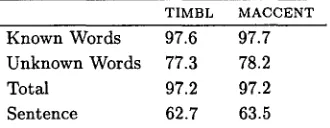
T h e Test P h a s e of t h e experiment consists of r u n n i n g the optimised s u b a l g o r i t h m paired with the o p t i m a l feature set on t h e test set. TIMBL, a u g m e n t e d w i t h the Modified Value Difference Metric a n d k set to 5, was used to disambiguate known words w i t h a
dfa
feature value, u n k n o w n words w i t h t h e featuresddaapss.
MACCENT used the same features for u n k n o w n words, b u t used more elaborate features(ddfaa)
to disam- biguate known words. T h e results of the opti- mised algorithms on t h e test set can be found in Table 4.T I M B L M A C C E N T
Known Words 97.6 97.7
Unknown Words 77.3 78.2
Total 97.2 97.2
Sentence 62.7 63.5
Table 4: Test results with M B T features
[image:4.596.345.510.551.615.2]Algorithm Accuracy (%) on test set
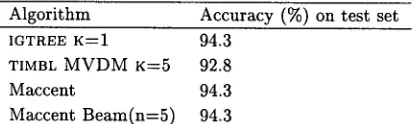
IGTREE K----1 94.3
T I M B L M V D M K : 5 92.8
Maccent 94.3
Maccent B e a m ( n = 5 ) 94.3
Table 5: Test results with MXPOST features tested.
B e a m S e a r c h
Note that MACCENT does not include the beam search over N highest probability tag sequence candidates at sentence level, which is part of
the MXPOST tagger (but not part of maximum
entropy-based learning proper; it could be com- bined with MBL as well). To make sure that this omission does not affect maximum entropy learning adversely for this task, we implemented the beam search, and compared the results with the condition in which the most probable tag is used, for different beam sizes and different amounts of training data. The differences in accuracy were statistically not significant (beam search even turned out to be significantly worse for small training sets). The beam search very rarely changes the probability order suggested
by MACCENT, and when it does, the number of
times the suggested change is correct is about equal to the number of times the change is wrong. This is in contrast with the results of Ratnaparkhi (1996), and will be investigated further in future research.
5 U s i n g MXPOST-type f e a t u r e s
In order to complete the systematic compari- son, we compared maximum entropy (again us- ing the MACCENT implementation) with MBL when using the features suggested in (Ratna- parkhi, 1996). Due to the computational ex- pense of the iterative scaling method that is in- herent to maximum entropy learning, it was not tractable to incorporate an extensive validation phase for feature selection or algorithmic vari- ant selection. We simply took the features sug- gested in that paper, and 2 different settings for our MBL implementation, IGTREE and MVDM K----5, the latter being the optimal algorithm for the previous experiments. The results on the test set are shown in Table 5.
B e a m s e a r c h
Notice that again, the sentence level beam search does not add significantly to accuracy. Also note that the results report in Table 5 dif- fer significantly from those reported for MXPOST
in (van Halteren et al., 1998). The difference in tagging accuracy is most likely due to the prob- lematic translation of MXPOST'S binary features to nominal features. This involves creating in- stances with a fixed number of features (not just the active features for the instance as is the case in M X P O S T ) , resulting in a bigger, less manageable instance space. When IGTREE com- presses the elaborate instance space, we conse- quently notice a significant improvement over a
MVDM approach.
6 E r r o r A n a l y s i s
The following table contains some more detailed information about the distribution of the er- rors 4:
Known Unknown
Both wrong - same tag 1384 335
Both Wrong - different tag 117 130
Only MACCENT Wrong 1008 181
Only TIMBL Wrong 1103 193
In 87% of the cases where both algorithms are wrong, they assign the same tag to a word. This indicates that about 55% of the errors can either be attributed to a general shortcoming present in both algorithms or to an inadequate informa- tion source. We can also state that 97.8% of the time, the two algorithms agree on which tag to assign to a word (even though they both agree on the wrong tag 1.7% of the time).
We also observed the same (erroneous) tag- ging behavior in both algorithms for lower- frequency tags, the interchanging of noun tags and adjective tags, past tense tags and past par- ticiple tags and the like.
Another issue is the information value of the ambitag. We have observed several cases where the correct tag was not in the distribution spec- ified by the ambitag, which has substantial in- formation value. In our test set, this is the case for 1235 words (not considering unknown words). 553 times, neither algorithm finds the correct tag. Differences can be observed in the
[image:5.596.70.278.80.142.2]way the algorithms deal with the information value of the ambitag, with Maximum Entropy exhibiting a more conservative approach with respect to the distribution suggested by the am- bitag, more reluctant to break free from the am- bitag. It only finds the correct part-of-speech tag 507 times, whereas TiMBL performs better at 594 correct tags. There is a downside to this: sometimes the correct tag is featured in the am- bitag, but the algorithm breaks free from the ambitag nevertheless. This happens to TiMBL 267 times, and 288 times to M A C C E N T .
In any case, the construction of the ambitag seems to be a problematic issue that needs to be resolved, since its problematic nature accounts for almost 40% of all tagging errors. This is especially a problem for M B T as it relies on am- bitags in its representation.
7
Concluding Remarks
A systematic comparison between two state- of-the-art tagging systems (maximum entropy and memory-based learning) was presented. By carefully controlling the information sources available to the learning algorithms when used as a tagger generator, we were able to show that, although there certainly are differences between the inherent bias of the algorithms, these differ- ences account for less variability in tagging ac- curacy than suggested in previous comparisons (e.g. van Halteren et al. (1998)).
Even though overall tagging accuracy of both learning algorithms turns out to be very similar, differences can be observed in terms of accuracy on known and unknown words separately, but also in the differences in the (erroneous) tagging behaviour the two learning algorithms exhibit.
Furthermore, evidence can be found that given the same information source, different learning algorithms, and also different instan- tiations of the same learning algorithm, yield small, but significant differences in tagging ac- curacy. This may be in line with theoretical work by Roth (1998);Roth (1999) in which both maximum entropy modeling and memory-based learning (among other learning algorithms) are shown to search for a decision surface which is a linear function in the feature space. The results put forward in this paper support the claim that, although the linear separator found can be different for different learning algorithms, the
feature space used is more important.
We also showed that which information sources, algorithmic parameters, and even algo- rithm variants are optimal depends on a com- plex interaction of learning algorithm, task, and data set, and should accordingly be decided upon by cross-validation.
References
Adam Berger, Stephen Della Pietra, and Vincent Della Pietra. 1996. Maximum Entropy Approach to Natural Language Processing. Computational
Linguistics, 22(1).
C. Caxdie. 1994. Domain Specific Knowledge Acqui-
sition for Conceptual Sentence Analysis. Ph.D.
thesis, University of Massachusets, Amherst, MA. W. Daelemans, J. Zavrel, P. Berck, and S. Gillis. 1996. MBT: A memory-based part of speech tag- ger generator. In E. Ejerhed and I. Dagan, ed- itors, Proc. of Fourth Workshop on Very Large
Corpora, pages 14-27. ACL SIGDAT.
W. Daelemans, A. Van den Bosch, and J. Zavrel. 1999a. Forgetting exceptions is harmful in lan- guage learning. Machine Learning, Special issue
on Natural Language Learning, 34:11-41.
W. Daelemans, J. Zavrel, K. Van der Sloot, and A. Van den Bosch. 1999b. TiMBL: Tilburg Mem- ory Based Learner, version 2.0, reference manual. Technical Report ILK-9901, ILK, Tilburg Univer- sity.
A. Ratnaparkhi. 1996. A maximum entropy part-of- speech tagger. In Proc. of the Conference on Em- pirical Methods in Natural Language Processing, May 1Y-18, 1996, University of Pennsylvania.
Dan Roth. 1998. Learning to resolve natural lan- guage ambiguities: A unified approach. In Pro- ceedings of the 15th National Conference on Ar- tificial Intelligence (AAAI-98) and of the lOth Conference on Innovative Applications of Artifi-
cial Intelligence (IAAI-98), pages 806-813, Menlo
Park, July 26-30. AAAI Press.
Dan Roth. 1999. Learning in natural language. In
Proceedings of the 16th Joint Conference on Arti- ficial Intelligence.
C. Stanfill and D. Waltz. 1986. Toward memory- based reasoning. Communications of the ACM, 29(12):1213-1228, December.
H. van Halteren, J. Zavrel, and W. Daelemans. 1998. Improving data-driven wordclass tagging by system combination. In Proceedings of the 36th Annual Meeting of the Association for Compu- tational Linguistics, Montr'eal, Quebec, Canada,
pages 491-497, Montreal, Canada, August 10-14. H. van Halteren (ed.). 1999. Syntactic Word-
class Tagging. Kluwer Academic Publishers, Dor-