Joint Training and Decoding Using Virtual Nodes for Cascaded
Segmentation and Tagging Tasks
Xian Qian, Qi Zhang, Yaqian Zhou, Xuanjing Huang, Lide Wu School of Computer Science, Fudan University
825 Zhangheng Road, Shanghai, P.R.China
{qianxian, qz, zhouyaqian, xjhuang, ldwu}@fudan.edu.cn
Abstract
Many sequence labeling tasks in NLP require solving a cascade of segmentation and tag-ging subtasks, such as Chinese POS tagtag-ging, named entity recognition, and so on. Tradi-tional pipeline approaches usually suffer from error propagation. Joint training/decoding in the cross-product state space could cause too many parameters and high inference complex-ity. In this paper, we present a novel method which integrates graph structures of two sub-tasks into one using virtual nodes, and per-forms joint training and decoding in the fac-torized state space. Experimental evaluations on CoNLL 2000 shallow parsing data set and Fourth SIGHAN Bakeoff CTB POS tagging data set demonstrate the superiority of our method over cross-product, pipeline and can-didate reranking approaches.
1 Introduction
There is a typical class of sequence labeling tasks in many natural language processing (NLP) applica-tions, which require solving a cascade of segmenta-tion and tagging subtasks. For example, many Asian languages such as Japanese and Chinese which do not contain explicitly marked word boundaries, word segmentation is the preliminary step for solv-ing part-of-speech (POS) taggsolv-ing problem. Sen-tences are firstly segmented into words, then each word is assigned with a part-of-speech tag. Both syntactic parsing and dependency parsing usually start with a textual input that is tokenized, and POS tagged.
The most commonly approach solves cascaded subtasks in a pipeline, which is very simple to im-plement and allows for a modular approach. While,
the key disadvantage of such method is that er-rors propagate between stages, significantly affect-ing the quality of the final results. To cope with this problem, Shi and Wang (2007) proposed a rerank-ing framework in which N-best segment candidates generated in the first stage are passed to the tag-ging model, and the final output is the one with the highest overall segmentation and tagging probabil-ity score. The main drawback of this method is that the interaction between tagging and segmentation is restricted by the number of candidate segmentation outputs. Razvan C. Bunescu (2008) presented an improved pipeline model in which upstream subtask outputs are regarded as hidden variables, together with their probabilities are used as probabilistic fea-tures in the downstream subtasks. One shortcom-ing of this method is that calculation of marginal probabilities of features may be inefficient and some approximations are required for fast computation. Another disadvantage of these two methods is that they employ separate training and the segmentation model could not take advantages of tagging infor-mation in the training procedure.
On the other hand, joint learning and decoding using cross-product of segmentation states and tag-ging states does not suffer from error propagation problem and achieves higher accuracy on both sub-tasks (Ng and Low, 2004). However, two problems arises due to the large state space, one is that the amount of parameters increases rapidly, which is apt to overfit on the training corpus, the other is that the inference by dynamic programming could be in-efficient. Sutton (2004) proposed Dynamic Con-ditional Random Fields (DCRFs) to perform joint training/decoding of subtasks using much fewer pa-rameters than the cross-product approach.
ever, DCRFs do not guarantee non-violation of hard-constraints that nodes within the same segment get a single consistent tagging label. Another draw-back of DCRFs is that exact inference is generally time consuming, some approximations are required to make it tractable.
Recently, perceptron based learning framework has been well studied for incorporating node level and segment level features together (Kazama and Torisawa, 2007; Zhang and Clark, 2008). The main shortcoming is that exact inference is intractable for those dynamically generated segment level fea-tures, so candidate based searching algorithm is used for approximation. On the other hand, Jiang (2008) proposed a cascaded linear model which has a two layer structure, the inside-layer model uses node level features to generate candidates with their weights as inputs of the outside layer model which captures non-local features. As pipeline models, er-ror propagation problem exists for such method.
In this paper, we present a novel graph structure that exploits joint training and decoding in the fac-torized state space. Our method does not suffer from error propagation, and guards against viola-tions of those hard-constraints imposed by segmen-tation subtask. The motivation is to integrate two Markov chains for segmentation and tagging sub-tasks into a single chain, which contains two types of nodes, then standard dynamic programming based exact inference is employed on the hybrid struc-ture. Experiments are conducted on two different tasks, CoNLL 2000 shallow parsing and SIGHAN 2008 Chinese word segmentation and POS tagging. Evaluation results of shallow parsing task show the superiority of our proposed method over tradi-tional joint training/decoding approach using cross-product state space, and achieves the best reported results when no additional resources at hand. For Chinese word segmentation and POS tagging task, a strong baseline pipeline model is built, experimental results show that the proposed method yields a more substantial improvement over the baseline than can-didate reranking approach.
The rest of this paper is organized as follows: In Section 2, we describe our novel graph structure. In Section 3, we analyze complexity of our proposed method. Experimental results are shown in Section 4. We conclude the work in Section 5.
2 Multi-chain integration using Virtual Nodes
2.1 Conditional Random Fields
We begin with a brief review of the Conditional Ran-dom Fields(CRFs). Letx = x1x2. . . xldenote the
observed sequence, wherexi is the ith node in the
sequence,lis sequence length,y = y1y2. . . yl is a
label sequence overxthat we wish to predict. CRFs (Lafferty et al., 2001) are undirected graphic mod-els that use Markov network distribution to learn the conditional probability. For sequence labeling task, linear chain CRFs are very popular, in which a first order Markov assumption is made on the labels:
p(y|x) = 1 Z(x)
Y
i
φ(x,y, i)
,where
φ(x,y, i) = exp³wTf(x, yi−1, yi, i)
´
Z(x) =X
y Y
i
φ(x,y, i)
f(x, yi−1, yi, i) = [f1(x, yi−1, yi, i), . . .,fm(x, yi−1, yi, i)]T, each
ele-mentfj(x, yi−1, yi, i)is a real valued feature
func-tion, here we simplify the notation of state feature by writingfj(x, yi, i) = fj(x, yi−1, yi, i),mis the cardinality of feature set{fj}. w= [w1, . . . , wm]T
is a weight vector to be learned from the training set. Z(x)is the normalization factor over all label sequences forx.
In the traditional joint training/decoding approach for cascaded segmentation and tagging task, each label yi has the form si-ti, which consists of
seg-mentation label si and tagging label ti. Let s =
s1s2. . . slbe the segmentation label sequence over x. There are several commonly used label sets such as BI, BIO, IOE, BIES, etc. To facilitate our dis-cussion, in later sections we will use BIES label set, where B,I,E representsBeginning, InsideandEndof a multi-node segment respectively, S denotes a sin-gle node segment. Lett=t1t2. . . tlbe the tagging
label sequence overx. For example, in named entity recognition task, ti ∈ {PER, LOC, ORG, MISC,
x2
s × t
2
2
x1
s × t
1
1
S-P S-O
x3
s × t
3
3
S-O
x4
s × t
4
4
B-P
x5
s × t
5
5
E-P
[image:3.612.72.296.54.140.2]Hendrix ’s girlfriend Kathy Etchingham
Figure 1: Graphical representation of linear chain CRFs for traditional joint learning/decoding
name and other). Graphical representation of lin-ear chain CRFs is shown in Figure 1, where tagging label “P” is the simplification of “PER”. For nodes that are labeled as other, we definesi=S,ti =O.
2.2 Hybrid structure for cascaded labeling tasks
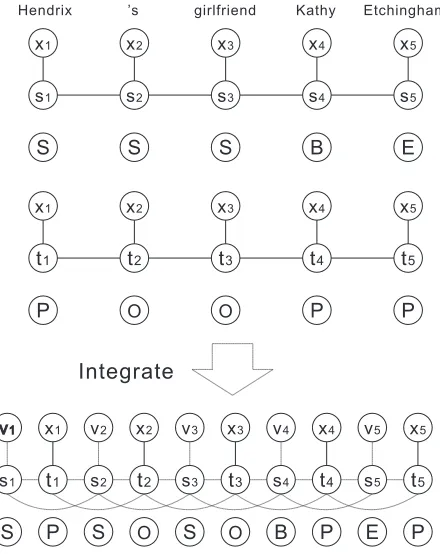
Different from traditional joint approach, our method integrates two linear markov chains for seg-mentation and tagging subtasks into one that con-tains two types of nodes. Specifically, we first regard segmentation and tagging as two indepen-dent sequence labeling tasks, corresponding chain structures are built, as shown in the top and mid-dle sub-figures of Figure 2. Then a chain of twice length of the observed sequence is built, where nodes x1, . . . , xl on the even positions are original
observed nodes, while nodesv1, . . . , vl on the odd
positions are virtual nodes that have no content in-formation. For original nodesxi, the state space is
the tagging label set, while for virtual nodes, their states are segmentation labels. The label sequence of the hybrid chain isy =y1. . . y2l =s1t1. . . sltl,
where combination of consecutive labelssiti
repre-sents the full label for nodexi.
Then we let si be connected with si−1 andsi+1
, so that first order Markov assumption is made on segmentation states. Similarly, ti is connected
with ti−1 andti+1. Then neighboring tagging and segmentation states are connected as shown in the bottom sub-figure of Figure 2. Non-violation of hard-constraints that nodes within the same seg-ment get a single consistent tagging label is guar-anteed by introducing second order transition fea-turesf(ti−1, si, ti, i) that are true ifti−1 6= ti and
si ∈ {I,E}. For example, fj(ti−1, si, ti, i) is
de-fined as true if ti−1 =PER, si =I and ti =LOC.
In other words, it is true, if a segment is partially tagging as PER, and partially tagged as LOC. Since such features are always false in the training corpus, their corresponding weights will be very low so that inconsistent label assignments impossibly appear in decoding procedure. The hybrid graph structure can be regarded as a special case of second order Markov chain.
Hendrix ’s girlfriend Kathy Etchingham
x1 x2 x3 x4 x5
s1 s2 s3 s4 s5
S S S B E
x1 x2 x3 x4 x5
t1 t2 t3 t4 t5
P O O P P
x1 x2 x3 x4 x5
t1 t2 t3 t4 t5
P O O P P
s2
s1 s3 s4 s5
S S S B E
v1 v2 v3 v4 v5
Integrate
Figure 2: Multi-chain integration using Virtual Nodes
2.3 Factorized features
Compared with traditional joint model that exploits cross-product state space, our hybrid structure uses factorized states, hence could handle more flexible features. Any state feature g(x, yi, i) defined in
the cross-product state space can be replaced by a first order transition feature in the factorized space:
f(x, si, ti, i). As for the transition features, we
use f(si−1, ti−1, si, i) and f(ti−1, si, ti, i) instead
ofg(yi−1, yi, i)in the conventional joint model.
[image:3.612.317.537.185.462.2]want to specify requirement on only segmentation or tagging label. For example, “Smith” may be an end of a person name, “Speaker: John Smith”; or a sin-gle word person name “Professor Smith will . . . ”. In such case, our observation is that “Smith” is likely a (part of) person name, we do not care about its seg-mentation label. So we could define state feature
f(x, ti, i) = true, ifxiis “Smith” with tagging
la-belti=PER.
Further more, we could define features like
f(x, ti−1, ti, i), f(x, si−1, si, i), f(x, ti−1, si, i),
etc. The hybrid structure facilitates us to use varieties of features. In the remainder of the paper, we use notations f(x, ti−1, si, ti, i) and
f(x, si−1, ti−1, si, i)for simplicity.
2.4 Hybrid CRFs
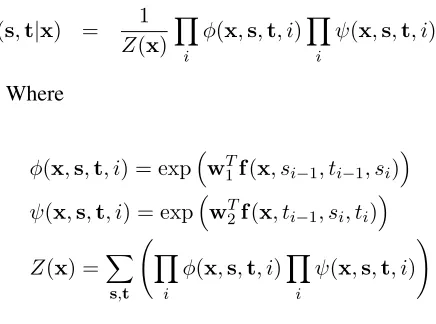
A hybrid CRFs is a conditional distribution that fac-torizes according to the hybrid graphical model, and is defined as:
p(s,t|x) = 1 Z(x)
Y
i
φ(x,s,t, i)Y i
ψ(x,s,t, i)
Where
φ(x,s,t, i) = exp³wT1f(x, si−1, ti−1, si)
´
ψ(x,s,t, i) = exp³w2Tf(x, ti−1, si, ti)
´
Z(x) =X
s,t Ã
Y
i
φ(x,s,t, i)Y i
ψ(x,s,t, i)
!
Wherew1,w2are weight vectors.
Luckily, unlike DCRFs, in which graph structure can be very complex, and the cross-product state space can be very large, in our cascaded labeling task, the segmentation label set is often small, so far as we known, the most complicated segmenta-tion label set has only 6 labels (Huang and Zhao, 2007). So exact dynamic programming based algo-rithms can be efficiently performed.
In the training stage, we use second order forward backward algorithm to compute the marginal proba-bilitiesp(x, si−1, ti−1, si)andp(x, ti−1, si, ti), and
[image:4.612.80.298.343.505.2]the normalization factor Z(x). In decoding stage, we use second order Viterbi algorithm to find the best label sequence. The Viterbi decoding can be
Table 1: Time Complexity
Method Training Decoding Pipeline (|S|2cs+|T|2ct)L (|S|2+|T|2)U Cross-Product (|S||T|)2cL (|S||T|)2U
Reranking (|S|2cs+|T|2ct)L (|S|2+|T|2)N U Hybrid (|S|+|T|)|S||T|cL (|S|+|T|)|S||T|U
used to label a new sequence, and marginal compu-tation is used for parameter estimation.
3 Complexity Analysis
The time complexity of the hybrid CRFs train-ing and decodtrain-ing procedures is higher than that of pipeline methods, but lower than traditional cross-product methods. Let
• |S|=size of the segmentation label set.
• |T|=size of the tagging label set.
• L=total number of nodes in the training data set.
• U =total number of nodes in the testing data set.
• c=number of joint training iterations.
• cs = number of segmentation training
itera-tions.
• ct=number of tagging training iterations.
• N =number of candidates in candidate rerank-ing approach.
Time requirements for pipeline, cross-product, can-didate reranking and hybrid CRFs are summarized in Table 1. For Hybrid CRFs, original nodexi has
features{fj(ti−1, si, ti)}, accessing all label subse-quences ti−1siti takes |S||T|2 time, while virtual
nodevi has features{fj(si−1, ti−1, si)}, accessing
all label subsequencessi−1ti−1sitakes|S|2|T|time,
Table 2: Feature templates for shallow parsing task Cross Product CRFs Hybrid CRFs
wi−2yi,wi−1yi,wiyi wi−1si,wisi,wi+1si
wi+1yi,wi+2yi wi−2ti,wi−1ti,witi,wi+1ti,wi+2ti
wi−1wiyi,wiwi+1yi wi−1wisi,wiwi+1si
wi−1witi,wiwi+1ti
pi−2yi,pi−1yi,piyi pi−1si,pisi,pi+1si
pi+1yi,pi+2yi pi−2ti,pi−1ti,pi+1ti,pi+2ti pi−2pi−1yi, pi−1piyi, pipi+1yi,
pi+1pi+2yi
pi−2pi−1si,pi−1pisi,pipi+1si,pi+1pi+2si
pi−3pi−2ti, pi−2pi−1ti, pi−1piti, pipi+1ti,
pi+1pi+2ti,pi+2pi+3ti,pi−1pi+1ti pi−2pi−1piyi, pi−1pipi+1yi,
pipi+1pi+2yi
pi−2pi−1pisi,pi−1pipi+1si, pipi+1pi+2si
wipiti
wisi−1si
wi−1ti−1ti,witi−1ti,pi−1ti−1ti,piti−1ti
yi−1yi si−1ti−1si,ti−1siti
method. When decoding, candidate reranking ap-proach requires more time if candidate numberN > |S|.
Though the space complexity could not be com-pared directly among some of these methods, hybrid CRFs require less parameters than cross-product CRFs due to the factorized state space. This is sim-ilar with factorized CRFs (FCRFs) (Sutton et al., 2004).
4 Experiments
4.1 Shallow Parsing
Our first experiment is the shallow parsing task. We use corpus from CoNLL 2000 shared task, which contains 8936 sentences for training and 2012 sen-tences for testing. There are 11 tagging labels: noun phrase(NP), verb phrase(VP) , . . . and other (O), the segmentation state space we used is BIES label set, since we find that it yields a little improvement over BIO set.
We use the standard evaluation metrics, which are precision P (percentage of output phrases that ex-actly match the reference phrases), recall R (percent-age of reference phrases returned by our system), and their harmonic mean, the F1 scoreF1 = 2P R
P+R
(which we call F score in what follows).
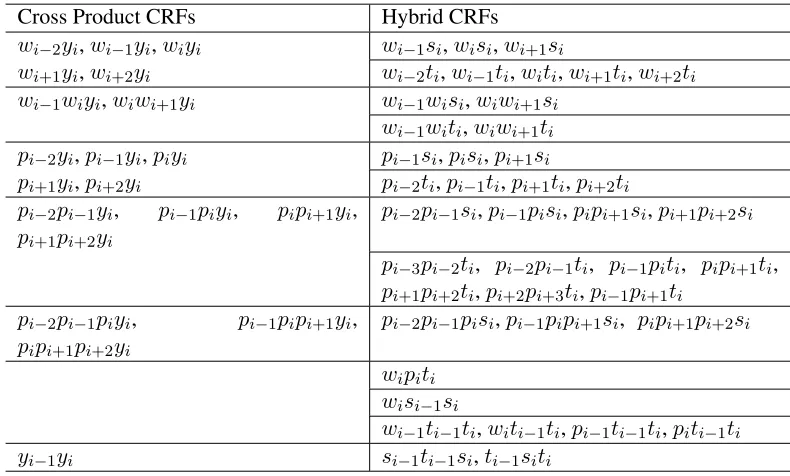
We compare our approach with traditional cross-product method. To find good feature templates, development data are required. Since CoNLL2000 does not provide development data set, we divide the training data into 10 folds, of which 9 folds for training and 1 fold for developing. After selecting feature templates by cross validation, we extract fea-tures and learn their weights on the whole training data set. Feature templates are summarized in Table 2, wherewidenotes theithword,pidenotes theith
POS tag.
Notice that in the second row, feature templates of the hybrid CRFs does not containwi−2si,wi+2si,
since we find that these two templates degrade per-formance in cross validation. However, wi−2ti,
wi+2tiare useful, which implies that the proper
con-text window size for segmentation is smaller than tagging. Similarly, for hybrid CRFs, the window size of POS bigram features for segmentation is 5 (from pi−2 to pi+2, see the eighth row in the
sec-ond column); while for tagging, the size is 7 (from
pi−3 to pi+3, see the ninth row in the second
col-umn). However for cross-product method, their win-dow sizes must be consistent.
signifi-Table 3: Results for shallow parsing task, Hybrid CRFs significantly outperform Cross-Product CRFs (McNe-mar’s test;p <0.01)
Method Cross-Product CRFs
Hybrid CRFs Training Time 11.6hours 6.3hours Feature
Num-ber
13million 10 mil-lion
Iterations 118 141
F1 93.88 94.31
cantly affect the results when it varies between1and
10. LBFGS(Nocedal and Wright, 1999) method is employed for numerical optimization. Experimen-tal results are shown in Table 3. Our proposed CRFs achieve a performance gain of0.43points in F-score over cross-product CRFs that use state space while require less training time.
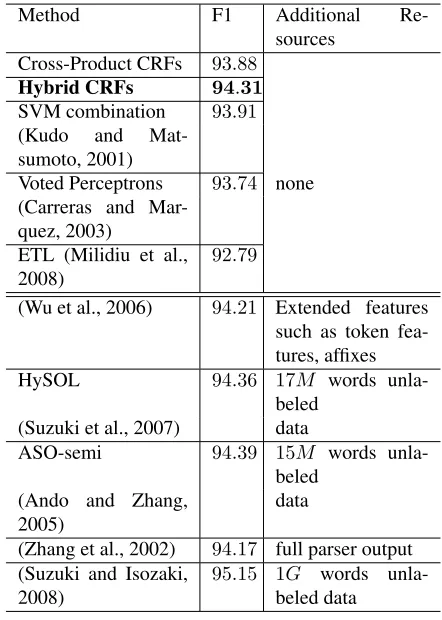
For comparison, we also listed the results of pre-vious top systems, as shown in Table 4. Our pro-posed method outperforms other systems when no additional resources at hand. Though recently semi-supervised learning that incorporates large mounts of unlabeled data has been shown great improve-ment over traditional supervised methods, such as the last row in Table 4, supervised learning is funda-mental. We believe that combination of our method and semi-supervised learning will achieve further improvement.
4.2 Chinese word segmentation and POS tagging
Our second experiment is the Chinese word seg-mentation and POS tagging task. To facilitate com-parison, we focus only on the closed test, which means that the system is trained only with a des-ignated training corpus, any extra knowledge is not allowed, including Chinese and Arabic numbers, let-ters and so on. We use the Chinese Treebank (CTB) POS corpus from the Fourth International SIGHAN Bakeoff data sets (Jin and Chen, 2008). The train-ing data consist of 23444 sentences, 642246 Chinese words, 1.05M Chinese characters and testing data consist of 2079 sentences, 59955 Chinese words, 0.1M Chinese characters.
[image:6.612.315.536.90.400.2]We compare our hybrid CRFs with pipeline and candidate reranking methods (Shi and Wang, 2007)
Table 4: Comparison with other systems on shallow pars-ing task
Method F1 Additional Re-sources
Cross-Product CRFs 93.88
Hybrid CRFs 94.31
SVM combination 93.91
(Kudo and Mat-sumoto, 2001)
Voted Perceptrons 93.74 none (Carreras and
Mar-quez, 2003)
ETL (Milidiu et al., 2008)
92.79
(Wu et al., 2006) 94.21 Extended features such as token fea-tures, affixes HySOL 94.36 17M words
unla-beled (Suzuki et al., 2007) data
ASO-semi 94.39 15M words unla-beled
(Ando and Zhang, 2005)
data
(Zhang et al., 2002) 94.17 full parser output (Suzuki and Isozaki,
2008)
95.15 1G words unla-beled data
using the same evaluation metrics as shallow pars-ing. We do not compare with cross-product CRFs due to large amounts of parameters.
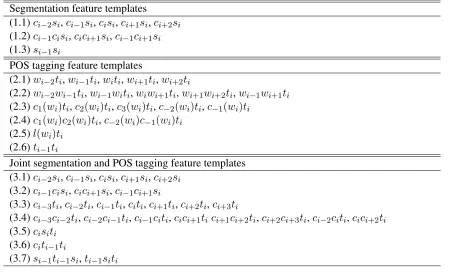
For pipeline method, we built our word segmenter based on the work of Huang and Zhao (2007), which uses 6 label representation, 7 feature tem-plates (listed in Table 5, where ci denotes the ith
Chinese character in the sentence) and CRFs for pa-rameter learning. We compare our segmentor with other top systems using SIGHAN CTB corpus and evaluation metrics. Comparison results are shown in Table 6, our segmenter achieved 95.12 F-score, which is ranked 4th of 26 official runs. Except for the first system which uses extra unlabeled data, dif-ferences between rest systems are not significant.
[image:6.612.76.295.103.191.2]Table 5: Feature templates for Chinese word segmentation and POS tagging task
Segmentation feature templates
(1.1)ci−2si,ci−1si,cisi,ci+1si,ci+2si
(1.2)ci−1cisi,cici+1si,ci−1ci+1si
(1.3)si−1si
POS tagging feature templates
(2.1)wi−2ti,wi−1ti,witi,wi+1ti,wi+2ti
(2.2)wi−2wi−1ti,wi−1witi,wiwi+1ti,wi+1wi+2ti,wi−1wi+1ti
(2.3)c1(wi)ti,c2(wi)ti,c3(wi)ti,c−2(wi)ti,c−1(wi)ti
(2.4)c1(wi)c2(wi)ti,c−2(wi)c−1(wi)ti
(2.5)l(wi)ti
(2.6)ti−1ti
Joint segmentation and POS tagging feature templates (3.1)ci−2si,ci−1si,cisi,ci+1si,ci+2si
(3.2)ci−1cisi,cici+1si,ci−1ci+1si
(3.3)ci−3ti,ci−2ti,ci−1ti,citi,ci+1ti,ci+2ti,ci+3ti
(3.4)ci−3ci−2ti,ci−2ci−1ti,ci−1citi,cici+1tici+1ci+2ti,ci+2ci+3ti,ci−2citi,cici+2ti
(3.5)cisiti
(3.6)citi−1ti
(3.7)si−1ti−1si,ti−1siti
Table 6: Word segmentation results on Fourth SIGHAN Bakeoff CTB corpus
Rank F1 Description
1/26 95.89∗ official best, using extra
un-labeled data (Zhao and Kit, 2008)
2/26 95.33 official second 3/26 95.17 official third
4/26 95.12 segmentor in pipeline sys-tem
Table 7: POS results on Fourth SIGHAN Bakeoff CTB corpus
Rank Accuracy Description
1/7 94.29 POS tagger in pipeline sys-tem
2/7 94.28 official best 3/7 94.01 official second 4/7 93.24 official third
the sentence,cj(wi), j > 0denotes thejthChinese
character of wordwi,cj(wi), j < 0denotes thejth
last Chinese character,l(wi)denotes the word length
ofwi. We compare our POS tagger with other top
systems on Bakeoff CTB POS corpus where sen-tences are perfectly segmented into words, our POS tagger achieved94.29accuracy, which is the best of 7 official runs. Comparison results are shown in Ta-ble 7.
For reranking method, we varied candidate num-bers n among n ∈ {10,20,50,100}. For hybrid CRFs, we use the same segmentation label set as the segmentor in pipeline. Feature templates are listed in Table 5. Experimental results are shown in Figure 3. The gain of hybrid CRFs over the baseline pipeline model is 0.48 points in F-score, about 3 times higher than 100-best reranking ap-proach which achieves 0.13 points improvement. Though larger candidate number can achieve higher performance, such improvement becomes trivial for
n >20.
re-0 20 40 60 80 100 90.3
90.4 90.5 90.6 90.7 90.8 90.9
candidate number
F score
[image:8.612.76.285.62.219.2]candidate reranking Hybrid CRFs
Figure 3: Results for Chinese word segmentation and POS tagging task, Hybrid CRFs significantly outperform 100-Best Reranking (McNemar’s test;p <0.01)
Table 8: Comparison of word segmentation and POS tag-ging, such comparison is indirect due to different data sets and resources.
Model F1
Pipeline (ours) 90.40
100-Best Reranking (ours) 90.53
Hybrid CRFs (ours) 90.88
Pipeline (Shi and Wang, 2007) 91.67
20-Best Reranking (Shi and Wang, 2007)
91.86
Pipeline (Zhang and Clark, 2008) 90.33
Joint Perceptron (Zhang and Clark, 2008)
91.34
Perceptron Only (Jiang et al., 2008) 92.5
Cascaded Linear (Jiang et al., 2008) 93.4
sources. One common conclusion is that joint mod-els generally outperform pipeline modmod-els.
5 Conclusion
We introduced a framework to integrate graph struc-tures for segmentation and tagging subtasks into one using virtual nodes, and performs joint training and decoding in the factorized state space. Our approach does not suffer from error propagation, and guards against violations of those hard-constraints imposed by segmentation subtask. Experiments on shal-low parsing and Chinese word segmentation tasks demonstrate our technique.
6 Acknowledgements
The author wishes to thank the anonymous review-ers for their helpful comments. This work was partially funded by 973 Program (2010CB327906), The National High Technology Research and De-velopment Program of China (2009AA01A346), Shanghai Leading Academic Discipline Project (B114), Doctoral Fund of Ministry of Education of China (200802460066), National Natural Science Funds for Distinguished Young Scholar of China (61003092), and Shanghai Science and Technology Development Funds (08511500302).
References
R. Ando and T. Zhang. 2005. A high-performance semi-supervised learning method for text chunking. In Pro-ceedings of ACL, pages 1–9.
Razvan C. Bunescu. 2008. Learning with probabilistic features for improved pipeline models. InProceedings of EMNLP, Waikiki, Honolulu, Hawaii.
X Carreras and L Marquez. 2003. Phrase recognition by filtering and ranking with perceptrons. InProceedings of RANLP.
Changning Huang and Hai Zhao. 2007. Chinese word segmentation: A decade review. Journal of Chinese Information Processing, 21:8–19.
Wenbin Jiang, Liang Huang, Qun Liu, and Yajuan Lu. 2008. A cascaded linear model for joint chinese word segmentation and part-of-speech tagging. In Proceed-ings of ACL, Columbus, Ohio, USA.
Guangjin Jin and Xiao Chen. 2008. The fourth interna-tional chinese language processing bakeoff: Chinese word segmentation, named entity recognition and chi-nese pos tagging. In Proceedings of Sixth SIGHAN Workshop on Chinese Language Processing, India. Junichi Kazama and Kentaro Torisawa. 2007. A new
perceptron algorithm for sequence labeling with non-local features. InProceedings of EMNLP, pages 315– 324, Prague, June.
Taku Kudo and Yuji Matsumoto. 2001. Chunking with support vector machines. InProceedings of NAACL. J. Lafferty, A. McCallum, and F. Pereira. 2001.
Con-ditional random fields: Probabilistic models for seg-menting and labeling sequence data. InProceedings of ICML.
Hwee Tou Ng and Jin Kiat Low. 2004. Chinese part-ofspeech tagging: One-at-a-time or all-at-once? word-based or character-word-based? InProceedings of EMNLP. J. Nocedal and S. J. Wright. 1999.Numerical
Optimiza-tion. Springer.
Yanxin Shi and Mengqiu Wang. 2007. A dual-layer crfs based joint decoding method for cascaded segmenta-tion and labeling tasks. InProceedings of IJCAI, pages 1707–1712, Hyderabad, India.
C. Sutton, K. Rohanimanesh, and A. McCallum. 2004. Dynamic conditional random fields: Factorized prob-abilistic models for labeling and segmenting sequence data. InProceedings of ICML.
Jun Suzuki and Hideki Isozaki. 2008. Semi-supervised sequential labeling and segmentation using giga-word scale unlabeled data. In Proceedings of ACL, pages 665–673.
Jun Suzuki, Akinori Fujino, and Hideki Isozaki. 2007. Semi-supervised structured output learning based on a hybrid generative and discriminative approach. In
Proceedings of EMNLP, Prague.
Yu-Chieh Wu, Chia-Hui Chang, and Yue-Shi Lee. 2006. A general and multi-lingual phrase chunking model based on masking method. In Proceedings of Intel-ligent Text Processing and Computational Linguistics, pages 144–155.
Yue Zhang and Stephen Clark. 2008. Joint word seg-mentation and pos tagging using a single perceptron. InProceedings of ACL, Columbus, Ohio, USA. T. Zhang, F. Damerau, and D. Johnson. 2002. Text
chunking based on a generalization of winnow. ma-chine learning research. Machine Learning Research, 2:615–637.