Sparse Multi-Scale Grammars
for Discriminative Latent Variable Parsing
Slav Petrov and Dan Klein
Computer Science Division, EECS Department University of California at Berkeley
Berkeley, CA 94720
{petrov, klein}@eecs.berkeley.edu
Abstract
We present a discriminative, latent variable approach to syntactic parsing in which rules exist at multiple scales of refinement. The model is formally a latent variable CRF gram-mar over trees, learned by iteratively splitting grammar productions (not categories). Dif-ferent regions of the grammar are refined to different degrees, yielding grammars which are three orders of magnitude smaller than the single-scale baseline and 20 times smaller than the split-and-merge grammars of Petrov et al. (2006). In addition, our discriminative approach integrally admits features beyond lo-cal tree configurations. We present a multi-scale training method along with an efficient CKY-style dynamic program. On a variety of domains and languages, this method produces the best published parsing accuracies with the smallest reported grammars.
1 Introduction
In latent variable approaches to parsing (Matsuzaki et al., 2005; Petrov et al., 2006), one models an ob-served treebank of coarse parse trees using a gram-mar over more refined, but unobserved, derivation trees. The parse trees represent the desired output of the system, while the derivation trees represent the typically much more complex underlying syntac-tic processes. In recent years, latent variable meth-ods have been shown to produce grammars which are as good as, or even better than, earlier parsing work (Collins, 1999; Charniak, 2000). In particular, in Petrov et al. (2006) we exhibited a very accurate
category-splitting approach, in which a coarse ini-tial grammar is refined by iteratively splitting each grammar category into two subcategories using the EM algorithm. Of course, each time the number of grammar categories is doubled, the number of bi-nary productions is increased by a factor of eight. As a result, while our final grammars used few cat-egories, the number of total active (non-zero) pro-ductions was still substantial (see Section 7). In ad-dition, it is reasonable to assume that some genera-tively learned splits have little discriminative utility. In this paper, we present a discriminative approach which addresses both of these limitations.
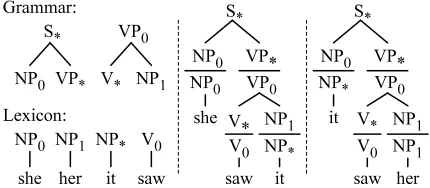
We introduce multi-scale grammars, in which some productions reference fine categories, while others reference coarse categories (see Figure 2). We use the general framework of hidden variable
CRFs (Lafferty et al., 2001; Koo and Collins, 2005),
where gradient-based optimization maximizes the likelihood of the observed variables, here parse trees, summing over log-linearly scored derivations. With multi-scale grammars, it is natural to refine
productions rather than categories. As a result, a
category such as NP can be complex in some re-gions of the grammar while remaining simpler in other regions. Additionally, we exploit the flexibility of the discriminative framework both to improve the treatment of unknown words as well as to include
span features (Taskar et al., 2004), giving the
bene-fit of some input features integrally in our dynamic program. Our multi-scale grammars are 3 orders of magnitude smaller than the fully-split baseline grammar and 20 times smaller than the generative split-and-merge grammars of Petrov et al. (2006).
In addition, we exhibit the best parsing numbers on several metrics, for several domains and languages.
Discriminative parsing has been investigated be-fore, such as in Johnson (2001), Clark and Curran (2004), Henderson (2004), Koo and Collins (2005), Turian et al. (2007), Finkel et al. (2008), and, most similarly, in Petrov and Klein (2008). However, in all of these cases, the final parsing performance fell short of the best generative models by several per-centage points or only short sentences were used. Only in combination with a generative model was a discriminative component able to produce high parsing accuracies (Charniak and Johnson, 2005; Huang, 2008). Multi-scale grammars, in contrast, give higher accuracies using smaller grammars than previous work in this direction, outperforming top generative models in grammar size and in parsing accuracy.
2 Latent Variable Parsing
Treebanks are typically not annotated with fully de-tailed syntactic structure. Rather, they present only a coarse trace of the true underlying processes. As a result, learning a grammar for parsing requires the estimation of a more highly articulated model than the naive CFG embodied by such treebanks. A manual approach might take the category NP and subdivide it into one subcategory NPˆS for subjects and another subcategory NPˆVP for objects (John-son, 1998; Klein and Manning, 2003). However, rather than devising linguistically motivated features or splits, latent variable parsing takes a fully auto-mated approach, in which each symbol is split into unconstrained subcategories.
2.1 Latent Variable Grammars
Latent variable grammars augment the treebank trees with latent variables at each node. This cre-ates a set of (exponentially many) derivations over split categories for each of the original parse trees over unsplit categories. For each observed category Awe now have a set of latent subcategoriesAx. For example, NP might be split into NP1through NP8.
The parameters of the refined productions Ax→By Cz, where Ax is a subcategory of A,By of B, and Cz ofC, can then be estimated in var-ious ways; past work has included both generative
(Matsuzaki et al., 2005; Liang et al., 2007) and dis-criminative approaches (Petrov and Klein, 2008). We take the discriminative log-linear approach here. Note that the comparison is only between estimation methods, as Smith and Johnson (2007) show that the model classes are the same.
2.2 Log-Linear Latent Variable Grammars
In a log-linear latent variable grammar, each pro-duction r = Ax → By Cz is associated with a multiplicative weightφr(Johnson, 2001; Petrov and Klein, 2008) (sometimes we will use the log-weight θrwhen convenient). The probability of a derivation tof a sentencewis proportional to the product of the weights of its productionsr:
P(t|w) ∝Y
r∈t φr
The score of a parseT is then the sum of the scores of its derivations:
P(T|w) =X t∈T
P(t|w)
3 Hierarchical Refinement
Grammar refinement becomes challenging when the number of subcategories is large. If each category is split intok subcategories, each (binary) produc-tion will be split intok3
. The resulting memory lim-itations alone can prevent the practical learning of highly split grammars (Matsuzaki et al., 2005). This issue was partially addressed in Petrov et al. (2006), where categories were repeatedly split and some splits were re-merged if the gains were too small. However, while the grammars are indeed compact at the (sub-)category level, they are still dense at the production level, which we address here.
As in Petrov et al. (2006), we arrange our subcat-egories into a hierarchy, as shown in Figure 1. In practice, the construction of the hierarchy is tightly coupled to a split-based learning process (see Sec-tion 5). We use the naming convenSec-tion that an origi-nal categoryAbecomesA0andA1in the first round; A0then becomingA00andA01in the second round, and so on. We will use xˆ ≻ x to indicate that the subscript or subcategoryxis a refinement ofxˆ.1 We
1
Conversely,xˆis a coarser version ofx, or, in the language
+ 7 .3
+ 5 .0
+ 7 .3
+ 1 2
+ 2 .1
S ing les ca le p ro d u ctio ns
+ 5 .0
+ 5 .0
+ 7 .3
+ 2 .1
+ 2 .1
+ 2 .1
+ 2 .1
M u ltis c a le p ro d u c tio ns
+ 2 .1
+ 1 2
+ 5 .0
→
00
1
010 011
+ 5 .0+ 5 .0 + 7 .3 + 12
→
000 001 010 011 100 101 110 111
+ 2 .1+ 2 .1+ 2 .1+ 2 .1
θ
¯
r
θ
rˆ00
0
*
1
10
01 11
0
*
01
D T 000 → th e
D T 00 1 → th e
D T 0 10 → th e
D T 0 11 → th e
D T 100 → th e
D T 10 1 → th e
D T 110 → th e
D T 111 → th e
D T 00 → th e
D T 0 10 → th e
D T 0 11 → th e
D T 1 → th e
}
}
[image:3.612.81.534.66.142.2]+ 1 2
Figure 1: Multi-scale refinement of theDT →theproduction. The multi-scale grammar can be encoded much more compactly than the equally expressive single scale grammar by using only the shaded features along the fringe.
will also say thatxˆdominatesx, andxwill refer to fully refined subcategories. The same terminology can be applied to (binary) productions, which split into eight refinements each time the subcategories are split in two.
The core observation leading to multi-scale gram-mars is that when we look at the refinements of a production, many are very similar in weight. It is therefore advantageous to record productions only at the level where they are distinct from their children in the hierarchy.
4 Multi-Scale Grammars
A multi-scale grammar is a grammar in which some productions reference fine categories, while others reference coarse categories. As an example, con-sider the multi-scale grammar in Figure 2, where the NP category has been split into two subcategories (NP0, NP1) to capture subject and object distinc-tions. Since it can occur in subject and object po-sition, the production NP→it has remained unsplit.
In contrast, in a single-scale grammar, two produc-tions NP0→it and NP1→it would have been nec-essary. We use * as a wildcard, indicating that NP∗
can combine with any other NP, while NP1can only combine with other NP1. Whenever subcategories of different granularity are combined, the resulting constituent takes the more specific label.
In terms of its structure, a multi-scale grammar is a set of productions over varyingly refined symbols, where each production is associated with a weight. Consider the refinement of the production shown in Figure 1. The original unsplit production (at top) would naively be split into a tree of many subpro-ductions (downward in the diagram) as the grammar categories are incrementally split. However, it may be that many of the fully refined productions share
the same weights. This will be especially common in the present work, where we go out of our way to achieve it (see Section 5). For example, in Figure 1, the productions DTx → the have the same weight for all categories DTxwhich refine DT1.2 A multi-scale grammar can capture this behavior with just 4 productions, while the single-scale grammar has 8 productions. For binary productions the savings will of course be much higher.
In terms of its semantics, a multi-scale grammar is simply a compact encoding of a fully refined latent variable grammar, in which identically weighted re-finements of productions have been collapsed to the coarsest possible scale. Therefore, rather than at-tempting to control the degree to which categories are split, multi-scale grammars simply encode pro-ductions at varying scales. It is hence natural to speak of refining productions, while considering the categories to exist at all degrees of refinement. Multi-scale grammars enable the use of coarse (even unsplit) categories in some regions of the grammar, while requiring very specific subcategories in others, as needed. As we will see in the following, this flex-ibility results in a tremendous reduction of grammar parameters, as well as improved parsing time, be-cause the vast majority of productions end up only partially split.
Since a multi-scale grammar has productions which can refer to different levels of the category hierarchy, there must be constraints on their coher-ence. Specifically, for each fully refined tion, exactly one of its dominating coarse produc-tions must be in the grammar. More formally, the multi-scale grammar partitions the space of fully re-fined base rules such that each r maps to a unique
2
it
sa w
V P 0
N P 1
V *
S *
N P 0
V 0 N P *
h e r
sa w
V P 0
N P 1
V *
S *
N P 0
V 0 N P 1
V P 0
N P 1
V *
S *
V P *
N P 0
h e r
N P 1
s
h e
N P 0
it
N P *
sa w
V 0
L e x ic o n :
a m m a
V P * V P *
s
h e
N P 0
it
[image:4.612.76.291.60.154.2]N P *
Figure 2: In multi-scale grammars, the categories exist at varying degrees of refinement. The grammar in this example enforces the correct usage of she and her, while allowing the use of it in both subject and object position.
dominating rulerˆ, and for all base rulesr′
such that ˆ
r ≻ r′,r′ maps torˆas well. This constraint is
al-ways satisfied if the multi-scale grammar consists of fringes of the production refinement hierarchies, in-dicated by the shading in Figure 1.
A multi-scale grammar straightforwardly assigns scores to derivations in the corresponding fully re-fined single scale grammar: simply map each rere-fined derivation rule to its dominating abstraction in the multi-scale grammar and give it the corresponding weight. The fully refined grammar is therefore triv-ially (though not compactly) reconstructable from its multi-scale encoding.
It is possible to directly define a derivational se-mantics for multi-scale grammars which does not appeal to the underlying single scale grammar. However, in the present work, we use our multi-scale grammars only to compute expectations of the underlying grammars in an efficient, implicit way.
5 Learning Sparse Multi-Scale Grammars
We now consider how to discriminatively learn multi-scale grammars by iterative splitting produc-tions. There are two main concerns. First, be-cause multi-scale grammars are most effective when many productions share the same weight, sparsity is very desirable. In the present work, we exploit L1-regularization, though other techniques such as structural zeros (Mohri and Roark, 2006) could also potentially be used. Second, training requires repeated parsing, so we use coarse-to-fine chart caching to greatly accelerate each iteration.
5.1 Hierarchical Training
We learn discriminative multi-scale grammars in an iterative fashion (see Figure 1). As in Petrov et al. (2006), we start with a simple X-bar grammar from an input treebank. The parametersθof the grammar (production log-weights for now) are estimated in a log-linear framework by maximizing the penalized log conditional likelihoodLcond−R(θ), where:
Lcond(θ) = log Y
i
P(Ti|wi) R(θ) = X
r
|θr|
We directly optimize this non-convex objective function using a numerical gradient based method (LBFGS (Nocedal and Wright, 1999) in our imple-mentation). To handle the non-diferentiability of the L1-regularization termR(θ)we use the orthant-wise method of Andrew and Gao (2007). Fitting the log-linear model involves the following derivatives:
∂Lcond(θ) ∂θr
=X
i
Eθ[fr(t)|Ti]−Eθ[fr(t)|wi]
where the first term is the expected countfrof a pro-ductionrin derivations corresponding to the correct parse tree Ti and the second term is the expected count of the production in all derivations of the sen-tence wi. Note thatr may be of any scale. As we will show below, these expectations can be com-puted exactly using marginals from the chart of the inside/outside algorithm (Lari and Young, 1990).
Once the base grammar has been estimated, all categories are split in two, meaning that all binary productions are split in eight. When splitting an al-ready refined grammar, we only split productions whose log-weight in the previous grammar deviates from zero.3 This creates a refinement hierarchy over productions. Each newly split productionris given a unique feature, as well as inheriting the features of its parent productionsrˆ≻r:
φr= exp X
ˆ r≻r
θˆr
The parent productionsˆrare then removed from the grammar and the new features are fit as described
3
V P
N P
S
N P
DT N N V B D D T N N
V P
i k j
S 0 → N P 1 VP 01
I(S0, i, j)
[image:5.612.74.297.65.146.2] [image:5.612.313.536.253.403.2]I(S11, i, j)
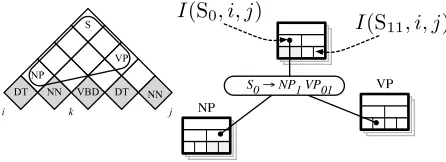
Figure 3: A multi-scale chart can be used to efficiently compute inside/outside scores using productions of vary-ing specificity.
above. We detect that we have split a production too far when all child production features are driven to zero under L1regularization. In such cases, the chil-dren are collapsed to their parent production, which forms an entry in the multi-scale grammar.
5.2 Efficient Multi-Scale Inference
In order to compute the expected counts needed for training, we need to parse the training set, score all derivations and compute posteriors for all sub-categories in the refinement hierarchy. The in-side/outside algorithm (Lari and Young, 1990) is an efficient dynamic program for summing over deriva-tions under a context-free grammar. It is fairly straightforward to adapt this algorithm to multi-scale grammars, allowing us to sum over an expo-nential number of derivations without explicitly re-constructing the underlying fully split grammar.
For single-scale latent variable grammars, the in-side scoreI(Ax, i, j)of a fully refined categoryAx spanning hi, ji is computed by summing over all possible productionsr =Ax→ByCzwith weight φr, spanninghi, kiandhk, jirespectively:4
I(Ax, i, j) = X
r φr
X
k
I(By, i, k)I(Cz, k, j)
Note that this involves summing over all relevant fully refined grammar productions.
The key quantities we will need are marginals of the formI(Ax, i, j), the sum of the scores of all fully refined derivations rooted at any Ax dominated by Ax and spanning hi, ji. We define these marginals
4
These scores lack any probabilistic interpretation, but can be normalized to compute the necessary expectations for train-ing (Petrov and Klein, 2008).
in terms of the standard inside scores of the most refined subcategoriesAx:
I(Ax, i, j) = X
x≺x
I(Ax, i, j)
When working with multi-scale grammars, we expand the standard three-dimensional chart over spans and grammar categories to store the scores of all subcategories of the refinement hierarchy, as il-lustrated in Figure 3. This allows us to compute the scores more efficiently by summing only over rules ˆ
r=Aˆx→Bˆy Cˆz≻r: I(Ax, i, j) =
X
ˆ r
X
r≺rˆ φr
X
k
I(By, i, k)I(Cz, k, j)
=X
ˆ r
φˆr X
r≺ˆr X
k
I(By, i, k)I(Cz, k, j)
=X
ˆ r
φˆr X
y≺yˆ
X
z≺zˆ
X
k
I(By, i, k)I(Cz, k, j)
=X
ˆ r
φˆr X
k X
y≺yˆ
I(By, i, k) X
z≺zˆ
I(Cz, k, j)
=X
ˆ r
φˆr X
k
I(Bˆy, i, k)I(Cˆz, k, j)
Of course, some of the same quantities are computed repeatedly in the above equation and can be cached in order to obtain further efficiency gains. Due to space constraints we omit these details, and also the computation of the outside score, as well as the han-dling of unary productions.
5.3 Feature Count Approximations
6 Additional Features
The discriminative framework gives us a convenient way of incorporating additional, overlapping fea-tures. We investigate two types of features: un-known word features (for predicting the part-of-speech tags of unknown or rare words) and span fea-tures (for determining constituent boundaries based on individual words and the overall sentence shape).
6.1 Unknown Word Features
Building a parser that can process arbitrary sen-tences requires the handling of previously unseen words. Typically, a classification of rare words into word classes is used (Collins, 1999). In such an ap-proach, the word classes need to be manually de-fined a priori, for example based on discriminating word shape features (suffixes, prefixes, digits, etc.).
While this component of the parsing system is rarely talked about, its importance should not be un-derestimated: when using only one unknown word class, final parsing performance drops several per-centage points. Some unknown word features are universal (e.g. digits, dashes), but most of them will be highly language dependent (prefixes, suf-fixes), making additional human expertise necessary for training a parser on a new language. It is there-fore beneficial to automatically learn what the dis-criminating word shape features for a language are. The discriminative framework allows us to do that with ease. In our experiments we extract prefixes and suffixes of length≤3and add those features to words that occur25times or less in the training set. These unknown word features make the latent vari-able grammar learning process more language inde-pendent than in previous work.
6.2 Span Features
There are many features beyond local tree config-urations which can enhance parsing discrimination; Charniak and Johnson (2005) presents a varied list. In reranking, one can incorporate any such features, of course, but even in our dynamic programming ap-proach it is possible to include features that decom-pose along the dynamic program structure, as shown by Taskar et al. (2004). We use non-local span
fea-tures, which condition on properties of input spans
(Taskar et al., 2004). We illustrate our span features
with the following example and the spanh1,4i: 0“ 1[Yes 2” 3 , ] 4he 5said 6. 7
We first added the following lexical features:
• the first (Yes), last (comma), preceding (“) and following (he) words,
• the word pairs at the left edge h“,Yesi, right edge hcomma,hei, inside border hYes,commai
and outside borderh“,hei.
Lexical features were added for each span of length three or more. We used two groups of span features, one for natural constituents and one for synthetic ones.5 We found this approach to work slightly better than anchoring the span features to particular constituent labels or having only one group.
We also added shape features, projecting the sentence to abstract shapes to capture global sen-tence structures. Punctuation shape replaces ev-ery non-punctuation word with x and then further collapses strings of x to x+. Our example be-comes#‘‘x’’,x+.#, and the punctuation feature for our span is ‘‘[x’’,]x. Capitalization shape projects the example sentence to#.X..xx.#, and
.[X..]x for our span. Span features are a rich source of information and our experiments should be seen merely as an initial investigation of their ef-fect in our system.
7 Experiments
We ran experiments on a variety of languages and corpora using the standard training and test splits, as described in Table 1. In each case, we start with a completely unannotated X-bar grammar, ob-tained from the raw treebank by a simple right-branching binarization scheme. We then train multi-scale grammars of increasing latent complexity as described in Section 5, directly incorporating the additional features from Section 6 into the training procedure. Hierarchical training starting from a raw treebank grammar and proceeding to our most re-fined grammars took three days in a parallel im-plementation using 8 CPUs. At testing time we marginalize out the hidden structure and extract the tree with the highest number of expected correct pro-ductions, as in Petrov and Klein (2007).
5
Training Set Dev. Set Test Set ENGLISH-WSJ Sections
Section 22 Section 23
(Marcus et al., 1993) 2-21
ENGLISH-BROWN see 10% of 10% of the
(Francis et al. 2002) ENGLISH-WSJ the data6 the data6 FRENCH7 Sentences Sentences Sentences
(Abeille et al., 2000) 1-18,609 18,610-19,609 19,609-20,610 GERMAN Sentences Sentences Sentences
[image:7.612.64.310.62.163.2](Skut et al., 1997) 1-18,602 18,603-19,602 19,603-20,602
Table 1: Corpora and standard experimental setups.
We compare to a baseline of discriminatively trained latent variable grammars (Petrov and Klein, 2008). We also compare our discriminative multi-scale grammars to their generative split-and-merge cousins, which have been shown to produce the state-of-the-art figures in terms of accuracy and effi-ciency on many corpora. For those comparisons we use the grammars from Petrov and Klein (2007).
7.1 Sparsity
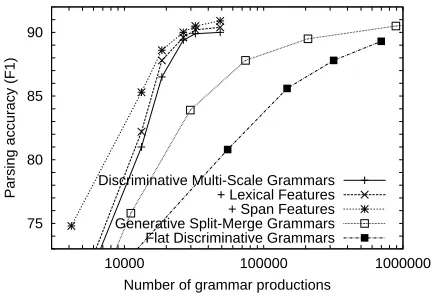
One of the main motivations behind multi-scale grammars was to create compact grammars. Fig-ure 4 shows parsing accuracies vs. grammar sizes. Focusing on the grammar size for now, we see that multi-scale grammars are extremely compact - even our most refined grammars have less than 50,000 ac-tive productions. This is 20 times smaller than the generative split-and-merge grammars, which use ex-plicit category merging. The graph also shows that this compactness is due to controlling production sparsity, as the single-scale discriminative grammars are two orders of magnitude larger.
7.2 Accuracy
Figure 4 shows development set results for En-glish. In terms of parsing accuracy, multi-scale grammars significantly outperform discriminatively trained single-scale latent variable grammars and perform on par with the generative split-and-merge grammars. The graph also shows that the unknown word and span features each add about 0.5% in final parsing accuracy. Note that the span features im-prove the performance of the unsplit baseline gram-mar by 8%, but not surprisingly their contribution
6See Gildea (2001) for the exact setup. 7
This setup contains only sentences without annotation er-rors, as in (Arun and Keller, 2005).
90
85
80
75
1000000 100000
10000
Parsing accuracy (F1)
Number of grammar productions Discriminative Multi-Scale Grammars
+ Lexical Features + Span Features Generative Split-Merge Grammars Flat Discriminative Grammars
Figure 4: Discriminative multi-scale grammars give sim-ilar parsing accuracies as generative split-merge gram-mars, while using an order of magnitude fewer rules.
gets smaller when the grammars get more refined. Section 8 contains an analysis of some of the learned features, as well as a comparison between discrimi-natively and generatively trained grammars.
7.3 Efficiency
[image:7.612.318.536.63.210.2]≤40words all
Parser F1 EX F1 EX
ENGLISH-WSJ
Petrov and Klein (2008) 88.8 35.7 88.3 33.1 Charniak et al. (2005) 90.3 39.6 89.7 37.2 Petrov and Klein (2007) 90.6 39.1 90.1 37.1
This work w/o span features 89.7 39.6 89.2 37.2 This work w/ span features 90.0 40.1 89.4 37.7
ENGLISH-WSJ (reranked) Huang (2008) 92.3 46.2 91.7 43.5
ENGLISH-BROWN
Charniak et al. (2005) 84.5 34.8 82.9 31.7 Petrov and Klein (2007) 84.9 34.5 83.7 31.2 This work w/o span features 85.3 35.6 84.3 32.1 This work w/ span features 85.6 35.8 84.5 32.3
ENGLISH-BROWN (reranked) Charniak et al. (2005) 86.8 39.9 85.2 37.8
FRENCH
Arun and Keller (2005) 79.2 21.2 75.6 16.4 This Paper 80.1 24.2 77.2 19.2
GERMAN
[image:8.612.73.300.53.352.2]Petrov and Klein (2007) 80.8 40.8 80.1 39.1 This Paper 81.5 45.2 80.7 43.9
Table 2: Our final test set parsing accuracies compared to the best previous work on English, French and German.
7.4 Final Results
For each corpus we selected the grammar that gave the best performance on the development set to parse the final test set. Table 2 summarizes our final test set performance, showing that multi-scale grammars achieve state-of-the-art performance on most tasks. On WSJ-English, the discriminative grammars per-form on par with the generative grammars of Petrov et al. (2006), falling slightly short in terms of F1, but having a higher exact match score. When trained on WSJ-English but tested on the Brown corpus, the discriminative grammars clearly outperform the generative grammars, suggesting that the highly reg-ularized and extremely compact multi-scale gram-mars are less prone to overfitting. All those meth-ods fall short of reranking parsers like Charniak and Johnson (2005) and Huang (2008), which, however, have access to many additional features, that cannot be used in our dynamic program.
When trained on the French and German tree-banks, our multi-scale grammars achieve the best figures we are aware of, without any language spe-cific modifications. This confirms that latent
vari-able models are well suited for capturing the syn-tactic properties of a range of languages, and also shows that discriminative grammars are still effec-tive when trained on smaller corpora.
8 Analysis
It can be illuminating to see the subcategories that are being learned by our discriminative multi-scale grammars and to compare them to generatively es-timated latent variable grammars. Compared to the generative case, the lexical categories in the discrim-inative grammars are substantially less refined. For example, in the generative case, the nominal cate-gories were fully refined, while in the discrimina-tive case, fewer nominal clusters were heavily used. One reason for this can be seen by inspecting the first two-way split in the NNP tag. The genera-tive model split into initial NNPs (San, Wall) and final NNPs (Francisco, Street). In contrast, the dis-criminative split was between organizational entities (Stock, Exchange) and other entity types (September,
New, York). This constrast is unsurprising.
Genera-tive likelihood is advantaged by explaining lexical choice – New and York occur in very different slots. However, they convey the same information about the syntactic context above their base NP and are therefore treated the same, discriminatively, while the systematic attachment distinctions between tem-porals and named entities are more predictive.
discrimina-N
P
V
P
P
P
S SB
A
R
A
D
JP
A
D
V
P
Q
P
P
R
N
Generative
32 24 20 12 12 12 8 7 5 subcategories
Discriminative
[image:9.612.325.530.54.182.2]19 32 20 14 14 8 7 9 6 production parameters
Table 3: Complexity of highly split phrasal categories in generative and discriminative grammars. Note that sub-categories are compared to production parameters, indi-cating that the number of parameters grows cubicly in the number of subcategories for generative grammars, while growing linearly for multi-scale grammars.
tive grammars split the VP. This distinction seems to be because the complexity of VPs is more syntac-tic (e.g. complex subcategorization), while that of NPs is more lexical (noun choice is generally higher entropy than verb choice).
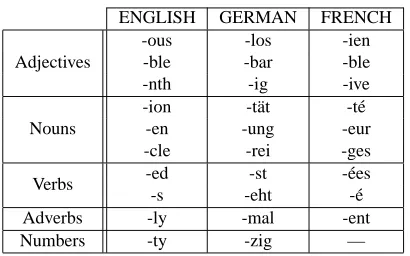
It is also interesting to examine the automatically learned word class features. Table 4 shows the suf-fixes with the highest weight for a few different cat-egories across the three languages that we experi-mented with. The learning algorithm has selected discriminative suffixes that are typical derviational or inflectional morphemes in their respective lan-guages. Note that the highest weighted suffixes will typically not correspond to the most common suffix in the word class, but to the most discriminative.
Finally, the span features also exhibit clear pat-terns. The highest scoring span features encourage the words between the last two punctuation marks to form a constituent (excluding the punctuation marks), for example,[x+]. and:[x+]. Words between quotation marks are also encouraged to form constituents: ‘‘[x+]’’andx[‘‘x+’’]x. Span features can also discourage grouping words into constituents. The features with the highest neg-ative weight involve single commas: x[x,x+],
and x[x+,x+]x and so on (indeed, such spans were structurally disallowed by the Collins (1999) parser).
9 Conclusions
Discriminatively trained multi-scale grammars give state-of-the-art parsing performance on a variety of languages and corpora. Grammar size is dramati-cally reduced compared to the baseline, as well as to
ENGLISH GERMAN FRENCH
Adjectives
-ous -los -ien -ble -bar -ble -nth -ig -ive
Nouns
-ion -t¨at -t´e -en -ung -eur -cle -rei -ges
Verbs -ed -st -´ees
-s -eht -´e
Adverbs -ly -mal -ent
[image:9.612.74.299.56.129.2]Numbers -ty -zig —
Table 4: Automatically learned suffixes with the highest weights for different languages and part-of-speech tags.
methods like split-and-merge (Petrov et al., 2006). Because fewer parameters are estimated, multi-scale grammars may also be less prone to overfitting, as suggested by a cross-corpus evaluation experiment. Furthermore, the discriminative framework enables the seamless integration of additional, overlapping features, such as span features and unknown word features. Such features further improve parsing per-formance and make the latent variable grammars very language independent.
Our parser, along with trained grammars for a variety of languages, is available at
http://nlp.cs.berkeley.edu.
References
A. Abeille, L. Clement, and A. Kinyon. 2000. Building a treebank for French. In 2nd International Conference
on Language Resources and Evaluation.
G. Andrew and J. Gao. 2007. Scalable training of L1-regularized log-linear models. In ICML ’07.
A. Arun and F. Keller. 2005. Lexicalization in crosslin-guistic probabilistic parsing: the case of french. In
ACL ’05.
E. Charniak and M. Johnson. 2005. Coarse-to-Fine N-Best Parsing and MaxEnt Discriminative Reranking. In ACL’05.
E. Charniak, S. Goldwater, and M. Johnson. 1998. Edge-based best-first chart parsing. 6th
Workshop on Very Large Corpora.
E. Charniak, M. Johnson, D. McClosky, et al. 2006. Multi-level coarse-to-fine PCFG Parsing. In
HLT-NAACL ’06.
E. Charniak. 2000. A maximum–entropy–inspired parser. In NAACL ’00.
S. Clark and J. R. Curran. 2004. Parsing the WSJ using CCG and log-linear models. In ACL ’04.
M. Collins. 1999. Head-Driven Statistical Models for
J. Finkel, A. Kleeman, and C. Manning. 2008. Effi-cient, feature-based, conditional random field parsing. In ACL ’08.
W. N. Francis and H. Kucera. 2002. Manual of infor-mation to accompany a standard corpus of present-day edited american english. In TR, Brown University. D. Gildea. 2001. Corpus variation and parser
perfor-mance. EMNLP ’01.
J. Henderson. 2004. Discriminative training of a neural network statistical parser. In ACL ’04.
L. Huang. 2008. Forest reranking: Discriminative pars-ing with non-local features. In ACL ’08.
M. Johnson. 1998. PCFG models of linguistic tree rep-resentations. Computational Linguistics, 24:613–632. M. Johnson. 2001. Joint and conditional estimation of
tagging and parsing models. In ACL ’01.
D. Klein and C. Manning. 2003. Accurate unlexicalized parsing. In ACL ’03, pages 423–430.
T. Koo and M. Collins. 2005. Hidden-variable models for discriminative reranking. In EMNLP ’05.
J. Lafferty, A. McCallum, and F. Pereira. 2001. Con-ditional Random Fields: Probabilistic models for seg-menting and labeling sequence data. In ICML ’01. K. Lari and S. Young. 1990. The estimation of
stochas-tic context-free grammars using the inside-outside al-gorithm. Computer Speech and Language.
P. Liang, S. Petrov, M. I. Jordan, and D. Klein. 2007. The infinite PCFG using hierarchical Dirichlet processes. In EMNLP ’07.
M. Marcus, B. Santorini, and M. Marcinkiewicz. 1993. Building a large annotated corpus of English: The Penn Treebank. In Computational Linguistics. T. Matsuzaki, Y. Miyao, and J. Tsujii. 2005.
Probabilis-tic CFG with latent annotations. In ACL ’05.
M. Mohri and B. Roark. 2006. Probabilistic context-free grammar induction based on structural zeros. In
HLT-NAACL ’06.
J. Nocedal and S. J. Wright. 1999. Numerical
Optimiza-tion. Springer.
S. Petrov and D. Klein. 2007. Improved inference for unlexicalized parsing. In HLT-NAACL ’07.
S. Petrov and D. Klein. 2008. Discriminative log-linear grammars with latent variables. In NIPS ’08.
S. Petrov, L. Barrett, R. Thibaux, and D. Klein. 2006. Learning accurate, compact, and interpretable tree an-notation. In ACL ’06.
W. Skut, B. Krenn, T. Brants, and H. Uszkoreit. 1997. An annotation scheme for free word order languages. In Conf. on Applied Natural Language Processing. N. A. Smith and M. Johnson. 2007. Weighted and
prob-abilistic context-free grammars are equally expressive.
Computational Lingusitics.
B. Taskar, D. Klein, M. Collins, D. Koller, and C. Man-ning. 2004. Max-margin parsing. In EMNLP ’04. J. Turian, B. Wellington, and I. D. Melamed. 2007.