Arabic Named Entity Recognition using Optimized Feature Sets
Yassine Benajiba• Mona Diab Paolo Rosso•
•
Natural Language Engineering Lab., Dept. de Sistemas Inform´aticos y Computaci´on
Universidad Polit´ecnica de Valencia {ybenajiba,prosso}@dsic.upv.es
Center of Computational Learning Systems
Columbia University [email protected]
Abstract
The Named Entity Recognition (NER) task has been garnering significant attention in NLP as it helps improve the performance of many natural language processing applica-tions. In this paper, we investigate the im-pact of using different sets of features in two discriminative machine learning frameworks, namely, Support Vector Machines and Condi-tional Random Fields using Arabic data. We explore lexical, contextual and morphological features on eight standardized data-sets of dif-ferent genres. We measure the impact of the different features in isolation, rank them ac-cording to their impact for each named entity class and incrementally combine them in or-der to infer the optimal machine learning ap-proach and feature set. Our system yields a performance of Fβ=1-measure=83.5 on ACE 2003 Broadcast News data.
1 Introduction
Named Entity Recognition (NER) is the process by which named entities are identified and classified in an open-domain text. NER is one of the most im-portant sub-tasks in Information Extraction. Thanks to standard evaluation test beds such as the Auto-matic Content Extraction (ACE)1, the task of NER has garnered significant attention within the natu-ral language processing (NLP) community. ACE has facilitated evaluation for different languages cre-ating standardized test sets and evaluation metrics. NER systems are typically enabling sub-tasks within
1
http://www.nist.gov/speech/tests/ace/2004/doc/ace04-evalplan-v7.pdf
large NLP systems. The quality of the NER sys-tem has a direct impact on the quality of the overall NLP system. Evidence abound in the literature in areas such as Question Answering, Machine Trans-lation, and Information Retrieval (Babych and Hart-ley, 2003; Ferr´andez et al., 2004; Toda and Kataoka, 2005). The most prominent NER systems approach the problem as a classification task: identifying the named entities (NE) in the text and then classify-ing them accordclassify-ing to a set of designed features into one of a predefined set of classes (Bender et al., 2003). The number of classes differ depending on the data set. To our knowledge, to date, the ap-proach is always to model the problem with a sin-gle set of features for all the classes simultaneously. This research, diverges from this view. We recog-nize that different classes are sensitive to differing features. Hence, in this study, we aspire to discover the optimum feature set per NE class. We approach the NER task from a multi-classification perspec-tive. We create a classifier for each NE class inde-pendently based on an optimal feature set, then com-bine the different classifiers for a global NER sys-tem. For creating the different classifiers per class, we adopt two discriminative approaches: Support Vector Machines (SVM)(Vapnik, 1995), and Condi-tional Random Fields (CRF)(Lafferty et al., 2001). We comprehensively investigate many sets of fea-tures for each class of NEs: contextual, lexical, mor-phological and shallow syntactic features. We ex-plore the feature sets in isolation first. Then, we employ the Fuzzy Borda Voting Scheme (FBVS) (Garc´ıa Lapresta and Mart´ınez Panero, 2002) in or-der to rank the features according to their
mance per class. The incremental approach to fea-ture selection leads to an interpretable system where we have a better understanding of the resulting er-rors. The paper is structured as follows: Section 2 gives a general overview of the state-of-the-art NER approaches with a particular emphasis on Ara-bic NER; Section 3 describes relevant character-istics of the Arabic language illustrating the chal-lenges posed to NER; in Section 4.1 we describe the Support Vector Machines and Conditional Ran-dom Fields Modeling approaches. We discuss de-tails about our feature-set in 4.2 and describe the Fuzzy Borda Voting Scheme in Section 4.3. Sec-tion 5 describes the experiments and shows the re-sults obtained; Withing Section 5, Section 5.1 gives details about the data-sets which we use; finally, we discuss the results and some of our insights in Sec-tion 6 and draw some conclusions in 7.
2 Related Work
To date, the most successful language independent approaches to English NER are systems that employ Maximum Entropy (ME) techniques in a supervised setting (Bender et al., 2003).
(Tran et al., 2007) show that using a Sup-port Vector Machine (SVM) approach outperforms (Fβ=1=87.75) using CRF (Fβ=1=86.48) on the NER
task in Vietnamese. For Arabic NER, (Benajiba et al., 2007) show that using a basic ME approach yields Fβ=1=55.23. Then they followed up with
fur-ther work in (Benajiba and Rosso, 2007), where they model the problem as a two step classification ap-proach applying ME, separating the NE boundary detection from the NE classification. That mod-ification showed an improvement in performance yielding an Fβ=1=65.91. None of these studies
in-cluded Arabic specific features, all the features used were language independent. In a later study, (Be-najiba and Rosso, 2008) report using lexical and morphological features in a single step model us-ing CRF which resulted in significant improvement over state of the art to date for Arabic NER, yield-ing Fβ=1=79.21. However, the data that was used in
these evaluation sets were not standard sets. Most recently, (Farber et al., 2004) have explored using a structured perceptron based model that employs Arabic morphological features. Their system
ben-efits from the basic POS tag (15 tags) information and the corresponding capitalization information on the gloss corresponding to the Arabic word. Exploit-ing this information yields a significant improve-ment in recall of 7% and an overall Fβ=1=69.6 on
the ACE2005 data set. The authors note the lack of improvement in the system’s performance when us-ing other Arabic morphological information.
3 Arabic in the context of NER
The Arabic language is a language of significant in-terest in the NLP community mainly due to its po-litical and economic significance, but also due to its interesting characteristics. Arabic is a Semitic lan-guage. It is known for its templatic morphology where words are made up of roots, patterns, and af-fixes. Clitics agglutinate to words. For instance, the surface word
ÑîEA Jm'.ð
wbHsnAthm2 ‘and by their virtues[fem.]’, can be split into the conjunction w ‘and’, preposition b ‘by’, the stem HsnAt ‘virtues [fem.]’, and possessive pronounhm‘their’.With respect to the NER task, Arabic poses sev-eral major challenges:
Absence of capital letters in the orthography:
English like many other Latin script based languages has a specific marker in the orthography, namely capitalization of the initial letter, indicating that a word or sequence of words is a named entity. Arabic has no such special signal rendering the detection of NEs more challenging.
Absence of short vowels: The absence of short vowels renders the lexical items a lot more ambigu-ous than in other languages exacerbating the homog-raphy problem. The average polysemy for surface unvowelized words in Arabic is 12 possible vow-elized forms and when the inflections are removed the average is 4 possible vowelized forms.3 For in-stance, words such as
X@QK.
brAdcan be read both as ‘refrigerator’ or ‘Brad’,respectively, where the for-mer is a common noun and the latter is an NE.2
We use the Buckwalter transliteration scheme to show ro-manized Arabic (Buckwalter, 2002).
3
The Arabic language is highly inflectional: As we mentioned earlier, Arabic language uses an ag-glutinative strategy to form surface tokens. As seen in the example above, a surface Arabic word may be translated as a phrase in English. Consequently, the Arabic data in its raw surface form (from a statistical viewpoint) is much more sparse which decreases the efficiency of training significantly.
4 Our Approach
We approach the problem of NER from a per NE class based perspective. The intuition is that features that are discriminative for one NE class might not be for another class. In the process, we decide on an op-timal set of features for each NE class. Finally we combine the different classifiers to create a global NER system. Hence, we identify a set of features for NER and proceed to investigate them individually. Then we use an automatic ranking system to pick the optimal set of features per NE class. To that end, we use the Fuzzy Borda Voting Scheme (FBVS). We employ two discriminative classification techniques: Support Vector Machines (SVM) and Conditional Random Fields (CRF). Even though some previous studies seem to point to the superiority of SVM over CRF for NER (Tran et al., 2007), it is hard to draw a definitive conclusion since their assessment was based on comparing the average F-measure.4 More-over, the best system to date on Arabic NER reports results using CRF (Benajiba and Rosso, 2008). We adopt an IOB2 annotation scheme for classification. For each NE class, we have two types of class labels: B-Class, marking the beginning of a Class chunk, and I-Class marking the inside of a class chunk. Fi-nally, we mark words not participating in an NE as O, meaning they are outside some NE class label.
4.1 SVM and CRF
SVM approach is based on Neural Networks (Vapnik, 1995). The goal is to find, in the training phase, the best decision function which allows us to obtain the classc for each set of featuresf. SVM are robust to noise and have powerful generalization ability, especially in the presence of a large number of features. Moreover, SVM have been used
suc-4The authors did not report any per class comparison
be-tween SVM and CRF.
cessfully in many NLP areas of research in general (Diab et al., 2007), and for the NER task in partic-ular (Tran et al., 2007). We use a sequence model Yamcha toolkit,5which is defined over SVM.
CRF are a generalization of Hidden Markov Mod-els oriented toward segmenting and labeling se-quence data (Lafferty et al., 2001). CRF are undi-rected graphical models. During the training phase the conditional likelihood of the classes are maxi-mized. The training is discriminative. They have been used successfully for Arabic NER (see sec-tion 2). We have usedCRF++6for our experiments.
4.2 Our Feature Sets
One of the most challenging aspects in machine learning approaches to NLP problems is deciding on the optimal feature sets. In this work, we investigate a large space of features which are characterized as follows:
Contextual (CXT): defined as a window of+/−
n tokens from the NE of interest
Lexical (LEXi): defined as the lexical
ortho-graphic nature of the tokens in the text. It is a representation of the character n-grams in a token. We define the lexical features fo-cusing on the first three and last three char-acter n-grams in a token. Accordingly, for a token C1C2C3...Cn−1Cn, then the lexical
fea-tures for this token are LEX1=C1, LEX2=C1C2, LEX3=C1C2C3, LEX4=Cn, LEX5 = Cn−1Cn,
LEX6=Cn−2Cn−1Cn.
Gazetteers (GAZ): These include hand-crafted dictionaries/gazetteers listing predefined NEs. We use three gazetteers for person names, locations and organization names.7 We semi-automatically enriched the location gazetteer using the Arabic Wikipedia8 as well as other web sources. This en-richment consisted of: (i) taking the page labeled “Countries of the world” (
ÕËAªË@ ÈðX
, dwl AlEAlm) as a starting point to crawl into Wikipedia and re-trieve location names; (ii) we automatically filter the data removing stop words; (iii) finally, the resulting5http://chasen.org/∼taku/software/yamcha/ 6http://crfpp.sourceforge.net/
7http://www.dsic.upv.es/∼ybenajiba 8
list goes through a manual validation step to ensure quality. On the training and test data, we tag only the entities which exist entirely in the gazetteer, e.g. if the entity ‘United States of America’ exists in our gazetteer, we would not tag ‘United States’ on the data as a location. Exception is made for person names. We augment our dictionary by converting the multiword names to their singleton counterparts in addition to keeping the multiword names in the list. We tag them on the evaluation data separately. Accordingly, the name ‘Bill Clinton’ and ‘Michael Johnson’ as two entries in our dictionary, are further broken down to ‘Bill’, ‘Clinton’, ‘Michael’, ‘John-son’. The intuition is that the system will be able to identify names such as ‘Bill Johnson’ and ‘Clin-ton’ as person names. This is always true for person names, however this assumption does not hold for location or organization names.
Part-Of-Speech (POS) tags and Base Phrase Chunks (BPC): To derive part of speech tags (POS) and base phrase chunks (BPC) for Arabic, we employ the AMIRA-1.0 system9described in (Diab et al., 2007). The POS tagger has a reported accu-racy of 96.2% (25 tags) and the BPC system per-forms at a reported Fβ=1=96.33%, assuming gold
tokenization and POS tagging.
Nationality (NAT): The input is checked against a manually created list of nationalities.
Morphological features (MORPH): This feature set is based on exploiting the characteristic rich mor-phological features of the Arabic language. We rely on the MADA system for morphological dis-ambiguation (Habash and Rambow, 2005), to ex-tract relevant morphological information. MADA disambiguates words along 14 different morphologi-cal dimensions. It typimorphologi-cally operates on untokenized texts (surface words as they naturally occur), hence, several of the features indicate whether there are clitics of different types. We use MADA for the preprocessing step of clitic tokenization (which ad-dresses one of the challenges we note in Section 3, namely the impact different morphological surface forms have on sparseness). Recognizing the varying importance of the different morphological features and heeding the reported MADA performance per
9http://www1.cs.columbia.edu/∼mdiab/
feature, we carefully engineered the choice of the relevant morphological features and their associated value representations. We selected 5 morphological features to include in this study.
1. Aspect (MASP) : In Arabic, a verb maybe
im-perfective, perfective or imperative. However since none of the NEs is verbal, we decided to turn this feature into a binary feature, namely indicating if a token is marked for Aspect (APP, for applicable) or not (NA, for not applicable).
2. Person (MP ER) : In Arabic, verbs, nouns,
and pronouns typically indicate person information. The possible values arefirst, secondorthirdperson. Again, similar toaspect, the applicability of this fea-ture to the NEs is more relevant than the actual value offirstversussecond, etc. Hence, we converted the values to APP and NA, where APP applies if the per-son feature is rendered asfirst, secondorthird.
3. Definiteness (MDEF) : MADA indicates
whether a token is definite or not. All the NEs by definition are definite. The possible values are DEF, INDEF or NA.
4. Gender (MGEN) : All nominals in Arabic bear
genderinformation. According to MADA, the pos-sible values for this feature are masculine (MASC), feminine (FEM), and neuter (or not applicable NA), which is the case where gender is not applicable for instance in some of the closed class tokens such as prepositions, or in the case of verbs. We use the three possible values MASC, FEM and NA, for this feature. The intuition is that since we are using a sequence model, we are likely to see agreement in genderinformation in participants in the same NE.
5. Number (MN U M) : For almost all the tokens
categories (verbs, nouns, adjectives, etc.) MADA provides the grammatical number. In Arabic, the possible values are singular (SG), dual (DU) and plural (PL). The correlation of the SG value with most of the NEs classes is very high. Heeding the underlying agreement of words in Arabic when they are part of the same NE, the values for this feature are SG, DU, PL and NA (for cases where number is not applicable such as closed class function words).
Corresponding English Capitalization (CAP):
words it morphologically disambiguates as it is based on an underlying bilingual lexicon. The in-tuition is that if the translation begins with a capital letter, then it is most probably a NE. This feature is an attempt to overcome the lack of capitalization for NEs in Arabic (see Section 3). This is similar to the GlossCAPfeature used in (Farber et al., 2004).
4.3 Fuzzy Borda Voting Scheme
Fuzzy Borda Voting Scheme (FBVS) is useful when several possible candidates (cn) are ranked by
differ-ent experts (em) and we need to infer a single
rank-ing (Garc´ıa Lapresta and Mart´ınez Panero, 2002). It is based on the Borda count method which was introduced by Jean-Charles de Borda in 1770. In FBVS, each expert provides the ranking of the can-didates with a weight10 (wnm) assigned to each of them. Thereafter, for each expert ei, we generate
a square matrix such asei = (ri1,1. . . rin,n)where:
rj,ki = w
i j
wij+wik (1)
Given each expert matrix, we calculate for each row r0ij = P
krij,k; rij,k > α whereα is a certain
threshold. Accordingly, for each candidate, we sum up the weights obtained from the different experts in order to obtain a final weight for each candidate (r00j = P
irj0i). Finally, we rank them according to
r00j. In our experiments, the candidates we rank are the features. The FBVS ranking is calculated per ML technique and class of NEs across all the data sets according to the features’ performances Fβ=1,
i.e. the weights. The Fβ=1ranges from0−1. We use α = 0.5, thereby taking into consideration only the features which have shown a significant difference in performance.
5 Experiments and Results
5.1 Data
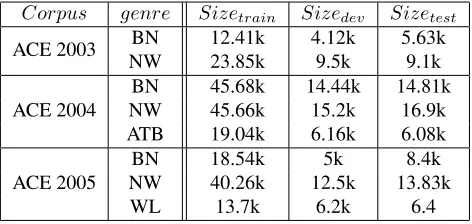
We report the results of our experiments on the stan-dard sets of ACE 2003, ACE 2004 and ACE 2005 data sets.11 The ACE data (see Table 1) is anno-tated for many tasks: Entity Detection and Track-ing (EDT), Relation Detection and Recognition
10
weights are not required for classical Borda count.
11
http://www.nist.gov/speech/tests/ace/
Corpus genre Sizetrain Sizedev Sizetest
ACE 2003 BN 12.41k 4.12k 5.63k
NW 23.85k 9.5k 9.1k
ACE 2004
BN 45.68k 14.44k 14.81k
NW 45.66k 15.2k 16.9k
ATB 19.04k 6.16k 6.08k
ACE 2005
BN 18.54k 5k 8.4k
NW 40.26k 12.5k 13.83k
[image:5.612.313.549.58.170.2]WL 13.7k 6.2k 6.4
Table 1: Statistics of ACE 2003, 2004 and 2005 data
(RDR), Event Detection and Recognition (EDR). All the data sets comprise Broadcast News (BN) andNewswire(NW) genres. ACE 2004 includes an additional NW data set from the Arabic TreeBank (ATB). ACE 2005 includes a different genre of We-blogs(WL).
We create a dev, test and train set for each of the collections. Table 1 gives the relevant statis-tics. It is worth noting that the standard training sets have 4 folds that are typically used for training. We used one of the folds as dev data for tuning pur-poses, rendering our training data less for our exper-iments. For data preprocessing, we remove all anno-tations which are not oriented to the EDR task. Also, we remove all the ‘nominal’ and ‘pronominal’ men-tions of the entities and keep only the ‘named’ ones. Hence, all the listed characteristics for this corpus pertain to the portions of the data that are relevant to NER only. The ACE 2003 data defines four differ-ent NE classes: Person (e.g. Albert Einstein), Ge-ographical and Political Entities (GPE) (e.g. Kaza-khistan), Organization (e.g. Google Co.) and Facil-ity (e.g. the White House). Whereas in ACE 2004 and 2005, two NE classes are added to the ACE 2003 tag-set: Vehicles (e.g. Rotterdam Ship) and Weapons (e.g. Kalashnikof). In order to overcome the sparseness issues resulting , we clitic tokenize the text using the MADA system. We use the ATB style clitic tokenization standard. Finally, we con-vert the data from the ACE format into the IOB2 an-notation scheme (Tjong Kim Sang and De Meudler, 2003).
5.2 Experimentation
global NER system for Arabic. We set the context window to be of size−1/+1for all the experiments, as it empirically yields the best performance. We use the CoNLL evaluation metrics of precision, recall, and Fβ=1measures. The CoNLL metrics are geared
to the chunk level yielding results as they pertain to the entire NE (Tjong Kim Sang and De Meudler, 2003). Our experiments are presented as follows:
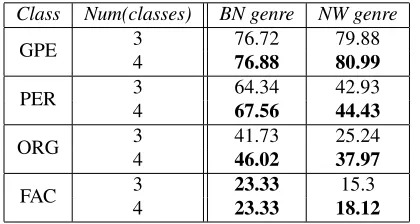
1. Training per individual NE class: We train for an individual class by turning off the other an-notations for the other classes in the training set. We experimented with two settings: 1. Setting all the other NE classes to O, similar to non-NE words, thereby yielding a 3-way classification, namely, B-NE and I-B-NE for the class of interest, and O for the rest including the rest of the NEs and other words and punctuation; 2. The second setting discrimi-nated between the other NE classes that are not of interest and the rest of the words. The intuition in this case is that NE class words will naturally be-have differently than the rest of the words in the data. Thereby, this setting yields a 4-way classifi-cation: B-NE and I-NE for class of interest, NE for the other NE classes, and O for the other words and punctuation in the data. In order to contrast the 3-way vs the 4-3-way classification, we run experiments and evaluate using the ACE 2003 data set with no features apart from ‘CXT’ and ‘current word’ using SVM. Table 2 illustrates the yielded results. For all
Class Num(classes) BN genre NW genre
GPE 3 76.72 79.88
4 76.88 80.99
PER 3 64.34 42.93
4 67.56 44.43
ORG 3 41.73 25.24
4 46.02 37.97
[image:6.612.70.280.471.583.2]FAC 3 23.33 15.3 4 23.33 18.12
Table 2: Fβ=1Results using 3-way vs. 4-way class anno-tations using SVM
the NE classes we note that the 4-way classification yields the best results. Moreover, we counted the number of ‘conflicts’ obtained for each NE classifi-cation. A ‘conflict’ arises when the same token is classified as a different NE class by more than one classification system. Our findings are summarized
as follows:
(i). 3 classes: 16 conflicts (8 conflicts in BN and 8 in NW). 10 of these conflicts are between GPE and PER, and 6 of them are between GPE and ORG.
(ii). 4 classes: 10 conflicts (3 conflicts in BN and 7 in NW). 9 of these conflicts are between GPE and ORG, and only one of them is between GPE and FAC.
An example of a conflict observed using the 3-way classification that disappeared when we ap-ply the 4-way classification is in the following sen-tence:
@QKQ
®K ÖßAK ᢠJ
@ð
é
®Jm HQå
n$rt SHyfp WA$nTn tAyms tqryrA, which is translated as ‘The Washington Times newspaper published a report’. When trained using a 3-way classifier, ‘Washington’ is assigned the tag GPE by the GPE classifier sys-tem and as an ORG by the ORG classifier syssys-tem. However, when trained using the 4-way classifier, this conflict is resolved as an ORG in the ORG clas-sifier system and an NE in the GPE clasclas-sifier sys-tem. Thereby confirming our intuition that a 4-way classification is better suited for the individual NE classification systems. Accordingly, for the rest of the experiments in this paper reporting on individual NE classifiers systems, we use a 4-way classification approach.
2. Measuring the impact of Individual features per class : An experiment is run for each fold of the data. We train on data annotated for one NE class, one Machine Learning (ML) method (i.e. SVM or CRF), and one feature. For each experiment we use the tuning set for evaluation, i.e. obtaining the Fβ=1performance value.
Feats PER GPE ORG FAC VEH/WEA
LEX1 16 12 12 15 4
LEX2 3 15 7 12 5
LEX3 10 6 15 10 6
LEX4 7 16 4 8 7
LEX5 15 14 16 16 8
LEX6 12 4 10 9 9
GAZ 14 7 9 11 3
BPC 4 13 13 6 1
POS 1 5 1 4 16
NAT 8 3 2 3 15
MASP 13 2 5 2 10
MP ER 11 11 3 5 14
MDEF 9 9 6 7 11
MGEN 5 8 11 13 12
MN U M 6 10 14 14 13
[image:7.612.70.300.57.263.2]CAP 2 1 8 1 2
Table 3: Ranked features according to FBVS using SVM for each NE class
4. Feature set/class generalization : Finally, we pick the firstnfeatures that yield the best converging performance (after which additional features do not impact performance or cause it to deteriorate). We use the topnfeatures to tag the test data and compare the results against the system when it is trained on the whole feature set.
5.3 Individual Features Experiments
After running experiments using each feature indi-vidually, each result is considered an expert (the ob-tained F-measure is the weight in this framework).
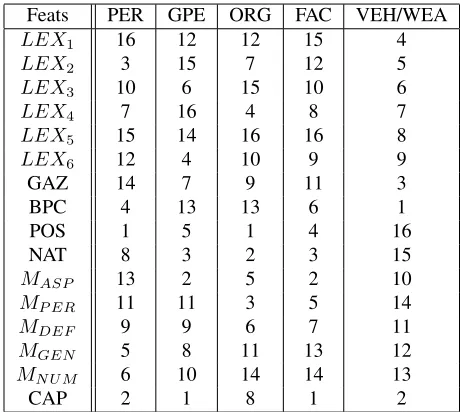
Our goal is to find a general ranking of the fea-tures for each ML approach and each class. Table 3 shows the obtained rankings of the features for each class using SVM. It is worth noting that the obtained CRF rankings are very similar to those yielded by using SVM. We note that there are no specific fea-tures that have proven to be useless for all classes and ML approaches.
5.4 Feature set/class Experiments
We combine the features per NE class incrementally. Since the total number of features is 16, each ML classifier is trained and evaluated on the tuning data 16 times for each genre. A best number of features per class per genre per ML technique is determined based on the highest yielded Fβ=1. Finally, the last
step is combining the outputs of the different
clas-sifiers for all the classes. In case of conflicts, where the same token is tagged as two different NE classes, we use a simple heuristic based on the classifier pre-cision for that specific tag, favoring the tag with the highest precision.
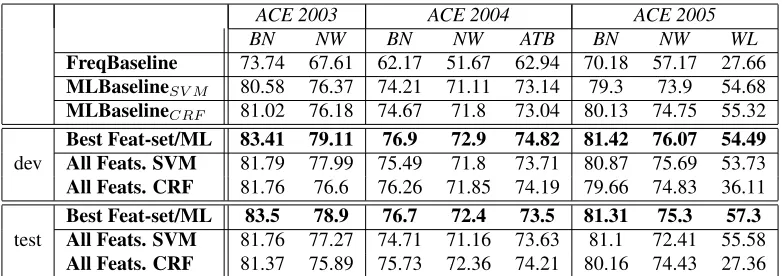
Table 4 illustrates the obtained results. For each data set and each genre it shows the F-measure ob-tained using the best feature set and ML approach. We show results for both the dev and test data using the optimal number of featuresBest Feat-Set/ML
contrasted against the system when using all 16 fea-tures per classAll Feats/ML. The table also illus-trates three baseline results on the test data only.
FreqBaseline: For this baseline, we assign a test token the most frequent tag observed for it in the training data, if a test token is not observed in the training data, it is assigned the most frequent tag which is the O tag. MLBaseline: In this baseline setting, we train an NER system with the full 16 features for all the NE classes at once. We use the two different ML approaches yielding two baselines:
MLBaselineSV M andMLBaselineCRF.
It is important to note the difference between theAll Feats/MLsetting and the MLBaselinesetting. In the former,All Feats/ML, all 16 features are used per class in a 4-way classifier system and then the classifications are combined and the conflicts are re-solved using our simple heuristic while in the lat-ter case of MLBaselinethe classes are trained to-gether with all 16 features for all classes in one sys-tem. Since different feature-sets and different ML approaches are used and combined for each experi-ment, it is not possible to present the number of fea-tures used in each experiment in Table 4. However, Table 5 shows the number of features and the ML approach used for each genre and NE class.
6 Discussion and Error Analysis
ACE 2003 ACE 2004 ACE 2005 BN NW BN NW ATB BN NW WL
FreqBaseline 73.74 67.61 62.17 51.67 62.94 70.18 57.17 27.66
MLBaselineSV M 80.58 76.37 74.21 71.11 73.14 79.3 73.9 54.68 MLBaselineCRF 81.02 76.18 74.67 71.8 73.04 80.13 74.75 55.32
dev
Best Feat-set/ML 83.41 79.11 76.9 72.9 74.82 81.42 76.07 54.49 All Feats. SVM 81.79 77.99 75.49 71.8 73.71 80.87 75.69 53.73
All Feats. CRF 81.76 76.6 76.26 71.85 74.19 79.66 74.83 36.11
test
Best Feat-set/ML 83.5 78.9 76.7 72.4 73.5 81.31 75.3 57.3 All Feats. SVM 81.76 77.27 74.71 71.16 73.63 81.1 72.41 55.58
[image:8.612.111.502.56.194.2]All Feats. CRF 81.37 75.89 75.73 72.36 74.21 80.16 74.43 27.36
Table 4: Final Results obtained with selected features contrasted against all features combined
BN NW ATB WL N ML N ML N ML N ML
Person 12 SVM 14 SVM 9 SVM 11 SVM
Location 10 SVM 7 SVM 16 CRF 14 SVM
Organization 9 CRF 6 CRF 10 CRF 12 CRF
Facility 10 CRF 14 CRF 14 SVM 16 CRF
Vehicle 3 SVM 3 SVM 3 SVM 3 SVM
Weapon 3 SVM 3 SVM 3 SVM 3 SVM
Table 5: Number of features and ML approach used to obtain the best results
the results obtained from both ML approaches. Table 4, shows that our Best Feat-set/ML set-ting outperforms the baselines and the All Feats
{SVM/CRF}settings for all the data genres and sets forthe test data. Moreover, the Best Feat-set/ML
setting outperforms both All Feats {SVM/CRF}
settings for the dev data for all genres except for ACE2003 NW, where the difference is very small.
The results yielded from the ML baselines are comparable across all the data genres and the two ML approaches.
Comparing the global ML baseline systems against the All Feature Setting, we see that theAll Featssetting consistently outperforms the MLBase-linesettings except for ACE2005 NW data set. This suggests that training separate systems for the differ-ent NEs has some benefit over training in one global system.
Comparing the performance per genre across the different data sets. We note better performance across the board for BN data over NW per year. The worst results are yielded for ACE 2004 data for both BN and NW genres. There is no definitive con-clusion that a specific ML approach is better suited
for a specific data genre. We observe slightly bet-ter performance for the CRF ML approach in the
MLBaselineCRF condition for both BN and NW.
The worst performance is yielded for the WL data. This may be attributed to the small amount of training data available for this genre. Moreover the quality of the performance of the different fea-ture extraction tools such as AMIRA (for POS tag-ging and BPC) and MADA (for the morphological features) are optimized for NW data genres, thereby yielding suboptimal performance on the WL genre, leading to more noise than signal for training. How-ever, comparing relative performance on this genre, we see a significant jump from the most frequent baseline FreqBaseline (Fβ=1=27.66) to the best
baselineMLBaselineCRF (Fβ=1=55.32). We see a
further significant improvement when theBest Feat-set/ML setting is applied yielding an Fβ=1=57.3.
Interestingly, however the MLBaselineCRF yields
a much better performance (Fβ=1=55.32) than All
Feats CRF with an Fβ=1=27.36. This may
out-puts. It is worth noting the difference between
MLBaselineSV M andAll Feats SVM, Fβ=1=54.68
and Fβ=1=55.58, respectively. This result suggests
that SVM are more robust to less training data as il-lustrated in the case of the individual classifiers in the latter setting.
Comparing dev and test performance, we note that the overall results on the dev data are better than those obtained on the test data, which is expected given that the weights for the FBVS ranking are de-rived based on the dev data used as a tuning set. The only counter example for this trend is with the WL data genre, where the test data yields a significantly higher performance for all the conditions except for
All Feats CRF.
As observed in Table 3, the ranking of the indi-vidual features could be very different for two NE classes. For instance, the BPC is ranked 4th for the PER class and is ranked 13th for GPE and ORG classes. The disparity in ranking for the same indi-vidual features strongly suggests that using the same features for all the classes cannot lead to a global op-timal classifier. With regards to morphological fea-tures, we note in Table 3, that Definiteness,MDEF,
is helpful for all the NE classification systems, by virtue of being included for all optimal systems for all NE classification systems. Aspect,MASP, is
use-ful for all classes except PER. Moreover,MGEN and
MN U M, corresponding to Gender and Number,
re-spectively, contributed significantly to the increase in recall for PER and GPE classes. Finally, the Per-son feature, MP ER contributed mostly to
improv-ing the classification of ORG and FAC classes. Ac-cordingly, observing these results, contrary to pre-vious results by (Farber et al., 2004), our results strongly suggest the significant impact morpholog-ical features have on Arabic NER, if applied at the right level of granularity.
Inconsistencies in the data lead to many of the ob-served errors. The problem is that the ACE data is annotated primarily for a mention detection task which leads to the same exact words not being anno-tated consistently. For instance, the word ’Palestini-ans’ would sometimes be annotated as a GPE class while in similar other contexts it is not annotated as a named entity at all. Since we did not manually cor-rect these cases, the classifiers are left with mixed signals. The VEH and WEA classes both exhibit a
uniform ranking for all the features and yield a very low performance. This is mainly attributed to the fact that they appear very rarely in the training data. For instance, in the ACE 2005, BN genre, there are 1707 instances of the class PER, 1777 of GPE, 103 of ORG, 106 of FAC and only 4 for WEA and 24 for VEH.
7 Conclusions and Future Directions
We described the performance yielded using language-dependent and language independent fea-tures in SVM and CRF for the NER task on differ-ent standard Arabic data-sets comprising differdiffer-ent genres. We have measured the impact of each fea-ture individually on each class, we ranked them ac-cording to their impact using the Fuzzy Borda Vot-ing Scheme, and then performed an incremental fea-tures’ selection considering each time the N best features.
We reported the importance of each feature for each class and then the performance obtained when the best feature-set is used. Our experiments yield state of the art performance significantly outper-forming the baseline. Our best results achieve an Fβ=1score of 83.5 for the ACE 2003 BN data. Our
ACE2005 results are state of the art when compared to the best system to date. It is worth noting that these obtained results are trained on less data since we train only on 3 folds vs the standard 4 folds. Our results show that the SVM and CRF have very sim-ilar behaviors. However, SVM showed more robust performance in our system using data with very ran-dom contexts, namely for the WL data, i.e. We-blogs. We definitively illustrate that correctly ex-ploiting morphological features for languages with rich morphological structures yields state of the art performance. For future work, we intend to investi-gate the use of automatic feature selection methods on the same data.
References
Bogdan Babych and Anthony Hartley. 2003. Improving Machine Translation Quality with Automatic Named Entity Recognition. In Proc. of EACL-EAMT. Bu-dapest.
Yassine Benajiba and Paolo Rosso. 2008. Arabic Named Entity Recognition using Conditional Random Fields. InProc. of Workshop on HLT & NLP within the Arabic World, LREC’08.
Yassine Benajiba, Paolo Rosso and Jos´e Miguel Bened´ı. 2007. ANERsys: An Arabic Named Entity Recogni-tion system based on Maximum Entropy. In Proc. of CICLing-2007, Springer-Verlag, LNCS(4394), pp. 143-153.
Yassine Benajiba and Paolo Rosso. 2007. ANERsys 2.0 : Conquering the NER task for the Arabic language by combining the Maximum Entropy with POS-tag infor-mation. InProc. of Workshop on Natural Language-Independent Engineering, IICAI-2007.
Oliver Bender, Franz Josef Och, and Hermann Ney. 2003. Maximum Entropy Models For Named Entity Recognition. In Proc. of CoNLL-2003. Edmonton, Canada.
Tim Buckwalter. 2002. Buckwalter Arabic Morpho-logical Analyzer. In Linguistic Data Consortium. (LDC2002L49).
Mona Diab, Kadri Hacioglu and Daniel Jurafsky. 2007. Arabic Computational Morphology: Knowledge-based and Empirical Methods, chapter 9, pp. 159–179. Abdelhadi Soudi, Antal van den Bosch and Gunter Neumann (Eds.), Springer.
Benjamin Farber, Dayne Freitag, Nizar Habash and Owen Rambow. 2008. Improving NER in Arabic Us-ing a Morphological Tagger.InProc. of LREC’08. Sergio Ferr´andez, ´Oscar Ferr´andez, Antonio Ferr´andez
and Rafael Mu˜noz. 2007. The Importance of Named Entities in Cross-Lingual Question Answering In Proc. of RANLP’07.
Jos´e Luis Garc´ıa Lapresta and Miguel Mart´ınez Panero 2002. Borda Count Versus Approval Voting: A Fuzzy Approach. Public Choice, 112(1-2):pp. 167–184. Nizar Habash and Owen Rambow. 2005. Arabic
Tok-enization, Part-Of-Speech Tagging and Morphological Disambiguation in One Fell Swoop. InProc. of Work-shop of Computational Approaches to Semitic Lan-guages, ACL-2005.
John Lafferty, Andrew McCallum and Fernando Pereira. 2001. Conditional Random Fields: Probabilistic Models for Segmenting and Labeling Sequence Data. InProc. of ICML-2001.
Erik F. Tjong Kim Sang and Fien De Meulder. 2003. Introduction to the CoNLL-2003 Shared Task: Language-Independent Named Entity Recognition. In Proc. of CoNLL-2003. pp. 142–147.
Hiroyuki Toda and Ryoji Kataoka. 2005. A Search Result Clustering Method using Informatively Named Entities.. InProc. of the 7th ACM International Work-shop on Web Information and Data Management. Q. Tri Tran, T.X. Thao Pham, Q. Hung Ngo,Dien Dinh,
and Nigel Collier. 2007.Named Entity Recognition in Vietnamese documents. Progress in Informatics Jour-nal. 2007.