Abstract—Electricity is a source of energy which is needed to
support daily activities. High electricity-consumption will cause electricity crisis if not managed properly. One of usage which consumes electricity is Public Street lighting (PSL). Currently, PSL uses fossil fuel to generate electricity. Although fossil fuel is known cheap and mostly used to generate energy, it is non-renewable and not environment friendly caused by carbon dioxide as an excess by ignition. Due to environmentally friendly, solar power can be used as an alternative to generate electricity and unused power can be stored to lithium battery. However, thoroughly technical and economic analysis must be conducted before mass deployment of solar energy is implemented. To assess the feasibility of technical and financial aspect, this paper proposes economics analysis in order to determine the feasibility of solar power investment. The feasibility study comprise of comparing the cost of conventional and solar-powered PSL with 25 years projection, calculating net present value (NPV) and benefit-cost ratio. The results show solar-powered PSL is economically feasible.
Index Terms—B/C Ratio, LED Light, Lithium Battery, Net
Present Value, Public Street Light Solar
I. INTRODUCTION
LECTRIC power is a source of important energy for human life for daily activities, from lighting to powering large-scale production process and office. One example of electric energy usage is street lighting system. Public Street Light (PSL) serves as a source of street lighting to maintain security and convenience of the riders at night. Public Street Lighting in Indonesia usually still use electric power as its energy source. The increasing number of Public Street Light (PSL) that uses electric power causes the electricity consumption is high. Unfortunately, high demand of electric power is not followed by the supply provided. Previous research showed that electricity reserve
Manuscript received Dec 7, 2015; revised Jan 18, 2016.
Ika Shinta Mardikaningsih is with the Laboratory of Business and Logistic System, Industrial Engineering Department, Faculty of Engineering, Sebelas Maret University, Indonesia (corresponding author to provide phone: +6282226541360; e-mail: [email protected]).
Muhammad Hisjam is with Laboratory of Business and Logistic System, Industrial Engineering Department, Faculty of Engineering, Sebelas Maret University, Indonesia (e-mail: [email protected]).
Wahyudi Sutopo is with Industrial Engineering and Techno Economy Research Group, Industrial Engineering Department, Faculty of Engineering, Sebelas Maret University, Indonesia (corresponding author, email: [email protected]).
Roni Zakaria is is with Industrial Engineering and Techno Economy Research Group, Industrial Engineering Department, Faculty of Engineering, Sebelas Maret University, Indonesia (corresponding author, email: [email protected]).
supply in Java is only about 25-30%, 10% for Sumatra and less than 10% in Eastern Indonesia [1].
Benefit and importance of electrical energy especially for PSL needed to be considered as an alternative to replace conventional fossil fuel, which is not renewable and depleted as time goes by. Among various renewable energy sources based technologies, the photovoltaic technology for power generation is considered well-suited technology particularly for distributed power generation. The large implementation of PV systems may replace or postpone the extension of conventional central stations of electricity production and the investment in grid reinforcement having a positive overall economic impact [2]. Solar energy has been many applied in various parts of the world, and if managed properly solar energy has a potential to become a future main energy.
Solar energy supply of sunlight received by the surface of the earth is large enough up to 3 x 1024 joules per year or equivalent to 2 x 10¹⁷ watts. That amount of energy is equivalent to 10,000 times energy consumption in the world right now [3]. As a country that lies around equator, Indonesia has a great potential to produce solar energy for about by 4.8 kwh / m2 or equivalent to 112.000 gwp solar energy [4]. Of course this advantage must be carefully studied.
The application of solar power to power PSL is expected to become the solution, because PSL has an important role in supporting human activities. PSL use lithium battery which will be developed by Sebelas Maret University as the depositary of energy derived from the sun. The importance of this study is not only to do analysis of investment to implement the use of solar energy to power PSL but also as a support of lithium battery research currently developed in Sebelas Maret University. Besides as a supporting strategy, lithium battery development is also intended to increase global competitiveness of Indonesia [5]. The plan is to established mini plant to manufacture lithium-ion battery that will be implemented by electric vehicle which also is currently developed by Sebelas Maret University [6],[18]-[19]. One of the important stages to implement a new technology is to study the feasibility of business plan using several criteria that had been developed by a lot of management [7]. The feasibility of investment comprises of both in the technical and economical aspects.
II. LITERATURE REVIEW
The public street light is a part of support building to put or mounted in left or right roads and or in the middle (at the median) used to illuminate the road and the environment around way required including crossroads, flyover, bridges and roads underground, a unit of complete consisting of light source, optical elements, elements electrical and buttresses foundation structure and the lampposts [8]. While
Techno-economic Feasibility Analysis of a
Public Street Light with Solar Cell Power
Ika Shinta Mardikaningsih, Wahyudi Sutopo, Muhammad Hisjam, Roni Zakaria
Public Street Lighting Solar (PSLS) is street lighting that uses the light of the sun as a source of energy [9]. A smart street light system consists of power generation, storage and management device (solar panel or photovoltaic cells, maintenance free batteries and a controller) as well as an efficient light [10] PSLS own made up of several components namely solar cell panel, LED, a tower, and PSLS battery box. The most important parameter in the performance of a solar panels is intensity of sun radiation or commonly called irradiance sunlight, the sum of the sun comes to the surface per board area [3]. Value of irradiance the sun can be used for determining great power may be generated by the solar cells. The solar cells composed of silicon, which serves change intensity sunlight into electricity. The silicon in on the panels solar cells solar drenched make photon moving toward electrons and produces a current and voltage .The electric current generated is electricity with direct current or dc [9].
In one package PSLS box battery there are several component that has the functions, a battery, a controller, block terminal, and battery management system [11]. It uses lithium battery as a medium the storage of energy. This type of battery chosen because it has advantages than with battery of others, lithium not having memory effect it means battery can be done rechargeable without having to empty in total before discharge. It twice was more durable age use compared with battery ordinary, batteries lithium for PSLS predicted to have life time for five years .The battery can store in the capacity of large enough .Other component is solar charge of a controller (SCC) that serves as control time and control deposit PSLS as well as maintain direct current filled into the battery and extracted from a battery to load . Besides batteries and SCC there were also BMS (Battery Management System) which serves to cut off when battery already occupied full of, and there are also discharge of that serves to set output power necessary to use. BMS manages charge batteries and monitored the condition of the battery, and keep the balancing of battery [12]. Block the terminal at box serves as divider current be on several, things are needed in the event of damage does not occur having difficulties in the process of refinement and to minimize the sparks because of the number of the elapsed .
III. METHOD
The investment is the cost to the investor for project development, financing, the construction, and for getting the plant into regular operation (commissioning, operation permits and test operation phase). Also the cost for establishing the infrastructure for the project (area purchase, traffic areas, building, electrical connection to grid etc.) is included, if paid as initial investment [13].
On this paper analysis was conducted technical and economical related feasibility investments. In technical, analysis on specification material used in PSLS. While to gauge if investment were suitable based on economic side , then done calculation comparison the cost between PSL conventional and PSLS, so that known whether going on thrift or not . In addition feasibility investment PSLS calculation with the methods NPV and B/C ratio .
The necessary data in an analysis technical and economical in the preparation of this article is taken from secondary data , namely data already provided .The data
obtained was from conventional PSL and compare with the data PSLS.
The technical specifications analysis covering, life time of components PSLS compared to conventional PSL .The economic analysis covered the cost installations and maintenance costs, operational costs from PSLS compared to conventional PSL.
IV. RESULT AND ANALYSIS
In application of PSLS required a technical design. Technical design intended to know specification products that has been adjusted for the things needed .By knowing the specifications required it will be easy in determining material or what component is required in the implementation of the PSLS . It own made up of several components, the panel solar cells , LED light , a tower, and PSLS box battery. In designing PSLS of course to do calculation to the needs lighting in the way of to be fitted . After all the things needed in the each light will be adjusted to specification components or material a builder .And to be elected , design PSLS 40 watts , where consisting of panel solar cells 145 the wp , SSC 10A 12V , lithium battery 60 Ah 12V , led light 40 Watt .
PSLS use the solar cells to catch the light of sun , then energy from the sun stored in battery .The solar cells capture energy derived from it then turn it into the current DC .On a calculation had been determined that the solar cells to be used powerless 145 wp , the panel specification to be elected consider several factors namely efficiency panel , the temperature , and influence the intensity of light. The solar cells there are 2 types of monocrystalline and polycrystalline. Under consideration and panel technical chosen solar cells with a kind of monocrystalline , although retention not optimum when the weather over cast but the panel monocrystalline able to absorb a lot of energy when the situation bright.
For the media storage energy on PSLS can use some sort of the battery battery VRLA ( Valve Regulated Lead Acid ) and battery lithium .Several factors that election into consideration the types of batteries chosen were energy per weight stored , life cycle and DoD ( depth of discharge ) , sensitivity temperature , and efficiency.
TABLEI
COMPARISON OF VRLA AND LITHIUM BATTERY
VRLA Lithium
Energy 40 Wh/kg 150 Wh/kg
Life Cycle 1000 @ 50% DoD 1900 @80% DoD
Temperature
Significant temperature >25°C 100% @ 20-hr rate
Significant temperature >45°C 100% @ 20-hr rate
Efficiency 80% @ 4-hr 99% @ 4-hr rate 60% @ 1-hr rate 92% @ 1-hr rate
power, the other battery can loss of about 20 % per month. , more powerful than with other battery, because can accommodate 150 watt per hour on each kilogram, other battery can only accommodate 100 watts per hour on each kilogram. Nevertheless lithium have some disadvantages, the price of expensive, hence in the next stage will be economic analysis related to the use of lithium. Lack of others are lithium can’t stand in high temperatures, hence to overcome this some BMS that serves as balancing from a battery, so security batteries was safe.
The application of PSLS use a LED as lighting output . Majority PSL use fluorescent to lighting, compared with LED light of course are more advantages owned by LED light. Life cycle of LED lights longer in average 50.000 -10.000 hours. If it is assumed that age is 50.000 hours to the use of lights every day are 12 hours , then estimated age lights able to survive until 11 years. Compare to fluorescent lamp whose age discharging 2,000 hours if used for 12 hours per day, so less than 1 year of discharging. A part from that, with use LED power consumption is more efficient, because LED light with a capacity of pure 40-120 watts, can replace the conventional PSL or mercury 150-350 watts. Other excellence LED light environmentally friendly because they did not contain mercury. Fluorescent lamps emit UV, pollute the environment with mercury and rare earths if disposed recklessly. These also present higher performance degradation levels, lower efficiency and shorter lifespans if compared to LEDs (light emitting diodes), which require higher initial investment [14]. The presented study and analysis suggest that LED tube has great potential to replace the conventional fluorescent lamp, mainly driven by the power reduction savings associated with a one-to-one lamp replacement (or retrofit). However, the consumers should be aware of the inherent characteristics of the LED lamps, such as poorer total harmonic distortion performance and the quantity and quality of illumination level on the work plane [15].
Excess of the use of PSLS this is not use sources of electrical energy derived from electrical company (PLN), only rely on solar energy. PSLS do not affect when problem occurs tissue in PLN , this means not it matter if blackout. Because with function of PSLS these serve as street lighting common to community activities. When PSLS has disorder of course will have an influence to security and comfort the community. With using sunlight as a source of energy of course PSLS is device environmentally friendly and to support to reduce its use of electrical energy. PSLS support energy efficiency and that into factors the main this PSLS have to be long. So operational costs and maintenance costs more less. As known life time of solar cells estimated 25 years , for the LED to the use 50,000 hours if every day the lights are on for 12 hour then light bulb can be operating for 11 years , the age use to be compared with conventional PSL. So far PSLS having an excess compared with conventional PSL , but really the consideration the application of PSLS is obstacles weather . Feared when enter rainy season PSLS was not able to function , of course it can be solved because PSLS have autonomy battery , in addition while it is there is light the sun panel will remain absorbs energy though with low absorption capacity
After all the calculation on and analysis the technical implementation of the PSLS, the next step is to calculate and economical analysis implementation of PSLS in
Indonesia . Methods used in economical analysis on the implementation of PSLS is the method cost and benefit (Net Present Value , IRR , b / c ratio). Before analyze the economical aspect, we must known cost investment to be of PSLS. The investment consisting of some charge such as the components , the cost of installation , and distribution cost . The cost of investment for the installation of 1 unit PSLS is IDR 18.110.500 , - as for the construction of who planned is 50 unit , so total the investment is IDR 905.525.000 , - .
The expense of maintaining and operational per year for PSLS generally reckoned of 1-2 percent of the total cost of the initial investment [16]. Based on reference above then on calculations of analysis economical implementation PSLS large percentage maintaining costs and operational cost is 1 percent. The cost of maintening and operational covered the cost of cleaning solar cell panel, the expense of maintaining and inspection equipment .The determination percentage based that a state Indonesia has undergone two seasons course , cleaning so that the panel is not as big as the state of being experienced four seasons .
M &O Cost = 1% x cost investment = 0.01 x IDR 905.525.000,- = IDR 9.055.250,-
Besides the cost of M & O there were also the cost of the batteries and the cost of new LED light. To the battery is based at the age of the battery, battery worn in the application of PSLS this is lithium battery who believed to have age use twice longer than in battery ordinary, in addition lithium battery minimal done theft such as a battery ordinary. Lithium battery estimated was five years, so that will be conducted new for five years ( 5 / 25 ).
TABLEII INVESTMENT COST OF PSLS
Cost of replacement battery =
=
= IDR 2.000.000,- / year
Cost of replacement LED =
=
= IDR 5.800.000,- / year (M&O) per year is = IDR 16.855.250,-
The next step is to count of electricity PSLS rates by first know scenario IRR set on a calculation economic analysis PSLS .There are two scenario IRR to be achieved, IRR 10 % and IRR 15% . As known PSLS is expected to operate 25 years in based on recommendations suggested by distributor . So as to count production kWh annually is as follows . Production (kWh) = 40 watts x 50 units x 50 % x 80 % x 8760 hours ( Wh) = 7.008.000 kWh/ year
40 watts obtained from the burden used , 50% is the operational time during 12 hours of 24 hours , while 80% is capacity battery can be used , and 8760 hours are total hours in 1 year . After such production kWh per year can be done calculation net present value ( NPV ) and B/C ratio as to whether the investment quite feasible to be implemented . Following will be presented at 1 calculation scenario if IRR trying to achieve is 10 %
Capital cost = IDR 905.525.000,-. M&O cost = IDR 16.855.250,- Production kWh = 7.008.000 kWh/year Total cost per year = IDR 922.380.250,-
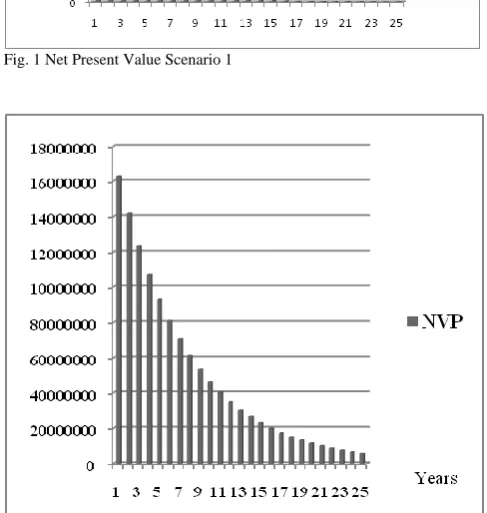
If known IRR 10%, we can see NPV at the first year NPV at first year =
=
= IDR 170.669.365,45
NPV at second years = IDR 155.153.968,60 NPV at third years = IDR 141.049.062,36 Following until end of projection
Value of B/C ratio in scenario 1, IRR 10 %
Internal Rate of Return (IRR) = 10% NPV cumulative =
= IDR 852.379.272,44
Benefit Cost Ratio (B/C Ratio) = = 1.94
To scenario 2 with 15 % irr the calculations are the same as on scenarios 1
TABLEIII
CALCULATED INVESTMENT OF PSLS
IRR NPV B/C Ratio
Scenario 1 10% IDR 852,379,272.44 1.94
Scenario 2 15% IDR 308,030,444.85 1.34
[image:4.595.44.271.55.210.2]Based on the calculation above it known that scenario 1 NPV > 1 so investing is appropriate to be implemented , the B/C ratio on 1 scenario is 1.34 that means investment is appropriate to be implemented .The scenario 2 note that the NPV > 1 that the investment can be said to be worth , the B/C ratio than scenarios 2 also > 1 so investing is appropriate for use.
[image:4.595.304.546.216.353.2]Fig. 1 Net Present Value Scenario 1
Fig. 2 Net Present Value Scenario 2
In addition to performing calculations NPV and B/C ratio in the analysis effects calculation comparison is related to the conventional PSL still use electricity and PSLS .To compare operating costs will be counted first routine conventional expenditure PSL as below (example the metering calculation ) [17] .The total electric charge of per year = 20.531.250 Wh = 20.531 kWh.
[image:4.595.303.547.336.593.2]projected for 25 years, total cost consisting of the investment, the cost of the lights, the cost of the battery, and M&O costs, then: total cost IDR 1.326.906.250, -
Based on the calculation on above known difference of the cost of implementation PSLS and conventional PSL IDR 37.791.284.375, - efficiency of 97 %, so based on the above it can be said that PSLS is efficient and effective as an alternative conventional PSL because it also frugal environmentally friendly
V. CONCLUSION
PSL is known as essential equipment to support human activities at night. However, PSL need large amount of electric power generated by fossil so that it can cause energy crisis. Hence, it is important to implement PSLS that uses alternative source of energy such as solar energy. It is also known that solar energy is environmental friendly. In addition, Indonesia as a tropical country has potential for the development of PSLS because sun emits the region almost all year. PSLS has several advantages compare with conventional PSL such as easy to install, work independently and automatically, can be used for 12 hours per day, not using electric power, longer life cycle, and environmentally friendly based on technical analysis.
PSLS uses lithium battery as the depositary of electrical energy to prevent stolen because it is difficult to detach it from PSLS. It is also environmental friendly and having longer life time. The most important is PSLS uses solar energy as to support the environmentally friendly and energy savings movement promoted by government.
From calculation of several criteria such as NPV and B/C ratio using 25 years projection, investment of PSLS is feasible and worth to be implemented. It is also 97% cheaper than fossil fuel PSL.
ACKNOWLEDGMENT
Thanks to Research Group of Industrial Engineering and Techno Economy, Sebelas Maret University.
REFERENCES
[1] Tempo. “A working meeting minister sudirman call the crisis electricity”. 2014.[online]. Available at tempo.co/read/news/2014 [2] Jami, Majid., Kirmani, Sheeraz.,Rizwan, Mohammad., “
Techno-Economic Feasibility Analysis of Solar Photovoltaic Power Generation: A Review”. In Smart Grid Renewable energy, 2012, pp. 266-274
[3] Astuti, Duwi. Suryoatmajo, Heri., Ashari, Mochamad,”Design Simulator Solar Panels Using the Lab View”. Surabaya : Teknik Elektro ITS , 2012
[4] ESDM .”Photovoltaic”, 2012. [online]. Available at
http://www.p3tkebt.esdm.go.id/index.php?option=com_content&view =article&id=377&Itemid=486&lang=en
[5] Laraswati, L, D., Wahyudi, S., Atikah, N, “Simulation Model Analysis Feasibility an Alternative Form of to Commercialize Company Mini Plant Lithium-Ion Battery In Indonesia”, National Conference IDEC ,pp. 157-162, Surakarta: Teknik Industri UNS,2014.
[6] Sutopo, W., Atikah, N., Purwanto, A., Nizam, M. “ Battery 10 kWh: A Financial Analysis of Mini Manufacturing Plant”. Proceedings of the 2013 Joint International Conference on Rural Information and Communication Technology and Electric-Vehicle Technology, rICT and ICEV-T 2013.
[7] Irawan, Ahmad F., Dofhir, Moch., Suyono, Hadi. “An Analysis Of The Increase In Efiensi Street Lighting ( PSL ) In District Jember”. Malang : Teknik Elektro Brawijaya, 2013.
[8] Kusumayogo, Engga.,Wibawa, Unggul., Suyono, Hadi.” Technical Analysis and Economical the Application of Public Street Lighting of
Solar Cell to the Needs of Lighting on The Freeway Darmo Surabaya”. Malang : Teknik Elektro Brawijaya, 2010.
[9] Sihombing, D.T.B .”Planning a System of Public Street Lighting and Park in the Area of The Campus By Means of Technology Solar ( Application Pavilion and Parking Lot )”. Medan : Teknik Elektro USU.2013.
[10] Nagendra R Velaga , Amit Kumar, “Techno-economic Evaluation of the Feasibility of a Smart Street Light System: A case study of Rural India”,2012, Social and Behavioral Sciences, Vol.62, pp. 1220 – 1224 [11] Hermanto, “Design Solar Street a Lamp 12 volts / 30Ah”.Bogor : PT.
Nipress, tbk,2014.
[12] Sulistiono, Ari, “Battery Management System”,2010, [online]. Available at http://www.arisulistiono.com/2010/06/sistem-manajemen-baterai.html#.Vbc6PKTtmko
[13] Maximilian Lauer, “ Methodology guidelineon techno economic assessment (TEA), in Generated in the framework of thermal Net WP3B.
[14] Fabrício P. Vahl, Lucila M.S. Campos, Nelson Casarotto Filho, Sustainability constraints in techno-economi analysis of general lighting retrofits” Journal Energy and Building, pp.500-507
[15] Chin Kim Gan, Ahmad Farid Sapar, Yik Chee Mun, Kuan Eng Chong, “ Techno-economic Analysis of LED Lighthing: A case Study in UTeM’s Faculty Building”, in Malaysian Technical Universities Conference on Engineering & Technology 2012, MUCET 2012, pp.208-216
[16] Athanasia A, Lazou., Papatsoris, Anastassios,D,. “The Economic of Photovoltaic Stand-Alone Residential Households :A Case Study for Various European and Mediterranean Location”. Heslingtong : Department of Electronics University of York, 2000.
[17] Gunawan, Hasta, “Strategy Solo to Support Energy Conservation”.Surakarta: DKP Kota Surakarta, 2014.
[18] W. Sutopo, I. Mariyanie, A. Purwanto, M. Nizam, “A Comparative Value Chain Analysis of Battery Technologies for Electrical Vehicles,” Proceedings of the 2013 Joint International Conference on Rural Information and Communication Technology and Electric-Vehicle Technology, rICT and ICEV-T 2013.