Selection of a chipper technology for small-scale
operations – a Finnish case
Juha Laitila*, Robert Prinz, Lauri Sikanen
Natural Resources Institute Finland (Luke), Production systems, Joensuu, Finland
*Corresponding author: [email protected]
Citation: Laitila J., Prinz R., Sikanen L. (2019): Selection of a chipper technology for small-scale operations – a Finnish case. J. For. Sci., 65: 121–133.
Abstract:The objective of this study was to determine the economic performance of alternative chipper choices for
small-scale chipping based on unit cost (€ per chip-m3) and net present value (NPV) calculations. For the chipping
cost and investment profitability analyses four tractor-powered professional or semi-professional disc chippers and two professional drum chippers mounted on a truck or powered by tractor were selected. Initial investment, operat-ing costs, and the cost of outsourced chippoperat-ing were the key elements for comparoperat-ing the profitability of investment alternatives. The average purchase prices, cost factors, and technical details of the chipper units were acquired from machine dealers, specification sheets, a literature review, and interviews with chipping entrepreneurs. The results of the three tractor-powered professional chippers involved in the comparison were very close to each other. The profit-able running of a truck-mounted drum chipper calls for high annual chipping volumes: the chipper type is therefore a feasible choice for an entrepreneur in large-scale chipping. Semi-professional disc chippers offer lower investment costs, but their economic feasibility is relatively poor.
Keywords: investment; decision making; unit cost; chipping; entrepreneurship; productivity
Small-scale chipping can be defined as operations in which wood chips are produced to heat buildings or small district heating systems, usually in a scale be-tween 500 and 2,500 kW (McCallum 1997). In Fin-land, small-scale chipping is a typical operation e.g. for heat entrepreneurs who operate locally and pro-vide heat for a community from locally sourced wood fuels (Okkonen 2008; Okkonen, Suhonen 2010; Suhonen, Okkonen 2013). Quality requirements for fuel chips are high, and the efficient operation of several small-scale heating plants presupposes the use of delimbed wood as a raw material for the chips to remove needles or sticks from branches (Laitila et al. 2010; Laitila, Väätäinen 2012; Kühmaier, Erber 2018). The operational chain of heat entre-preneurship can be divided into heat production and fuel supply (Okkonen 2008; Okkonen, Suhonen 2010; Suhonen, Okkonen 2013). A heat
entrepre-neur can take care of all practical operations or use subcontracting for fuel procurement (Okkonen 2008; Okkonen, Suhonen 2010; Suhonen, Ok-konen 2013). Nevertheless, this business model can only succeed if all steps in the operational chain are profitable for all parties involved in the business (Ok-konen 2008; Ok(Ok-konen, Suhonen 2010; Suhonen, Okkonen 2013).
Underestimating the chipping cost will result in a financial loss for the entrepreneur, whereas an overestimate will make the entrepreneur less com-petitive on the open market (Spinelli, Magag-notti 2010). In some cases, the simplest solution for small-scale heating operators is to utilise the chipping service of a professional contractor (Spi-nelli, Magagnotti 2013) if it is available.
Chipping is the primary element of the forest chip supply chain and affects the whole system, because the location where comminution is per-formed determines the form of the material to be transported. Chipping is also an essential element of fuel supply e.g. to modern biomass boilers (Jen-sen et al. 2004; Hartmann et al. 2006; Strehler 2000; Lu et al. 2010; Spinelli, Magagnotti 2010; Spinelli et al. 2011a, b; Röser et al. 2012; Spinel-li, Magagnotti 2013; Spinelli et al. 2013; Spi-nelli, Magagnotti 2014; Wolfsmayr, Rauch 2014; Ghaffariyan et al. 2017; Kühmaier, Erber 2018; Prinz et al. 2018). Particle size distribution also affects handling and combustion efficiency, and emissions at heating plants (Mattsson 1990; Kristensen, Kofman 2000; Jensen et al. 2004; Paulrud, Nilsson 2004; Bäfver, Renström 2013). In addition, chips have to be delivered regu-larly, which makes good planning a crucial issue (Spinelli, Magagnotti 2010; Windisch et al. 2015; Väätäinen et al. 2017). In turn, planning re-quires a correct estimate of chipping productivity and cost. Otherwise, shortfalls are experienced in both supply chain management and price setting (Spinelli, Magagnotti 2010; Spinelli, Magag-notti 2014; Windisch et al. 2015; Mola-Yudego et al. 2015; Väätäinen et al. 2017).
In small-scale chipping operations, three basic types of chipper are used: disc type, drum type, and screw type (McCallum 1997; Eriksson et al. 2013; Spinelli et al. 2013; Wolfsmayr, Rauch 2014). Drum and disc chippers are the primary technology used, whereas screw chippers are rare-ly used (McCallum 1997; Eriksson et al. 2013; Spinelli et al. 2013; Wolfsmayr, Rauch 2014). Drum chippers are more expensive to manufacture. In addition, power demand and fuel consumption are somewhat higher compared with disc chippers, due to a bigger cutting angle (McCallum 1997). With disc chippers, the infeed angle of stems into the chipper disc knives is about 45°. Stems are fed into the drum chipper at an angle perpendicular (90°) to the drum axis and chipper knives. The
in-feed opening on drum chippers is wide but lim-ited in height, whereas the infeed openings of disc chippers are almost square (McCallum 1997; Er-iksson et al. 2013). The infeed opening effectively defines the maximum diameter of log that can be chipped, and the wide infeed opening of the drum chipper favours the chipping of branchy whole trees or logging residues (Eriksson et al. 2013; Kühmaier, Erber 2018). To control the oversized splitters, the drum chipper can be equipped with a built-in screen, through which the reduced mate-rial passes before leaving the chipper (Eriksson et al. 2013; Kons et al. 2015; Kühmaier, Erber 2018). The use of narrower screens improves prod-uct quality but decreases prodprod-uctivity and increas-es fuel consumption (Kühmaier, Erber 2018). Disc chippers vary in their ability to produce qual-ity chips from whole trees including limbs (Mc-Callum 1997).
Truck-mounted chippers are most suitable for entrepreneurs with large annual chipping volumes and wide procurement areas, whereas tractor-pow-ered chippers are interesting options for entrepre-neurs who work locally (Spinelli, Magagnotti 2014; Laitila, Routa 2015; Kühmaier, Erber 2018). During the cold season, chipping machin-ery is intensively used, while during the summer months, the problem is a lack of work (Spinel-li, Magagnotti 2014; Laitila, Routa 2015; Väätäinen et al. 2017). Tractor-towed chippers are usually powered by the tractor’s power take-off (PTO), and it is possible to utilise the tractor for other purposes when there is no chipping work (Spinelli, Magagnotti 2014; Eliasson et al. 2015). Tractor-powered units are also cheaper to acquire and easier to resell in sections compared with truck-mounted chippers (Spinelli, Mag-agnotti 2014). However tractor-powered units have certain disadvantages compared with truck-mounted chippers: first, their chipping productiv-ity is lower; second, they cannot relocate between working sites as quickly as truck-mounted units (Spinelli, Magagnotti 2013, 2014).
Choosing the appropriate technology means a technology appropriate for the conditions in question, and this can be based on several criteria (Harstela 1991). In forest technology, the com-parison of chippers’ performance often focuses on productivity or quality issues, and the amount of produced fuel chips is measured e.g. as a solid
dry weight (kg), or according to energy content (MWh) (Magagnotti, Spinelli 2012; Elias-son et al. 2018). Correspondingly, chipping time
consumption can be defined as effective time (E0h)
or gross effective time (E15h) (Harstela 1991;
Björheden, Thompson 2000; Uusitalo 2010). Since normal machine work always includes short breaks or pauses, gross effective working time is more precise in describing actual work produc-tivity (Harstela 1991; Björheden, Thompson 2000; Uusitalo 2010). In addition to short breaks or pauses, the degree of machine utilization (MU) depends on the technical reliability of the ma-chine and the organisation’s operational efficiency (Harstela 1991).
Comparing the profitability of investments alter-natives may be feasible using different calculation methods instead of an intuitive decision-making process (Öhlmér, Lönnstedt 2004; Virlics 2013). The objective of this study was to determine the economic performance of alternative chipper choices for small-scale chipping, based on unit cost (e.g. Harstela 1991; Uusitalo 2010; Acker-man et al. 2014; Di Fulvio et al. 2017; Kaleja et al. 2018) and net present value (NPV) calculations (e.g. Beranek 1975; Levy, Sarnat 1994), thus of-fering an insight into price setting for small-scale chipping operations and the profitability of chip production.
MATERIAL AND METHODS
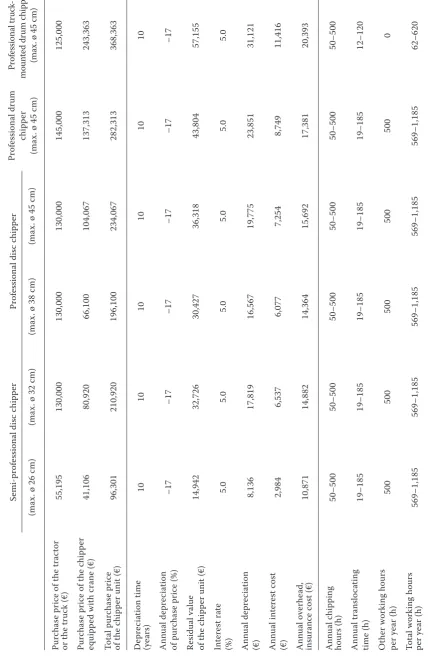
Four tractor-powered professional or semi-pro-fessional disc chippers and one prosemi-pro-fessional drum chipper with an intake opening in a range of 26 to 45 cm and a power requirement of between 90 kW and 150 kW were selected for the chipping cost and investment profitability analyses. A truck-mount-ed drum chipper powertruck-mount-ed by the truck’s 338 kW engine and with an intake opening of 45 cm were also included in the analyses. The purchase prices of the chipper units were in the range of €96,301 to €368,363, and chipping productivity was in the
range of 24 to 136 chip-m3 (bulk) per operating
hour (Table 1). The commands for manoeuvring the timber loader and chipper were positioned in the cabin of the tractor or truck. The average pur-chase prices, cost factors, and technical details of the chipper units (Table 1) were acquired from ma-chine dealers, specification sheets, a literature
re-view, and interviews with chipping entrepreneurs. Classification to professional or semi-professional chippers were based on recommendations for the intended use and from chipper manufacturers. Chipping of delimbed stems was expected to be undertaken at the heating plant or at the terminal. For heat entrepreneurs, the most convenient way to receive chips is if they are chipped directly into the silo at the heating plant. Conversely, chipping at the terminal is a feasible choice, e.g. if other ac-tivities are disturbed by a loud and dusty chipping operation at the heating plant.
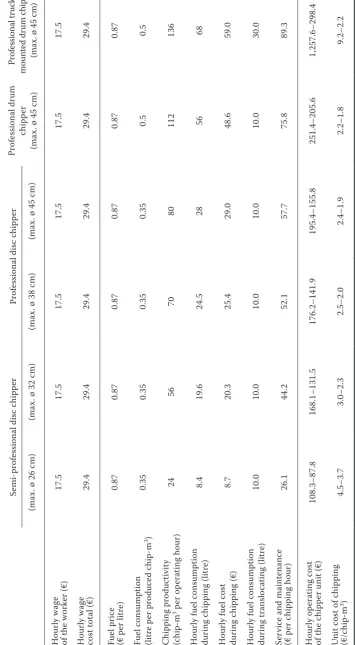
The operating hour costs (excluding value added tax) of the chippers (Table 1) were calculated per
gross effective hour (E15h), and the costs were
pre-sented in euros (€). The costs included both fixed costs (e.g. capital depreciation, interest expenses, insurance fees, and administration expenses) and variable operating expenses (e.g. fuel, repairs, ser-vice, and machine transfers). In addition to the an-nual total cost, 5% extra was added to take the risk of entrepreneurship into account. Capital costs were calculated using an interest rate of 5%. In the operating cost, analyses were expected to include chipping work of between 50 and 500 operating hours by the tractor, chipper translocating time of between 19 and 185 operating hours, and other tractor work (without a chipper) of 500 operat-ing hours per year (Table 1). Because a purpose-built truck-mounted chipper cannot be used for other purposes, the annual operating hours of the chipper were between 50 and 500 hours, and the translocating time was between 12 and 120 operat-ing hours. The unit cost of chippoperat-ing (Table 1 and Fig. 2), which is calculated based on the chipper’s hourly cost and productivity (e.g. Uusitalo 2010), was defined as: Euros per bulk volume of produced
chips (€/chip-m3).
The profitability of the alternative chipper choic-es was calculated using the method of net prchoic-esent value (NPV), with the following Eq. 1 (Levy, Sar-nat 1994):
01 1
n t
t t
S
NPV I
k
(1)where:
St – the expected net cash receipt at the end of year t,
I0 – the initial investment of the chipper unit,
k – the discount rate, i.e., the required minimum annual
rate of return on new investments (5%),
Semi-pr of essional di sc c hipp er Pr of essional di sc c hipp er Pr of essional dr um chipp er (ma
x. ø 45 c
m) Pr of essional tr uc k-moun te d dr um c hipp er (ma
x. ø 45 c
m)
(ma
x. ø 26 c
m)
(ma
x. ø 32 c
m)
(ma
x. ø 38 c
m)
(ma
x. ø 45 c
m)
Pur
cha
se pr
ic
e of t
he trac tor or t he tr uc k (€) 55,195 130,000 130,000 130,000 145,000 125,000 Pur cha se pr ic
e of t
he c hipp er equipp ed w ith c rane (€) 41,106 80,920 66,100 104,067 137,313 243,363 Tot al pur cha se pr ic e of t he c hipp
er unit (€)
96,301 210,920 196,100 234,067 282,313 368,363 D epr ec ia tion time (ye ars) 10 10 10 10 10 10 Ann ual de pr ec ia tion of pur cha se pr ic e (%) –17 –17 –17 –17 –17 –17 Re sidu al v alue of t he c hipp
er unit (€)
[image:4.595.87.516.106.763.2]14,942 32,726 30,427 36,318 43,804 57,155 In ter est ra te (%) 5.0 5.0 5.0 5.0 5.0 5.0 Ann ual de pr ec ia tion (€) 8,136 17,819 16,567 19,775 23,851 31,121 Ann ual in ter est c ost (€) 2,984 6,537 6,077 7,254 8,749 11,416 Ann ual over he ad, insuranc e c ost (€) 10,871 14,882 14,364 15,692 17,381 20,393 Ann ual c hipping hours (h) 50–500 50–500 50–500 50–500 50–500 50–500 Ann ual trans lo ca ting time (h) 19–185 19–185 19–185 19–185 19–185 12–120 O ther wor king hours per ye ar (h) 500 500 500 500 500 0 Tot al wor king hours per ye ar (h) 569–1,185 569–1,185 569–1,185 569–1,185 569–1,185 62–620 Ta
ble 1. In
ve
stmen
t and unit c
ost c
alc
ul
ation de
tail
s of trac
tor
-p
ower
ed and tr
H our ly w age of t he wor ker (€) 17.5 17.5 17.5 17.5 17.5 17.5 H our ly w age co st t ot al (€) 29.4 29.4 29.4 29.4 29.4 29.4 Fue l pr ic e (€ p er litr e) 0.87 0.87 0.87 0.87 0.87 0.87 Fue l c onsum ption (litr e p er pr oduc ed c hip-m 3) 0.35 0.35 0.35 0.35 0.5 0.5 C hipping pr oduc tiv ity (c hip-m
3 p
er op era ting hour) 24 56 70 80 112 136 H our ly f ue l c onsum ption dur ing c hipping (litr e) 8.4 19.6 24.5 28 56 68 H our ly f ue l c ost dur ing c hipping (€) 8.7 20.3 25.4 29.0 48.6 59.0 H our ly f ue l c onsum ption dur ing trans lo ca ting (litr e) 10.0 10.0 10.0 10.0 10.0 30.0 Ser vic
e and main
tenanc e (€ p er c hipping hour) 26.1 44.2 52.1 57.7 75.8 89.3 H our ly op era ting c ost of t he c hipp
er unit (€)
108.3–87.8 168.1–131.5 176.2–141.9 195.4–155.8 251.4–205.6 1,257.6–298.4 U nit c
ost of c
hipping (€/c hip-m 3) 4.5–3.7 3.0–2.3 2.5–2.0 2.4–1.9 2.2–1.8 9.2–2.2 Semi-pr of essional di sc c hipp er Pr of essional di sc c hipp er Pr of essional dr um chipp er (ma
x. ø 45 c
m) Pr of essional tr uc k-moun te d dr um c hipp er (ma
x. ø 45 c
m)
(ma
x. ø 26 c
m)
(ma
x. ø 32 c
m)
(ma
x. ø 38 c
m)
(ma
x. ø 45 c
m)
[image:5.595.87.443.111.757.2]Ta
ble 1. t
The cost of outsourced chipping was defined as
€4.0/chip-m3, and it was determined by interviews
with chipping entrepreneurs. The profitability of the alternative chipper choices was evaluated as a function of the annual chipping hours or the an-nual volume of produced chips. If NPV displays a positive result, the investment yields a positive payback compared with the initial investment costs. When an NPV calculation result is zero, the investment reaches break-even given the required rate of return. If the calculation displays a negative result, the investment does not yield sufficient cash flows to balance out the initial investment cost. The most feasible investment option is the chipper op-tion which yields the highest positive NPV (e.g. Be-ranek 1975, Levy, Sarnat 1994).
RESULTS
The cost of chipping
The volume of produced chips increased as a function of annual operating hours (50–500), de-pending on chipper choice (Fig. 1). The professional truck-mounted drum chipper had the highest pro-ductivity and volume of produced chips (6,800 to
68,000 chip-m3). The small semi-professional
chip-per had the lowest productivity and lowest volume
of produced chips (1,200–12,000 chip-m3).
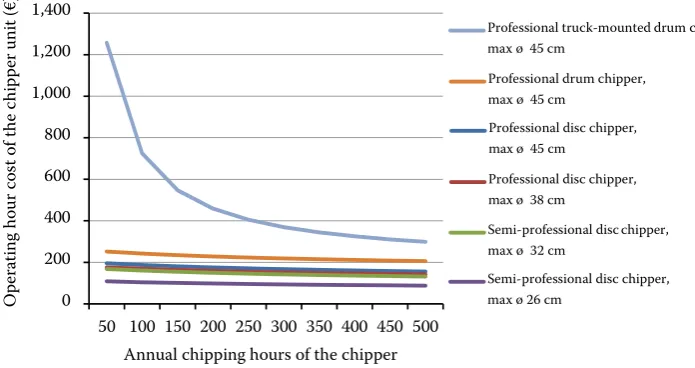
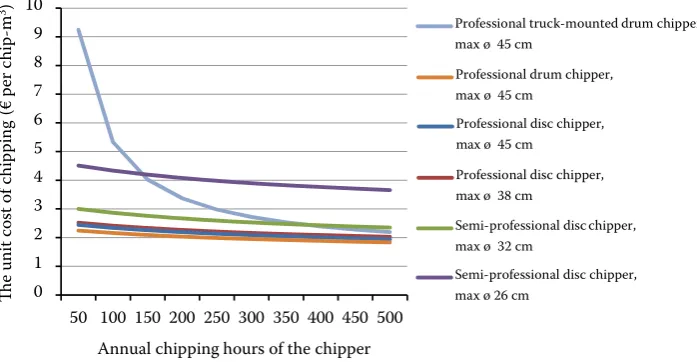
The operating hour costs (Fig. 2) and the unit costs (Fig. 3) decreased when the annual operating hours of the chipper unit increased (Table 1). The operating hour cost of the tractor-powered semi-Fig. 1. The volume of produced chips as a function of the annual operating hours of the chippers
0 10,000 20,000 30,000 40,000 50,000 60,000 70,000 80,000
50 100 150 200 250 300 350 400 450 500
V
ol
um
e
of
p
ro
du
ce
d
ch
ip
s(
ch
ip
-m
3)
Annual chipping hours of the chipper
Professional drum chipper, max ø 45 cm
Professional disc chipper, max ø 45 cm
Professional disc chipper, max ø 38 cm
Semi-professional disc chipper, max ø 26 cm
Professional truck-mounted max ø 45 cm
drum chipper,
Semi-professional disc max ø 32 cm
chipper,
0 200 400 600 800 1,000 1,200 1,400
50 100 150 200 250 300 350 400 450 500
O
pe
ra
ting
h
ou
r c
os
t o
f t
he
c
hi
pp
er
u
ni
t(
€)
Annual chipping hours of the chipper
Professional drum chipper, max ø 45 cm
Professional disc chipper, max ø 45 cm
Professional disc chipper, max ø 38 cm
Semi-professional disc chipper, max ø 26 cm
Professional truck-mounted max ø 45 cm
drum chipper,
Semi-professional disc max ø 32 cm
[image:6.595.124.474.96.280.2]chipper,
[image:6.595.124.472.547.731.2]professional chipper units was in a range between €87.8 – €168.8; for the tractor-powered profession-al chipper units, the hourly costs were €141.9 to €251.4 (Fig. 2 and Table 1). For the truck-mount-ed professional drum chipper, the operating hour cost changed steeply in a range between €298.4 and €1,257.6 (Fig. 2). The operating hour cost was high-est mainly due to the high invhigh-estment cost and be-cause the truck-mounted chipper cannot be used for other purposes, unlike the tractor. Low annual equipment use increases the share of fixed cost per operating hour, especially when the annual operat-ing hours and produced chip volumes are low.
Unit costs (€/chip-m3) take into account both
chipping productivity (Fig. 1) and the operating hour cost of the chipper (Fig. 2). This is essential information for comparing chipper alternatives with a different productivity and fixed and vari-able costs. In this study, the unit costs of chipping were lowest for the tractor-powered professional chipper units (Fig. 3). For the professional drum chipper, the unit cost of chipping was in a range
between €1.8 and €2.2/chip-m3 (Fig. 3). For
profes-sional disc chippers, the unit cost was in a range
between €1.9 and €2.4/chip-m3 (max. ø 45 cm)
and €2.0 and €2.5/chip-m3 (max. ø 38 cm) (Fig. 3).
For the truck-mounted professional drum chip-per, the unit cost of chipping increased rapidly in
a range between €2.2 and €9.2/chip-m3. For
semi-professional chippers, the unit cost was in a range
between €4.5 and €3.7/chip-m3 (max. ø 26 cm) and
€3.0 and €2.3/chip-m3 (max. ø 32 cm) (Fig. 3).
To reach a cost level below the cost of outsourced
chipping (€4.0/chip-m3), the annual chipping hours
of the professional truck-mounted drum chipper should be above 150 h; with a semi-professional disc chipper (max. ø 26 cm) the annual chipping hours should be at least 250 h (Fig. 3). Expressed as an annual volume of produced chips, the
break-even point was reached at 6,000 chip-m3 for the
semi-professional disc chipper and at 20,400 chip-m3
for the professional truck-mounted drum chipper (Fig. 4). Due to low chipping productivity, the unit costs of chipping were highest almost invariably for the small (max. ø 26 cm) semi-professional chipper, although the professional truck-mounted chipper showed higher units costs for low annual chipping hours (Fig. 3). The cost difference for the tractor-powered professional chippers was
approximate-ly €1.9 per chip-m3 and about €1.4 per chip-m3
compared with the bigger semi-professional chipper powered by a 150 kW tractor (Fig. 3). The high capacity of the professional chippers (Figs 1 and 4) enables the expansion of a chipping en-trepreneurship business in future without the re-quirement of extra investment in machinery. The wide intake opening of professional chippers also enables the efficient chipping of large-diameter fuel logs. A weakness is the investment costs: they are relatively high for a professional chipper and a powerful tractor or truck.
The profitability of the chipper investment
To get a positive NPV, the break-even point was 152 annual chipping hours for the tractor-powered drum chipper, 175 h and 186 chipping hours for the
0 1 2 3 4 5 6 7 8 9 10
50 100 150 200 250 300 350 400 450 500
Th
e
un
it
co
st
o
f c
hi
pp
ing
(€
pe
r c
hi
p-m
3)
Annual chipping hours of the chipper
Professional drum chipper, max ø 45 cm
Professional disc chipper, max ø 45 cm
Professional disc chipper, max ø 38 cm
Semi-professional disc chipper, max ø 26 cm
Professional truck-mounted max ø 45 cm
drum chipper,
Semi-professional disc max ø 32 cm
[image:7.595.132.481.99.280.2]chipper,
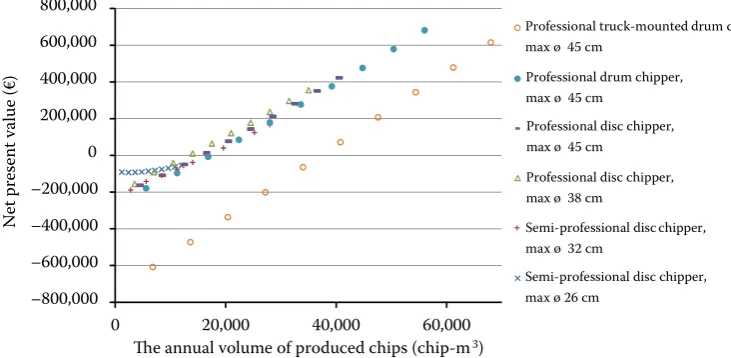
tractor-powered disc chippers (max. ø 45 cm and ø 38 cm), 272 chipping hours for the truck-mount-ed drum chipper, and 286 chipping hours for the tractor-powered semi-professional (max. ø 32 cm) disc chipper (Fig. 5). The NPV of the smaller semi-professional disc chipper (max. ø 26 cm) was al-ways negative, with a given range for the annual chipping hour of between 50 and 500 hours (Fig. 5).
The break-even points for the positive NPV, ex-pressed as an annual volume of produced chips
(Fig. 6), were 13,000 and 14,000 chip-m3 for the
tractor-powered disc chippers (max. ø 38 cm and
ø 45 cm), 16,000 chip-m3 for the tractor-powered
semi-professional disc chipper (max. ø 32 cm),
17,000 chip-m3 for the tractor-powered drum
chip-per, and 37,000 chip-m3 for the truck-mounted
drum chipper (Fig. 6). The NPV of the smaller
semi-professional disc chipper (max. ø 26 cm) was always negative (Fig. 6) within the given range for the
chip-per’s annual capacity (1,200–12,000 chip-m3).
The key finding is that below an annual chipping
demand of 13,000 chip-m3, outsourced chipping
is economically a feasible choice. From the invest-ment perspective, a tractor-powered professional disc chipper with an intake opening of 38 cm was assessed to be the most profitable chipper choice when the annual chipping volumes were above
13,000 chip-m3 and below 35,000 chip-m3 (Fig. 6).
The larger professional disc chipper (max. ø 45 cm) with a higher productivity (Fig. 1) was the second most profitable choice if the annual chipping
vol-umes were between 14,000 and 40,000 chip-m3
(Fig. 6). The third feasible choice was the tractor-powered drum chipper with a demand for
pro-0 1 2 3 4 5 6 7 8 9 10
Th
e
uni
t c
os
t o
f c
hi
ppin
g
The annual volume of produced chips
(€
pe
r c
hi
p-m
3)
(chip-m3)
0 20,000 40,000 60,000 80,000
Professional drum chipper, max ø 45 cm
Professional disc chipper, max ø 45 cm
Professional disc chipper, max ø 38 cm
Semi-professional disc chipper, max ø 26 cm
Professional truck-mounted max ø 45 cm
drum chipper,
Semi-professional disc max ø 32 cm
[image:8.595.125.463.98.280.2]chipper,
Fig. 4. The unit cost of chipping as a function of annually produced fuel chip volume
Fig. 5. Net present value as a function of the chipper’s annual chipping hours
–800,000 –600,000 –400,000 –200,000 0 200,000 400,000 600,000 800,000
50 100 150 200 250 300 350 400 450 500
N
et
pre
sent
v
al
ue
(€
)
Annual chipping hours of the chipper
Professional drum chipper, max ø 45 cm
Professional disc chipper, max ø 45 cm
Professional disc chipper, max ø 38 cm
Semi-professional disc chipper, max ø 26 cm
Professional truck-mounted max ø 45 cm
drum chipper,
Semi-professional disc max ø 32 cm
[image:8.595.115.473.556.734.2]duced chips from 17,000 chip-m3 to 56,000 chip-m3.
The truck-mounted drum chipper was an eco-nomically feasible choice if the annual demand for fuel chips was within a range between 56,000 and
68,000 chip-m3.
DISCUSSION AND CONCLUSIONS
Decision analysis in economic theory shows that the decision-making process is based on an objec-tive, punctual analysis of the investment and its pos-sible outcomes, but also on the investor’s subjective perspective (Virlics 2013). The dimensions and properties of the material to be chipped, the quality requirements for fuel chips, and the annual chip-ping volumes are the key criteria for the selection of a suitable chipper technology. Furthermore, initial investment, operating costs, and the cost of out-sourced chipping are the key elements for compar-ing the profitability of investment alternatives. To
calculate a cost per unit of product (e.g. €/chip-m3),
a productivity estimate is also needed.
The operational cost depends on all the incurred expenses when the chipper unit is actually op-erating. Conversely, the capital cost depends on the initial investment, the economic service life of the chipper unit, and the interest rate charged on borrowed capital; it is incurred whether or not the machine is working (Nurminen et al. 2009; Ackerman et al. 2014; Spinelli et al. 2017). The investment risk exists because it is uncertain that the cost of the investment will be recovered and a profit gained (Virlics 2013). Risk and uncertainty
is subjectively perceived, and it involves psycholog-ical and emotional factors (Virlics 2013).
In our study the cost of outsourced chipping was
defined as €4.0/chip-m3. It is obvious that the
chip-per investment is less feasible if the market price of chipping will decrease e.g. due to tightening com-petition on the open market. In our cost analyses the risk of entrepreneurship was defined to be 5% of the total annual costs. With tractor-powered professional chippers, the increase of the risk mar-gin to 10% or 15% could increase chipping cost by
0.06 € and 0.12 € per produced chip-m3. Similarly,
if the risk margin is removed (0%), the unit cost of
chipping is 0.06 euros lower per produced chip-m3.
Thus, the impact of risk margin is rather nominal to the unit cost of chipping, but rather affects the result of the financial year.
[image:9.595.124.490.101.280.2]In forest engineering, the estimation of main-tenance and repair costs has been considered the most unpredictable cost element, because operat-ing conditions, operator skills, repair and mainte-nance strategies, and machine qualities influence this cost (Nurminen et al. 2009; Ackerman et al. 2014; Dodson et al. 2015; Di Fulvio et al. 2017; Spinelli et al. 2019). Since the machinery is expen-sive and is essential for the entrepreneur, it needs to operate both in an economically feasible way and with few breakdowns. Owning the chipper unit for an extended period may lead to a low annual capital cost, but due to higher maintenance costs it might be better to replace the chipper unit with a new one instead of repairing it after a certain period. Un-predictable and unexpected machine breakdown means the entrepreneur is unable to carry out the Fig. 6. Net present value as a function of the annual volume of produced chips
–800,000 –600,000 –400,000 –200,000 0 200,000 400,000 600,000 800,000
0 20,000 40,000 60,000
Ne
t p
rese
nt
valu
e
(€
)
The annual volume of produced chips (chip-m3)
Professional drum chipper, max ø 45 cm
Professional disc chipper, max ø 45 cm
Professional disc chipper, max ø 38 cm
Semi-professional disc chipper, max ø 26 cm
Professional truck-mounted max ø 45 cm
drum chipper,
Semi-professional disc max ø 32 cm
work. Leasing the chipper for a shorter period may result in a more reliable operation, but the hourly cost may be higher.
It has been noted that the use of powerful and stable machinery in timber harvesting yields many advantages, because the alternative of downsizing inevitably leads to more frequent situations where the operator needs to use the machine close to its maximum capacity (Arlinger et al. 2014). This is unfavourable from the perspective of machine reli-ability and downtime, as well as ergonomics (Ar-linger et al. 2014). In chipping, time consump-tion is inversely proporconsump-tional to engine power and grapple load size in feeding (Spinelli, Hart-sough 2001; Van Belle 2006; Spinelli, Mag-agnotti 2010; Ghaffariyan et al. 2013). Larger machines have higher engine power, which gener-ally results in higher productivity if the conditions are suitable and the machine is managed properly (Laitila, Routa 2015). However, this does not
necessarily mean that the unit cost (€/chip-m3)
will be lower, since the hourly costs of the chipper will also be higher. Chipping requires power, and entrepreneurs operating tractor-powered chipper units have observed that an underestimating of the chipping power requirement leads to transmis-sion breakdowns, low productivity, and excessive fuel consumption (Spinelli, Magagnotti 2014). Interruptions are much less frequent with more powerful tractors (McCallum 1997).
The chipping cost is sensitive to transport logis-tics when chipping is done at the roadside land-ing. The fluctuation of interactions directly affects the degrees of utilisation of chippers and vehicles and the number of vehicles required (e.g. Mobini et al. 2011; Karttunen et al. 2012; Karttunen et al. 2013; Eriksson et al. 2014; Windisch et al. 2015; Eliasson et al. 2017; Väätäinen et al. 2017; Belbo, Vivestad 2018; Eliasson et al. 2018; Prinz et al. 2019). As the chipper is the most ex-pensive machine in the fuel chip supply chain, it is unacceptable for an entrepreneur to spending around half their scheduled worktime on tasks other than chipping.
In our study, the chipping of delimbed stems was done at the heating plant or at the terminal. Cen-tralised chipping makes it possible to work effec-tively and avoid the problems of ‘hot systems’ such as waiting and queuing at the landing, when chip-ping and long-distance transportation are inde-pendent of each other (Kärhä 2011; Eriksson et
al. 2014; Wolfsmayr, Rauch 2014; Kühmaier, Erber 2018). When chipping at the heating plant or terminal, operating times and cost factors are much more constant and predictable compared with chipping operations at roadside landings, which justifies the static spreadsheet-based cost calculation approach applied in this study.
The results for the three tractor-powered profes-sional chippers involved in the comparison were very close to each other. High chipping capac-ity and a wide infeed opening favours the drum chipper. However, the investment cost of a drum chipper is higher, and fuel consumption and ser-vice costs are somewhat higher compared with disc chippers. With tractor-powered chippers, the key to economic success is to find additional work for the powerful tractor (Akay 2005; Laiti-la, Väätäinen 2013) outside the hectic chipping season. The profitable running of truck-mounted drum chippers calls for high annual chipping vol-umes, and this chipper type is therefore a feasible choice for a professional chipping entrepreneur.
Semi-professional disc chippers offer lower in-vestment costs, but their economic feasibility is rather poor. However, if an outsourced chipping service is unavailable and annual demand for fuel chips is low, entrepreneurs can consider an invest-ment in a semi-professional chipper. This is espe-cially the case if the entrepreneur can utilise exist-ing applications such as a suitably powerful farm tractor or other second-hand machinery, which will greatly reduce the capital outlay for chipping equipment. This may be relevant for rural areas and remote communities, where the use of fuel chips for heating may be a new alternative to existing sys-tems, typically based on imported fossil fuels.
References
Ackerman P., Belbo H., Eliasson L., de Jong A., Lazdins A., Lyons J. (2014): The COST model for calculation of forest operations costs. International Journal of Forest Engineering 25: 75–81.
Akay A. (2005): Using farm tractors in small-scale forest harvesting operations. Journal of Applied Sciences Re-search, 1: 196–199.
OS-CAR14. Solutions for Sustainable Forestry Operations, June 25–27, NOVA Park Conference, Knivsta, Sweden. Arbetsrapport Från Skogforsk, 830: 54–55.
Belbo H., Vivestad H. (2018): Predicting delay factors when chipping wood at forest roadside landings. International Journal of Forest Engineering, 29: 128–137.
Beranek W. (1975): The cost of capital, capital budgeting and the maximization of shareholder wealth. The Journal of Financial and Quantitative Analysis, 10: 1–20. Björheden R., Thompson M. (2000): An international
nomenclature for forest work study. In: Field D.B. (ed.):
Proceedingsof the 20th World Congress – Caring for the
Forest: Research in a Changing World, Tampere, Aug 6–12, 1995: 190–215.
Bäfver L., Renström C. (2013): Fraktionsfördelning som kvalitetsparameter för skogsbränsle – kraftoch värme-verkens perspektiv. [Fraction distribution as a qual-ity parameter of energy wood, from the perspective of combined heat and power plants and heating plants.] Uppsala, Skogforsk. Arbetsrapport Från Skogforsk nr. 805–2013: 43. (in Swedish with English abstract) Di Fulvio F., Eriksson G., Bergström D. (2015): Effects of
wood properties and chipping length on the operational efficiency of a 30 kW electric disc chipper. Croatian Journal of Forest Engineering, 36: 85–100.
Di Fulvio F., Abbas D., Spinelli R., Acuna M., Ackerman P., Lindroos O. (2017): Benchmarking technical and cost factors in forest felling and processing operations in different global regions during the period 2013–2014. International Journal of Forest Engineering, 28: 94–105. Dodson E., Hayes S., Meek J., Keyes C.R. (2015): Montana
logging machine rates. International Journal of Forest Engineering, 26: 85–95.
Eliasson L., Fridh L., Spinelli R. (2018): The effect of output unit choice on detection of feedstock effects on chipper productivity and fuel consumption. Biomass and Bioen-ergy, 119: 37–42
Eliasson L., Eriksson A., Mohtashami S. (2017): Analysis of factors affecting productivity and costs for a high-perfor-mance chip supply system. Applied Energy, 185: 497–505. Eliasson L., von Hofsten H., Johannesson T., Spinelli R.,
Thierfelder T. (2015): Effects of sieve size on chipper productivity, fuel consumption and chip size distribu-tion for open drum chippers. Croatian Journal of Forest Engineering, 36: 11–17.
Eriksson G., Bergström D., Nordfjell T. (2013): The state of the art in woody biomass comminution and sorting in Northern Europe. International Journal of Forest Engineering, 24: 194–215.
Eriksson A., Eliasson L., Jirjis R. (2014): Simulation-based evaluation of supply chains for stump fuel. International
Journal of Forest Engineering, 25: doi.org/10.1080/149 42119.2014.892293
Ghaffariyan M.R., Brown M., Acuna M., Sessions J., Gal-lagher T., Kühmaier T., Spinelli R., Visser R., Devlin G., Eliasson L., Laitila J., Laina L., Iwarsson Wide M., Egnell G. (2017): An international review of the most productive and cost effective forest biomass recovery technologies and supply chains. Renewable and Sustainable Energy Reviews, 74: 145–158.
Hartmann H., Böhm T., Jensen P.D., Temmerman M., Rabier F., Golser M. (2006): Methods for size classification of wood chips. Biomass and Bioenergy, 30: 944–953. Harstela P. (1991): Work studies in forestry. Silva Carelica,
18: 41.
Jensen P., Mattson J., Kofman P., Klausner A. (2004): Ten-dency of wood fuels from whole trees, logging residues and roundwood to bridge over openings. Biomass and Bioenergy, 26: 107–113.
Kaleja S., Lazdins A., Zimelis A., Spalva G. (2018): Model for cost calculation and sensitivity analysis of forest op-erations. Agronomy Research, 16: 2068–2078.
Kärhä K. (2011): Industrial supply chains and production machinery of forest chips in Finland. Biomass Bioenergy, 35: 3404–3413.
Karttunen K., Väätäinen K., Asikainen A., Ranta T. (2012): The operational efficiency of waterway transport of for-est chips on Finland’s Lake Saimaa. Silva Fennica, 46: 395–413.
Karttunen K., Lättilä L., Korpinen O.J., Ranta T. (2013): Cost-efficiency of intermodal container supply chain for forest chips. Silva Fennica, 47: doi.org/10.14214/sf.1047. Kons K., Bergström D., Di Fulvio F. (2015): Effects of sieve
size and assortment on wood fuel quality during chipping operations. International Journal of Forest Engineering, 26: 114–123.
Kristensen E.F., Kofman P.D. (2000): Pressure resistance to air flow during ventilation of different types of wood fuel chip. Biomass and Bioenergy, 18: 175–180.
Kühmaier M., Erber G. (2018): Research trends in Euro-pean forest fuel supply chains: A review of the last ten years (2007–2016) – Part two: Comminution, transport & logistics. Croatian Journal of Forest Engineering, 39: 139–152.
Laitila J., Heikkilä J., Anttila P. (2010): Harvesting alter-natives, accumulation and procurement cost of small-diameter thinning wood for fuel in Central Finland. Silva Fennica, 44: 465–480.
Laitila J., Väätäinen K. (2013): Hakkuutyön tuottavuus metsävarustellulla turvetuotantotraktorilla karsitun aines- ja energiapuun korjuussa. [The cutting productiv-ity in integrated harvesting of pulpwood and delimbed energy wood with a forestry-equipped peat harvesting tractor]: Suo – Mires and Peat, 64: 97–112.
Laitila J., Routa J. (2015): Performance of a small and a medium sized professional chippers and the impact of
storage time on Scots pine (Pinus sylvestris) stem wood
chips characteristics. Silva Fennica, 49: doi.org/10.14214/
sf.1382.
Laitila J., Ahtikoski A., Repola J., Routa J. (2017): Pre-feasibility study of supply systems based on artificial drying of delimbed stem forest chips. Silva Fennica, 51: doi.org/10.14214/sf.5659.
Levy H., Sarnat M. (1994): Capital Investment and Finan-cial Decisions. New York, Prentice Hall: 782 .
Lu H., Ip E., Scott J., Foster P., Vickers M., Baxter L. (2010): Effects of particle shape and size on devolatilizationof biomass particle. Fuel, 89: 1156–1168.
Maganotti N., Spinelli R. (eds) (2012): Good practice guidelines for biomass production studies. COST action FP-0902. Florence, CNR IVALSA: 52.
Mattsson J.E. (1990): Basic handling characteristics of wood fuels: angle of repose, friction against surfaces and tendency to bridge for different assortments. Scandina-vian Journal of Forest Research, 5: 583–597.
McCallum B. (1997): Handbook for Small Scale Fuelwood Chipping Operations. Vantaa, IEA Bioenergy: 49. Mobini M., Sowlati T., Sokhansanj M. (2011): Forest
biomass supply logistics for a power plant using the discrete-event simulation approach. Applied Energy, 88: 1241–1250.
Mola-Yudego B., Picchi G., Röser D., Spinelli R. (2015): Assessing chipper productivity and operator effects in forest biomass operations. Silva Fennica, 49: doi. org/10.14214/sf.1342.
Nurminen T., Korpunen H., Uusitalo J. (2009): Applying the activity-based costing to cut-to-length timber har-vesting and trucking. Silva Fennica, 43: 847–870. Öhlmér B., Lönnstedt L. (2004): Design of economic
information. A pilot study of accounting information in decision-making processes. Food Economics – Acta Agriculturae Scandinavica, Section C 1: 222–231. Okkonen L. (2008): From exogenous to endogenous
de-velopment in Scottish forestry: the feasibility of small-scale wood energy enterprise. Journal of Environmental Planning and Management, 51: 221–232.
Okkonen L., Suhonen N. (2010): Business models of heat entrepreneurships in Finland. Energy Policy, 38: 3443–3452.
Paulrud S., Nilsson C. (2004): The effects of particle char-acteristics on emissions from burning wood fuel powder. Fuel, 83: 813–821.
Prinz R., Laitila J., Eliasson L., Routa J., Järviö N., Asikainen A. (2018): Hybrid solutions as a measure to increase energy efficiency – study of a prototype of a hybrid technology chipper. International Journal of Forest Engineering, 29: 151–161.
Prinz R., Väätäinen K., Laitila J., Sikanen L., Asikainen A. (2019): Analysis of energy efficiency of forest chip supply system using discrete-event simulation. Applied Energy, 235: 1369–1380.
Röser D., Mola-Yudego B., Prinz R., Emer B., Sikanen L. (2012): Chipping operations and efficiency in different operational environments. Silva Fennica, 46: 275–286. Spinelli R., Magagnotti N. (2010): A tool for productivity
and cost forecasting of decentralized wood chipping. Forest Policy and Economics, 12: 194–198.
Spinelli R., Nati C., Sozzi L., Magagnotti N., Picchi G. (2011a): Physical characterization of commercial wood-chips on the Italian energy market. Fuel, 90: 2198–2202. Spinelli R., Magagnotti N., Paletto G., Preti C. (2011b): Determining the impact of some wood characteristics on the performance of a mobile chipper. Silva Fennica, 45: 85–95.
Spinelli R., Magagnotti N. (2013): Performance of a small-scale chipper for professional rural contractors. Forest Science and Practice, 15: 206–213.
Spinelli R., Cavallo E., Eliasson L., Facello A. (2013): Com-paring the efficiency of drum and disc chippers. Silva Fennica, 47: doi.org/10.14214/sf.930.
Spinelli R., Magagnotti N. (2014): Determining long-term chipper usage, productivity and fuel consumption. Bio-mass and Bioenergy, 66: 442–449.
Spinelli R., Eliasson L., Magagnotti N. (2017): Value retention, service life, use intensity and long-term pro-ductivity of wood chippers as obtained from contractor records. Forests, 8: doi.org/10.3390/f8120503
Spinelli R., Eliasson L., Maganotti N. (2019): Determin-ing the repair and maintenance cost of wood chippers. Biomass and Bioenergy, 122: 202–210.
Strelher A. (2000): Technologies of wood combustion. Ecological Engineering, 16: 25–40.
Suhonen N., Okkonen L. (2013): The Energy Services Com-pany (ESCo) as business model for heat entrepreneur-ship – A case study of North Karelia, Finland. Energy Policy, 61: 783–787.
Uusitalo J. (2010): Introduction to Forest Operations and Technology. Tampere, JVP Forest Systems Oy: 287. Väätäinen K., Prinz R., Malinen J., Laitila J., Sikanen L.
terminal as a part of the forest chip supply system for a CHP plant. GCB Bioenergy, 9: 1657–1673. doi: 10.1111/ gcbb.12463
Virlics A. (2013): Investment decision making and risk. Procedia Economics and Finance, 6: 169–177.
Windisch J., Väätäinen K., Anttila P., Nivala M., Laitila J., Asikainen A., Sikanen L. (2015): Discrete-event simula-tion of an informasimula-tion-based raw material allocasimula-tion
process for increasing the efficiency of an energy wood supply chain. Applied Energy, 149: 315–325.
Wolfsmayr U.J., Rauch P. (2014): The primary forest fuel supply chain: a literature review. Biomass and Bioenergy, 60: 203–221.