
Speech Spectral Quantizers for Wideband Speech Coding
G. GUIBE´, H.T. HOW,ANDL. HANZO
Dept. of Electr. and Comp. Sc.,Univ. of Southampton, SO17 1BJ, UK.
Tel: +44-1703-593 125, Fax: +44-1703-594 508
Email: [email protected] http://www-mobile.ecs.soton.ac.uk
November 15, 2000
Abstract. In this treatise a range of Line Spectrum Frequency (LSF) Vector Quantization (VQ) schemes were studied comparatively, which were designed for wideband speech codecs. Both predictive arrangements and memoryless schemes were investigated. Specifically, both memoryless Split Vector Quantization (SVQ) and Classified Vector Quantization (CVQ) were studied. These techniques exhibit a low complexity and high channel error resilience, but require high bit rates for maintaining high speech quality. By contrast, Predictive Vector Quantizers (PVQ) offer an enhanced Spectral Distortion (SD) performance, although they are sensitive to channel error propagation. It is shown that the family of so-called Safety-Net Vector Quantization (SNVQ) schemes offers a good design compromise, providing an extension to memory-based PVQ, and thereby improving the performances both over noisy and noiseless channels.
1
I
NTRODUCTIONIn wideband speech codecs a high number of spectral co-efficients - typically - 16 has to be quantized, in order to represent the spectrum up to frequencies of 7kHz. How-ever, the Line Spectral Frequency (LSF) coefficients above 4kHz are less amenable to Vector Quantization (VQ) than their low-frequency counterparts.
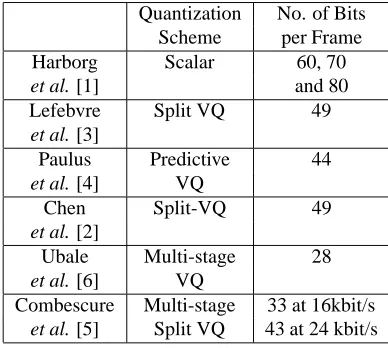
Table 1 summarizes most of the recent approaches to wide-band speech spectral quantization found in the literature.
The approach employed by Harborg textitet al. [1] is
based on Scalar Quantization (SQ). However, the result-ing bit rate is excessive, requirresult-ing 3 or 4 bits for each LSF. Chen textitet al. [2] as well as Lefebvre textitet al. [3] utilized low dimensional split VQ. For instance, a
(2;2;2;2;2;3;3)
7777777 split VQ is invoked in their
ap-proach, where only 2 or 3-dimensional VQs are used, em-ploying 7 bits - i.e. 128 codebook entries - per sub-vector. This reduces the number of bits allocated to the LSF quan-tization compared to SQ, although the resulting number of bits still remains somewhat high, namely 77=49. Clearly,
these approaches are simple, but a large number of bits is required.
Paulus textitet al. [4] proposed a coding scheme based on sub-band analysis of the speech signal. The speech signal
Quantization No. of Bits
Scheme per Frame
Harborg Scalar 60, 70
et al. [1] and 80
Lefebvre Split VQ 49
et al. [3]
Paulus Predictive 44
et al. [4] VQ
Chen Split-VQ 49
et al. [2]
Ubale Multi-stage 28
et al. [6] VQ
Combescure Multi-stage 33 at 16kbit/s
[image:1.612.326.520.420.594.2]et al. [5] Split VQ 43 at 24 kbit/s
Table 1: Overview of Wideband LPC Quantizers.
ap-proach Combescure textitet al. in [5] described a system based on two sub-bands, where the lower band (0-5kHz) applied a 12-th order LP filter with its coefficients quan-tized using 33 bits. The upper band (5-7kHz) uses an 8-th order LP filter encoded with 10 bits, but these coefficients were only transmitted in the higher bit rate mode of the coder, namely at 24 kbit/s. The lower-band coefficients were quantized using Predictive Multi-Stage Split Vector Quantization (MSVQ). These types of LSF quantizers are not directly amenable to employment in fullband wideband speech codecs. However, the approach using separate cod-ing of the higher- and lower-band LSFs can be helpful in general for LPC quantization.
Finally, Ubale textitet al. in [6] proposed a scheme us-ing predictive MSVQ of seven stages employus-ing four bits each. This method employed a so-called multiple survivor method, where four - rather than one - residual survivors were retained at each pattern-matching stage and were then tested at the next pattern-matching stage. The final deci-sion was taken at the last VQ stage as to which of the split vector combinations gave the lowest quantization error. In addition, the MSVQ was designed by a joint optimization procedure, clearly demonstrating the advantages of using schemes, which predictively exploit the knowledge of the signal’s past history, in order to improve the coding effi-ciency.
Having reviewed the background of wideband speech spec-tral quantization, we now focus our attention on the statis-tical properties of the wideband speech LSFs, which render it attractive for vector quantization.
1.1 STATISTICALPROPERTIES OFWIDEBANDLSFS
The employment of the LSF [7, 8, 9] representation for quantization of the LPC parameters is motivated by their statistical properties. Figure 1 shows the Probability Den-sity Functions (PDFs) of 16 wideband speech LSFs over the interval of 0-8kHz. Their different PDFs have to be taken into account in the design of the quantizers.
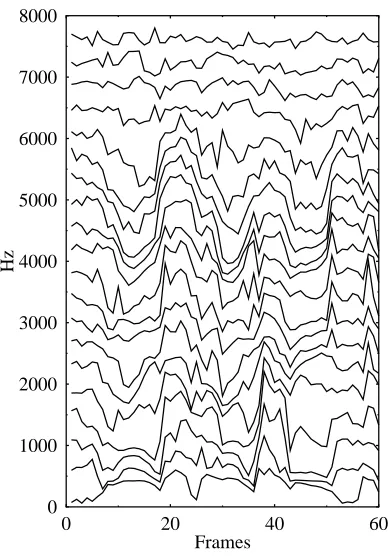
The essential motivation of vector quantization is the ex-ploitation of the relationship between the LSFs in both the frequency and the time domain. Figure 2 shows the time-domain evolution of the wideband (WB) speech LSF traces, demonstrating their strong correlation in consecu-tive frames in the time-domain, which is often referred to as their inter-frame correlation. Similarly, it demonstrates within each speech frame the ordering property of neigh-bouring LSF values, which is also referred to as intra-frame correlation.
Intra-frame correlation motivates the employment of vec-tor quantization, since it enables a mapping that matches the multi-dimensional LSF distribution. We observe at the top of Figure 2 that the correlation of the individual LSFs within a given speech frame tends to decrease, as the
fre-0 1000 2000 3000 4000
Frequency (Hz) 0.0
0.01 0.02 0.03 0.04 0.05
3000 4000 5000 6000 7000 8000 Frequency (Hz)
0.0 0.01 0.02 0.03 0.04 0.05
[image:2.612.311.508.59.322.2]Figure 1: PDFs of the LSFs using LPC analysis with a filter order of 16, demonstrating the ordering property of the LSFs.
0 20 40 60
Frames 0
1000 2000 3000 4000 5000 6000 7000 8000
Hz
[image:2.612.319.513.401.680.2]^ Hamming
Window
LPC Analysis
{a }i
LSF Encoder
LSF Decoder
{a }^i ^ s(t) Encoder Decoder 1/A(z) s(t)
[image:3.612.72.280.50.116.2]LPC Residual A(z)
Figure 3: Evaluation of the perceptual speech quality after apply-ing LSF vector quantization
quency increases, i.e. higher frequency LSFs are more sta-tistically independent of each other, although they still obey the ordering property. This clearly manifests itself for ex-ample around frame 18 in Figure 2. The highest frequency LSFs describe the noisy high frequency bands of the speech signal, which typically appear to be noise-like. This char-acteristic will mostly be exploited in the design of memo-ryless VQ schemes.
Inter-frame correlation of the LSFs can be exploited by interframe predictive vector quantization schemes having memory, where predictions of the current LSF values are employed, in order to reduce the variance of the vector we want to quantize. Finally, when rapid spectral changes are observed in the LSF traces, affecting both their intra- and inter-frame correlation, various multi-mode schemes can be invoked, as we will show during our further discourse.
1.2 SPEECHCODECSPECIFICATIONS
The design of speech codecs is based in general on a trade-off between the conflicting factors of perceptual speech quality, the required bit rate, the channel error resilience and the implementational complexity. Wideband speech coding [12] aims to provide a better perceptual quality, than narrowband speech codecs. Hence, a fine quantization of the LPC parameters is required.
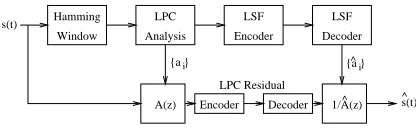
Listening tests using the scheme depicted in Figure 3 indi-cate that the transparency criterion formulated by Paliwal and Atal [13] in the context of narrowband speech codecs is also relevant in wideband scenarios. This criterion uses a Spectral Distortion (SD) measure given by
SD 2
= 1 f
s Z
fs 0
h 10log
10
(P(f)) 10log 10
( b P(f))
i 2
df;
whereP(f)and b
P(f)are the amplitude spectra of the
orig-inal and reconstructed signal, respectively. The required criteria are satisfied, if an average SD of about 1 dB is maintained and there are only a few ’outliers’ between SD=2 and 4 dB, while there are no outliers in excess of SD=4 dB. In addition, an important issue in speech qual-ity terms is the preservation of the stabilqual-ity of the Short Term Predictor (STP). The STP filter’s stability has a dra-matic influence on the reconstructed speech quality, which
is guaranteed by preserving the ordering property of the LSFs.
Every codec designed for transmission over noisy channels has to exhibit a good robustness against channel errors. The effect of transmission errors is characterized by their imme-diate impact on both the present speech frame and also on the forthcoming frames. The effect of channel errors and the associated bit sensitivity issues will be discussed in Sec-tion 4. Complexity reducSec-tion is also of high importance for real time applications. The codebook storage requirements and codebook search complexity are the main factors to be taken in consideration in the field of vector quantization.
In our investigations, training and testing of the vec-tor quantization schemes was performed using wideband speech files from the TIMIT database [15]. An LPC
anal-ysis of orderp = 16was performed every 10 ms, using
a 15 ms Hamming analysis window. A 30 Hz bandwidth expansion was applied to each pole of the LPC coefficient vector. A training set of 14000 LSF vectors was gener-ated from speech files recorded from American male and female speakers. However, for the sake of reduced com-puting time, our codebook computations using the Gener-alized Max Lloyd algorithm [14], were usually processed using 7000 LSF vectors. In addition, a test set of 778 LSF vectors was used for the evaluation of the resulting percep-tual quality.
Let us now examine in the next section a few wideband LSF vector quantization schemes.
2
W
IDEBANDLSF V
ECTORQ
UANTIZERS2.1 MEMORYLESSVECTORQUANTIZATION
The so-called Nearest Neighbour Vector Quantization (NNVQ) scheme [14] theoretically constitutes the optimal memoryless solution for VQ. However, the high number of LSFs - typically 16 - required for wideband speech spectral quantization results in a complexity that is not realistic for a real time implementation, unless the 16-component LSF vector is split into subvectors. As an extreme alternative, low complexity scalar quantization constitutes the ultimate splitting of the original LSF vector into reduced-dimension sub-vectors. This method exhibits a low complexity and a good SD performance can be achieved using 16-entry or 4-bit codebooks. Nevertheless, the large number of LSFs required in wideband speech codecs implies a requirement of 416=64 or 516=80 bits per 10 ms speech frame. As a
result, the contribution of the scalar quantized LSFs to the codec’s bit rate is 6.4 or 8 kbit/s. Slight improvements can be achieved using a non-uniform bit allocation, when more bits are allocated to the perceptually most significant LSFs.
+
-++
LSF STAGE 1 LSF_q STAGE 2
E_q
index stage 1
index stage 2 SPLIT VQ SPLIT VQ
[image:4.612.59.281.50.118.2]E
Figure 4: Schematic of the multi-stage split VQ
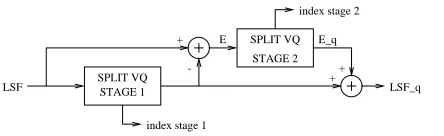
SD within a given total complexity. Specifically, split vec-tor quantization operates on sub-vecvec-tors of dimensions that can be vector quantized within the given constraints of complexity, following the schematic of Figure 4.
One of the main issues in split LSF VQ is defining the best possible partitioning of the initial LSF vector into sub-vectors. Since the high frequency LSFs typically exhibit a different statistical behaviour from their low frequency counterparts, they have to be encoded separately. For lin-ear predictive filters of order 16 the 3 highest order LSFs behave differently from the other LSFs, as exemplified by Figure 2. Hence, this leads naturally to a (13,3)-split VQ scheme. Figure 5 shows the PDF of the SD using a (6,7,3)-split LSF VQ scheme, where the lower frequency 13-component sub-vector is split into two further 6- and 7-component sub-vectors, in order to reduce the implemen-tational complexity. Seven bits, i.e 128 codebook entries were used for each sub-vector. Additionally, a (4,4,4,4)-split second stage VQ was applied according to Figure 4 using five bits, i.e. 32 codebook entries for each sub-vector. We refer to this scheme as the[(6;7;3)
777
;(4;4;4;4) 5555
]
41-bit regime.
0.0 0.5 1.0 1.5 2.0 2.5 3.0 3.5 4.0 Spectral Distortion (dB) 0.0
0.02 0.04 0.06 0.08 0.1
Probability
Split VQ 41 bits
Avg. SD = 1.46 dB
Figure 5: PDF of the SD for the 41-bit split VQ scheme using the
[(6;7;3)777;(4;4;4;4)5555] two-stage regime
(Com-pare to Figure 10 and 13).
The lower intra-frame correlation of the higher frequency LSFs imposes a high bit rate requirement on the SVQ in the light of the relatively low energy contained in the cor-responding speech band (typically less than 1%). Although split VQ schemes are attractive in complexity terms and can preserve the LSFs ordering property, they often fail to
Classifier C1,C2,..,Cm
Speech
VQ Codebook Ci
Ci
i
Codeword index
Codebook index LSF
Figure 6: Schematic of the Classified VQ
reach the target SD within a low bit rate budget.
The introduction of LSF Classified Vector Quantization (CVQ) [14] aims to assign the LSF vectors into classes hav-ing a particular statistical behavior, in an effort to improve the coding efficiency.
In Figure 6 the LSF vectors are classified into one of m
categories C 1
C
m and then a reduced-size codebook
C
m, which reflects the statistical properties of class mis
searched in order to find the best matching codebook en-try for the unquantized LSF vector. Clearly, this scheme searches a reduced-size codebook, reducing the matching complexity and the quantization precision in comparison to a VQ using no pre-classification before quantization. In the context of wideband speech LSF quantization, we wish to find a classification of the LSFs, which can provide a more efficient representation of the vector to be quantized, than the previous SVQ. Accordingly, the main issue in classified vector quantization is the design of an accurate classifier. In this context, we briefly investigate the performance of a voiced/unvoiced classifier.
[image:4.612.312.517.51.115.2]The problem of voicing detection can be solved upon in-voking an auto-correlation based pitch detector [11], ex-ploiting the waveform similarities between the original speech and its pitch-duration shifted version. The high-est correlation between these two signals is registered, when their displacement corresponds to the pitch. Fig-ure 7(a) shows a low-pass filtered speech waveform ban-dlimited to 900Hz, which was subjected to autocorrelation-based voicing-strength evaluation and thresholding at a normalised cross-correlation of 0.5, in order to generate the binary voiced/unvoiced (V/UV) decisions seen in Figure 7(b).
[image:4.612.67.238.454.590.2]0 10000 20000 30000 40000 50000 Samples -1000 -500 0 500 1000 1500 Magnitude
(a) Low-pass filtered speech signal
0 20 40 60 80 100 120 140 160
Frames 0.0 0.4 0.8 1.2 V oicing Strength
Voicing Strength Voicing Decision
(b) Voicing Strength and the associated binary Voicing De-cisions
Figure 7: V/UV speech classification using low-pass filtering of the speech to 900Hz and auto-correlation based pitch detection.
but less pronounced clustering along the ordering property border.
Voiced and unvoiced LSFs do not necessarily exhibit a to-tally different statistical behavior in their clusters along the ordering property border in Figure 8. However, the typi-cally more concentrated clusters of the voiced LSF frames can be typically more accurately vector quantized, whereas the somewhat more scattered occurences of the unvoiced frames’ LSFs are expected to be less amenable to CVQ. Similar scatter diagrams can be obtained also for higher frequency LSFs, although the pronounced difference be-tween voiced and unvoiced frames tends to decrease, as the frequency increases. This is directly related to the less pronounced correlation between neighbouring LSFs for the higher frequencies of the 8kHz range.
Although our simulations using this CVQ gave better SD results, than the previously discussed Split VQ, the overall scheme presents shortcomings. Specifically, if the speech frame classification is carried out before the LSF quanti-zation, classification errors at the voiced/unvoiced speech boundaries increase the average SD, as well as the number of outliers. At the decoder, this method has to rely on the voiced/unvoiced information extracted from the excitation
0 200 400 600 800
LSF 1 (in Hz) 0 200 400 600 800 1000 1200 1400 LSF 2 (in Hz) Voiced Frames . . . . . . . .. . .... . . . . . . . . . . . ... . . . . ... . . . .. . . . ... . . . . . . ... . .... ... . . . .. . . . . . .... . . . . .. . . . . .. .. . ... .. .. ... . . ... .. . . . .. ... . . . . . . . . . . . .. . . . . . . . . . . . . . .. . . ... . .. .. . . . . . .. . . . .. . . . . . . . . . . . . . . . . . .. . . .. . .. . . ...... ... .. . . .. . . . . .... ... . .. . . .... . . .. . . .. . .. . . ... . . .. . .... ... . . . . .. . . . . .. . . . . . .. .... . .. . . . . .. . .. . . .. . .. . . . .... . . . . . . . . . . . . . . . . .... . .. . ... . . . . . .. . . .. . . . ... .. . . . . . . . . .. . . . .. . . .. . . .. . . .. . .... . . . . . . . . . . . . . . .... . . . .. . . . . .. . . . . . .. . . . ... . . . . . . . . .. . . . . . . . . . . . . .. . . . . .. . . . . .. . . . . . . . . .. . . . . . . . . . . . . . . . . . . . . . . . . ... . ... . . . . . ... . .. . . . . . . .. . . . . .. . . . . . . . . ... .... .. . . . . .. . . . . . . .. .. . . .. .. . . . . . . . ... . . . . . . . . . . . . . . . . . . . . . .. . ... . . .. . . . . . . . . . . . . .. . . . . ... . . . . . . .. . . .. . . .. . . . .. . . . .... . . . . ... . . . . . .. ... . . . . ... . . . . .. . .. . . . ... ... . ... .. . . . . . . . . .. . . . . . . . . . .. . ... . . . . .. . . . . . . . . . . . .... . . . . . . . . . ... . . . . . . . . . .. . ... ... .... .. . .. ... . . . .. . . . . . . . . . . ... . . . .. .. . . . . . . ... . .. . . . .. .... ... . . . ... . .. . . . . .... . . . . .. ... .. . .. . . . . . . . . .. . . . . . ... . .. .. ... .. . . . . . . . . .. ... ... . .. . . .. . . ... . . . . . .. . . . . . . . . . .. .. .... . .... .... . . . . . . . .. ... . . . . . .. . . . .. . . .. . . . . . . . . . . .. . . . . . ... . . . . . . . . . . .... . . . . . .. . ... . .. . . . . . . ... ... . . . . . . . . .. . . .. . ... .... . .. ... . . .. . . .. ... . . ... ... . . . . . . . . . . .... . . . . . . .. .. .. . .. . . . .. . . . . .. . . .... .. .... . . . . . . . . .. . . . ... ... . . . . .... . . . .. . . ... . . . . . . .. . . .. . .... . . . . .. . . . . ... . . .. . . . ... . . . . .. . . . . . . . ... . .. . . . . . .. . .. .. . .. . . . . . .... . . . ... . . . . . . .. . ... .. . . . . . ... . . . ... . .. ... ... . . . .. . .. . . . . . ... . . . . .... . .. . . . . .. ... . . . .. . . . . ... ... . ... . . ... . .. . . .. . . . . . . . . . . . . ...... .... . . . . . .. .... .... . . . . . . . . . . ... . . . . . . . .. .. . . . . .. ... . . ... . . . ... . . ... . . . . . . . .. . .. . . ... . . . . . . . .. . . . . .. . . . . .. . .. . . .. .. . ... . . . . .. . . . . .. . ... . . . ... .. . .. . . .. . . . . . . . . .. . . . . ... . . . . . .. .... .. . . ..... ... . . . . .. . .... ... . . .. . . . . . . .. . ... . . . . . . . . .. . . . .. . . .. . . . . . . . . . . ... . ... . . . . .. . . . . ... ... . . . .... . . . . . .. . . . . . . .. . . . . . . . ... . . .. . . . ... . . . . ... . . . . ... . . . . . .. . . . . .... . . .. .. . . . .. .. ........ ... .. . . ... . . . .. . . . . . . . . . .. . . . . . .. .... . . . . .. .. ... . .. .. .. . .... . . . . .. .. . . .. . . . . . . . . . . . . . . . .. . . .. . . .. . . . . . .. . . . .... . .. ... . . . .. . . . . . ... . .... . .. . .. . . .. . . .. . .. . . . ... . . . . . . ... . . . . . .... .. . . . . ... . . . . . . ... . . . ... ... .... . . . . . . . . . ... . . . ... . . . . . . . . ... . .. . . . ... . ... . ... . . ... . .. . . . . . .. . . . .. . . . . .. .. . . . .. . . . . ... ... . . . . .. . . . . . .. .. . . . .. . . . . . . . . .. . . . . .. ... . . .. . . . . . . . .... . . . . . ... ... .. . . . . . .. . . . . . . . . . .. . .. . . . . . .. . .... .... .. . .. ... . . .. ... . . . .. . . . . . . . . . . .. . . . .. . .. . .... . . . . ... .... . . . . . . . .. . .. . .. .. . .. . .... . . . . . . . . . .. . .. . . . . . . . . ... . ... . . .... ... ... . . .. . . . . . . .. . . . . . . . . . . . . .. .. . .... . . . . .. .... .. . . .. .. . ... .. . . . . . . . . . .. . . . . ... . . . . ... ... ... . . . . . . . . . . . . .. .... ... . . . . . . . ... . . . . . . . . .. . . .. . . . . ... . . . . . .. .. . . . . . . . . . . . . . . . . . . . . .. . . . .. ... . . . . . . .. . .. ... . . . . ... . ... . . .. .. . . ... .. . . . .. . ... .... . ... . . . . . . . ... . . . . .. . .. . . . ... . . . . . . . . .. .. . . .. . .. . . .. . . . .. . . . . . . .. .... . .... . ... . . . ... . . . . . . ... ... . ... . . . . .. . . . . . . . . . . . . . . . . ... .. . . .. . . . . . . ..... . . . . .. . . .. ... . . . ... . . . ... .. .. . ... .. . . . . . .. .... ... . . . . . . . .. . .. . . . . . .. ... . . . . . . . .. . . . . . . . . .. . . .. . .... . . .. . . . . . . .. . . . . .. ... . . . . . .. . . . . . .... . . . . . . .. . . . .. .. . . . . ... . . ... . .... . . . . . .. . .. . . . ... .. . .. . . . . .. . . . .. . .. . .. . . . . . . ... ... . ... .. . . . ... . . .. .. . ... .. . . . . .. . . . . .. . ... . .. .. . . . . .. ... . . . .. . . . ... . .. .... . ... .. . . . ...... . . . . . . ... . . . . . . . . . . . . . . .... .... . ... . . . . . . . . . . . . . . .. . . . . . . . . . .. . . . . .. . .. . .... .. . .. . . . . .... . . .. . . .. . . . .. . . . . . . ... . .. . . . .. . . .. .. . . . . . . . . . . . . . . . . . . . . . ... ... . . . .... ... .. .. ... . . . . . .. . .. . . . . . . . ... . . . . . . . ...... . .. . . ... ... . .. . . . .. ... . . .... . . . .. . . . .. . .. .. .. .. . . . . .. . .... . ... . ... . . . . . .... . . .. . . ... . . . .... . . . .. . . . . . . . . ... .. . . . . .. . . .... . . . . .. . . . .. . . . .. . ... . . .. .. . .. ... .. . . ... ... . . . ... ..... . . . . . . .. . . . .. . ... . . .... ... .. ... . . . .. .... . . . . .... . . . . ... ... . . . . . . ... . . . ... .. . . . . . . .... . . .. . . . . .. . . . .. .. . . . . . . . . .... . . . ... .. . . . . . . .. . . . . . . . . . . . . . . . . . .. ... . . . ... . . . . . . . . . . . . . . ... . . . . . ... ... . . . .. . . .... . . ... .. . . . . . . . . .. . ... . . . . . . . . . . ... . . . . . . . . . . . ... . . . . . . . .. . . . . . . .... . . . . . . .. . .. . .. . . . . . . . .. .. .. . . ... . . . . . . . . . . . ... ... . . . . . ... . .. . ..... . . . ... .. . . . . . ... . .. .. ... . . . . . . . . . . . .. .. . . . ... .. . . . .. . . ... . . . . . ... . . . . . . . . . . . . . . . . . . . . .... .. . . . . . . . . . . .. . . ... . . . ... .. . . . . .. . . . . . .. . . . . . . . .. . . . . .... . . . . .. . . . . .. . . . . . . . .. ... . .. . . . . . ... .. . . . . . . . .. .... . . . . . . . . . . . . . . .. . . . . . . . . . . ... .. . . . ... . . . . .. .. . . . . . .. . . . . . ... . . .. ... . . . . . . . . . .... . . .. . . . . . . ... . . . . . . . . . . . . .. . . . . . . . . . . . . .... . .... . . . . . .. . .. . . . . . .. ... . . . . . . . . .. . ... . .. . . . . . . . . . . .... ... . . . . . . . . . . . . . . . . . . . .. . . ... . .. . . .. ... . .... . .. ... . . .. . . . . . . . . . . . . .. . . . . . . . . . . . . .. .. . .. .. . . . . . . .. .. . . . . .. .. .. ... . . .... ... . .. . . . ... . . . . . . ... . .. . . . . . . . . . .. . .. . . . . . . .... .. ... . . . . .... .. .... . ... . . ... . . . ... . . .... . . .. . . . .. . .. . . ... . . . .... . . . . . . . . . . .. . . . . . . . . . ... . . ... . . . . . .. . . . . . ... . ... . . . . .. . ..... .... .. . . . . . . . . .. . .... . . . . . . . ... . . . .... . . . . . . . . ... . . . . . .. . . . . . . .. . . . . . .... . .... .. . .... . ... . . . . . .. . . . . . . . . . . .. . . . ... ... . . . . .. . . . . . . . . ... . . . . .. . . . . . ... . . ..... . . . . . . . . . . . . . .. . . .. .. .. . . . . . . . . . .. . . ... .. . . .... . . . .. . .. . . . . . .. . . . . . .. ... . . . . . . . . . . .. . . . . . . . . . .. .... . ... . . . . . . .... . . . . .. .. . ... . . . . . . . .. . . . . . . . . . . . .. . . ... . . . . . . .. . . .. . . . .. .. . . . . . . ... .... . ... . . . . .. . . . . . . .. . . . . ... . . . . . .. .. .. ... . . . . .. ... . . . . . . . . . . . . . . . .. .. ... ... . . . . . . . .. . . . .. . . . . ... . . . .. . . .. . . . . . . . .. . . .... . . .. . . . . . . . . .... .. . . .. . . . . .. ... . . . . . . . . .. . .... . . . .. .. . . . . . . .. . . . .. . ... .. . .... . . . . . . . ... . .. ... . . . . . . . . .. . . . . .. . . ... . ... . .. .. .... . . . ... . . ... .. . . .. . . . . .. . .. . . . . . . ... . . . . . . . . . .. . . . . . . . . .. ... ... . . . .... ... ... . . . . . . . . . . . . .. . .... . . .... . . . ... . . . . . . . . . . . . . . .. . . . . . . . ... . .. . . . .... . . .. . ... . . .. ... . . . . . . . . ... .. .. . ... . .... . . . . . . .. . . ... . . .. . . . . . . . ... . .. . . . . . .. . . . . . . .. .. . . . . . . . . . . . . . .... . . . . ... . . . .. .. ... . . . . . . . . . . .. . . . . . . . . . . ... . . . . .. .. . . . ......... ... ... . . . . . .. . . . . . . . .. . . . . . ... . ... ... . . . . . . .. .. . . . . . . . . . . . . . . . . . . . ... . . . . .. . . . . . . . . . . . . . . ... . .... . .. . . ... . . . . . . .. . . ... . . . . . . . . . .. . . . . . . .. . .. . .. . .. . . . . . . ... . . . . .. .. . . . . .. . . . ... . . .... . . . . . . . . . . . . . .. . .. . . .. . . . . . .. . . . . .. .. ... .. . . . . .. . . . .... . .. .. ... .. . .. . . . . . . ... . ... . . . . . . ..... .. . .. . . . . ........ .. . . . . . . . . . . . .... . . . .. .. .. . . . . . . ... . . . . . ... . . ... . . . .. .... . .. ... .... . ... . .. .. . . . .. . . ... .. . .... .. .. .... . .... . . . . . . . . . .... . . . . . . . ... . . . . . .. . . . ... . . .. . . . ... . . . ... . . .. . . . . . . . ... . . . . . .. .. . . .. . . .. .. ... . . .. .. .. . .. . . ... . . . . . . . .. . .. . . . . . . . . ... . . . .. . . . . . .. . . ... . . . . .. . . . .. . . . . . . . ... . . . . .. . . . . .. . . . . . . . . . . . .... .. .... . . .. ... . . . . ... .. . . . . .. . . . . .. . . . . . .... . . . .. .. .. . .. . ... .. . . ... . . . . .. . . . . . . .. . . . . ... . .. . .. .. . .. . .... . . .. .. . . . . . ... ... . . . . .. .. . . . .. . . . .. . . . . ... . . . ... . . ... . .... . . . . . . . . .. . .. . . . . . . . . . .. . . . . . .. .. . . . . . . ... .. . . . . . . . . . . . . .. .. . ... . . . . . . . . . . . . . . . . . . . . . . . .. . .. . . . . . . . . . . . . . . . . . . . . . .. . . . . . . . . . .. . .. ... . .. . . . . . . . . .. . . . . .. . . . . . .... ... .. . ... .. ... .. . . . . . . . . . . . ... . . . . . .. . .. . . . . . . . . . . . . . . . . .... . .. . . . . . . . . . . .. . . . ... .. .. . . ... . . . . ... . .... ... .... .. . .. . . .. . . . .. . . ... . . . . . . . ... . .... . . . .. ... . ... . ... ... . . . . . . . . .. . . . .. . . . . .. . . .. . . . . . . . . . . ... ... . . . . . . ... .... . ... . . ... ... . . . .... . . . . . . . . . ... . . ... .. . . . . . . . . ... . . .. ... ... .. . .. .. ... . . . ... . . . . . . .... . . . . . ... . .. . . . . . . . . ... . . . . .. . . .... . . .. .... . . . . . . . .... . . . . . . . . . . .. . . . . . .. . . . . . . ... . .. . . . . .. . . . .. . . ... . . . .. . . .. . . . . . .. . . ... . . ... ... . . . . . . . ... ... . . . . . . . . ... . .. . ... . . . .. . ... . . ... . ... . . . . . . . . . .. .. . . . . . .. . . . . .. . . ... . .. . . . . . . . .. . . . . ... . . . . . . ... . . . ... . ... . . . .... . . .. . .. . . . . . .. . . . . ... . . . . . . . ... .. . .. . . . .. . . . . . .... . ... ... . . . . . .. . . . .. . .. . . . ..... . . ... .. . . .. .. . .. . . .... .. . .. ... . . . ... . . . . . . . . . . . . . . .... . . . . . . ... . . . .. . . . ... . . . . . . .. . . ... . .. . . . . . . . ... . .. .. .. . ... ... .. ... . . . . ... . . . . . . . .. .. . ... .. . .. . ... . . . . . . .. . . ... . ... . .. . . . . ... ... .... . . . . .. . . . .. . . . . . . . . . . .... . . . . .... . . . .. .. . .. . . .. . . . .. . . ... . .. .. . . . . . ... . . . .. . ... .. ... . . . ... . . . . . . . . . .. . . .. .. . ... .. . .. .. ... . ... . .. . . . . . . . . . ... . . . . . . . . . . . . . ... .. . . ... . . ... ... ... . . . .. . . .. . .... . . . .. . . ... .... . . . .. . . . . . . .. ... .. . . . . ... . ... .... .. .. . . .... . . . . . . ... . . . . . . . . .... . ... . . ... . . . . . . .. ... . . .. . .. . . . . .... . . . .. . . . . . . . .. . . . .. . . . . . . . . . .. . . . . . . . . . .. .... .. . . ... .. . . . . . . . .. . . . . . .. . . . . . . ... ...
0 200 400 600 800
LSF 1 (in Hz) 0 200 400 600 800 1000 1200 1400 LSF 2 (in Hz) Unvoiced Frames . . . . . . . . . . . . . . . . . . . . . . . . . . . . . . . . . . . .. . . . . . ... .... . . . . .. .. . . . . . . . . . . . . . . . . . . . . . . . . . . . . . . . . . . . . . . . . .. . . . . . . . .. . . . . . .. . . . . . . .. . . . . . . . . . . . . . . . . ... .. .. .. . . . . . .. . . .. . . . . . . . . .. . . . . ... . . .. ... . . . . . . .. . . . . . . . .. . . . . . . ... . . . . . . . . . . . . . . . . . . . . . . . . . . . . . . . .... ... . . . . . . .. . . . . . . . . .. . . . . . . . . . . . . . . . .. . .. . . . .. ... .. .. . . .. . . . . . .. . . . . . . . . . . . .... . . . . . . . . . .. . ... . ... . . . . . . . . . . . . ... . .. . ... . ... ... . . . . . . . . .. .. . .. . . . . . . . .. . . . . . . . . . . . . . . .... . . . . . . . . . . . . .. .. . ... .. . . . .. . . . . . .. . . . . . . . ... . .. . . . . . . . . .. . . . . . . . . . . . . ... . . . . ... . . . . . . . .. . . . . . . .. . . . .. . . . . . .. . .. . . . . . . . . . . . . . . . . . . . . . . .. . .. . . . . . . . . . . . . . . ... . . . . . . . . . . . . . . .. . .... .. . . . . . . . . . .. . . . ... . . . . . ... .. . . ... .. . . . . .. .. .. . . . . ... ... . ... . . . . . . . . . . . .. . . . . . . . . . . . . . ... . . . . . . . . . . . . .... . . . . . . . . . ... . . . . . . . . . . . . . . . . . . . . . . . . . . . . . . . . . . . . ... . . . . . . . . . . . . .. . . . . . . . . . . . . . . .. .. . . . . . . . . . . . .. . . . . . . . . . . . . .. . . . . . . . .. . . . . . . . .. . ... .. . .. . . . . . . . . . . . . . . . . . . . . . . . . . ... . . . . . . .. . . . . .... . . . . . . . . . . . .. . . . . .. . .. . . . . . .. ... . ... .. . . . . . . .. ... . . . . . ... ... . . . . . . . . . . .. .. . . . ... . . . . . .. .. . .. . . . . . . . . . . . . .. . . . . . . . . . . . .. . . . . . . . . . . . . . . . . ... . .. .. .. ... ... . . . . . . . . . . . .. . . . . . . ... . ... . . ... . . . . . . . . . . . . .. . . . . .. ... . . .. .. .. . . . . . .... . . . . . . . . . .. . .. . .. . . . . . ... ... . . .. . .... . . . . . . . .... . . . . . . . . . . . . . . . . . . .. . . . . . . . . . . . . . . . . . . . . . . . . . .. . . . . . ... . . . .. . . . . . . . ... . . . . . . . . . . .. . . . ... . . . . . . . . . . . . . . . . . . . . . . . . .. . . . . . . . ... .. . ... ... . . . . . . . . . . . . . . . . . . . .. . . . . . . . . . . . . .. . .. . . . . . . . . . . . . . . . . . ... . . . . . . . . . .. .. . . . . . . . . . . . . . . . .. . . . .... . .. . . . . . . . . . . . . . . . . . .. . . . . . . . . .. . . . . . . . .. .. . . . . . . . . . . . . . .... ... . . . ... . . . . . . .. . ... . . . . . . . . . . ... . . . . . . . . .. . . . . . . . . ... . . . . . . . . . . . . . . . . . . . . . . . .. . . . . . . . . . . . . .. . .. . . . ... . . . . . . . . . . . . . . . . .. . . ... .. . .. . . . . . . . . . . . . . . .. . . . .. .. . . . . . . . . . . . . . . . . . . . . . . . . . . . . . . . . . . . . . . . . . . .... . . . . . . . . . . . . . .. . . .. .. .. . . .. . . . . . . . . . . . . .. . . . . . . . . . . . . . . . . . . . . . . . . . . . . . . . . . . . . .. . . . . . . . . . . . .. . .. . . .. .. . . . . . . . . . . . . . . . . . . . . . .. . . . . . . . . . . . .. . . . . . . .. . . . . . . . . . . . . . . . . .. . . ... . .. . . .. . . .. . . . . . ... . . . . . . . . . . . . . . . . . ... . . . . . . . .. . . . . . . . . . . . . . . . . . . . . . . . .. . . . . . . .. . . . . . . . . . . . . . .. . . ... .. . . . . . . . . . . . . . . . . . . . . ... . . . . . .. . . . . . .. .... .. ... . . . . . . . . . . . . . . .. . . . .. . . . . .. .. .. ... . . .. . . . . . . . . . . . . . . . . .. . .. . . .. . .. . .. . . . . . . . . . .. . . . . . . . . . . . . . . . . . . . . . . .. . . . . . . . . . . . . . . . . . . . . . . . ... . . . . . . .. . . . . . . . . ... . . . . . . . . . .. . ... ... . .. . ... . . . . . .. . . . . . . ... . . . . . . . . . . . . . . ... .. . . .. . . . . . .. . . .. . . . .. .. . . . . . . . .. . . . . . . . . ... .. . . . .. .. . . . . . . . . .. . . . . . . . . . .... . ... . . . . . . .. . . . . . . .. . . . . . . . . . .. .... . .. .. .... . . . . . . . . . . . .. . . . . . . .. . . . . . . . . . . . . . . . . . . . . . . . . . .. . . . . . . . . . . ... . . . ...... . . . .... . . . . . . . . . ... . . . . . . . . .... . ... . .. . .. . . . . . . . . . .... . . .. . . . . .. . . . . . . . . . . . . . . .. ... . . . . . . . . . . . . . . . . . .... . . . . .. . .... . . .. . . . . . . . . . . . . . . . . . . . .. . . . . . . . . . . .. . .. . . . . . . .... . . . . . . . . . . . . .. ... .. .. . . ... .. . . . . . . . . . ... . . .... .... . .. . . . . . . . . . .... . .. .. . . .. .. .. . .. . . . . . . . .. . ... .. . . . . . . . . .. . .... . ... . . . . . . . . . . . . .. . .. .. . . . .. . . . . . . . . .. . . . . . . . . . . . . .. . .. . . .. .. . . . . ..... . . . . . ... . . . . . . . . .. . .. ... . . . . . . . . . . . . . . . . . . . . . . . . . . . . . . . . . . . . .. . . .. . . . . . . . . . . . . . . . . .. . . . . . . . . . . . . .. . .. . . . . . . . . . .. . . . .. . . . . . . . . . . . . . . . .. . . . . . . . . . . . . . . ... . . . . . . . . .. . . . . . . . . . . . . . . .. . . .. . . .. . . .. . . . .. . . . . . .. . . .. . . .. . . ... .. .. . .. . . . . ... . . . . . . . . . . .. .. . . . . . .. . . .. . . . .. . . . . . . . ... . . . . . .. . . . . . . . .. . . . . . . .. . . . . .. . . . . . . .. . . . .... . . . . . . . . . . .. . . . . . . . . . . ... ... ..... .. ... . . . . . . . . . .... . . .. . . .. . . . . . . . .. . . . ... . .. . . .. . . . . . . . . .. .. . . . . . . .. .. . . . .. . . . . . . . . . . . . . . . . . .. . . . . ... .. . . . . . ... .... ... .. . . ... .... . . . . . . . ... . . . ... . .. . .. . . . . . . . . . . . . . . . . . . . . . . . . . . . .. . ... . . . . . . .. . . . . . . ... . .. . . . . . ... . . .... ... . . . . . ... . .. . . . . . . . . . . . . . . . . . . . . . . . . . . . . . .. .... .. . . . .. . . . . .. . . . . . .. . .. . ... . . . . . . . . . ... . . . . . . . . .. . . . . .. .. . . . . . . . . . ... . . . . . . . . . . . . . .. . . . . . . . . . . . .. .. . . . . . . . . . .. . .. . .. . . . . . . . . . . . . . . . . . . . . . . . .. . . . . . . . . . .. . . . . . . .. . . . . . . . . . . . .. . . . ... . . . . .. .. .. . . . . . . . . .. . . . . . .. . . .. . . . . . . . . . . . .... . . . .. . . . .... . . . . .. . ... . .. . . .. . . .. . . . . . . . . . .. .. . . . . . . . . . . . . . . . . . . . . . . .. . . . . ... . .. . . . . . ... . ... . . . .. . . . . . . . . .. . .. . . . . .. . . . . . . . .. . . . . .. . . . . . . . . . . . .. . . .. . . . . . .. . . . . . . . . .. .. . .... . . . . . . . . . . . . . . . . . . . . . . . . . . . . . . . . . .. . . . . . . . . . . . . . . . . . . . . . . ... . . . . . .. .. .. . . . . . . .. .. . . . . . . . .. . . . . . . . . . . . . .. . . . . . . . . . .. . . . . . . . . . . ... .. . . . . . . . .. .. . . .. . . . . . . . . . .. . . . . . .. . . . . . .. ... . . . . . . ... .. .. . .. . . . . . . . . .. . . . . ... . . . . .. . . . . .... . . . . . . .. .. . . . . ..... . . . . . .. . . .. ... . . . .. . . . . . . . . .. ... . . ... . . . . . . . . . . .. . . .. ... . . . . . . .... ... . . . . . . . . . . .. .. .. .. . . . . . . ...... .. .. . . . . . . . . . . . . . . . ... . . . . . . . .. . .. . . . . ... .. .. . .. . . . .. . . .. . . .. . . . . . . . . . . . . . . . . . .. . . . . . . .. .. .. . . . . . . . . .. . . . . .. . . . . . . . . . . .. . . . . . . . . . . . . . . . . ... . . . . . ... . . . . . .. . . . .. . . . . . . . . . . . . . . . . . . . . . .. . . . . . . . . . . .... . .. . . . . . . . .. . .. . . . . . . . . . . . . . .. . . . . . .. . . . . ... . .. . . . . . . . . . . . . . .. .. . . .. . . . . . . . . . . . . . ... . .. . . . . . . . . . . . . . ... . . .. . . . . . . .. . . . . . . . . . . . . . . .. . . . . . . .... . . . . .. . . . . . ... . . . . . . . .. .. . . . . . . . . . . .. . .. . . . . .... .. . . . . . . . . . . . . . . . . . . . . . . . . .. . . .. . . . . . .... .. . . . ... ... . . . . . .... . .. . .... . .. . . ... . ... ... . . . . . . . . . . . . . . . . . .... . . . . . . . . . . . . . . . .. .. . . . . . . . .. . . . . . . .. . . . .. .. . .. . . . . . . . . . . . . . . . .. .. . . .. .. . .. . . . . . . . . . . . . .. . . . . .. . . . .. . . . . . . . . . . . . . . . . . . . . . . . . . . ... . . . . . . . . . . . . . . . . . . ... . .. . . . .... .. . . . . ... . . . . . ... .. . . . .... .. . ... . . . . . . . . .... . .. . . . . . .. . . . ... . . . . . . . . . . . . . . . . . . . . . . . . . . . . . . .. . . . . . . . . . ... . . . .. . .. . . . . . . . . . . . . . . .. . . . . . . . . . .. . . . . .. . . . . . . . . . . . . . . . . . . . .. . . . . .. . . .. . . . . . . . . . . . .. .. . . . . . . . . . . . . . . .. . .... . . .. . . . . . . .. . . . . .. . . . .. .. . .... . . . . . . . . . . . .... . . . . . . . . . . . . . .. . . . . . . . . . .... . . . . . . ... . . .... . . . . ... . . .. . . . . . . . . . . ... . . . . .. . . . . . . . . . . . . ... . .... . . . . . . .. .. . . . . . . . . . . . . .. . . .. . . . . . .. . . . . . . . . ... .. .. . . . . . . .. . . .... .. . .. . . . . . . . . . . . . . . . . . . . . . . . . .. . . .... . . . . . . . .. . . . . .. . . . . .. . . . . .. . . . . .. . .. . . ... . . . . . . . .. . . . . . . . . . . . . . . . .. . . . . . . .... . . . . . . . . . .. . .. . . . . . . . . . . . . . . . . . . . . . .. . . . . . . . . . . . . . . .. . . . . . . . . . . . . . . . .. . . . . ... . . . . .. . . . . . . .. . . .. .. . . . . . . . . . . . . . . . . . . . . . . . . . . . . . . . . . . . . . . . . . . . . . . . . . . . . . . .. . . . . . ... . . . . . . .. . . .. . . . . . . .. . .. .... . .. . .. . . . . . . . . . . . . . . . .. .. . . . .. .. ... . . .. . . . .. .. . . . . .. . . . . . . . . . . .. . . . . . . . . .. .. . . . . . .. . . . . . . . .. . . .. .. . . .. . . . . . . . . . . . .. . . .. . .. ... . . . . . .. . . .. . . .. . . .. . .. . . . . . . . . . . . . . . . . . . . .. . . . . .. .. . . . . . . . . . . . . . . ... .... . .. .. . . . . . . ... . . . . .. . . . ... . . .. .. . . . . . . . .. . . . . .. ... . . . . . . .. . . . .. . . . . . . . . . . ... . . ... . . . . .... . . . . .. . . .. . . . . . .. . . . . . .. . . . . . .... . . .. .. . . . . . . . .. . . . . . . . . . . . . .. . . . . . . . . . . . . . . . . .. . . . . . . . . . .. . . . . . . .. .. . . . . . . . . . . . . . . . . . . . . . . . . . . . . . . . . . .. . . . . ... . .. . .. . . . . . . . . . . . . . . . . . . . . .. . . . . . . . . . .. . . . . . . . . . . .. . . . . . . . . . . . . . . . ... . .. .. . . . . ... . . . . . . . . . . . . . . . . . . . . . . . . . . . . . . . . . . . . . .... . . . . . . .. . . . . . . . . . . . .. . . . . . .. . .... ... . . . .. . . . . . . . . . .. . . . . . . .. . . . . . . . ... . . . . . . .. .. ... . . . . . . . . . .. . .. . ... .... . . . . . . .... .. . . . . . . . . . .. . . . . . . . . . . .. . . . . . . .... ... .. . . . . . . . . .. . .. . . . . . . . . . . . . . . . . . . . .. . ... . . . . ... . . . ... . . . ... . . . . . ... . . . . ... . . . . . . . .. . . . ... . . .. . . . . . .. . . . . . .. . . . . . . . . .. . . . . ... . . . . . . . ... .. .... . . . . . . . . . . . . . . . . . . . . . . . .. . . . . . . . . . . . . . . .. . .. . . . . . . . . .. . . . .. . . . . . . . . . . . . .. . . . .. . . . . .. .. . . . . . . . . . . . . . . . . . . . . .. . . .. . . . . . . . . .... . . . . . . . . .. . .. . .. . . . . . . . .. . . . . . . . . . .
Figure 8: Scatter diagrams of the first two LSFs for WB voiced and unvoiced frames.
signal in order to reconstruct the LSF coefficients, unless the V/UV mode is explicitly signalled to the decoder. Alter-natively, if the V/UV classification is processed after LSF quantization upon selecting the mode having the lower SD, no classification errors occur, although one bit per speech frame is required for transmitting the V/UV mode selec-tion. When using the [(6;7;3)
777
;(4;4;4;4) 5555
] 41-bit
Split LSF VQ for each mode, an average SD of 1.15 dB is obtained upon invoking a mode selection bit, whereas an average SD of 1.35 dB is achieved using the pitch-detection based classification.
Additionally, it is difficult to proceed to a joint optimization of both the voiced and the unvoiced codebooks, since there are regions of the LSF domain where both types of LSFs can be located. The LSF clusters, which are encountered in both modes, are quantized independently by the voiced codebook and the unvoiced codebooks. Hence the same sub-domain of the LSF space is mapped twice by the quan-tization cells of both modes. This leads to a sub-optimal quantization of this area. Let us now consider predictive VQ schemes.
2.2 PREDICTIVEVECTORQUANTIZATION
In this section our work evolves from memoryless vec-tor quantization to more efficient vecvec-tor quantization schemes exploiting the time-domain inter-frame correla-tion of LSFs. According to this approach we typically quantize a sequence of vectors, where successive vectors may be statistically dependent.
ex-VQ
PREDICTOR LSF
LSF_q +
[image:6.612.58.272.50.139.2]
-+ +
Figure 9: Schematic of a Predictive Vector Quantizer (PVQ).
0.0 0.5 1.0 1.5 2.0 2.5 3.0 3.5 4.0 Spectral Distortion (dB) 0.0
0.02 0.04 0.06 0.08 0.1
Probability
Predictive VQ 36 bits
Avg. SD = 1.45 dB
Figure 10: PDF of the SD for the 36-bit PVQ scheme (Compare to Figure 5 and 13).
hibiting a reduced dynamic range. Hence, for a given num-ber of codebook entries, PVQ is expected to give a lower SD, than non-predictive VQ.
Auto-Regressive (AR) predictors use recursive reconstruc-tion of the LSFs, hence they potentially suffer from severe propagation of channel errors over consecutive frames. By contrast, a Moving-Average (MA) predictor can typically limit the error propagation to a lower number of frames, given by the predictor order. For example, a fourth-order MA predictor was succesfully employed in the G.729 nar-rowband standard speech codec. Other methods of limiting bit error propagation have also been studied by Eriksson
et al. [19], in the context of narrowband speech. Here,
however we will restrict our experiments to first order AR vector predictors.
Predictive vector quantization does not necessarily pre-serve the LSFs’ ordering property. This may results in in-stability of the STP filter, deteriorating the perceptual qual-ity. In order to counteract this problem, an LSF rearrange-ment procedure [16] can be introduced, ensuring a mini-mum distance of 50Hz between neighbouring LSFs in the frequency domain.
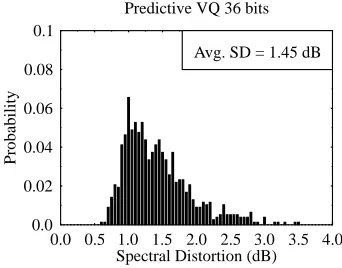
Figure 10 shows the PDF of the SD using(4;4;4;4) 9999
36-bit split vector quantization of the prediction error, em-ploying a 9-bit codebook per 4-LSF sub-vector. This quan-tizer hence requires a total of49=36bits per LSF vector.
Based on the above experience we conclude that our 36-bit
Predictive VQ provides a gain of 5 bits per LSF vector in comparison to our previous 41-bit memoryless SVQ hav-ing a similar complexity. Equivalently, predictive VQ gen-erates an average SD gain of approximatively 0.3 dB for a given bit rate. A deficiency of this method is its higher sen-sitivity to channel error propagation, although this problem can be mitigated by using MA prediction instead of AR prediction. During our investigations we noted that this scheme was sensitive to unpredictable LSF vectors gener-ated by rapid speech spectral changes, which increase both the average SD as well as the number of SD outliers beyond SD=2dB. This problem is addressed in the next section.
2.3 MULTIMODEVECTORQUANTIZATION
Our previous classified vector quantization scheme has primarily endeavored to define V/UV correlation modes. When we observe these voiced/unvoiced speech transitions in the time domain, they result in the rapid changes of the LSF traces seen in Figure 2 for example around frame 20. Several methods exist for differentiating between these modes. Switched prediction is widely employed [11, 16]. In this section, we will investigate the separate encoding of the unpredictable frames due to rapid spectral changes and that of the highly-correlated frames. This can be achieved by the combination of a predictive VQ and a fixed mem-oryless SVQ, referred to as the so-called Safety-Net VQ (SNVQ) scheme [17, 18, 19, 20]. In this context, we invoke a full search using both the predictive VQ and the fixed memoryless SVQ schemes for every speech frame, and the better candidate with respect to a mean-squared distortion criterion is chosen.
The Safety-Net VQ improves the overall robustness against outliers, which are typically due to input LSF vectors hav-ing a low correlation with the previous LSF vectors. In addition, the Safety-Net VQ allows the PVQ to concen-trate on the predictable, highly correlated frames. Hence, the variance of the LSF prediction error is reduced and a higher-resolution LSF prediction error codebook can be designed. The advantage of this method is that when the inter-frame correlation cannot be successfully exploited in a PVQ scheme, the intra-frame correlation is capitalised on instead. Another interesting aspect to consider is the performance of the SNVQ scheme for transmission over noisy channels, which will be discussed in Section 4. In a memory-based PVQ scheme, a bit error will lead to er-ror propagation over consecutive frames. By invoking a memoryless SVQ scheme together with a memory-based scheme, error propagation will be cancelled every time an entry from the Memoryless SVQ codebook is selected and correctly transmitted to the decoder.
[image:6.612.68.239.190.324.2]Memoryless
VQ
Predictive
VQ
COMP
[image:7.612.70.282.52.153.2]LSF LSF_q
Figure 11: Schematic of the Safety-Net Vector Quantizer (SNVQ) constituted by a memoryless- and a predictive-VQ.
are compared to the input vector, in order to select the bet-ter quantization scheme. The codebook index selected is transmitted to the decoder, along with a signalling bit that indicates the selected mode. The specific transmitted quan-tized vector is finally used by the PVQ, in order to predict the LSF vector of the next frame.
The performance difference between the memoryless SVQ and predictive VQ sections of the SNVQ suggests the em-ployment of variable bit rate schemes, where the lower per-formance of the memoryless SVQ can be compensated by using a larger codebook. In our experiments below - as before - a memoryless SVQ 41-bit codebook was used. Hence, the SNVQ is characterized by its average bit rate, depending on the proportion of vectors quantized by the
predictive and memoryless VQ, respectively. Eriksson,
Linden and Skoglund [19] argued that the optimum per-formance is attained, when 50 to 75% of frames invoke the PVQ.
28 30 32 34 36 38 40
Predictive VQ Size (in bits) 0
10 20 30 40 50 60 70 80 90 100
%
Predictable
V
ectors
[image:7.612.91.252.483.606.2]Split VQ 43 bits Split VQ 41 bits Split VQ 36 bits
Figure 12: Proportion of frames using PVQ in various SNVQ schemes, employing memoryless SVQs of 36, 41 and 43 bits.
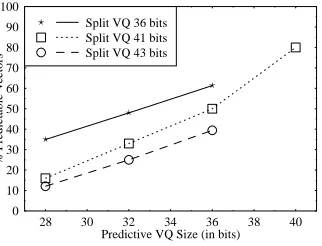
Figure 12 shows the proportion of frames quantized us-ing the 28-, 32- and 36-bit PVQs in the context of SNVQ schemes employing 36-, 41- and 43-bit SVQs. We observe in Figure 12 that for a PVQ codebook size of 28 and 32 bits
a relatively low proportion of the LSF vectors was quan-tized using the PVQ and this indicated that its codebook size was too small, failing to outperform the memoryless 36-, 41- or 43-bit SVQs. Accordingly, only the 36-bit PVQ was deemed suitable. This figure illustrates that if the pre-dictive VQ exhibits a low performance compared to the memoryless SVQ, i.e. the proportion of its utilization tends to zero, the SNVQ will tend to behave like a simple memo-ryless SVQ. Alternatively, if the memomemo-ryless SVQ exhibits a low performance compared to the PVQ, i.e. the propor-tion of PVQ LSF vectors tends to 100%, the SNVQ will tend to behave like a PVQ.
The individual PVQ and memoryless SVQ schemes em-ployed so far were designed independently from each other, hence the resulting scheme is sub-optimal. Furthermore, both quantizers were designed without distinction between predictable and unpredictable LSF vectors. Hence, their optimization will aim, on one hand, to have the PVQ fo-cusing on predictable frames, which generate LSF pre-diction errors with a low variation range. On the other hand, the memoryless SVQ codebook is to be matched to the distribution of the unpredictable LSF vectors in the
p-dimensional LSF space. In order to obtain an optimal
SNVQ we will proceed as follows:
1) The original training sequenceT is passed through
our previously used individual sub-optimum code-book based SNVQ, in order to generate the sub-training sequencesT
PVQand T
SNof vectors,
quan-tized using either the predictive VQ or the memory-less SVQ, respectively, depending on which gener-ated a lower SD.
2) Then codebooks for both the PVQ and the memo-ryless SVQ are designed using the sub-training se-quences generated above.
Our results to be highlighted with reference to Table 2 show that the optimized PVQ results in significant improve-ments, but only a modest further gain was obtained with the aid of the Safety-Net approach, invoking the optimised memoryless SVQ. Clearly, optimization is the main issue in SNVQ design, requiring the joint design of both parts of the SNVQ. We designed a [36,36]-bit and a [36,41]-bit scheme, where the first bracketed number indicates the number of bits assigned to the PVQ, while the second one that of the memoryless SVQ. Again, the performance of these schemes is summarised in Table 2. In both cases a SD gain of about 0.15 dB was obtained upon the joint op-timisation of the component VQs, as seen in Table 2. In addition, the number of outliers between 2 and 4 dB was substantially reduced and all the outliers over 4 dB were removed.
Scheme Avg. SD Outliers (%)
(dB) 2-4 dB >4 dB
[36,36] SNVQ scheme
non-optimized 1.34 7.19 0.12
optimized 1.17 2.18 0
[36,41] SNVQ scheme
non-optimized 1.25 4.5 0.12
[image:8.612.67.265.51.153.2]optimized 1.09 0.38 0
Table 2: Optimization effects for the [36,36] and [36,41] SNVQ schemes.
0.0 0.5 1.0 1.5 2.0 2.5 3.0 3.5 4.0 Spectral Distortion (dB) 0.0
0.02 0.04 0.06 0.08 0.1
Probability
SNVQ [36,41]
Avg. SD = 1.09 dB
Figure 13: PDF of the SD for the [36,41] bit SNVQ scheme (Compare to Figure 5 and 10).
74%. Similarly, for the [36,41] SNVQ scheme constituted by the 36-bit PVQ and 41-bit memoryless SVQ, respec-tively, this proportion increased from 50% to 60%. Hence, in case of such switched variable bit rate schemes, the opti-mization tends to reduce the average SNVQ bit rate, since the PVQ requires less bits, than the memoryless SVQ.
Figure 13 shows the PDF of the SD for the [36,41] SNVQ scheme, indicating a significant SD PDF enhancement compared to both the memoryless SVQ and the PVQ. In addition, this system improves the robustness against chan-nel errors, since the propagation of bit errors was limited due to the low number of consecutive employment of the PVQ. Clearly, the SNVQ enabled an efficient exploitation of both the inter-frame correlation and the intra-frame cor-relation of LSF vectors. Its main deficiency is the increased complexity of the codebook search procedure, requiring twice as many comparisons as the memoryless SVQ or the PVQ.
3
S
IMULATIONR
ESULTSFigure 14 summarizes the performance of the split memo-ryless SVQ, the PVQ and the SNVQ. As observed in the figure, the SD results for the memoryless SVQ are more modest and in general a better performance was obtained
26 28 30 32 34 36 38 40 42 44
Average Number of Bits per Frame 1.0
1.2 1.4 1.6 1.8 2.0
A
vg.
Spectral
Distortion
(dB)
SNVQ 36 bits SNVQ 32 bits SNVQ 28 bits Predictive VQ Split VQ
Figure 14: Average SD of the various vector quantizers consid-ered in this study
Scheme No. of Avg. SD Outliers (%)
Bits (dB) 2-4 dB >4 dB
PVQ 40 1.09 4.24 0
[image:8.612.309.496.59.229.2]SNVQ 38 1.09 0.38 0
Table 3: Transparent quantization schemes.
by using the predictive quantization schemes. This figure illustrates a difference of 4 or 5 bits between the mem-oryless SVQ and the PVQ for the same SD. The three SD curves corresponding to the SNVQ schemes using 28-, 32- and 36-bit PVQs in conjunction with various memo-ryless SVQ configurations employing 36, 41 and 43 bits are also shown in Figure 14. The x-axis, which is char-acterised by the average number of bits per frame in Fig-ure 14 is obtained by taking into account the proportion of utilization for the SVQ and PVQ schemes in a frame. As an example, in our SNVQ[36,41] scheme, where 60% of frames invoked the 36-bit PVQ while 40% used 41-bit SVQ scheme, the average number of bits per frame be-comes 0.6(36)+0.4(41)=38 bits. For the SNVQ using
28-and 32-bit PVQs, the lines crossing the PVQ performance curve drawn using a solid line indicate that at this stage the PVQ starts to attain a better performance, than the SNVQ for the equivalent bit rate. Hence, in this scenario there is no benefit from employing SNVQ schemes using 28- and 32-bit PVQs beyond this cross-over point. A consistent SD gain in comparison to the PVQ is only ensured for the SNVQ using the 36-bit PVQ. In this case a 2-bit reduction in the number of required coding bits was obtained. Infor-mal listening tests have shown that the best perceptual per-formance was obtained by employing the [36,41] SNVQ scheme.
[image:8.612.68.239.200.332.2]0 5 10 15 20 25 30 35 40 0
1 2 3 4 5 6 7 8
SD
Degradation
(dB) (a) 41-bit SVQ
0 5 10 15 20 25 30 35
Bit Index 0
1 2 3 4 5 6 7 8
SD
Degradation
[image:9.612.309.541.51.142.2](dB) (b) 36-bit PVQ
Figure 15: The SD degradations due to 100% Bit Error Rate in the (a) 41-bit SVQ and (b) 36-bit PVQ schemes.
0 1 2 3 4 5 6 7 8 Frame Number 0.0
0.5 1.0 1.5 2.0 2.5
SD
Degradation
(dB)
SVQ Bit 3
0 1 2 3 4 5 6 7 8 Frame Number 0.0
0.5 1.0 1.5 2.0 2.5
PVQ Bit 3
Figure 16: The SD degradation propagation effects for Bit 3 of 41-bit SVQ and 36-bit PVQ schemes, respectively.
(4;4;4;4)
10;10;10;10PVQ scheme employing 4
10= 40 bits
and the second scheme used a [36,41] SNVQ arrangement with an average of 38 bits. Although both schemes have a similar average SD, the SNVQ provides a large reduction in the number of SD outliers between 2 and 4 dB, which have a significant effect on the perceptual speech quality. A high speech quality was also obtained for the [36,36] fixed bit rate SNVQ, as shown in Table 2. Let us now consider the effects of transmission errors in the next section.
4
E
FFECT OFC
HANNELE
RRORSIn this section, we study the performance of the various LSF vector quantizers in the presence of channel errors. We first measured the bit sensitivity of the 41-bit SVQ
BER (%) 38-bit SNVQ 36-bit PVQ 41-bit SVQ
0 1.09 1.45 1.46
0.1 1.34 1.68 1.56
0.5 1.89 2.45 1.92
1 2.56 3.25 2.41
2 3.56 4.21 3.17
[image:9.612.75.261.61.226.2]5 5.38 5.81 4.91
Table 4: SD comparisons of the 38-bit SNVQ, 36-bit PVQ and 41-bit SVQ for different Bit Error Rates (BER).
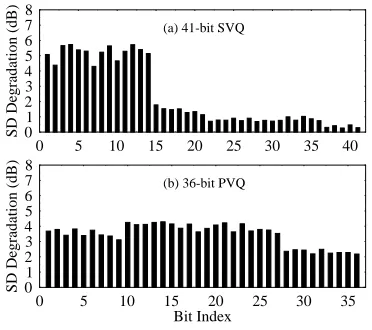
and 36-bit PVQ schemes, which were employed in the SNVQ[36,41] arrangement. An often used approach to evaluating the bit sensitivity is to invert a given bit in ev-ery speech frame and measure the associated SD degrada-tion inflicted. The error sensitivity of various bits for the 41-bit and 36-bit PVQ schemes are shown in Figure 15. Specifically, in the 41-bit SVQ scheme, 7 bits were used to quantize the 6-, 7- and 3-component subvectors, and their respective bit sensitivity is shown at bit indeces 1-21 in Fig-ure 15(a). Additionally, a (4,4,4,4)-split second stage VQ was applied for further quantizing the quantization error due to the first-stage, using five bits for each sub-vector. This was plotted at bit indeces 21-42 in Figure 15(a), which exhibit a lower SD degradation compared to bit indeces 1-20. This is due to the higher bit sensitivity of those bits at the first stage, where the LSF subvectors were quantized, while at the second stage, the quantization error from the first stage - which is more noise-like - will be less sensi-tive to channel errors. For the 40-bit PVQ shown in Figure 15(b), almost all the bits exhibit similar SD degradation.
Using the method described above for quantifying the er-ror sensitivity of various bits does not illustrate clearly the error propagation properties of different bits. In order to obtain a better picture of the error propagation effects, we employed another error sensitivity measure, where for each bit we find the average SD degradation due to a single bit error both in the frame in which the error occurs and in con-secutive frames. These effects are shown in Figure 16 for bit index 3 of the 41-bit SVQ and 36-bit PVQ schemes, respectively. It can be observed that although the SVQ scheme exhibits a higher SD in Frame 1, the bit errors do not propagate over consecutive frames. By contrast, Bit 3 of the PVQ scheme in Figure 16 shows some error propa-gation effects due to the employment of the AR predictor, which uses recursive reconstruction of the LSFs.
[image:9.612.64.278.296.454.2]Preference
Speech Material A Speech Material B A (%) B (%) Neither (%)
SNVQ[36,41] 41-bit SVQ 75.0 0.0 25.0
BER 0% - UQR BER 0% - UQR
SNVQ[36,41] 41-bit SVQ 55.0 10.0 35.0
BER 1% - UQR BER 1% - UQR
SNVQ[36,41] 41-bit SVQ 50.0 30.0 20.0
BER 0% - QR BER 0% - QR
SNVQ[36,41] 41-bit SVQ 25.0 15.0 60.0
[image:10.612.133.442.50.177.2]BER 1% - QR BER 1% - QR
Table 5: Details of the listening tests conducted using the pairwise comparison method, where the listeners were given a choice of preference between two speech files coded using SNVQ[36,41] or 41-bit SVQ schemes. UQR denotes using unquantized residual while QR means using the quantized residual by ACELP.
5
S
UBJECTIVEE
VALUATIONInformal listening tests were conducted, in order to verify the objective results obtained in the previous section. In the test, the 38-bit SNVQ[36,41] scheme was compared to the 41-bit Memoryless SVQ benchmarker. The coders were compared both for noiseless conditions and for a BER of 1%. We used the model shown in Figure 3 to evaluate the perceptual speech quality after applying LSF vector quan-tization. The prediction residual was formed by filtering the speech signal using the unquantized prediction filter coefficients, and the reconstructed speech was generated by exciting a quantized synthesis filter with the undistorted residual. In this way, the effects of LSF quantization can be studied separately from the encoding of the residual.
For the sake of completeness, we also evaluated the sub-jective performance of the vector quantizers in conjunction with a wideband ACELP codec. In the ACELP codec, we performed the LPC analysis every 10 ms and the pitch anal-ysis for every subframe of 5 ms, in the form of an adaptive codebook. The adaptive codebook index and gain were quantized using 8 bits and 5 bits, respectively. In every 5ms subframe, the process of fixed codebook search proce-dure was applied twice on the basis of two 2.5ms segments, which was found to reduce the complexity significantly without degrading the performance of the codec [21]. A 20-bit algebraic codebook was employed, which consists of 15 bits encoding the five excitation pulse positions and an additional 5 bits to encode the sign of each pulse. Thus the bit rate used for the quantization of LSFs employing the SNVQ[36,41] scheme was 3.8 kbit/s, and that used for the quantization of the adaptive- and fixed-codebook parame-ters was 12.2 kbit/s. This gave a total bit rate of 16 kbit/s.
The subjective evaluation was carried out here through pairwise comparison tests using 10 listeners. Eight sen-tences spoken by four males and four females were used for the evaluation. The sentences were pairwise compared, including some comparisons with the uncoded original sen-tences. All possible A-B pairs were generated and
pre-sented in a randomized order. The listeners’ task was to in-dicate their preference concerning either one or the other of the coded versions, or to indicate no preference. Our results accruing from these informal tests were shown in Table 5. The listening tests revealed that under perfect channel con-ditions, using the unquantized residual (UQR), the SNVQ was preferred to the 41-bit SVQ scheme in 75% of the com-parisons. For a channel exhibiting 1% BER, 55% of the lis-teners favoured the SNVQ[36,41] scheme as shown in Ta-ble 5. In the case of quantizing the residual (QR) using the above ACELP codec under perfect channel conditions, the SNVQ[36,41] scheme still outperformed the 41-bit SVQ benchmarker, although at a BER of 1% its subjective supe-riority eroded.
6
C
ONCLUSIONSIn this contribution, we have comparatively studied various predictive and memoryless vector quantizers. In the con-text of memoryless vector quantization, a[(6;7;3)
777
;(4;4;4;4) 5555
]
41-bit multi-stage split vector quantizer was designed. This method enabled a simple implementation. In order to im-prove the performance of this initial memoryless scheme, we introduced V/UV classification. This approach gave about 0.2dB SD improvement, but increased the complex-ity. Nonetheless, both of these sub-optimum approaches maintained a low computational complexity, as well as a high error resilience.
in a SNVQ scheme. Even though the SNVQ scheme in-creased the complexity, it improved significantly the SD performance and mitigated the propagation of channel er-rors. Our future work considers the design trade-offs of wideband backwards adaptive speech codecs and transform codecs.
7
A
CKNOWLEDGEMENTSThe financial support of the following organisations is gratefully acknowledged: Motorola ECID, Swindon, UK; European Community, Brussels, Belgium; Engineering and Physical Sciences Research Council, Swindon, UK; Mobile Virtual Centre of Excellence, UK.
R
EFERENCES[1] E. Harborg, J.E. Knudsen, A. Fuldseth, and F. Johansen, ”A Real-Time Wideband CELP Coder for a Videophone Appli-cation”, in Proc. ICASSP, pp.121-124, 1994.
[2] J-H. Chen and D. Wang, ”Transform Predictive Coding of Wideband Speech Signals”, in Proc. ICASSP, pp. 275- 278, 1996.
[3] R. Lefebvre, R. Salami, C. Laflamme , and J-P. Adoul, ”High Quality Coding of Wideband Audio Signals Using Transform Coded Excitation (TCX)”, in Proc. ICASSP, pp. 193-196, 1994.
[4] J. Paulus and J. Schnitzler, ”16 kbit/s Wideband Speech Coding Based on Unequal Subbands”, in Proc. ICASSP, pp. 255-258, 1996.
[5] P. Combescure, J. Schnitzler, K. Fischer, R. Kirchherr, C. Lamblin, A. Le Guyader, D. Massaloux, C. Quinquis, J. Stegmann, and P. Vary, ”A 16, 24, 32 Kbit/s Wide-band Speech Codec Based on ATCELP”, in Proc. ICASSP, Phenix, 1999.
[6] A. Ubale and A. Gersho, ”A Multi-Band CELP Wideband Speech Coder”, in Proc. ICASSP,pp. 1367-1370, 1997.
[7] F. Itakura, ”Line Spectrum Representation of Linear Predic-tor Coefficients of Speech Signals”, in J. Acoust. Soc. Amer., Vol. 57, pp. S35(A), 1975
[8] L. Rabiner, M. Sondhi and S. Levinson, ”Note on the Prop-erties of a Vector Quantizer for LPC Coefficients”, in The
Bell System Technical Journal, Vol. 62, No. 8, pp.
2603-2616, October 1983.
[9] F. Soong and B.-H Juang, ”Line Spectrum Pair (LSP) and Speech Data Compression”,in Proc. ICASSP, pp. 1.10.1-1.10.4, San Diego, 1984.
[10] R. Steele and L. Hanzo, Mobile Radio Communications, IEEE Press, 1999, 2nd Edition.
[11] A. Kondoz, Digital Speech, Coding for Low Bit Rate
Com-munication System, John Wiley, 1994.
[12] ”7 kHz Audio Coding within 64 kbit/s”, CCITT Recommen-dation G.722, 1988.
[13] K. Paliwal and S. Atal, ”Efficient Vector Quantization of LPC Parameters at 24 Bits/Frame”, in IEEE Trans. Speech
and Audio Processing, Vol. 1, January 1993.
[14] A. Gersho and M. Gray, Vector Quantization and Signal
Compression, Kluwer Academic Publishers, 1991.
[15] NTIS Federal Computer Products Center, ”DARPA TIMIT Acoustic-phonetic continuous speech corpus”, US Depart-ment of Commerce.
[16] ITU-T, ”Recommendation G.729-Coding of speech at 8 kb/s using conjugate algebraic-code-excited linear-prediction (CS-ACELP)”, March 1996.
[17] T. Eriksson, J. Linden, and J. Skoglund, ”A Safety-Net Ap-proach for improved exploitation of speech correlation”, in
Proc. International Conference on Digital Signal Process-ing, Vol. 1, pp. 96-101, 1995.
[18] T. Eriksson, J. Linden, and J. Skoglund, ”Exploiting Inter-frame Correlation in Spectral Quantization. A Study of Dif-ferent Memory VQ Schemes”, in Proc. ICASSP, pp. 765-768, May 1996.
[19] T. Eriksson, J. Linden and J. Skoglund, “Interframe LSF Quantization for Noisy Channels,” IEEE Transactions on
Speech and Audio Processing, vol. 7, pp. 495–509, Sept
1999.
[20] H. Zarrinkoub and P. Mermelstein, ”Switched Prediction and Quantization of LSP Frequencies”, in Proc. ICASSP, pp. 757-764, May 1996.
[21] J.W. Paulus and J. Schnitzler, “16kbit/s Wideband Speech Coding Based On Unequal Subbands,” in Proceedings of
![Table 2: Optimization effects for the [36,36] and [36,41] SNVQschemes.](https://thumb-us.123doks.com/thumbv2/123dok_us/1032441.618657/8.612.309.496.59.229/table-optimization-effects-snvqschemes.webp)
![Table 5: Details of the listening tests conducted using the pairwise comparison method, where the listeners were given a choice ofpreference between two speech files coded using SNVQ[36,41] or 41-bit SVQ schemes](https://thumb-us.123doks.com/thumbv2/123dok_us/1032441.618657/10.612.133.442.50.177/details-listening-conducted-pairwise-comparison-listeners-ofpreference-schemes.webp)
