Dynamic Distance Learning Framework
Using Problem Based Assessment
Dr. Shakeel A. Khoja ([email protected]) Afzal Rahman ([email protected])
Dr. Zubair A. Shaikh ([email protected])
Karachi Institute of Information Technology (KIIT) Gulshan-e-Maymar, Karachi.
Abstract:
Education is undergoing a major paradigm shift towards learning rather then teaching. Learning is no longer considered as a process transferring and distributing knowledge to the students. It is now viewed as a transformational process whereby students acquire facts, principles, and theories as conceptual tools for reasoning and problem solving in meaningful contexts. Internet is playing an important role for such student based learning.
The objective of this paper is to develop an educational framework, using data mining technologies, with the help of Dynamic Web technologies (JSP and .net) that will be used by teachers to organize the course contents on the web according to existing infrastructure, experience, needs, and later on reorganizing it if necessary, depending upon the performance of students. The approach to organize the lecture contents is based on the adaptive learning theory, incorporating Problem Based Learning (PBL) strategy. For online-real time lectures and evaluations, we are using video conferencing tools (VCON Falcon IP, POLYCON view station FX) through IP, at a bandwidth of 1MB-DXX. Finally a good amount of emphasis is given on evaluation procedures that the tutor can adopt to evaluate the students, in order to provide them further course contents.
Presently, the course syllabus and handouts on the web sites provided to the student are static in nature. Once distributed, these documents cannot be changed or modified, and also lack depth. When course materials are placed on the web, students can select a topic in the course outline and look at the description of a topic, and required reading assignments. Instructors can easily change schedules in these on-line documents and inform the students via e-mail. Students can also submit assignments, projects and take-home exams electronically. A course take-home page is comprised of syllabus, assignments, projects and exams, readings and references, class presentation charts and student handouts. Students in a course are mostly assessed on the basis of the questions like why, how what, etc. In this way a student can be graded and ranked, which gives in turn provides the feedback to student for future improvements and challenges. Most of the web sites are implemented on the theory of constructivism. Constructivists propose that the construction for new knowledge starts from one’s observations of events through past experiences. Hence, learning is the integration of new knowledge and behaviors into a framework and subsequently recalling relevant events in the appropriate situation. This theory is also applied in our educational framework.
1. Introduction
The objective of this paper is to develop an e-learning framework that will be used by
teachers to organize the course contents for distance learning through existing
amount of emphasis is given on evaluation procedures that the tutor can adopt to evaluate
the students, in order to provide them further course contents.
Learning mechanisms and learning styles are changing at a rapid pace. Learners get more
and rapid learning through new technologies such as electronic media. The trend of
education has largely shifted towards the web based learning environment with the
ever-increasing popularity of the Internet. More and more web based learning sites and CBTs
are becoming common, providing various mediums of interaction amongst tutors and
learners. The most commonly used mediums are passive posting of study material,
Internet chat and email. The major problem among the above mentioned mediums is the
lack of face-to-face communication between the tutor and the learner.
The delivery of information and learning through a web based instructional systems could
be done by using text, graphics, sounds, video, etc. To provide true replica of real world
learning, these systems should also provide reference sections of the topics that are being
offered on that site, which could be in the form of hypermedia. But still it lacks the
learning through behaviors i.e. the learning with the help of gestures and face-to-face
question and answer sessions. To overcome this, web based systems use 3-D or video
chat sessions (Microsoft Net Meeting, CUseeme, etc) and email group discussions. Sites
constructed like this are said to be implemented on the theory of constructivism. Once the
material distribution issue is resolved the issue of assessment becomes active. In real
classroom environment a teacher takes quizzes, hands over course works and
assignments. Again this could be done using chat and email capabilities of the system.
But how to keep track of the efforts put in by a student to achieve the learning and ability
outcomes of the subject is not yet standardized. Furthermore, most sites are static in
nature as for as the organization of the course contents is concerned. In this paper we will
try to address the issues of adaptive learning through student feedback. In the beginning
the theory of constructivism is explained then a discussion on learning through
constructivism, teaching, teaching / learning on the Web and assessment is provided and
finally we propose our solution to the assessment and reorganization of the course
2.0 Constructivism
Constructivist theory is highly promising for web-based learning, from which many new
strategies are emerging. Constructivists propose that the construction for new knowledge
starts from one’s observations of events through past experiences one already has.
Learning something new involves changing the meaning of one’s previous
experiences[1]. However it can be debated that under certain conditions, absolutely new
concepts might have been developed instead of altering the old ones.
2.1 Learning: Individual and Social process.
Students decide what they need to learn by setting personal learning goals. Students
construct for themselves meaningful knowledge as a result of their own activities and
interaction with others[2]. Learning strategies include library research, problem and
case-based learning, solving assignments and projects, group work, discussions, and
fieldwork. On the contrary, classroom teaching is a stimulus to the student’s real learning
that mostly takes place outside formal classes. Further unstructured (Constructivism)
classes with individualized activities, much discussion and optional attendance will
provide more chances of learning then traditional class room methods. Students engage
actively with the subject matter and transform new information into a form that makes
personal sense to them and connects with prior knowledge. Students are placed
immediately into a realistic context with specific coaching provided as needed[3].
The constructionist model is learner-centered. The student must control the pace of
learning. The teacher acts as a moderator who facilitates the process of learning. Students
learn better when they are allowed to discover things by themselves rather than being told
what to learn. Variations of the constructionist theory include the collaborative theory of
learning, and the cognitive information-processing model of learning.
Constructionism-based theories are very popular and have triggered a paradigm shift in the education
process towards a student-centered learning approach. This means that there should be
some contact between the teacher and the student for the achievement of learning and
learner has a different experience of learning. A learner can acquire knowledge from
social interaction (social-constructivism) with others[1].
According to different theories of learning, it could be summarized that the ability to
learn is the result of some sort of input and then constructing the meaning from it.
Learning consists both of constructing meaning and constructing systems of meaning[4].
There could be many factors involved the process of learning of learner e.g. language,
environment and the medium of communications.
2.2 Modern Style of Learning
Learning is the integration of new knowledge/ behaviors into a framework and
subsequently recalling what is relevant in the appropriate situation. To understand
learning we must consider how new information is received and the stage through which
new information is processed as it progresses from immediate sensory experience to
long-term storage. It is also important to understand how novices and experts organize,
analyze, or encode, and then retrieve necessary information. Teaching consists of
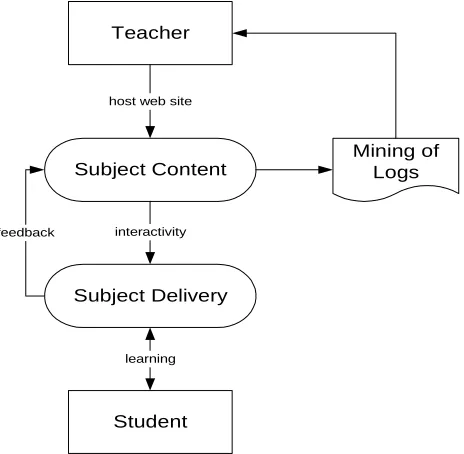
organizing, planning, delivering and evaluating the content of the subject area. Figure 1
shows the basic elements and their relation in an adaptive learning environment.
Teacher
Student Subject Content
Subject Delivery
Mining of Logs
host web site
interactivity
[image:4.595.185.417.452.679.2]learning feedback
Learning is contingent upon perception. It improves concept formation- the essential
element of human thought. Learning is benefited by memory and is achieved through
thoughtfulness and critical thinking[5].
2.3 Modern Style of Teaching
Teaching may best be defined as the organization of learning. So the problem of
successful teaching is to organize learning for authentic results. Teaching may be thought
of as the establishment of a situation in which it is hoped and believed that effective
learning will take place. This situation is complicated and made up of many parts, such as
the requirement of a learner, facilities (stated place, time of meeting, books, aids, etc.),
orderly and understood procedures, rules for grading and finally an organizer who brings
these parts into a whole – in other words a teacher.
Teaching is the organization of learning. Thus it follows that a teacher is essentially an
organizer. The task of any organizer is to enable a group and the individuals in it to
function effectively together for the achievement of a common purpose. This is precisely
your proper role as a teacher[6].
2.4 Teaching / Learning on the Web
Presently, the course syllabus and handouts provided to the student are static in nature.
Once distributed, these documents cannot be changed or modified, and also lack depth.
The topics to be covered may be listed in the course outline, but including descriptions
makes the document lengthy and thus is rarely done. This makes the course devoid of the
requisite flexibility. The costs of duplicating handouts, syllabi, and assignments have
proven to be a burden. Sometimes logistical factors prevent a student from receiving an
assignment in time.
When course materials are placed on the Web, students can select a topic in the course
outline and look at the description of a topic, and required reading assignments. Students
can select the exam schedule and look at the topics included for that exam. Assignments
Instructors can easily change schedules in these on-line documents and inform the
students for example via e-mail. Students can also submit assignments, projects and
take-home exams electronically. Alternatively, all the handouts and the hypermedia software
can be provided to the students on disk and they can browse the course materials off-line
at their convenience.
Traditional course materials were rendered unusable when the software package in which
they were created became obsolete. For example, a handout prepared using an old
business graphics software cannot be used anymore because it is no longer available in
the office or classroom. Instructors also face problems when the software package that
they use at home is not available in the office.
Web course materials are software and hardware independent. Instructors can re-use
handouts and presentation materials that were created with old or incompatible software,
by converting them from the original format straight to a format that can be used on the
Web, for example GIF files. Browser software can be used across computer platforms.
2.5 Assessment of students
The Web-based informal assessment represents a cognitive behavior modification
technique designed to help students develop goal setting behavior, planning and
self-monitoring and provides the opportunity for students to master the concepts. For
example, students can regulate and monitor their own learning throughout the course in a
sequential and constructive fashion as they respond to the questions and receive ongoing
feedback[7]. Students in a course are mostly assessed on the basis of the question like
why, how what, etc. In this way a student can be graded and ranked, which gives in turn
student a feedback for future improvements and challenges. There are various modes in
which a student can be assessed, such as written exam and quizzes, viva voce, projects,
lab reports, thesis, dissertation, self assessment, peer assessment and many more.
3.0 Proposed Framework for E-learning using adaptive techniques
The above sections provided details of the different aspect of education. I this section, we
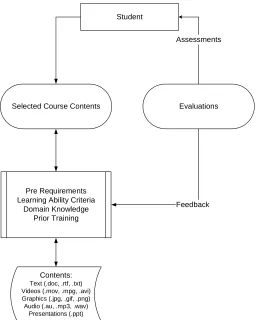
the above mentioned aspects of education. Figure 2 depicts the basic elements or our
model. This is a student centered model and the teacher’s job along with providing
education, is to tune certain parameters, through student’s feedback, to describe what
next should be provided to the student.
Student
Selected Course Contents
Contents:
Text (.doc, .rtf, .txt) Videos (.mov, .mpg, .avi) Graphics (.jpg, .gif, .png) Audio (.au, .mp3, .wav)
Presentations (.ppt)
Pre Requirements Learning Ability Criteria
Domain Knowledge Prior Training
Evaluations
[image:7.595.170.427.193.513.2]Feedback Assessments
Figure 2:’ Student Centered’ Model for Adaptive Learning
PBL utilizes student groups, but each group member is also responsible for independent
research. Further, instructor scaffolding is considerably less direct in problem-based
learning than in other constructivist models such as anchored instruction. Students are
allowed to struggle and induct their own mental model of course concepts with only
occasional "life-lines" from the instructor when concept processing falls off-track.
Problem-based learning is most similar to case-based instruction, but in its purest form,
Constructivist teaching methods place responsibility on students for managing their own
learning while the teacher guides them and manages their learning environment. Students
are given tasks and opportunities, information resources and support, and encouraged to
construct their own knowledge structure which is guided through feedback and revision.
Learning strategies include library research, problem and case-based learning, doing
assignments and projects, group work, discussions, and fieldwork. Classroom teaching is
a stimulus to the student's real learning that mostly takes place outside formal classes[9].
4.0 Proposed Website
Our proposed web site would be developed on the basis of both the constructivism theory
and PBL. For the case study, Object Oriented Programming courses like Java and C++
are inspected. The course contents are developed on a wider assessment difficulty index
of easy, moderate and difficult (to be decided by the tutor). For example, topics in which
the syntax and the basics of a language are discussed could be placed in easy difficulty
index category. Topics which discuss the use of already made utilities and supporting
files could be placed in the moderate difficulty index. Finally, Difficult index could
encompass topics which are dependent on some other subjects e.g. networks, videos, etc.
The difficulty index would be different for each course according to targeted audience
and would be decided by tutor by allocating less points for topics that lie in the easy
level, average points for moderate level and maximum points for topics difficult index
level (a linear mechanism). Each topic taught would increase learner’s knowledge points
by a predefined increment. If a learner’s knowledge points match or come closer the tutor
defined outcome points of the course, a student would be considered to have good
problem solving skills. If no one or only few come closer to outcome points the tutor can
reorganize the course contents in the difficulty index to achieve the expected outcomes.
4.1 Web Based implementation
The site currently is developed using the server side technology (JSP). Tutors (authors of
course) and learners are asked to register themselves in a course. A profile is stored for
8i is used for the database, hence comprising the typical 3-tier web application. Options
for Live Video sessions and streaming the stored video clips are also provided. For
arranging Live Video sessions, we are using PolyCom ViewStation FX which can
connect up to 200 users, with the data rate of 1 Mbps. This equipment uses a built-in web
server to stream videos in .mov (QuickTime) format. At the client site, QuickTime
viewer or Cisco IPtv can be used to view live videos. For interactive chats, we have
developed customized Java applets, where the registered students can login in particular
class rooms. In the profile, student thumbnail pictures of the students are also provided.
Tutor is responsible for organizing subject materials according to the introduction of the
topic and the sub-topics in a particular lecture are cross-referenced using hyperlinks on to
other web pages. Those sub-topics fall in the categories of explanations, examples,
questions and references. It is the responsibility of the tutor to develop and maintain the
formula by using the above mentioned entities, to decide whether a student is allowed to
proceed further. The development and study of this formula is beyond the scope of this
paper. Currently in our framework, we have adopted linear incremental method for
modifying difficulty index.
Each course on the site is created on the basis of course title. Followed by a topic and
sub-topics in a particular index of difficulty. Learners can navigate a topic using links on
a page for its sub-topic. Each link clicked increases a student’s points for directed
unsupervised activity. If a page is clicked from its sub-topic it will not constitute to the
points of a student. Once the learner has finished reading through the topic, he/she can
check his/her skills by appearing in a quiz. The scored marks in the quiz are added to
already scored points through navigation of pages. This way, students’ performance is
checked by comparing their old scores with the current ones.
At the end of the course a tutor can calculate the average of students performance, which
in turn will be matched with his expected points for each difficulty index. If there is any
difference found then the tutor can change the criteria of difficulty index.
the customized delivery of course material to students. Currently many researchers are
putting their efforts towards adaptive learning environment. So the results from our
E-learning framework will help to dynamically organize notes according to student’s
learning abilities. This research is not limited to text only but will also incorporate
extensive research in voice and video for semantically organized content-based retrieval.
This will aid in conducting online lectures to simulate a real-world classroom
environment.
The paper has considered theoretical and research issues associated with design and use
of an E-learning framework. Overall this study has found evidence that an E-learning
framework incorporating adaptive learning techniques, its models and architectures for
WWW, provide more help to students for learning then traditional systems.
6.0 References
1. Eric Zhi-Feng Liu, Sunny S. J. Lin, Chi-Huang Chiu and Shyan-Ming Yuan, “Web Based Peer
Review: The learner as both Adapter and Reviewer”, IEEE Transactions of Education, Vol 44,
No. 3, Pg. 246-251
2. Montgomery S.M., “Addressing Diverse Learning Styles Through the Use of Multimedia”, University of Michigan USA, 1995.
http://www.vpaa.uillinois.edu/tid/resources/montgomery.html
3. Fardouly N, “Learner-Centered Teaching Strategies”, in Principles of Instructional Design and Adult Learning Series, The University of New South Wales, Australia, September 1998.
http://www.fbe.unsw.edu.au/learning/instructionaldesign/strategies.htm
4. Hein, G.E., “Constructivist Learning Theory”, CECA (International Committee of Museum Educators) Conference, Jerusalem Israel, 15-22 October 1991.
5. Buriak,P., McNurlen, B., and Harper,J., “Systems Model for Learning”, ASEE/IEEE Frontiers in Education 95 Conference, Atlanta, USA, November 2, 1995.
6. Ashcroft, K. and Foreman-Peck, L. Managing Teaching and Learning in Further and Higher
Education. London: The Falmer Press, 1994.
7. Hazari,S., and Schno,D., “Leveraging Student Feedback to Improve Teaching in Web-based
Courses”, Feature Article, THE Journal, June 1999.
8. Albanese, M., & Mitchell, S. “Problem-based learning: A review of the literature on its outcomes
and implementation issues”. Academic Medicine. 68(1), 52-81, 1993.