www.nonlin-processes-geophys.net/21/339/2014/ doi:10.5194/npg-21-339-2014
© Author(s) 2014. CC Attribution 3.0 License.
Nonlinear Processes
in Geophysics
Ion acceleration by parallel propagating nonlinear Alfvén wave
packets in a radially expanding plasma
Y. Nariyuki1, T. Umeda2, T. K. Suzuki3, and T. Hada4
1Faculty of Human Development, University of Toyama, 3190, Toyama City, Toyama 930-8555, Japan 2Solar-Terrestrial Environment Laboratory, Nagoya University, Nagoya, Aichi 464-8601, Japan 3Department of Physics, Nagoya University, Furo-cho, Nagoya, Aichi 464-8602, Japan
4Department of Earth System Science and Technology, Kyushu University, 6-1, Kasuga City, Fukuoka 816-8580, Japan
Correspondence to: Y. Nariyuki ([email protected])
Received: 30 July 2013 – Revised: 7 February 2014 – Accepted: 11 February 2014 – Published: 27 February 2014
Abstract. The numerical simulation of the nonlinear evolu-tion of the parallel propagating Alfvén waves in a radially ex-panding plasma is performed by using a kinetic-fluid model (the Vlasov–MHD model). In our study, both the nonlinear evolution of the Alfvén waves and the radial evolution of the velocity distribution function (VDF) are treated simultane-ously. On the other hand, important ion kinetic effects such as ion cyclotron damping and instabilities driven by the non-equilibrium ion velocity distributions are not included in the present model. The results indicate that the steepened Alfvén wave packets outwardly accelerate ions, which can be ob-served as the beam components in the interplanetary space. The energy of imposed Alfvén waves is converted into the longitudinal fluctuations by the nonlinear steepening and the nonlinear Landau damping. The wave shoaling due to the in-homogeneity of the phase velocity is also observed.
1 Introduction
It is well known that nonlinear Alfvén waves are ubiquitously observed in the solar wind (Bruno and Carbone, 2013). These Alfvén waves are probably generated in the vicinity of the solar photosphere, and may play an important role in heat-ing and acceleration of the coronal and solar wind plasmas. A lot of authors have already discussed the damping of the Alfvén waves in coronal plasmas (Ofman, 2010a; Galinsky and Shevchenko, 2013). In particular, the nonlinear damping of low-frequency, quasi-parallel propagating Alfvén waves is of great interest. This is because they can carry the momen-tum and energy over a long distance, since the linear
col-lisionless damping of these waves is too small to dissipate them (Barnes, 1966).
On the other hand, it is also known that the proton beams are frequently observed in solar wind plasmas (Marsch, 2006). Recently, it was shown by Araneda et al. (2008) and Matteini et al. (2010) that the protons trapped by the enve-lope modulation (or corresponding longitudinal fluctuations) due to the parametric instabilities of Alfvén waves can be observed as the beam protons in the velocity space (Araneda et al., 2008). Past studies (Araneda et al., 2008; Matteini et al., 2010) assumed the uniform background plasmas and the periodic system. However, the radial inhomogeneity of the plasma density and the magnetic field may not be negligible to discuss the nonlinear evolution of low-frequency Alfvén waves in coronal plasmas, since the radial change of the non-linearity and the non-WKB effects such as the reflection may occur (e.g., Chandran et al., 2011).
agree with those in the ion hybrid simulation (Nariyuki et al., 2011). In Sect. 2, the one-dimensional (1-D) Vlasov–MHD model in the spherical coordinate and the simulation setup are introduced briefly. Section 3 contains the numerical re-sults. We discuss and summarize the results in Sects. 4 and 5, respectively.
2 Simulation setup
We consider a radially expanding flux tube, which is mea-sured by the heliocentric distancer. To discuss both the non-linear evolution of the transverse fluid motion due to the Alfvén waves and the longitudinal (radial) ion kinetics, we introduce the 1-D Vlasov–MHD model in the spherical coor-dinate below. For simplicity, we here neglect the gravitational force term, since it is relatively small and may not play im-portant roles in the super Alfvénic solar wind atr >10Rs, whereRsis the solar radius.
The velocity distribution functions obey the Vlasov equa-tion
df (x,v, t )
dt =
∂f
∂t +v· ∇xf+
dv
dt · ∇vf =0, (1)
wheref (x,v, t ) is the single particle distribution function, and
dv dt =a=
q
m(e+v×b). (2)
v=(vx, vy, vz) is the particle velocity, e=(ex, ey, ez) the
electric field, b=(bx, by, bz)the magnetic field,mthe rest
mass, andq the charge.
In the spherical coordinate (xs=(r, θ, φ), where x=
rsinθcosφ, y=rsinθsinφ, z=rcosθ), dvdt can be written as
dv dt =a=
dvr
dt ir+
dvθ
dt iθ+
dvφ
dt iφ
+dir
dt vr+
diθ
dt vθ+
diφ
dt vφ, (3)
where ij is the unit vector of thej =r, θ, φcomponent, v= vs=(vr, vθ, vφ)=(ddrt, rddθt, rsinθddφt), and a=arir+aθiθ+ aφiφ. Notice that vsis the function of x. By transforming (1)
into the six-dimensional spherical coordinate ((xs,vs)), we find (Larson, 1969)
df (x,v, t )
dt =
df
dt +
dr dt ∂f ∂r + dθ dt ∂f ∂θ+ dφ dt ∂f ∂φ
+ dvr
dt ∂f ∂vr
+dvθ
dt ∂f ∂vθ
+dvφ
dt ∂f ∂vφ
=0, (4) where
dvr
dt = v2θ+vφ2
r +ar, (5)
dvθ
dt =
vφ2cotθ−vrvθ
r +aθ, (6)
dvφ
dt = −
vθvφcotθ+vφvr
r +aφ. (7)
The relation (5)–(7) can be derived from Eq. (2). We here define the longitudinal distribution function
g=
Z Z
fdvθdvφ. (8)
We assume the spherical symmetry (∂f∂θ =∂f
∂φ =0) and
isotropic plasmas. By integrating Eq. (1) onvθ andvφ, we
obtain
∂g ∂t +vr
∂g ∂r+
u2⊥+2Ti
r +Ar
! ∂g ∂vr
= −2gvr
r +
2gvruθcosθ
r , (9)
whereuj is thej component of the bulk velocity, andn= R
gdvr, the number density. By taking the boundary condi-tionf →0 whenvθ,φ→ ±∞,
Z Z ar
∂f ∂vr
dvθdvφ=
Z Z ∂a rf ∂vr
dvθdvφ
=(er+uθbφ−uφbθ)∂g ∂vr
≡Ar ∂g ∂vr
(10) where
guθ,φ=
Z Z
vθ,φfdvθdvφ. (11)
Equation (11) is valid in isotropic plasmas (Nariyuki et al., 2013). We here take the ion massmi=1,q=1, and gTi ≡
Z Z
(vθ,φ−uθ,φ)2fdvθdvφ, (12) wherepi =nTi=R R R(vr−ur)2fdv=R(vr−ur)2gdvr.
When electrons can be treated as the massless fluid, we obtain
er+uθbφ−uφbθ= − 1
qn ∂p e ∂r + 1 r2
∂r2pb
∂r
, (13)
wherepb=(|b⊥|2)/2, b⊥=bθiθ+bφiφ, andpeis the elec-tron pressure. Then, we find that
Ar= −
1 n ∂p e ∂r + 1 r2
∂r2pb
∂r
. (14)
The first term on the right-hand side of Eq. (9) comes from the sixth and seventh terms on the left-hand side of Eq. (4). Notice that Eq. (9) is obtained for arbitraryf. While the sec-ond term on the right-hand side of Eq. (9) comes from the sixth term, we here neglect it by takingθ=π/2.
∂g0 ∂t +vr
∂g0 ∂r +
|u0⊥|2+2Ti0 r3 +Ar
! ∂g0 ∂vr
=0, (15)
∂ρ0u0 ∂t = −
∂urρ0u0
∂r +
∂Cb0
∂r , (16)
∂b0 ∂t = −
∂ ∂r urb
0−
whereb=bθ+ibφandu=uθ+iuφare the complex trans-verse magnetic field and velocity,g=R Rfdvθvφthe longi-tudinal VDFs (f (vr, vθ, vφ)is the original VDF),g0=r2g,
u0=ru,b0=rb,Ti0=r2Ti, Ar= −1
ρ0 ∂(p0
e+p 0 b)
∂r −
2pe0 r
, (18)
ρ0=r2ρ, ur the longitudinal velocity, pe the electron pressure,pb= |b|2/2, andp0e(b)=r2pe(b).C=brr2=100,
since the physical quantities are normalized to the parame-ters at the inner boundary as shown below. We here assume the isothermal electrons (pe/ρ=const.).
By integrating Eq. (15) onvr, we recover the continuity equations and the momentum equation of the radial compo-nent in the ideal MHD system (Suzuki and Inutsuka, 2006; Tanaka et al., 2007). The ion pressure pi is also evalu-ated by the integration ofg. Isotropic ions are assumed in Eqs. (15)–(17) to close the system. Note that the assumption of isotropic ions is reasonable as far as we concentrate on the low-frequency wave dynamics in low beta plasmas, although the VDFs of ions in the coronal and solar wind plasmas may be anisotropic. This is because the pressure anisotropy ef-fects in the dispersion relation of Alfvén waves are negligibly small in low beta plasmas (see Sect. 4.2).
The simulation region of the present study is from 10Rs to 110Rs. All the physical quantities are normalized to the parameters atr=10Rsas follows: the number densityn0=
ρ0/mp=2.9×109 [m−3] (mp is the mass of protons), the longitudinal magnetic fieldbr0=1.3×10⁻⁶[T], the Alfvén velocityVA0=br0/
√
(µ0ρ0)=5.0×10⁵[m s−1] (µ0is the vacuum permeability), respectively. The space and time are normalized to the solar radius Rs=7×10⁸ [m] and T0=
Rs/VA0=1.4×103 [s], respectively. We use the uniform mesh with 4000 grid points in ther direction and 1000 grid points in thevr direction. The grid spacing is1r=0.025, 1vr=0.01 and the time step is1t=2.5×10⁻⁴. The
trans-verse momentum Eq. (16) and the induction Eq. (17) are solved by the second-order rational Runge–Kutta scheme (Wambecq, 1978) for time integration and the second-order central difference method for evaluating spatial derivatives. The splitting scheme (Cheng, 1976) and the PIC (Positive In-terpolation for hyperbolic Conservation laws) scheme are ap-plied for time advancement of the Vlasov Eq. (15) (Umeda, 2009; Umeda et al., 2012). Note that no artificial dissipation term is included in the Vlasov–MHD system. The detailed numerical scheme to solve Eqs. (15)–(17) has also been de-scribed in a past study (Nariyuki et al., 2011).
Since the solar wind may become super Alfvénic flow withinr <10 (r=10 is the inner boundary at 10Rs), we here assume the constant radial velocityur0=1ρRvrg0dvr=VA0 as the initial condition, whereg0 is the initial VDF. Then, the initial densityρ=100/r2due to the conservation of the mass flux. Thus, the critical point at which the solar wind becomes super Alfvénic flow isrc=10 in the present study. The radial magnetic field isbr=100/r2due to the
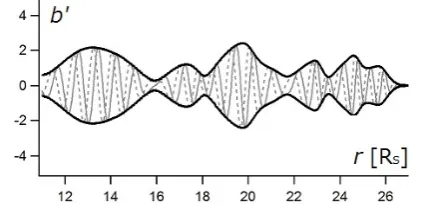
conser-Fig. 1. The transverse magnetic field (bθ0 (gray solid lines),bφ0 (gray dashed lines),±|b0|(black bold lines) att=11 (1.5×10⁴[s])).
vation of magnetic flux. Note thatur> VA=br/
√
(µ0ρ)at
r >10. Thus, the initial ion pressurep0is assumed to be uni-form. The initial ion beta isβi =p0/(br2/2)=0.02 atr=10. g0=√π v1
thexp(
−(vr−ur0)2/v2th)wherev2th=2Ti(t=0)= 0.002r.
The nonmonochromatic right-handed circularly polarized Alfve´n waves
b(r=10)=a6
N 2
n=−N
2
bpexp[i(ωnt+αn)] (19) and v(r=10)= −b(r=10) are imposed at the lower boundary, where ωn=VA0kn,kn=k0±n1k,1k=π/50,
nis an integer, andN is the number of wave modes, respec-tively. The phaseαnis given by a uniform random number
generator with a range[0,2π]. The inner boundary condition forgis fixed at the initial value. The open boundary condi-tion is imposed at the upper boundary (r=110). Initially,
βe=0.02.
The imposed Alfvén waves are given as the white noise (bp is independent of ωn). We here setω0=12.566 (ω0/T0=0.009 [Hz]), and N=60 (0.0076 [Hz]< ω/T0< 0.0104 [Hz]) (Run A), N=100 (0.0067 [Hz]< ω/T0< 0.0113 [Hz]) (Run B), N=140 (0.0058 [Hz]< ω/T0< 0.0122 [Hz]) (Run C). At the early stage (t <10π/ω0), the linearly increasing wave amplitudea=t (ω0/10π )is set to avoid the discontinuity of the wave front. During 10π/ω0<
t <11, we seta=1 andbpas<|b(r=10)|>=0.2 (where
<> indicates time average), which is consistent with pre-vious studies (e.g., Maneva et al., 2013). Aftert >11, the imposed wave amplitude is diminished.
3 Results
In this section, we mainly show the results of Run B, since those of runs A and C are essentially the same as those of Run B. The difference between the runs is discussed in the last part of this section.
Figure 1 shows the transverse magnetic field (b0θ, b0φ,
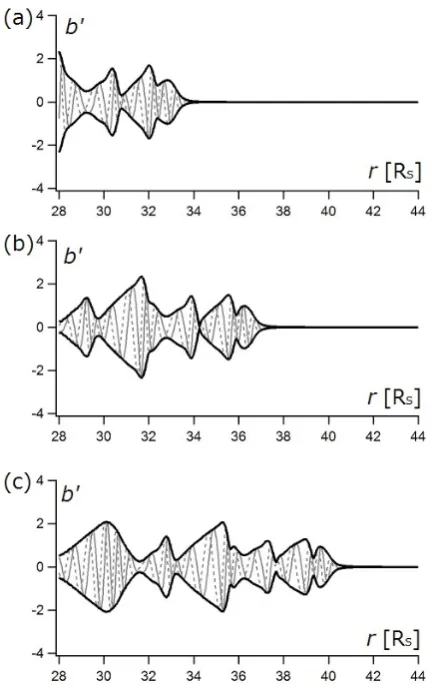
Fig. 2. The snapshot of the transverse magnetic field at (a)t=16.5,
(b)t=19.25, and (c)t=22.0 in Run B.
the density fluctuation by the ponderomotive force (the sec-ond term of the right-hand side of Eq. 14) (Mjølhus, 1976; Mio et al., 1976). Such longitudinal fluctuations can dis-sipate through the nonlinear Landau damping (Nariyuki et al., 2008, 2010; Markovskii et al., 2009). Figures 2 and 3 show the snapshots of the transverse magnetic field (b0) and
g0 at (a) t=16.5, (b)t=19.25, and (c) t=22.0, respec-tively. As time elapses, nonlinear steepening of the envelope-modulated Alfvén waves (Cohen and Kulsrud, 1975) is ob-served (Figs. 1 and 2). In Fig. 3, the ions accelerated by the nonlinearly steepened wave front of the Alfvén waves are observed. Some ions with the higher velocity than the local phase velocity of the Alfvén waves move away from the steepened wave front and form the stretched structure in the phase space (Fig. 3b, c). It is important that the acceler-ated ions can be observed as the ion beams by the spacecraft observation (Fig. 4). For instance, sinceVA'10VA0/r, the relative beam speed in Fig. 4a isvr=0.5'1.8VA(r=36),
which is consistent with the one observed in solar wind plas-mas (Marsch, 2006).
Fig. 3. The snapshot ofg0at (a)t=16.5, (b)t=19.25, and (c) t=22.0 in Run B. The white lines indicate|b0|.
Fig. 4. The local VDFs (g0att=22.0) at (a)r=36 and (b)r=41 in Run B.
Fig. 5. The snapshot of (a) the transverse magnetic field and (b)g0 att=22.0 in Run A.
Figures 5 and 6 show the snapshot of the transverse mag-netic field andg0att=22.0 in runs A and C, respectively. In the resultant VDFs of all the runs (Figs. 4c, 5b, and 6b), the accelerated ions can be observed. The number of generated beams increases with increasing frequency range of the im-posed Alfvén waves, since the wave length of the envelope modulation becomes smaller.
Fig. 6. The snapshot of (a) the transverse magnetic field and (b)g0 att=22.0 in Run C.
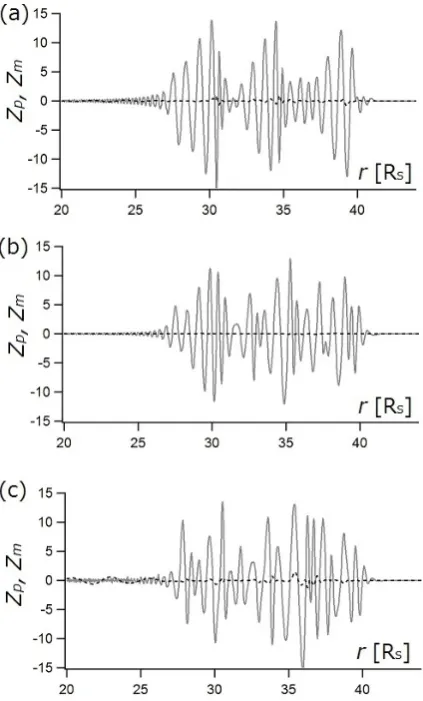
Figure 7 shows the Elsasser variables z0p=u0y−b0y/√ρ
andz0m=u0y+b0y/√ρ att=22.0. As shown in Fig. 7, the intensity of the sunward-propagating waves (zm) is much
less than the anti sunward-propagating waves (zp). Namely,
the non-WKB reflection by the background inhomogene-ity (Suzuki and Inutsuka, 2006; Chandran et al., 2011) is weak, and the parametric decay instability of Alfvén waves (Tanaka et al., 2007) does not occur. The absence of the non-WKB reflection indicates that the non-WKB (Wentzel–Kramers– Brillouin) approximation is well satisfied in the present study. The absence of the parametric decay instability of Alfvén waves is discussed in the next section.
4 Discussion
4.1 Wave shoaling
Fig. 7. The Elsasser variablesz0p=u0y−b0y/√ρ (gray solid line) andz0m=u0y+b0y/√ρ(black dashed line) att=22.0 in (a) Run A,
(b) Run B, and (c) Run C.
affect the decrease in energy of envelope-modulated Alfvén waves (Nariyuki et al., 2008). In contrast to the previous studies (Suzuki and Inutsuka, 2006; Tanaka et al., 2007) in which the MHD system was used, the decay instability is not clearly observed in the present study. This is consistent with the previous studies (Nariyuki et al., 2008; Markovskii et al., 2009) in which the ion hybrid simulations in uniform plas-mas were carried out. Actually, the growth rate of the decay instability is small due to the small amplitude of each wave number mode in the present study. Moreover, the growth rate of the decay instability is weakened by the ion Landau damp-ing of the longitudinal waves (Nariyuki and Hada, 2007).
By comparing both Figs. 1 and 2c, the contraction of the wave length (2π/ k) is also observed. This is due to the con-servation of the wave frequency
ω=(ur+VA)k, (20)
where the phase velocity ur+VA decreases with
increas-ing heliocentric distance. When the wave packets satisfy the WKB approximation, the nonlinearity of the waves (Barnes,
1992) |b|
br 2
=C0r
1+VA
ur −2
∝ r
3
(r+C1)2
, (21)
where the constantsC0andC1are determined by using the boundary condition. Equation (21) indicates that the nonlin-earity of the wave packets increases with increasing heliocen-tric distance. The increase in the nonlinearity with the con-traction of the wave length is similar to the wave shoaling of the surface gravity waves. When ur>> VA (r >> C1),
ω'urkand|bb|
r
2
∝r. In this limit, the wave numberkis the quasi-invariant and the waves can be described by using the expanding box (Grappin et al., 1993; Grappin and Velli, 1996; Liewer et al., 2001; Hellinger and Travnicek, 2005; Of-man et al., 2011). On the other hand, ifur<< VA(r << C1), k∝rand|bb|
r
2
∝r3. Thus, the nonlinearity|bb|
r at a certain
rbecomes larger with increasing heliocentric distance from the critical pointrc. This effect of inhomogeneity promotes the nonlinear steepening and the ion acceleration by pondero-motive force.
The polarization of the imposed waves does not affect the time evolution of the system, since the wave dispersion due to the Hall effect and the finite Larmor radius effect is ne-glected in the present model. Notice that the nonlinear evolu-tion of low-frequency Alfvén waves generates the higher fre-quency waves. The linear damping (ion cyclotron damping) and nonlinear damping (parametric instabilities) of the dis-persive Alfvén waves are affected by the polarization (e.g., Liewer et al., 2001; Hellinger et al., 2005; Matteini et al., 2010). Actually, while the polarization of Alfvén waves does not affect the time evolution of the present dispersionless sys-tem, dispersive left-handed porarized waves are unstable to both decay and modulational instabilities in low beta plasmas (Longtin and Sonnerup, 1986). To incorporate the non-MHD effects (Chandran et al., 2011) such as the kinetic effects dis-cussed in the next subsection into the present one-fluid model is an important future issue.
4.2 Ion kinetics
velocity distribution function. Notice that the assumption of the isotropic VDFs in the present model is only valid for low beta plasmas such as those in the vicinity of the sun. Although the protons observed in the solar wind have the temperature anisotropy (Marsch, 2006; Bale et al., 2009; Maruca et al., 2011), the phase velocity of Alfvén waves evaluated by the Chew–Goldberger–Low (CGL) system is close to the Alfvén velocity in low beta plasmas (Nariyuki et al., 2013). The phase velocity of anti-sunward propagating Alfvén waves in CGL system is
vφ=ur+ br
√
ρµ0
1−µ0(pk−p⊥) |b|2
12
, (22)
wherepk and p⊥ are the pressure parallel and perpendic-ular to the total magnetic field b. Equation (22) indicates that even if temperature (and pressure) anisotropy is large,
vφ'ur+VAin low beta plasmas. For instance, by using an empirical law of fast solar wind plasmas in Hellinger et al. (2011),vφ−ur '1.019VA(r=20), 1.020VA(r=40), and 1.018VA (r=60), respectively. On the other hand, as dis-cussed below, some important kinetic effects are not included in the present model. Of course, even if the effect of tempera-ture anisotropy on the phase velocity of Alfvén waves is neg-ligible, the various instabilities can be caused by temperature anisotropy (Matteini et al., 2013).
In the present study, Alfvén wave packets excite the lon-gitudinal fluctuations (deformation of the VDFs). Maneva et al. (2013) have recently confirmed the similar phase space vortex in the expanding box model. Moreover, nonresonant scattering of ions neglected in the present model can also af-fect the local VDFs (Araneda et al., 2008; Dong and Singh, 2013). In addition, the wave-particle resonant interactions between the Alfvén wave packets and ions become important with increasing heliocentric distance, since the ion cyclotron frequency decreases (Liewer et al., 2001). The Alfvén wave steepening observed in the present study causes the paral-lel cascading in the frequency space and may promote the ion cyclotron damping. It is also noteworthy that the kinetic instabilities driven by the beam components could not be de-scribed in the present system. The beam instabilities are af-fected by the inhomogeneity (e.g., Ofman, 2010b; Hellinger and Travnicek, 2011). To fill the gap between the past stud-ies with the uniform system and the present study, further implementation of kinetic simulations with mesoscale mod-els such as the expanding box modmod-els (Liewer et al., 2001; Hellinger and Travnicek, 2005; Ofman et al., 2011; Maneva et al., 2013) is required.
5 Conclusions
In the present paper, we discuss numerically the ion accel-eration by nonlinear Alfvén wave packets in the radially expanding plasma. The results indicate that the steepened Alfvén wave packets outwardly accelerate ions, which can
be observed as the beam components in the interplanetary space. The wave shoaling of the WKB Alfvén waves is also observed. On the other hand, as discussed in the previous section, important ion kinetic effects such as ion cyclotron damping and instabilities driven by the non-equilibrium VDFs are not included in the present model and the quan-titative results of the present study may be modified by the kinetic effects. Actually, the effective heating and accelera-tion of ions by the Alfvén waves are very weak in the present study, while the ion beams are formed corresponding to the envelope modulation. The non-equilibrium VDFs observed in the runs still preserve the free energy to cause the insta-bilities. In order to address the effective ion heating of solar wind plasmas by low-frequency Alfvén waves, the kinetic effects and the other non-MHD effects such as turbulent cas-cading and collisions should be incorporated into the present model.
Acknowledgements. YN thanks the organizers of NWCW9 held at
La Jolla, San Diego in March 2013. This work was supported by Grant-in-Aid for Young Scientists (B) no. 22740324 from MEXT of Japan. The computer simulations are performed on the DELL PowerEdge R815 supercomputer system at the Solar-Terrestrial Environment Laboratory at Nagoya University as a joint research program.
Edited by: G. S. Lakhina
Reviewed by: two anonymous referees
References
Araneda, J. A., Marsch, E., and Vinas, A. F.: Proton Core Heating and Beam Formation via Parametrically Unstable Alfven-Cyclotron Waves, Phys. Rev. Lett., 100, 125003, doi:10.1103/PhysRevLett.100.125003, 2008.
Bale, S. D., Kasper, J. C., Howes, G. G., Quataert, E., Salem, C., and Sundkvist, D.: Magnetic fluctuation power near proton tem-perature anisotropy instability thresholds in the solar wind, Phys. Rev. Lett., 103, 211101, doi:10.1103/PhysRevLett.103.211101, 2009.
Barnes, A.: Collinsionless Damping of Hydrodynamic Waves, Phys. Fluids, 9, 1483, doi:10.1063/1.1761882, 1966.
Barnes, A.: Theory of magnetohydrodynamic waves: The WKB approximation revisited, J. Geophys. Res., 97, 12105, doi:10.1029/92JA00996, 1992.
Bruno, R., and Carbone, V.: The Solar Wind as a Turbulence Labo-ratory, Living Rev. Solar Phys., 10, 2, doi:10.12942/lrsp-2013-2, 2013.
Chandran, B. D. G., Dennis, T. J., Quataert, E., and Bale, S. D.: Incorporating kinetic physics into a two-fluid sola-wind model with temperature anisotropy and low-frequency Alfvén-wave turbulence, Astrophys. J., 743, 197, doi:10.1088/0004-637X/743/2/197, 2011.
Cohen, R. H. and Kulsrud, R. M.: Nonlinear ecolution of parallel-propagating hydro-magnetic waves, Phys. Fluids, 17, 2215, doi:10.1063/1.1694695, 1975.
Dong, C. and Singh, N.: Ion pseudoheating by low-frequency Alfvén waves revisited, Phys. Plasmas, 20, 012121, doi:10.1063/1.4789608, 2013.
Galinsky, V. L. and Shevchenko, V. I.: Induced Emission of Alfvén-Waves in Inhomogeneous Streaming Plasma: Implications for Solar Corona Heating and SolarWind Acceleration, Phys. Rev. Lett., 111, 015004, doi:10.1103/PhysRevLett.111.015004, 2013. Grappin, R. and Velli, M.: Waves and streams in the expanding solar wind, J. Geophys. Res., 101, 425–444, doi:10.1029/95JA02147, 1996.
Grappin, R., Velli, M., and Mangeney, A.: Nonlinear wave evolution in the expanding solar wind, Phys. Rev. Lett., 70, 2190–2193, doi:10.1103/PhysRevLett.70.2190, 1993.
Hellinger, P. and Travnicek, P.: Magnetosheath compression: Role of characteristic compression time, alpha particle abundance, and alpha/proton relative velocity, J. Geophys. Res., 110, A04210, doi:10.1029/2004JA010687, 2005.
Hellinger, P. and Travnicek, P.: Proton core-beam system in the ex-panding solar wind: Hybrid simulations, J. Geophys. Res., 116, A11101, doi:10.1029/2011JA016940, 2011.
Hellinger, P., Velli, M., Travnicek, P., Gary, S. P., Goldstein, B. E., and Liewer, P. C.: Alfvén wave heating of heavy ions in the ex-panding solar wind: Hybrid simulations, J. Geophys. Res., 110, A12109, doi:10.1029/2005JA011244, 2005.
Hellinger, P., Matteini, L., Stverak, S, Travnicek, P. M., and Marsch, E.: Heating and cooling of protons in the fast solar wind between 0.3 and 1 AU: Helios revisited, J. Geophys. Res., 116, A09105, doi:10.1029/2011JA016674, 2011.
Larson, R. B.: A model for the formation of a spherical galaxy, Mon. Not. R. Astr. Soc., 145, 405–422, 1969.
Liewer, P. C., Velli, M., and Goldstein, B. E.: Alfvén wave prop-agation and ion cyclotron interactions in the expanding solar wind: One-dimensional hybrid simulations, J. Geophys. Res., 106, 29261, doi:10.1029/2001JA000086, 2001.
Longtin, M. and Sonnerup, B.: Modulational instability of circularly polarized Alfvén waves, J. Geophys. Res., 91, 6816–6824, 1986. Maneva, Y. G., Vinas, A. F., and Ofman, L.: J. Geophys. Res., 118,
1–12, doi:10.1002/jgra.50363, 2013.
Markovskii, S. A., Vasquez, B. J., and Hollweg, J. V.: Proton heating by nonlinear field-aligned Alfvén waves in solar coronal holes, Astrophys. J., 695, 1413, doi:10.1088/0004-637X/695/2/1413, 2009.
Marsch, E.: Kinetic Physics of the Solar Corona and Solar Wind, Living Rev. Solar Phys., 3, 1, doi:10.12942/lrsp-2006-1, 2006. Maruca, B. A., Kasper, J. C., and Bale, S. D.: What are
the relative roles of heating and cooling in generating solar wind temperature anisotropies?, Pys. Rev. Lett., 107, 201101, doi:10.1103/PhysRevLett.107.201101, 2011.
Matteini, L., Landi, S., Velli, M., and Hellinger, P.: Kinet-ics of parametric instabilities of Alfvén waves: Evolution of ion distribution functions, J. Geophys. Res., 115, A09106, doi:10.1029/2009JA014987, 2010.
Matteini, L., Hellinger, P. Goldstein, B. E., Landi, S., Velli, M., and Neugebauer, M.: Signatures of kinetic instabilities in the solar wind, J. Geophys. Res., 118, 1, doi:10.1002/jgra.50320, 2013.
Mio, K., Ogino, T., Minami, K., and Takeda, S.: Modified nonlin-ear Schrodinger equation for Alfvén waves propagating along the magnetic field in cold plasmas, J. Phys. Soc. Japan, 41, 265–271, 1976.
Mjølhus, E.: On the modulational instability of hydromagnetic waves parallel to the magnetic field, J. Plasma. Phys., 16, 321– 334, 1976.
Nariyuki, Y. and Hada, T.: Consequences of finite ion tem-perature effects on parametric instabilities of circularly po-larized Alfvén waves, J. Geophys. Res., 112, A10107, doi:10.1029/2007JA012373, 2007.
Nariyuki, Y., Hada, T., and Tsubouchi, K.: On nonlinear evolution of Alfvénic turbulence in low beta plasmas, Phys. Plasmas, 15, 114502, doi:10.1063/1.3028316, 2008.
Nariyuki, Y., Hada, T., and Tsubouchi: Heating and acceleration of ions in nonresonant Alfvénic turbulence, Phys. Plasmas, 17, 072301, doi:10.1063/1.3449592, 2010.
Nariyuki, Y., Umeda, T., Kumashiro, T., and Hada, T.: A new nu-merical method for simulating the solar wind Alfvén waves: De-velopment of the Vlasov-MHD model, Planetary and Space Sci-ence, 59, 767–771, doi:10.1016/j.pss.2011.02.017, 2011. Nariyuki, Y., Saito, S., and Umeda, T.: A primitive kinetic-fluid
model for quasi-parallel propagating magnetohydrodynamic waves, Phys. Plasmas, 20, 072115, doi:10.1063/1.4816809, 2013.
Ofman, L.: Wave modeling of the solar wind, Living Rev. Solar Phys., 7, 4, doi:10.12942/lrsp-2010-4, 2010.
Ofman, L.: Hybrid model of inhomogeneous solar wind plasma heating by Alfvén wave spectrum: Parametric studies, J. Geo-phys. Res., 115, A04108, doi:10.1029/2009JA015094, 2010. Ofman, L., Viñas, A.-F., and Moya, P. S.: Hybrid models of
solar wind plasma heating, Ann. Geophys., 29, 1071–1079, doi:10.5194/angeo-29-1071-2011, 2011.
Sakai, J.-I., and Sonnerup, B. U. O.: J. Geophys. Res., 88, 9069– 9079, 1983.
Suzuki, T. K., and Inutsuka, S.-I.: Solar winds driven by nonlinear low-frequency Alfvén waves from the photosphere: Parametric study for fast/slow winds and disappearance of solar winds, J. Geophys. Res., 111, A06101, doi:10.1029/2005JA011502, 2006. Tanaka, S., Ogino, T., and Umeda, T.: Parametric decay of circularly polarized Alfvén waves in the radially expanding solar wind, J. Geophys. Res., 112, A10110, doi:10.1029/2007JA012513, 2007. Umeda, T.: A conservative and non-oscillatory scheme for Vlasov
code simulations, Earth Planet. Space, 60, 773–779, 2009. Umeda, T., Nariyuki, Y., and Kariya, D.: A non-oscillatory
and conservative semi-Lagrangian scheme with fourth-degree polynomial interpolation for solving the Vlasov equation, Computer Phys. Communic., 183, 1094–1100, doi:10.1016/j.cpc.2012.01.011, 2012.