Open Access
Research
Does productivity influence priority setting? A case study from the
field of CVD prevention
Lars Lindholm*
1, Emil Löfroth
1,2and Måns Rosén
3Address: 1Umeå International School of Public Health and Centre for Populations Studies: Ageing and Living Conditions Programme, Umeå
University, Sweden, 2Centre for Epidemiology, National Board of Health and Welfare, Stockholm, Sweden and 3The Swedish Council on
Technology Assessment in Health Care, Stockholm, Sweden
Email: Lars Lindholm* - [email protected]; Emil Löfroth - [email protected]; Måns Rosén - [email protected] * Corresponding author
Abstract
In this case study, different measures aimed at preventing cardiovascular diseases (CVD) in different target groups have been ranked based on cost per QALY from a health care sector perspective and from a societal perspective, respectively. The innovation in this study is to introduce a budget constraint and thereby show exactly which groups would be included or excluded in treatment or intervention programs based on the two perspectives. Approximately 90% of the groups are included in both perspectives. Mainly elderly women are excluded when the societal perspective is used and mainly middle-aged men are excluded when the health care sector perspective is used. Elderly women have a higher risk of CVD and generally lower income than middle-aged men. Thus the exclusion of older women in the societal perspective is not a trivial consequence since it is in conflict with the general interpretation of the "treatment according to need" rule, as well as societal goals regarding gender equality and fairness. On the other hand, the exclusion of working individuals in the health care perspective undermines a growth of public resources for future health care for the elderly. The extent and consequences of this conflict are unclear and empirical studies of this problem are rare.
Introduction
Cost-effectiveness analysis is often considered to be a sim-ple and straightforward tool for resource allocation deci-sions. However, there are many unsolved methodological controversies debated in the literature, such as the choice of perspective. Many economists recommend a societal perspective based on welfare economics rooted in utilitar-ian philosophy. The goal of society is commonly assumed to be the maximization of utility, irrespective of distribu-tion. A state with a higher sum of utility is always preferred to a state with a lower sum. However, such a framework raises equity concerns and the use of social welfare
func-tions are a possible solution but are still rare in empirical studies.
Adopting the maximization view in the evaluation of health care programs means that all health effects, costs and savings should be considered independently of the identity of the beneficiary and payer. One important but controversial aspect of this is productivity changes as a consequence of health care interventions [1]. From a soci-etal perspective, these productivity changes should always be included in cost-effectiveness analyses, usually in the numerator. However, there are many opponents to this view and their main argument is fairness – it is not fair to
Published: 17 March 2008
Cost Effectiveness and Resource Allocation 2008, 6:6 doi:10.1186/1478-7547-6-6
Received: 30 May 2007 Accepted: 17 March 2008 This article is available from: http://www.resource-allocation.com/content/6/1/6
© 2008 Lindholm et al; licensee BioMed Central Ltd.
include productivity changes as a savings factor in the cal-culus because it will discriminate against people with low income (women, pensioners, ethnic minorities, immi-grants etc.). A response to this critique has been the use of a "standard" income figure, equal for all individuals in full-time employment [1].
In addition to fairness, some argue that the application of the societal perspective in health implies an imbalance because the effect side is only focused on health and there-fore it may be considered inconsistent to include all costs. Brower et al [2] describe a responsibility argument. Deci-sion-makers in health care commonly interpret their man-date as maximizing health gains subject to the resources devoted for this purpose. Thus it is natural for them to only be concerned with the costs and savings that affect the specific budget they are responsible for. This in turn causes the analysts to choose a health care sector perspec-tive. Yet, Brouwer et al [2] suggest the adoption of a two-perspective approach as standard.
In addition to the way in which productivity changes are dealt with, there are several important differences between the societal perspective and the health sector perspective, such as their differing treatment of costs incurred by the patient and/or the family and voluntary caring time. In the current study, however, we focus on the issue of pro-ductivity changes.
The precise consequences of including or excluding pro-ductivity changes depends of course on the specific con-text, but in general the consequences are that some patients are treated while others are denied treatment (assuming that decision-makers base their decisions on the findings of cost-effectiveness analyses). It is unlikely that exactly the same groups will be denied treatment based on the two perspectives. Despite general awareness of the consequences of the different perspectives, how-ever, quantifications are rare. We have not found any stud-ies attempting to show who will receive and who will be denied treatment in either a societal or health care sector perspective.
In order to make the consequences of the differing per-spectives explicit, the whole process of cost-effectiveness analysis must be outlined. This process has been described as:
"Most often, CEA is applied from a societal viewpoint or from the viewpoint of a national health care system. In this formulation, the implied decision-maker is an agent for society at large, and the objective is to achieve the max-imum possible health benefit (e.g. life years, or quality-adjusted life years [QALY's]) subject to overall limits on health-care resources. [3]
However, to our knowledge there have been few attempts in the literature to carry out the whole process of CEA (we are aware of only two: [4,5]).
The aims of this case study are:
A. To show exactly which groups will be excluded from treatment based on a health care sector perspective and a societal perspective respectively;
B. Decompose the ratios and examine the opportunity costs (and QALY's) of a health sector perspective.
Methods
The case used in this study is the prevention of CVD. An intervention is defined as an effort with the purpose of reducing CVD risk in a defined target group and each intervention thus has the capacity to prevent CVD and produce QALYs. At the same time, interventions also con-sume resources from the available budget. This amount of resources can be considered as a monetary measure of "need". Culyer and Wagstaff [6] suggest a definition of need relevant to economics: "the minimum amount of resources required to exhaust a person's capacity to bene-fit i.e. the costs necessary to satisfy a need during a certain time period (e.g. one year)".
The cost of applying an intervention in a target group is equal to the number of people in the target group multi-plied by the cost per person.
Savings are based on prevented cases of CVD and they are calculated according to the two perspectives – a societal and a health care sector perspective.
The budget is defined as the actual direct cost of the inter-ventions, i.e. the proportion of the set (the "needs") that are financed today.
We use a deterministic model to compute the effect of an intervention. The starting point is a cohort of CVD-free individuals. Every year the cohort is exposed to the risk of suffering a myocardial infarction (MI), suffering a stroke, or death from other causes.
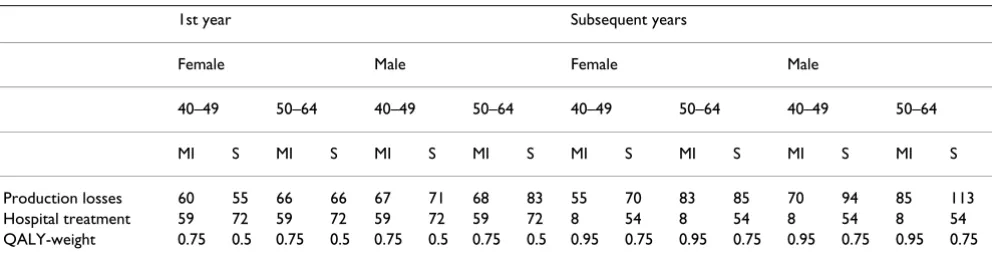
The costs included for the interventions are drugs and smoking cessation (table 1), and hospital treatment and production loss relating to manifest disease (table 2). In the societal perspective (table 1), the patient's travel costs as well as their co-payment for drug costs are added. The value of production was estimated as the difference between the annual gross income for the patients with an MI or stroke and the general population. The estimations were based on all patients between 1995 and 1998 in Swe-den using the Swedish Hospital Patient Discharge Regis-ter, the Cause of Death Register and data of income registered at Statistics Sweden [8,9]. The hospital treat-ment costs are a result of MI or stroke and are stratified according to the first year and all subsequent following years. The QALY weights are obtained from the literature [10].
Three interventions to prevent CVD are included in this study: smoking cessation advice; hypertension drugs; and cholesterol drugs. A single intervention or a combination of two or three may be taken. Thus there are a total of eight different possible intervention strategies and it is neces-sary to analyse the incremental effects and costs of each.
The health gains of any particular intervention depend, among other things, on the risk of the target group. There-fore, the population is stratified according to risk into 108 groups (table 3).
The effect of cholesterol-lowering drugs is assumed to be a 20% reduction in the yearly risk for both MI and stroke [11,12]. The effect of blood pressure lowering drugs is assumed to be a 16% reduction in risk for MI and 38% risk reduction for stroke [13]. The effect of smoking cessa-tion is a 45% reduccessa-tion in the yearly risk of MI and a 49% reduction in the yearly risk of stroke [14].
We calculated the cost per QALY in two ways, according to two sets of cost components in table 1 and 2, and produc-tivity gains were only included in calculations based on the societal perspective. Budget claims was set as equal to "local needs", which were calculated as the number of per-sons belonging to certain risk groups (and thus the popu-lation that could expect improved health from the intervention) multiplied by the direct intervention cost per person. The county council budget for a certain pur-pose is equal to the amount of resources currently used for that specific purpose. In total, the resources spent on pri-mary prevention of CVD with drugs and smoking cessa-tion in Västerbotten county council is 36.5 million SEK and this amount is used as a budget constraint in the cal-culations. All the interventions were ranked, initially according to the cost-effectiveness ratio based on societal costs, and subsequently on the ratio including health care costs only. Thus two different rankings of each interven-tion up to the budget limit are presented here.
Table 1: Costs of different interventions (SEK) in two perspectives.
Intervention Cost (SEK)
Health care sector perspective Societal perspective
Smoking cessation 150 150
Blood pressure reduction 2284 3122
Cholesterol reduction 3641 4600
Blood pressure reduction and smoking cessation 2434 3272 Cholesterol reduction and smoking cessation 3791 4750 Blood pressure reduction and cholesterol reduction 4725 6182 Blood pressure reduction, cholesterol reduction and smoking cessation 4875 6332
Table 2: Assumed costs (tSEK) for production losses and hospital treatment, and QALY-weights.
1st year Subsequent years
Female Male Female Male
40–49 50–64 40–49 50–64 40–49 50–64 40–49 50–64
MI S MI S MI S MI S MI S MI S MI S MI S
Results
Altogether 160 combinations of groups and treatments were not dominated and constitute the complete "league-table" in this study. 94 groups would be given the same treatment in both perspectives even if the ranking order differed. Twelve groups (notations A to L) are included either in the societal or the health care sector perspective (table 4). 57 groups were excluded from treatment using the societal perspective and 63 groups using the health care sector perspective. The group A-I contains 4053 indi-viduals and the group J-L 4039, so the treatment costs are equal (figures not shown). In the societal perspective, A to I have ratios equal to or below 54101 SEK/QALY and are included while J to L have ratios equal to or larger than 54855 SEK/QALY. In the health care sector perspective, J to K have the lowest ratios (59413–77047 SEK/QALY) and are included, while A-I have ratios of 79599 SEK/ QUALY or greater, and are thus excluded. The main pat-tern is that older females (J-L) are included in the health care sector perspective only, while primarily younger males and some females (A-I) are included in the societal perspective only.
The two perspectives will cause different consequences on the margin measured as gained QALY's and net costs. Comparing A-I with J-L, the former interventions have a 93 million lower net cost (71289 tSEK versus 164760 tSEK), while the latter (J-L) gains 729 more QALY's. From a health maximization point of view, the health care sec-tor perspective must be preferable. From a welfare maxi-mization point of view, the situation is unclear.
Discussion
This is a case study bearing the inherent limitations regarding generalization. However, only empirical studies can provide the information necessary for a deeper under-standing of the potential conflict between the two CEA perspectives. Not even the most convinced advocates for a certain principle are likely to be completely insensitive to the size of the sacrifices one has to make when principles clash.
Our calculations show that the ranking order is sensitive to the choice of perspective but, in general, when a budget constraint is introduced the same groups will receive treat-ment. Therefore one can say that the choice of perspective is only important for those groups close to the budget line.
The health care sector perspective is more effective in pro-ducing health gains. If the calculations are further decom-posed, age is a critical factor in several respects:
1. The risk for disease increases with age.
Table 3: Combination of risk factors used in the stratification of the population.
Age 40 – 49, 50 – 59, 60 – 69 Sex Female, Male
Smoking Yes, No
Cholesterol 5,9 mmol/l, 6,0–7,4 mmol/l, 7,5 mmol/l -Blood pressure 139 mmHg, 140–179 mmHg, 180 mmHg
-Table 4: Treatment groups either excluded in the societal or health care sector perspective
Intervention Sex and age Risk profile Gained QALYs Societal perspective Health care sector perspective
Net costs, SEK Cost/QALY Included Net costs, SEK Cost/QALY Included
A M40 5.0, 180 6 1 167 Yes 606 101000 No
B M40 S, 6.0, 150 90 434 4822 Yes 7947 88300 No C M40 S, 7.5, 139 63 1045 16587 Yes 6451 102397 No D M50 S, 5.0, 150 147 3036 20653 Yes 12194 82952 No
E M40 7.5, 150 68 1772 26059 Yes 7105 104485 No F M50 S, 6.0, 139 346 13254 38306 Yes 32258 93231 No G M50 6.0, 150 624 26209 42002 Yes 58805 94239 No
H F50 S,6.0,150 247 13257 53672 Yes 19661 79599 No I M50 7.5, 139 227 12281 54101 Yes 23964 105568 No
A-I 1812 71289
J F60 7.5, 150 765 41964 54855 No 45451 59413 Yes K F60 6.0,150 1541 105851 68690 No 112247 72841 Yes
L F60 S,6.0,139 235 16945 72106 No 18106 77047 Yes
J-L 2541 164760
M = male F = female
2. The accumulated gains counted as QALYs are larger the younger the person is at the time of the prevented event (ceteris paribus).
3. The cost for a continuous treatment such as hyperten-sion drugs are larger the younger the person is at the time of the initiation of treatment. "Point interventions" such as smoking advice have the same costs independent of age.
4. The accumulated production losses are larger the younger the person is at the time of the prevented event. The production losses normally approach zero soon after retirement.
Points 1–3 above are common for the two perspectives. In the health sector perspective the higher risk and lower treatment costs for old women outweigh the longer dura-tion of the gaining period for younger males. However, in the societal perspective the latter have a higher lifetime income resulting in larger productivity gains in the case of successful prevention and thus a lower net cost. This pat-tern would be even more pronounced if individuals aged over 60 were included in the study. Initially, our intention was to include individuals up to 70 years of age since they have almost completely left the labour-market, however this proved to be impossible because epidemiological data for that age-group were not available.
In the example used here (CVD) the risk of disease increases sharply with age thereby compensating for declining income in the ratio calcuation. This example is likely to be representative of many diseases since inci-dence is often positively correlated with age.
Productivity changes is not the only components in the calculations that are controversial from a normative point of view. It has been argued that QALY's are ageist because younger people typically have a longer life expectancy and treatment of younger individuals thus yields more QALYs than similar treatment of older people [15]. The counter argument is best known as the "fair innings" argument [16], which argues that everyone is entitled to a fair innings of life, and the old have had more of their innings than the young. This position receives some support from several empirical studies indicating that people in general want to give priority to the young over the old [17,18]. However, there exist two qualitatively different reasons for this standpoint. One has its roots in equity considerations – the young have lived less than the old. The second is based on efficiency considerations – the benefit to society is larger if priority is given to young people.
One circumstance making this even more complicated is the dependence between the health of the working
popu-lation and public resources for health and elderly care. Olsen and Richardson [19] investigate this dilemma and argue that most publicly funded health care is based on the principle of "equal access for equal need", meaning that a health gain has the same social value irrespective of the income level of the beneficiaries. Thus it would be wrong to exclude older women. But a dilemma arises if economic evaluations strive to incorporate this principle. On one hand, the fact that a patient's priority depends on his income is in conflict with "equal access for equal need". On the other hand, to disregard increased produc-tivity gains means ignoring increased societal welfare, which is the fundamental core of welfare economics.
Brouwer et al.[2] discuss the conflict between the broad societal perspective and the more narrow perspective of health care decision-makers. In some European countries, decision-makers have a democracy mandate, they are responsible for a certain budget and equity goals are important. This creates tension between the two perspec-tives and, assuming that the purpose of health economic analyses is to aid decision-makers, one can question if all dollars have the same value. "We conclude that although all costs are equal, in a health economic evaluation, some may be more equal than others." [2 p 347]
To summarize, allocating health care resources often requires a trade off between conflicting principles. An ambition to establish a general balance seems to imply futile efforts. Rather, the balance has to be set from case to case. Baltuseen and Niessen [20] have proposed a multi-criteria analysis for priority setting in health care, and we believe this would be a step towards more appropriate assistance to the decision-makers. It has been argued that an analysis in two perspectives would be a part of such a development, and we agree. However, we want to add that more studies making the consequences of different per-spectives visible would be a further step forward. Who will be treated and who will not? Thus we need to involve the cost-effectiveness studies in a budgetary context more often.
Conclusion
Publish with BioMed Central and every scientist can read your work free of charge
"BioMed Central will be the most significant development for disseminating the results of biomedical researc h in our lifetime."
Sir Paul Nurse, Cancer Research UK
Your research papers will be:
available free of charge to the entire biomedical community
peer reviewed and published immediately upon acceptance
cited in PubMed and archived on PubMed Central
yours — you keep the copyright
Submit your manuscript here:
http://www.biomedcentral.com/info/publishing_adv.asp
BioMedcentral
Competing interests
The author(s) declare that they have no competing inter-ests.
Authors' contributions
LL, EL and MR designed the study. EL made the calcula-tions. LL, EL and MR interpreted the results. LL drafted the manuscript. EL and MR critically revised the manuscript. LL, EL and MR have approved the final version.
Acknowledgements
Grants were received from the Vårdal foundation and the Swedish Research Council; the "Linné Grant" to the Ageing and Living Conditions Programme.
References
1. Drummond M, Schulper M, O'Brien B, Stoddart G: Methods for the Economic Evaluation of Health Care Programmes Third edition. Oxford University Press; 2005.
2. Brouwer WBF, van Exel JA, Baltussen RMPM, Rutten FFH: A Dollar Is a Dollar Is a Dollar-or Is It? Value in Health 2006, 9:341-347. 3. Weinstein MC: Principles of cost-effective resource allocation
in health care organisations. Int J Tech Assess Health Care 1990,
6:93-103.
4. Lindholm L, Hallgren C-G, Boman K, Markgren K, Weinehall L, Ögren J-E: Cost-effectiveness analysis with defined budget: how to distribute resources for the prevention of cardiovascular dis-ease? Health Policy 1999, 48:155-170.
5. Löfroth E, Lindholm L, Wilhelmsen L, Rosén M: Optimising health care within given budgets: primary prevention of cardiovas-cular disease in different regions of Sweden. Health Policy 2006,
75:214-29.
6. Culyer AJ, Wagstaff A: Equity and equality in health and health care. J of Health Economics 1993, 12:431-457.
7. Dobson AJ, Evans A, Ferrario M, Kuulasmaa KA, Moltchanov VA, Sans S, Tunstall-Pedoe H, Tuomilehto JO, Wedel H, Yarnell J: Changes in estimated coronary risk in the 1980s: data from 38 popula-tions in the WHO MONICA Project. Ann Med 1998,
30:199-205.
8. Centre for Epidemiology [http://www.socialstyrelsen.se/en/ about/epc/]
9. Statistics Sweden [http://www.scb.se]
10. Teng TO, Wallace A: One Thousand Health-Related Quality-of-Life Estimates. Med Care 2000, 38:583-637.
11. Shepherd J, Cobbe SM, Ford I, Isles CG, Lorimer AR, MacFarlane PW, McKillop JH, Packard CJ: Prevention of coronary heart disease with pravastatin in men with hypercholesterolemia. West of Scotland Coronary Prevention Study Group. New Engl J Med
1995, 333:1301-7.
12. Downs JR, Clearfield M, Weis S, Whitney E, Shapiro DR, Beere PA, Langendorfer A, Stein EA, Kruyer W, Gotto Am Jr: Primary pre-vention of acute coronary events with lovastatin in men and women with average cholesterol levels: result of AFCAPS/ TexCAPS. JAMA 1998, 279:165-22.
13. Collins R, Peto R, MacMahon S, Hebert P, Fiebach NH, Eberlein KA, Godwin J, Qizilbash N, Taylor JO, Hennekens CH: Blood pressure, stroke, and coronary heart disease. Part 2, Short-term reductions in blood pressure: overview of randomised drug trials in their epidemiological context. Lancet 1990,
335:827-38.
14. The Swedish Council on Technology Assessment in Health Care:
Smoking cessation methods. Stockholm 1998.
15. Edgar A, Salek S, Darren S, Cohen D: The Ethical QALY. Ethical Issues in Healthcare Resource Allocations. Euromed Commu-nications Ltd, Chippenham; 1998.
16. Williams A: Intergenerational equity: an exploration of the "fair innings" argument. Health Economics 1997, 6:117-132. 17. Tsuchiya A, Dolan P, Shaw R: Measuring people's preferences
regarding ageism in health: some methodological issues and some fresh evidence. Soc Sci Med 2003, 57:687-696.
18. Tsuchiya A: Age-related preferences and age weighting health benefits. Soc Sci Med 1999, 48:267-276.
19. Olsen JA, Richardson J: Production gains from health care: what should be included in cost-effectiveness analyses? Soc Sci Med
1999, 49:17-26.