Open Access
Software
A software tool for creating simulated outbreaks to benchmark
surveillance systems
Christopher A Cassa*
1,2,4, Karin Iancu
2, Karen L Olson
1,3and
Kenneth D Mandl
1,3Address: 1Children's Hospital Informatics Program, Informatics Program – Mandl Group, 1 Autumn St, #721, Children's Hospital Boston, Boston,
MA 02115, USA, 2Clinical Decision Making Group, Computer Science and Artificial Intelligence Laboratory, Massachusetts Institute of
Technology, Cambridge, MA 02139, USA, 3Harvard Medical School, Boston, MA 02115, USA and 4Harvard/MIT Division of Health Sciences and
Technology, Cambridge, MA 02139, USA
Email: Christopher A Cassa* - [email protected]; Karin Iancu - [email protected]; Karen L Olson - [email protected]; Kenneth D Mandl - [email protected]
* Corresponding author
Abstract
Background: Evaluating surveillance systems for the early detection of bioterrorism is particularly challenging when systems are designed to detect events for which there are few or no historical examples. One approach to benchmarking outbreak detection performance is to create semi-synthetic datasets containing authentic baseline patient data (noise) and injected artificial patient clusters, as signal.
Methods: We describe a software tool, the AEGIS Cluster Creation Tool (AEGIS-CCT), that enables users to create simulated clusters with controlled feature sets, varying the desired cluster radius, density, distance, relative location from a reference point, and temporal epidemiological growth pattern. AEGIS-CCT does not require the use of an external geographical information system program for cluster creation. The cluster creation tool is an open source program, implemented in Java and is freely available under the Lesser GNU Public License at its Sourceforge website. Cluster data are written to files or can be appended to existing files so that the resulting file will include both existing baseline and artificially added cases. Multiple cluster file creation is an automated process in which multiple cluster files are created by varying a single parameter within a user-specified range. To evaluate the output of this software tool, sets of test clusters were created and graphically rendered.
Results: Based on user-specified parameters describing the location, properties, and temporal pattern of simulated clusters, AEGIS-CCT created clusters accurately and uniformly.
Conclusion: AEGIS-CCT enables the ready creation of datasets for benchmarking outbreak detection systems. It may be useful for automating the testing and validation of spatial and temporal cluster detection algorithms.
Published: 14 July 2005
BMC Medical Informatics and Decision Making 2005, 5:22 doi:10.1186/1472-6947-5-22
Received: 07 November 2004 Accepted: 14 July 2005
This article is available from: http://www.biomedcentral.com/1472-6947/5/22
© 2005 Cassa et al; licensee BioMed Central Ltd.
Background
The public health information infrastructure is yielding real-time access to health data, enabling new approaches to surveillance for infectious outbreaks. Prior to the labo-ratory confirmation or physician diagnosis of an infec-tious disease, ill persons may exhibit behavioral patterns, symptoms, signs, or laboratory findings that can be tracked through a variety of data sources. The process of monitoring these data is often referred to as syndromic surveillance [1-3].
Real time outbreak detection algorithms tend to focus on the temporal and spatial patterns of cases. Some detection routines, such as Cusum [4], look at just one type of pat-tern, while others, such as the Space-Time Scan Statistic [5] incorporate both. What these algorithms have in com-mon is an underlying model of typical, or baseline pat-terns, and the goal of detection is to recognize perturbations from the baseline [1]. The outbreak detec-tion performance of a surveillance system can be meas-ured in terms of its ability to distill "signal" (a cluster of cases in time and/or space) from noisy baseline.
Benchmarking the performance of detection algorithms requires training and validation data. When real data are not available, simulated data are often used [6,7]. Simu-lated outbreaks must reflect the diversity of threats that a surveillance system is expected to encounter and detect, whether these outbreaks occur naturally or are man-made.
Our approach to validating detection algorithms is to use semi-synthetic data, that is, authentic baseline data injected with artificial signals [8]. These signals are defined by a controlled feature set of variable parameters such as the size, location, shape, and duration of simu-lated outbreaks. Here we describe a software tool, the
AEGIS Cluster Creation Tool (AEGIS-CCT), that enables users to create simulated clusters with controlled feature sets, varying the desired cluster radius, density, distance, and relative location away from a central point. AEGIS-CCT does not require the use of an external geographic information system (GIS) program for cluster creation.
Implementation
Functional specifications
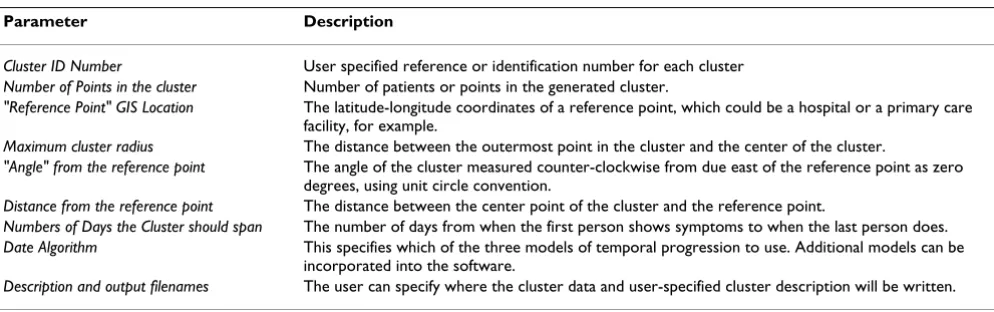
AEGIS-CCT can create single patient clusters as well as sets of patient clusters based on a simple geographical model. Cluster data points are outputted as comma separated var-iable (CSV) files, and can optionally be appended to an existing file, supplied by the user. The tool can also gener-ate different sets of clusters that range in value over a sin-gle parameter to rigorously validate detection algorithms. To create individual clusters, the user can vary a number of relevant outbreak parameters (Table 1). AEGIS-CCT creates at least two output files each time it is executed, with file names specified by the user. One is a cluster data file that contains the artificial cluster data, and the other is a record file describing the session cluster parameters. The data file contains a cluster point identification number (assigned numerically from 0 to the number of points minus 1), the latitude and longitude of the cluster point, and the relative date of the cluster point. When generating a series of n clusters, the program automatically generates
n files with appended identifiers, each as separate data
files.
The AEGIS-CCT is a Java package including a geospatial engine and a user interface created using the Swing toolkit. The source for the entire package is provided under the Lesser GNU Public License [9] on a source-forge.net development site [10]. Full details and updates to AEGIS-CCT can be obtained online [11].
Table 1: Parameters that can be altered when creating a single cluster.
Parameter Description
Cluster ID Number User specified reference or identification number for each cluster Number of Points in the cluster Number of patients or points in the generated cluster.
"Reference Point" GIS Location The latitude-longitude coordinates of a reference point, which could be a hospital or a primary care facility, for example.
Maximum cluster radius The distance between the outermost point in the cluster and the center of the cluster.
"Angle" from the reference point The angle of the cluster measured counter-clockwise from due east of the reference point as zero degrees, using unit circle convention.
Distance from the reference point The distance between the center point of the cluster and the reference point.
Numbers of Days the Cluster should span The number of days from when the first person shows symptoms to when the last person does. Date Algorithm This specifies which of the three models of temporal progression to use. Additional models can be
incorporated into the software.
Geocoding and precision of location
Programmatic methods were implemented to assign lati-tude-longitude coordinates to simulated cluster points, taking into account physical earth surface distances and not relying on external GIS software. Inside an AEGIS-CCT GIS class, there are three primary methods to handle these conversions. The first is a method to find the dis-tance between two locations, which uses the specific lati-tude-longitude of the reference point to create a ratio of degrees per meter for north-south latitude and east-west longitude. Artificial data points are created 0.05 degrees to the north or east, and the corresponding physical dis-tances (x, y) are calculated using the Haversine Formula, described below. The ratio is then computed, dividing the artificial data point distance by the calculated physical dis-tance in meters on the Earth's surface. A second method finds a point that is a specific physical distance, measured at a specified angle, from a reference point. The angle is measured from the Euclidian x-axis and increased in a counter-clockwise form. The output is a second GIS data point related to the reference point by the angle and dis-tance specified by the user. The third method finds the number of degrees of latitude and longitude per unit of physical distance in each respective direction.
GIS precision
Placing patients on a map requires consideration of earth curvature and precise latitudes and longitudes. Spherical equations break down significantly at small distances, but the Haversine formula [12] provides computationally exact results in almost all circumstances. For this calcula-tion, Earth has radius R, and the locations of two points in spherical coordinates (latitude and longitude) have names [lon1, lat1] and [lon2, lat2]. The Haversine For-mula is calculated using the following code:
dlon = lon2 - lon1;
dlat = lat2 - lat1;
a = (sin(dlat/2)) ^2 + cos(lat1) * cos(lat2) * (sin(dlon/2)) ^2;
c = 2 * atan2(sqrt(a), sqrt(1-a));
d = R * c;
This implementation was quality tested for accuracy using a series of latitude-longitude pairs from a sample dataset, measuring distances between two data points. Those results were identical with distances calculated by com-mercially-available GIS software.
Geotemporal progression
Outbreaks vary in their temporal progressions or epi-demic curves. Three such progressions were implemented in AEGIS-CCT as date algorithms to model the ways in which a disease might manifest in a population over time: a random, a linear, and an exponential growth spread. Additional epidemiological date algorithms can be added by other users to the AEGIS-CCT by implementing a method to assign a specific temporal distribution within an array in Java.
For the random algorithm, a random number is generated that falls within the range of the number of days in the
An example of the linear date algorithm estimation for thirty points spanning three days
Figure 1
An example of the linear date algorithm estimation for thirty points spanning three days. The x-axis represents the day number.
An example of the exponential date algorithm estimation for thirty points spanning three days
Figure 2
cluster, producing a random distribution. For the linear distribution, the day value is divided by the total day val-ues and multiplied by the total number of points to deter-mine the fraction of the total points to be injected each day. Scaling by a multiplier can alter the rate of linear growth. Similarly for the exponential distribution, the numerical value of e(multiplier * day number) is divided by the
sum of e(multiplier * day number), for all day values. This ratio is
then multiplied by the total number of points to deter-mine the number of points that occur each day. Examples of the linear and exponential growth modified probability distribution estimations for date distribution are pre-sented in Figures 1 and 2.
Results
Analysis of accuracy and uniformity of patient cluster data Semi-synthetic datasets created by the cluster generator fall within a specified set of parameter-based boundaries. Cluster data points are created randomly within the domain defined by those parameters, so it is important to verify that the clusters are accurately created and are close to uniformly generated.
To measure the uniformity of generated clusters, 10 test clusters were created with 100 points in each cluster. The centroid of each set of cluster points was then calculated and compared to the specified center point of that cluster. In every case, the cluster centroid was within five percent of the specified cluster radius, in distance, from the speci-fied center point. This result demonstrates that the data-sets are uniform, within a small threshold, when they contain a sufficient number of points, as would be expected with a random distribution.
To measure the accuracy of the geocoding engine, 360 clusters were made, forming a circle, around a single
center point, varying the angle evenly (one degree added per cluster,) and they each had a cluster center point that fell precisely along the circle defined by all points at the same radial distance from the original counterpoint. This same test was conducted at five randomly selected lati-tude-longitude locations and the same results were obtained.
Sample cluster parameters and output
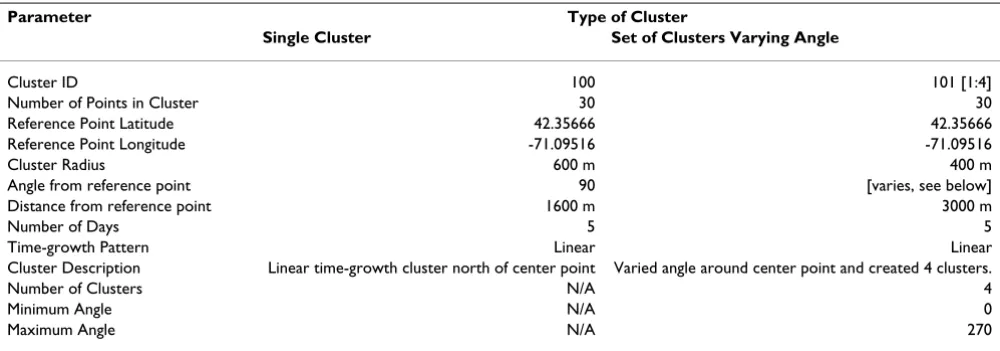
Two sample scenarios are described below, and their parameters are listed in Table 2. The first example demon-strates the creation of a single artificial cluster and the sec-ond example demonstrates the creation of several clusters at various angles around a single reference point. The first cluster includes cases in a simulated outbreak spanning five days.
The single linear time-growth cluster was placed approximately 1600 m due north of a center point at longitude
-Table 2: Example of single cluster parameters and multiple cluster parameters.
Parameter Type of Cluster
Single Cluster Set of Clusters Varying Angle
Cluster ID 100 101 [1:4]
Number of Points in Cluster 30 30
Reference Point Latitude 42.35666 42.35666
Reference Point Longitude -71.09516 -71.09516
Cluster Radius 600 m 400 m
Angle from reference point 90 [varies, see below]
Distance from reference point 1600 m 3000 m
Number of Days 5 5
Time-growth Pattern Linear Linear
Cluster Description Linear time-growth cluster north of center point Varied angle around center point and created 4 clusters.
Number of Clusters N/A 4
Minimum Angle N/A 0
Maximum Angle N/A 270
Table 3: Sample output to a comma separated value file from AEGIS-CCT. Note: Values are point identification number, longitude, latitude and day number.
71.09516 and latitude 42.35666. AEGIS-CCT outputted a CSV file and partial results are listed in Table 3. There are two points on the first day, four on the second day, six on the third day, linearly increasing to include thirty patient points by day 5.
The output CSV can be imported into a GIS analysis tool. A map made from AEGIS-CCT output using MapPoint 2002 (Microsoft Corporation, Redmond, WA) is pre-sented in Figure 3. The temporal progression (linear-growth algorithm) is indicated by the shaded color of coordinate points for each simulated case as shown in the legend. The temporal growth pattern of a similar injected linear-growth cluster spanning 7 days (containing a total of 56 points) is graphed when appended to a low-volume week (120 visits, 07/15-21/2001) and a high-volume week (472 visits, 01/14-20/2001) in Figure 4.
In the second example, the angle around the center point was varied, creating a series of four clusters. The series cluster generator automatically created four files, and each file was imported into MapPoint, and charted in a differ-ent color, as shown in Figure 5.
The CCT can create new data files or it can append cluster data to an existing file. The artificial portion of a semi-syn-thetic dataset can then be automatically combined with baseline patient distributions by specifying a file that
con-A single linear time-growth cluster north of center point
Figure 3
A single linear time-growth cluster north of center point.
Artificially-Injected Temporal Cluster into Low and High-Vol-ume Weeks of Children's Hospital Boston ED Visit Data: An artificially-generated cluster (dashed line at bottom) contain-ing a total of 56 additional points, linearly increascontain-ing in magni-tude over a 7 day span, was added to two separate weeks of Children's Hospital Boston temporal visit data
Figure 4
Artificially-Injected Temporal Cluster into Low and High-Vol-ume Weeks of Children's Hospital Boston ED Visit Data: An artificially-generated cluster (dashed line at bottom) contain-ing a total of 56 additional points, linearly increascontain-ing in magni-tude over a 7 day span, was added to two separate weeks of Children's Hospital Boston temporal visit data. The first week of data was from a low-volume week, containing a total of 120 authentic patient visits with an additional 56 artifi-cially-generated visits while the second series contains a total of 472 authentic visits with the same 56 artificially-generated visits appended. While growth in the low-volume week is vis-ible by inspection, it is difficult to notice the artificially added visits in a higher-volume week.
Creation of a series of four clusters around the center point (with the angle varied
Figure 5
tains the baseline data. In future versions, the CCT may provide an xml schema to which input baseline data files should conform.
Limitations
AEGIS-CCT does not yet have built-in procedures to gen-erate more complicated time-series or spatial distribu-tions. Extensibility was taken very seriously when creating AEGIS-CCT, and sufficient abstractions were made to allow for ease of adding additional models. The generator is also extensible in other ways so that additional param-eters can be added if they are easily computable. Parame-ters can be added or deleted by updating the GUI and modifying the GenerateCluster method in the main geospatial class. Potential areas for expansion in future versions include log-linear and logarithmic time-series models as well as Gaussian spatial distributions. It will be necessary to determine what the most pertinent and phys-ically realistic models of syndromic spread are. Once the most realistic scenarios are assessed and modeled, they can be programmatically implemented and incorporated into the cluster creation tool. As long as these distributions can be implemented using Java methods, it is possible to quickly add another temporal distribution to AEGIS-CCT.
Conclusion
Evaluation of surveillance systems for the early detection of outbreaks is particularly challenging [13] when the systems are designed to detect events for which there are a few or no historical examples. Some real-time surveillance systems are designed to provide early warning of a biological attack. Fortunately, few people have been infected with biological warfare agents, although there are notable exceptions. For example, residents of Sverdlovsk were exposed in 1979 during an accidental release of anthrax from a weapons plant [14] and there were eleven infections, resulting in five deaths in the Florida, New York and Washington DC mailed-anthrax attacks in 2001 [15]. In the absence of sufficient real outbreak data, meas-uring the detection performance of a system requires sim-ulation. AEGIS-CCT enables the ready creation of datasets for benchmarking outbreak detection systems.
Availability and requirements
Lists the following
* Project name: AEGIS Cluster Creation Tool
* Project home page: http://sourceforge.net/projects/ chipcluster/
* Operating system(s): Platform independent
* Programming language: Java
* Other requirements: Java 1.3.1 or higher
* License: e.g. GNU LGPL
* Any restrictions to use by non-academics: none
List of abbreviations
GIS – Geographical Information Systems
GUI – Graphical User Interface
CSV – Comma-Separated Values
Competing interests
The author(s) declare that they have no competing interests.
Authors' contributions
CC implemented the GIS engine and dataset manage-ment, thoroughly tested of program, and was the primary author of the manuscript. KI helped implement the graph-ical user interface and the file read and write components. KO provided datasets and domain knowledge of specific issues relevant to the evaluation of detection perform-ance. KM conceived of the study and participated in its design and coordination. All authors read and approved the final manuscript.
Acknowledgements
This work was supported by the National Institutes of Health through R01LM007970-01 from the National Library of Medicine, and by grant 2002-12-1 from the Alfred P. Sloan Foundation. This software was pre-sented in part at the 2003 National Syndromic Surveillance Conference in New York, NY.
References
1. Mandl KD, Overhage JM, Wagner MM, Lober WB, Sebastiani P, Mos-tashari F, Pavlin J, Gesteland PH, Treadwell T, Koski E, Hutwagner L, Buckeridge DL, Aller R, Grannis S: Implementing syndromic sur-veillance: a practical guide informed by the early experience. J Am Med Inform Assoc 2004, 11:141-150 [PrePrint published Nov 21, 2003; as doi:10.1197/jamia.M1356].
2. Tsui FC, Espino JU, Dato VM, Gesteland PH, Hutman J, Wagner MM:
Technical description of RODS: a real-time public health sur-veillance system. J Am Med Inform Assoc 2003, 10:399-408. 3. Lombardo J, Burkom H, Elbert E, Magruder S, Lewis SH, Loschen W,
Sari J, Sniegoski C, Wojcik R, Pavlin J: A Systems Overview of the Electronic Surveillance System for the Early Notification of Community-Based Epidemics (ESSENCE II). J Urban Health
2003, 80:I32-I42..
4. Hutwagner LC, Maloney EK, Bean NH, Slutsker L, Martin SM: Using laboratory-based surveillance data for prevention: an algo-rithm for detecting Salmonella outbreaks. Emerging Infectious Diseases 1997, 3:395-400.
5. Kulldorff M, Athas WF, Feurer EJ, Miller BA, Key CR: Evaluating cluster alarms: a space-time scan statistic and brain cancer in Los Alamos, New Mexico. Am J Public Health 1998,
88:1377-1380.
6. Reis BY, Pagano M, Mandl KD: Using temporal context to improve biosurveillance. Proc Natl Acad Sci U S A 2003,
100:1961-1965.
over-the-Publish with BioMed Central and every scientist can read your work free of charge
"BioMed Central will be the most significant development for disseminating the results of biomedical researc h in our lifetime."
Sir Paul Nurse, Cancer Research UK
Your research papers will be:
available free of charge to the entire biomedical community
peer reviewed and published immediately upon acceptance
cited in PubMed and archived on PubMed Central
yours — you keep the copyright
Submit your manuscript here:
http://www.biomedcentral.com/info/publishing_adv.asp
BioMedcentral
counter medication sales. Proc Natl Acad Sci U S A 2002,
99:5237-5240.
8. Mandl KD, Reis BY , Cassa C: Measuring outbreak detection performance using controlled feature set simulations. MMWR 2004, National Syndromic Surveillance Conference Proceedings:.
9. Open Source Initiative: GNU Lesser General Public License.
[http://www.opensource.org/licenses/lgpl-license.php].
10. SourceForge: AEGIS-CCT. [http://www.sourceforge.net/projects/ chipcluster/].
11. Sinnott RW: Virtues of the Haversine. Sky and Telescope 1984,
68:159.
12. Buehler JW, Hopkins RS, Overhage JM, Sosin DM, Tong V: Frame-work for evaluating public health surveillance systems for early detection of outbreaks: recommendations from the CDC Working Group. MMWR Recomm Rep 2004, 53:1-11. 13. Meselson M, Guillemin J, Hugh-Jones M, Langmuir A, Popova I,
Shelokov A, Yampolskaya O: The Sverdlovsk anthrax outbreak of 1979. Science 1994, 266:1202-1208.
14. Jernigan JA, Stephens DS, Ashford DA, Omenaca C, Topiel MS, Gal-braith M, Tapper M, Fisk TL, Zaki S, Popovic T, Meyer RF, Quinn CP, Harper SA, Fridkin SK, Sejvar JJ, Shepard CW, McConnell M, Guarner J, Shieh WJ, Malecki JM, Gerberding JL, Hughes JM, Perkins BA, Anthrax Bioterrorism Investigation T: Bioterrorism-related inha-lational anthrax: the first 10 cases reported in the United States. Emerging Infectious Diseases 2001, 7:933-944.
Pre-publication history
The pre-publication history for this paper can be accessed here: