R E S E A R C H A R T I C L E
Open Access
The effect of a test ordering software
intervention on the prescription of
unnecessary laboratory tests - a
randomized controlled trial
Carlos Manuel Silva Martins
1,4*, Andreia Sofia da Costa Teixeira
2, Luís Filipe Ribeiro de Azevedo
3,
Luísa Maria Barbosa Sá
1, Paulo Alexandre Azevedo Pereira Santos
1, Maria Luciana Gomes Domingues do Couto
1,
Altamiro Manuel Rodrigues da Costa Pereira
3, Alberto Augusto Oliveira Pinto Hespanhol
1and Cristina Maria Nogueira da Costa Santos
3Abstract
Background:The way software for electronic health records and laboratory tests ordering systems are designed may influence physicians’prescription. A randomised controlled trial was performed to measure the impact of a diagnostic and laboratory tests ordering system software modification.
Methods:Participants were family physicians working and prescribing diagnostic and laboratory tests.
The intervention group had a modified software with a basic shortcut menu changes, where some tests were withdrawn or added, and with the implementation of an evidence-based decision support based on United States Preventive Services Task Force (USPSTF) recommendations. This intervention group was compared with usual software (control group). The outcomes were the number of tests prescribed from those: withdrawn from the basic menu; added to the basic menu; marked with green dots (USPSTF’s grade A and B); and marked with red dots (USPSTF’s grade D).
Results:Comparing the monthly average number of tests prescribed before and after the software modification, from those tests that were withdrawn from the basic menu, the control group prescribed 33.8 tests per 100 consultations before and 30.8 after (p= 0075); the intervention group prescribed 31.3 before and 13.9 after (p< 0001). Comparing the tests prescribed between both groups during the intervention, from those tests that were withdrawn from the basic menu, the intervention group prescribed a monthly average of 14.0 vs. 29.3 tests per 100 consultations in the control group (p< 0.001). From those tests that are USPSTF’s grade A and B, intervention group prescribed 66.8 vs. 74.1 tests per 100 consultations in the control group (p= 0.070). From those tests categorised as USPSTF grade D, the
intervention group prescribed an average of 9.8 vs. 11.8 tests per 100 consultations in the control group (p= 0.003).
Conclusions:Removing unnecessary tests from a quick shortcut menu of the diagnosis and laboratory tests ordering system had a significant impact and reduced unnecessary prescription of tests.
The fact that it was not possible to perform the randomization at the family physicians’level, but only of the computer servers is a limitation of our study. Future research should assess the impact of different tests ordering systems during longer periods.
(Continued on next page)
* Correspondence:[email protected] 1
Family Medicine Unit, Social Sciences and Health Department of the Faculty of Medicine of Porto, Porto, Portugal
4Unidade de Medicina Geral e Familiar, Faculdade de Medicina da
Universidade do Porto, Al. Prof. Hernâni Monteiro, 4200-319 Porto, Portugal Full list of author information is available at the end of the article
(Continued from previous page)
Trial registration:ISRCTN45427977, May 1st2014 (retrospectively registered).
Keywords:Preventive health services, Primary health care, Evidence-based practice, Decision support systems, clinical, Decision making, computer-assisted
Background
Informatics has undoubtedly changed the way societies live, socialize, learn, work, and deal with healthcare. We now live in a period of increasing concern about the ex-cessive presence of medicine in our lives [1–3]. When inefficient software is combined with a nonevidence-based medical practice, there is the risk of patient harm, significant impact to quality of life, and damage to the healthcare system due to unnecessary costs.
The implementation of electronic health records (EHR) has both potential benefits and drawbacks [4]. Among the benefits, the prevention of medical errors and the promotion of patient safety has often been men-tioned and confirmed in clinical practice [4–6]. Despite the positive effects of EHR implementation in clinical practice, a range of barriers faced by physicians has been identified. These barriers may include technical and fi-nancial aspects, time, psychological, social, legal, and organizational changes to the process [7]. After having removed the first barriers to EHR implementation, it is now time to implement continuing improvement and development of the available tools and to incorporate the scientific evidence obtained to this point [4, 8–10].
To achieve better patient safety standards and improve healthcare system cost-effectiveness, there has been a worldwide effort to implement an integrated EHR system with diagnostic and laboratory test ordering communica-tion systems [11–13]. There have also been attempts to in-corporate clinical decision support systems to further improve the quality of medicine. Prescribing diagnostic and laboratory tests is a key component of medical con-sultation. In the primary health care setting, tests are often ordered with preventive intentions and fulfillment of pa-tient expectations [14, 15]. There is also great uncertainty and variability among family physicians’ordering routines [16–18]. The effects of test ordering communication sys-tems integrated with clinical decision support syssys-tems have been reported in various clinical practice settings. Main C et al. (2010) have performed a systematic review of this topic and reported that integration of clinical deci-sion support systems resulted in significant benefits to the prescribing process and practitioner performance out-comes in nearly two-thirds of the 24 studies that met the inclusion criteria [19].
In Portugal, the use of EHR software with a diagnostic and laboratory test order communication system has
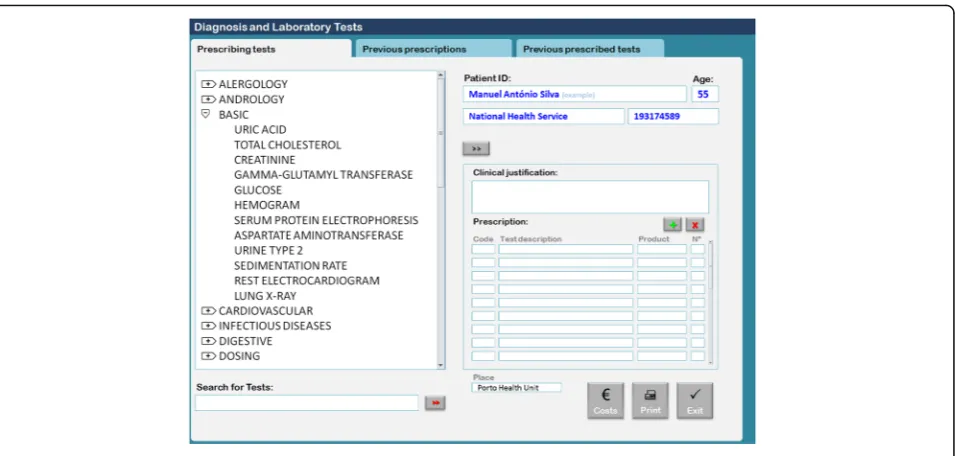
been mandatory since September 2011. Most of the pri-mary healthcare centers use software called Sistema de Apoio ao Médico(Physician’s Support System [SAM]). In the module used to order diagnostic and laboratory tests, physicians access a searchable test menu by two possible strategies: 1) typing the test name in a search box or 2) browsing by a shortcut menu structure (Fig. 1). Different menus are available for most areas of medicine, including basic, allergology, andrology, cardiovascular, Infectious diseases, digestive, dosing, endocrinology, gy-naecology, haematology, rheumatology, obstetrics, on-cology, otorhinolaringology, osteoarticular, preoperative, respiratory, central nervous system, urology and neph-rology. Under each menu there is a set of specific lab tests. Physicians can choose one or more tests by double-clicking each test or can choose the entire set by double-clicking on the shortcut menu’s title. For ex-ample, the basic menu is composed of uric acid, total cholesterol, creatinine, gamma-glutamyl transferase, glu-cose, hemogram, serum protein electrophoresis, aspar-tate aminotransferase, urine type 2, sedimentation rate, electrocardiogram, and lung X-ray tests.
If a physician would like to choose only hemogram and glucose, they must double-click on each test. How-ever, if they would like the entire basic set of tests, they must double-click on the basic menu title. Our research team suspected that this basic shortcut menu is often se-lected during routine consultations in which patients ask for routine check-ups without specific reason. As we have shown in a previous study, there is a high preva-lence of Portuguese adults (99.2%) that believe they should have routine blood and urine tests annually [14]. This statistic demonstrates the importance of examining the effectiveness and efficiency of this basic submenu.
requires it to be installed at a server level, which deter-mines that all physicians at all healthcare centers served by that server will receive the same version of the soft-ware. For this reason, it was not possible to randomize the study at the physician level. Rather, we had to randomize the servers at the healthcare center group level.
Methods
Trial design
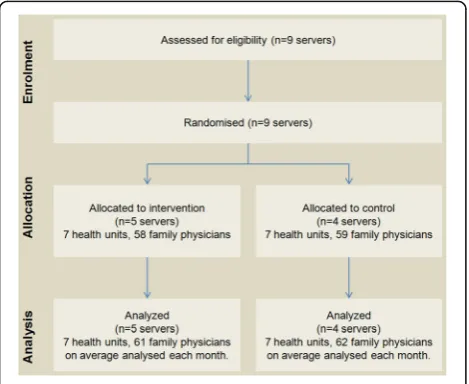
All servers of the Western Oporto grouping of health cen-ters counted for randomization, except that serving the center where study authors worked (to avoid possible bias). The remaining nine servers were randomized into two groups: 1) five servers were randomly allocated to the inter-vention group and 2) four servers to the control group.
Participants
All family physicians working and prescribing diagnostic and laboratory tests in the Western Oporto group of health centers (except in those where the authors worked) participated in this study.
Data of the diagnostic and laboratory tests prescriptions were centrally collected by informatics staff belonging to the Ministry of Health and sent to the research team with-out patients’or physicians’identifications.
Interventions
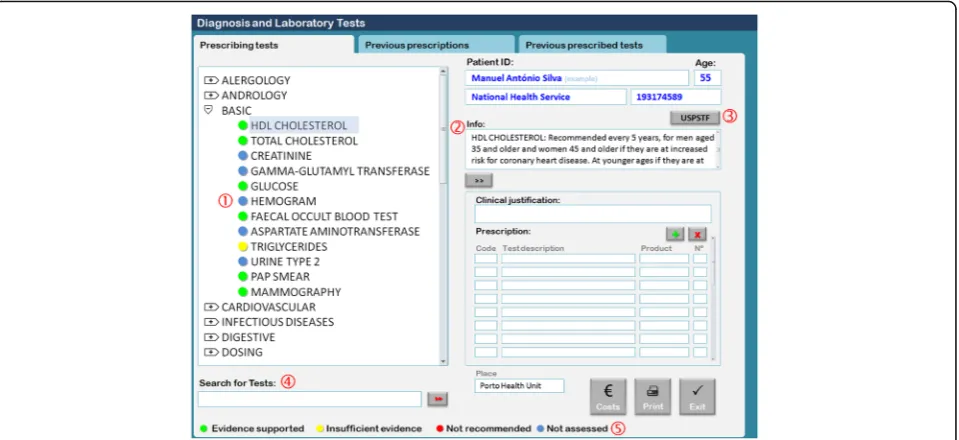
The control group continued to use the standard version of the EHR software (SAM) as presented in Fig. 1. The intervention group used a modified version of the software (SAM modified) installed in each server (Fig. 2). Software modifications consisted of two principal changes: 1) Basic shortcut menu changes; the composition of the basic menu
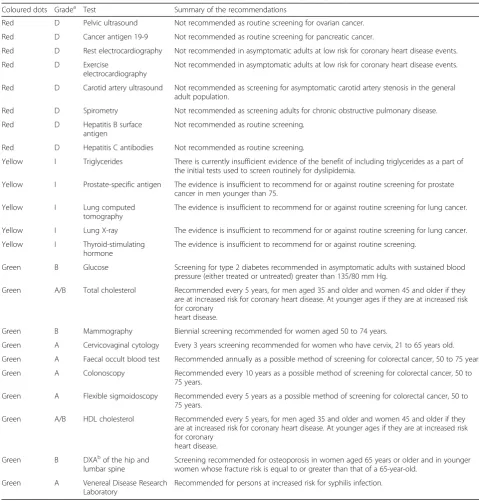
set of diagnostic laboratory tests was changed. Some tests were removed, including uric acid, serum protein electro-phoresis, sedimentation rate, electrocardiogram, and lung X-ray. Other tests were added, including HDL cholesterol, faecal occult blood test, triglycerides, Pap smear, and mam-mography. Although some tests were removed from the basic menu, physicians were still able to request them by typing their names in the search for tests box. 2) Addition of an evidence-based decision support. For the tests listed in Table 1, we added traffic light-based coloured dots according to the USPSTF recommendations and an add-itional information box containing the summary of the USPSTF recommendation and a link to the integral recommendation at the USPSTF website (Fig. 2) [21].
The selection of the specific tests to be removed from or added to the basic shortcut menu was made after discus-sion and debate with eight family physicians selected by proximity and convenience. The main rational was to re-move tests that are not recommended to be used as rou-tine screening tools and to substitute them with others that may be recommended for certain risk groups. How-ever, creating a change that was that was not too disrup-tive to the current family physicians’ practices was a concern, and that is why tests such as creatinine, gamma-glutamyl transferase, hemogram, aspartate aminotransfer-ase, and urine type 2 were left in the basic shortcut menu.
EHR software modifications were implemented on 30th and 31stMay 2012 in all of the intervention groups’servers. Prospective monthly monitoring and data collection oc-curred until 31stJanuary 2013. To allow a pre-post analysis in both groups, a retrospective monthly data collection of both control and intervention groups was also performed between 1stDecember 2011 and 31stMay 2012.
The collected data included monthly parameters, in-cluding numbers of prescribing family physicians, face to face consultations made, and number of each prescribed diagnostic and laboratory test.
Independent variables
Group (control and intervention) and time (before and after the modifications) were the independent variables.
Dependent variables
Primary outcomes were chosen to assess the impact of our intervention on the number of diagnostic and la-boratory tests prescribed by physicians using four differ-ent perspectives: 1) impact on the number of the prescriptions of diagnostic and laboratory tests that were withdrawn from the basic menu; 2) impact on the num-ber of the prescriptions of diagnostic and laboratory tests that were added to the basic menu; 3) impact on the number of the prescriptions of diagnostic and la-boratory tests that were marked with green dots (USPSTF recommendation grades A and B); and 4) im-pact on the number of prescriptions of diagnostic and laboratory tests that were marked with red dots (USPSTF recommendation grade D). Diagnostic and la-boratory tests were the dependent variables.
Sample size
Given administrative and technical barriers related to the permission process for the introduction of EHR soft-ware modifications, our sample size was obtained by
convenience. We decided to run this trial at the Western Oporto grouping of healthcare centers, which includes a total of 15 primary care healthcare centers and an in-formatics network of 10 servers. One of the servers, which served the healthcare center in which some of the study authors worked, was excluded from the study.
The power calculation was done for the mean number of monthly prescribed tests per 100 consultations com-parison between control and intervention groups. A sig-nificance level of 0.05, a power of 0.8, and a standard deviation of two tests prescribed per 100 consultations per month was considered. A mean difference of 3.3 tests prescribed per 100 consultations per month be-tween control and intervention groups was used.
Randomization
The remaining nine servers were sequentially numerated and randomly assigned to the intervention and control group by an investigator blinded to the server identifica-tion. The allocation sequence was computer generated resulting in five servers (seven healthcare Centers, 58 family physicians) allocated to the intervention group, and four servers (seven healthcare centers, 59 family physicians) allocated to the control group.
Executive Council of the Western Oporto Group of Health Centers.
Statistical methods
To examine whether the software modification changed test prescription trends we performed an interrupted time series analysis with an autoregressive integrated moving average (ARIMA) model, using the monthly
number of tests prescribed per 100 consultations and the intervention (the software modification) as a dichot-omous variable (before and after intervention). In the control group, we also performed an ARIMA model ana-lysis using the monthly number of tests prescribed per 100 consultations and the same dichotomous variable (before and after intervention), although there was no intervention in this group. The before and after
Table 1United States Preventives Services Task Force (USPSTF) recommendations (March, 2012)
Coloured dots Gradea Test Summary of the recommendations
Red D Pelvic ultrasound Not recommended as routine screening for ovarian cancer. Red D Cancer antigen 19-9 Not recommended as routine screening for pancreatic cancer.
Red D Rest electrocardiography Not recommended in asymptomatic adults at low risk for coronary heart disease events.
Red D Exercise
electrocardiography
Not recommended in asymptomatic adults at low risk for coronary heart disease events.
Red D Carotid artery ultrasound Not recommended as screening for asymptomatic carotid artery stenosis in the general adult population.
Red D Spirometry Not recommended as screening adults for chronic obstructive pulmonary disease. Red D Hepatitis B surface
antigen
Not recommended as routine screening.
Red D Hepatitis C antibodies Not recommended as routine screening.
Yellow I Triglycerides There is currently insufficient evidence of the benefit of including triglycerides as a part of the initial tests used to screen routinely for dyslipidemia.
Yellow I Prostate-specific antigen The evidence is insufficient to recommend for or against routine screening for prostate cancer in men younger than 75.
Yellow I Lung computed tomography
The evidence is insufficient to recommend for or against routine screening for lung cancer.
Yellow I Lung X-ray The evidence is insufficient to recommend for or against routine screening for lung cancer. Yellow I Thyroid-stimulating
hormone
The evidence is insufficient to recommend for or against routine screening.
Green B Glucose Screening for type 2 diabetes recommended in asymptomatic adults with sustained blood pressure (either treated or untreated) greater than 135/80 mm Hg.
Green A/B Total cholesterol Recommended every 5 years, for men aged 35 and older and women 45 and older if they are at increased risk for coronary heart disease. At younger ages if they are at increased risk for coronary
heart disease.
Green B Mammography Biennial screening recommended for women aged 50 to 74 years.
Green A Cervicovaginal cytology Every 3 years screening recommended for women who have cervix, 21 to 65 years old. Green A Faecal occult blood test Recommended annually as a possible method of screening for colorectal cancer, 50 to 75 years. Green A Colonoscopy Recommended every 10 years as a possible method of screening for colorectal cancer, 50 to
75 years.
Green A Flexible sigmoidoscopy Recommended every 5 years as a possible method of screening for colorectal cancer, 50 to 75 years.
Green A/B HDL cholesterol Recommended every 5 years, for men aged 35 and older and women 45 and older if they are at increased risk for coronary heart disease. At younger ages if they are at increased risk for coronary
heart disease.
Green B DXAb
of the hip and lumbar spine
Screening recommended for osteoporosis in women aged 65 years or older and in younger women whose fracture risk is equal to or greater than that of a 65-year-old.
Green A Venereal Disease Research Laboratory
Recommended for persons at increased risk for syphilis infection.
a
USPSTF grades A and B: the USPSTF recommends the service, marked with green dots. Grade D: the USPSTF recommends against the service, marked with red dots. Grade I: the USPSTF concludes that the current evidence is insufficient to assess the balance of benefits and harms of the service, marked with yellow dots b
intervention comparison of the monthly average number of diagnostic and lab tests prescribed per 100 consulta-tions between control and intervention groups was made using an independent sample t test. The Bonferroni correction was used for adjusting for multiple testing (several diagnostic and laboratory tests) [22]. A signifi-cance level of 0.05 was used. As size effect measure, Cohen’s d was calculated and a d of≥0.8 was considered a large effect.
Ethical considerations
This study was approved by the Northern Regional Health Administration Medical Ethics Committee with several considerations:“1) Given that the study will col-lect only anonymous data there is no need for the ob-tainment of informed consent by physicians; 2) The study is of great relevance and with an expected prac-tical interest of the results; and 3) The methodology used safeguards the rights of participants.”
In accordance with the Medical Ethics Committee, be-fore the implementation of the study (but after the ran-domized allocation), a letter was sent to all Western Oporto Group of healthcare centers informing them of and explaining the study aims and methodology.
Results
The number of servers enrolled was constant without loss (Fig. 3). The number of family physicians after the intervention ranged from 58 to 64 in the intervention group and from 55 to 70 in the control group. Recruit-ment was performed in April 2012 and the trial began on 1st June 2012 with a follow-up period until 31st January 2013 (8 month follow-up). Baseline data are presented in Table 2.
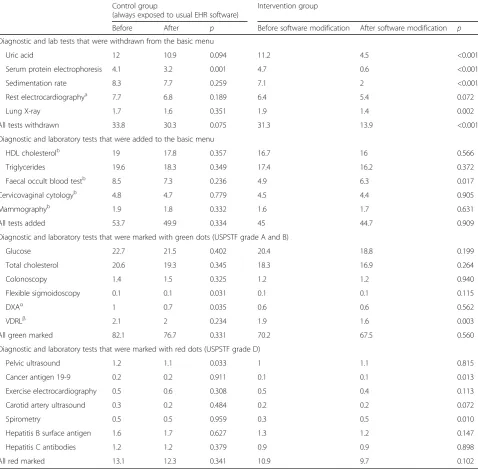
For both groups, Table 3 compares the monthly aver-age number of diagnostic and laboratory tests prescribed for each 100 consultations before and after EHR soft-ware modification, under a time series analysis perspec-tive (ARIMA model). Within the five tests that were withdrawn from the basic menu, we observe a statisti-cally significant reduction in the prescription of four tests (uric acid, serum protein electrophoresis, sedimen-tation rate, and lung X-ray tests) in the intervention group after software modification. Within the five tests that were added to the basic menu, we observed a sig-nificant increase in prescription of the faecal occult blood test in the intervention group after software modi-fication. Within the tests that were marked with green dots (USPSTF recommendation grades A and B) there were no significant increases in either the control or intervention groups. Within the tests that were marked with red dots (USPSTF recommendation grade D), there was a significant reduction only in the prescription of cancer antigen 19-9, but the amount of this test that was prescribed was so low that this variation may be justified by other factors and not a result of software modification.
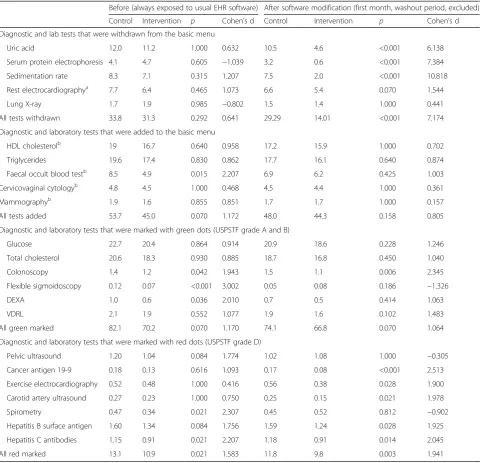
Table 4 presents a direct comparison between the con-trol and intervention groups before and after software modifications (excluding the first month following modi-fication that was considered as a washout period). Re-garding the set of tests that were withdrawn from the basic menu, we observe that there were no significant differences between either group before software modifi-cation, but that there was a significantly lower prescrip-tion rate in the intervenprescrip-tion group for the following tests after software modification: 1) uric acid; 2) serum protein electrophoresis; and 3) sedimentation rate. When we consider all tests belonging to the set with-drawn from the basic menu, we have verified that after software modification the intervention group prescribed less than half of those tests when compared with the control group (14.01 tests per 100 consultations versus 29.29 tests per 100 consultations, p< 0.001). Regarding the five tests that were added to the basic menu, we ob-served no significant differences after software modifica-tion between the two groups. Considering the tests that were marked with green dots (USPSTF recommendation grades A and B) we observed no significantly higher prescription rates in the intervention group after the software modification compared to the control group. For the tests that were marked with red dots (USPSTF recommendation grade D), we observed sig-nificant lower prescription rates in five tests (cancer antigen 19-9, exercise electrocardiography, carotid artery ultrasound, hepatitis B surface antigen, and hepatitis C antibodies) in the intervention group after software modification.
Table 2Baseline data ranges for each group based on the last 6 months before the electronic health record (EHR) software modification
Usual software (control group) min - max
Modified software (intervention group) min - max
Family physicians 57–61 55–63
Total of patients covered by Health Centers 110,781–110,783 79,847–79,850
Face to face consultations 10,725–13,493 10,047–12,598
Table 3Pre-post comparison of the monthly number of diagnostic and lab tests prescribed per 100 consultations (time series analysis, ARIMA model)
Control group Intervention group (always exposed to usual EHR software)
Before After p Before software modification After software modification p
Diagnostic and lab tests that were withdrawn from the basic menu
Uric acid 12 10.9 0.094 11.2 4.5 <0.001
Serum protein electrophoresis 4.1 3.2 0.001 4.7 0.6 <0.001
Sedimentation rate 8.3 7.7 0.259 7.1 2 <0.001
Rest electrocardiographya 7.7 6.8 0.189 6.4 5.4 0.072
Lung X-ray 1.7 1.6 0.351 1.9 1.4 0.002
All tests withdrawn 33.8 30.3 0.075 31.3 13.9 <0.001
Diagnostic and laboratory tests that were added to the basic menu
HDL cholesterolb 19 17.8 0.357 16.7 16 0.566
Triglycerides 19.6 18.3 0.349 17.4 16.2 0.372
Faecal occult blood testb 8.5 7.3 0.236 4.9 6.3 0.017
Cervicovaginal cytologyb 4.8 4.7 0.779 4.5 4.4 0.905
Mammographyb 1.9 1.8 0.332 1.6 1.7 0.631
All tests added 53.7 49.9 0.334 45 44.7 0.909
Diagnostic and laboratory tests that were marked with green dots (USPSTF grade A and B)
Glucose 22.7 21.5 0.402 20.4 18.8 0.199
Total cholesterol 20.6 19.3 0.345 18.3 16.9 0.264
Colonoscopy 1.4 1.5 0.325 1.2 1.2 0.940
Flexible sigmoidoscopy 0.1 0.1 0.031 0.1 0.1 0.115
DXAα 1 0.7 0.035 0.6 0.6 0.562
VDRLβ 2.1 2 0.234 1.9 1.6 0.003
All green marked 82.1 76.7 0.331 70.2 67.5 0.560
Diagnostic and laboratory tests that were marked with red dots (USPSTF grade D)
Pelvic ultrasound 1.2 1.1 0.033 1 1.1 0.815
Cancer antigen 19-9 0.2 0.2 0.911 0.1 0.1 0.013
Exercise electrocardiography 0.5 0.6 0.308 0.5 0.4 0.113
Carotid artery ultrasound 0.3 0.2 0.484 0.2 0.2 0.072
Spirometry 0.5 0.5 0.959 0.3 0.5 0.010
Hepatitis B surface antigen 1.6 1.7 0.627 1.3 1.2 0.147
Hepatitis C antibodies 1.2 1.2 0.379 0.9 0.9 0.898
All red marked 13.1 12.3 0.341 10.9 9.7 0.102
a
Tests that were also marked with red dots.b
Tests that were also marked with green dots
Discussion
Our results show that removing unnecessary tests from a quick shortcut menu of diagnostic and laboratory tests available on the EHR test ordering system might have significantly impacted ordering habits and reduced un-necessary test prescriptions. This result emphasized the importance of careful attention and scientific rigor when building shortcut menus in ordering systems. This im-pact was significant, and it could be observed from two perspectives of analysis: 1) when we compared the re-sults for the intervention group before and after the
modification of the software and 2) when we compared the intervention group with the control group.
Furthermore, our results demonstrated that the intro-duction of an evidence-based decision support tool had no significant impact on the test prescription profiles. However, it should be noted that as a passive instrument, the decision for support addition did not interfere with the normal flow of the ordering system. The doctors had only visual contact with the colored recommendations and optional access to the additional information from the USPSTF recommendations. The absence of impact of this
Table 4Comparison of the monthly number of diagnostic and lab tests prescribed per 100 consultations between control and intervention groups, before and after EHR software modification (independent sample t test with Bonferroni correction)
Before (always exposed to usual EHR software) After software modification (first month, washout period, excluded) Control Intervention p Cohen’s d Control Intervention p Cohen’s d Diagnostic and lab tests that were withdrawn from the basic menu
Uric acid 12.0 11.2 1.000 0.632 10.5 4.6 <0.001 6.138
Serum protein electrophoresis 4.1 4.7 0.605 −1.039 3.2 0.6 <0.001 7.384
Sedimentation rate 8.3 7.1 0.315 1.207 7.5 2.0 <0.001 10.818
Rest electrocardiographya 7.7 6.4 0.465 1.073 6.6 5.4 0.070 1.544
Lung X-ray 1.7 1.9 0.985 −0.802 1.5 1.4 1.000 0.441
All tests withdrawn 33.8 31.3 0.292 0.641 29.29 14.01 <0.001 7.174 Diagnostic and laboratory tests that were added to the basic menu
HDL cholesterolb 19 16.7 0.640 0.958 17.2 15.9 1.000 0.702
Triglycerides 19.6 17.4 0.830 0.862 17.7 16.1 0.640 0.874
Faecal occult blood testb 8.5 4.9 0.015 2.207 6.9 6.2 0.425 1.003
Cervicovaginal cytologyb 4.8 4.5 1.000 0.468 4.5 4.4 1.000 0.361
Mammographyb 1.9 1.6 0.855 0.851 1.7 1.7 1.000 0.157
All tests added 53.7 45.0 0.070 1.172 48.0 44.3 0.158 0.805
Diagnostic and laboratory tests that were marked with green dots (USPSTF grade A and B)
Glucose 22.7 20.4 0.864 0.914 20.9 18.6 0.228 1.246
Total cholesterol 20.6 18.3 0.930 0.885 18.7 16.8 0.450 1.040
Colonoscopy 1.4 1.2 0.042 1.943 1.5 1.1 0.006 2.345
Flexible sigmoidoscopy 0.12 0.07 <0.001 3.002 0.05 0.08 0.186 −1.326
DEXA 1.0 0.6 0.036 2.010 0.7 0.5 0.414 1.063
VDRL 2.1 1.9 0.552 1.077 1.9 1.6 0.102 1.483
All green marked 82.1 70.2 0.070 1.170 74.1 66.8 0.070 1.064
Diagnostic and laboratory tests that were marked with red dots (USPSTF grade D)
Pelvic ultrasound 1.20 1.04 0.084 1.774 1.02 1.08 1.000 −0.305
Cancer antigen 19-9 0.18 0.13 0.616 1.093 0.17 0.08 <0.001 2.513 Exercise electrocardiography 0.52 0.48 1.000 0.416 0.56 0.38 0.028 1.900 Carotid artery ultrasound 0.27 0.23 1.000 0.750 0.25 0.15 0.021 1.978
Spirometry 0.47 0.34 0.021 2.307 0.45 0.52 0.812 −0.902
Hepatitis B surface antigen 1.60 1.34 0.084 1.756 1.59 1.24 0.028 1.925 Hepatitis C antibodies 1.15 0.91 0.021 2.207 1.18 0.91 0.014 2.045
All red marked 13.1 10.9 0.021 1.583 11.8 9.8 0.003 1.941
a
support decision tool may also be related to high level of agreement between the way Portuguese family doctors perform preventive health services and the USPSTF rec-ommendations as shown in a previous national cross-sectional study [22].
Limitations of our study include the sampling method and sample size. The moderate size of the sample might have limited our conclusions regarding the less fre-quently prescribed tests, but this is unlikely to have af-fected the main conclusion of our study.
The fact that it was not possible to perform randomization at the family physician level, but only at that of the computer servers, also constitutes a limitation and a possible biasing factor, since the number of servers in the Western Oporto Grouping of healthcare centers was small. In the Western Oporto Grouping of healthcare centers we had nine servers. Since our intervention was a software modification, we had to randomize at the level of the electronic server. One hypothesis would be used to consider each server as a cluster, but the problem is that some servers serve only one health unit, not being a real cluster, while others serve two or three healthcare units. The ideal would be to consider each healthcare unit as a cluster of family physicians. For that, however, we had to have access to the number of tests prescribed by each family physician, which we did not. The Ministry of Health only allowed us access to the tests prescribed by each healthcare unit. This is the reason why it is not possible to consider this study as a cluster randomized controlled trial. Without the number of tests prescribed by each family physician, we were not able to calculate the intracluster correlation coefficient.
Another limitation of our study is that the time avail-able for its completion was relatively short. An extended study period could have allowed us to draw more exten-sive conclusions (for example, regarding the tests that are prescribed less frequently). A prolonged study period would also have diluted possible seasonal effects that might exist in seeking medical consultations and also minimized the impact of factors inherent in the eco-nomic situation of Portugal during the study period. In the context of the economic crisis, there was an increase in user fees paid by patients for medical consultations and laboratory tests in addition to Ministry of Health publications of clinical guidelines for prescriptions of some diagnostic and laboratory tests. These facts may have contributed to the gradual decrease in test pre-scriptions that we have observed during the study period both in the control and intervention groups. The exten-sion of the study might also have diluted this effect and could have allowed a clearer reading of the impact of software modifications. However, the socio-economic status of intervention and control medical centers was identical. All healthcare centers involved in the study are
located in the urban area of Oporto in a geographic area of approximately 22Km2, [23]. All study physicians were exposed to the same Ministry of Health guidelines and general education materials.
These limitations were mainly due to technical issues related to the fact that our research could not disrupt the normal functioning of resources and services of the Ministry of Health. However, we consider it unlikely that any of these limitations limited the main conclusion of this study: the considerable impact of unnecessary test removal in the shortcut menu of the ordering system.
Considering the potential generalizability of our results to other groups of healthcare centers of the Portuguese National Health Service, we believe that there is a high probability that the same effect will be found with simi-lar software intervention. We believe that this is the case for two reasons: 1) the size of the obtained effect was evident and 2) the main features of the ordering system of other groups of healthcare centers are similar.
For this study, we used the recommendations of the USPSTF as our standard guidelines because it bases its recommendations on freely accessible, evidence-based systematic reviews with recognized methodological qual-ity that covers a considerable range of topics. Portugal is in a phase of transition regarding clinical guidelines and recommendations. The Ministry of Health has recently published guidelines covering some topics related with test prescriptions. However, many of these guidelines are still in the phase of public discussion and are not based on systematic reviews but rather on experts’ opinion. For these reasons we chose the USPSTF recommenda-tions. Exceptions to this are the recommendations of the Portuguese Ministry of Health for three tests: 1) breast cancer screening by mammography every two years for women 50–69 years old; 2) colorectal cancer screening by a faecal occult blood test every 1–2 years for adults 50–74 years old; and 3) cervical cancer screening with a cervicovaginal cytology for women between 25 and 60 years every three years after two annual normal tests [24]. These recommendations are in line with those from USPSTF but could have influenced our results.
as an alternative to the shortcut menu was not consid-ered a major obstacle.
The reduction of unnecessary test prescriptions that we verified was in line with other studies in which changes in laboratory request forms also resulted in the reduction of unnecessary tests requests [25–27]. However, there are some practical implications that may result from this study. For example, the Portuguese Health Authorities could use these results to improve test ordering software and to reduce the prescription of unnecessary tests at a national level. This study also reinforces the importance of adequately testing medical related software tools, and we hope that in the future, this will be the rule for other medical software tools.
Conclusions
Our results might have a significant impact on improv-ing the design of shortcut menus of diagnostic and la-boratory test ordering systems either in the Portuguese National Health Service or in other countries’health sys-tems. These improvements can help reduce the prescrip-tion of unnecessary tests, leading to the reducprescrip-tion of negative patient effects and to the reduction of unneces-sary costs. These study results demonstrate the import-ance of testing and evaluating various aspects of medical informatics programs to improve efficiency and contrib-ute to improved clinical practice and clinical outcomes.
Abbreviations
ARIMA:Autoregressive integrated moving average; HER: Electronic health records; SAM:Sistema de Apoio ao Médico(Physician’s Support System); USPSTF: United States Preventive Services Task Force
Acknowledgements Not applicable.
Funding
We have received a financial support of 15,000 Eur from the Astrazeneca Portugal Foundation’s 2010 program for support of research. The funders had no role in study design, data collection and analysis, decision to publish, or preparation of the manuscript. The co-author Andreia Teixeira thanks the financial support by FCT (SFRH/BPD/86383/2012).
Availability of data and materials
The data are not available because the ethics committee only provided authorization for the research team to perform the raw data analysis.
Authors’contributions
CMSM had the original idea of the study, designed the trial and made the quality control during the data collection, drafted and revised the paper. LFRA contributted to the trial design and revised the paper. ASCT and CMNCS planned, supervised and has performed the statistical data analysis, contributed to the paper draft and revised the paper. LMBS, PAAPS, MLGDC, AMRCP and AAOPH revised the paper. All the authors read and approved the final version of the manuscript.
Competing interests
The authors declare that they have no competing interests.
Consent for publication Not applicable.
Ethics approval and consent to participate
This study was approved by the Northern Regional Health Administration Medical Ethics Committee that considered: a) Given that the study will collect only anonymous data there is no need for the obtainment of informed consent by physicians; b) The study is of great relevance and with an expected practical interest of the results; and c) the methodology used safeguards the rights of participants.
In accordance with the Medical Ethics Committee, before the
implementation of the study (but after the randomized allocation), a letter was sent to all Western Oporto Group of health centers informing and explaining the aims and methodology of the study.
Author details
1Family Medicine Unit, Social Sciences and Health Department of the Faculty
of Medicine of Porto, Porto, Portugal.2DCC- Faculty of Sciences, SQIC at
Institute of Telecommunications, University of Porto, Porto, Portugal.3Centre for Research in Health Technologies and Information Systems (CINTESIS), Information Sciences and Decision on Health Department (CIDES), Faculty of Medicine, University of Porto, Porto, Portugal.4Unidade de Medicina Geral e
Familiar, Faculdade de Medicina da Universidade do Porto, Al. Prof. Hernâni Monteiro, 4200-319 Porto, Portugal.
Received: 29 April 2016 Accepted: 9 February 2017
References
1. Glasziou P, Moynihan R, Richards T, Godlee F. Too much medicine; too little care. BMJ. 2013;347:f4247.
2. Moynihan R, Doust J, Henry D. Preventing overdiagnosis: how to stop harming the healthy. BMJ. 2012;344:e3502.
3. Getz L, Sigurdsson JA, Hetlevik I. Is opportunistic disease prevention in the consultation ethically justifiable? BMJ. 2003;327(7413):498–500.
4. Raposo VL. Electronic health records: Is it a risk worth taking in healthcare delivery? GMS Health Technol Assess. 2015;11:Doc02.
5. Ben-Assuli O. Electronic health records, adoption, quality of care, legal and privacy issues and their implementation in emergency departments. Health Policy Amst Neth. 2015;119(3):287–97.
6. Ben-Assuli O, Leshno M. Assessing electronic health record systems in emergency departments: using a decision analytic Bayesian model. Health Informatics J. 2016;22(3):712–29.
7. Boonstra A, Broekhuis M. Barriers to the acceptance of electronic medical records by physicians from systematic review to taxonomy and interventions. BMC Health Serv Res. 2010;10:231.
8. Roukema J, Los RK, Bleeker SE, van Ginneken AM, van der Lei J, Moll HA. Paper versus computer: feasibility of an electronic medical record in general pediatrics. Pediatrics. 2006;117(1):15–21.
9. Bowman S. Impact of electronic health record systems on information integrity: quality and safety implications. Perspect Health Inf Manag AHIMA Am Health Inf Manag Assoc. 2013;10:1c.
10. Nguyen L, Bellucci E, Nguyen LT. Electronic health records implementation: an evaluation of information system impact and contingency factors. Int J Med Inform. 2014;83(11):779–96.
11. Moen A, Hackl WO, Hofdijk J, Van Gemert-Pijnen L, Ammenwerth E, Nykänen P, et al. eHealth in Europe - Status and Challenges. Yearb Med Inform. 2013;8(1):59–63.
12. Olsson S, Lymberis A, Whitehouse D. European Commission activities in eHealth. Int J Circumpolar Health. 2004;63(4):310–6.
13. Iakovidis I, Purcarea O. eHealth in Europe: from Vision to Reality. Stud Health Technol Inform. 2008;134:163–8.
14. Martins C, Azevedo LF, Ribeiro O, Sá L, Santos P, Couto L, et al. A Population-Based Nationwide Cross-Sectional Study on Preventive Health Services Utilization in Portugal—What Services (and Frequencies) Are Deemed Necessary by Patients? Sun Q, editor. PLoS ONE. 2013;8(11), e81256. 15. van Bokhoven MA, Pleunis-van Empel MCH, Koch H, Grol RPTM, Dinant G-J,
van der Weijden T. Why do patients want to have their blood tested? A qualitative study of patient expectations in general practice. BMC Fam Pract. 2006;7:75.
17. van Bokhoven MA, Koch H, Dinant G-J, Bindels PJ, Grol RP, van der Weijden T. Exploring the black box of change in improving test-ordering routines. Fam Pract. 2008;25(3):139–45.
18. Verstappen WHJM, ter Riet G, Dubois WI, Winkens R, Grol RPTM, van der Weijden T. Variation in test ordering behaviour of GPs: professional or context-related factors? Fam Pract. 2004;21(4):387–95.
19. Main C, Moxham T, Wyatt JC, Kay J, Anderson R, Stein K. Computerised decision support systems in order communication for diagnostic, screening or monitoring test ordering: systematic reviews of the effects and cost-effectiveness of systems. Health Technol Assess Winch Engl. 2010;14(48):1–227. 20. CostaPereira A, Giest S, Dumortier J, Artmann J. eHealth Strategies
-Country Brief. Portugal: European Commission; 2010.
21. U.S. Preventive Services Task Force, United States, Agency for Healthcare Research and Quality. The guide to clinical preventive services, 2014: recommendations of the U.S. Preventive Services Task Force. [Internet]. 2014. Available from: https://www.overdrive.com/search?q=FA5164C1-4F7F-45B5-9619-F85551B997F4. [cited 2016 Oct 8].
22. Martins C, Azevedo LF, Santos C, Sá L, Santos P, Couto M, et al. Preventive health services implemented by family physicians in Portugal-a cross-sectional study based on two clinical scenarios. BMJ Open. 2014;4(5), e005162. 23. Administração Regional de Saúde do Norte, IP. Action plan 2010-2012 of
the Western Oporto grouping of health centers. 2010.
24. da Saúde M. National Plan for Prevention and Control of Oncological Diseases 2007/2010. 2007.
25. Zaat JO, van Eijk JT, Bonte HA. Laboratory test form design influences test ordering by general practitioners in The Netherlands. Med Care. 1992;30(3): 189–98.
26. Barth JH, Balen AH, Jennings A. Appropriate design of biochemistry request cards can promote the use of protocols and reduce unnecessary investigations. Ann Clin Biochem. 2001;38(Pt 6):714–6.
27. Bailey J, Jennings A, Parapia L. Change of pathology request forms can reduce unwanted requests and tests. J Clin Pathol. 2005;58(8):853–5.
• We accept pre-submission inquiries
• Our selector tool helps you to find the most relevant journal
• We provide round the clock customer support
• Convenient online submission
• Thorough peer review
• Inclusion in PubMed and all major indexing services • Maximum visibility for your research
Submit your manuscript at www.biomedcentral.com/submit