SECURE VOICE COMMUNICATION
USING LOW BIT RATE SYSTEM FOR
GSM USERS
1M. Jasmine Pemeena Priyadarsini, 2Dr..M.Murugesan, 3Ankur Sood, 4Y.N.Suresh Reddy
5
Dr.Srinivasa Rao Inbathini,
1345
School of Electronics Engineering, VIT University,Vellore,Tamilnadu-632014,INDIA 2
Bharathiyar Institute of Engineering for women, Anna University(Coimbatore),INDIA
Abstract:
The ever popular world of wireless mobile communication is taking wide strides and is becoming to a greater extent more technologically advanced as compared to its predecessors. Mobile communications such as GSM (Global System for Mobile Communication) is already widespread and supports a large number of subscribers all around the global. The voice traffic is on an increase over the already existing system thereby demanding bulk resources, increasing the overall cost and putting a limit to its use in the long run. The security of the voice traffic is also an issue of concern to avoid intrusion by unscrupulous elements over the mobile communication network. A bankable solution for this is to reduce the overall bit rate of the system while still maintaining toll-quality speech and providing security to the speech signal before its transmission over the network. The advantages benefited are efficient use of available bandwidth, robustness to errors, secure communication, and reliability and flexibility of the system.
Keywords: GSM, speech coding, security, encryption, bandwidth
1. Introduction
With the dawn of the wireless communication technology, mobile communication persists to provide its large subscriber base with the plethora of services. GSM offers its customers with voice and data communication services. GSM network is deployed at even the far-flung areas and this provides its subscribers with its wide range of services at cheaper costs. Many improvements are also being incorporated in the already existing list of services. It offers various voice and non-voice services such as data, fax and SMS.
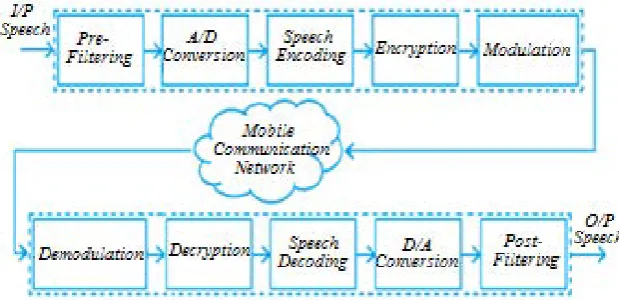
The GSM transcoding process is applied to reduce the number of bits needed in the digital representation of the speech signal while still maintaining an acceptable perceived quality of the decoded signal. Fig.1 shows the block diagram of a GSM speech transcoding process employed in the digital mobile radio. The pre-processing stage includes pre-filtering, A/D conversion with the aim of providing the encoder with the signal that maximizes the coding efficiency.
Fig. 1 GSM Speech Transcoding Process
depends on the efficiency of the system. As the bit rate of the speech coder reduces, the information content present per bit becomes more important and for the extreme case of the lowest bit rate coder, even the corruption of a single bit causes a severe degradation in the speech quality in terms of the perceived intelligibility. For the GSM speech transcoding, inverse process is applied at the receiver side to get the reconstructed speech signal.
2. Speech and Audio Codecs
Digital speech processing is becoming very important for communication purposes in order to efficiently utilize the available bandwidth. This is achieved by compressing the speech signal whilst maintaining an acceptable signal quality. It is also required to decrease delays in transmission. The compression and decompression process is performed by speech coders using various algorithms. The attributes that differentiate different speech coders are bit rate and speech quality. The bit rate is the measure of how the speech signal has been modeled. Speech quality which is another attribute defines the degradation in the speech signal in terms of its perceived intelligibility. Thus speech quality and bit rate are in direct conflict with each other. The lower is the bit rate, the higher is the compression ratio and so higher is the degradation in quality of the speech signal.
The bit rate is an important attribute with respect to the present scenario where bandwidth is the major problem. The low bit rate coder is used when bandwidth is low and the high bit rate coder is used when bandwidth available is high. The bandwidth problem also leads to high delays in communication. However because of the constant developments in wireless mobile communication, delay criterion is taking a back seat in comparison to low bit rate and acceptable signal quality. So there is a need to achieve reasonable signal quality on the expense of the bit rate of the system.
GSM has used a variety of voice codecs to compress 3.1 kHz audio into between 6.5 and 13 kbps with the aim to compress the speech signal before its transmission while maintaining an acceptable quality of the decoded speech signal. Three speech coding algorithms that are part of this standard are GSM EFR (Enhanced Full Rate), GSM FR (Full Rate) and GSM HR (Half Rate). These are described as follows:
1) GSM HR (Half Rate): It is a 5.6 kbps VSELP (Vector Sum Excited Linear Prediction) coder. It supports 5.8 kbps for error correction and in total supports 11.4 kbps and thus doubles the capacity of the GSM cellular system. The speech quality is however low.
2) GSM FR (Full Rate): It is a 13 kbps RPE-LTP (Regular Pulse Excitation- Linear Predictive Coder). The GSM FR channel supports 22.8 kbps where 9.8 kbps is used for error correction. Its quality is however better in comparison for HR coder.
3) GSM EFR (Enhanced Full Rate): It is a 12.2 kbps ACELP (Algebraic Code Excited Linear Prediction) and provides 10.6 kbps for error protection. The quality is however improved in comparison to HR and FR coder.
There are diverse speech coders each plying to a different quality of speech signal. Implementing speech coding over the wireless communication network is a difficult task since subscribers are usually in noisy environment where there is background noise. Fading effect is also to be considered. Therefore the design of the coder should be robust to handle these adverse conditions.
3. Linear Predictive Coding
ratio between the original and the encoded signal. Fig. 2 shows the speech production model used at the decoder side for the reconstruction process.
Fig. 2 Speech Production Model
For the voiced part of the speech, excitation is an impulse train generated by an estimate of the local pitch period which mimics the pulse excitation from the vocal chords. For the unvoiced speech, white Gaussian noise is employed which mimics a noise like excitation. It is this voiced or unvoiced part that further drives the speech shaping filter.
4. Secure Communication
In order to ensure secure voice communication between two GSM users, it is important to ascertain that the encoded bits from the encoder block are encrypted before its transmission over the mobile communication network. The data to be encoded is either positive or negative integer or decimal values. The method that is used for encoding is based on scaling the values based on the number of quantization levels used. The larger the quantization levels the higher is the precision. For 8 bits there will be 256 levels of quantization. For encryption a random key is generated which is then used with the quantized data to get the encrypted data stream. It is this data stream that is modulated and sent over to the mobile communication network. At the receiver side, the data stream is demodulated and decrypted which will be given as an input to the speech decoding block. For the decryption process, the same key is used at the receiver side to get the decrypted data stream. The data stream is then passed to the decoder block to get the reconstructed speech signal.
5. Results & Simulations
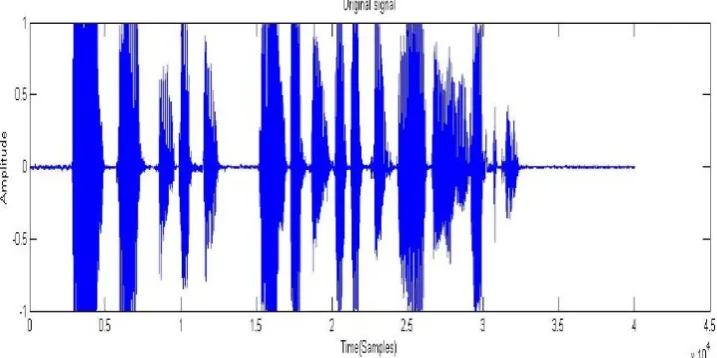
The simulations are done using the MATLAB software. The speech signal that is given as an input is shown in Fig. 3.
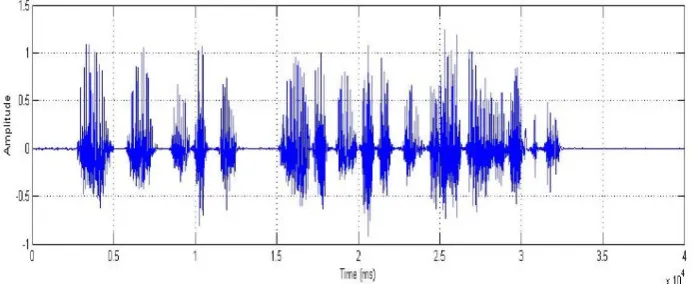
The reconstructed speech signal obtained as an output by the speech decoder is shown in Fig. 4. The signal is corrupted with noise and so its quality is degraded. However there is no loss of information to the GSM user at the receiving side. But considering the bandwidth limitations what comes to the quality criterion is that the quality of the speech has not to be too good in order for the mutual understanding between the two GSM subscribers to happen. The compression ratio achieved is 17:1 and the SNR obtained is 2.402 dB. Since for a low bit rate coder speech is represented by the just sufficient amount of bits necessary, the value of compression ratio obtained is adequate. The SNR value justifies the fact the reconstructed speech signal is corrupted with noise as can be seen from the Fig. 4.
Fig. 4 Reconstructed Speech Signal
References
[1] Bojan Kotnik, Zdenko Mezgeca, Janja Sveˇcko, Amor Chowdhury, “Data transmission over GSM voice channel using digital modulation technique based on autoregressive modeling of speech production”, December, 2008.
[2] W T K Wong, R M Mack, B M G Cheetham and X Q Sun, “Low rate speech coding for telecommunications”.
[3] N.N. Katugampala, K.T. Al-Naimi, S. Villette, and A.M. Kondoz, “Real Time Data Transmission Over GSM Voice Channel For Secure Voice & Data Applications”.2007
[4] N. Katugampala, S. Villette, and A.M.Kondoz, “Secure voice over GSM and other low bit rate systems,” IEE Secure GSM and beyond: End to End Security for Mobile Communications, London, February 2003.
[5] C. Lo and Y. Chen, “Secure communication mechanisms for GSM networks”, IEEE Transactions on Consumer Electronics, Vol. 45, No. 4, pp. 1074-1079, November ,1999.
[6] Rekha AB, Umadevi B, Yogesh Solanke and Srnivasa Rao Kolli, “End-to-End Security for GSM Users,” IEEE conference, ICPWC-2005.
[7] M. Street, “Interoperability and international operation: An introduction to end to end mobile security,” IEE Secure GSM and beyond: End to End Security for Mobile Communications, London, February 2003.
[8] Kondoz, 1994, “Digital speech: coding for low bit rate communication systems”, J. Wiley, New York.
Mrs.M.Jasmin Pemeena Priyadarsini. received her BE degree in Electronics and Communication Engineering from Madras University, Tamilnadu, India. She received her ME degree in Micro wave and optical Communication from Madurai Kamaraj University, Madurai, India. She is currently pursuing her PhD in Optical communication and Image Processing. Her areas of interest include Optical communication, Image Processing and Digital Signal Processing.
Prof.K.Murugesan obtained B.E. and M.E. degrees from Madurai Kamaraj University, Madurai in 1990 and 1994 respectively. He earned his Ph.D from Anna University, Chennai in 2001. He has published more than 40 research papers in National and International journals and reputed conferenes. He has a teaching experience of about 18 years in various educational institutions in India and abroad. presently, he is serving as Principal at Bharathiyar Institute of Engineering for Women, Attur, Salem in India. He is a life member ofIndian Society for Technical Education, Fellow of Institution of Engineers, Fellow of Institution Electronics and Telecommunication Engineers. He achieved Best ISTE Chapter Secretary Award (TN & P Section) in 2007. He has authored about eight technical books. His research area include Optical Code Division Multiple Access, Optical Signal Processing, Lightwave Communication Systems, Optical Coding Theory and Biometric Image Processing. He is a reviewer of several international conferences and journals
.
Y.N.Suresh Reddy received his BE degree[2001-2005] in Electronics and Communication Engineering from Anna University, Tamilnadu, India. He received his M.Tech degree[2005-2007] in communication Engineering from VIT University, Vellore, India. His areas of interest includes wireless communication,Digital Signal Processing and Image Processing .