Review of Genetic Algorithm based face
recognition
S.N. Palod*, Dr S.K.Shrivastav**,Dr P.K.Purohit***
*Smt. Radhikatai Pandav College of Engineering,Nagpur-411204
**Shri Balaji Institute of Technology & Management,Baitul(M.P)
*** National Institute of Technical Teachers’ Training & Research, Shamla Hills,Bhopal- 462 002
Abstract- Digital images have a huge information and characteristics quantities. But until today, a complete efficient mechanism to extract these characteristics in an automatic way, is yet unknown. Referring to facial images, its detection in an image is a problem that requires a meticulous investigation due to its high complexivity. Here, we investigate tha aspects of genetic in face recognition. Genetic Algorithms (GA's) are characterized as one search technique inspired by Darwin Evolutionist Theory, shaped using some selection mechanisms used in Nature, according with that individuals who are fit in a population are those who have more survival possibility, when adapting themselves more easily to the changes that occur in their habitats. Genetic Algorithm are efficient in reducing computation time for a huge heapspace. Face recognition from a very huge heapspace is a time consuming task hence genetic algorithm based approach is used to recognize the unidentified image within a short span of time. This paper reviews the work done by eminent authors previously and throws light on what next is to be done. Though though they don’t give exact and accurate result but are very efficient in time bound recognition for very huge database. For quickness on a random pickup base it gives fastest result. Genetic Algorithm are used when user has no time or less time for giving results without going for check related to each database face. Feature extraction along with genetic algorithm will prove better for quicker face recognition.
Key Words : Principal component analysis (PCA), independent component analysis (ICA).
I. INTRODUCTION
With the advent of electronic medium, especially computer, society is increasingly dependent on computer for processing, storage and transmission of information. Computer plays an important role in every parts of today life and society in modern civilization. With increasing technology, man becomes involved with computer as the leader of this technological age and the technological revolution has taken place all over the world based on it. It has opened a new age for humankind to enter into a new world, commonly known as the technological world. Computer vision is a part of everyday life. One of the most important goals of computer vision is to achieve visual recognition ability comparable to that of human. Among many recognition subjects, face recognition has drawn considerable interest and attention from many researchers for the last two decades because of its potential applications, such as in the areas of surveillance, secure trading terminals, Closed Circuit Television (CCTV) control, user authentication, HCI Human Computer Interface, intelligent robot and so on. A number of face recognition methods have been proposed and some related face recognition systems have been developed. In this project we propose a GENETIC ALGORITHM based face recognition.
Face recognition is a biometric authentication method that has become more significant and relevant in recent years. It is becoming a more mature technology that has been employed in many large scale systems such as Visa Information System, surveillance access control and multimedia search engine. Generally, there are three categories of approaches for recognition, namely global facial feature, local facial feature and hybrid feature. Although the global facial-based feature approach is the most researched area, this approach is still plagued with many difficulties and drawbacks due to factors such as face orientation, illumination, and the presence of foreign objects.
II. Genetic Algorithm methodology
a group of imaginary lives having a string of codes for a chromosome on the computer. The GA evolves the group of imaginary lives (referred to as population), and gets and almost optimum solution for the problem. The GA uses three basic operators to evolve the population: selection, crossover, and mutation.
Genetic algorithm was developed by John Holland- University of Michigan (1970.s)- to provide efficient techniques for optimization and machine learning applications through application of the principles of evolutionary biology to computer science. It uses a directed search algorithms based on the mechanics of biological evolution such as inheritance, mutation, natural selection, and recombination (or crossover). It is a heuristic method that uses the idea of .survival of the fittest .. In the genetic algorithm, the problem to be solved is represented by a list of parameters which can be used to drive an evaluation procedure, called chromosomes or genomes. Chromosomes are typically represented as simple strings of data and instructions. In the first step of the algorithm, such chromosomes are generated randomly or heuristically to to form an initial pool of possible solutions called first generation pool. In each generation, each organism (or individual) is evaluated, and a value of goodness or fitness is returned by a fitness function. In the next step, a second generation pool of organisms is generated, by using any or all of the genetic operators: selection, crossover (or recombination), and mutation. Pair of organisms is selected for to survive based on elements of the initial generation which have better fitness. In other words, the organisms that have relatively higher fitness than other organisms in the generation are selected to survive. Some of the well-defined organism selection methods are roulette wheel selection and tournament selection. After selection, the crossover (or recombination) operation is performed on the selected chromosomes, with some probability of crossover (Pc)- typically between 0.6 and 1.0. Crossover results in two new child chromosomes, which are added to the second generation pool. The crossover operation is done by simply swapping a portion of the underlying data structure of the chromosomes of the parents. This process is repeated with different parent organisms until there are an appropriate number of candidate solutions in the second generation pool. In the mutation step, the new child organism’s chromosome is randomly mutated by randomly altering bits in the chromosome data structure. The aim of these is to produce a second generation pool of chromosomes that is both different from the initial generation and hence have better fitness, since only the best organisms from the first generation are selected for surviving. The same process is applied for the second, third, generations until an organism is produced which gives a solution that is "good enough".
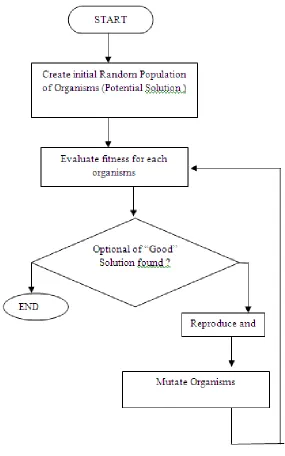
The genetic algorithm and different genetic operations are shown by a flowchart shown in next pages.
The algorithm starts with an initial set of random solutions called the population. Each individual in the population, known as chromosome, represents a particular solution of the problem. Each chromosome is assigned a fitness value depending on how good its solution to the problem is.
After fitness allotment, the natural selection is executed and the ‘survival of the fittest chromosome’ can prepare to breed for the next generation. A new population is then generated by means of genetic operations: cross-over and mutation. This evolution process is iterated until a near-optimal solution is obtained or a given number of generations is reached.
Fitness function:
In order to identify the best individual during the evolutionary process, a function needs to assign a degree of fitness to each chromosome in every generation. So in order to determine whether the assumed region of the input image is a face or not, the fitness value of the possible face region is computed by means of similarity. Selection:
Selection operator is a process in which chromosomes are selected into a mating pool according to their fitness function. Good chromosomes that contribute their gene-inherited knowledge to breed for the next generation are chosen.
Cross-over:
This operator works on a pair of chromosomes and produces two offspring by combining the partial features of two chromosomes. Here we will have to learn single point over, two point over and uniform cross-over operators.
Mutation:
This operator alters genes with a very low probability.
Fig. 2 The Flow chart of the genetic algorithm
III. Review of Work
Section 2 will present a concise review of these findings. Barring a few exceptions that use range data [Gordon 1991], the face recognition problem has been formulated as recognizing three-dimensional (3D) objects from two-dimensional (2D) images.1 Earlier approaches treated it as a 2D pattern recognition problem. As a result, during the early and mid-1970s, typical pattern classification techniques, which use measured attributes of features (e.g., the distances between important points) in faces or face profiles, were used [Bledsoe 1964; Kanade 1973; Kelly 1970]. During the 1980s, work on face recognition remained largely dormant. Since the early 1990s, research interest in FRT has grown significantly. One can attribute this to several reasons: an increase in interest in commercial opportunities; the availability of real-time hardware; and the increasing importance of surveillance-related applications. Over the past 15 years, research has focused on how to make face recognition systems fully automatic by tackling problems such as localization of a face in a given image or video clip and extraction of features such as eyes, mouth, etc. Meanwhile, significant advances have been made in the design of classifiers for successful face recognition. Among appearance-based holistic approaches, eigenfaces [Kirby and Sirovich[7] 1990; Turk and Pentland [8] 1991] and Fisherfaces [Belhumeur et al.[9] 1997; Etemad and Chellappa [10] 1997; Zhao et al. [11-12] [1996-2005] have proved to be effective in experiments with large databases. Feature-based graph matching approaches [Wiskott et al.[13] 1997] have also been quite successful. Compared to holistic approaches, feature-based methods are less sensitive to variations in illumination and viewpoint and to inaccuracy in face local-ization. However, the feature extraction techniques needed for this type of approach are still not reliable or accurate enough [Cox et al.[14] 1996]. For example, most eye localization techniques assume some geometric and textural models and do not work if the eye is closed. Section 3 will present a review of still-image-based face recognition. During the past 5 to 8 years, much research has been concentrated on video based face recognition. The still image problem has several inherent advantages and disadvantages. For applications such as drivers’ licenses, due to the controlled nature of the image acquisition process, the segmentation problem is rather easy. However, if only a static picture of an airport scene is available, automatic location and segmentation of a face could pose serious challenges to any segmentation algorithm. On the other hand, if a video sequence is available, segmentation of a moving person can be more easily accomplished using motion as a cue. But the small size and low image quality of faces captured from video can significantly increase the difficulty in recognition. Video based face recognition is reviewed in Section 4. As we propose new algorithms and build more systems, measuring the performance of new systems and of existing systems becomes very important. Systematic data collection and evaluation of face recognition systems is reviewed in Section 5. Recognizing a 3D object from its 2D images poses many challenges. The illumination and pose problems are two prominent issues for appearance- or image-based approaches. Many approaches have been proposed to handle these issues, with the majority of them exploring domain knowledge. Details of these approaches are discussed in Section 6. In 1995, a review paper [Chellappa et al. 1995] gave a thorough survey of FRT at that time. (An earlier survey [Samal and Iyengar 1992] appeared in 1992.) At that time, video-based face recognition was still in a nascent stage. During the past 8 years, face recognition has received increased attention and has advanced technically. Many commercial systems for still face recognition are now available. Recently, significant research efforts have been focused on video-based face modeling/ tracking, recognition, and system integration. New datasets have been created and evaluations of recognition techniques using these databases have been carried out. It is not an overstatement to say that face recognition has become one of the most active applications of pattern recognition, image analysis and understanding. In this paper we provide a critical review of current developments in face recognition.
CONCLUSIONS
This review paper signifies the use of evolution theory approach for big heap or image database. Such approach can be effective at airports, railways etc where very little time is allotted for face recognition considering traveler interruption time. Random search from big heap for recognition saves time of computation hence quick recognition with reasonable accuracy can be determined using genetic approach.
REFERENCES
[1] Bledsoe, W. W. 1966b. Some Results on Multicategory Patten Recognition. Journal of the Association for Computing Machinery 13(2):pp 304-316.
[2] Darwin C (1872-1898), “The expressions of the emotions in man and animals”, New Tork: D.Appleton & Co. [3] Galton, F. (1878). Composite portraits. Nature. pp 97-100. May, 1878.
[4] Kelly, M.D., “Visual Identification of People by Computer”, Stanford AI Project, Stanford, CA, Technical Report. AI-130, 1970. [5] Kanade's old Ph. D. Thesis (Kyoto University, 1973), "Picture Processing System by Computer Complex and Recognition of Human
Faces"
[6] I. Biederman, P. Kalocsai, “Neurocomputational Basis of Object and Face Recognition”, Philosophical Transactions of the Royal Society: Biological Sciences, 352, pp. 1203-1219, 1997.
[7] M. Kirby and L. Sirovich, ``Application of the karhunen-loeve procedure for the characterization of human faces,'' IEEE Pattern Analysis and Machine Intelligence, vol. 12, no. 1, pp. 103-108, 1990.
[9] P. Belhumeur, J. Hespanha and D. Kriegman, “Eigenfaces vs. Fisherfaces: Recognition Using Class Specific Linear Projection,” IEEE Trans. PAMI, Special Issue on Face Recognition, 19(7), pp. 711-20, July 1997.
[10] K. Etemad and R. Chellappa, ``Discriminant analysis for recognition of human face images,'' Journal of the Optical Society of America, vol. 14, pp. 1724-1733, 1997
[11] Wen-Yi Zhao, Rama Chellappa, N. Nandhakumar, “Empirical Performance Analysis of Linear Discriminant Classifiers”, pp. 164-17, 1998.
[12] Wen-Yi Zhao, David Nistér, Steven C. Hsu, “Alignment of Continuous Video onto 3D Point Clouds”, IEEE Trans. Pattern Anal. Mach. Intell. 27(8): pp 1305-1318, 2005
[13] Wiskott, L., Fellous, J.-M., Kr uger, N., and von der Malsburg, C., “Face recognition by elastic bunch graph matching”, IEEE Trans. on Pattern Analysis and Machine Intelligence, pp775-779, 1997.