Indian J. Plant Phyliol •• Vol. XXXV No. 1.I'p. , ..1$ (March, 1992)
SOME PHYSIOLOGICAL PARAMETERS OF SALT TOLERANCE IN
HUSKED AND HUSKLESS BARLEY (Hordeum vulgare L.)
VARIETIES
K.S. GILL·
Central Soil Salinity Research Institute, Karnal- B2001
Received on 21uJy. 1989
SUMMARY
Five barley cultivars i.e. CS 80-2, CS 8, CS 37 (husked). Karan-407 and Karan 4 (huskJess) were grown under salinity levclsof BCe 2.3. 6.5, 10.0 and 12.5 dS/m in pots.
HUsked variety (CS 8 and CS 37) accumulated higher biomass than buskless variety . (Karan II) and hence were more tolerant. Husked barley varieties had comparatively higher potassium, Na/K ratio and less sodium, lesser water saturation deficit over busk less varieties. Ionic disturbances in shoot were more at grain filling than at tillering . stage in huskless over husked barley while other physiological parameters showed varied
behaviour.
INTRODUCTION
Barley is one of the most important rabi crop grown mainly in arid and semi-, arid regions which are generally affected by salinity of the soil or irrigation water (Gill, 1987). Husked barley is not relished for human consumption as wheat and other cereals. Huskless barley had been reported as energy rich feed stuff which is '
best adapted to 2-row barley areas (Natalini et al., 1985). It was, therefore,
decided to test salt tolerance in huskless barley varieties and to establish some physiological parameters related to its tolerance/susceptibility as compared to husked barley.
MATERIALS AND METHODS
Five barley varieties i.e. CS 80-2. CS 8 and CS 37 (Husked) and Karan 4 and Karan 407 (huskless) were grown under varying salinity levels of BCe 2.5, 6.5, 10.0 and 12.5 dS/m. Soil was artificially prepared by adding sodium chloride, sodium
suJphate and calcium chloride and keeping Na+ : Ca+2 and CI- : SO-14 ratios at 4:1.
Sowing was done in leak proof, glazed pots of 20 kg capacity placed in completely
randomized block design. Only five plants were maintained in each pot. Sampling was done by taking 3 replications at tillering and grain filling stages. Samples were
analysed for chlorophyll (Arnon, 1949), Starch and sugars (Mc Cready et aI.,
1950), wafer .sf4turation deficit (Slatyer and Barrs, 1965), cell wall permea.bility (Biswas and Chaudbary 1976), plant dry weight and sodium and potassium contents by fiame-photometery.
RESULTS AND DISCUSSION
At tiUering stage, dry weight decreased with increase in salinity, however,
varieties CS 80-2, CS 8 (husked) and Karan 4 (huskless) had higher dry weight than I
CS 37 (husked) and Karan 407 (huskless). At grain filling stage husked varieties
i
produced more straw weight, ear weight and total biomass (Table I). Decrease in \.
\
dry weight under salt stress has been reporteci'by various workers (Gill and Dutt,I I
1987j Maliwal and Paliwal, 1982 and EI-Monayeri et aI., 1984).
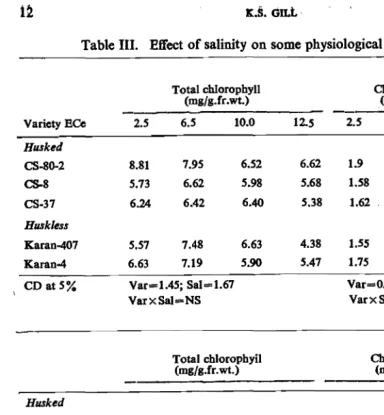
Tot~ chlorophyll content decreased with increase in l$alinity at both the
stages. Varieties CS 8()"2 (husked) had higher total chlorophyll and chlorophyll a
content at tillering stage while at grain filling stage. variety Karan 407 (husk less)
and CS 37 (husked) maintained higher total as well as chlorophyll a and b at higher salinity level. Lowest chlorophyll content was present iIi Karan 4 (huskless)and CS 8 husked variety at grain fiIling stage. Decreased chlorophyll content under salt stress have been reported by Gill (1987) and Gill and Dutt (1987) also.
Total sugar content decreased with increasing salinity, Varieties Karan 407 (huskless) and CS 80-2 (husked) had lower while CS 8 had the highest sugar content
(Table
IO.
Similar· results were observed for starch content at tillering stage.Decrea,se insoluble carbohydrate content in barley under salt stress have also been
reported by Munns etal. (1982).
Relative turgidity decreased with increase in salinity. Husked variety (CS 8()"2, CS8 and CS 37) suffered more in relative turgidity than huskless varieties (Karan 401 and Ka.ran 4) at grain filling stage. Cell wall permeability increased withincre ase in salinity level and highest permeability was observed in husked (CS 80-2) and huskless (Karan 4) varieties at· highest salinity level at grain filling stage .
.. At fillering stage, Na content increaSed with salinity and was highest in varieties Karim 4 (huskless) and CS 8()"2 (husked). Potassium content decreased
with sa.linity arid lowest K was present in CS 37 (husked) and Karan
4
(huskless)resulting into higher Na/K ratio. However, the differences were statistically non
----
-
--
-
---3 r ... K::en ! ft. 22!iif q; ,...,. S6 AXdC .. au L, ~iI"r:zlll"",r'i~,."' -Table I. Effect of salinity on dry matter production (s/plant) in husked and huskless barley varieties at tillering and grain filling stages ~ Tillering stage Grain filling stage Variety Dry matter production Straw weight (g)/5 Ear weight (1)/5 Biomass (g)/5 (gfpot) plants plants plants ECe 2.5 6.5 10.0 12.S 2.5 6.5 10.0 12.5 2.S 6.5 10.0 12.S 2.5 6.S 10.0 12.5[
>-IHusked ~ eS-80-2 S.4 2.4 1.7 1.0 28.3 13.7 6.S 4.3 31.0 16.5 4.3 2.4 59.3 30.2 10.8 6.7 ~, eS-8 4.7 2.8 1.4 1.3 35.6 16.2 7.7 S.O 26.2 11.1 4.0 I.S 61.8 27.3 16.5 11.7
2:'
g
eS~37 5.3 1.8 0.9 0.6 39.7 15.4 S.7 7.4 24.3 14.7 2.9 2.5 64.0 30.1 8.6 9.9
!e
Husklesl Karan-407
r·
...
\
•
"'II'
•
....
--:.I'
'-'-'.
-,
-~-,
_ ... ~,r'---r 13 2 3 4 5 6 7 8 9 10 11 12 "'7[""-''WJ Ear
Husked CS-80-2
23.6 42.7 65.2 71,6 51.7 64.2 77.7 74.7 .43 .66 .84 .96 CS-8 23.7 34.6 60.0 67.0 63.8 70.3 76.5 76.2 .37 .49 .78 .87 CS-37 23.2 39.6 44.1 52.2 66.7 71.0 76.5 75.5 .35 .56 .57 .69
Huskless Karan-407
36.6 55.0 69.0 69.6 60.2 68.4 80.2 71.0 .61 .80 1.00 .98 Karan-4 33.S 46.3 61.8 59.8 61.3 70.9 79.6 81.3 .54 .65 .77 .73 CD at 5% Var=18.43; Sal=21.28 Varx Sal
=
10.56 Var~NS; Sal-9.79 VarxSal-NS1;;>;. > I:'" ""I. ""I ~
~
z
Q
z'
1:11~:
~,--
12
K.S. GILt·Table III. Effect of salinity on some physiological parameters in husked
Total chlorophyll Chlorophyll a
(mg/g.fr.wt.) (mg/g.fr.wt.)
Variety Bee 2.5 6.5 10.0 12.5 2.5 6.5 10.0 12.5
Husked
CS..so.2 8.81 7.95 6.52 6.62 1.9 2.00 1.62 1.72
CS-8 5.73 6.62 5.98 5.68 1.58 1.75 1.30 1.48
CS-37 6.24 6,42 6.40 5.38 1.62 1.70 1.60 1.28
Huskless
Karan-407 5,57 7.48 6.63 4.38 1.55 1.53 1.73 1.28
Karan-4 6.63 7.19 5.90 5,47 1.75 1.87 1.72 l.SS
CDatS% Var=1.4S; 8al=I.67 Var=0,42; 8al=0.48
VarX Sal=N8 Varx8al=0.24
Total chlorophyil Chlorophyll a
(mg/g.fr. wt.) (mg!g.fr .wt.)
Husked
CS-80-2 8.92 7.37 6.95 4.72 4.10 3.42 3.40 2.65
CS-8 7.38 6.89 5.82 4.70 3.90 3.67 3.22 2.70
CS-37 6.89 7.49 7.38 7.18 3.92 4.07 3.98 3.60
Huskless
Karan-407 8.19 8.45 8.03 7.93 4.27 4.1S 4.00 4.00
Karan-4 7.21 7.00 4.68 4.25 4.41 3.68 2.S3 2.90
CDatS% \,ar=0.78; 8al=0.69 Var=0.71; 8al=0.81
VarX 8al =1.S6 VarX 8al=N8
(Continued)
Karan 407 (huskless) over husked varieties (CS 80-2, CS 8 and CS 37). K content decreased witb increasing salinity and lowest K was present in huskless compared
to husked varieties resulting into higher Na/K ratio. Sodium content in ear increased
j
with salinity and highest Na was in CS 8 (busked). Contrary to straw. K content
'1
increased in ear under salinity but lowest and highest K content were recorded in
Karan 407 and Karan 4. Increasing K content in ears resulted into lower distur
I
i
bances in Na/K ratio in the ear. Na/K. ratio increased with salinity at both the
I
I
I
i--
-SALT TOLIRANCB.IN BAIW!Y
13
, and huskless barley varieties at various growth stages
..
~".
Tillering Stage
Chlorooholl b (mg/gfr-wt.)
Total sugar
(mg/g.d.wt.) (ma/g.d.wt.) Starch
2.5 6.5 10••0 12.5 2.5 6.5 10.0 12.5 2.5 6.5 10.0 12.5
5.83 5.93 4.90 4.90 28.9 22.1 16.9 16.1 320.0 293.0 257.1 220.1
6.15 4.87 4.68 4.20 38.5 33.9 28.7 23.0 345.5 337.5 358.0 328.1
4.62 4.78 4.80 4.10 28.5 18.1 19.1 18.9 287.5 412.0 393.0 370.5
r
4.02 5.95 4.90 3.10 43.1 20.6 19.3 14.7 370.8 354.0 271.8 148.0
f
4.78 5.32 4.18 3.92 35.8 33.3 24.7 18.0 354.0 355.0 360,0 331.0Var=1.15; SaJ=I.43 Var=3.11; Sal == 13.82 Var=8.09; SaJ=7.25
VarxSal=NS VarX Sal=6.91 VarxSaJ=16.19
I
•
Grain Filling Stap
Chloraphyll b Relative Turgidity Call wall permeability
(ma/g.fr.wt.) (% age) (EC micromhos/m)
-4.82 3,95 3.55 2.07 83.4 80.8 75.0 69.1 203 313 520 753
3.48 3.22 2.60 2.00 80.3 73.1 69.0 67.6 176' 390 667 667
t
2.92 3.42 3.40 3.58 80.4 77.5 74.4 67.7 253 293 420 SOl3.92 4.30 4.03 3.95 81.9 76.0 79.0 70.2 187 ' 217 350 600
'2.90 3.35 2.15 1.35 87.2 81.1 76.2 74.6 223 296 700 603
Var=0.45; Sal=0.39 Var=5.32; SaJ=6.15 Var=88.37; Sal=79.48
Varx Sal =0.89 Varx Sal =3.07 Varx Sal=117.73
stages, highest being in Karan 4 and CS 37 at tillering stage. At grain filling stage, Na/K ratio increased more in straw than in ear at the highest salinity level of 10.0 and 12.5 dS/m. Huskless varieties bad highest Na/K ratio in straw while husked varieties had much lower.
It is seen that at tillering stage, varietal variation in various characters were less distinctive. At grain filling stage, based on biomas, and components of dry
14
~
. . • . . . .r- ...
..
It.S.OU'
like chlorophyll. ceJ] wall permeability, starch, sugar, Na, K and Na/K in ear at
grain filling stage showed varied behaviour in both husked and huskless varieties. While Na, K and Na/K ratio in straw and rdative turgidity in leaves at grain filling stage were quite distinct in tolerant and sensitive characters of husked and huskless varieties, respectively. This higher Na content in straw of huskless barley might have created lesser water deficit conditions in huskless barley by creating higher a osmotic conditions in shoot as ~hown by higher relative t~rgidity. Highly disturbed Na/K ratio may cause nutritional imbalance and metabolic malfunctioning leading to injury and low yield in huskless barley. In many sensitive genotypes of various crops a highly disturbed Na/K ratio have also been reported in wheat (Joshi et al , 1979) in barley; Greenway (1962) in rice Paricha et al., (1975) and in bajra Gill (1987). Efforts should be made to select/breed husk less barley varieties which could control its Na transport to shoot and thus maintain favourable ionic balance especially during grain filling stage.
ACKNOWLEDGEMENTS
Author is thankful to Director, C.S.S.R.I., Karnal for providing research facilities and to Head, Division of Genetics and Plant Physiology for encourage ments.
REFERENCES
Arnon, D.1. (1949). Copper enzymes in isolated chloroplasts. phonol oxidase in Beta
vuigalis. Plant Physiol., 14 : I-IS.
Biswas. A.K. and Choudbary. M.A. (1976). Senescence of rice leaf by foliar treatment with essential elements. Science and Culture. 41 : 236-239.
EI-Monayeri, M.O., Ebard. F.A., Yossel, M., and Salem, H.M. (1984). Effect of soil moisture stress on carbobydrates. proteins and mineral composition of three barley varieties. J. College Science. King Saud University, 15 : 97-111.
Gill, K.S. (1987). Elfect of soil alkalinity on growth and some biochemical parameters at grain filling stage in cowpea and susbania cannabina. Indian J. Plant Physio/, 30:
38-43.
Gill, K.S. and Dutt, S.K. (1987). Physiology of salt tolerance of a wild rice in comparison witb cultivated rice. Oryza,14; 182-184.
Greenway, H. (1962). Response of plants to saline substrates. [. Growth and ionic uptake of several varieties of Hordeum during and after sodium chloride treatments. Australian J. Bioi. Sci .. 15: 16-38.
Josbi, Y.C .• Qadar, A. and Rana, R.S. (1979). Differential sodium and potassium accumulation related to sodicity tolerance in wheat. Indian J. Plant Physiol., 11: 226-230.
Maliwal. G.L. and Paliwal, K.Y. (1982). Effect or different levels of bicarbonates alone and in combination with carbonates in irrigation water on gro\Hb, mineral nutritl9n lind qualitr of barltl)' frown in sand cultur~. Inci1an /. A,ri. Sci., 51 ; 593-597,
..
1SALT TOLERANCE IN BARLEY 15
Mo-Cn:ady, R.M., Guggaloz. I., Silviera, V. and Ownes, H.S. (1950). Determination of starch and amylose in vegetables. Analyt. Chem., 21: 1156-1158.
Munn, R.t Greenway, H., Delane, R. and Gibbs,l. (1982). Ion concentration and carbohydrate
, status of elongating leaf tissue of Hordeum vulgare growing at high internal NaCI. n
Cause of growth reductions. J. Exptal. Bot., 33 : 574-583.
Natalini, S., Buonganone, B. aM Porifirl, O. (1985). Naked barley. The crop with past. Has it a future? In/ormator Agrarlo, 4: 75-78.
Parlcha, P., Patra, 0.1. and Shaoo, P. (1975). The effect of synthetic sea water on growth and . chemical composition of rice at different growth stages of development. Indian Soc.
Soil Science, 23 : 344-348.
Slatyer, R.P. and Barrs, H.D. (1965). Modifications to the relative turgidity technique with notes on its significance as an index of internal water status of leaves. Arid Zone