APPLICATION OF QUEUING THEORY
TO AUTOMATED TELLER MACHINE
(ATM) FACILITIES USING MONTE
CARLO SIMULATION
UDOANYA RAYMOND MANUEL, ANIEKAN OFFIONG
Department of Mechanical Engineering, University of Uyo, Akwa Ibom State, Nigeria. [email protected]
ABSTRACT
This paper presents the importance of applying queuing theory to the Automated Teller Machine (ATM) using Monte Carlo Simulation in order to determine, control and manage the level of queuing congestion found within the Automated Teller Machine (ATM) centre in Nigeria and also it contains the empirical data analysis of the queuing systems obtained at the Automated Teller Machine (ATM) located within the Bank premises for a period of three (3) months. Monte Carlo Simulation is applied to this study in order to review the queuing congestion and queuing discipline at the Automated Teller Machine facilities or Automated Teller Machine service centers, and also estimate the arrival time, waiting time and service time of each customer found during the peak hours and off peak hours.
An experiment was been carried out with the aid of a stop watch, recording material, etc on order to obtain the time in which every customer spends at the Automated Teller Machine (ATM) service centre from the time of arrival to the time of departure. The model contains five servers which are heavily congested during the peak hours and during the off peak hours, servers are found being idle. Policy recommendations that could be use to manage and control the high level of queuing congestion at Automated Teller Machine (ATM) centers were made using the statistical results presented by Monte Carlo simulation software attached to this work, such results include having not more than 15 customers within 1 hour, etc.
Keywords: Automated Teller Machine (ATM), Monte Carlo Simulation, Queuing theory, arrival time, waiting time, service time, departure time, peak hours, off-peak hours, and idle time.
1.0 INTRODUCTION
Queues (or waiting lines) help facilities or businesses provide services in an orderly fashion. Forming a queue is a social phenomenon; it is beneficial to the society if it can be managed so that both the unit that waits and the one that serves get the most benefits. For instance, there was a time when in airline terminals passengers formed separate queues in front of check-in counters, but now we see invariably only one line feeding into several counters. Queue occurs when services rendered is low compared to the high level demand in a particular place and time. The queuing theory is the mathematical study of waiting lines, or queues.
The Automated Teller Machine (ATM) was invented to help minimize the high level of customers queuing in the banking hall, but due to the fast growth in population daily, the level of queuing at the Automated teller Machines (ATMs) facilities increases rapidly which is now a major problem to the banking sector. As stated, the problem which most Automated Teller Machines (ATMs) faces is the long queue in front, but then when the problem is only for short while as rest of the time the Automated Teller Machine (ATM) remains idle adding to operating cost and maintenance cost.
The overall objectives of this research using Monte Carlo Simulation are:
1. Minimizing the high level of queue within the Automated Teller Machine (ATM) during the peak hours. 2. Identifying the idle time at each server and how it can be reduce during the off-peak period.
3. Increasing the level of customer’s satisfaction by making appropriate recommendations base on the result presented by the simulation software.
1.1 TERMINOLOGY DEFINED
The terminologies of queuing theory analysis are as follows:
number waiting or receiving service, and the probability of having an available server or having to wait a certain time to be served.
2. Automated Teller Machine (ATM) facility: Automated Teller Machine (ATM) is an electro mechanical machine which is used to save the cost and reach ability of a bank by satisfying their customer needs. Automated Teller Machine (ATM) facilities is use by customers to withdraw money without any paper work and also facilitates them to reduce time and cost of going to the banking halls.
3. Arrival time: This is the actual time in which every customer arrives at the service station, hence joining the waiting line from the back. The arrival time is mostly recorded from to point entry to the service station to the point at which every customer joins the waiting line.
4. Waiting time: This is the time it takes every customer to wait on the line from the point of arrival to the point where they are about to be served.
5. Service channel: These are the different type of service channels deployed to serve the customers. The type of service channel is usually deployed based on the population of customers needed to be served at a particular point in time. We have the single service channel and the multi-service channels mostly deployed around the Automated Teller Machine (ATM) facilities.
6. Customer’s behavior: This is the attitude and behavior exhibited by the customer during the waiting line and after him or her has been served. Most customers are highly impatient, hence always trying to force their way on the waiting line to the server without waiting for their turn and time to be served.
7. Reneging: Reneging is phenomenon that occurs when a customer on the waiting line or queue decides to forgo the services due to the fact that he or she is not to wait any longer.
8. Jockeying: Customers switch between queues if they think they will get served faster by so doing.
2.0 METHOD USED
The following methods were use to carry out this research work:
a. COUNTING AND RECORDING METHOD: With help of a stopwatch, calculator and writing materials the arrival time, and service time of random customers were documented with careful observation of the queuing behavior displayed at the Automated Teller Machine (ATM) services points. The departure time of each customer was neglected during the course of carrying the field work. The observation was done randomly five (5) days a week for three (3) months, spanning May, 2012 to August, 2012.
b. SIMULATION METHOD: During the course of this research, conclusions, recommendations and comments at the end of this research are all based on the simulated results obtained in the course of the research. The inputs (arrival and service time) generated in the simulation are randomly sampled. See the simulation data page using excel software program attached to this work. The simulation technique involved in this research was done on a popular spreadsheet application program Microsoft Excel. Simulating queues using dedicated software packages is flexible, powerful and widely used. It is often the best technology for computing quantitative results. Many simulation packages are available, such as SLAM, GPSS, Extend +, and Arena. However, simulation packages are expensive, time-consuming to learn and hide mechanics of queues. This is why simulation with spreadsheet is better as it gives a better insight to the queuing behavior and mechanics.
Monte Carlo simulation is categorized as a sampling method because the inputs are randomly generated from probability distribution to simulate the process of sampling from an actual population. So we try to choose a distribution for the inputs that most closely matches data we already have or best represents our current state of knowledge.
2.1 DATA ANALYSIS AND COMPUTATION\
Arrival # Arrival time Inter-arrival time(min)
Service tim Inter-service time Departure time Total waiting time (min)
1 9:00 - 9:04 - 9:05 4
2 9:02 2 9:05 1 9:06 5
3 9:06 4 9:08 3 9:11 5
4 9:09 3 9:12 4 9:15 6
5 9:14 5 9:16 4 9:21 7
6 9:19 5 9:22 6 9:26 7
7 9:19 1 9:27 5 9:32 13
8 9:30 11 9:33 6 9:39 9
9 9:38 8 9:40 7 9:46 8
10 9:43 5 9:47 7 9:53 10
11 9:48 5 9:54 7 9:54 5
12 9:49 1 9:55 1 9:57 8
13 9:51 2 9:58 3 9:58 7
14 9:53 2 9:59 1 10:01 8
15 9:59 6 10:02 3 - -
Daily Average
Inter-arriva
4 Daily average inter-servic
4 Daily Average of Total waiting tim
7
Table 1.1 A typical Daily Data Collection at Peak Period for server 3
(Collected at 9.00am-10.00am on 01-07-2012)
a)
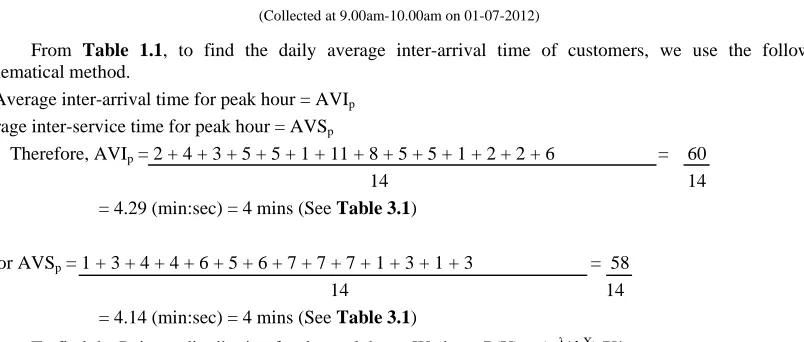
From Table 1.1, to find the daily average inter-arrival time of customers, we use the following mathematical method.Let Average inter-arrival time for peak hour = AVIp
Average inter-service time for peak hour = AVSp
Therefore, AVIp = 2 + 4 + 3 + 5 + 5 + 1 + 11 + 8 + 5 + 5 + 1 + 2 + 2 + 6 = 60
14 14
= 4.29 (min:sec) = 4 mins (See Table 3.1)
For AVSp = 1 + 3 + 4 + 4 + 6 + 5 + 6 + 7 + 7 + 7 + 1 + 3 + 1 + 3 = 58
14 14
= 4.14 (min:sec) = 4 mins (See Table 3.1)
b)
To find the Poisson distribution for the peak hour, We have P(X) = (e-λ*λX)/X!,Therefore, P (7) = [(2.7183(-4) * 4(7))/(7)(6)(5)(4)(3)(2)(1)] P (7) = [(0.01832 * 16384)/(5040)]
P (7) = [(300.15)/(5040)] P (7) = 0.06
The percentage of Poisson distribution = 0.06 * 100 = 6%.
So we have about a 6% chance that 7 customers show up during the same peak hour.
c)
To calculate for the total cost per hour for each customer’s waiting time in the system Let CW = Cost of one customer waiting in a queue for an hourCS = Hourly cost per server C = Number of servers
Lq = Mean number of customers in queue
So therefore, Total cost/ Hour = Hourly Service Cost + Hourly Customer Waiting Cost Total cost/ Hour = CS*C + CW*Lq -- -- -- -- -- -- -- -- -- -- -- -- -- -- -- -- -- -- (1.1)
Let’s assume that each customer makes at least N2000.00 in a day and the hourly service cost per hour for one server is N180.00 (which is the price of one liter of diesel in the oil market).
So therefore, Total cost/ Hour = (180*1) + [(2000/24)*4] Total cost/ Hour = N513.33
This implies that for a customer to spend 5 minutes before departure, he or her waiting cost will be calculated as: Waiting cost = (5 minutes/ 60 minutes) * (N513.33/ 1)
= N42.78k
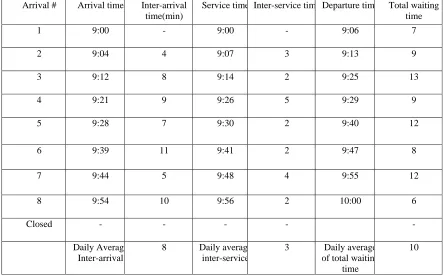
To sample off -peak period, the following data was also collected at 9.00pm - 10.00pm of the same day. Table 1.2 shows the arrival, inter-arrival, service and departure time for a certain group of random customers that used the ATM facilities as at the time of observation and data collection.
Arrival # Arrival time Inter-arrival time(min)
Service time Inter-service tim Departure tim Total waiting time
1 9:00 - 9:00 - 9:06 7
2 9:04 4 9:07 3 9:13 9
3 9:12 8 9:14 2 9:25 13
4 9:21 9 9:26 5 9:29 9
5 9:28 7 9:30 2 9:40 12
6 9:39 11 9:41 2 9:47 8
7 9:44 5 9:48 4 9:55 12
8 9:54 10 9:56 2 10:00 6
Closed - - - - -
Daily Averag Inter-arrival
8 Daily averag inter-service
3 Daily average of total waitin
time
10
Table 1.2 A typical Daily Data Collection at Off Peak Period for server 3
(Collected at 9.00pm-10.00pm on 01-07-2012)
From Table 1.2 to find the daily average inter-arrival time of customers, we use the following mathematical method.
Therefore AVIo = 4 + 8 + 9 + 7 + 11 + 5 + 10 = 54
7 7
= 7.71 (min:sec) = 8 mins (See Table 1.2) For AVSo = 3 + 2 + 5 + 2 + 2 + 4 + 2 = 20
7 7
= 2.86 (min:sec) = 3 mins (See Table 1.2)
To find the Poisson distribution for the off-peak hour, We have P(X) = (e-λ*λX)/X!,
Where λ is the average arrival rate per time period which is 8, e is that number 2.7183 and X!is simply means X factorial which is 10.
Therefore, P (10) = [(2.7183(-8) * 8(7))/(10)(9)(8)(7)(6)(5)(4)(3)(2)(1)] P (10) = [(703.48)/(3628800)]
P (10) = 1.94*10^ (-4)
The percentage of Poisson distribution =1.94*10^ (-4) * 100 = 0.0194% = 0%.
So we have about a 0% chance that 10 customers show up between 9.00pm to 10.00pm during off-peak hours. N/B: the above calculation was carried out from 01-07-2012 to 30-09-2012 during the peak and off-peak hours. Weekly average, monthly average and quarterly average was obtained based on the results obtained from the daily data obtained.
3.1 RESULTS AND DISCUSSION
Based on the results obtained from Monte Carlo simulation, the following conclusion was drawn up:
Due to daily increase in population and high level of business transactions within Uyo metropolis, the rate at which the Automated Teller Machine (ATM) facilities will be used will keep increasing as time goes on. The level queuing capacity and also waiting time of each customer during the peak periods is far greater than that of the off-peak period.
Variability in arrivals and service time contribute equally to congestion as observed during the field work. Service capacity must exceed demand.
Servers must be idle some of the times.
Large single servers preferred to multiple-servers if minimizing mean time in a system. Single queue is preferred to multiple-queue unless jockeying is permitted.
The queuing policy at the Automated Teller Machine (ATM) point is based on First-Come-First-serve (FCFS).
Customers arrive randomly and join the next available server or that has the lowest waiting line.
The actual data gotten from the real life queuing system at the ATM points is relatively close to the date obtained from the simulation.
From the computation analysis, more servers tend to be idle during the off peak hours than the peak hours. From the results presented by Monte Carlo simulation, it was concluded that the highest number of customers that uses the Automated Teller Machine (ATM) during the peak hours are 15 and the lowest number customers is 4.
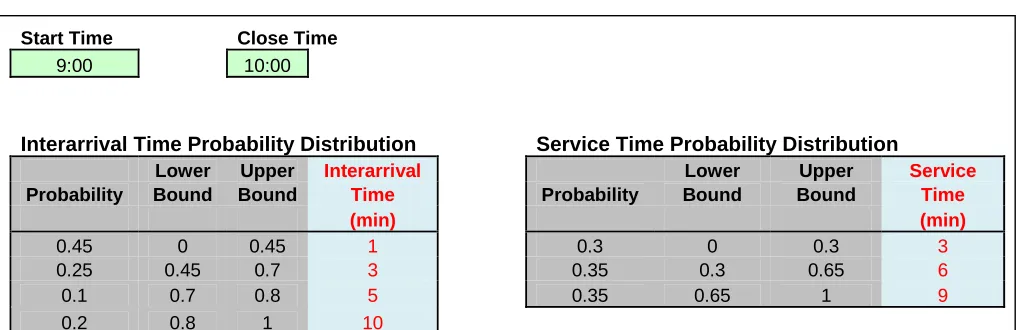
From the Monte Carlo simulation graph, it was concluded that the highest time recorded for the inter-arrival time for the peak period is 10 minutes and the lowest time is 1 minutes.
3.2
CONCLUSIONApplication of queuing theory to Automated Teller Machines (ATMs) using Monte Carlo Simulation has help in analyzing the level of queuing congestion found within the Automated Teller Machine (ATM) and also researchers can easily make recommendations based on the analysis presented by the simulation in order to minimize the high level of queuing congestion found within the Automated Teller Machine (ATM) facilities.
3.3
RECOMMENDATIONSThis research has been done by the researcher through observing the customers arrival time, waiting time in the queue, service time at the ATM servers, different behaviors of customers in the queue like balking, reneging, and jockeying. However, during the course of this work, queuing characteristics like balking, reneging, and jockeying where not considered in the simulation. To improve service delivery and reduce running cost of the Automated Teller Machine (ATM) service point the researcher has proposed a couple of recommendations.
i. REDUCTION OF SERVICE TIME
transaction, the more people will queue (especially at peak periods) impatiently for a chance to be serve. There are a number of factors that directly affects the service time. They include;
ATM downtime due to technical issues: Automated Teller machine (ATM) downtime can be caused by lots of issues like power outage, network failure, machine malfunction etc. To reduce the downtime every possible technicality should be taken into consideration and reliable backup systems put in place in the event of a fault. Cash machine empty and prompting for a reload: The system for reloading the cash machine in event of cash shortage should be robust. A reliable threshold alert mechanism should be deployed to notify the appropriate personnel of the imminent empty status of the cash machine well before it occurs. Also a quick and efficient reload system should be in place to avoid downtime and its corresponding inconveniences to the banks’ customers.
Customers’ knowledge of ATM usage; Most banks just assume that its customers should be able to use the Automated Teller Machine (ATM) machines. They issue ATM debit/credit cards to new users daily without giving a brief introductory session on how to use the cards. Some customers thus spend too much time fumbling at the ATM during transaction. Sometimes feeling too uncomfortable to ask for any kind of help from anyone as they do not want to be seen as ‘ignorant’ or unable to use a ‘common’ ATM machine. During data collection in the course of the research, a customer was seen spending more than eight minutes (during peak period) at the ATM machine doing almost nothing until other customers grumbled impatiently and later discovered that the fellow simply could not used the machine. A brief introductory session on an ATM simulation machine should be used be employed by banks to get its customers up to speed with the basics of using the Automated Teller Machine (ATM). The number of transactions a customer is does at the ATM; The number of transactions that a customer is doing at any single moment is completely dependent on the customer’s needs at the said time. A customer who wants to do four transactions will definitely take up more time than a customer who wants to do one transaction. Inasmuch as one cannot practically ask a customer to leave the machine for another person while he or she is still making any transaction. To check this, an attendant personnel stationed at the Automated Teller Machine (ATM) service point can always appeal (in a friendly tone) to the conscience of a customer trying to do too much all at once during the rush hours, so as to make way for other customers on the queue.
Ceased /Trapped cards: Another traumatic situation at Automated Teller Machine (ATM) points are issues of trapped/ceased cards in the Automated Teller Machine (ATM) machine. Most Automated Teller Machine (ATM) machines are configured to cease holder’s card after more three consecutive failed attempts to supply a pass code that matches the account. This is a security feature to check cases of stolen or authorized usage of another person’s card. In the event of such cards being ceased, some customers become hysterical and disrupt the free flow of the queue by demanding their cards be retrieved from the machine immediately. Attendant personnel should be there to caution the customers on the consequences of supplying the wrong pass code several times and advise them according in the event of forgotten pass codes.
ii. ALTERNATIVE METHODS OF TRANSACTIONS
Other methods of transactions like e-banking, mobile banking etc should be introduced to the customers to reduce over dependence on ATM cash machines and improve service delivery. The bank can install Point of Sales (POS) machines at shopping malls and major retail outlets to enable its customers pay for services without having to queue first at ATM points for cash.
iii. POWER SAVE
From the data collected as well as the simulation, it is obvious that some of the machines at the ATM service point are always idle (especially during off peak periods) and as such consumes electricity while doing no work, unnecessarily adding to the running cost of the ATM machines. It is recommended that an inverter system that switches of the power supply for machines that have been idle for a stipulated length of time. That way power is saved and running cost reduced.
iv. GROWTH AND EXPANSION OF SERVICE POINTS
It is recommended that banks keep statistics of customers’ growth in other to determine when additional ATM machines are required to meet the growing demands for the service.
4.1 FURTHER RESEARCH
For further research and more recommendations on this project, the following points should be taken into consideration;
i. HIGH LEVEL PROGRAMMING LANGUAGE SHOULD BE USE
ii. INSTALLATION OF CCTV CAMERAS
The installation of CCTV cameras within the Automated Teller Machine (ATM) service centers is highly recommended in order to monitor the level of queuing congestions, theft, conflicts, etc. Also, it is advisable for any researcher embarking or trying to modify this project to have a CCTV camera installed at the Automated Teller Machine (ATM) center in order to help him or her carry the daily count on the number of customers using the Automated Teller Machine (ATM) facilities without errors and unnecessary stress.
ACKNOWLEDGEMENT
The author would like thank Dr. Aniekan Offiong for his assistant and concern towards this research work and also appreciate our God Almighty who help me through my research.
REFERENCES
[1] M. Law (1974), “Efficient Estimators for Simulated Queuing Systems,” ORC 747, Operations Research Center, University of California, Berkeley, California.
[2] Alfa, A. S. and Fitzpatrick, G. J. (1999), “Waiting time distribution ofa FIFO/LIFO Geo/D/1 queue”, INFOR, 37: 149–159. [3] Avi-Itzhak, B., Blecher, J., Mandelbaum, M., and Saltzman, S. (1966),Mathematical and Simulation Models for Airport Terminal
Flow,International Conference on Management Science, Warsaw,Poland, pp. 456–460.
[4] Avi-Itzhak, B. and Mandelbaum, M. (1968), “Mathematical Modelsfor Outgoing Traffic Flow in an Airport Terminal”, IsraelJournal of Technology, 6: 288–298.
[5] Bookbinder, J. H. and Martell, D. L. (1979), “Time dependent queuingapproachtohelicopter allocation for forest fire initial attack”,INFOR, 17: 58–70.
[6] Bookbinder, J. H. and Kotwa, T. R. (1987), “Modeling an AGV automobilebody-framing system”, Interfaces, 17: 41–50. [7] Brill, P. H. and Posner, M. J. M. (1977), “Level crossings in point processesapplied to queues: single-server case”, Operations
Research,25: 662–674.
[8] Cooper, R. B. (1981) Introduction to Queueing Theory, 2nd edn. North Holland, New York.
[9] D.S Hira and P.K.Gupta,“Simulation and Queuing Theory”, Operation Research, S.Chand and Company Ltd., New Delhi, 2004. [10] Feller, W. (1968) An Introduction to Probability Theory and its Applications, 3rd edn., p. 18. John Wiley, New York.
[11] G. S. Fishman, (1974), “Estimation in Multi-server Queuing Simulations,” Oper.Res.22, pp 72.
[12] Hammersley, J. M. and Handscomb, D. C. (1983) Monte Carlo Methods.Monographs on Statistics and Applied Probability.Chapman & Hall, London.
[13] Hesse, R. (1997), Managerial Spreadsheet Modeling and Analysis, Richard D. Irwin, Chicago, IL.
[14] In Closed Queueing Networks,” Proceedings in Computational Statistics, PhysicaVerlag, Vienna, Austria, pp 353-362. [15] Kleinrock, L. (1975), Queueing Systems, Volume 1: Theory, John Wiley and Sons, New York, NY.
[16] Krolark, P., Felts, W and Marble, J,(1970). “A man machine approach toward solving the generalized truck dispatching problem”, Transportation Science, Vol.6, pp 149-170.
[17] Lawrence, J. A. and B.A. Pasternack (1998), Applied Management Science, a Computer-Integrated Approach for Decision Making, John Wiley andSons, New York, NY.
[18] Liberatore, M. J. and R. L. Nydick (1999), "Breaking the mold: A new approach for teaching the first MBA management science course," Interfaces, vol.29, no.4, pp.99:116.
[19] M. A. Crane and D. L. Iglehart(1975), “Simulating Stable Stochastic Systems:
[20] M. A. Crane and D. L. Iglehart, (1974), “Simulating Stable Stochastic Systems, I: General Multi-server Queues,” J. ACM 21, pp 103. [21] Plane, D. R. (1994), Management Science, a Spreadsheet Approach, Boyd and Fraser, Danvers, MA.
[22] Powell, S. G. (1998), "The studio approach to teaching the craft of modeling," Annals of OperationsResearch, vol. 82, no. 1, pp.29-47. [23] Ragsdale, C. T. (1998), Spreadsheet Modeling and Decision Analysis, second edition, South-WesternCollege Publishing, Cincinnati, OH. [24] Saunders, R. (2008), The Taming of the Queue V: In Search of excellence. Canadian Policy Research Networks ResearchReport,
Document number 50244.
[25] S. S. Lavenberg and D. R. Slutz,(1970) “Introduction to Regenerative Simulation,” IBM J. Res. Develop. 19, pp 458
[26] S. S. Lavenberg and G. S. Shedler (1975), “Derivation of Confidence Intervals for Work Rate Estimators in a Closed Queuing Network,” SIAM J. Comput. 4, pp 108
[27] Winston, W. L. and S. C. Albright (1997), PracticalManagement Science, Spreadsheet Modeling andApplications, Duxbury Press, Belmont, CA.
[28] Son JH, Kim MH (2004). An analysis of the optimal number of servers in distributed client/servers, Environ. Decision Support Syst., 36: 297-312.
[29] Zoran R, Branislav D (2005). Optimal Number and Capacity of Servers in Queuing Systems, Inf. Manage. Sci., 16(3): 1-16.
AUTHOR’S BIOGRAPHY
Udoanya, Raymond Manuel is a Masters student in the department of Mechanical Engineering, University of Uyo, Akwa Ibom State, Nigeria. This research was been carried out in order to apply queuing theory to Automated Teller Machine (ATM) using Monte Carlo simulation so that the high level of queuing congestion of customers at the service centers will be minimized. He specializes in production engineering.
APPENDIX
Start Time Close Time
9:00 10:00
Interarrival Time Probability Distribution Service Time Probability Distribution
Lower Upper Interarrival Lower Upper Service
Probability Bound Bound Time Probability Bound Bound Time
(min) (min)
0.45 0 0.45 1 0.3 0 0.3 3
0.25 0.45 0.7 3 0.35 0.3 0.65 6
0.1 0.7 0.8 5 0.35 0.65 1 9
0.2 0.8 1 10