© 2018, IRJET | Impact Factor value: 6.171 | ISO 9001:2008 Certified Journal | Page 3205
Implementation of Soft Computing Models for Fruit Grading- A Review
Miss. Sonal S. More
1, Prof. S. S. Hippargi
21
ME Student, Electronics and telecommunication Department of N.B. Navale Sinhgad College
of Engineering, Solapur University, Solapur
2
Assistant Professor, Electronics and telecommunication Department of N.B. Navale Sinhgad College
of Engineering, Solapur University, Solapur
---***---Abstract -
This paper presents the recent development andapplication of image analysis and computer vision system in quality evaluation of products in the field of agriculture. Computer vision is a rapid, consistent and objective inspection technique, which has expanded into many diverse industries. Its speed and accuracy satisfy ever increasing production and quality requirements, hence aiding in the development of totally automated processes. The requirements and recent developments of hardware and software for machine vision systems are discussed, with emphases on monochrome imaging, colour imaging and multispectral imaging for modern grading and sorting systems. Examples of applications for detection of disease, defects, and contamination on fruits and vegetables are also given. In this paper we have analyzed a grading system for the Sweet cherry, Mangos etc.
Key Words:
Fruit Grading, Computer Vision Technology.1. INTRODUCTION
Fruit industry contributes a major part in nations growth, but there has been a decrease in production of good quality fruits, due to manual inspection, lack of knowledge of quick quality evaluation techniques. Also, rising labor costs, shortage of skilled workers, and the need to improve production processes have all put pressure on producers and processors for the demand of a rapid, economic, consistent and nod-destructive inspection method. In such a scenario, automation can reduce the costs by promoting production efficiency. Automatic fruit grading and sorting requires the implementation of computer vision systems. The application of Computer Vision Systems in agriculture has increased considerably in recent years, since it provides substantial information about the nature and attributes of the produce, reduces costs, guarantees the maintenance of quality standards and provides useful information in real time. Computer vision is a novel technology for acquiring and analyzing an image of a real scene by computers to control machines or to process it. It includes capturing, processing and analyzing images to facilitate the objective and non-destructive assessment of visual quality characteristics in agricultural and food products. The techniques used in image analysis include image acquisition, image pre-processing and image interpretation, leading to quantification and classification of images and objects of interest within images. The overall appearance of fruit object is a combination of its chromatic attributes (color) and its geometric attributes (shape, size, texture), together with the presence of defects that can diminish the external quality. Thus automated fruit gradation plays an important role to
increase the value of produces. Automatic fruit classification offers an additional benefit of reducing subjectiveness arising from human experts.
2. FRUITS AND THEIR CLASSIFICATION METHODS
2.1 SWEET CHERRIES
Qi Wang and et. al. [3] has done the research on Outdoor color rating of sweet cherries using computer vision. In this paper, they report the results of an exploration study of the feasibility of using computer vision to conduct accurate color rating of sweet cherry in outdoor orchard environments. There are four steps used in the overall process as-1) Image acquisition 2) Image processing 3) Removal of glaring reflection 4) Skin color rating.
A conceptual, computer vision-based sweet cherry color rating system was developed in this research, focusing on removing two major obstacles in the outdoor rating of the color of fruit. The obstacles are (1) how to get a more consistent rating under varying ambient light conditions and (2) how to obtain a higher accuracy rating by removing glaring reflection on fruit skin. Test results indicated that the use of a camera flash could provide an effective means of suppressing the inconsistency of the ambient light and reducing glaring reflection from the surface of the fruit. An image processing algorithm was developed to classify sweet cherry colors into seven levels for this purpose. The test results also showed that the overall accuracy of the color rating system was over 85% based on 660 measurements taken at three different outdoor lighting conditions. This preliminary research validated both the possibility and the feasibility of using computer vision-based technology to provide accurate ratings of sweet cherry color in an orchard environment.
© 2018, IRJET | Impact Factor value: 6.171 | ISO 9001:2008 Certified Journal | Page 3206 Fig-1: Values of seven levels of the color chart in three
images taken under direct sunshine, with camera flash on.
The algorithm would calculate and compare the l and Md values of the obtained histogram in the green channel. If l were greater than Md, then a glaring reflection would be showing in the image. Then, the algorithm would start a searching loop to find a threshold (T) by trying the values from l to 255 by increments of 1. In each loop, the algorithm would recalculate the mean (l0) and median ðM0dÞ of the histogram distribution from 0 to T. The process would be reiterated until the final threshold (Tf) satisfied the relationship l0 6 M0d. All pixels with a green value larger than the threshold value T f represented the glaring reflection on the surface of the fruit, and the image processing software would remove those reflection pixels from the selected rating area, using white color to fill the space, as shown in Fig. 3.
[image:2.595.299.559.48.218.2]Fig-2: An illustration of the reduction and removal of the glaring reflection at three test lighting conditions.
Fig. 3 shows the human rating results based on a set of 18 randomly picked samples. The horticulturists obtained same rating results for 12 of the 18 samples; however, small differences of one level of redness did exist among their decisions.
Fig-3. Color rating from horticulturists for 18 randomly picked cherry samples.
When one horticulturist drew a different conclusion from others, the assessment of others was used as the final decision of color rating. Fig. 4 compares the computer rating results obtained with camera flash using different methods based on the same set of 18 randomly picked samples. Among them, Fig. 4a presents the color rating results estimated using the developed algorithm without compensation. Based on the comparison between the automated color rating results and the grading results of the horticulturists, it was found that most of the computer ratings were one level higher than the human grading. To analyze the possible attributes of such a difference, the rating results, before rounding to the nearest integers, were plotted in Fig. 4b. Since the bias of the human ratings based on the color chart could be within a half-level tolerance, the boundary of ±0.5 from the benchmark shows the range where the true levels of redness could be. The plot shows that most of the estimates before rounding were very close to the upper boundary.
[image:2.595.48.280.75.221.2] [image:2.595.41.284.463.604.2] [image:2.595.315.557.602.747.2]© 2018, IRJET | Impact Factor value: 6.171 | ISO 9001:2008 Certified Journal | Page 3207 Fig-4: Color rating results and Improvement of 18
randomly picked cherry samples using developed algorithm, Fig. a and b.
2.2 MANGO
Okoth E. M et. al. [1] have done research on Evaluation of physical and sensory quality attributes of three mango varieties at three stages of ripeness, grown in lower eastern province of Kenya. Physical attributes at three stages of ripeness (unripe, intermediate and fully ripe) and sensory quality at full ripe stage of Apple, Ngowe and Kent mango varieties grown in Lower Eastern Province (Machakos (Machakos also called Masaku is a town in Kenya, 63 kilometres southeast of Nairobi. It is the capital of the Machakos County, Kenya.) and Kitui (2)) of Kenya were evaluated. They were stored under ambient temperatures of 25ºC and relative humidity of 65-70. Apple and Ngowe ripened fully after 7 days whereas Kent took 10 days.
This study established that different varieties had different desirable physical and sensorial quality characteristics, which qualified them for different economical and nutritional utilization. Kent varieties portrayed longer shelf life (9-10 days) and firmer textures for its flesh and skin at unripe stage with moderate weights (g) and excellent pulp yield of 73%; this showed that it would be best utilized for export market. Apple and Kent varieties at their intermediate and ripe stages of ripeness had the best.
The weight and firmness decreased with increasing ripeness and was accompanied by notable colour change for all the varieties. Kent had the most firm skin (5.8KN) and flesh (3.7KN) whereas the softest was Apple with a skin and flesh firmness of 0.6KN and 0.07KN respectively. There were clear differences in skin and flesh color in different varieties (p≤0.05). At the unripe stage, Ngowe exhibited the greenest colour on the skin, however with increasing ripeness, the skin and flesh colors turned from green to yellow/orange; the most yellow variety being Kent. The heaviest variety was Ngowe (˃625g) at unripe stage, while Apple had the lowest weight (363.46g) at the ripe stage. All the varieties lost weight with increasing ripeness, with Kent varieties exhibiting the most remarkable total mean weight loss
(˃15g). The highest and lowest varieties in pulp yield were Apple (75%) and Ngowe (70%) respectively. The most and least preferred skin fruit colour Kent and Ngowe varieties with a mean score of 6.54±1.5 and 5.61±1.7 respectively. The most preferred flesh colour, flavor, taste, texture and overall acceptability was the Apple varieties, followed by the Ngowe and lastly Kent variety. This clearly showed that different varieties have different physical and sensory characteristics where Apple varieties would be most suitable for fresh consumption and in processing due to it higher yields than the rest. This study revealed that variety and stage of ripeness had influence on physical and sensory attributes of the varieties analyzed.
Author have studied the following Physical characterization of the fruit with changing maturity stage:
1) Fruit weight (g)
2) Fruit colour
3) Fruit firmness
4) Proportionate fruit part (%)
5) Viscosity measurements
Sensory evaluation: Sensory evaluation of the ripe fruits was done using 30 untrained panelists sourced from staff and students of Jomo Kenyatta University of Agriculture and Technology (JKUAT), Food Science Department. It was based on the 9 hedonic score (1-Dislike extremely; 2- Dislike it very much. 3- Dislike moderately; 4- Dislike it; 5- Neither like it nor dislike it. 6- Like it; 7-Like it moderately; 8- Like it very much; 9- Like it extremely). The parameter evaluated were, skin and flesh color, flavor, taste texture and overall acceptability of the fruit (Larmond, 1977). 2.4 Statistical data analysis: All the data was statistically analyzed for variance (ANOVA) using Genstat® computer program14th Edition. The comparison for means, standard deviations at 5% level of significant were done using Duncan’s Multiple Range Tests (DMRT) as described by Steel et. al.
Fig-5: Flesh firmness of Apple, Ngowe and Kent mango varieties at three stages of ripeness MAV: Apple variety Machakos, KAV: Apple variety Kitui, MNV: Ngowe variety
© 2018, IRJET | Impact Factor value: 6.171 | ISO 9001:2008 Certified Journal | Page 3208 Fig-6: Skin firmness of Apple, Ngowe and Kent mango
varieties at their three stages of ripeness MAV: Apple Variety Machakos, KAV: Apple Variety Kitui, MNV: Ngowe variety Machakos; Ngowe variety Kitui; MKV: Kent Variety
Machakos, KKV: Kent Variety Kitui.
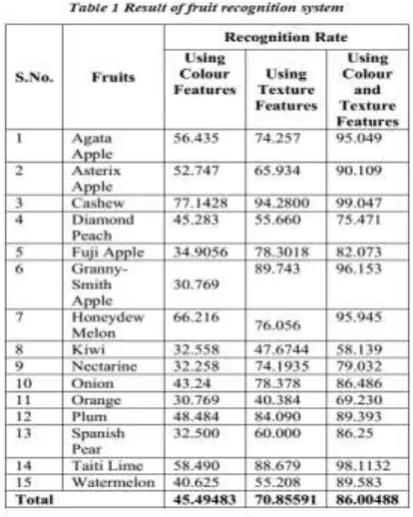
3. S. Arivazhagan et all. [11] The computer vision strategies used to recognize a fruit rely on four basic features which characterize the object: intensity, color, shape and texture. This paper proposes an efficient fusion of color and texture features for fruit recognition. The recognition is done by the minimum distance classifier based upon the statistical and co-occurrence features derived from the Wavelet transformed sub- bands. Experimental results on a database of about 2635 fruits from 15 different classes confirm the effectiveness of the proposed approach.
The proposed method by author can process, analyze and recognize fruits based on color and texture features. In order to improve the functionality and flexibility of the recognition system shape and size features can be combined together with color and texture features. Further, by increasing the number of images in the database the recognition rate can be increased. This algorithm can be used for smart self-service scales.
3.1 METHODOLOGY
The two sections that involved in this work are Training and Classification. The block diagram of method is given in Figure 7.
Fig-7:Different steps for image of fruit processing
The use of computers to analyze images has many potential applications for automated agricultural tasks. But, the variability of the agricultural objects makes it very difficult to adapt the existing industrial algorithms to the agricultural
domain. The proposed method can process, analyze and recognize fruits based on color and texture features. In order to improve the functionality and flexibility of the recognition system shape and size features can be combined together with color and texture features. Further, by increasing the number of images in the database the recognition rate can be increased. This algorithm can be used for smart self-service scales.
[image:4.595.330.536.188.456.2] [image:4.595.331.538.499.758.2] [image:4.595.44.287.601.691.2]© 2018, IRJET | Impact Factor value: 6.171 | ISO 9001:2008 Certified Journal | Page 3209
CONCLUSION
Based on the survey conducted, it has been seen that soft computing models have shown a remarkable performance in fruit classification. While a number of promising technologies exist, nondestructive assessment of fruit classification is achieved through computer vision systems and soft computing models. Accuracy of these methods are considerably high and can be implemented in actual practice quite easily. In future food industry is expected to make big profits through the use of more robust soft computing models.
ACKNOWLEDGEMENT
The authors acknowledge N.B. Navale Sinhgad College of Engineering, Solapur University, Solapur, for their facilities and support.
REFERENCES
1) Okoth E. M, Sila D. N, Onyango C. A, Owino W.O., Musembi S. M., Mathooko F. M, “Evaluation of physical and sensory quality attributes of three mango varieties at three stages of ripeness, grown in lower eastern province of Kenya - part 1”, Journal of Animal &Plant Sciences, 2013. Vol.17, Issue 3: 2608-2618.ISSN 2071-7024.
2) Arman Arefi, and Asad Modarres Motlagh, “Development of an expert system based on wavelet transform and artificial neural networks for the ripe tomato harvesting robot”, Austrian journal of crop science AJCS 7(5):699-705 (2013) ISSN:1835-2707.
3) Qi Wang, Hui Wang, Lijuan Xie, Qin Zhang, “Outdoor color rating of sweet cherries using Computer Vision”, Elsevier- Computers and Electronics in Agriculture 87 (2012), 113–120.
4) Keren Kapach, Ehud Barnea and Rotem Mairon, Yael Edan, Ohad Ben-Shahar, “Computer vision for fruit harvesting robots – state of the art and challenges ahead” Int. J. Computational Vision and Robotics, Vol. 3, Nos. ½.
5) Mahendran R, Jayashree GC, Alagusundaram K, “Application of Computer Vision Technique On Sorting and Grading of Fruits and Vegetables” Omics publishing group- Food Processing & Technology.
6) Hetal N. Patel, Dr. R. K. Jain, Dr. R. K. Jain, “Fruit Detection using Improved Multiple Features Based Algorithm” International Journal of Computer Applications (0975 – 8887) Volume 13– No.2.
7) Tadhg Brosnan, Da-Wen Sun, “Improving quality inspection of food products by computer vision––a Review”, Elsevier- Journal of Food Engineering 61 (2004) 3–16.
8) Judith A. Abbott, “Quality measurement of fruits and vegetables”, Elsevier-Postharvest Biology and Technology 15 (1999) 207 – 225.
9) Jasmeen Gill, Dr. Parvinder Singh Sandhu, and Dr. Tejwant Singh, “A Review of Automatic Fruit Classification using Soft Computing Techniques” , International Journal of Computer Science and Electronics Engineering (IJCSEE) Volume 2, Issue 2 (2014) ISSN 2320–4028.
10) Yousef Al Ohali, “Computer vision based date fruit
grading system: Design and implementation” ,Journal of King Saud University –Computer and Information Sciences (2011), 23, 29-36.
11) S. Arivazhagan, R. Newlin Shebiah , S. Selva Nidhyanandhan1, L. Ganesan, “Fruit Recognition using Color and Texture Features” , Journal of Emerging Trends in Computing and Information Sciences, VOL. 1, NO. 2, Oct 2010, E‐ISSN, 2218‐6301.
12) Misigo Ronald, Miriti Evans., “Classification Of Selected Apple Fruit Varieties Using Naive Bayes”, Indian Journal of Computer Science and Engineering (IJCSE), ISSN : 0976-5166 Vol. 7 No. 1 Feb-Mar 2016.
13) Asghar Mousavi balestani , Parviz Ahmadi Moghaddam Asaad Modares motlaq, Hamed Dolaty, “Sorting and Grading of Cherries on the Basis of Ripeness, Size and Defects by Using Image Processing Techniques”, International Journal of Agriculture and Crop Sciences. ISSN 2227-670X 2012 IJACS Journal.
14) Mathew George, “Multiple Fruit and Vegetable Sorting System Using Machine Vision”, International Journal of Advancements in Technology, George.
BIOGRAPHIES
Miss. Sonal S. More is PG student at Electronics and telecommunication Department of N.B. Navale Sinhgad College of Engineering, Solapur University, Solapur. Her total teaching experience is 5 Years.