Y3
KEY CONCEPT Biotogists study life in all its forms.f,[
ueln
tDEAs. Earth is home to an incredible diversity of [ife.
. All ortanisms share certain characteristics.
VOCABULARY
biorpher,e, p. + biodiv€rsityrp. s
sP.€ei€$, p. 5
biotogy,p. s
organisr-nr.p. s
celln p. 5
nretabolism' p. o DNtd,p.6
FIGURE
t.l
Honeypot ants live in deserts where foodand water are scarce. Some of the ants in the colony act as storate tanks for other ants in the colony.
4
Unit l: lntroducing BiologYCOnneCt It's a warm summer evening. Muyb. you're laughing and joking while waiting to eat at a family barbecue. As you sit down for dinner, mosquitoes flying around have the same idea. But their dinner is you, not the barbecue. Probably the most attention that you pay to mosquitoes is when you take careful aim before smacking them. Biologists have a somewhat different view of mosquitoes, unless of course they are the ones being bitten. But in those times of logic and reason, a biologist can see a mosquito as just one example of the great diversity of life found on Earth.
QnltN
toel
Earth
is
home
to
an
incredible
diversity
of
[ife.
In Yellowstone National Park, there are pools of hot water as acidic as vinegar'
It
might be difficult to believe, but those pools are also frrll of life. Life is foundin the darkness at the deepest ocean floors and in thousands-of-years-old ice in Antarctica. Not only are living things found just about anywhere on Earth but they also come in a huge variety of shapes and sizes. Plants, for example, include tiny mosses and giant redwood trees on which moss can grow. There
are massive animals such as the blue whale, which is the largest animal living
on Earth. There are tiny animals such as the honelpot ant in FIGURE I.l, which
can store so much food for other ants that
it
swells to the size of a grape.The Biosphere
A1l living things and all the places they are found on Earth make up the biosphere. Every part of the
bio-sphere is connected, however distantly, with every other part of the biosphere. The biosphere includes land environments such as deserts, grasslands, and different types of forests. The biosphere also includes saltwater and freshwater environments, as well as portions of the atmosphere. And different types of plants, animals, and other living things are found in different areas of the
biosphere. Even the inside of your nose, which
Biodiversity
Across the biosphere, the variety
of
life is called biological diversity, or
biodi'versity. Biodiversity generally increases from Earth's poles to the equator. This means that greater biodiversity is found in warmer areas. Why is biodiversity greater closer to the equator? More living things are able to survive in consistently warm
temperatures than in areas that
have
, biospherb = everywhere life exists large temperature changes duringa
:*.
year. Because more living things, especially plants, can survive in warm areas, those areas provide alarger,more consistent food supply for more species.
There are several different ways species can be defined. one definition
of
rpeeies is a particular type of living things that can reproduce by interbreed-ing among themselves. About 2
million
different living species have been identified, but biologists estimate that tens of millions of species remain to be discovered. over half of the known species are insects, but no one knows how many insect species actually exist.Every year, biologists discover about 10,000 new species. In contrast, some scientists estimate that over 50,000 species die out, or become extinct, every
year. occasionally, however, a species thought to be extinct is found again. For example, the ivory-billed woodpecker was thought to have become extinct in 1944,bfi a team of scientists reported seeing it in Arkans as
in
2004.Describe biodiversity in terms of species.
AIN IDEA
ortanisms
share
certain
characteristics.
Bdosy
is the scientific study of all forms of life, or all types of organisms. An organism is any individual living thing.All
organisms on Earth shareertain
characteristics, but an actual definition of life is not simple. why? The categories of living and nonliving are constructed by humans, and they ere not perfect. For example, some things, such as viruses, fall into a middle range between living and nonliving. They show some, but not all, of the tharacteristics of living things.lls
,$
organisms are made up of one or more cells. A celt is the basicit of life. In fact, microscopic, single-celled organisms are the most VISUAT VOCAB
Across the biosphere, the variety of [ife is called biodiversigr.
Biodiversity is
treater ctoser to
the equator.
I
TAKING NOTES
Use a two-column chart to hetp you summarize vocabu[ary terms and concepts.
tera or concept Meailtq
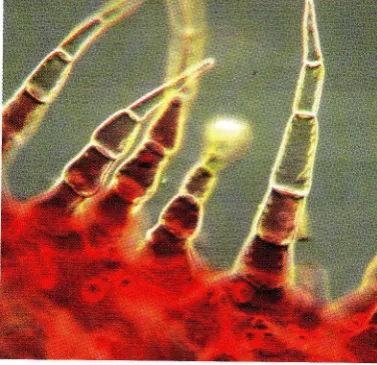
FIGURE 1.2 Cells can work together
in specialized structures, such as
these leaf hairs that protect a leaf
from insects. (LM, magnification 700x)
Chapter l: Biology in the 2lst Century trn# r#r
#;
rnon forms of life on Earth. A single-celled, or unicellular organism ies out all of the functions of life, just as you do. Larger organisms that
see every day are made of many cells, and are called multicellular
organ-;. Different types of cells in a multicellular organism have specialized ions, as shown in FIGURE 1.2. Your muscle cells contract and relax, your rch cells secrete digestive juices, and your brain cells interpret sensory
Cells and Energj You will read
in Chapter 4 about different
processes used by ce[[s to capture and release
enerty-photosynthesis, chemosynthesis, and cellular respiration.
FIGURE 1.3 Reproductive
strate-gies differ amonS species. The male gold-specs jawfish protects unhatched eggs by holding them in his mouth.
Need for
enerty
A1l organisms need a source of energy for their life processes.Energy is the ability to cause a change or to do work. The form of energy used by all living things, from bacteria to ferrets to ferns, is chemical energy. Some organisms use chemicals from their environment to make their own source
of
chemical energy. Some organisms, such as plants, algae, and some bacteria, absorb energF from sunlight and store some of it in chemicals that can be used later as a source of energy. Animals get their source of energy by eating other organisms. In all organisms, energy is important for rnetabolisfi, or all of the chemical processes that build up or break down materials.Response to environment
All
organisms must react to their environment to survive. Light, temperature, and touch are just a few of the physical factors, called stimuli, to which organisms must respond. Think about how you respond to light when you leave a dimlylit
room and go into bright sunlight. One of yog,p body's responses is to contract the pupils of your eyes. Your behavior niight also change. You might put on sunglasses or raise your hand to shade your eyes. Other organisms also respond to changes in light. For example, plants grow toward light. Some fungi need light to form the struc-tures that you know as mushrooms.Reproduction and development Members of a species must have the ability
to produce new individuals, or reproduce. When organisms reproduce, they
pass their genetic material to their offspring. In all organisms, the genetic material is a molecule called deoxyribonucleic acid
(dee-nH r-see-nv-boh-noo-KLEE-ihk), or DNA.
Single-celled organisms can reproduce when one cell divides
into two cells. Both new cells have genetic information that is
identical to the original cell. Many multicellular organisms, such as the gold-specs jawfish in FIGURE I.3, reproduce by combining the genetic information from two parents. In both
cases, the instructions for growth and development of organisms, from bacteria to people, are carried by the same
chemicals-DNA and ribonucleic acid (RNA). The process of development allows organisms to mature and gain the ability to reproduce. Summarize What characteristics are shared by all
living things?
laoNLrNE
QU|Zd2
classzone.comREVIEWING
O
MAIN
IDEASI.
How are sp-eeie$ retated to the concept ofbiodiver+ ri
2. How do the characteristics of living things contribute to an orgtrtis*nt
surviva[?
CRITICAL
THINKING
3. Apply Describe the relationship between cells and organisms. 4. Synthesize How does biodiversity
depend on a species' ability to reproduce?
5. Human Biotogy You respond automatically to many differ-ent stimuli, such as loud noises. Why might a quick response to
a sound be important?
2
H
:iTyHr-:"T":x,:.:.:[.Li:torv
ffi
rrnllN
tDEAs. Al[ levels of life have systems of related parts.
r Structure and function are related in biology. . Ortanisms must maintain homeostasis to
survive in diverse environments.
. Evolution explains the unity and diversity of life.
VOCABULARY ystern, p. z +cosy.ste.rn, p. z horne.ostasis, p. g
evoft,*ion, p. to adap.tation, p. ro
fhe moray ee[ and the
are parts of a
sys-organisms ben-cleans the eelS
food and
protec-Connect
what
do you think about when you hear the term theme? Maybe youthink about the music at the start of your favorite TV show. Muyb" you
think
about the colors and organization of a computer desktop. In both cases, that theme shows up over and over again. In biology, you
will
see something similar. That is, some concepts come up time after time, even in topics that might seemto be completely unrelated. Understanding these themes, or concepts, can help you to connect the different areas ofbiology.
str,tlrN
toel
All
levels
of life
have systems
of
related
parts.
Think about the separate parts of acar-tires,
engine, seats, and so on. Evenif
you have a complete set of car parts, you might not have a functioning car.only
when all of the parts that make up a car are put together in the correct way do you have a working car. A car is a system. As.y{.te6 is an organized group of related parts that interact to form a whole. Like any other system,a /
car's characteristics come from the arrangement and interaction of iisparts.
/
systems exist on all scales in biology, from molecules that cannot be seen,
to cells that can be seen only with a microscope, to the entire biosphere. In just
one heart muscle cell, for example, many chemicals and processes interact in a precise way so that the cell has energy to do its, work. Moving up a level, heart muscle, valves, arteries, and veins help form a system in your
body-the
circulatory system.Two organisms that interact can also be a
system, as you can see in FIGURE 1.4. On alarger
scale, you are a partof a biological system-an
ecosystem-that has living and nonliving parts. An r€g1|$Steftis a physical environment with different
species that interact with one another and
with
nonliving things. When you hear the term ecosys-tem, you might think about a large region, such as a desert, a coral reef, or a forest. But an ecosystem can also be a very small area, such as an individual tree.
Biochemistry Proteins are a tYPe
of motecute found in atl living iiin*r. Prot"ins have manY
differ-"nt iun.tiont,
which You will
read about in ChaPter 2'
FIGURE 1.5 The snout beetle
ii"ft*f
n"t specialized prongs and;Jt ;
its tarsi (ritht)that allow itil;;i,
walk onboth smooth and rough surfaces' (olored tEMt',^^..,Often, different biologists study different systems' For example' a person
studyingDNAmightfocusonverysPecificchemicalinteractionsthattake
placeinacell.Apersonstudyingbehaviorinbirdsmightfocusonpredator_
prey relationships in an ecosystem' However) more and more biologists
are
workingacrossdifferentsystemlevels.Forexample,somescientistsstudyhow
chemicils in the brain affect social interactions'
Connect Describe how your biology class could be considered a system'
$ullx
lorl
structure
and
function
are
related
in
biology'
Thinkaboutacaragain.Inacar,differentpartshavedifferentstructures.The
structureofacarpartgivesthepartu'p"tifitfunction'Forexample'atire's
functionisdirect$relatedtoitsstructure.Nootherpartofthecarcanper.
form that function. structure and function are also related in living things'
What somethhg
ao"'1;u'
o'gu"i'-
is directly related- to-its shapeor
form'
For example, when you
":u',yoi
p'obublybite into food with your sharpfront
teeth. Then youp,or.lally
cie*ii
mostlywith your grinding molars'All
of
your teeth help you eat'
but
drfferent typesof
teethhave different
functions
Structureandfunctionarerelatedatthelevelofchemicalsincells'For
example, membrane channels and enzymes are both
n11|t't::':*
theyhave
very different
structui'eJ"rJfor.,ions.
A channelis a protein molecule that
extends through the membrane, or out.r luy.r, of
a cell' It has
-a
structure like a
tubethatallowsspecificchemicalstopassintoandoutofacell.Enzymesare
proteinmolecules.n".-"r."chemicaiplocessespossibleinlivingthings.
These proteins
h"".
;;;;;thut
ullow;il;
Ach
to onlv certain chemigals
and then cause the
;#;'
to reactwith
eachother'
/
Differenttypesofcellsalsohavedifferentfunctionsthatdependontheir
specialized
*,ott"tt]io'
t*u-pt"'
cells in your brainprocess information'
They have Inurry
urur.t
.,
that receiveinio.'*utio"
fromother cells' They also
have long extensions that allow them to
*"d
*t"uges
to other cells' Red
bloodcellsareverydifferent'Theyaremuch't'11*'disk-shaped'arldare
,i.lg;'f'..i.nt, beetie 30x; tarsus l00x)
to carry oxygen. Their structure allows them to
fit
through even smallest blood vessels to deliver oxygen throughout your body. Of course,hom your brain cannot take the place of one of your red blood cells.
5tructure and function are also related on the level of the organism. For
ple, your foot structure allows you to walk easily on rough, fairly leve1 fuces. Walking on a surface such as ice is more difficult, and walking up a
is impossible for you. The beetle in FIGURE 1.5 is different. Its tarsi, or "feet," sharp prongs that can grip smooth or vertical surfaces, as well as soft i** tbr walking on rough surfaces. The beetle's tarsus has a different
struc-and function than your foot has, but both are specialized for walking.
Do you think heart muscle has the same structure as arm muscle? Explain.
isms
must maintain
homeostasis
to
in diverse environments.
ature and other environmental conditions are always changing,
tre conditions inside organisms usually stay quite stable. How does
polar bear in FIGURE 1.6 live in the arctic? How can people be ide rvhen the temperature is below freezing,but still have a stable
temperature around 37"C (98.6"F)? Why do you shiver when you .ald, sweat when you are hot, and feel thirsty when you need water?
lneostasis
(uoH-mee-oh-STAY-sihs) is the maintenanceof
t internal conditions in an organism. Homeostasis is important cells function best
within
a limited range of conditions.rre, blood sugar, acidity, and other conditions must be
. Breakdowns in homeostasis are often life-threatening. Homeostasis is usually maintained through a process called
nega-fuedback.In negative feedback, a change in a system causes a that tends to return that system to its original state. For , think about how a car's cruise control keeps a car moving
t set speed. A cruise control system has sensors that
ior
the car's speed and then send that information to a .If
the car begins to go faster than the set speed, thetel1s the car to slow down.
If
the car slows below the , the computer tells the car to speed up. Similarly,if
body temperature drops below normal, systems in yourpa-t
to return your temperature to normal. Your musclesrou to shiver, and blood vessels near your skin's surface L-r If your body temperature rises above normal,
t responses cool your body.
f,'|rarior
is also involved in homeostasis. For example, regulate their temperature through behavior. If you)'ou may put on a jacket. Reptiles sit on a warm rock in sunlight
if
flEt too cold, and they move into shade
if
they get too warm./:.'
,. _/
),:
//l
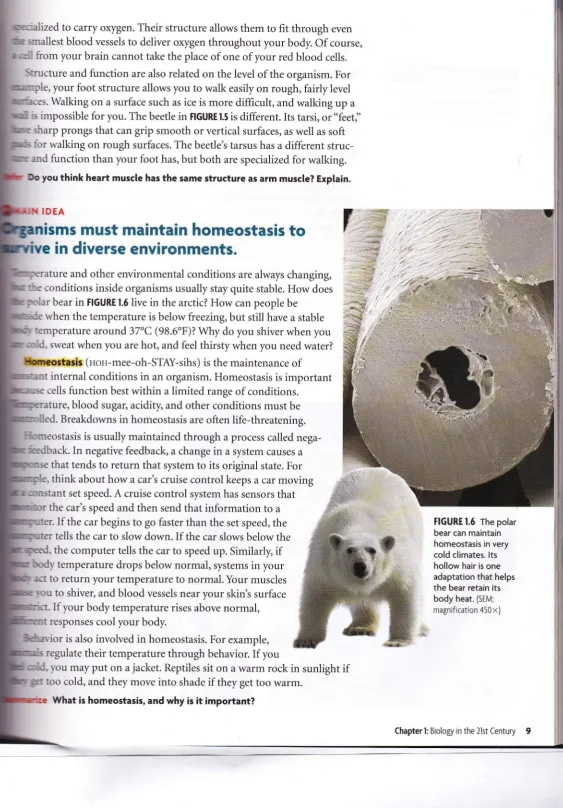
FIGURE 1.5 The potar bear can maintain homeostasis in very cotd climates- lts hol[ow hair is one adaptation that helps
the bear retain its body heat. (SEM;
magnification 450x)
What is homeostasis, and why is it important?
Evolution The processes ofevo-lution, natural selection, and adaptation are described in more detail in Unit 4.
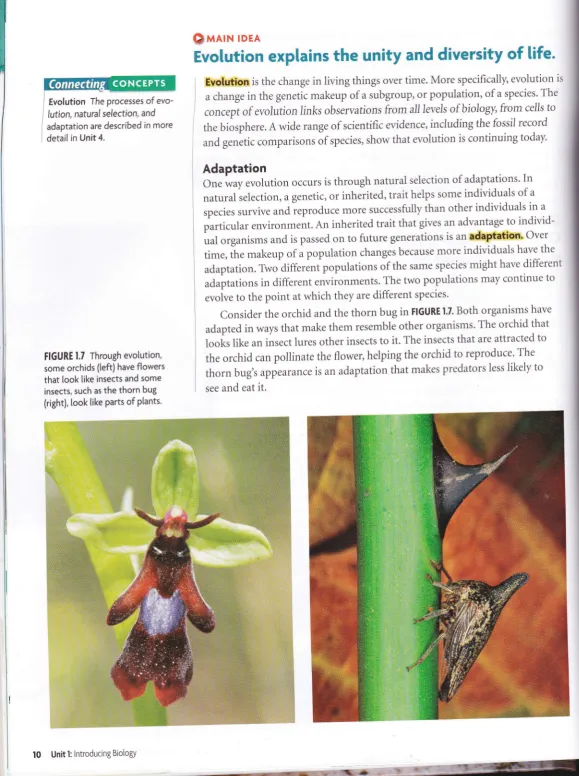
FIGURE 1.7 Through evolution, some orchids (teft) have flowers
that look like insects and some insects, such as the thorn bug
(right), took like Parts of Plants.
QunrN
loel
Evolution explains
the unity
and
diversity
ef
&Efe.Evolution is the change in living things over time. More specifically, evolution is a change in the genetic makeup of a subgroup, or population, of a species. The
concept
of
evolutionlinks observationsftomal]
levels of biology,ftom
cells to the biosphere. A wide range of scientific evidence, including the fossil record and genetic comparisons of species, show that evolution is continuin g today'Adaptation
one way evolution occurs is through natural selection of adaptations.
In
natural selection, a genetic, or inherited, trait helps some individuals of aspecies survive and ieproduce more successfully than other individuals in a particular e.rrrirorrmert. An inherited trait that gives an advantage to individ-ual organisms and is passed on to future generations is an adaptation. over time, ihe makeup of a population changes because more individuals have the adaptation. Two differenipopulations of the same species might have different adaptations in different environments. The two populations may continue to evolve to the point at which they are different species'
Consider the orchid and the thorn bug in FIGURE 1.7. Both organisms have
adapted in ways that make them resemble other organisms. The orchid that looks like an insect lures other insects to it. The insects that are attracted to the orchid can pollinate the flower, helping the orchid to repro_duce. The
thorn bug's appearance is an adaptation that makes predators less likely to see and eat it.
IO
Unit l: lntroducing Bio[ogY-r-This adaptation allows the thorn bug to survive and reproduce. In different environments, however, you would find other orchid and insect species that have different adaptations.
Adaptation in evolution is different from the common meaning of adapta-tion. For example, if you say that you are adapting to a new classroom or to a new town, you are not talking about evolution. Instead, you ale talking about consciously getting used to something new. Evolutionary adaptations are changes in a species that occur over many generations due to environmental pressures, not through choices made by organisms. Evolution is simply a long-term response to the environment. The process does not necessalily lead to more complex organisms, and
it
does not have any special end point.Evolu-tion continues today, and it
will
continue as long as life exists on Earth.Unity
and Diversity
Evolution is a
unifring
theme of biology becauseit
accounts for both the diversity and the similarities, or the unitF, of life. As you study biology, youwill
see time after time that organisms are related to one another. When you read about cells in Unit 2 and genetics in Unit 3, youwill
see that all organ-isms have similar cell structures and chemical processes. These shared charac-teristics result from a common evolutionary descent.Humans and bacteria have much more in common than you may think.
Both human and bacterial genetics are based on the same
molecules-DNA
and RNA. Both human and bacterial cells rely upon the same sources
of
energy, and they have similar cell structures. Both human and bacterial cells have membranes made mostly of fats that protect the inside of the cell fromthe environment outside the cell.
Now think about the vast number of different types of organisms.
All
of
the species now alive are the result of billions of years of evolution and adap-tation to the environment. How? Natural selection of genetic traits can lead to the evolution of a new species. In the end, this genetic diversity is responsible for the diversity of life on Earth.Analyze How does evolution lead to both the diversity and the unity of life?
REVIEWING
O
MAIN
IDEASl.
Describe a biologicalsyct€m, 2. Give an example of how structure isretated to function in [iving things.
3. Why is homeostaslg essentia[ for living things?
4. What is the relationship between
adapt*ior't and natura[ selection?
CRITICAL
THINKING
5. Analyze How are structure and
function related to adaptation? 6. Apply How is the process
of
natural setection involved in €votution?
Cells Do you think homeo-stasis is necessary at the [eve[
of a single celt? txplain.
tl
:l
t
a
;
i: iil
i{
rt
1
*