This may be the author’s version of a work that was submitted/accepted for publication in the following source:
Teo, Melissa& Loosemore, Martin (2014)
The role of core protest group members in sustaining protest against con-troversial construction and engineering projects.
Habitat International,44, pp. 41-49.
This file was downloaded from: https://eprints.qut.edu.au/72874/
c
Consult author(s) regarding copyright matters
This work is covered by copyright. Unless the document is being made available under a Creative Commons Licence, you must assume that re-use is limited to personal use and that permission from the copyright owner must be obtained for all other uses. If the docu-ment is available under a Creative Commons License (or other specified license) then refer to the Licence for details of permitted re-use. It is a condition of access that users recog-nise and abide by the legal requirements associated with these rights. If you believe that this work infringes copyright please provide details by email to [email protected]
License: Creative Commons: Attribution-Noncommercial-No Derivative Works 2.5
Notice:Please note that this document may not be the Version of Record (i.e. published version) of the work. Author manuscript versions (as Sub-mitted for peer review or as Accepted for publication after peer review) can be identified by an absence of publisher branding and/or typeset appear-ance. If there is any doubt, please refer to the published source.
The role of core protest group members in sustaining protest against controversial construction and engineering projects
Abstract
Community-based protests against major construction and engineering projects are becoming increasingly common as concerns over issues such as corporate social accountability, climate change and corruption become more prominent in the public’s mind. Public perceptions of risk associated with these projects can have a contagious effect, which mismanaged can escalate into long-term and sometimes acrimonious protest stand-offs that have negative implications for the community, firms involved and the construction industry as a whole. This paper investigates the role of core group members in sustaining community-based protest against construction and engineering projects. Using a thematic story telling approach which draws on ethnographic method and social contagion theories, it presents an in-depth analysis of a single case study – one of Australia’s longest standing community protests against a construction project. It concludes that core group members play a critical role, within anarchic structures which provide a high degree of spontaneity and improvisation, in sustaining movement continuity by building collective identity, mobilising resources and a moving interface which developers find hard to communicate with.
Keywords: Protest; continuity; community; social contagion; social networks; collective action
Introduction
A ‘community’ refers to a fluid group of people united by at least one common characteristic such as geography, shared interests, values, experiences, or traditions (Parsons 2008). Healthy community systems comprise well-integrated, interdependent subsystems of individuals who represent specialized functions, activities, or interests, who share responsibility to resolve problems and work to enhance the well-being of the community as a whole. From the perspective of a construction project, ‘community’ refers to the people whose interests are potentially affected by that project (Moodley 1999, Loosemore et al 2005). Atkinson and Cope’s (1997) analysis of community participation and activism in urban regeneration projects showed that these communities cannot be treated as a single homogeneous, easily identifiable group. Similarly, Teo’s (2009) research showed that construction project communities comprise a multitude of overlapping, competing and often conflicting interests groups which shift over the life of a project, through planning, design, construction and operation.
different interest groups in many different ways (Awakul and Ogunlana 2002, Sjoberg 2004, Murray and Dainty 2009, Spillane et al 2013). As Loosemore et al’s (2005) critical analysis of risk management in the construction industry showed, as communities become increasingly educated, informed, vocal and empowered, the risk of community action against even the most innocuous construction and engineering projects have escalated significantly. Close and Loosemore’s (2013) research into community consultation has shown that construction project managers are generally ill-equipped to handle community concerns about projects and tend to assume that community concerns have been handled during the early planning stages of projects. Communities are widely seen as a liability rather than an asset and their concerns are often dismissed as being irrational, emotional and uninformed (Burgmann 1993, Crowther and Cooper 2002, Broadbent 2003, Foster-Fishman et al 2007). The consequences of this ignorance is that too often, seemingly innocuous community protests escalate into lengthy and acrimonious disputes which cause considerable delays, financial cost and reputational damage to the firms involved and social damage to the communities themselves (Berglund 1988, Crowther and Cooper 2002, Cleland and Ireland 2007). Much of this problem is due to a poor understanding in the project management community of how to manage community members who are concerned about development risk. As Close and Loosemore (2013) found, there is very little research into how communities perceive the risks and opportunities associated with construction projects and how they organise themselves in opposition or support. Currently, no insights can be offered into how to best interact with them for mutual benefit. To address this gap in knowledge, the aim of this paper is to investigate the social processes which create and sustain community action against construction projects. In particular it is to focus on the role of core group members in driving and sustaining community action. Such knowledge is essential to inform more effective and evidence-based community consultation practices, enabling projects to progress smoothly in consultation with communities rather than in conflict with them.
The social basis of community protest
(individual action) or do so to improve the condition of one’s wider community (collective action). This action can take many forms on a continuum from behavior that conforms to existing social norms (like petitioning and taking part in a demonstration) to those that violate existing social norms (like illegal protests and civil disobedience). According to van Stekelenburg and Klandermans’ (2010) research the emergence of community action against a construction project would rest on the presence of shared grievances, emotions and identity within a community about the potential risks (and opportunities) associated with a construction project. The more threatened community members feel and the more shared their interests then the angrier they are likely to be and the more probable it is that they will engage in action to protect their interests and principles and/or to vent their anger.
The spread of risk perceptions through protest networks
The above theories have provided some insight into why communities may join protest groups and how the groups may push their behaviour beyond normal social norms. However, they do not explain how perceptions about project risks and opportunities escalate and spread through communities, building solidarity and commitment to protest over time. Given the lack of research in this area, these social dynamics are currently invisible to construction project managers and therefore represent a barrier to preventing the potential escalation of community action against projects. However, theoretical developments in contagion theory in other fields such as epidemiology, consumption patterns, gang behaviour, criminal and terrorist networks and of financial markets, are also of potential use in explaining how perceptions of construction project risk might spread through communities (Kretschmer et al., 1999, McPhail, 1994; Myers, 2000). According to social contagion theory, behaviours and perceptions initiated by one community member can influence others in the same community, depending on the structure and quality of the relationships within that community network (Jones and Jones 1995, Scherer and Choo 2003). Social contagion theory suggests that the social contagion effect is likely to travel along designated pathways based on existing social network structures. It also shows that the contagion effect is likely to be influenced by social network characteristics such as the frequency of interactions between people, network stability (existence of link over time), multiplexity (number of relationship types – friendship, advice, power etc), strength (time, intimacy), direction (reciprocity), density (level of connectedness), equivalence (similarity of ties) and network centrality (Brass 1995). For example, highly centralised networks are more contagious than dispersed networks, as are networks with a high degree of structural equivalence (similarity of ties between network members).
contagion (by spreading ideas) by virtue of their unique location in a protest network (core group membership). For example, people in central positions (the core protest group), who may be community leaders, local or imported activists or simple long standing residents who are well liked by other activists, are more likely to be influential in spreading ideas. Their power is magnified in divided protest networks where they form a bridge between disconnected protest cliques which may focus on different protest issues which might otherwise not communicate. It is this issue of core group influence that has been relatively neglected in the literature and on which this paper focuses.
Monge and Contractor’s (2003) research indicates that it is critically important that construction project managers are be able to identify and communicate with the core protest group to prevent the escalation of community action into non-normative forms which could severely disrupt project success and detrimentally affect the community itself.
Method
Protest Website & Documentary Review Semi- Structured Interview #1 Interview Data Analysis Participant Observation Ethnographies Material from Protest Group e.g. flyers, reports, website Other Documentary Accounts e.g. external reports, newspapers Semi- Structured Interview #2 Interview Data Analysis Final findings To complement To complement
• To obtain snowball sample. • To identify core group (&
its members)
• To obtain deeper insights of issues affecting movement continuity
• Get background information on case study • Create event
Figure 1 – The two-phase research method
Our case study was a community-based protest against a large-scale 61-hectare highly controversial housing project in a sensitive coastal area south of Sydney, Australia. The area being developed is recognised as an area of great natural beauty and ecological importance as one of the last green corridors in the region. It also has huge cultural and historical heritage importance to both the local Aboriginal and European community. This development has been the subject of long-standing, sometimes contentious and even violent community protest over 15 years which eventuated in the establishment and maintenance of Australia’s longest standing 24-hours community picket. The picket evolved in early 2001 and stood as a symbol of community resilience and opposition against the proposed development, but was burnt down in 2006. The protest also resulted in the erection of an Aboriginal tent embassy to protect the many thousands of Aboriginal artefacts dug up on the site which included ancient 6000 year old Aboriginal human remains. While this development and the protest has divided many in the community, the social and community networks which have sustained the protest over such a long period of time are extensive and underpinned by widespread support from other community-based action groups in the region. There have been and continues to be numerous court battles between the community protest group (represented by individuals) and the developer. During the height of the protest in 2001-2003, numerous public meetings and rallies were held, hundreds of petitions with thousands of signatures were signed which eventually led to a government commission of inquiry (COI) report into optimal use of the proposed land. The COI found in favour of the community, and recommended that certain portions of the development be brought back into public ownership, although a subsequent review of the COI by a new state government reduced the recommended area of land to be in public ownership, ensuring that the protest continues to this day. To date, the community protest has successfully delayed a significant portion of the project for 7 years and permanently halted construction of 13 stages of 20 until a final decision is made on the COI recommendations. The community protest also highlighted alleged abuses of power and corruption in the local council, which was subsequently disbanded because of corrupt behaviour over a number of other local projects. It has also generated significant community distrust towards the state authorities, local council and developer and created widespread perceptions of incompetence and lack of concern for the local community. Finally, among other things, it contributed directly to the loss of a Labour party stronghold to the Australian Greens in 2002.
This protest epitomised movement continuity at work since it represented one of the longest standing, high profile and organised community protests against a construction project in Australian history.
within the protest community. Activists were a self-selecting sample who were approached at protest events and invited to participate in the interview sessions. Snowball sampling was adopted to facilitate identification and access to a larger pool of activists and this continued to the point of theoretical saturation. A total of twenty-four semi-structured interviews were conducted with protest members and revolved around patterns of communication and personal stories of protest involvement to identify core group members. All interviews were tape recorded and transcribed for analysis. Ethnographies involved detailed field notes depicting observational data on protest group processes, behavioural norms, patterns of communication and the context in which they occurred were recorded. These were complemented by a documentary analysis of published information on the protest movement e.g. newspaper articles and protest group documentation e.g. media releases to gain further insights into protest group dynamics. Leads and insights from phase one were investigated in seven follow up interviews in phase two.
Establishing trusting relationships with community members and gaining access to reliable and quality data was an exceptionally intensive and engaging process which necessitated complete immersion in the protest movement, through a difficult initiation process and participation in many protests and cultural events over a two year period. There was no contact with the developer at any point before, during or after the protest since this would have undermined the trust shown by activists in the research process and compromised the research. This research was a tricky, unpredictable and emotional experience that varied from warm welcome from the majority of the group, through to scepticism from a minority, through to outright hostility from one member of the group who perceived the research (being led out of a built environment faculty) as a potential infiltration by the developer. However, such experiences, which mirrored those experienced by other group members, were a necessary part of gaining detailed insights into the movement’s culture and led to an increased willingness of people to share their “stories” in an open and trusting environment where they could be assured that it cannot be used against them or the protest itself.
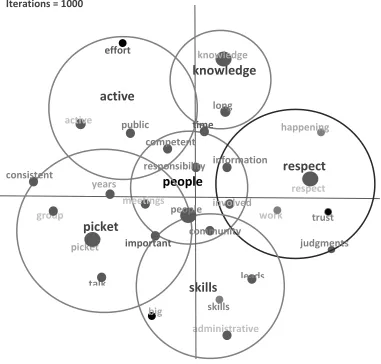
In analysing the rich data collected, text mapping was undertaken using software called Leximancer which is a text mining and visualisation tool used to help perform network, content and thematic analysis of textual documents. Leximancer draws on established methods in computational linguistics and Bayesian theory and uses complex network theory to discover emergent themes from a group of similar concepts, as well as content analysis to quantify the knowledge inherent in the text by coding or tagging text segments that contains the concept discovered (Leximancer 2005). The output is displayed on a concept map of key data themes and their relationships. An example of a concept map is shown in Figure 4.
light grey for inadequate. Related concepts that tend to co-occur are located close to each other, the size of a concept reflects its connectedness to others while similar colours indicate similar themes. The key themes within each concept map form the basis of discussions that are further expanded through topic-centred narratives to provide detailed explanations into the story of movement continuity and protest networks.
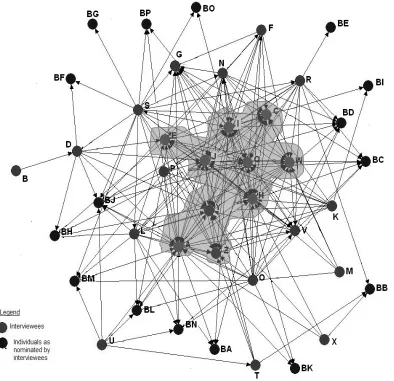
Sociograms depicting the social networks underpinning the protest were produced using a social network analysis software called UCINET (Borgatti et al 1999, Katz 2004). They are able to reveal the structure of relational patterns in a network at a particular point in time and can be analysed to reveal structural characteristics which can be associated with certain network attributes. To check the extent that activists’ self-reported network relations reflected the true nature of the protest networks, network data derived from the interviews and ethnographies were cross referenced as a whole across the entire data set. Where discrepancies occurred, network members were consulted and the data affirmed. A sociogram is illustrated in Figure 3 with nodes identifying individuals involved in a protest and the lines between them indicating the existence of a relationship (communication, friendship, family, power etc).
Finally, narrative analysis incorporating topic-centred storytelling was used to explore the deeper meanings that people attach to the protest and their role within it (Polkinghorne 2007). Used extensively in community-based research (Rappaport, 2000) but rarely used in construction research, narrative analysis of stories about the protest were used to ground the theoretical insights derived from the documentary analysis, ethnographies, concept maps, sociograms and literature. Activists’ stories were obtained through a series of semi-structured interviews and were examined from a wide range of different perspectives to corroborate them. The result was a series of shared stories that depict the experiences common among the protest group members that enabled the construction of a validated, balanced and reliable account of the issues that shaped movement continuity that transcended the accounts of individual protestors.
Results
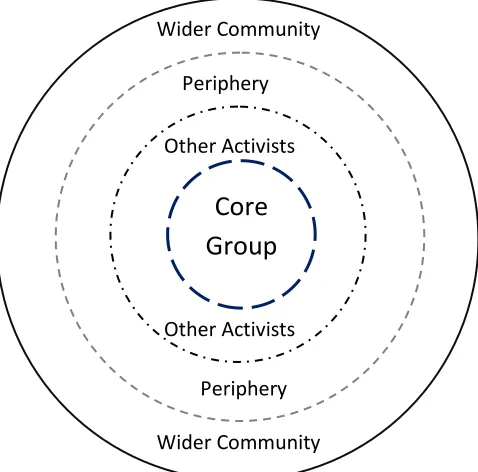
Figure 2 Protest network layers
In Figure 2, the outermost layer depicts the ‘wider community’ in which the protest is based who are casually associated with the protest on an event- or event-specific basis. As one of our interviewees stated:
“... there are a whole lot of people who don’t want to do the picket but they are happy to deliver newsletters or letterboxing.... put up posters and things like that...”
The periphery layer depicted activists at the fringe of the protest who maintain an ongoing but limited and inconsistent involvement in protest activities.
“I have always kind of been there, more or less on the periphery and contributed where I could... I kind of devote a bit of time every week to doing my little bit for the picket..”
The next layer represents the activists who get involved on a more consistent basis such as picket duty and attendance at meetings and protest events but typically do not get involved in organisational activities.
“... you know who you can count on, and for instances, some people will help with raffles and some people will help with the barbeque selling food or something like that...”
Finally at the heart of the protest is the core group comprising a small number of respected long-term activists who have played a central role in the protest over time by motivating people, organising events and shaping perceptions and opinions through the provision of information via newsletters, an email network web etc.
“... there is a fairly loose central structure which has representatives from major groups.... I mean you certainly had the movers-and-shakers at the picket too, the picket monsters and that...”
Core
Group
Other Activists
Other Activists Periphery
Wider Community Wider Community
While it was possible to identify a core group which drove the protest, the protest network was described by many activists within as being an informal, amorphous, anarchic and unstructured.
“You have a bunch of volunteers that have no rules or real structure... an individual or group can initiate something... you don’t have to be a member to attend, its very loose, there is no real control over it... that’s why this campaign has been very hard to pin down, there is no real cookbook on this one...”
The absence of a clearly defined network structure represented a departure from traditional protest organisation and was strategic on two levels. Firstly, it protected activists being the target of potentially litigious actions by the developer. Secondly, it promoted a sense of collective responsibility and effort by discouraging overreliance or delegation of work to specific activists which can be a threat to movement continuity should these activists depart the protest network.
“… everyone can come along to meetings… put up ideas… initiate their own action, its been a very loose-knit group too… Try and sue someone who is responsible… there is often no one particular person. Someone may have done the job for six months in one area that someone else has done.”
“… the loose structure is a good one because it is too easy for people to say they will leave it to the president or secretary because they are too busy. This way everyone needs to participate…”
Activists however, acknowledged that there were inherent weakness and inefficiencies associated with the anarchic nature of protest that was potentially detrimental to the achievement of protest objectives.
“… I see more disadvantages in that at times it is anarchic… (needed to be) better organised to cover the issues and if the (protest) issues are not being covered and things fall off the edge, then maybe you are not effectively campaigning against the outcome that you want.”
Figure 3 Sociogram of protest network core
Figure 4 Map of thematic groups of concepts of key qualities of core group members
In interpreting Figure 4, respect was a central theme in the concept map, as was evident in activists accounts below:
“.. some are more influential and effective that others...they know he is a very balanced, cautious and sensible person .. a lot of people know him and just have confidence in him. A lot of respect for him..”
Active and sustained participation over time was another theme identified as common among core group members who played a pivotal role in connecting activists old, current and new:
“.. people like him who has been there all the time… he has been a common kind of component of it all.. he has been central to virtually everything that has happened.”
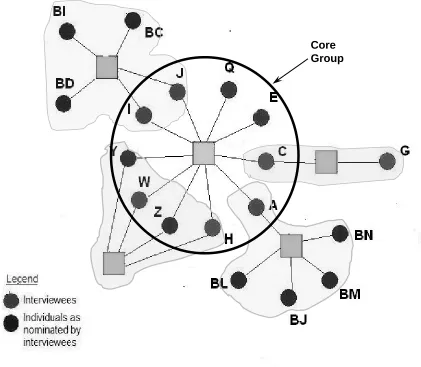
Knowledge was also a key factor in the central group and Figure 5 illustrates the different areas of expertise and knowledge that resided within core members and their connectivity and access to other knowledge experts outside of the core group.
group
respect
picket
picket
knowledge
work
talk
administrative
people
skills Iterations = 1000
trust
happening
effort
big years
skills
active
respect
leads consistent
knowledge
long
judgments
important
active
people meetings
public
community
involved
information responsibility
competent
Figure 5 Network of core group members connectivity to external expertise
As one core group member said:
“... people see me as an expert.. so you have your experts who could help you and you build up a community group of people who could be useful...”
Certain skill sets are also critical to core group membership:
“... there has been natural order in terms of skills... he is “Mr Leader” with fundraising and banking and all those administrative things..”
While there was no consistent and definable leadership role within the core group, it was sustained by a continuous cycle of both existing and new activists who volunteer their unique skills set to take on specific roles within the protest campaign to drive it forward over time:
“... there is a picket monster who rings people up.. and so every five or six weeks it rotates and there is a new person who take it on... So if you have not done your bit for a while.. someone will ring you up. Its incredibly well organised but incredibly anarchistic..”
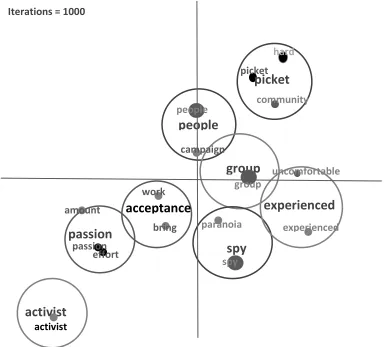
There were also barriers to entry to the core group which ensured that members were able to maintain focus, minimise conflict and direct communications and activities in a consistent manner. The concepts that influenced the receptivity of the core group to new members are illustrated in Figure 6.
Figure 6 Thematic groups of concepts relating to core group entry
Entry to the exclusive core group membership involved an initiation process where people were tested in terms of their commitment to the cause, their reliability, trustworthiness, fit with existing protest group membership and their ability to contribute:
“... it depends on the newcomer, what ideas and what they can bring to the group, what they produce for the group and what sorts of things will add credibility..”
“... there is paranoia everywhere, some people think that this new person is a spy... ”
The core group was the key source of energy for the entire protest movement and exercised its influence on other non-core members in a range of ways including emails, community meetings, media exposure and personal lobbying of other group members to maintain enthusiasm and energy. Of particular interest was the role of the community picket as a meeting point sustain protest group identity, cohesion and news of progress.
spy
group
people
passion
picket
experienced
activist
acceptance
activist
paranoia Iterations = 1000
amount
hard
picket
community people
campaign
group
experienced
spy
work
bring passion
effort
The symbolic and practical importance of physical artifacts such as the picket as a meeting point for the community was even more evident during the later stages of the protest after it had been burnt down by arsonists.
“... it used to be that you would bump into people ... whole lines of communication went down with the picket and the friendships you made were based on your efforts at (the protest) and they didn’t really continue after that... ”
Conclusion
The aim of this paper was to investigate the the role of core group members in driving and sustaining community action. Through an in-depth single case study of one of Australia’s longest standing community protests against a construction project our findings indicate that it is a lack of formal protest group structure, rather than the existence of formal structure that is the most important factor in sustaining community action over time. This finding qualifies those of McAdam and McCarthy (2996) and Porta and Diani (1999) which suggest that protest movements are more enduring when they are highly structured. The differences in our findings could be explained by the key role of the core group in managing and promoting cohesion among protest members so that this anarchic group functioned effectively. Our results suggest that when handled badly, the core group is driven under the surface and becomes the invisible driving force which sustains protests against construction projects. Through the coordination and leadership of the central group, a loosely coupled protest network was able to be highly effective in responding quickly to unexpected developments (such as attempts to dismantle the community picket or further development of the site), and make it difficult for the developer to communicate with the group (a deliberate defencestrategy to protect individuals from being targeted for legal action). It also helped build a sense of collective responsibility that motivated on-going participation in protest actions which would have been difficult to achieve in a hierarchical structure. Finally, it ensured that ideas and perceptions of risk spread rapidly and uncontrollably through the protest network and that out-groups such as the developer are left frustrated by the lack of identifiable leadership to communicate with.
While there was clear evidence of a core group driving the largely informal protest group structure, our research did detect different network layers differentiated by levels of participation, knowledge and contribution to the protest. The existence of activist layers highlighted the distinctive patterns of behaviour that had emerged during the protest and it was also found that activists would move through these layers over time depending on various constraints such as personal circumstances, motivation or work-protest-family balance etc. The core protest group had the least permeable boundary and the highest barriers to entry, consistency in membership and dedication to the cause. Members of this group could be defined by certain common attributes and given the high levels of time and commitment involved, membership did vary at times, largely drawn from trusted activists in the adjacent layer and in response to the need for expertise and resources which were salient to emerging protest issues.
existed to minimise exhaustion and burnout during periods of high activity and disillusionment during periods of inactivity. Another contributor to social cohesion was the initiation process which activists would go through to gain acceptance into the protest. People had to work and prove themselves over time to be deemed trustworthy and gain acceptance, particularly into the core group where initiations and rejection could be quite severe and indeed, sometimes destructive. This extends Taylor’s (1989) finding that initiation rites create feelings of in-groupness. Our findings also support McPherson and Smith-Lovin’s (2002) research that collective perceptions of external threat strongly contributed to feelings of cohesiveness. Our findings suggest that collective survival of a perceived threat created an ideal climate to build trust, confidence, perception of success and create war stories which became part of protest mythology and collective history, thereby perpetuating perceptions of out-groups and risk and cementing social ties, thereby sustaining collective action.
experience significant challenges in intervening, communicating with a protest group and alleviating its members’ concerns. However, the discovery of different layers of membership and a core group of relatively stable “leaders” means that there is some hope of effective communication if a manager can discover who this central group comprises. The problem for project managers is that the identity of these people are often protected and hidden from view to prevent legal action being taken against any one individual. The establishment of early contacts with opinion leaders in the community is thus an essential strategy that should be employed by project managers. These early contacts should aim to establish an open and trusting non-legalistic relationship with the protestors since our findings indicate that the more threatened the protest group feels, the more protective and cohesive it will become, and the more difficult it will be to communicate with. While there is a common perception that community consultation has been undertaken and completed during the pre-construction planning phases of projects, it is clear that residual community concerns can spill-over into the construction phase creating the need for continued community interactions.
Acknowledgement
The authors would like to acknowledge that funding for the research was provided by the Royal Institute of Chartered Surveyors (RICS) Foundation and the University of New South Wales.
References
Appleton, J. V. (2002), Critiquing approaches to case study design for a constructivist inquiry, Qualitative Research Journal, 2 (2), 80-97.
Atkinson R and Cope, S (1997) Community participation in urban regeneration in Britain, In Hoggett, P (ed) Contested communities, Bristol Policy Press, 201-221
Awakul, P. and Ogunlana, S. O. (2002), The effect of attitudinal differences on interface conflict on large construction projects: The case of the Pak Mun Dam project, Environmental Impact Assessment Review, 22, 311-335.
Berg, B. L. (2001), Qualitative research methods for the social sciences, Needham Heights, MA: Allyn & Bacon.
Berglund, E. K. (1998), Knowing nature, knowing science: An ethnography of environmental activism, Cambridge: The White Horse Press.
Borgatti, S. P., Everett, M. G. and Freeman, J. (1999), UCINET 5 for Windows: Software for Social Network Analysis, Harvard, MA: Analytic Technologies, Inc,.
Broadbent, J. (2003), Movement in context: Thick networks and Japanese environmental protest, in: M. Diani and D. McAdam (Eds), Social movements and networks: Relational approaches to collective action, Oxford: Oxford University Press, 204-229.
Brown, R. (2000), Group processes: Dynamics within and between groups, Oxford: Blackwell Publishers Ltd.
Burgmann, V. (1993), Power and protest: Movements for change in Australian society, St Leonards, NSW: Allen & Unwin Pty Ltd.
Cleland, D. I. and Ireland, L. R. (2007), Project Management: Strategic design and implementation, New York: McGraw-Hill.
Close, R and Loosemore, M (2013) Community consultation during construction: attitudes, experiences and skills, Association of Researchers in Construction
Management (ARCOM): 29th Annual Conference, Reading University, United Kingdom. 3-5 September, 849-859
Commissioner of Inquiry, Office of (2003), Land use planning for certain land at Sandon Point, Wollongong City, Sydney: Office of the Commissioners of Inquiry for Environment and Planning.
Crowther, D. and Cooper, S. (2002), Rekindling community spirit and identity: The role of ecoprotestors, Management Decision, 40 (4), 343-353.
Dalton, R. J., Recchia, S. and Rohrschneider, R. (2003), The environmental movement and the modes of political action, Comparative Political Studies, 36 (7), 743-771.
Foster-Fishman, P. G., Cantillon, D. Pierce, S. J. and Van Egeren, L. A. (2007), Building an active citizenry: The role of neighbourhood problems, readiness, and capacity for change, American Journal of Community Psychology, 39 (1-2), 91-106.
Flyvbjerg, B, 2006, Five misunderstandings about case study research Case Study, Qualitative Inquiry, 12 (1) 219-245
Gamson, J. (2003), The dilemmas of identity politics, in: J. Goodwin and J. M. Jasper (Eds), The social movements reader: Cases and concepts, Oxford: Blackwell Publishers Ltd, 335-344.
Glass J and Simmonds M, (2007) Considerate Construction: Case studies of current practice”, Engineering , Construction and Architectural Management Vol. 14 Iss: 2 pp 131-149
Goodwin, J. and Jasper, J. M. (Eds) (2003), The social movement reader: Cases and concepts, Oxford: Blackwell Publishers Ltd.
Hurlbert, J. S., Haines, V. A. and Beggs, J. J. (2000), Core networks and tie activation: What kinds of routine networks allocate resources in nonroutine situations?, American Sociological Review , 65 (4), 598-618.
Kasperson, R., Jhaveri, N., & Kasperson, J. (2001), Stigma and the social amplification of risk: Toward a framework of analysis, in J.Flynn, P.Slovic, & H.Kunreuther (Eds.), Risk media and stigma(ch. 2). London: Earthscan.
Katz, N., Lazer, D., Arrow, H. and Contractor, N. (2004), Network theory and small groups, Small Group Research, 35 (3), 307-332.
King, D. (2005), Sustaining activism through emotional reflexivity, in: H. Flam and D. King (Eds), Emotions and social movements, London and New York: Routledge, 150-169.
Kitts, J. A. (1999), Not in our backyard: Solidarity, social networks, and the ecology of environmental mobilization, Sociological Inquiry, 69 (4), 551-574.
Klandermans, B. (2003), Disengaging from movements, in: J. Goodwin and J. M. Jasper (Eds), The social movements reader: Cases and concepts, Oxford: Blackwell Publishers Ltd, 116-127.
Klandermans, B. and Staggenborg, S. (Eds) (2002), Methods of social movement research, Minneapolis: University of Minnesota Press.
Kretschmer, M., Klimis, G. M. and Choi, C. J. (1999), "Increasing returns and social contagion in cultural industries", British Journal of Management, 10, S61-S72.
Le Bon, G. (1960), The crowd, New York: Viking Press.
Le Bon, G. (2002), The crowd: A study of the popular mind, Mineola: Dover Publications, Inc.
Leximancer Manual (version 2.2) (2005), www.leximancer.com
Loosemore, M, Raftery, J, Reilly, C and Higgon, D (2005) Risk management in construction projects, Taylor and Francis, London.
Marwell, G. and Oliver, P. (1993), The critical mass in collective action: A micro-social theory, Cambridge: Cambridge University Press.
McPherson, M. and Smith-Lovin, L. (2002), Cohesion and membership duration: Linking groups, relations and individuals in an ecology of affiliation, in: S. R. Thye and E. J.
Moodley K, (1999) Project Performance and enhancement – improving relations with community stakeholders, Profitable Partnering in Construction procurement. E &F.N Spon, London pp 127-36
Lawler (Eds), Group cohesion, trust and solidarity, Oxford: Elsevier Science Ltd, 19, 1-36.
McPhail, C. (1994), "The dark side of purpose: Individual and collective violence in
Monge, P. R. and Contractor, N. S. (2001), Emergence of communication networks in: F. M. Jablin and L. L. Putnam (Eds), The new handbook of organisational communication: Advances in theory, research and methods, Thousand Oaks: Sage Publications, Inc., 440-502.
Monge, P. R. and Contractor, N. S. (2003), Theories of communication networks, Oxford: Oxford University Press.
Morgan, D. L., Neal, M. B. and Carder, P. (1996), The stability of core and peripheral networks over time, Social Networks, 19, 9-25.
Murray, M and Dainty, A (eds) (2009) Corporate social responsibility in the construction industry, Taylor and Francis London, UK
Myers, D. J. (2000), The diffusion of collective violence: Infectiousness, susceptibility and mass media networks, American Journal of Sociology, 106 (1), 173-208.
Oberschall, A. (1989), The 1960 sit-ins: Protest diffusion and movement take-off, Research in Social Movements, Conflict and Change, 11, 31-53.
Owens, S. (2004), Siting, sustainable development and social priorities, Journal of Risk Research, 7 (2), 101-114.
Parsons R, (2008) Constructions of ‘community engagement’ in the Australian minerals industry. School of Business University of Queensland, Doctor of Philosophy, Thesis.
Polkinghorne, D. E. (2007), Validity issues in narrative research, Qualitative Inquiry, 13 (4), 471-486.
Pryke, S and Smyth H (eds) (2009) The management of complex projects, Blackwell Publishing, Oxford, UK
Rappaport, J. (2000), Community narratives: Tales of terror and joy, American Journal of Community Psychology, 28 (1), 1-24.
Robbins, S. P., Millett, B. and Waters-Marsh, T. (2004), Organisational behaviour, 4th Edition, Frenchs Forest, NSW: Pearson Education Australia.
Sandler, T. (1992), Collective action: Theory and applications, Ann Arbor: The University of Michigan Press.
Scherer, C. W. and Cho, H. C. (2003), A social network contagion theory of risk perception, Risk Analysis, 23 (2), 261-267.
Sjöberg, L. (2004), Local acceptance of a high-level nuclear waste repository, Risk Analysis, 24 (3), 737-749.
Spillane, J P Flood, M, Oyedele, L O, von Meding, J K and Konanahalli, A (2013) Urban high-density construction sites and their surrounding community: issues encountered and startegies adopted by contractors, In Smith, S D and Ahiaga-Dagbui, D D (eds) Procs 29th Annual ARCOM Conference, 2-4 September 2013, Reading, UK, Association of Researchers in Construction Management, 871-880
Staggenborg, S. (1998), Social movement communities and cycles of protest: The emergence and maintenance of a local women's movement, Social Problems, 45 (2), 180-204.
Taylor, V. (1989), Social movement continuity: The women’s movement in abeyance, America Sociological Review, 54 (5), 761-775.
Teo, M. M. M. (2009), An investigation of community-based protest movement continuity against construction projects, unpublished PhD thesis, Sydney: FBE, UNSW.
Teo, M. and Loosemore, M. (2011), Community-based protest against construction projects: a case study of movement continuity, Construction Management and Economics, 29 (2), 131-144.
Valente, T. W. (1995), Network models of the diffusion of innovation, Cresskill, NJ: Hampton Press.
van Stekelenburg, J and Klandermans, B (2010) The social psychology of protest VU University, The Netherlands Sociopedia.isa