M E T H O D O L O G Y
Open Access
Cluster randomized adaptive implementation trial
comparing a standard versus enhanced
implementation intervention to improve uptake
of an effective re-engagement program for
patients with serious mental illness
Amy M Kilbourne
1,2*, Kristen M Abraham
1,2, David E Goodrich
1,2, Nicholas W Bowersox
1,2, Daniel Almirall
3,
Zongshan Lai
1,2and Kristina M Nord
1,2Abstract
Background:Persons with serious mental illness (SMI) are disproportionately burdened by premature mortality. This disparity is exacerbated by poor continuity of care with the health system. The Veterans Health Administration (VA) developed Re-Engage, an effective population-based outreach program to identify veterans with SMI lost to care and to reconnect them with VA services. However, such programs often encounter barriers getting implemented into routine care. Adaptive designs are needed when the implementation intervention requires augmentation within sites that do not initially respond to an initial implementation intervention. This protocol describes the methods used in an adaptive implementation design study that aims to compare the effectiveness of a standard implementation strategy (Replicating Effective Programs, or REP) with REP enhanced with External Facilitation (enhanced REP) to promote the uptake of Re-Engage.
Methods/Design:This study employs a four-phase, two-arm, longitudinal, clustered randomized trial design. VA sites (n = 158) across the United States with a designated Re-Engage provider, at least one Veteran with SMI lost to care, and who received standard REP during a six-month run-in phase. Subsequently, 88 sites with inadequate
uptake were stratified at the cluster level by geographic region (n = 4) and VA regional service network (n = 20) and randomized to REP (n = 49) vs. enhanced REP (n = 39) in phase two. The primary outcome was the percentage of veterans on each facility outreach list documented on an electronic web registry. The intervention was at the site and network level and consisted of standard REP versus REP enhanced by external phone facilitation consults. At 12 months, enhanced REP sites returned to standard REP and 36 sites with inadequate participation received enhanced REP for six months in phase three. Secondary implementation outcomes included the percentage of veterans contacted directly by site providers and the percentage re-engaged in VA health services.
(Continued on next page)
* Correspondence:[email protected]
1VA Center for Clinical Management Research, VA Ann Arbor Healthcare
System, 2215 Fuller Road, Mailstop 152, Ann Arbor, MI 48105, USA 2Department of Psychiatry, University of Michigan Medical School, North
Campus Research Complex, 2800 Plymouth Road, Building 16, Ann Arbor, MI 48109, USA
Full list of author information is available at the end of the article
(Continued from previous page)
Discussion:Adaptive implementation designs consisting of a sequence of decision rules that are tailored based on a site’s uptake of an effective program may produce more relevant, rapid, and generalizable results by more quickly validating or rejecting new implementation strategies, thus enhancing the efficiency and sustainability of
implementation research and potentially leading to the rollout of more cost-efficient implementation strategies. Trial registration:Current Controlled Trials ISRCTN21059161.
Keywords:Adaptive designs, Mental disorders, Comparative effectiveness, Care management, Population health
Background
Persons with serious mental illnesses (SMI),e.g., bipolar disorder or schizophrenia, experience a disproportionate burden in morbidity and premature mortality from com-mon medical conditions including cardiovascular diseases and certain cancers [1-3]. These physical health disparities may be exacerbated by long gaps in care from the health-care system due to psychiatric symptoms or access barriers such as lack of transportation, insurance, or relationship with a primary care provider [4,5]. Many evidence-based practices help to mitigate these risks when this population remains engaged in care [6].
Continuity and coordination of care for vulnerable health populations with chronic conditions such as SMI are key components of the Chronic Care Model [7,8]. The Chronic Care Model is a population- and measurement-based approach that calls for healthcare organizations to use electronic registries to monitor vulnerable populations and to adjust treatment according to patient response. Not only has this model of care been successful in man-aging mental health across various healthcare settings [9,10], a number of large healthcare providers including the Veterans Health Administration (VA) have demonstrated that this model of care is effective for re-engaging persons with SMI who had been lost to care to prevent adverse health effects [11-13].
Despite the promise of the Chronic Care Model and similar population management programs, they are rarely routinely implemented in practice [14,15]. Several reasons that contribute to this research-to-practice gap have been described elsewhere [16] and include system and provider-level barriers to program uptake.
Identifying effective implementation interventions that address system and provider barriers can speed program uptake in routine practice. Implementation interventions are operationalized techniques based on an underlying frame-work or theory that are designed to enhance the uptake of effective programs across different healthcare settings [17]. Implementation interventions address multilevel barriers to program adoption, such as organizational culture, leadership buy-in, and provider training and capacity [16,18-24] to ultimately enhance program uptake [25].
Studies involving implementation intervention strategies have been referred to as type III hybrid-effectiveness
implementation studies [17], where the intervention is the implementation strategy and the primary outcomes are fo-cused on program uptake rather than testing the effective-ness of the program itself on patient outcomes.
A handful of type III hybrid effectiveness-implementation studies based on underlying implementation frameworks [26-30] have been recently conducted [17,31-34]. These studies involved highly specified implementation interven-tion strategies such as Replicating Effective Programs, Facilitation, or Evidence-based Quality Improvement that address multiple organizational and provider barriers [17,32,34]. These studies typically randomized sites to re-ceive a new implementation strategy or standard dissem-ination to enhance the uptake of an effective program. Most of these studies take place in highly organized sites or treatment settings such as the VA.
Applying traditional randomized trial designs to complex implementation interventions can be challenging because they require several sites to achieve adequate power, and involve monitoring of both program and implementation intervention fidelity. Hence, these designs may not accom-modate lower resourced sites that are less willing to be randomized or participate in study assessments [35]—the very sites implementation interventions are designed to assist. Moreover, not all sites may require the same level of implementation intervention, and some may require additional assistance due to underlying barriers to pro-gram adoption that are not apparent or measurable at baseline. This can lead to less cost-efficient use of imple-mentation resources such as provider training, technical assistance, and the time require to build relationships with leaders and frontline providers across sites. In many situa-tions, it is also unclear how long an implementation inter-vention is needed to improve program uptake [36,37].
implementation non-response across sites, studies of adap-tive implementation interventions can help to determine the added value of a more intensive implementation intervention strategy and how long the more intensive implementation strategy should be continued to achieve improved program uptake at individual sites.
Aims and objectives
The aim of this study is to use an adaptive implementa-tion design to compare the effectiveness of an enhanced versus standard version of an implementation strategy (Replicating Effective Programs, or REP) to promote the uptake of a population management program for patients with serious mental illness who have dropped out of care (‘Re-Engage’). REP is a previously operationalized im-plementation strategy that has been shown to improve the uptake of effective Chronic Care Model and related programs [28,31,42] and consists of program manual dissemination, training, and brief technical assistance. Enhanced REP includes standard REP with facilitation, which involves proactive coaching by a program expert that is focused on enhancing provider buy-in and uptake.
The primary implementation outcome is the uptake of the Re-Engage program, defined as the percentage of veterans’with an updated documentation of their clinical status within 12 months, which is a central component of Re-Engage population management. The primary hy-pothesis is that among facilities not initially responding to standard REP, the addition of facilitation (enhanced REP) will be associated with increased percentages of docu-mented updates to veterans’clinical status. Secondary outcomes include facilities’percentage of veterans who were provided brief care management, defined as per-centage contacted or perper-centage returning to VA care. Additionally, we seek to explore whether among facilities that initially did not respond to standard REP the im-mediate addition of facilitation (enhanced REP) is asso-ciated with better outcomes than receiving Facilitation after a six-month delay.
Methods
Described previously [5,11,13,43-48] Re-Engage is a VA nationally mandated brief care management program for veterans with serious mental illness [48]. At the time of protocol submission, the trial intervention had already started and collection of outcomes had begun. This study was reviewed and approved by the local VA Institutional Review Boards and was registered as a clinical trial (Current Controlled Trials ISRCTN21059161).
Trial design
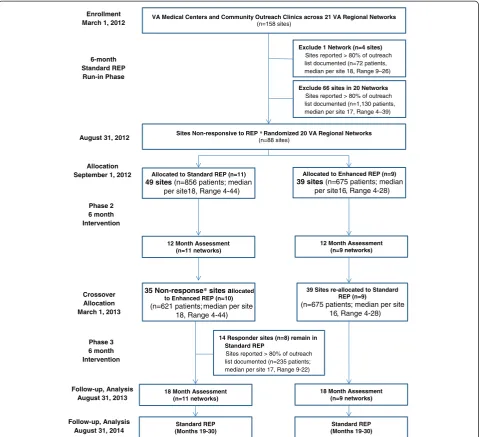
This study employed a four-phase, two-arm, longitudinal, clustered randomized trial design (see CONSORT diagram-Figure 1). The four phases, described below, are: run-in,
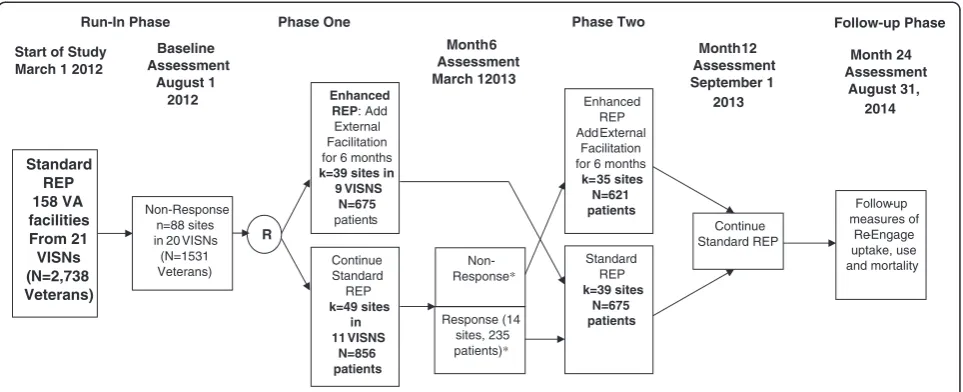
phase one, phase two, and follow-up (Figure 2). The unit of intervention in this study is the site. All VA sites in the 50 United States (N = 158) within the VA’s 21 regional networks that were required as part of the VA National Directive [48] to implement Re-Engage and had at least one veteran with serious mental illness who had dropped out of care were included and received standard REP in the run-in phase of the trial.
The six-month run-in phase included standard REP components, and at the end of the run-in phase, sites not responding to standard REP were identified. Phase one involved randomization to two site-level implementation interventions: Enhanced REP (adding Facilitation) or continuation of standard REP technical assistance on an as-needed basis. Phase two involved offering sites who were randomized to standard REP in phase one the enhanced REP facilitation, and discontinuing facilitation among sites who received facilitation in phase one.
Run-in phase
During the initial run-in phase (1 March 2012 to 31 August 2012), all eligible VA sites nationally received standard REP to implement the Re-Engage program. As in the original study [11], providers implementing Re-Engage were asked to identify and document their patients' current disposition based on a pre-generated list of those who had dropped out of care, as well to attempt to contact them and invite them back to VA health services. The initial run-in phase began when the requirement to implement the program was com-municated to sites in March 2012 and continued until 31 August 2012 [48]. During this phase, the designated mental health provider was identified at each eligible facility, and he or she received a computerized list of patients who had dropped out of care and a website link to track their status, a package describing the Re-Engage program, training, and brief technical assistance.
Phase one
to practice guidelines based on the Agency for Healthcare Research and Quality [49].
Sites having successfully implemented Re-Engage by the end of the run-in phase (31 August 2012) continued to receive standard REP for phases one, two, and the follow-up phase of the trial (Figure 2).
Sites that had not adequately implemented Re-Engage as of the end of the run-in phase (i.e., non-responding sites) were stratified by geographic region and 1:1 randomized by the sites’ VA regional network (n = 20) to enhanced or continued standard REP. Because each VA regional network has mental health leaders that communicate across sites, randomization was conducted at the VA regional network
level to minimize potential for contamination. Non-responding sites randomized to receive enhanced REP received six months of facilitation and those randomized to standard REP received technical assistance calls only if they requested it for six months during phase one.
Phase two
After the end of phase one (28 February 2013), sites originally randomized to receive standard REP and who were still non-responsive (<80% documentation of patients’ clinical status) received enhanced REP facilitation. Sites that were initially randomized to receive standard REP and met the implementation benchmark as of the end of phase one VA Medical Centers and Community Outreach Clinics across 21 VA Regional Networks
(n=158 sites)
Allocated to Standard REP (n=11) 49 sites (n=856 patients; median
per site18, Range 4-44)
Enrollment March 1, 2012
6-month Standard REP Run-in Phase
Sites Non-responsive to REP *Randomized 20 VA Regional Networks
(n=88 sites)
August 31, 2012
Allocated to Enhanced REP (n=9) 39 sites (n=675 patients; median
per site16, Range 4-28)
Phase 2 6 month Intervention
Allocation September 1, 2012
39 Sites re-allocated to Standard REP (n=9)
(n=675 patients; median per site 16, Range 4-28)
35 Non-response* sites allocated to Enhanced REP (n=10)
(n=621 patients; median per site 18, Range 4-44)
12 Month Assessment (n=9 networks) 12 Month Assessment
(n=11 networks)
14 Responder sites (n=8) remain in Standard REP
Sites reported > 80% of outreach list documented (n=235 patients; median per site 17, Range 9-22)
Crossover Allocation March 1, 2013
Phase 3 6 month Intervention
18 Month Assessment (n=11 networks)
18 Month Assessment (n=9 networks)
Standard REP (Months 19-30)
Standard REP (Months 19-30) Follow-up, Analysis
August 31, 2014 Follow-up, Analysis
August 31, 2013
Exclude 1 Network (n=4 sites)
Sites reported > 80% of outreach list documented (n=72 patients, median per site 18, Range 9–26)
Exclude 66 sites in 20 Networks
Sites reported > 80% of outreach list documented (n=1,130 patients, median per site 17, Range 4–39)
continued to receive standard REP during phase two. Sites receiving enhanced REP during phase one received stand-ard REP in phase two regstand-ardless of responsiveness.
Follow-up phase
After the end of phase two of the study (31 August, 2013), standard REP will continue and outcomes including VA use [50] will be monitored through 31 August 2014 using previously established methods [51,52].
Participants
This implementation trial is being conducted at the VA facility-level between January 2012 and August 2013. A VA facility was eligible for the current trial if it was included in the national VA Re-Engage program. VA facilities were included in the national Re-Engage program if they were within the 50 United States or Puerto Rico, were required, per VA policy [53], to have a mental health provider who filled the role of a Local Recovery Coordinator, and had at least one veteran with serious mental illness who was lost to care—i.e., had been seen at the facility in fiscal year (FY) 2008 or FY 2009, but had no subsequent outpatient visits or an inpatient stay of less than two days as of January 2012. There were a total of 158 facilities eligible for Re-Engage, of which 139 were medical centers (i.e., with hospital beds) and 19 were community-based outpatient clinics.
Setting and target population
Re-Engage is a national VA program which has three core components: panel management, brief care management, and proactive outreach services that are designed to
re-engage in VA healthcare veterans with serious mental illness (i.e., schizophrenia or bipolar disorder) who pre-viously received VA healthcare, but have not been seen in VA healthcare for at least one year. Re-Engage was initially developed by VA Office of Medical Inspector as a quality improvement program based on awareness that vet-erans with serious mental illness face high rates of medical comorbidities that require regular medical care [43-45], and that gaps in healthcare services among this population con-tribute to early mortality [5,46]. The VA Office of Medical Inspector quality improvement program was completed in 2010 and found that veterans with SMI who returned to care had lower rates of mortality (0.3%) than veterans who were targeted for re-engagement, but did not return to care (3.9%) [11,47]. As a result, VA mandated that Re-Engage be implemented as part of standard clinical care [48].
One provider at each VA facility, specifically the Local Recovery Coordinator, [53], is designated to implement Re-Engage components at his or her facility. Local Recovery Coordinators are typically social workers or psychologists who have both administrative and clinical duties [53]. Re-Engage core components were designed to be part of Local Recovery Coordinator’s clinical duties [48], and include the following: panel management: receiving a list of veterans with SMI whose last VA healthcare visit was at their facility, reviewing the medical record and other infor-mational sources to locate the veterans, updating their clin-ical status or disposition (e.g., vital status, whereabouts, etc.) in a web-based clinical registry; outreach: i.e., attempt-ing to contact the veterans in person, via telephone, or mail; and brief care management: completing a semi-structured assessment of veterans current health status *Non Response was defined using the as having less than 80% of Veterans on the site’s list with an updated documentation of clinical status in the web-based registry. Site response was defined as having >=80% of Veterans on the site list with an updated documented clinical status
Standard REP 158 VA facilities From 21
VISNs (N=2,738 Veterans)
Non-Response n=88 sites in 20 VISNs
(N=1531 Veterans) Baseline Assessment
August 1 2012
Month 6 Assessment March 12013 Enhanced
REP: Add External Facilitation for 6 months k=39 sites in
9 VISNS N=675 patients
Month 12 Assessment September 1
2013
R
Continue Standard REP k=49 sites
in 11 VISNS
N=856 patients Start of Study
March 1 2012
Continue Standard REP Standard
REP k=39 sites
N=675 patients Enhanced
REP Add External
Facilitation for 6 months
k= 35 sites N=621 patients Phase Two Phase One
Run-In Phase Follow-up Phase
Non-Response*
Response (14 sites, 235 patients)*
Follow-up measures of
Re-Engage uptake, use and mortality Month 24 Assessment
August 31, 2014
and healthcare needs and inviting veterans to return to VA care and assisting with the scheduling of any desired VA appointments.
As part of the Re-Engage program, the VA National Serious Mental Illness Treatment Resource and Evaluation Center (SMITREC) provides the Local Recovery Coordinator at each facility with lists containing the names, last known contact information, and last known recent clinical history for the veterans for the Re-Engage program. Based on previously described processes [11,13], patients were eligible for Re-Engage if they had at least one diagnosis of schizophrenia (International Classification of Diseases, Ninth Revision, Clinical Modification (ICD-9-CM) codes 295.0–295.4; 295.6–295.9) or bipolar disorder (ICD-9-CM codes 296.0–296.8) recorded in an inpatient or outpatient visit in FY 2008 or FY 2009; had not been seen in VA care for at least one year (i.e., dropped out of care: defined as no recorded outpatient visits or an inpatient stay of less than two days in the FYs after their last year with any visit); and were still alive as of March 2012 based on currently available mortality information from the VA Beneficiary Identification and Records Locater Subsystem (BIRLS), a well-established resource for VA mortality data, the Social Security Administration Death Master File, and the National Death Index [54].
As of March 2012, a total of 5,240 veterans were identi-fied through Re-Engage. The average number of identiidenti-fied veterans at each facility was 33.2 (standard dev = 22.5), with a range of 4 to 147. Of these, a subset of veterans were targeted as high-priority for the Re-Engage program if they had at a history of at least one inpatient hospitalization prior to drop out and were less than 65 years of age (i.e., less likely to be in a nursing home or covered by Medicare services). All high priority veterans were included on initial lists that were disseminated to facilities in March 2012. Additional veterans (up to a total of 42 per facility) were included on initial lists based on the dates they were last seen in VA healthcare. Each facility’s initial list contained no more than 42 veterans in order to provide Local Recovery Coordinators with a manageable number of veterans to contact. In March 2012, contact information for a total of 2,733 veterans was disseminated to facilities on the initial lists (n = 2,733, mean per facility = 17.3, std dev 6.3, range: 4–42). Contact information for the remaining 2,507 veterans (‘second list’) identified in March 2012 was disseminated in July 2012.
Although Re-Engage is an ongoing clinical program and over time additional veterans who have been lost-to-care will continue to be identified and their names disseminated to local Recovery Coordinators at each facility, this implementation study focused on the first list of veterans (n = 2,733) identified and disseminated in March 2012, and outcomes will be measured on the basis of this cohort.
Randomization
In phase two of the trial, facilities with insufficient im-plementation of Re-Engage were stratified by geographic region and randomized at the VA integrated services network-level to receive enhanced REP or continue receiv-ing standard REP. We stratified by geographic region because preliminary analyses indicated that uptake of Re-Engage at the end of phase one differed by geographic region. Randomization was conducted by the study program analyst and occurred at the veterans integrated service network-level as opposed to the facility level because in enhanced REP External facilitation involved communications with regional VA leadership and we sought to minimize the potential for contamination across facilities within the same integrated service network. Because the pro-viders involved in the implementation knew that they were receiving enhanced versus standard REP, allocation conceal-ment and blinded randomization were not applicable.
Implementation interventions
REP is based on the Centers for Disease Control and Prevention’s Research-to-Practice Framework [28,29,42]. Derived from Social Learning Theory [55] and Rogers’ dif-fusion model [56], REP consists of three central operational components: program ‘packaging’ (i.e., translation of treatment materials into user-friendly language), provider training, and brief technical assistance for providers to address barriers to uptake. The combination of these three components compared to package dissemination alone resulted in improved uptake and fidelity to HIV prevention intervention programs in AIDS service or-ganizations [42,57].
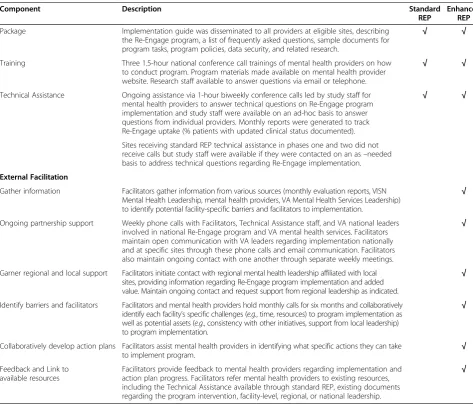
Although standard REP employs key tactical strategies that can promote effective adoption of effective programs [42,58], it was not designed address multilevel barriers to implementation, such as competing demands on providers and limited leadership support for new pro-grams [59]. Hence, REP was enhanced by including fa-cilitation based on the Promoting Action on Research Implementation in Health Services (PARiHS) framework [58,60-62]. Facilitation is a systematic and iterative process in which implementation experts promote program uptake by working with frontline providers to identify and mitigate barriers to program adoption [63,64].
Re-Engage (Table 1). Enhanced REP included additional External Facilitators [65] with backgrounds in psychology who made calls on a weekly basis to mental health pro-viders to provide specific guidance to overcoming bar-riers to implementing Re-Engage (Table 1). Facilitators also reached out to VA regional mental health leaders to promote the program and provided feedback on imple-mentation progress based on monthly reports on uptake across sites.
Outcomes
Primary implementation outcome
The primary measure of the uptake of Re-Engage was the percentage of veterans on each facility’s list whose clinical status was updated in the Re-Engage web-based clinical registry. The Veteran Clinical Status Updated measure was calculated as the number of veterans with
an update on their clinical status or disposition in the web-based registry compared to the total number of veterans on each facility’s list. This outcome measure indicates whether facilities are actively attempting to locate and contact the veterans who have dropped out of care and is independent of whether the veterans are reachable, and thus is a good indicator of implementation. Consistent with recommen-dations from previous studies of cut-points used to estab-lish adequate adherence to clinical processes or guidelines [66,67], inadequate uptake of Re-Engage is defined as whether an updated clinical status was available for less than 80% of the veterans on a given facility list. Although this measure is tabulated monthly for the purposes of the VA Re-Engage program, for the purposes of this imple-mentation study, this outcome measure was examined at the end of the run-in period (end of August 2012), the end of phase one (end of February 2013), the end of phase
Table 1 Implementation components of standard REP and enhanced REP
Component Description Standard
REP
Enhanced REP
Package Implementation guide was disseminated to all providers at eligible sites, describing the Re-Engage program, a list of frequently asked questions, sample documents for program tasks, program policies, data security, and related research.
√ √
Training Three 1.5-hour national conference call trainings of mental health providers on how to conduct program. Program materials made available on mental health provider website. Research staff available to answer questions via email or telephone.
√ √
Technical Assistance Ongoing assistance via 1-hour biweekly conference calls led by study staff for mental health providers to answer technical questions on Re-Engage program implementation and study staff were available on an ad-hoc basis to answer questions from individual providers. Monthly reports were generated to track Re-Engage uptake (% patients with updated clinical status documented).
√ √
Sites receiving standard REP technical assistance in phases one and two did not receive calls but study staff were available if they were contacted on an as–needed basis to address technical questions regarding Re-Engage implementation.
External Facilitation
Gather information Facilitators gather information from various sources (monthly evaluation reports, VISN Mental Health Leadership, mental health providers, VA Mental Health Services Leadership) to identify potential facility-specific barriers and facilitators to implementation.
√
Ongoing partnership support Weekly phone calls with Facilitators, Technical Assistance staff, and VA national leaders involved in national Re-Engage program and VA mental health services. Facilitators maintain open communication with VA leaders regarding implementation nationally and at specific sites through these phone calls and email communication. Facilitators also maintain ongoing contact with one another through separate weekly meetings.
√
Garner regional and local support Facilitators initiate contact with regional mental health leadership affiliated with local sites, providing information regarding Re-Engage program implementation and added value. Maintain ongoing contact and request support from regional leadership as indicated.
√
Identify barriers and facilitators Facilitators and mental health providers hold monthly calls for six months and collaboratively identify each facility’s specific challenges (e.g., time, resources) to program implementation as well as potential assets (e.g., consistency with other initiatives, support from local leadership) to program implementation.
√
Collaboratively develop action plans Facilitators assist mental health providers in identifying what specific actions they can take
to implement program. √
Feedback and Link to available resources
Facilitators provide feedback to mental health providers regarding implementation and action plan progress. Facilitators refer mental health providers to existing resources, including the Technical Assistance available through standard REP, existing documents regarding the program intervention, facility-level, regional, or national leadership.
two (end of August 2013), and during the follow-up phase (end of February 2014, end of August 2014).
Secondary outcomes
Secondary measures of implementation include the per-centage of veterans that the Local Recovery Coordinators successfully contacted among those who were on their lists and still alive and able to be contacted (e.g., had available address or phone number, no documentation of institutionalization or incarceration), and the percentage of veterans contacted who re-engaged in VA healthcare services. These measures, percentage of veterans con-tacted and percentage of veterans Re-Engaged, reflect the brief care management strategies that are part of Re-Engage.
Additional secondary outcome measures include veteran-level variables. All-cause mortality and utilization of VA healthcare services will be compared as a function of whether or not veterans were able to be contacted, and if contacted, whether or not they indicated an interested in returning to VA healthcare. Healthcare utilization variables will include number and length of stay of inpatient medical and mental health hospitalizations, number of outpatient mental health and general medical visits, and number of emergency department visits. Utilization of mental healthcare will be further examined by identifying the number of visits to recovery-oriented mental health services (e.g., psychosocial rehabilitation and recovery centers, supported employment services), as these services are targeted to veterans with SMI [53]. Moreover, because a large proportion of homeless veterans have a psychiatric diagnosis [51,52], the number of visits to VA homeless program services will be examined.
Analysis
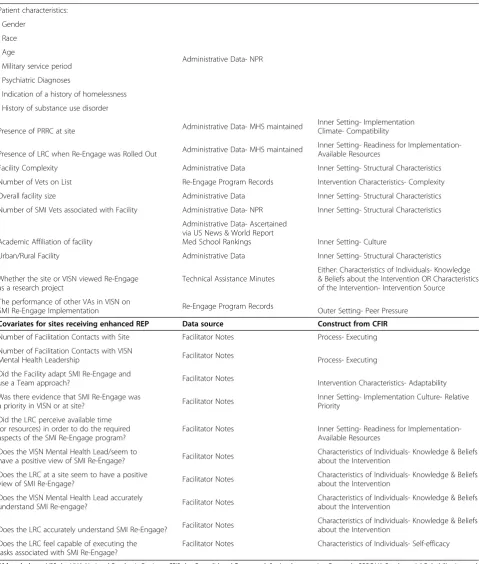
To examine the implementation of Re-Engage, we will use generalized estimating equations repeated mea-sures models to examine facility-level changes in the percentage of veterans with an updated clinical status, percentage of veterans contacted, and percentage of veterans re-engaged over time (end of phase one, end of phase two, end of phase three, follow-up periods), controlling for veteran-level (i.e., percentage of veterans on a facility’s list with particular demographic or clinical characteristics) and facility-level characteristics. The covariates section below and Table 2 contain specific veteran-level and facility-level variables.
To examine the effects of contacting veterans and re-engaging veterans on patient-level outcomes of mortal-ity and healthcare utilization, we will use generalized mixed effects models to account for VISN and facility-level covariates as well as patient-facility-level characteristics. We will employ logistic regression models or Poisson models as appropriate, based on whether dependent
measure is dichotomous (e.g., mortality) or a count variable (e.g., number of hospitalizations).
Sample size
Our study included all eligible VA facilities (n = 158) within the 21 VA integrated service networks (VISNs) that had a provider to implement Re-Engage at the time of this study. All 158 VA facilities received standard REP in phase one of this trial. Among these, at the end of phase one, 88 facilities (55.7%) in 20 of the 21 VISNs had updated the clinical status of less than 80% of veterans’, indicating in-sufficient implementation of Re-Engage. These 20 VISNs (containing 88 facilities with insufficient implementation of Re-Engage) entered phase two of the trial and were thus randomized (as described above) to continue standard REP or receive enhanced REP. Through randomization, nine VISNs that included facilities were assigned to enhanced REP, and the remaining 11 VISNS that included 49 facilities were assigned to standard REP.
Statistical power considerations
The data analysis plan for the primary aim is a two-sample comparison of facilities within VISNs randomized to enhanced versus standard REP. Based on the sample sizes described above, we conducted analyses to determine whether we had adequate statistical power to detect a significant difference in our primary (percentage of veterans with updated clinical status) and secondary (percentage of veterans contacted, percentage veterans Re-Engaged) facility-level implementation outcomes between the two groups of facilities.
At the end of phase one, the average percentage of veterans with and updated clinical status (primary implementation outcome) among the 88 underperforming facilities was 22% (SD = 25%). To account for the between-VISN variation induced by the within-between-VISN correlation in the average rate of the percentage of veterans with updated clinical status, we inflate the variance term in the standard sample size formula by 1 + (n-1)*ICC where ICC is the VISN interclass correlation coefficient for the average percentage of veterans with updated clinical status. The ICC for the average percentage of veterans with updated clinical status among the 20 VISNs entering phase two was 0.177. Using a two-sided, two-samplettest based on the sample sizes given above, a Type-I error rate of 5%, an ICC = 0.177, we will have 80% power to detect an effect size of 0.72 (Cohen’s D). This effect size corresponds to a between-site difference of 21 percentage points in the percentage of veterans with an updated clinical status.
Table 2 Potential covariates of re-engage implementation
Covariates for all facilities Data source Construct from CFIR
Patient characteristics:
Administrative Data- NPR •Gender
•Race •Age
•Military service period •Psychiatric Diagnoses
•Indication of a history of homelessness •History of substance use disorder
Presence of PRRC at site Administrative Data- MHS maintained
Inner Setting- Implementation Climate- Compatibility
Presence of LRC when Re-Engage was Rolled Out Administrative Data- MHS maintained
Inner Setting- Readiness for Implementation-Available Resources
Facility Complexity Administrative Data Inner Setting- Structural Characteristics
Number of Vets on List Re-Engage Program Records Intervention Characteristics- Complexity
Overall facility size Administrative Data Inner Setting- Structural Characteristics
Number of SMI Vets associated with Facility Administrative Data- NPR Inner Setting- Structural Characteristics
Academic Affiliation of facility
Administrative Data- Ascertained via US News & World Report
Med School Rankings Inner Setting- Culture
Urban/Rural Facility Administrative Data Inner Setting- Structural Characteristics
Whether the site or VISN viewed Re-Engage as a research project
Technical Assistance Minutes
Either: Characteristics of Individuals- Knowledge & Beliefs about the Intervention OR Characteristics of the Intervention- Intervention Source
The performance of other VAs in VISN on
SMI Re-Engage Implementation Re-Engage Program Records Outer Setting- Peer Pressure
Covariates for sites receiving enhanced REP Data source Construct from CFIR
Number of Facilitation Contacts with Site Facilitator Notes Process- Executing
Number of Facilitation Contacts with VISN
Mental Health Leadership Facilitator Notes Process- Executing
Did the Facility adapt SMI Re-Engage and
use a Team approach? Facilitator Notes Intervention Characteristics- Adaptability
Was there evidence that SMI Re-Engage was
a priority in VISN or at site? Facilitator Notes
Inner Setting- Implementation Culture- Relative Priority
Did the LRC perceive available time (or resources) in order to do the required aspects of the SMI Re-Engage program?
Facilitator Notes Inner Setting- Readiness for Implementation-Available Resources
Does the VISN Mental Health Lead/seem to
have a positive view of SMI Re-Engage? Facilitator Notes
Characteristics of Individuals- Knowledge & Beliefs about the Intervention
Does the LRC at a site seem to have a positive
view of SMI Re-Engage? Facilitator Notes
Characteristics of Individuals- Knowledge & Beliefs about the Intervention
Does the VISN Mental Health Lead accurately
understand SMI Re-engage? Facilitator Notes
Characteristics of Individuals- Knowledge & Beliefs about the Intervention
Does the LRC accurately understand SMI Re-Engage? Facilitator Notes
Characteristics of Individuals- Knowledge & Beliefs about the Intervention
Does the LRC feel capable of executing the tasks associated with SMI Re-Engage?
Facilitator Notes Characteristics of Individuals- Self-efficacy
for the secondary outcome, the percentage of veterans re-engaged in care, based on the initial values of 26% (SD = 38%), we will have 80% to detect an effect size of 0.88 (Cohen’s D), or a difference of 33 percentage points.
Covariates of implementation outcomes
Drawing on the Consolidated Framework for Implementa-tion Science (CFIR) [68] and the PARiHS Framework, we identified organizational and facility as well as patient-level variables that we will adjust for in examining implementa-tion of Re-Engage. Covariates are listed in Table 2, along with the constructs they represent based on CFIR, and the data source(s) that will be used to ascertain the variable.
Data sources for patient-level data will include informa-tion ascertained from nainforma-tional VA administrative databases (e.g., National Psychosis Registry) as well as information gathered through Local Recovery Coordinators’contacts with veterans. Data sources for organizational and context-ual factors will include VA administrative records and the all-employee survey, minutes from standard REP technical assistance calls, and surveys completed by facility clinicians and administrators. Surveys were disseminated to facility Local Recovery Coordinators, Homelessness Coordinators, and Mental Health Service Line Leaders beginning in March 2012. The surveys sent to the Local Recovery Coordinators and Homeless Coordinators ascertained their job duties and the frequency of their interactions with clinicians in other roles. Mental Health Service Line Leaders were provided with the Mental Health Program Survey [69] to assess structural and organizational char-acteristics of mental health services at the facility. For facilities that received enhanced REP, Facilitators’notes on contacts with facilities and stakeholders will serve as additional data sources.
Qualitative data from Facilitators’notes and technical assistance minutes will be coded to identify possible barriers and facilitators to program implementation. Al-though many of the potential covariates were identified a priori(e.g., structural and organizational characteristics), additional potential covariates have been identified through standard REP and enhanced REP processes.
Monitoring implementation intervention
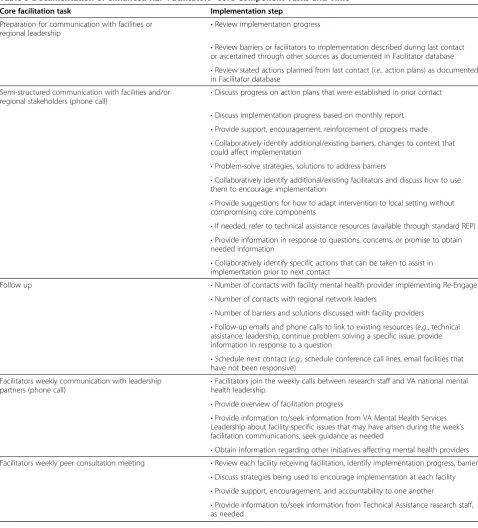
A central component of the Re-Engage adaptive implemen-tation intervention design was documenting and monitor-ing activities related to the implementation interventions. A primary reason for documenting these activities was not only to monitor whether the implementation interven-tions are being conducted with fidelity, but to monitor the time and effort required in order to determine the added costs of enhanced REP over time. For sites that received enhanced REP, Facilitators completed a regular log form for each contact with each site provider, and notes from these contact sheets serve as additional data sources to
monitor facilitation activities and time (Table 3). Data from Facilitators’ notes and minutes from the Facilitators’ weekly meetings will be coded using a previously established fidelity tool for enhanced REP [13] to determine to what extent Facilitators utilized core components of facilitation. The tool will assess core tasks of facilitation, notably whether the Facilitators identified possible barriers and solutions to Re-Engage implementation at each site, and whether site providers used Facilitator recommendations.
Trial status
To date the run-in phase and phase one of the imple-mentation trial have been completed, and phase two of the trial is ongoing at this time. All 39 sites within 9 VA regional networks that received enhanced REP dur-ing phase one have now returned to receivdur-ing standard REP. Of the 49 sites within 11 VA regional networks that were randomized to standard REP during phase one of the trial, 36 sites (73.5%) in 10 VA regional net-works continued to have less than 80% of their patients on their list with updated clinical status at the end of phase 1 and will receive enhanced REP.
Discussion
This paper describes to our knowledge one of the first adaptive implementation intervention trial designs. The study is testing the effectiveness of facilitation as an adjunct to standard REP among non-responding sites on the imple-mentation of a national VA program, Re-Engage, which is designed to assist patients with serious mental illness who have dropped out of care return to VA services.
An adaptive implementation design was optimal for this particular study because enhanced REP included additional personnel time and effort that may, over time, be too expensive to implement. Not all sites may need a more intensive implementation intervention (enhanced REP facilitation) to promote the uptake of an effective program. Hence, the adaptive nature of this trial randomized sites that required additional assistance, which allowed for more efficient use of facilitation resources. In addition, comparing the timing of added facilitation (immediately after observed non-response in phase one or six months later during phase two) provided an opportunity to focus on the impact of facilitation among later adopters of effective programs at the site level.
of national patient data and provider networks to identify those who had dropped out of care and to monitor sub-sequent use and outcomes at the patient and site levels. By including all sites that were required to implement Re-Engage per the mandate, there was opportunity to test the implementation interventions among sites that were less likely to initially respond to a lower-cost im-plementation strategy (REP). Previous imim-plementation
intervention trials often had to seek permission first from sites to participate in a study, often leading to poten-tial cherry-picking and selection effects that may skew im-plementation results [19].
Another advantage in conducting an adaptive implemen-tation strategy is that measuring site contextual factors that might influence program uptake is not required. Instead, sites are included in the randomization portion of the study
Table 3 Documentation of enhanced REP Facilitators’Core Component Tasks and Time
Core facilitation task Implementation step
Preparation for communication with facilities or
regional leadership •
Review implementation progress
•Review barriers or facilitators to implementation described during last contact or ascertained through other sources as documented in Facilitator database •Review stated actions planned from last contact (i.e., action plans) as documented in Facilitator database
Semi-structured communication with facilities and/or
regional stakeholders (phone call) •
Discuss progress on action plans that were established in prior contact
•Discuss implementation progress based on monthly report •Provide support, encouragement, reinforcement of progress made •Collaboratively identify additional/existing barriers, changes to context that could affect implementation
•Problem-solve strategies, solutions to address barriers
•Collaboratively identify additional/existing facilitators and discuss how to use them to encourage implementation
•Provide suggestions for how to adapt intervention to local setting without compromising core components
•If needed, refer to technical assistance resources (available through standard REP) •Provide information in response to questions, concerns, or promise to obtain needed information
•Collaboratively identify specific actions that can be taken to assist in implementation prior to next contact
Follow up •Number of contacts with facility mental health provider implementing Re-Engage
•Number of contacts with regional network leaders
•Number of barriers and solutions discussed with facility providers
•Follow-up emails and phone calls to link to existing resources (e.g., technical assistance, leadership, continue problem solving a specific issue, provide information in response to a question
•Schedule next contact (e.g., schedule conference call lines, email facilities that have not been responsive)
Facilitators weekly communication with leadership
partners (phone call) •
Facilitators join the weekly calls between research staff and VA national mental health leadership
•Provide overview of facilitation progress
•Provide information to/seek information from VA Mental Health Services Leadership about facility-specific issues that may have arisen during the week’s facilitation communications, seek guidance as needed
•Obtain information regarding other initiatives affecting mental health providers Facilitators weekly peer consultation meeting •Review each facility receiving facilitation, identify implementation progress, barriers
•Discuss strategies being used to encourage implementation at each facility •Provide support, encouragement, and accountability to one another
only if they are not responding to an initial implementation strategy, and the reasons for non-response may not be observable or measurable even with organizational as-sessments. Moreover, because the national rollout of Re-Engage occurred relatively quickly, the window of opportunity to ascertain organizational data across all of the sites to predict implementation non-response was limited. Several organizational assessments exist [70], but to date most have not been systematically used to identify predictors of program uptake, and those predictors may vary depending on the particular program.
There are limitations to this type of design that warrant consideration, especially when deciding to replicate the design in other settings. Notably, adaptive implementation intervention designs are potentially less feasible in settings without large numbers of sites that are either willing or mandated to provide the effective program, and have access to common data sources to gauge patient outcomes. Second, the large number of sites precluded more intensive monitoring of program fidelity beyond documentation by the frontline provider via the website. Third, cost considerations precluded having Facilitators as part of the enhanced REP intervention make site visits or involve local site leaders on a more regular basis. At least one prior study or enhanced REP included an Internal as well as External Facilitator who can provider more on-the-ground coaching and guidance to the frontline mental health pro-vider, linking them to leaders and resources not available or known to an outside External Facilitator [31-34].
Conclusions
The results of this study will yield new information on how to conduct adaptive implementation intervention trials at the national level. These findings will have the potential to inform not only further implementation research, but also the actual implementation of effective programs in large healthcare settings. This study also sets the stage for determining the added value of more intensive imple-mentation interventions within sites that need additional support to promote the uptake of effective programs. Ultimately, adaptive implementation designs may produce more relevant, rapid, and generalizable results by more quickly validating or rejecting new implementation strat-egies, thus enhancing the efficiency and sustainability of implementation research and potentially lead to the roll-out of more cost-efficient implementation strategies.
Competing interests
The authors have no conflicts of interest—financial or non-financial—in the methods described in this manuscript.
Authors’contributions
All authors have made substantial contributions to conception and design, or acquisition of data, or analysis and interpretation of data, have been involved in drafting the manuscript or revising it critically for important intellectual content, and have given final approval of the version to be
published. AK conceptualized the study, acquired funding, developed the implementation framework and interventions, and drafted the manuscript. AK, DG, NB, KA, and KN contributed to the development of the implementation intervention tools and contributed to the editing of the manuscript; AK, DA, DG, and ZL contributed to the methods and design of the manuscript draft and final revisions. All authors read and approved the final manuscript.
Acknowledgements
This research was supported by the Department of Veterans Affairs, Veterans Health Administration, Health Service Research and Development Service (SDR 11–232). The views expressed in this article are those of the authors and do not necessarily represent the views of the VA. We would also like to acknowledge the support of the VA Office of the Medical Inspector, and the Office of Mental Health Services and Mental Health Operations of the Veterans Health Administration.
Author details
1VA Center for Clinical Management Research, VA Ann Arbor Healthcare
System, 2215 Fuller Road, Mailstop 152, Ann Arbor, MI 48105, USA. 2Department of Psychiatry, University of Michigan Medical School, North
Campus Research Complex, 2800 Plymouth Road, Building 16, Ann Arbor, MI 48109, USA.3Institute for Social Research, University of Michigan, 426 Thompson Street 2321, Ann Arbor, MI 48104, USA.
Received: 17 July 2013 Accepted: 14 November 2013 Published: 20 November 2013
References
1. Crump C, Winkleby MA, Sundquist K, Sundquist J:Comorbidities and Mortality in Persons With Schizophrenia: A Swedish National Cohort Study.Am J Psychiatr2013,170:324–333.
2. Kilbourne AM, Ignacio RV, Kim HM, Blow FC:Datapoints: are VA patients with serious mental illness dying younger?Psychiatr Serv2009,60:589. 3. Saha S, Chant D, McGrath J:A systematic review of mortality in
schizophrenia: is the differential mortality gap worsening over time?
Arch Gen Psychiatry2007,64:1123–1131.
4. McCarthy JF, Blow FC, Valenstein M, Fischer EP, Owen RR, Barry KL, Hudson TJ, Ignacio RV:Veterans Affairs Health System and mental health treatment retention among patients with serious mental illness: evaluating accessibility and availability barriers.Health Serv Res2007, 42:1042–1060.
5. Copeland LA, Zeber JE, Rosenheck RA, Miller AL:Unforeseen inpatient mortality among veterans with schizophrenia.Med Care2006,44:110–116. 6. Kreyenbuhl J, Buchanan RW, Dickerson FB, Dixon LB:Schizophrenia Patient
Outcomes Research T: The Schizophrenia Patient Outcomes Research Team (PORT): updated treatment recommendations 2009.Schizophr Bull
2010,36:94–103.
7. Wagner EH, Austin BT, Von Korff M:Organizing care for patients with chronic illness.Milbank Q1996,74:511–544.
8. Goodrich DE, Kilbourne AM, Nord KM, Bauer MS:Mental health collaborative care and its role in primary care settings.Curr Psychiatry Rep2013,15:383. 9. Woltmann E, Grogan-Kaylor A, Perron B, Georges H, Kilbourne AM, Bauer MS:Comparative effectiveness of collaborative chronic care models for mental health conditions across primary, specialty, and behavioral health care settings: systematic review and meta-analysis.Am J Psychiatr2012, 169:790–804.
10. Thota AB, Sipe TA, Byard GJ, Zometa CS, Hahn RA, McKnight-Eily LR, Chapman DP, Abraido-Lanza AF, Pearson JL, Anderson CW,et al:Collaborative care to improve the management of depressive disorders: a community guide systematic review and meta-analysis.Am J Prev Med2012,42:525–538. 11. Davis CL, Kilbourne AM, Pierce JR, Langberg R, Blow FC, Winkel BM, Huycke
E, Visnic S, Lyle D, Yancy P:Reduced mortality among VA patients with schizophrenia or bipolar disorder lost to follow-up and engaged in active outreach to return to care.Am J Public Health2012,102:S74–S79. 12. Smith TE, Appel A, Donahue SA, Essock SM, Jackson CT, Karpati A, Marsik T,
Myers RW, Tom L:Use of administrative data to identify potential service gaps for individuals with serious mental illness.Psychiatr Serv2011, 62:1094–1097.
for veterans with mental disorders lost to follow-up care.Depress Res Treat2012,2012:325249.
14. Riley WT, Glasgow RE, Etheredge L, Abernethy AP:Rapid, responsive, relevant (R3) research: a call for a rapid learning health research enterprise.Clin Transl Med2013,2:10.
15. Kessler R, Glasgow RE:A proposal to speed translation of healthcare research into practice: dramatic change is needed.Am J Prev Med2011,40:637–644. 16. Damschroder LJ, Aron DC, Keith RE, Kirsh SR, Alexander JA, Lowery JC:
Fostering implementation of health services research findings into practice: a consolidated framework for advancing implementation science.Implement Sci2009,4:50.
17. Curran GM, Bauer M, Mittman B, Pyne JM, Stetler C:Effectiveness-implementation hybrid designs: combining elements of clinical effectiveness and implementation research to enhance public health impact.
Med Care2012,50:217–226.
18. Shortell SM, Bennett CL, Byck GR:Assessing the impact of continuous quality improvement on clinical practice: what it will take to accelerate progress.Milbank Q1998,76:593–624. 510.
19. VanDeusen LC, Engle RL, Holmes SK, Parker VA, Petzel RA, Nealon Seibert M, Shwartz M, Sullivan JL:Strengthening organizations to implement evidence-based clinical practices.Health Care Manage Rev2010,35:235–245. 20. Lukas CV, Holmes SK, Cohen AB, Restuccia J, Cramer IE, Shwartz M, Charns
MP:Transformational change in health care systems: an organizational model.Health Care Manage Rev2007,32:309–320.
21. Lukas CV, Mohr DC, Meterko M:Team effectiveness and organizational context in the implementation of a clinical innovation.Qual Manag Health Care2009,18:25–39.
22. Damschroder LJ, Lowery JC:Evaluation of a large-scale weight management program using the consolidated framework for implementation research (CFIR).Implement Sci2013,8:51.
23. Rubenstein LV, Parker LE, Meredith LS, Altschuler A, DePillis E, Hernandez J, Gordon NP:Understanding team-based quality improvement for depression in primary care.Health Serv Res2002,37:1009–1029.
24. Lukas CV, Meterko MM, Mohr D, Seibert MN, Parlier R, Levesque O, Petzel RA: Implementation of a clinical innovation: the case of advanced clinic access in the Department of Veterans Affairs.J Ambul Care Manage2008,31:94–108. 25. Shortell SM, O'Brien JL, Carman JM, Foster RW, Hughes EF, Boerstler H, O'Connor
EJ:Assessing the impact of continuous quality improvement/total quality management: concept versus implementation.Health Serv Res1995,30:377–401. 26. Green LW, Kreuter MW, Deeds SG, Partridge KB:Health Education Planning:
A Diagnostic Approach.1st edition. Mountain View, CA: Mayfield Publishing Co.; 1980.
27. Greenhalgh T, Robert G, Macfarlane F, Bate P, Kyriakidou O:Diffusion of innovations in service organizations: systematic review and recommendations.Milbank Q2004,82:581–629.
28. Kilbourne AM, Neumann MS, Pincus HA, Bauer MS, Stall R:Implementing evidence-based interventions in health care: application of the replicating effective programs framework.Implement Sci2007,2:42.
29. Neumann MS, Sogolow ED:Replicating effective programs: HIV/AIDS prevention technology transfer.AIDS Educ Prev2000,12:35–48. 30. Stetler CB:Role of the organization in translating research into
evidence-based practice.Outcomes Manag2003,7:97–103. quiz 104–105. 31. Waxmonsky J, Kilbourne AM, Goodrich DE, Nord KM, Lai Z, Laird C, Clogston J, Kim HM, Miller C, Bauer MS:Enhanced fidelity to treatment for bipolar disorder: results from a randomized controlled implementation trial.
Psychiatr Serv2013,64. In press.
32. Kirchner JE, Ritchie M, Dollar K, Gundlach P, Smith J:Using external and internal facilitation to improve care in the Veterans Healthcare Administration.
1st edition. Washington, DC: VA Mental Health Quality Enhancement Research Initiative (QUERI), Department of Veteran Affairs; 2012. 33. Proctor EK, Landsverk J, Aarons G, Chambers D, Glisson C, Mittman B:
Implementation research in mental health services: an emerging science with conceptual, methodological, and training challenges.Adm Policy Ment Health Ment Health Serv Res2009,36:24–34.
34. Brown AH, Cohen AN, Chinman MJ, Kessler C, Young AS:EQUIP: implementing chronic care principles and applying formative evaluation methods to improve care for schizophrenia: QUERI Series.Implement Sci2008,3:9. 35. Rothwell PM:External validity of randomised controlled trials:‘to whom
do the results of this trial apply?’.Lancet2005,365:82–93.
36. Mendel P, Meredith LS, Schoenbaum M, Sherbourne CD, Wells KB:Interventions in organizational and community context: a framework for building evidence
on dissemination and implementation in health services research.Adm Policy Ment Health Ment Health Serv Res2008,35:21–37.
37. Parker LE, Kirchner JE, Bonner LM, Fickel JJ, Ritchie MJ, Simons CE, Yano EM: Creating a quality-improvement dialogue: utilizing knowledge from frontline staff, managers, and experts to foster health care quality improvement.Qual Health Res2009,19:229–242.
38. Almirall D, Compton SN, Gunlicks-Stoessel M, Duan N, Murphy SA:Designing a pilot sequential multiple assignment randomized trial for developing an adaptive treatment strategy.Stat Med2012,31:1887–1902.
39. Almirall D, McCaffrey DF, Ramchand R, Murphy SA:Subgroups Analysis when Treatment and Moderators are Time-varying.Prev Sci2013,14:169–179. 40. Almirall D, Ten Have T, Murphy SA:Structural nested mean models for
assessing time-varying effect moderation.Biometrics2010,66:131–139. 41. Murphy SA, Collins LM, Rush AJ:Customizing treatment to the patient:
adaptive treatment strategies.Drug Alcohol Depend2007,88(Suppl 2):S1–S3. 42. Kelly JA, Somlai AM, DiFranceisco WJ, Otto-Salaj LL, McAuliffe TL, Hackl KL,
Heckman TG, Holtgrave DR, Rompa D:Bridging the gap between the science and service of HIV prevention: transferring effective research-based HIV prevention interventions to community AIDS service providers.Am J Public Health2000,90:1082–1088.
43. Kilbourne AM, Brar JS, Drayer RA, Xu X, Post EP:Cardiovascular disease and metabolic risk factors in male patients with schizophrenia, schizoaffective disorder, and bipolar disorder.Psychosomatics2007,48:412–417. 44. Kilbourne AM, Post EP, Bauer MS, Zeber JE, Copeland LA, Good CB, Pincus
HA:Therapeutic drug and cardiovascular disease risk monitoring in patients with bipolar disorder.J Affect Disord2007,102:145–151. 45. Chwastiak L, Rosenheck R, Leslie D:Impact of medical comorbidity on the
quality of schizophrenia pharmacotherapy in a national VA sample.
Med Care2006,44:55–61.
46. Copeland LA, Zeber JE, Wang CP, Parchman ML, Lawrence VA, Valenstein M, Miller AL:Patterns of primary care and mortality among patients with schizophrenia or diabetes: a cluster analysis approach to the retrospective study of healthcare utilization.BMC Health Serv Res2009,9:127. 47. Veterans Health Administration:Office of the Medical Inspector final report:
Quality improvement assessment: outreach services to schizophrenic and bipolar patients lost to follow-up care (2010-D-252).Washington, DC: Department of Veteran Affairs; 2010.
48. Veterans Health Administration:VHA Directive 2012–002: Re-Engaging Veterans with Serious Mental Illness in Treatment.Washington, DC: Department of Veterans Affairs; 2012.
49. Methodological Considerations in Generating Provider Performance Score: A Guide for Community Quality Collaboratives: White Paper.http://www.ahrq. gov/professionals/quality-patient-safety/quality-resources/value/ perfscoresmethods/index.html.
50. Blow FC, Mccarthy JF, Valenstein M, Bowersox NW, Visnic S:Care for Veterans with Psychosis in the Veterans Health Administration, FY10: 12th Annual National Psychosis Registry Report.Ann Arbor, MI: VA Serious Mental Illness Treatment Resource and Evaluation Center (SMITREC); 2011.
51. O'Toole TP, Conde-Martel A, Gibbon JL, Hanusa BH, Fine MJ:Health care of homeless veterans.J Gen Intern Med2003,18:929–933.
52. Perl L:Veterans and homelessness.Washington, DC: Congressional Research Service; 2009.
53. Veterans Health Administration (VHA):VHA Handbook 1160.01: Uniform Mental Health Services in VA Medical Centers and Clinics.Washington, DC: Department of Veteran Affairs; 2008.
54. Arnold N, Sohn MW, Maynard C, Hynes DM:VIReC Technical Report 2: VA-NDI Mortality Data Merge Project.Hines, IL: VA Information Resource Center, Department of Veterans Affairs; 2006.
55. Bandura A:Social Learning Theory.Englewood Cliffs, NJ: Prentice Hall; 1977. 56. Rogers E:Diffusion of Innovations.5th edition. New York, NY: Free Press; 2003. 57. Kelly JA, Heckman TG, Stevenson LY, Williams PN, Ertl T, Hays RB, Leonard
NR, O'Donnell L, Terry MA, Sogolow ED, Neumann MS:Transfer of research-based HIV prevention interventions to community service providers: fidelity and adaptation.AIDS Educ Prev2000,12:87–98. 58. Kitson A, Harvey G, McCormack B:Enabling the implementation of
evidence based practice: a conceptual framework.Qual Health Care1998, 7:149–158.
59. Nutting PA, Crabtree BF, Stewart EE, Miller WL, Palmer RF, Stange KC, Jaen CR:Effect of facilitation on practice outcomes in the National Demonstration Project model of the patient-centered medical home.
60. Kitson AL, Rycroft-Malone J, Harvey G, McCormack B, Seers K, Titchen A: Evaluating the successful implementation of evidence into practice using the PARiHS framework: theoretical and practical challenges.
Implement Sci2008,3:1.
61. Rycroft-Malone J:The PARIHS framework–a framework for guiding the implementation of evidence-based practice.J Nurs Care Qual2004, 19:297–304.
62. Stetler CB, Damschroder LJ, Helfrich CD, Hagedorn HJ:A Guide for applying a revised version of the PARIHS framework for implementation.
Implement Sci2011,6:99.
63. Kilbourne AM, Neumann MS, Waxmonsky J, Bauer MS, Kim HM, Pincus HA, Thomas M:Public-academic partnerships: evidence-based implementation: the role of sustained community-based practice and research partnerships.
Psychiatr Serv2012,63:205–207.
64. Zmud RW:An examination of push-pull theory applied to process innovation in knowledge work.Manag Sci1984,30:727–738. 65. Stetler CB, Legro MW, Rycroft-Malone J, Bowman C, Curran G, Guihan M,
Hagedorn H, Pineros S, Wallace CM:Role of‘external facilitation’in implementation of research findings: a qualitative evaluation of facilitation experiences in the Veterans Health Administration.
Implement Sci2006,1:23.
66. McGlynn EA, Asch SM, Adams J, Keesey J, Hicks J, DeCristofaro A, Kerr EA: The quality of health care delivered to adults in the United States.
N Engl J Med2003,348:2635–2645.
67. Galvin RS, McGlynn EA:Using performance measurement to drive improvement: a road map for change.Med Care2003,41:I48–I60. 68. Damschroder LJ, Goodrich DE, Robinson CH, Fletcher CE, Lowery JC:A
systematic exploration of differences in contextual factors related to implementing the MOVE! weight management program in VA: a mixed methods study.BMC Health Serv Res2011,11:248.
69. Kilbourne AM, Greenwald DE, Hermann RC, Charns MP, McCarthy JF, Yano EM:Financial incentives and accountability for integrated medical care in Department of Veterans Affairs mental health programs.Psychiatr Serv
2010,61:38–44.
70. Chaudoir SR, Dugan AG, Barr CH:Measuring factors affecting
implementation of health innovations: a systematic review of structural, organizational, provider, patient, and innovation level measures.
Implement Sci2013,8:22.
doi:10.1186/1748-5908-8-136
Cite this article as:Kilbourneet al.:Cluster randomized adaptive
implementation trial comparing a standard versus enhanced implementation intervention to improve uptake of an effective re-engagement program for patients with serious mental illness.
Implementation Science20138:136.
Submit your next manuscript to BioMed Central and take full advantage of:
• Convenient online submission
• Thorough peer review
• No space constraints or color figure charges
• Immediate publication on acceptance
• Inclusion in PubMed, CAS, Scopus and Google Scholar
• Research which is freely available for redistribution