Supplemental Iodide for Preterm
Infants and Developmental
Outcomes at 2 Years: An RCT
Fiona L.R. Williams, PhD, a Simon Ogston, PhD, a Robert Hume, FRCPCH, a Jennifer Watson, MPH, a Kayleigh Stanbury, BSc, b
Peter Willatts, PhD, c Anita Boelen, PhD, d Edmund Juszczak, MSc, b Peter Brocklehurst, MB ChB, e for the I2S2 Team
abstract
BACKGROUND: The recommendation for enteral iodide intake for preterm infants is 30 to 40μg/kg per day and 1 μg/kg per day for parenteral intake. Preterm infants are vulnerable to iodide insufficiency and thyroid dysfunction. The hypothesis tested whether, compared with placebo, iodide supplementation of preterm infants improves neurodevelopment.
METHODS: A randomized controlled trial of iodide supplementation versus placebo in infants
<31 weeks’ gestation. Trial solutions (sodium iodide or sodium chloride; dose 30 μg/kg per day) were given within 42 hours of birth to the equivalent of 34 weeks’ gestation. The only exclusion criterion was maternal iodide exposure during pregnancy or delivery. Whole blood levels of thyroxine, thyrotropin, and thyroid-binding globulin were measured on 4 specific postnatal days. The primary outcome was neurodevelopmental status at 2 years of age, measured by using the Bayley Scales of Infant Development-III. The primary analyses are by intention-to-treat, and data are presented also for survivors.
RESULTS: One thousand two hundred seventy-three infants (637 intervention, 636 placebo)
were recruited from 21 UK neonatal units. One hundred thirty-one infants died, and neurodevelopmental assessments were undertaken in 498 iodide and 499 placebo-supplemented infants. There were no significant differences between the intervention and placebo groups in the primary outcome: mean difference cognitive score, −0.34, 95% confidence interval (CI) −2.57 to 1.89; motor composite score, 0.21, 95% CI −2.23 to 2.65; and language composite score, −0.05, 95% CI −2.48 to 2.39. There was evidence of weak interaction between iodide supplementation and hypothyroxinemic status in the language composite score and 1 subtest score.
CONCLUSIONS: Overall iodide supplementation provided no benefit to neurodevelopment
measured at 2 years of age.
aDivision of Population Health Sciences, Ninewells Hospital and Medical School, University of Dundee, Dundee,
United Kingdom; bNuffield Department of Population Health, NPEU Clinical Trials Unit, National Perinatal
Epidemiology Unit, University of Oxford, Oxford, United Kingdom; cDepartment of Psychology, University of
Dundee, Dundee, United Kingdom; dNeonatal Screening Laboratory, Laboratory of Endocrinology, Academic
Medical Centre, Amsterdam, Netherlands; and eInstitute for Women’s Health, University College London, London,
United Kingdom
Dr Williams conceptualized and designed the study, contributed to the data analysis, and drafted the initial manuscript; Professor Hume conceptualized and designed the study and critically reviewed the manuscript; Dr Ogston, Mr Juszczak, and Ms Watson designed and contributed to the data analysis and reviewed and revised the manuscript; Professor Brocklehurst contributed to the study design and reviewed and revised the manuscript; Dr Willatts and Ms Stanbury contributed to the design of the neurodevelopmental assessments, coordinated and supervised
To cite: Williams FL, Ogston S, Hume R, et al. Supplemental Iodide for Preterm Infants and Developmental Outcomes at 2 Years: an RCT. Pediatrics.
2017;139(5):e20163703
WhaT’s KnoWn on This subjecT: The iodide
recommendation for preterm enteral nutrition is 30 to 40 μg/kg per day but 1 μg/kg per day for parental nutrition. Iodide is needed to produce thyroid hormones, which are essential for normal brain development. Observational studies report associations between low postnatal thyroid hormones and compromised neurodevelopment.
Thyroid hormone is essential for normal brain development in utero and for the first 2 years of life. Brain damage through deficiency of thyroxine (T4) is irreversible. Congenital hypothyroidism is the most extreme form of thyroid hormone deficiency. A milder form of deficiency, transient hypothyroxinemia, is characterized by low or normal levels of
thyrotropin (TSH) and low T4 levels. Transient hypothyroxinemia is common in preterm infants, 1
its etiology is multifactorial2–6 and
includes iodide deficiency.7, 8
The European guideline for preterm neonatal enteral iodide intake is 11 to 55 μg/kg per day9;
although, evidence from balance studies suggests that the intake for healthy preterm infants should be a minimum of 30 to 40 μg/kg per day.7
The guideline for parenteral nutrition is 1 μg/kg per day.10, 11
The iodide requirement of extreme preterm infants is complex and difficult to assess. Neonates have very small iodine reserves, 12 are
vulnerable to iodine toxicity, 13
and their immature physiology can demand higher levels of some nutrients, especially ions, relative to the term neonate.14 Extreme preterm
infants are fed parenterally until their clinical condition improves, when the contribution of parenteral to formula/breast milk gradually decreases. Iodide balance studies of preterm infants reveal that they are in negative iodide balance7, 8 until
their intake of nutrition is primarily enteral. Iodine is an essential component of thyroid hormones and because the preterm infant has small iodide reserves within the thyroid gland, 12 it is essential that daily
nutrients provide sufficient iodide to support T4 production.
Although transient hypothyroxinemia was formerly thought of as
clinically harmless, recent studies reveal associations with neurodevelopmental
compromise.15–20 Infants with
transient hypothyroxinemia perform less well on developmental tests and this compromise persists into at least late childhood.18 These children are
predicted to perform less well at school, which has consequences for their lifetime achievements and well-being. The link between suboptimal neurodevelopment and the early iodide status of preterm infants is not well known. It is also unknown whether iodide supplementation can confer a benefit to later outcome. Our aim was to determine whether iodine supplementation leads to improved neurodevelopmental outcome in extreme preterm infants at 2 years of age.
MeThods
I2S2 was a United Kingdom, randomized, placebo-controlled trial.21 The trial was approved by
Tayside Committee on Medical Research Ethics (08/S0501/31), Medicines and Healthcare Products Regulatory Agency (CTA No. 21584/0251/001), and registered with clinical trials (NCT00638092) and EudraCT (No. 2008-001024-31). Written informed consent was obtained from the infants’ parents. Infants were eligible if they were <42 hours old, born <31 weeks’ gestation in 1 of the trial recruiting hospitals, and had a realistic prospect of survival. The only exclusion criterion was maternal exposure to iodide during pregnancy or delivery (eg, the use of topical iodides for skin antisepsis before epidural/ cesarean delivery/other surgery, or from exposure to iodinated contrast media. Women absorbing iodide from multi-vitamins or from their habitual diet were eligible for enrollment).
Randomization and Masking
Eligible infants were randomly assigned to intervention or placebo (with roughly equal probability) by using a secure Web site with
24/7 telephone backup.21 The
randomization program used a bespoke minimization algorithm to ensure balance across hospitals on gender and gestational age (by individual week from 22 to 25 weeks, 26 to 27 weeks, and 28 to 30 weeks (Supplemental Table 3). Infants from multiple births were randomly assigned individually. Masking ensured that the research team, trial statistician, parents, neonatal staff, and pharmacy were blind to the content of the trial solutions.
Procedures
Mother/infants were recruited by I2S2 trained staff. Trial solutions were prescribed by medical staff following I2S2 guidance sheets. Infants received either the intervention (sodium iodide diluted to an iodide content of 75 μg/mL) or placebo (sodium chloride diluted to a chloride content of 75 μg/mL). The packaging and visual appearance of trial solutions were identical and the solutions could be given either parenterally or enterally. (Enteral absorption of iodide is almost complete, thus the parenteral and enteral intakes should be the same.) The dose was 30 μg/kg per day, given daily from randomization until the equivalent of 34 weeks’ gestational age (had the fetus remained in utero, referred to hereafter as equivalent gestational age).
Infant blood was collected on blood spot cards at postnatal days 7, 14, 28, and at 34 weeks’ equivalent gestational age, ±1 day. Cards were sent to the Amsterdam Neonatal Screening Laboratory for estimation of T4, TSH, and thyroid-binding globulin (TBG). Detailed clinical data were collected throughout the study by trial staff.21 Drug prescriptions,
nutritional data, and level of nursing care (as an indicator of illness severity, 6 Supplemental Table 4)
weeks’ equivalent gestational age, including all interunit transfers (or from discharge home/death if these occurred before 36 weeks). Medical and social information for the period between hospital discharge and the 2-year follow-up was recorded on a form, completed by the person bringing the child to the appointment. Infants were assessed by using the Bayley Scales of Infant and Toddler Development-III (Bayley-III)22 at 2 years of age
corrected for prematurity (±1 month). The Bayley-III provides information on 3 domains (cognitive, motor composite, and language composite scales, each with a population mean of 100 and SD of 15) and 4 subtest scales (expressive communication, receptive
com munication, fine motor, and gross motor scales, each with a mean of 10 and SD of 3). Infants were assessed by using trial personnel specifically trained to use the Bayley-III, and random performances were video-recorded and audited. The setting for the interventional phase was the neonatal unit, and follow-up at 2 years was undertaken in a hospital close to the infants’ home.
There were no restrictions on medications or treatments permitted during the trial, including levothyroxine if prescribed.
Infants were immediately withdrawn from receiving trial solutions if they were exposed to topical iodide containing antiseptics or if iodinated contrast media was given. Such infants were monitored locally for the biochemical features of iodine toxicity on thyroid dysfunction. These infants were included in all other aspects of the trial, including the 2-year follow-up.
Trial outcomes
The primary outcome was
neurodevelopmental status defined by the 3 domains of the Bayley-III at 2 years of age corrected for
prematurity. Secondary outcomes were as follows: the 4 subtests of the Bayley-III; Bayley-III analyzed as a dichotomous outcome (death or a Bayley-III score <85 in any of the main domains versus a Bayley-III score 85+); levels of T4, TSH, and TBG on postnatal days 7, 14, 28, and 34 weeks’ equivalent gestational age (±1 day); various measures of neonatal type and severity of
illness21; and prescribed drug usage.21
statistical analysis
To detect a difference in mean Bayley-III score of 6 units (assuming an SD of 15) and taking into account anticipated mortality, with 90% power and a 2-sided 5% level of significance, a target sample size of 1400 infants was required (Section 2, Supplemental
Information).21 Primary outcome
analyses were by intention-to-treat. Outcomes were compared for all infants allocated to intervention or placebo, regardless of whether, or for how long, they received trial solutions.
Baseline characteristics were described by randomization allocation, using numbers with percentages for binary and categorical variables, and means and SD for continuous data. For the 3 main domains of the Bayley-III, the difference in mean score between the iodide and placebo groups was assessed with the independent samples t test, using a 5% 2-sided significance level. No adjustment for multiple testing was planned, despite the multiplicity of primary outcome measures. If, for example, the results for each of the 3 main domains of the Bayley-III had been statistically significant, clinicians and parents alike would have assumed that the replication of effect was corroborating evidence of a genuine treatment effect. Therefore “penalizing” these effects statistically would be counterintuitive. Likewise, if only 1 of the domains
had been statistically significant, our interpretation would have been cautious.
The minimum Bayley-III score possible for each domain was assigned to deaths and to infants too disabled to make assessment meaningful. This is contrary to the published protocol, 21 which
referred only to deaths, and stated that 55 would be assigned to the main domains. However, analysis of preliminary data, blinded to allocation, revealed that 8% of surviving infants scored lower than the arbitrary cutoff of 55 we had proposed, hence our decision to use the value at the bottom of the scale. The primary outcomes were also analyzed for survivors only, to give a fair representation of the average ability of assessable children. (For further details about imputation of missing primary outcomes, see Section 2, Supplemental Information.) Secondary outcomes analyses were performed in survivors, although Bayley-III subtest scores are shown also for the intention-to-treat population. Comparative analyses used the odds ratio (OR) plus 99% confidence interval (CI) for dichotomous/ categorical outcomes, or the mean difference (plus 99% CI) for normally distributed continuous outcomes.
ResulTs
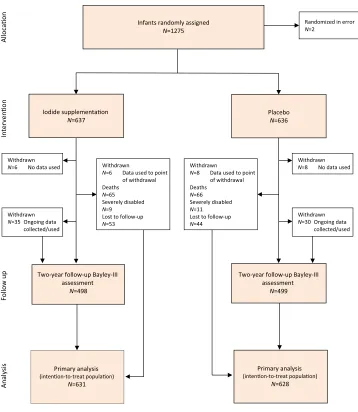
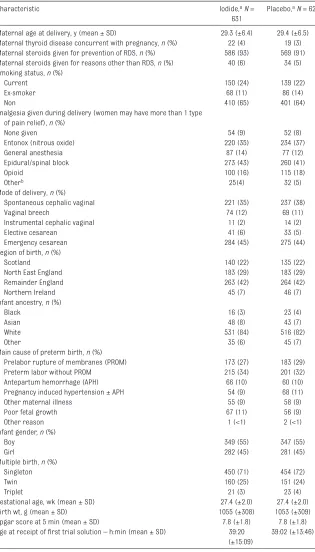
Between March 2010 and December 2012, 1275 infants were enrolled from 21 hospitals. Two infants were randomly assigned in error, and 14 parents withdrew consent for their infant’s data to be used (Fig 1). Bayley-III assessments were available for 498/631 (79%) iodide and 499/628 (79%) placebo-supplemented infants (Fig 1). Limited follow-up data were available for an additional 59/631 (9%) iodide and 48/628 (8%) placebo-supplemented infants. At baseline, infant/maternal characteristics were very similar (Table 1).
Sixty-five (65/631, 10%) infants from the iodide group and 66 (66/628, 11%) infants from the placebo group died between randomization and the 2-year follow-up. The main causes of death in the intervention phase were necrotizing enterocolitis (31% in each group), followed by infection (iodide group 23%, placebo 20%; Supplemental Table 5). During the neonatal period, 11 infants were treated with levothyroxine for variable durations and variable dosages (9 in the iodide arm, 2 in the placebo) and received a working clinical diagnosis of hypothyroidism. At 2 years of age, 13 infants (7 from the original 11, and 6 additional
infants) were receiving levothyroxine (8 iodide and 5 placebo); no infant was reported to have thyroid toxicity.
outcomes
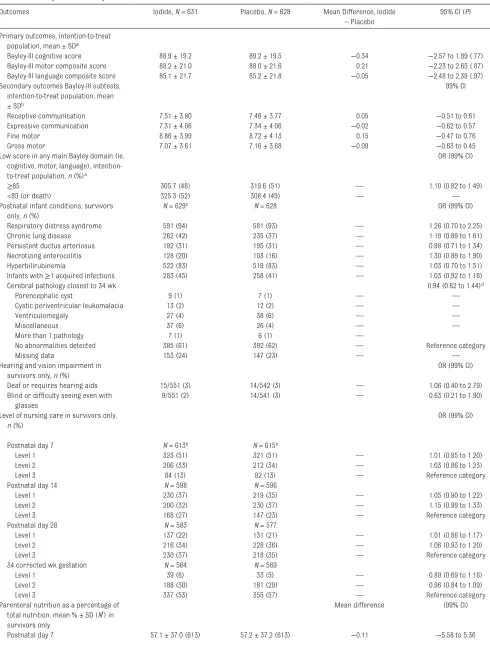
There was no significant difference between groups in the main domains of the Bayley-III: mean difference in cognitive score, −0.34, 95% CI −2.57 to 1.89; in motor composite score, 0.21, 95% CI −2.23 to 2.65; and in language composite score, −0.05, 95% CI −2.48 to 2.39 (Table 2). There were no differences when the analyses were repeated for survivors, either unadjusted or adjusted (Supplemental Tables 6–10). Overall, the frequency of postnatal
conditions was similar between the groups. The numbers of infants at each level of nursing care, the
amount of parenteral nutrition (as a percentage of the total nutrition) at each postnatal measurement day,
and the prescribed drug usage were the same in the iodide and placebo-supplemented groups (Table 2, Supplemental Table 11).
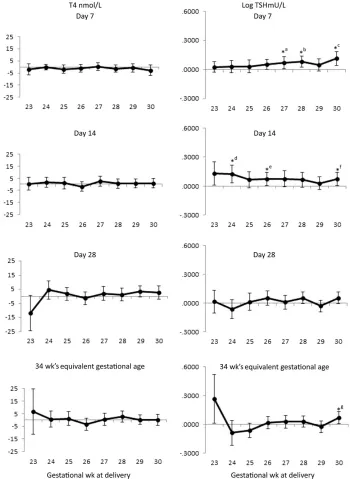
There were no significant differences between levels of T4 or TBG (Fig 2, Supplemental Fig 4). Levels of TSH were generally slightly higher in the iodide arm, with significant differences evident at postnatal days 7 and 14 (Fig 2).
Prespecified subgroup analysis
The differences in mean Bayley-III scores between the iodide and placebo groups did not differ appreciably by gestational age-group or maternal thyroid disease status (Supplemental Fig 5); nor by neonatal illness, which was approximated by using the level of nursing care (Supplemental Figs 6 and 7). For the hypothyroxinemic subgroup (n = 288), there was weak evidence of a treatment effect, which resulted in treated hypothyroxinemic infants having similar Bayley-III scores to euthyroid infants (Supplemental Table 12). A test of interaction between the hypothyroxinemic and euthyroid groups was significant at the 5% level for the Language Composite Score and its subtest score Receptive Communication (Fig 3).
adverse events
There were no suspected unexpected serious adverse reactions (SUSARs) reported during the trial. Sixty adverse events were reported for the iodide group and 28 for the placebo group. Because some UK newborn screening laboratories instigate follow-up tests at TSH levels ≥6 mU/L, we classified this level as an adverse event to ensure that these infants were investigated quickly by the local unit. The highest TSH level recorded was an isolated value of 34 mU/L; such mildly raised TSHs were not considered clinically as an adverse event (Supplemental Table 13).
Table 1 Infant and Maternal Baseline Characteristics
Characteristic Iodide, aN =
631
Placebo, aN = 628
Maternal age at delivery, y (mean ± SD) 29.3 (±6.4) 29.4 (±6.5)
Maternal thyroid disease concurrent with pregnancy, n (%) 22 (4) 19 (3) Maternal steroids given for prevention of RDS, n (%) 586 (93) 569 (91) Maternal steroids given for reasons other than RDS, n (%) 40 (6) 34 (5) Smoking status, n (%)
Current 150 (24) 139 (22)
Ex-smoker 68 (11) 86 (14)
Non 410 (65) 401 (64)
Analgesia given during delivery (women may have more than 1 type of pain relief), n (%)
None given 54 (9) 52 (8)
Entonox (nitrous oxide) 220 (35) 234 (37)
General anesthesia 87 (14) 77 (12)
Epidural/spinal block 273 (43) 260 (41)
Opioid 100 (16) 115 (18)
Otherb 25(4) 32 (5)
Mode of delivery, n (%)
Spontaneous cephalic vaginal 221 (35) 237 (38)
Vaginal breech 74 (12) 69 (11)
Instrumental cephalic vaginal 11 (2) 14 (2)
Elective cesarean 41 (6) 33 (5)
Emergency cesarean 284 (45) 275 (44)
Region of birth, n (%)
Scotland 140 (22) 135 (22)
North East England 183 (29) 183 (29)
Remainder England 263 (42) 264 (42)
Northern Ireland 45 (7) 46 (7)
Infant ancestry, n (%)
Black 16 (3) 23 (4)
Asian 48 (8) 43 (7)
White 531 (84) 516 (82)
Other 35 (6) 45 (7)
Main cause of preterm birth, n (%)
Prelabor rupture of membranes (PROM) 173 (27) 183 (29)
Preterm labor without PROM 215 (34) 201 (32)
Antepartum hemorrhage (APH) 66 (10) 60 (10)
Pregnancy induced hypertension ± APH 54 (9) 68 (11)
Other maternal illness 55 (9) 58 (9)
Poor fetal growth 67 (11) 56 (9)
Other reason 1 (<1) 2 (<1)
Infant gender, n (%)
Boy 349 (55) 347 (55)
Girl 282 (45) 281 (45)
Multiple birth, n (%)
Singleton 450 (71) 454 (72)
Twin 160 (25) 151 (24)
Triplet 21 (3) 23 (4)
Gestational age, wk (mean ± SD) 27.4 (±2.0) 27.4 (±2.0)
Birth wt, g (mean ± SD) 1055 (±308) 1053 (±309)
Apgar score at 5 min (mean ± SD) 7.8 (±1.8) 7.8 (±1.8)
Age at receipt of first trial solution – h:min (mean ± SD) 39:20 (±15:09)
39:02 (±13:46)
8 infants from the placebo group and 6 infants from the iodide group were withdrawn from the trial by their parents who would not allow their data to be used (see Fig 1). Percentages only add to 100% when there are no missing data. There were no significant differences between the groups for any variables. APH, antepartum hemorrhage; PROM, prelabor rupture of membranes; RDS, respiratory distress syndrome.
Table 2 Primary and Secondary Outcome
Outcomes Iodide, N = 631 Placebo, N = 628 Mean Difference, Iodide
– Placebo
95% CI (P)
Primary outcomes, intention-to-treat population, mean ± SDa
Bayley-III cognitive score 88.9 ± 19.2 89.2 ± 19.5 −0.34 −2.57 to 1.89 (.77)
Bayley-III motor composite score 88.2 ± 21.0 88.0 ± 21.6 0.21 −2.23 to 2.65 (.87)
Bayley-III language composite score 85.1 ± 21.7 85.2 ± 21.8 −0.05 −2.48 to 2.39 (.97)
Secondary outcomes Bayley-III subtests, intention-to-treat population, mean ± SDb
99% CI
Receptive communication 7.51 ± 3.80 7.46 ± 3.77 0.05 −0.51 to 0.61
Expressive communication 7.31 ± 4.06 7.34 ± 4.06 −0.02 −0.62 to 0.57
Fine motor 8.86 ± 3.99 8.72 ± 4.13 0.15 −0.47 to 0.76
Gross motor 7.07 ± 3.61 7.16 ± 3.68 −0.09 −0.63 to 0.45
Low score in any main Bayley domain (ie, cognitive, motor, language), intention-to-treat population, n (%)a
OR (99% CI)
≥85 305.7 (48) 319.6 (51) — 1.10 (0.82 to 1.49)
<85 (or death) 325.3 (52) 308.4 (49) — —
Postnatal infant conditions, survivors only, n (%)
N = 629c N = 628 OR (99% CI)
Respiratory distress syndrome 591 (94) 581 (93) — 1.26 (0.70 to 2.25)
Chronic lung disease 262 (42) 235 (37) — 1.19 (0.89 to 1.61)
Persistent ductus arteriosus 192 (31) 195 (31) — 0.98 (0.71 to 1.34)
Necrotizing enterocolitis 128 (20) 103 (16) — 1.30 (0.89 to 1.90)
Hyperbilirubinemia 522 (83) 519 (83) — 1.03 (0.70 to 1.51)
Infants with ≥1 acquired infections 283 (45) 258 (41) — 1.03 (0.92 to 1.16)
Cerebral pathology closest to 34 wk 0.94 (0.62 to 1.44)d
Porencephalic cyst 9 (1) 7 (1) — —
Cystic periventricular leukomalacia 13 (2) 12 (2) — —
Ventriculomegaly 27 (4) 38 (6) — —
Miscellaneous 37 (6) 26 (4) — —
More than 1 pathology 7 (1) 6 (1) —
No abnormalities detected 385 (61) 392 (62) — Reference category
Missing data 153 (24) 147 (23) — —
Hearing and vision impairment in survivors only, n (%)
OR (99% CI)
Deaf or requires hearing aids 15/551 (3) 14/542 (3) — 1.06 (0.40 to 2.79)
Blind or difficulty seeing even with glasses
9/551 (2) 14/541 (3) — 0.63 (0.21 to 1.90)
Level of nursing care in survivors only, n (%)
OR (99% CI)
Postnatal day 7 N = 613e N = 615e
Level 1 323 (51) 321 (51) — 1.01 (0.85 to 1.20)
Level 2 206 (33) 212 (34) — 1.03 (0.86 to 1.23)
Level 3 84 (13) 82 (13) — Reference category
Postnatal day 14 N = 598 N = 596
Level 1 230 (37) 219 (35) — 1.05 (0.90 to 1.22)
Level 2 200 (32) 230 (37) — 1.15 (0.99 to 1.33)
Level 3 168 (27) 147 (23) — Reference category
Postnatal day 28 N = 583 N = 577
Level 1 137 (22) 131 (21) — 1.01 (0.86 to 1.17)
Level 2 216 (34) 228 (36) — 1.06 (0.93 to 1.20)
Level 3 230 (37) 218 (35) — Reference category
34 corrected wk gestation N = 564 N = 569
Level 1 39 (6) 33 (5) — 0.89 (0.69 to 1.16)
Level 2 188 (30) 181 (29) — 0.96 (0.84 to 1.09)
Level 3 337 (53) 355 (57) — Reference category
Parenteral nutrition as a percentage of total nutrition, mean % ± SD (Nf) in
survivors only
Mean difference (99% CI)
discussion
The evidence from this large pragmatic trial reveals no overall benefit of iodide supplementation on neurodevelopment, measured at 2 years, for preterm infants. The iodide supplemented group had slightly higher levels of TSH (but not T4 or TBG) than the placebo group. The trial reveals no adverse consequences associated with iodide supplementation at 30 μg/kg per day.
The results of the trial were unexpected and do not agree with the evidence from observational studies. The impetus for this trial was the accumulating evidence from observational studies that hypothyroxinemia is associated with compromised neurodevelopment.15–20 In
response to this evidence, some researchers explored the use of treatment with thyroxine, 23, 24
but there were insufficient data to determine whether treatment was beneficial. Only 1 study of thyroxine supplementation in preterm infants included long-term neurodevelopmental outcome and the results were equivocal.23
In that study, infants receiving T4 supplementation (compared with placebo) scored 18 points higher aged 2 years on the Bayley-II cognitive component, but only if they were <27 weeks’ gestation; supplemented infants born ≥27 weeks scored 10 points lower than nonsupplemented infants. Subsequent follow-up at 5.725 and
10 years26 confirmed these findings.
Despite the equivocal results, a recent survey indicated that clinical treatment with thyroxine has increased 2.6-fold in neonates born <27 weeks’ gestation.27
Continuing clinical interest in hypothyroxinemia led to a phase 1 placebo-controlled trial of thyroxine with triiodothyronine therapy.24
That trial revealed changes in T4 with continuous supplement of low-dose thyroxine over 42 days, but no benefit of supplementation at 3 years of age in Bayley-III cognitive score, albeit the study included very few infants.28 In our trial, the
iodide arm revealed no difference in Bayley-III scores between infants classified as hypothyroxinemic and euthyroid, whereas in the placebo arm, the hypothyroxinemic group performed worse on the Bayley-III than the euthyroid group, especially in the language domain. This result suggests that hypothyroxinemia may not simply be an epiphenomenon of nonthyroidal illness. The results also suggest that iodide supplementation alone, at 30 μg/kg per day, without the addition of T4 replacement therapy, can mitigate the adverse consequences of hypothyroxinemia. This is important because T4 replacement therapy may be harmful if it is given to infants who do not require it.23
Explanation of the neutral impact of iodide supplementation that we observe is hindered by the lack of iodide balance data, especially urinary iodide excretion. We
considered monitoring urinary iodide during the active phase of the trial but concluded that the collection, storage, transport, and analysis of these data would have been prohibitively costly. Instead, we relied upon the evidence base, which suggests that preterm infants are vulnerable to iodide deficiency while on parenteral nutrition, 7, 8 breast
and formula milk provide highly variable amounts of iodide, 29 drugs
and supplements typically given to neonates contain miniscule amounts of iodide, 8 and the UK population is
mildly iodide deficient, 30, 31 which
exaggerates thyroid dysfunction. The neutral effect of this trial has at least 3 possible explanations: first, the placebo infants received iodide from hitherto unknown iodine sources; second, the level of iodide supplementation was too low; and thirdly, the Bayley-III is insufficiently sensitive. We do not believe that the infants in the placebo group were exposed to additional iodide. There are only 2 main sources of extraneous iodide that neonates are routinely exposed: topical iodide containing skin cleansers and variable quantities of free iodide from exposure to iodinated contrast media.32 Any infant exposed to
these sources during the I2S2 trial was immediately withdrawn from trial solutions. A study in 201233
reported that parenteral nutrition contained almost no iodine and, with no evidence to the contrary, 1 to 3 μg/ kg per day8 remains the best estimate
of likely intake of the placebo group.
Outcomes Iodide, N = 631 Placebo, N = 628 Mean Difference, Iodide
– Placebo
95% CI (P)
Postnatal day 14 23.9 ± 37.5 (597) 24.0 ± 37.0 (595) −0.11 −5.68 to 5.46
Postnatal day 28 13.5 ± 31.0 (575) 13.2 ± 30.6 (575) 0.26 −4.42 to 4.95
34 corrected wk gestation 8.8 ± 26.1 (558) 8.4 ± 24.9 (565) 0.38 −3.55 to 4.30
a Intention-to-treat population includes deaths and severely disabled infants, which were coded 55 for the cognitive score, 47 for the language composite score, and 46 for the motor
composite score. Missing outcomes for losses to follow-up and for infants who were withdrawn but allowed their data to be used were imputed.
b In the 4 Bayley-III subtest scores, deaths were scored as 1 or 0, reflecting their minimum scores. c Two infants had no postnatal data collection forms.
d The OR was any cerebral pathology compared with no cerebral pathology. eN varies due to deaths or to infant withdrawals.
The recommended level of iodide intake of 30 to 40 μg/kg per day for preterm infants is based on balance data for healthy preterm infants at around 1 month of age.7 It is
conceivable that the trial supplement of 30 μg/kg per day is too low an amount for sick, preterm neonates receiving parenteral nutrition, whose immature physiology may require
higher amounts of nutrients relative to the term infant. The extra nutrient requirement of the extreme preterm infant has already been shown for other ions, where the fractional urinary excretion is high in the most extreme preterm infants, but with maturation of the kidney this declines.14 It is also possible that
30 μg/kg per day is too low for a
mild-to-moderately iodine deficient population such as the United Kingdom. Future studies, such as the meticulous iodine balance study in term infants by Dold et al, 34 are
needed which examine the physiology of iodide metabolism in the
developing fetus and preterm infant. Finally, the use of the Bayley-III scales as the primary outcome may have
FiGuRe 2
Differences in mean levels of T4 and log TSH between iodide and placebo groups by gestation at delivery and day of blood sampling. Error bars 2 SEs. *aP = .03; *bP = .007; *cP = .002; *dP = .011; *eP = .035; *fP = .046; *gP = .033. Negative numbers indicate that the iodide group had lower levels of T4 or
contributed to the neutral findings. The Bayley-III is a test of global neurodevelopment, and it is possible that more targeted developmental tests incorporating, for example, visual acuity or autobiographical memory performance35 may, in the
future, identify differences between the groups.
Although it is not normally
appropriate to investigate subgroup variables that could be affected by the trial intervention, we felt it was important to do so on this occasion and specified a priori and in our statistical analysis plan our intention. The only known human role for iodine is for the production of thyroid
hormones, and we hypothesized that the iodide intervention (but not the placebo) would positively affect the Bayley score via the intermediary of (increased) thyroid hormone with a concomitant decrease in the incidence of hypothyroxinemia. There is no evidence or plausible reason why iodide would have a direct or independent effect on the Bayley score, and other factors which would contribute an independent effect on the Bayley score would be equally distributed between the arms of the trial due to random allocation. Thus, the typical confounders of interpretation are mitigated. This trial has 3 findings. Iodide supplementation to all infants born <31 weeks’ gestation confers no benefit to neurodevelopment measured by the Bayley-III scales at 2 years of age. Giving iodide at 30
μg/kg per day was associated with no adverse consequences. Finally, there is only weak evidence that the subgroup of hypothyroxinemic infants gained benefit from iodide supplementation in 1 of 3 main Bayley-III domains. The gain was small and the clinical relevance of a gain of this magnitude is uncertain. But, if transient hypothyroxinemia is considered an important clinical entity, iodide supplementation of infants with low T4 levels may provide a pragmatic solution to mitigating the condition. The alternative is to supplement only those infants who are hypothyroxinemic; however, identifying infants with low T4 levels contemporaneously remains challenging.36
acKnoWledGMenTs
NHS staff in receiving hospitals: In addition to the recruiting hospitals, a great many hospitals and NHS staff received I2S2 trial infants for temporary or permanent continuing care. Their help was invaluable and contributed appreciably to the
FiGuRe 3
smooth running and success of the trial.
We thank the parents and children who participated in this trial and the many NHS staff in UK hospitals who recruited, managed, or received infants under the trial protocol.
aPPendix
study oversight
The trial was designed by the I2S2 coinvestigators, and oversight was provided by an independent Trial Steering Committee and independent Data Monitoring Committee. Data were collected by I2S2-trained nurses and entered and verified in OpenClinica by experienced data handlers in National Perinatal Epidemiology Unit, Clinical Trials Unit. Trial solutions were manufactured by Torbay PMU, South Devon Healthcare NHS Foundation Trust with funds from the study; the company had no input to the trial design, conduct, or analysis. The manuscript was written by the authors, who vouch for the accuracy and completeness of this report and for the fidelity of the report to the study protocol. A full trial protocol is available at www. npeu. ox. ac. uk/ i2s2.
i2s2 collaborative Group
I2S2 Trial Team
Trial staff University of Dundee: Fiona Williams, Simon Ogston, Robert Hume, Jennifer Watson, Deirdre Plews, Patricia Black, and Peter Willatts.
Trial staff University of
Oxford: Edmund Juszczak, Ursula Bowler, Kayleigh Stanbury (née Morgan), Andrew King, Sarah Chamberlain, Stella Khenia, and Michelle Kumin.
Trial staff University College London: Peter Brocklehurst.
Trial Collaborators University of Amsterdam, Laboratory of Endocrinology, Academisch Medisch Centrum: Anita Boelen and Marja van Veen.
I2S2 local PIs: Mary Ledwidge, Altnagelvin Area Hospital, Londonderry; Clifford Mayes, Royal Maternity Hospital, Belfast; Julie Nycyk, Birmingham City Hospital; Jaideep Singh, Birmingham Heartlands Hospital; Andrew Ewer, Birmingham Women’s Hospital; Prakash Satodia, University Hospital Coventry; John McIntyre, Derbyshire Children’s Hospital; Mohammed Ibrahim, Ninewells Hospital and Medical School, Dundee; Lesley Jackson, the former Southern General Hospital, Glasgow; Andrew Powls, Princess Royal Infirmary, Glasgow; Sheena Kinmond, University Hospital Crosshouse, Ayrshire; Andrew Currie, Leicester Royal Infirmary; Mithilesh Lal, James Cook University Hospital, Middlesbrough; Nicholas Embleton, Royal Victoria Infirmary, Newcastle; Samir Gupta, University Hospital of North Tees, Stockton-On-Tees; Chidambara Harikumar, University Hospital of North Tees, Stockton-On-Tees; Dulip Jayasinghe, City Hospital, Nottingham; Anneli Wynn-Davies, City Hospital, Nottingham; Jon Dorling, City Hospital, Nottingham; Steve Wardle, Queen’s Medical Centre, Nottingham; Nicholas Mann, Royal Berkshire Hospital, Reading; Greg Boden, Royal Berkshire Hospital, Reading; Alan Gibson, Jessop Wing, Sheffield; Lorna Gillespie, Sunderland Royal Hospital; and Caroline Delahunty, Wishaw General Hospital.
I2S2 nursing staff: Julie Brown, Altnagelvin Area Hospital, Londonderry; Nicola McMonagle, Altnagelvin Area Hospital,
Londonderry; Patrick Lawlor, Royal Maternity Hospital, Belfast; Fran Wootton, Birmingham City Hospital; Susan Whitehouse, Birmingham City Hospital; Lara Alamad, NIHR Clinical Research Network West Midlands;
Jane Lovatt Birmingham Heartlands Hospital and NIHR Clinical Research Network West Midlands; Heather Barrow, Birmingham Women’s Hospital; Michael Dixie, Birmingham Women’s Hospital; Rachel Jackson, Birmingham Women’s Hospital; Elizabeth Simcox, Birmingham Women’s Hospital; Sarah Reynolds, University Hospital Coventry; Sue Dale, University Hospital Coventry; Vanessa Unsworth, Derbyshire Children’s Hospital; Nicola Watson, Derbyshire Children’s Hospital; Coral Smith, Derbyshire Children’s Hospital; Ruth Ballington, Derbyshire Children’s Hospital; Deirdre Plews, Ninewells Hospital and Medical School, Dundee; Lorna McKay the former Southern General Hospital and Princess Royal Hospital, Glasgow; Lorraine Herbert, University Hospital Crosshouse, Ayrshire; Liz Macrae, University Hospital Crosshouse, Ayrshire; Marie Hubbard, Leicester Royal Infirmary; Amanda Forster, James Cook University Hospital, Middlesbrough; Nicola Prosser, James Cook University Hospital, Middlesbrough; Tracy Davies, James Cook University Hospital, Middlesbrough; Steve Williamson, Royal Victoria Infirmary, Newcastle; Wendy Cheadle, University Hospital of North Tees, Stockton-On-Tees; Helen Navara, City Hospital and Queen’s Medical Centre, Nottingham; Yvonne Hooton, City Hospital and Queen’s Medical Centre, Nottingham; Sue Hallett, Royal Berkshire
Hospital, Reading; Julie Cook, Jessop Wing, Sheffield; Olwyn Major, Sunderland Royal Hospital; and Avril McManus, Wishaw General Hospital.
Trial Steering Committee
independent members: Jane Norman
(Chair) and James Boardman, University of Edinburgh; Joanne Rovet, University of Toronto; Fiona Douglas, University of Dundee; Sam Richmond, † Sunderland Royal
members: Fiona Williams, Robert Hume, University of Dundee; Edmund Juszczak, University of Oxford; Peter Brocklehurst, University College London. Observers: Ursula Bowler, Kayleigh Stanbury (née Morgan), University of Oxford.
Data Monitoring Committee: Henry Halliday (Chair), Belfast; Christopher Kelnar and Gordon Murray,
University of Edinburgh; Simon Ogston, University of Dundee.
†Sam Richmond died during the trial
on March 10, 2013.
ReFeRences
1. Williams FLR, Mires GJ, Barnett C, et al; Scottish Preterm Thyroid Group. Transient hypothyroxinaemia in preterm infants: the role of cord sera thyroid hormone levels adjusted for prenatal and intrapartum factors. J Clin Endocrinol Metab. 2005;90(8):4599–4606
2. Vulsma T, Gons MH, de Vijlder JJM. Maternal-fetal transfer of thyroxine in congenital hypothyroidism due to a total organification defect or thyroid agenesis. N Engl J Med. 1989;321(1):13–16
3. Thorpe-Beeston JG, Nicolaides KH, Felton CV, Butler J, McGregor AM. Maturation of the secretion of thyroid hormone and thyroid-stimulating hormone in the fetus. N Engl J Med. 1991;324(8):532–536
4. Hume R, Simpson J, Delahunty C, et al; Scottish Preterm Thyroid Group. Human fetal and cord serum thyroid hormones: developmental trends and interrelationships.
J Clin Endocrinol Metab. 2004;89(8):4097–4103
5. Pavelka S, Kopecký P, Bendlová B, et al. Tissue metabolism and plasma levels of thyroid hormones in critically ill
very premature infants. Pediatr Res. 1997;42(6):812–818
6. Simpson J, Williams FLR, Delahunty C, et al; Scottish Preterm Thyroid Group. Serum thyroid hormones in preterm infants and relationships to indices of severity of intercurrent illness. J Clin Endocrinol Metab. 2005;90(3):1271–1279
7. Ares S, Escobar-Morreale HF, Quero J, et al. Neonatal hypothyroxinemia: effects of iodine intake and premature birth. J Clin Endocrinol Metab. 1997;82(6):1704–1712
8. Ibrahim M, de Escobar GM, Visser TJ, et al. Iodine deficiency associated with parenteral nutrition in extreme preterm infants. Arch Dis Child Fetal
Neonatal Ed. 2003;88(1):F56–F57
9. Agostoni C, Buonocore G, Carnielli VP, et al; ESPGHAN Committee on Nutrition. Enteral nutrient supply for preterm infants: commentary from the European Society of Paediatric Gastroenterology, Hepatology and Nutrition Committee on Nutrition.
J Pediatr Gastroenterol Nutr. 2010;50(1):85–91
10. Greene HL, Hambidge KM, Schanler R, Tsang RC. Guidelines for the use
of vitamins, trace elements, calcium, magnesium, and phosphorus in infants and children receiving total parenteral nutrition: report of the Subcommittee on Pediatric Parenteral Nutrient Requirements from the Committee on Clinical Practice Issues of the American Society for Clinical Nutrition.
Am J Clin Nutr. 1988;48(5):1324–1342
11. Koletzko B, Goulet O, Hunt J, Krohn K, Shamir R; Parenteral Nutrition Guidelines Working Group; European Society for Clinical Nutrition and Metabolism; European Society of Paediatric Gastroenterology, Hepatology and Nutrition (ESPGHAN); European Society of Paediatric Research (ESPR). 1. Guidelines on paediatric parenteral nutrition of the European Society of Paediatric Gastroenterology, Hepatology and Nutrition (ESPGHAN) and the European Society for Clinical Nutrition and Metabolism (ESPEN), supported by the European Society of Paediatric Research (ESPR). J Pediatr
Gastroenterol Nutr. 2005;41(suppl
2):S1–S87
12. van den Hove MF, Beckers C, Devlieger H, de Zegher F, De Nayer P. Hormone synthesis and storage in the thyroid of human preterm and term newborns:
abbReviaTions
CI: confidence interval OR: odds ratio T4: thyroxine
TBG: thyroid-binding globulin TSH: thyrotropin
the data collection, and critically reviewed the manuscript; Dr Boelen coordinated and supervised the analysis of blood spot cards and critically reviewed the manuscript; and all authors approved the final manuscript submitted.
This trial has been registered at www. clinicaltrials. gov (identifier NCT00638092).
doi: 10.1542/peds.2016-3703 Accepted for publication Feb 23, 2017
Address correspondence to Fiona L.R. Williams, PhD, Division of Population Health Sciences, Ninewells Hospital and Medical School, University of Dundee, Dundee DD2 4BF, United Kingdom. E-mail: [email protected]
PEDIATRICS (ISSN Numbers: Print, 0031-4005; Online, 1098-4275). Copyright © 2017 by the American Academy of Pediatrics
Financial disclosuRe: The authors have indicated they have no financial relationships relevant to this article to disclose.
FundinG: Funded by Medical Research Council (UK) and managed by NIHR on behalf of the MRC-NIHR partnership.
effect of thyroxine treatment.
Biochimie. 1999;81(5):563–570
13. l’Allemand D, Grüters A, Beyer P, Weber B. Iodine in contrast agents and skin disinfectants is the major cause for hypothyroidism in premature infants during intensive care. Horm Res. 1987;28(1):42–49
14. Delgado MM, Rohatgi R, Khan S, Holzman IR, Satlin LM. Sodium and potassium clearances by the maturing kidney: clinical-molecular correlates.
Pediatr Nephrol. 2003;18(8):759–767
15. Reuss ML, Paneth N, Pinto-Martin JA, Lorenz JM, Susser M. The relation of transient hypothyroxinemia in preterm infants to neurologic development at two years of age. N Engl J Med. 1996;334(13):821–827
16. Lucas A, Rennie J, Baker BA, Morley R. Low plasma triiodothyronine concentrations and outcome in preterm infants. Arch Dis Child. 1988;63(10):1201–1206
17. Meijer WJ, Verloove-Vanhorick SP, Brand R, van den Brande JL. Transient hypothyroxinaemia associated with developmental delay in very preterm infants. Arch Dis Child. 1992;67(7):944–947
18. Den Ouden AL, Kok JH, Verkerk PH, Brand R, Verloove-Vanhorick SP. The relation between neonatal thyroxine levels and neurodevelopmental outcome at age 5 and 9 years in a national cohort of very preterm and/or very low birth weight infants. Pediatr Res. 1996;39(1):142–145
19. Simic N, Asztalos EV, Rovet J. Impact of neonatal thyroid hormone insufficiency and medical morbidity on infant neurodevelopment and attention following preterm birth. Thyroid. 2009;19(4):395–401
20. Delahunty C, Falconer S, Hume R, et al; Scottish Preterm Thyroid Group. Levels of neonatal thyroid hormone in preterm infants and neurodevelopmental outcome at 5 1/2 years: millennium cohort
study. J Clin Endocrinol Metab. 2010;95(11):4898–4908 21. Williams F, Hume R, Ogston S,
Brocklehurst P, Morgan K, Juszczak E; I2S2 Team. A summary of the iodine supplementation study protocol (I2S2): a UK multicentre randomised controlled trial in preterm infants.
Neonatology. 2014;105(4):282–289
22. Bayley N. Bayley Scales of Infant and Toddler Development (Bayley-III). 3rd ed. San Antonio, TX: Pearson; 2005 23. van Wassenaer AG, Kok JH, de Vijlder
JJM, et al. Effects of thyroxine supplementation on neurologic development in infants born at less than 30 weeks’ gestation. N Engl J Med. 1997;336(1):21–26
24. La Gamma EF, van Wassenaer AG, Ares S, et al. Phase 1 trial of 4 thyroid hormone regimens for transient hypothyroxinemia in neonates of <28 weeks’ gestation. Pediatrics. 2009;124(2). Available at: www. pediatrics. org/ cgi/ content/ full/ 124/ 2/ e258
25. Briët JM, van Wassenaer AG, Dekker FW, de Vijlder JJM, van Baar A, Kok JH. Neonatal thyroxine supplementation in very preterm children: developmental outcome evaluated at early school age.
Pediatrics. 2001;107(4):712–718 26. van Wassenaer AG, Westera J,
Houtzager BA, Kok JH. Ten-year follow-up of children born at <30 weeks’ gestational age supplemented with thyroxine in the neonatal period in a randomized, controlled trial.
Pediatrics. 2005;116(5). Available at: www. pediatrics. org/ cgi/ content/ full/ 116/ 5/ e613
27. Linn M, Yoder BA, Clark RH. Increasing supplemental thyroid hormone use among premature infants born at 23 to 32 weeks’ gestation. Am J Perinatol. 2010;27(9):731–735
28. van Wassenaer-Leemhuis A, Ares S, Golombek S, et al. Thyroid hormone supplementation in preterm infants born before 28 weeks gestational age and neurodevelopmental
outcome at age 36 months. Thyroid. 2014;24(7):1162–1169
29. Hume R, Lang K, Williams FLR. Iodine content of standard formula and specialized enteral preparations. In: Preedy VR, Burrow GN, Watson RR, eds.
Comprehensive Handbook of Iodine: Nutritional, Biochemical, Pathological
and Therapeutic Aspects. Cambridge,
MA: Academic Press; 2009 30. Vanderpump MPJ, Lazarus JH,
Smyth PP, et al; British Thyroid Association UK Iodine Survey Group. Iodine status of UK schoolgirls: a cross-sectional survey. Lancet. 2011;377(9782):2007–2012
31. Bath SC, Steer CD, Golding J, Emmett P, Rayman MP. Effect of inadequate iodine status in UK pregnant women on cognitive outcomes in their children: results from the Avon Longitudinal Study of Parents and Children (ALSPAC). Lancet. 2013;382(9889):331–337
32. Ahmet A, Lawson ML, Babyn P, Tricco AC. Hypothyroidism in neonates post-iodinated contrast media: a systematic review. Acta Paediatr. 2009;98(10):1568–1574
33. Belfort MB, Pearce EN, Braverman LE, He X, Brown RS. Low iodine content in the diets of hospitalized preterm infants. J Clin Endocrinol Metab. 2012;97(4):E632–E636
34. Dold S, Zimmermann MB, Baumgartner J, et al. A dose-response crossover iodine balance study to determine iodine requirements in early infancy. Am J Clin Nutr. 2016;104(3):620–628
35. Willoughby KA, McAndrews MP, Rovet J. Effects of early thyroid hormone deficiency on children’s autobiographical memory
performance. J Int Neuropsychol Soc. 2013;19(4):419–429
DOI: 10.1542/peds.2016-3703 originally published online April 14, 2017;
2017;139;
Pediatrics
the I2S2 Team
Stanbury, Peter Willatts, Anita Boelen, Edmund Juszczak, Peter Brocklehurst and for
Fiona L.R. Williams, Simon Ogston, Robert Hume, Jennifer Watson, Kayleigh
Years: An RCT
Supplemental Iodide for Preterm Infants and Developmental Outcomes at 2
Services
Updated Information &
http://pediatrics.aappublications.org/content/139/5/e20163703
including high resolution figures, can be found at:
References
http://pediatrics.aappublications.org/content/139/5/e20163703#BIBL
This article cites 34 articles, 8 of which you can access for free at:
Subspecialty Collections
http://www.aappublications.org/cgi/collection/neonatology_sub
Neonatology
sub
http://www.aappublications.org/cgi/collection/fetus:newborn_infant_
Fetus/Newborn Infant
following collection(s):
This article, along with others on similar topics, appears in the
Permissions & Licensing
http://www.aappublications.org/site/misc/Permissions.xhtml
in its entirety can be found online at:
Information about reproducing this article in parts (figures, tables) or
Reprints
http://www.aappublications.org/site/misc/reprints.xhtml
DOI: 10.1542/peds.2016-3703 originally published online April 14, 2017;
2017;139;
Pediatrics
the I2S2 Team
Stanbury, Peter Willatts, Anita Boelen, Edmund Juszczak, Peter Brocklehurst and for
Fiona L.R. Williams, Simon Ogston, Robert Hume, Jennifer Watson, Kayleigh
Years: An RCT
Supplemental Iodide for Preterm Infants and Developmental Outcomes at 2
http://pediatrics.aappublications.org/content/139/5/e20163703
located on the World Wide Web at:
The online version of this article, along with updated information and services, is
http://pediatrics.aappublications.org/content/suppl/2017/04/13/peds.2016-3703.DCSupplemental
Data Supplement at:
by the American Academy of Pediatrics. All rights reserved. Print ISSN: 1073-0397.