The Usefulness and
Efficacy of Linear
Programming Models as
Farm Management Tools
Evelyn Hurley
1
Guy Trafford
2,4
Elizabeth Dooley
3,4
Warren Anderson
3
July 2013
1 Consultant, Palmerston North
2 Centre of Excellence in Farm Business Management,
Lincoln University
3 Centre of Excellence in Farm Business Management,
Massey University
Copyright
Copyright in this publication (including text, graphics, logos and icons) is owned by or licensed to DairyNZ Incorporated. No person may in any form or by any means use, adapt, reproduce, store, distribute, print, display, perform, publish or create derivative works from any part of this publication or commercialise any information, products or services obtained from any part of this publication without the written consent of DairyNZ Incorporated.
Disclaimer
This report was prepared solely for DairyNZ Incorporated with funding from New Zealand dairy farmers through DairyNZ and the Ministry for Primary Industries under the Primary Growth Partnership. The information contained within this report should not be taken to represent the views of DairyNZ or the Ministry for Primary Industries. While all reasonable endeavours have been made to ensure the accuracy of the investigations and the information contained in the report, OneFarm, Centre of Excellence in Farm Business
Management expressly disclaims any and all liabilities contingent or otherwise to any party other than DairyNZ
Incorporated or DairyNZ Limited that may arise from the use of the information.
Date submitted to DairyNZ: August 2013
i Centre of Excellence in Farm Business Management
The Usefulness and Efficacy of Linear Programming Models as Farm Management Tools
Executive Summary
This study evaluating the usefulness and efficacy of linear programming (LP) models, and the Grazing Systems Ltd (GSL) model in particular, was undertaken for DairyNZ by the Centre of Excellence in Farm Business Management. The GSL model was selected because it is the only LP model available for use in the farm business environment in New Zealand. Two approaches were used to evaluate the usefulness and efficacy of LP models and the GSL model as farm management tools. The first approach involved case studies with two farm consultants experienced in the use of farm management models who worked with dairy farmer clients using the GSL model. The case studies resulted in an evaluation of both LP and the GSL model. The second approach was an expert evaluation of the GSL model conducted by members of a research panel with LP experience who evaluated the GSL model against a set of LP modelling criteria they developed.
The two consultants used the GSL model differently. One consultant‟s client was familiar with the use of models and the consultant discussed results with his client as they were being generated. The other consultants‟ clients were familiar with output from other models but preferred to have the consultant do the modelling and present them with the results. This consultant did the initial modelling in the GSL model, then subsequently in a model his clients were familiar with. Each of the three clients was presented with results indicating that a change in practice would result in improved farm profitability. Two of the three clients decided to implement the changes. The other client required further analysis regarding the changes indicated by the model.
Despite the different approaches, both the consultants and their three clients said they found the information obtained from running the model interesting and useful in assisting them to make decisions about their farm systems. The study concluded that LP can provide information to assist with improving farming systems, but the LP model has to be carefully constructed and interpreted so that model users will have confidence in the answers it provides. Users who are familiar with the concepts of marginal analysis will find that LP can provide valuable information to help with improving farm systems.
ii Centre of Excellence in Farm Business Management
The Usefulness and Efficacy of Linear Programming Models as Farm Management Tools
Contents
Executive Summary ... i
1.0 Introduction ... 1
2.0 Background ... 2
2.1 Modelling in Farm Management ... 2
2.2 Linear Programming Models in Farm Management ... 4
2.3 The Grazing Systems Ltd (GSL) LP Model ... 6
3.0 Method ... 6
3.1 Briefing Sessions and Model Access ... 7
3.2 Expert Evaluation by a Research Panel ... 7
3.3 Case Studies with Consultants and their Clients ... 8
4.0 GSL Model Evaluation by the Research Panel ... 10
4.1 Instructions ... 10
4.2 Simplicity of Use ... 11
4.3 User Level ... 11
4.4 How to use the Model ... 12
4.5 Accuracy of Results... 12
4.6 Understandability ... 12
4.7 Scenarios Modelled ... 12
4.8 Modelling Risk ... 13
4.9 Suitability for Research ... 13
4.10 Black Box Access to run the Model ... 13
4.11 Conclusion ... 14
4.12 GSL Model Availability and Information ... 14
5.0 GSL Model Case Study Results ... 15
5.1 Case Study A ... 16
5.1.1 The Pre-visit Interviews ... 16
5.1.2 The Consultant’s Visits ... 16
5.1.3 The Post-visit Interviews and Consultant’s Comments ... 18
5.1.4 Consultant’s Evaluation of the GSL Model ... 20
5.2 Case Studies B and C ... 23
5.2.1 The Consultant’s Pre-visit Interview ... 23
5.2.2 The Pre-visit Modelling Process used by Consultant B ... 23
5.3 Case Study B ... 24
5.3.1 The Client Pre-visit Interview ... 24
iii Centre of Excellence in Farm Business Management
The Usefulness and Efficacy of Linear Programming Models as Farm Management Tools
5.3.3 The Post-visit Interviews and Consultant’s Comments ... 28
5.4 Case Study C ... 29
5.4.1 The Client Pre-visit Interview ... 29
5.4.2 The Consultant’s Visits ... 30
5.4.3 The Post-visit Interview and Consultant’s Comments ... 33
5.4.4 Consultant’s Evaluation of the GSL Model ... 33
6.0 Discussion ... 39
7.0 Conclusions ... 44
8.0 Acknowledgements ... 45
9.0 Bibliography and References ... 46
10.0 Appendices... 47
Appendix I: Questions asked in Interviews with Consultants and their Clients ... 47
Appendix II: Consultant A: Report to Client A ... 49
Appendix III: Consultant A: GSL Model Evaluation ... 53
Appendix IV: Consultant B: Notes on the GSL LP Model Presented to Client B ... 59
Appendix V: Consultant B: Notes on the GSL LP Model Presented to Client C ... 61
1 Centre of Excellence in Farm Business Management
The Usefulness and Efficacy of Linear Programming Models as Farm Management Tools
1.0
Introduction
DairyNZ is interested in tools that can be used by farm management consultants and their farmer clients to assist with decision making. The Centre of Excellence in Farm Business Management has conducted on-going work in the Farm Tools domain to contribute to this objective. As part of that work, this study assessed the value of Linear Programming (LP) to farm management consultants and their dairy farmer clients in identifying feasible and profitable changes to their farming systems.
LP models have been available to assist in designing improved farming systems since the late 1950s (Malcolm, 1990). Yet despite their perceived potential, their use in agriculture has been primarily limited to the development of least cost feed rations for intensive pig, poultry and feedlot farming systems. Use within the New Zealand pastoral farming sector has been limited and the technique is rarely used by farm management consultants.
This study assessed the usefulness of the Grazing Systems Ltd (GSL) model to consultants and their clients, and evaluated its robustness and efficacy in identifying optimal and feasible dairy farming systems. The GSL model was selected for this evaluation because it is the only known LP model currently in use that has been developed for farm consultancy in New Zealand. GSL model use in New Zealand dairy systems has previously been reported in Anderson and Ridler (2010a, 2010b) and Ridler, Anderson and Fraser (2010).
The following research questions were identified.
1. Can linear programming models help farm management consultants work with their dairy farmer clients to develop improved pastoral-based dairy farm systems?
2. How effective and robust is the GSL linear programme model as an aid to dairy farm management decision making?
2 Centre of Excellence in Farm Business Management
The Usefulness and Efficacy of Linear Programming Models as Farm Management Tools
2.0
Background
2.1 Modelling in Farm Management
Since farm management has been recognised as a discipline, farmers and their management advisers and consultants have used models to represent the reality of farmers‟ businesses. Cash flow and cash forecast budgets, partial budgets, capital investment budgets and feed budgets were early farm management models, which were initially carried out using pencil and paper, followed by simple calculators then early forms of computers. Farm management models were able to be readily adapted to computers, especially with the advent of spreadsheets. More sophisticated financial and biophysical computer models were later, quite quickly, developed for use in farm management decision making and research, mainly in the form of simulation models.
Malcolm (1990) noted in his review of academic literature about farm management in Australia that:
The traditional, relatively simple, farm management budgets have stood up well to tests of time because they enable the full dimensions of the problem to be brought into
consideration. Further, the computer spreadsheet has enhanced the analytical power and problem solving relevance of the traditional farm management budgets. (p. 52)
There is now comprehensive literature on the use of models in farm management research, consulting and practice (see for example McCown, 2002). In the New Zealand dairy industry, the most widely used commercial simulation models are UDDER (described in Dooley, 2012, Appendix 4) and Farmax Dairy (described in Dooley, 2012, Appendix 3). These simulation models were primarily designed to generate a range of scenarios enabling practitioners to evaluate a range of alternative systems and select those that best fitted their objectives. This is in contrast to the role of LP models which find the system with the optimum use of resources, usually with the objective of maximising financial returns or minimising costs. It should be noted that the UDDER model has optimisation capabilities as well as simulation capabilities.
Prior to the research in this study being undertaken, a brief search of recent literature was undertaken to identify any studies evaluating models for use by consultants and their clients, particularly where LP and simulation models were being compared, and to help provide criteria against which models might be evaluated. While no such comparisons were evident, some papers of relevance to this study were found
Nuthall (2011) provided a brief overview of analytical methods for farming systems. In this, he observes that.
3 Centre of Excellence in Farm Business Management
The Usefulness and Efficacy of Linear Programming Models as Farm Management Tools
Malcolm (2004, p47), reviewing the Australian context, argued that “farm models can only ever be partial representations of reality”, and that “it is incumbent on those who carry out farmmanagement analysis to get it right”. Malcolm (2004) saw the modelling analysis as the thought processes surrounding the use of modelling techniques (which were often fairly basic) rather than the use of the actual models themselves.
In the Australasian context, these two prominent researchers, Nuthall (2011) and Malcolm (2004), were not convinced of the value of models, and in particular LP models, as aids to decision-making and suggested that other avenues might be better pursued. However, the current environment is such that consultants and their technology-savvy clients are becoming more accustomed to using models. Hence, one purpose of this research was to see if LP models were likely to add to the quality of the decisions being made. When models are used, both researchers noted that these models need to be carefully constructed, use reliable data, and the results need careful
interpretation if the models are to be useful decision aids.
An entire issue of the Agricultural Systems Journal was devoted to Decision Support Systems (DSS) in 2002 and a prolific writer in this area, Bob McCown (McCown, 2002), identified the “persistent „problem of implementation‟”, which amounted to a reluctance to engage with DSS by family farms in particular. He concluded that:
Users must undergo an iterative learning and practice change process. The researchers must be prepared to be involved in, lend support to, and learn from this process – learn what farmers are learning and learn what this means for conduct of their own future activity. This is the essence of action research. (p. 216)
Janssen and van Ittersum (2007) reviewed 42 different bio-economic farm models, which were essentially defined as mathematical programming models that are variations on LP. They defined and distinguished between approaches that were “empirical versus mechanistic” models on the one hand, and “normative versus positive” on the other, with a focus on mechanistic models which were often based on LP and its variants (Janssen & van Ittersum, 2007). They strongly proposed the development of:
…a consistent and widely accepted model evaluation procedure, comprising steps of checking the correspondence with observable values, calibration and validation. (p. 624) These latter two papers serve to underline the fact that, while many academic papers have been written about the use of models in agriculture, evaluation criteria and the means to
implementation were considered lacking. To address this, McCown (2002) called for researchers4
4 Centre of Excellence in Farm Business Management
The Usefulness and Efficacy of Linear Programming Models as Farm Management Tools
2.2 Linear Programming Models in Farm Management
LP is a mathematical (algebraic) technique whereby relationships between resources and outputs in a system are described by a set of algebraic (linear) equations. Because resources are limited, output will be constrained. Defining constraints on resources is a crucial part of building an LP model. The resource and output equations are linked to one another by another equation called an “objective function” which describes the desired outcome in mathematical terms. The objective function usually represents the cost and returns of the system, and the objective described by the objective function is usually to “maximise profit”. A matrix of equations is set up and, by the mathematical process of matrix inversion, moves progressively closer to the optimum solution, which in economic terms is usually maximum profit.
The information resulting from this mathematical process includes, not only the level of resource use required to meet the objective function, but also which of the resources is constraining the system from increasing profit further (i.e. limiting resources) and by how much that profit would increase if another unit of that limiting resource became available. In mathematical terms, this value is called the marginal value product (MVP) and, in economic terms, the opportunity cost or shadow price. This information can be extremely useful for evaluating and designing farming systems. The relationships between resource use and opportunity cost are explained in more detail by Makeham and Malcolm (1993) and by the GSL model developer, Barrie Ridler (Ridler, Anderson & Fraser, 2010).
Describing a grazing system as a set of mathematical equations is not an easy task, and the diagrammatic representation of a grazed livestock production system (Figure 1) prepared by the GSL model developers (Anderson & Ridler, 2010a) does not fully reflect the model‟s complexity. The quantitative information about the relationships between the model variables is typically held by many different people. Farmers and consultants usually rely on agronomists, soil scientists and animal nutritionists to help explain the complex relationships between the essential parts of the system. However, scientists prefer to describe the relationships in more complex terms than the linear equations required by an LP model, perhaps explaining in part why simulation models are more readily accepted than LP models. And, while bank managers and accountants can search for financial information in their farm records and annual accounts, these records are often not in the format required for farm management purposes and these people are often not familiar with the form of farm information that is used in generating an objective function.
4 In this context McCown talks about researchers as those who have developed underutilised models, or in the
5 Centre of Excellence in Farm Business Management
The Usefulness and Efficacy of Linear Programming Models as Farm Management Tools
+ Nitrogen
+Irrigation
+ Crops
Timing
Responses
Costs
Environ-mental
impacts
Graze off
Graze on
Income
Convenience
Cost
Additional cost
of
additional feed
needed
$MC
Base
operating
surplus
Marginal
operating
surplus
MR-MC
Animal type
Size Liveweight
gain
Production level
Replacement rate
Losses
Longevity
Stock policy
Establish
stocking rate
Establish stock
performance
required and
resulting income
Increase
production
Increase stocking
rate
Change perform-
ance required
Additional
income from
additional
production
$MR
Feed
supply
100ha: 5,000-18,000kgDM/ha/yr
Annual Variation +/-10%Pasture
Silage
Harvest
Feed
MJME
Cost
Availability
Ease of use
Utilisation
Animal health
Environment
Revised
Feed
operating
surplus
MJME
Silages
Pasture
Maize, Crops
MJME
Cost
Import
e.g.
PKE
MJME
cost +
Concentr
ates
Meals
MJME
cost + +
Figure 1: A model representing the relationship between feed supply, feed demand and production economics in a grazed livestock production system. MJME = Megajoules of metabilisable energy; MC = Marginal cost; MR = Marginal revenue; DM = Dry matter; PKE = Palm kernal expellar. Figure reproduced from Anderson & Ridler, 2010a, p. 25.
One of the most difficult relationships to describe is grazing management because of the
6 Centre of Excellence in Farm Business Management
The Usefulness and Efficacy of Linear Programming Models as Farm Management Tools
necessary and it is only the increases in computer capacity in recent times that have enabled this to be done in a manageable timeframe.A similar complexity arises with livestock feeding (Holmes et al., 2002). The relationships linking feed intake with levels of milk production and cow bodyweight and condition, vary with the physiological status of the cow through the milking season. Many iterations are needed to model the trade-offs between production and cow condition.
These complexities and the difficulties in modelling these relationships mean that consultants and their clients have to be confident in the efficacy of such models, and need to be convinced that the model represents reality for the farm being modelled.
2.3 The Grazing Systems Ltd (GSL) LP Model
During the 1980s and 1990s, academics at Massey University realized the value of data relating to farm physical performance and sought ways to use those data as a means to improved farm performance on university and other commercial farms. The precursor to the current GSL model was developed at that time, using these data.
The current GSL model, which was constructed by Jade software, uses sophisticated programming techniques and has enhanced computational speed. The model is a multi-period (seasonal) model that assumes that coefficients, costs and constraints are known with certainty. Pasture supply constraints are specified as pasture covers through time. This GSL model can be accessed on-line from desk-top or lap top computers to aid dairy farm management decision making. The model is promoted by its primary developer, Barrie Ridler from GSL. Barrie Ridler (personal communication, 2013) believes that, through its optimising routine and MVPs, LP model output is able to help users achieve an understanding of their system that is not available from using other models.
Although this GSL model has been promulgated over recent years, general awareness of the model in the industry remains limited and the model is only accessible to the farm consulting profession within New Zealand by contacting the developers directly. However, this GSL model is the only farm management LP model in New Zealand designed for business use.
3.0 Method
7 Centre of Excellence in Farm Business Management
The Usefulness and Efficacy of Linear Programming Models as Farm Management Tools
approaches used for the expert evaluation by a research panel and the case studies are described further in the sections below.3.1 Briefing Sessions and Model Access
Consultants and members of the research team were briefed by the developer on the conceptual aspects of LP and the specific means of setting up and running the GSL model. Working examples were used to demonstrate data input, and obtaining and interpreting output from the model. Members of the evaluation team participated in the first briefing session at Massey University, together with some other interested people. Three other briefing sessions were held in different locations for the two consultants (one-to-one sessions) and one of the evaluation team members, as either the timing or the geographical location of the first session did not suit those people.
Each consultant and evaluation team member was given on-line access to the GSL model, along with model instructions and examples of model output reports as an aid to understanding. As the project progressed, the model developer remained available for members of the group
(consultants and researchers) to consult to clarify and discuss model operation. Consultants in particular availed themselves of this opportunity. The developer also provided them with some assistance in setting up model scenarios.
3.2 Expert Evaluation by a Research Panel
The model was evaluated by a research panel with respect to its efficacy and robustness.
Researchers with previous experience in the use of LP and other farm management analysis models participated in the evaluation. These researchers had previously been involved in research projects where LP and simulation models were developed and used in farm management and other systems applications and analyses. Some had also been involved in farm management
consultancy, and/or in teaching the applied and theoretical aspects of LP to undergraduate and graduate students.
This panel met twice, the first time in a conference call in the early stages of the project and the second time, face-to-face to discuss the findings. They also communicated with each other by phone and email throughout the project. The GSL model was reported on by three members of the group with results from two members reported in the GSL model evaluation by the research panel (Chapter 4). While the expert evaluation was undertaken by a panel independently of the case studies, one of the panel also observed the case studies and her observations on the model and its use are reported in the GSL model case study results (Chapter 5). The evaluation of the efficacy and robustness of the model was also informed by the reports from the two consultants.
8 Centre of Excellence in Farm Business Management
The Usefulness and Efficacy of Linear Programming Models as Farm Management Tools
• Clarity of instructions: Is it easy to learn to use the model or does it require severaltraining sessions? Is the manual helpful and easy to follow?
• Simplicity of use: Is the model intuitive to use? Is data entry quick and simple? Are parameters easy to alter? Can multiple solutions be compared to each other? Are results well-presented so they are easy to understand? Is the model easy to navigate around? Can the base system be set up quite quickly?
• User level: What level of user is the programme most suitable for (e.g. farmer, technician, consultant)? What elements of the model require user expertise? What level of guidance does the model provide the user with? For example, the Farmax model will tell a user if a solution is infeasible based on pasture cover levels.
• Accuracy: How accurate do the results appear to be (biophysical and financial)? How do the results the GSL model came up with compare to Farmax DairyPro, bearing in mind Farmax is a simulation model and does not optimise?
• Understandability: How useful/easy to understand are the outputs? Does the model provide shadow prices? Is post-tax cash surplus or a gross margin modelled? Is this with or without capital costs?
• Scenario analysis: What scenarios can be easily modelled? What scenarios are difficult to model? e.g. integers, capital items.
• Risk: Can the model incorporate risk?
3.3 Case Studies with Consultants and their Clients
The GSL model was evaluated by two experienced consultants and their farmer clients who used the model to help resolve real world issues on the clients‟ farms. The two5 consultants were
selected on the basis of their interest in participating in the research and their experience in
working with other computer models. Both consultants used the UDDER simulation model as part of their regular consulting process and one consultant also used Farmax Dairy. Thus, these
consultants were able to make comparisons between LP and simulation models, and these two models in particular.
The consultants selected the consultancy approach that they would use with the GSL model, taking into consideration what they thought would garner the most useful information from their perspective and the nature of their relationship with their client. Each consultant selected a farmer client or clients who had a farm systems issue that could be addressed by the GSL model.
9 Centre of Excellence in Farm Business Management
The Usefulness and Efficacy of Linear Programming Models as Farm Management Tools
As part of the evaluation, the consultants were asked to compare the GSL model to other models (which were simulation models) currently used for farm systems design and evaluation. The consultants were also asked to model the solution(s) identified by the GSL LP model using another farm system tool, such as the Farmax Dairy or UDDER simulation models, to compare model outputs as an aid to model validation. Important criteria for model evaluation were also identified during the consultancy process.The consultants and their clients were interviewed both, prior to and, following the consultations. These interviews were carried out by phone, digitally recorded and transcribed verbatim for analysis. To capture the consultants‟ and their farmer clients‟ initial views, a semi-structured interview was held with each consultant and each client prior to their GSL model briefing and prior to the consultant‟s visit. They were asked about their knowledge and experience with models, and their expectations and views on the LP model, the modelling process and what they believed would be a good outcome. Clients were asked about the service their consultant provided and
consultants about the service they provided. The open-ended questions (Appendix I) asked during these interviews were similar for both the consultants and the three farmer clients. After the visits, the consultants and clients were interviewed again and asked further open-ended questions about their experiences with the model (Appendix I).
The LP model was evaluated by the two consultants during one or two consultancy visits with each of their farmer clients in which the GSL model and outputs from the GSL model runs were
discussed. The consultancy visit(s) where the consultant interacted directly with his client using the GSL LP model was observed by the researcher, and the voice commentary was digitally
5 A third consultant was also involved in the early stages of the project but was unable to complete the process
for personal reasons. Some of the insights gained are attributable to his contribution.
recorded and transcribed for analysis. The same researcher interacted with the consultants throughout the case studies (in both interviews and observation of the consultation process) and therefore had a broad overview of the whole process and the context for each case study.
Each consultant provided a written report which included a summary of the results they generated and their experiences with, and opinions of, the GSL model. The consultants‟ case reports written for each client were also provided.
The data provided by the interviews, consultancy visit observation and reports were analysed using qualitative data techniques. Each case study was analysed according to the processes and
interactions that occurred. Of particular interest was the nature of the information generated and how the information was used, and how useful this was in the consultancy process. The
10 Centre of Excellence in Farm Business Management
The Usefulness and Efficacy of Linear Programming Models as Farm Management Tools
4.0 GSL Model Evaluation by the Research Panel
An expert evaluation of the model was undertaken by members of the research panel. One member of the panel (Guy Trafford) provided a comprehensive evaluation of the GSL model as a farm decision support programme against the questions developed for this purpose. This researcher is an academic who is familiar with the construction and use of linear programmes for farm
management and research. After spending some time with the programme, the researcher felt able to make qualified comments against most of the criteria. His observations are provided below in normal font. Observations on similar points are provided by another member of the panel are shown in italics. Information relating to model access and commercial availability, which were not included in the initial set of criteria, are also commented on.
4.1 Instructions
The instructions provided for the programme need further development, both in the detail provided and in the format. Someone who is unfamiliar with LP, or has not had the benefit of being shown how to operate the programme, is likely to experience difficulty in engaging with it. The instructions suffer from the developer being very familiar with the GSL model and perhaps not appreciating the difficulty a lay person would have interpreting them. Including graphics of the layout and a contents page would assist, as would the inclusion of a mock farm and problem which the learning practitioner can work through. This would allow the person learning to check their result to confirm they are interpreting instructions correctly.
The manual provided was not particularly well laid out or intuitive. The informal format of the instructions provided was such that these may have been written for the benefit of those involved in this project. For commercial purposes, a more professional manual / set of instructions needs to be developed, including screenshots to demonstrate model use, and background information on the model, linear programming and how to interpret results. This would assist users who are more accustomed to working with spreadsheet models, or simulation models such as UDDER or Farmax. It is uncertain whether a manual for the GSL model exists: there may be very few users of the model other than the developer who also uses the model on behalf of clients.
The model installation and set-up instructions were informally presented and were provided by email. For commercial purposes, a more formal set of instructions might be expected. These could possibly be included in the manual, which would also ensure consistency in instructions provided to users and a more streamlined process for the model provider.
Good support would be needed for those getting started in using the GSL model. The
11 Centre of Excellence in Farm Business Management
The Usefulness and Efficacy of Linear Programming Models as Farm Management Tools
On a commercial basis, there would need to be formal systems in place to provide this training and support. If the model became more widely used, this training and support may need to allow for the possibility of a number of users e.g. full day courses or group training. Consideration could be given to providing a one-to-one initial session (which could be costed accordingly) to ensure new users, such as consultants, have a good understanding and are not deterred, especially considering that they will be more accustomed to spreadsheet or simulation models such as Farmax or UDDER which have a very different appearance and method of use.4.2 Simplicity of Use
For someone familiar with LP, model use is reasonably intuitive and a degree of competence can be gained quite quickly i.e. within an hour or so of practice. Data entry is relatively simple and some templates are provided for various inputs such as pasture growth, feed quality (MJME) and utilisation.
A weakness of the model is that having constructed a scenario there is no record of what data have been used. If a template is used, it would be useful to have some record of this.
The use of the Save As (PDF or HTL) option is a simple process to save results „outside‟ of the programme to a table, and it is also easy to build up a selection of “results” within the programme. It is recommended that if saving to a file external to the programme, the PDF option provides a tidier result. There is no option available to save the file to a spreadsheet. To compare results, printing out the various scenarios and then comparing them is likely to be the preferred approach. Additional information regarding changes to inputs and economic values would have to be added to the outputs by the practitioner. This aspect is seen as a weakness to the programme.
A comprehensive set of graphs is provided as output, with multiple graphs on the summary pages provided and larger more detailed graphs on the “Edit” pages.
4.3 User Level
Compared to Farmax, which is the main farm decision modelling programme currently used in the New Zealand context, setting up and understanding the requirements to use the GSL model is more easily learnt than the Farmax model due to the added complexity involved with Farmax as a simulation model. However, taking into account the basic differences between Farmax, which is a simulation model and the GSL model, which is an optimisation model, Farmax is able to provide more detailed results of both the financial and of the biological processes involved.
12 Centre of Excellence in Farm Business Management
The Usefulness and Efficacy of Linear Programming Models as Farm Management Tools
4.4 How to use the Model
Due to the different styles of model, the best way to use the GSL model is in conjunction with Farmax or a similar model such as UDDER. The GSL model is able to quickly develop the design of the optimal farming system (subject to the activities provided) but is not suitable for short term tactical management. As such, Farmax or Udder can then be used for the tactical management of the farming system through the season. The cost of obtaining and operating both systems may be a disincentive to many potential users.
4.5 Accuracy of Results
The results appear accurate although somewhat simplistic in detail. If discovering the optimal system of the farm is the main requirement, then providing the results are consistent in calculation and presentation, which they appear to be, then this simplicity is not necessarily a problem as it is the comparison which provides the main benefit.
4.6 Understandability
The letter included with the sample report stated that profit is the cash surplus for the year. Profit is a word with many meanings, so this needs to be clear to users in any documentation. Systems with different amounts of capital required may be less easily compared if optimisation is in terms of cash surplus only, i.e. the opportunity cost of capital is not taken into account. Where options require different levels of fixed capital (e.g. more cows, irrigation, drainage etc.), further analysis must be undertaken to account for differences in the cost of capital. It is not clear how the model handles inventory, depreciation, tax etc: from the report, it looks like some of these are available in the reporting, if not the optimisation.
A set of sample reports was provided. These appeared to be comprehensive and well presented, with output data reported at two weekly intervals.
4.7 Scenarios Modelled
13 Centre of Excellence in Farm Business Management
The Usefulness and Efficacy of Linear Programming Models as Farm Management Tools
4.8 Modelling Risk
Risk is able to be assessed through the running of various scenarios, however, from the evaluators‟ experience (which is limited) techniques such as “Monte Carlo” could be used to evaluate results or incorporate covariance techniques. This would need to be done in a non-linear programming model.
4.9 Suitability for Research
While there will be situations where the GSL model will be able to add information to research, it is felt that in most situations it will be more suitable to construct a „fit for purpose‟ model thereby being able to focus on the specific questions sought to be answered. However, the GSL model has been used comprehensively in a report compiled by DairyNZ (Howard, Romera & Doole, 2013) for consultation with the Selwyn – Waihora Zone Committee (a subcommittee of Environment
Canterbury) regarding the modelling of various dairy systems changes required for dairy farms to reduce their nitrogen leaching and meet future new limitations. As the model was controlled by the developer in this work, elements such as the addition of feed pads and herd homes may have been able to be added which a „regular‟ user may not be able to do.
4.10 Black Box Access to run the Model
Another limitation for research organisations is the requirement for the GSL model to be linked back to the main operating system via the „cloud‟. This has proved to be a considerable impediment for use due to the existence of „fire walls‟ which all universities have and most research organisations are also likely to have. While this may not affect many users, it has been an added complication in this assessment.
The model operates from a server out of Christchurch where Jade, the most recent software developer of the GSL model, is situated. This means that web access and access to the server is required to use the model, although the developer does have a stand-alone demonstration version used for training.
14 Centre of Excellence in Farm Business Management
The Usefulness and Efficacy of Linear Programming Models as Farm Management Tools
4.11 Conclusion
The GSL model does provide another useful addition to the „tool box‟ of farm system simulation programmes, and by itself or used in conjunction with other programmes (such as Farmax or Overseer) this programme should be considered a viable option. Subject to cost (unknown for this evaluation), if the practitioner is proficient in the construction of LP it may be easier to construct a model tailored to the farm or problem being studied, although this option may not be applicable to most users.
4.12 GSL Model Availability and Information
The functionality of the GSL model against the predetermined criteria has been the focus of this expert evaluation. However, for these findings to have relevance, the model needs to be available for people to use. For industry uptake to occur in the first place, there needs to be industry awareness of the model. It appears that awareness in the industry is relatively low and there is limited information available. If people are aware of the model’s existence, they know little about it. The model is only available through direct contact with the developers.
Finding information on the model was difficult, even when there is awareness of the model’s existence. Information available from a web search was limited and out of date. It appears an earlier version was released and promoted in 2002 (press articles about a release). A website was referred to in a 2002 article (www.grazingsystems.co.nz), however, this web site is non-functional. This non-functional website is also mentioned on the Jade Software site. Furthermore, the Jade Software site itself has very limited information on the model and is not a site where farm consultants or potential GSL model users would normally look for farm management software.
A brand clearly exists (GSL) and appears on the reports provided to the research panel, but the instructions were not presented in a similarly branded and well-presented document suggesting these are used only by the internal GSL consultancy team. In the absence of a web site, which most commercially available software models have, there is no obvious access to material on the model and what it does, information on costs, and how or who to contact to obtain access. Thus, while it is suggested that the model is “commercially available”, in reality, its availability is limited or restricted.
15 Centre of Excellence in Farm Business Management
The Usefulness and Efficacy of Linear Programming Models as Farm Management Tools
While this model has the potential to be fully commercial and would provide another useful tool for farm consultancy, processes, structures and information need to be put into place for the model to be considered truly commercial. The model would require a greater profile, with readily available information on what it does, the skills required to use this, costs and a person to contact if people are interested. The software needs to be easily downloaded or accessed, with a process in place for doing this. A standard set of branded and clearly set out promotional material and user instructions needs to be available to go with this software package. Thought also needs to be given to training and support requirements, and as with most models, this would need to be on-going: this could be provided one-on-one and/or on a group basis. In particular, training would be required for those starting out using the model. Currently, it appears Barrie does any training as required and provides on-going support, and in this project, he was very helpful in this respect.On a commercial basis, it is likely that there would need to be a person with a clear training role and a more definitive process.
5.0 GSL Model Case Study Results
Each case study is described with respect to the data collected from: the recorded interviews (“The Pre-visit Interviews” section); the observations from the consultancy visits (“The Consultant‟s Visits” section); the post-visit interviews and the consultant‟s comments on using the GSL model for the scenarios of interest (“The Post-visit Interviews and Consultant‟s Comments” section); and the consultant‟s report on his evaluation of the model (“Consultant‟s Evaluation of the GSL Model” section).
16 Centre of Excellence in Farm Business Management
The Usefulness and Efficacy of Linear Programming Models as Farm Management Tools
5.1 Case Study A
Case Study A involved a consultant and client, both experienced with using farm management models as an aid to farm planning and management.
5.1.1 The Pre-visit Interviews
Consultant A described the way in which he evaluated systems for his clients using his own experience, data held by his firm and simulation models. He had considerable experience with models and explained that he used UDDER and Farmax Dairy regularly. His exposure to LP was limited, but was likely to be sufficient for him to be well prepared for the briefing session with the model developer. For the GSL evaluation, he had chosen a client who was familiar with the modelling process, had considerable reliable data and was keen to explore a particular issue that had been encountered as a result of recent management changes on the farm.
Client A had a 5006 cow herd on a milking platform of 155ha. He also had a run-off a short
distance away. A K-line irrigation system for the purpose of increasing summer pasture growth rates was the most recent introduction to the milking platform.
The client had also had considerable experience with farm simulation models, and said that there were comprehensive physical and financial data available for modelling. He also described the farm structure, aims and objectives, and emphasised that their aim was to utilise pasture as effectively as possible. He was particularly concerned to find the best possible match between feed demand and feed supply, and to this end, he and his sharemilker had put considerable effort into finding the stocking rate and calving date that best fitted the goal of matching feed demand and supply. Cow numbers were constrained by milking shed capacity.
He had changed to an earlier calving date and this had the unanticipated effect of compacting calving, resulting in feed deficits in early lactation necessitating the purchase of (“expensive”) feed. Arising from these feed deficits were quite specific questions that the client wanted to explore with the model. The questions he wanted to ask included: Had they achieved the best match of feed supply with feed demand with their recent changes in calving date? Should calving be changed again (to a later date) given the high level of management input that was required to move to an earlier calving date? The consultant and his client both agreed that a good outcome would be “something that gives us more confidence and puts some numbers on our system, not just generic ones. What does it mean for our system?”
5.1.2 The Consultant’s Visits
At the first visit, which was also attended by the sharemilker, the model was run remotely on the consultant‟s laptop7. The consultant explained that he had modelled the current 2011/2012 season
17 Centre of Excellence in Farm Business Management
The Usefulness and Efficacy of Linear Programming Models as Farm Management Tools
• The way in which the model dealt with calving patterns. The client and sharemilker wereused to the concept of “mean calving date”, but for the purposes of the LP, a set of “calving regimes” (calving spread predicted from a fortnightly milk production profile) had been incorporated into the GSL model. This was the subject of some discussion at the time. Later both consultant and client would comment on this aspect of the model. • “Total milking cow numbers” was used in the model rather than “stocking rate”. The model uses a “normal” milk production curve based on their own farm data to calculate intake, and this can be constrained if feed is limiting based on pasture cover and growth rate.
• Maximum and minimum average pasture cover levels were constrained to the levels practised on the farm.
• Purchase of off-farm supplements expressed as kilograms of dry matter (kg DM). In the model all supplementary and concentrate feed is purchased generically as kg DM, and there is no distinction between the various forms that the feed might take.
• The concept of a “sustainable” system as being one that must have the same level of resources (say pasture cover, milking cows, replacement stock) at the end as at the beginning of the year.
• The model does not allow for extra capital investment (such as would be required to extend the milking shed to cater for increases in milking cow numbers)8.
• The model tries to work cost-effectively towards the highest level of operating result (the consultant‟s term for gross returns less user-defined variable costs which others might term total gross margin).
• The MVP information provided by the feed diary component of the model as feed became limiting, the opportunity cost of the feed increases.
The model was then run using current pasture growth rates to evaluate three different calving regimes and three different levels of cow numbers (with milksolids payout fixed at $5.50/kg MS). The outcome showed that the current calving regime was close to optimum, but indicated that it would be profitable to increase cow numbers. However, both the client and the sharemilker agreed that they would not wish to do this in the meantime because of the capital required for shed expansion and the increase in milking time. An upper constraint on cow number was therefore established at 520.
During the discussion, the client and sharemilker identified a potential strategy of carrying the number of cows suggested by the model during the winter and then varying the immediate post- calving cull number according to expected payout and pasture growth rates. With this in mind, the client requested further testing to explore scenarios around milksolids payout and the cost of supplementary feed. He also asked the consultant to increase model cow number to 550 to see if there were any “diminishing returns”. The client‟s time was limited at this visit so a subsequent
6 At the time of the visits the farm was milking 480 cows.
18 Centre of Excellence in Farm Business Management
The Usefulness and Efficacy of Linear Programming Models as Farm Management Tools
visit was arranged.At the second visit, which the sharemilker was not able to attend, the results of the requested analyses were presented and summarised (See Appendix II for the consultant‟s full report). Results showed that:
The optimum calving pattern (identified as slightly later than the current one) gave the best outcome and was not particularly sensitive to payout. However at lower cow numbers (current levels or fewer), the current (slightly earlier) calving date would give a similar financial outcome.
• As herd size increased, returns increased. This was tested at 550 cows (even though it was beyond acceptable cow numbers) as the client and the consultant were both interested in the stability of the model at that level. The result indicated that returns would continue to increase with herd size.
• In lower payout years ($5.00/kg MS) the model could not justify purchasing extra feed after calving, but could do so in higher payout years.
• With lower cow numbers it was difficult to control pasture cover to the maximum cover specified in the model.
The GSL modelling exercise identified that higher cow numbers offered increased flexibility. It provided the opportunity to cull more heavily immediately after calving if a lower payout was anticipated, and retain more cows to take advantage of a higher payout, even if it meant purchasing feed.
5.1.3 The Post-visit Interviews and Consultant’s Comments
In their final interviews, both the consultant and the client said they believed the model produced useful results as described in the consultant‟s report to the client (Appendix II). They each attributed this confidence in the model to the fact that they had worked together using models before – “we put in some data to road test the model” (Client A). The fact that model results were stable over quite wide variations in cow numbers increased their confidence in the model.
The model concepts of calving regimes and sustainability, and their implications were discussed, and both the consultant and the client recognised that they would influence implementation of strategies. The consultant and client both noted the fact that the GSL model arrived at a solution more quickly than the other models they had used. The client commented that he ran a “marginal” enterprise – that is, he expected that each additional input (especially bought-in feed) should return more in additional milksolids revenue than the cost of the additional input. So the concepts of “optimum” and “marginal revenue versus marginal cost” which underpin the LP model were useful to him.
8 Here it was noted that if the client was interested in increasing a fixed resource (such as cowshed and
19 Centre of Excellence in Farm Business Management
The Usefulness and Efficacy of Linear Programming Models as Farm Management Tools
The client also first identified a further objective, that of “repeatability” at the post-visit interview, saying that he wanted to put systems and strategies in place that were able to be used successfully in successive years without the need for continual modification. Both the client and the consultant felt that, because resources were required to be the same at the beginning and end of the year, the strategies suggested by the model output fitted with the client‟s objective.The consultant made some important points with respect to the GSL model and its results for this farm in his report to the client (Appendix II), as shown in italics below.
“The GSL LP tool has provided a useful insight into the interaction of stocking rate, calving date, payout and price of supplements. Some of these outcomes confirm a natural pattern of thinking and the other outcomes provide a challenge for further consideration”
and
“The clients have expressed a need to keep the operating system uncomplicated and repeatable. The capping of herd size is in part due to this, but requires no further changes to infrastructure”
The consultant also emphasised the following four points in relation to the results generated in the model:
• At 450 and 480 cows the amount of supplement required was minimal. This keeps the
practise of feeding cows relatively straightforward.
• The model described a conflict with 450 cows, the lowest herd size trialled in trying to keep
average pasture cover under 2500 kg DM/ha. This suggests 450 cows in most seasons would provide some under stocking-based issues or management challenges.
• At 520 cows and an early calving date there was some instability in the model –
suggesting it was very sensitive to early lactation feeding levels. The clients reflected that this is consistent with their experience in the current season (12/13). With a similar herd
• size and a spring feed deficit, it brought up a management conflict where it was considered
uneconomic to fill the deficit.
• At a higher milksolids payout, the model would encourage a higher stocking rate and
higher inputs, but the benefit of this with payout volatility presents some concerns.
He concluded that:
• Given the above, and attached reports, I would suggest the optimal peak cow number is
around 480-500 cows, calving at the start of August, requiring modest feed inputs, but able to deliver an optimum economic result in a low to medium payout environment.
• In a higher payout environment, the early August calving date remains appropriate, but
the question could be asked on herd size. The larger herd size would deliver the higher gross margin, but brings risk with payout volatility.
20 Centre of Excellence in Farm Business Management
The Usefulness and Efficacy of Linear Programming Models as Farm Management Tools
• The information from this software tool, and our collective interpretation increases our
confidence to change to a later calving date.
• We have identified that an easy “lever to pull” given an early August calving date and
seasons with higher milk payment would be to retain more cows. This could be as simple as culling 20 fewer cows. This allows the system to be kept simple and repeatable, yet responsive
• Changing herd size requires capital expenditure. Up-scaling to 550 cows would require a
new cowshed and possible changes to other aspects of farm infrastructure. Analysing the costs and benefits of this is outside the scope of this report.
• However the 550 cow information does give confidence that more cows should be carried
in any given single season.
• The client stressed that a higher input system runs the risk of other managerial and
environmental challenges.
• The tool was used with 20c and 40c/kg DM options for the cost of strategic supplements.
• The 40c cost was deemed more reasonable.
• The clients, in consultation with their sharemilker will take a stepwise progression in
response to this information. Their calving date will be shifted from mid-July to early August.
5.1.4 Consultant’s Evaluation of the GSL Model
The consultant also provided a report on his evaluation of the model (Appendix III), including a comparison with UDDER and Farmax Dairy and evaluative comments on the model.
5.1.6 Comparison with other models
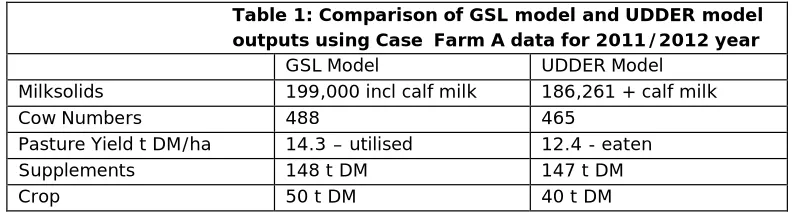
Table 1 shows the consultant‟s comparison of GSL model output with UDDER output. Actual farm production for the 2011/2012 year was 187,253kg milksolids plus calf milk. He noted a difference in pasture utilised between the models but could not say whether one was more accurate than the other, and was comfortable with the result.
Table 1: Comparison of GSL model and UDDER model outputs using Case Farm A data for 2011/2012 year
GSL Model UDDER Model
Milksolids 199,000 incl calf milk 186,261 + calf milk
Cow Numbers 488 465
Pasture Yield t DM/ha 14.3 – utilised 12.4 - eaten
Supplements 148 t DM 147 t DM
Crop 50 t DM 40 t DM
21 Centre of Excellence in Farm Business Management
The Usefulness and Efficacy of Linear Programming Models as Farm Management Tools
a similar manner to the GSL model. However, UDDER is easier to report from as the GSL modelrequires manual operating and thus more operator time. UDDER can also be used as a monitoring tool so can be used to verify progress against a plan. This is a useful feature for the GSL model to consider incorporating. UDDER does not track prior runs unless these are specifically saved as a different file, whereas the GSL model tracks prior runs which the consultant considered a good feature of the GSL model.
The consultant also compared the GSL model with Farmax Dairy. The GSL model established a model more quickly than Farmax, and was faster at analysing alternative options and providing information on optimal farm system requirements. In contrast, analysing alternatives and providing information would be a manual routine in Farmax. The GSL model does not appear to provide a comprehensive financial analysis or report so preparing results for presentation to a client would require further work on alternate software. In contrast to the GSL model, Farmax does not track prior model runs, and would require manual saving of different files to allow the same style of operation.
5.1.7 Other points noted by the consultant
The consultant felt uncomfortable about the way in which a calving pattern is established based on a milk production profile and did not consider this an intuitive way of thinking about calving patterns. He would have preferred to have entered a calving pattern.
The consultant noted that the manner of using a reserve supplement9 to ensure there are more
viable outcomes means care is needed to ensure that this is correctly accounted for in the outcome (see Appendix III, Issues, for an explanation). He also considered that all three tools lack a
“nutrition” function10 that accounts for feed components other than energy. Note that both UDDER
and Farmax Dairy are fundamentally energy based systems analysis tools as is the GSL model.
The consultant also discussed the use of the GSL model as an addition to the “tool box” (Appendix III) and concluded that the GSL model was a “niche tool” to help clients identify system
improvements. He considered the question of “cost of time and cost effectiveness for client”. Compared to the use of other models, he concluded that if the analysis is straightforward, the GSL model would be more cost effective than other models. If more analysis was requested, the GSL model would be more expensive because of the extra time required to set up a more complex report method using alternative software such as a spreadsheet or another model. Other models provide more information and indices than the GSL model. He, personally, was unlikely to add the GSL model to his tool box as he and his clients were already familiar with his current tools and his time was already fully occupied meeting his clients‟ current demands using these tools. He also reasoned that both the time cost of using the GSL model for anything other than straightforward problems, and also the time and monetary cost of buying another programme were detractions from using the GSL model.
9 The “reserve supplement” concept is explained in more detail in Appendix III
22 Centre of Excellence in Farm Business Management
The Usefulness and Efficacy of Linear Programming Models as Farm Management Tools
can be taken into account in the analysis.
5.1.8 Suggestions for GSL model improvement
The consultant offered a number of suggestions as to ways in which the model could be improved. Each of these is explained in more detail in Appendix III: Consultant A: GSL Model Evaluation.
• Improvement to the windows and navigation would help the user to set up, present and save runs as they are completed, and thus improve demonstration to clients. In particular, windows and drop down boxes obscured each other.
• A monitoring facility that would enable the user to enter actual performance against the plan generated by the GSL model would enhance the software to a level where extension people could use the tool.
• Simple reports to present both tables and graphs for use in the consultants‟ reports or for active demonstration to the client would be useful.
• It would be more conceptually acceptable to be able to engineer the calving pattern to closely represent real situations.
• A sensitivity template would have greatly helped in the case study. Since the model is a specialist LP tool, a sensitivity analysis component with a spreadsheet output could be developed. This feature, together with some reporting enhancements, would be a very powerful way to show the system‟s sensitivity and management options in an environment of fluctuating input costs11.
• The training programme for someone less experienced would need to be more extensive. A full training requirement might be at least one full day with a follow up day to verify full and correct use. Time would be needed initially to work through the concept of LP and ensure the participants understand its use and limits.
• Incorporating a nutrition function that accounts for feed components other than energy as a basic function in the GSL model would be useful. The industry is increasingly looking for information on nutritional implications when making diet decisions. A feed library could accommodate nutritional information which could then be used to verify points in the plan where nutrition may not match production expectations.
• Where financial aspects are concerned, the model does what it is designed to do, which is to demonstrate marginal changes in economic performance. A detailed financial plan attached would be useful. The model may already have the ability to link to a spreadsheet, but users need to see and use this facility to extract further value.
23 Centre of Excellence in Farm Business Management
The Usefulness and Efficacy of Linear Programming Models as Farm Management Tools
5.2 Case Studies B and C
These two case studies involved the same consultant (Consultant B) so only one pre-visit interview with the consultant was undertaken. The consultant‟s pre-visit interview and his modelling process were undertaken prior to the farm visit. The information related to these are described prior to the individual cases since this is relevant to both Case Study B and Case Study C.
The pre-visit interview for each client, the consultant‟s visits and the post-visit interviews are described separately for each case study. The consultant‟s observations on the model are summarised after the description of case studies.
5.2.1 The Consultant’s Pre-visit Interview
Consultant B gained a science qualification, which was followed by a period of business employment, study for a Massey post-graduate Diploma in Rural Studies and employment in a farm management consultancy business, before establishing himself as a sole consultant. He makes considerable effort to keep up-to-date through participation in professional associations and attending conferences. In particular, he follows the three-leaf grazing management philosophy of Professor Danny Donaghy of Massey University (Donaghy & Fulkerson, undated).
The consultant has used a range of modelling software to explore opportunities for his clients. He was aware of LP as a possible way of exploring opportunities, and had heard the GSL model developer present at a conference. A cursory attempt to follow up on this had not resulted in any developments until this study.
His usual consultancy process with a new client starts by collecting data from the client for a recent average season and using those data and modelling these data in an UDDER model. He then uses the model output to benchmark cow and pasture performance against UDDER model results for other clients, while looking for effective current and potential strategies. He uses the UDDER model to help him explore issues associated with grazing management, crop agronomy, cow genetics and nutrition while observing their effect on financial performance during this process. He then
establishes future strategies, together with targets and management practices to achieve them. This begins with ensuring that the pasture management is effective in providing enough energy to the cows in the system, as well as using supplements and urea to provide energy as the need and opportunity arises. The next steps are to look at the financial effects, feed conversion efficiency and aspects of genetics. His objective is to ensure that each client “continually grows their business”.
5.2.2 The Pre-visit Modelling Process used by Consultant B
24 Centre of Excellence in Farm Business Management
The Usefulness and Efficacy of Linear Programming Models as Farm Management Tools
In his pre-visit modelling, the consultant ran and validated the GSL model using data for the2011/2012 season as described at the beginning of Chapter 5. The resulting optimum solution for this season was then used to identify “critical parameters” (i.e. factors constraining production), and these factors, together with other constraining factors the consultant had identified from his own experience, formed the basis of a series of sensitivity analyses and scenarios which were worked through using the GSL model with assistance from the model developer. The results from these GSL model analyses were then explored using the UDDER model to test that the solutions were viable. These scenarios and their results were then presented to the clients in the UDDER model output format.
Consultant B commented that using a computer model with clients was impractical because
broadband access in this locale is slow and he did not consider that it was reliable. While this would be a logical reason not to use computer models outside the office, it later became apparent that he did not use computer models directly with his clients anyway. His consultancy process is to present them with pre-run results and his clients are accustomed to this style of consultancy.
5.3 Case Study B
Case study B involved a consultant (Consultant B) who was experienced in the use of models and a client (Client B) who relied on the consultant to do all the modelling work and present the results and their interpretation. In the interview before the consultant visited his client, the consultant said that he believed that Client B was likely to be interested in changing his system to fewer, higher-performing cows in an effort to lift profitability. This opportunity was possible because the farm has a very low empty cow rate so there was potential to cull poorer performing cows. A second opportunity was to find the optimum area of maize to grow for silage.
5.3.1 The Client Pre-visit Interview
The client runs a high-producing, 100 ha milking platform with 275 milking cows on a seasonal supply farm. Replacements are grazed off from November. Turnips are grown for summer feed and four hectares of maize is grown for silage. The feeding regime also included a moderate amount of concentrates, usually in the form of PKE or a substitute when PKE was not available. The cows are of high genetic value as AI has been used on the farm for 60 years. A manager is employed on the farm, with a new manager due to start in the coming season.
The farm falls naturally into two halves. The “home” block is closer to the dairy shed and has higher levels of soil fertility, having been farmed under the client‟s management for much longer. The second half, purchased more recently, has a higher sand content and is naturally less fertile. It is mainly used for daytime grazing, with the home block being used mainly for night grazing.