rfl1e Hyclri(le£1
Palla(litt:
rn Electrode
A
REVIEW OF RECENT RESEARCH
By F. A.
Lewis,
Ph.D.Chemistry Department, The Queen's University of Belfast
Changes in the electrical resistance and electrode potential of catalytically active
PdfH
are valuable when studying rates of diffusion ofJ·eactants up to the electrode surface. In this article the results of experiments con-cerning the diffusion of hydrogen molecules and their correlation with hydrogen overvoltage are reviewed and possible soz~rces of error in the measurements are discussed.Because of their general excellent resistance to corrosive attack and since equilibria can be conveniently established on their surfaces between hydrogen ions and hydrogen mole-cules dissolved in solution, the platinum group metals may all be employed as hydrogen electrodes. The establishment of equilibria requires reversible chemisorption and dis-sociation of hydrogen molecules at the electrode surfaces which are also inter-mediate steps when hydrogen is electro-lytically discharged at cathodes of platinum and related metals.
Although additional or alternative reaction steps have been suggested (r) perhaps the most condensed and idealised scheme of intermediate steps, in acidic solution, at hydrogen electrodes and cathodes is as follows:
H++ e =H (r)
*
H +H=H2 (2)
*
*
*
H2 =H2t (3)
*
H2t =H2tt (4)
where H and Hz are adsorbed species and
*
*
H21· and H2
tt
are hydrogen moleculesdis-solved in solution within about
5
A
of the surface and beyond the limit of the Nernst diffusion layer respectively.Conjointly with the formation of the chemisorbed intermediate H, there arises the
*
possibility of diffusion of hydrogen into the metal lattice, so that provided step 2 can
proceed unhindered the equilibrium amount of hydrogen absorbed from hydrogen-saturated electrolytes should correspond to the amount absorbed when suitably activated surfaces are in . direct contact with hydrogen in the gas phase at the same temperature and pressure. The amount of hydrogen absorbed by the platinum substrate of a standard (Pt/H/H2) hydrogen electrode (r atm H2 :
25°C) is however relatively small, extra-polation of pressure-concentration-tempera-ture (P-C-T) da~a at higher temperatures (2) indicating the solid electrode to have the composition H/Pt ,...., o.I x Io-4 atomic ratio. Moreover, few marked changes in conven-iently measured physical properties of platinum result from the absorption of this amount of hydrogen (3).
Th
e PdJH/H
2Electrode
Conflicting results have, until recently, still been reported, concerning
th'e
electrode potentials of the hydrided palladium electrode. A number of the major discordancies have now however been adequately resolved and, in particular, correlations between electrode potentials measured in solutions and the extensive P-C-T data available for the Pd/H system have been justified.that the hydrogen content of the palladium substrate of a standard equilibrium Pd/H/H2
electrode (r atm H2:25°C) to be H/Pd,.._,o.69
(atomic ratio) and this fact has now been verified experimentally (4, 5). This hydrogen content very greatly exceeds that of a standard Pt/H/H 2 electrode and although the other
members of the platinum group of metals have not been so fully investigated as platinum and palladium the weight of present evidence (3) suggests that the Pd/H/H2 electrode is
unique in possessing such a large "sink" of hydrogen in the solid. An immediate con-sequence is that while hydrogen is absorbed into the "sink", palladium requires (volume for volume) longer to attain equilibrium in hydrogen saturated solutions than the other platinum group metals. Moreover, in contrast to platinum the increase in hydrogen content is reflected by changes, at rates which are conveniently measurable, of electrode poten-tial, E, and of other physical properties such
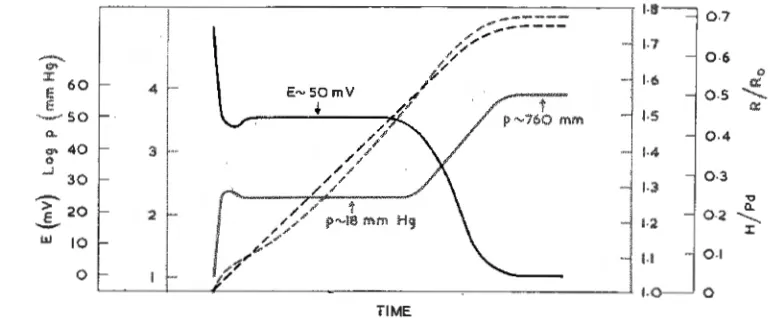
in Fig. I. By alteration of the partial pressure of dissolved hydrogen (7, 8) as well as by a detailed analysis (4b, 8) of extensive measure-ments both with palladium and a series of palladium alloys it has been shown that the rates of hydrogen absorption are in very good accord with the equation
(5)
where k0 has a value of ,._, Io
16 molecules cm-2
sec-1 atrn-1 which is virtually independent
of the hydrogen ion concentration in the electrolyte, P is the pressure under which the hydrogen molecules are dissolved in solution and p, the vapour pressure of the solid hydride, is related to E by the usual expression lnp=2FE/RT.
From the temperature dependence of the relationship between H/Pd and R/R0 (5), the
temperature dependence of k0 indicated the
activation energy of the rate controlling step as electrical resistance (4, 5, 6, 7, 8). Further- to have a low value between zero and 2 Kcal/ more, since diffusion of hydrogen within the . mole H2 (4, 7, 8). All this evidence supports
solid electrode is relatively rapid (6, 9, ro) the view that this step is the permeation of these changes can be utilised to measure
either the kinetics of slower steps such as hydrogenation reactions catalysed at the electrode surface or altematively to measure rates of diffusion of reactants up to the surfaces of electrodes which are very active catalytically.
Kinetics of Absorption of Hydrogen
Dissolved in Solution
\Vhen a catalytically active palladium wire is immersed in efficiently stirred hydrogen-saturated dilute acid solutions, the time dependent changes of electrode potential, E, and electrical resistance (plotted as R/R0
where R0 is the resistance of the
hydrogen-free specimen) are as shown in Fig. I where the time scale is dependent on the wire diameter (4, 7, II). From relationships, which may be independently derived, between the hydrogen content of the specimen and both E and R/R0 , the increase of H/Pd can
be measured simultaneously and is also shown
the dissolved hydrogen molecules up to the electrode surface (step 4 above).
Poisoning of Catalytic Surface
The results in Fig. I may be excellently reproduced if the surface is activated by palladisation, but virtually identical results can be obtained with "bright" surfaces activated either by anodisation or even merely by pre-flaming (4, 12). However, the catalytic activity of pre-flamed or pre-anodised speci-mens is more readily negatived by poisons (4). Poisonous species can be present in either insufficiently purified electrolytes or in the hydrogen or other gas streams or be leached from the electrolyte container or specimen holder. There is also the possibility of copper, zinc or mercury being introduced into the electrolyte from electrical connections.
effi-I
-
-
-
---
I
1·8 0.7~,
---,;
...
Ir /// . ,
-jl7
0.6
...
"
"
Ien ~/
-1
0:z:
60 I 1·6 a:
E 4 - E~ 50 m V
,
I
o.s ...E
+
/./ t-i
'
·
5
a:.___.so p~760 mm
0.. I '/
_.J OA
r·
-/,t
"" 40 3 // 1·4
0 / /
j
...J / /
0·3
30
I
/ ?l
/ / J.3
>
/ t I..,
a.~
20 / .;
E 2 p~IS mm H<:J -~
1·2 0·2 ...
-
/ ;:I:
/ / I
w 10 ~tl'
-~
11i" Q.l
0 l~ I
J.o 0
TIME
Fig. 1 Time dependence of Rf R0 , electrode potential and derived parameters for palladium immersed in hydrogen saturated dilute acids. Time for equilibrium (E= 0) ea. 2 hours with
.012 cm diam. wire and ea. 7 hours with ,027 cm diam. RJR0 and H/Pd are shown by
broken lines
ciently cleaned before introduction into Pd/H and an equilibrium hydrogen electrode solution since subsequent activation pro- in the same solution. This difference in cedures, such as anodisation or cathodisation,
may not thereafter be entirely successful.
Study
of H
ydroge
n O
ve
r
v
olta
ge
Although Fig. I illustrates the increase of
HjPd by absorption of molecules from a hydrogen saturated solution, hydrogen may of course also be introduced when the specimen is cathodised, the current density required to discharge ~2 X ro16 hydrogen
ions cm-2 sec-1 (i.e. k
0P where P= r atm)
being "'-'3 mA cm-2• Moreover if electro
-lytic charging is carried out subsequent to attainment of E=O (p=I atm, see Fig. I) in a hydrogen saturated electrolyte and time is allowed for a steady state to be established, the number of molecules of hydrogen (cm -2
sec-1) thereafter being evolved at the cathode
will be
~~
where i is the current density(A.cm-2), N is Avogardro's number and F the
Faraday Constant. Provided diffusion of molecules from the surface continues to be rate controlling:
Ni
2F=k0(p- P) (6)
potential constitutes a component of over
-voltage which has been termed (9, 12, 13) Y)2•
It can then be shown that '1}2 should be related
to current density by the equation
_RT1 (· 1 zP.F.k0) RT1n(2P.F.k0) ( ) - "1),- zF n 1'-~ - zF - -N- - 7
The experimental measurement of lJ 2
during cathodisation in the steady state is complicated by the fact that the actual potential, i.e. total apparent overvoltage "'J,
contains additional terms (12, 14). Thus there is an LR. drop (often written "'JR)
between the Pd/H cathode and the reference electrode. In addition, even with vigorously
stirred solutions there can remain a con
-centration overvoltage term "'Jc due (12, 14, 15) to the concentration of hydrogen ions at the electrode surface being limited by diffusion through the Nernst layer.
Once again the large sink of hydrogen in
..
.
,
.
Pd/H proves its experimental value. Follow-ing interruption of cathodisation the time dependent change of electrode potential E
(now entirely characterised by H/Pd-except for retention of an lJc term at very small times) can be conveniently and accurately measured: this is only approximately log
-Now the resulting increase of p should be arithmic but linearly time dependent expres
relationships between E, H/Pd and p, and
these can be extrapolated back to zero to give
reliable values of E during steady state
cathodisation, i.e. 7Jz· Values of 7]2 so
obtained (12) have been shown, for both
palladised and catalytically active "bright"
cathodes, to fit relation 7 very satisfactorily
in the range of current densities from zero
to ea 50 ma. cm-2 confirming that in this range of current densities the magnitude of 7J2
is controlled by the diffusion of dissolved
molecules. Present evidence suggests that at
higher current densities hydrogen evolution
by molecular diffusion becomes increasingly
supplemented by bubble formation and 7Jz
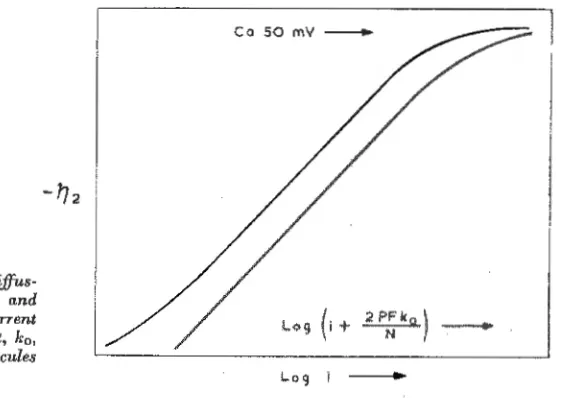
then tends to a limiting value (12, 13) as
shown in Fig. 2. These more recent results
in which resistance and electrode potential
measurements have been employed in
con-junction appear excellent confirmation of the
earlier experiments and conclusions of Knorr
and his collaborators (13, r6) who have also
presented evidence that relationships
comple-mentary to relation 7 apply equally well to
the overvoltage at catalytically active platinum
unfortunate that there has latterly been a
general lack of emphasis accorded to Knorr's
work since this clearly indicated the
limita-tions which are generally imposed by diffusion
controlled kinetics for obtaining data
con-cerning steps I and 2 from overvoltage
studies.
Possible Errors m Measurement
of
R/R
0In the course of our measurements of
electrical resistance in aqueous solutions
careful re-examination has been made
(8, ro, 12, 17) of the relative magnitude of
parallel conduction of the bridge measuring
current through the electrolyte, a factor which
had been generally underestimated. The
pro-portion of this "eo-conduction" through
solution is a function not only of the composi-tion of the electrolyte and of the dimensions
of the specimen but also of the catalytic
activity of
its
surface; those surfaces of highcatalytic activity possessing a lower impedance
to current flow. In the course of these
experiments and of complementary study of
electrodes. In principle, the relationships current flow (and of its polarisation) between
between current density and overvoltage pairs of Pd/H electrodes, progress has also
should also be capable of yielding information been made (12, r8) in obtaining quantitative
concerning the kinetics of proton discharge data regarding both the capacitance and
and chemisorbed hydrogen atom recombina- resistance components of the total impedance
tion (steps I and 2 above). It is therefore close to the electrode surface. Furthermore,
Fig. 2 Relationships between diffus-ion (or hydride) overvoltage, 'l)o, and
logarithmic functions of current
density i and the rate constant, k0 ,
for diffusion of hydrogen molecules
to the electrode surface
eo
so
mv-
-it has also been found possible to utilise such
studies as a further method of obtaining
P-C-T data for the hydrides of palladium and also of its alloys (ro).
Sources of Error in Electrode
Potential Measurements
Palladium electrodes are generally
con-nected to platinum leads, and exposed
platinum if catalytically active can attain a zero volt potential in hydrogen saturated solutions (and exhibit analogously differing
potentials under alternative experimental
conditions) more rapidly than palladium,
thus giving rise (7) to a mixed potential
which can be varyingly misleading as a
measure of H/Pd. In addition, the "local
cell" then set up can cause proton transfer
from the exposed Pt/H regions of Pd/H regions. However unless comparatively large regions of platinum are exposed, experiments
have shown (7, 19) that such a local cell effect should not cause marked errors in the measurement of diffusion controlled kinetics. The platinum may be shielded from
solu-tion by covering the leads and an adjoining small area of palladium with soda glass, which
bonds intimately to both metals. The entire specimen may thereafter be readily cleaned
by flaming, so that subsequent activation
procedures are then more likely to be
uniformly effective over the whole surface. Polythene and Teflon have also been widely used (7, 19) to cover the leads but extra care is required with these materials to shield both the platinum, and particularly base metal connections beyond the platinum, from the solution. As against this objection to polythene
the expansion of palladium which results from h.ydrogen absorption may cause fracture of the glass and expose the platinum during an experiment, although using fine wires as specimens both increases the probability of
completing an experiment before fracture and
decreases the general risk of its occurrence.
Although specimens with glass insulated
leads may be conveniently re-employed after
they have been outgassed and any fractured
glass repaired with a small flame, mixed potential effects, similar in principle to those resulting from exposed platinum, may arise
if the diameter of the specimen close to the
glass insulation is unduly decreased by
oxidation.
The Palladium Bi-electrode
A further feature of palladium, which follows from the rapid rate at which hydrogen
can permeate the solid, is its utility in the
form of a bi -electrode consisting of a palladi urn
membrane separating two solutions or a
gaseous atmosphere and an electrolyte (20, 2 I).
Hydrogen entering at the "absorption" side of the membrane diffuses to, and is released
at, the diffusion side. Provided both sides
are carefully activated and the stirring of the
solution is carefully controlled at both
inter-faces, the electrode potential at the diffusion
side can be controlled from the "absorption" compartment. A valuable synopsis of earlier
studies is available in a paper by Frumkin
and Aladjalova (9) and there is growing
interest (20, 21, 22, 23) in the practical value of the Pd/H electrode in this form. Once again the technical problems (arising from
expansion of the membrane on absorption of
hydrogen) of sealing the hi-electrode into its container, while preventing electrical
con-nections from contacting the solution, have been tackled in several ways but no method so far suggested is without some disadvant-ages.
References
r See e.g. D.
J.
G. Ives, Can.J.
Chem., !959,37, 213, D.
J.
G. Ives and G.J. Janz,
Reference Electrodes, Academic Press,
1961.
2 A. Sieverts and E. Jurisch;· Berichte, 1912,
45, 22I
3 See e.g. D. P. Smith, Hydrogen in Metals, Chicago University Press, 1948
4a T. B. Flanagan and F. A. Lewis, Tram.
Faraday Soc., 1959, 55, 1400, 1409
4b T. B. Flanagan and F. A. Lewis,
J.
Elecrro-chem. Soc., 196!, ro8, 473, cf. also (for
Pd/D/D2) T. B. Flanagan,J. Phys. Chem.,
1961, 65, 280.
5 T. B. Flanagan and F. A. Lewis, Z. Physik.
Chem. Frankfurt, 1961, 27, 104
6 See e.g. F. A. Lewis, Platinum Metals Rev.,
7 R.
J.
Fallon and G. W. Castellan,J.
Phys.Chem., 1960, 64, 4, r6o
8 A. W. Carson, T. B. Flanagan and F. A.
Lewis, Trans. Faraday Soc., 1960, 56,
363, 37l
9 A. N. Frumkin and N. A. Aladjalova, Acta.
Physicochim. U.R.S.S., 1944, 19, I (in English)
ro A. W. Carson, T. B. Flanagan and F. A.
Lewis, Trans. Faraday Soc., 1960, 56,
I3II, I324
rr M. Breiter, H. Kammermaier and C. A.
Knorr, Z. Elektrochem., 1954, 58, 702
12
J.
C. Barton and F. A. Lewis, in course ofpublication.
13 R. Clamroth and C. A. Knorr, Z. Elektro
-chem., 1953, 57, 399
14 G. W. Castellan,
J
.
Electrochem. Soc., 1961,ro8, 277, 28z
15 M. Eisenberg,
J.
Electrochem. Soc., 1955,102, 356
16 L. Kandler, C. A. Knorr and E. Schwitzer,
Z. Physik. Chem. Lpz., 1937, r8oa, 281;
C. A. Knorr, Z. Elektrochem., 1953, 57,
399; 1955, 59, 647
17 C. A. Knorr and D. Roemer, Z. Elektrochem.,
1960, 64, 456
r8
J.
C. Barton, F. A. Lewis, D. S. Mcllhaggerand R. K. Quigg, Naturwiss., 1961, 48, zr6
19
J.
P. Hoare,J. Phys. Chem., 1960, 64, 178020 A. Kussner and E. Wicke,
z.
Physik. Chem.,Frankfurt, 1960, 24, 152
21 R. Neihof and S. Schuldiner, Nature, 1960,
I8S, 526
22
J.
T. Stock, W. C. Purdy and T. R. Williams,Anal. Chim. Acta., 1959, 20, 73
23 S. Schuldiner and
J.
P. Hoare, Can.J.
Chem., 1959, 37, 228
Platinum
1\tletals in Photographic
Entulsions
A
STUDY
OF THEIR EFFECTS ON SENSITIVITY
During the last few years a considerable
increase has been made in the sensitivity of
photographic emulsions with little increase in
grain size. Some at least of this improvement
is due to the use of noble metals as sensitisers
and general emulsion improvers.
In the course of a symposium on "The
Ultimate Sensitivity in Photography-Today
and Tomorrow" organised last year by the
Royal Photographic Society, a contribution
on this subject was presented by two
inde-pendent workers in the field, A. Narath and
A. Tiilikka, of the Institut fiir angewandte
Photochemie und Filrntechnik, Technische
Universitli.t, Berlin. Their paper, now
published in The Journal of Photographic
Science, rg6r, 9, 303-3II, describes their investigation by potentiometric methods of
reactions between gelatin and the noble
metals.
· In a review of the literature, the authors
point out that although the sensitivity of silver
bromide suspensions is increased by the
. addition of gold, platinum and palladium,
much of this is lost in the presence of gelatin
and other colloid vehicles, which at present
are essential emulsion constituents. This
restraining effect is apparently due to
inter-action in the emulsion between the noble
metals and gelatin or its microcomponents,
with the result that the metals cannot
completely penetrate the adsorbed gelatin
layer on the silver. halide grains to increase their sensitivity.
In their investigation the authors simulated
photographic emulsions, but excluded silver
halides. The reactions were followed
potentio-metrically using gold, platinum and palladium
electrodes and a saturated calomel reference
electrode. Concentrated gelatin, polyvinyl
alcohol control solutions, gold thiocyanate
complex and K2PtC14 and K2PdC14 solutions
were used.
The results of the titrations were compared
with emulsion sensitising tests, using a simple
bromo-iodide emulsion employed in earlier
work. This contained o.o88 moles silver and
about 25 grammes gelatin in 250 millilitres
emulsion at the beginning of digestion. All
titrations and emulsion digestions were made
at pH 6.
The gelatins giving the greatest sensitivity
with silver halides were found to have the
strongest reaction with the noble metals,
preventing them from sensitising the silver.
Platinum and palladium react more strongly
than gold, and consequently have a greater
restraining effect on sensitivity. The metals
also react with many organic
sulphur-con-taining sensitisers and ripening restrainers
used in emulsions.
The authors suggest that platinum and
palladium (and also iridium and rhodium)
might be used to increase emulsion sensitivity
and/or contrast, providing that low
con-centrations of gelatin are used and that the
gelatin contains reducing agents, or
alter-natively that colloid vehicles are used which
do not form strong complexes with the
platinum metals. They propose to continue
their investigation in these directions.