The Effect Of Cyclic Olefin Copolymer Loading
On Linear Low Density Polyethylene Blends:
Characterization By Fourier-Transform Infrared
Spectroscopy And X-Ray Diffraction
H. C. Shah, S. K. Nema
Abstract In this work, linear low density polyethylene (LLDPE), a versatile commodity thermoplastic and cyclic olefin copolymer (COC), an amorphous engineering thermoplastic, were blended by melt-mixing technique using a co-rotating twin screw extruder in ratio of 5%, 10%, 15% and 20%. Effect of COC blending with LLDPE on X-ray Diffraction (XRD) patterns, and Fourier-transform infrared spectroscopy (FTIR) were analyzed. The characteristic absorption peaks of LLDPE, COC and LLDPE/COC blends were determined and compared. The intensity of fundamental vibration peaks in the spectra of LLDPE/COC blends tends to vary with respect to the component contents in the blends. X-ray diffraction studies were carried out to study the effect of blend composition on crystallinity and particle size.
Keywords — Cyclic olefin copolymer, Infrared spectroscopy, Linear low density polyethylene, Polymer blend, X-ray diffraction,
—————————— ——————————
1
I
NTRODUCTIONIn polymer blends, two or more polymers blended together for the favorable properties of those homopolymers. The properties of polymer blends depend on its molecular weight, structure, crystallisability, processability, compatibility, etc. [1-2]. Cycloolefin copolymer (COC) is novel type of amorphous engineering thermoplastics and prepared by the copolymerization of ethylene and norbornane through metallocene-based catalysis. Cyclic olefin copolymer has remarkable characteristics such as low density, superior transparency, high glass transition temperature also high rigidity, strength and hardness, chemical resistance to common solvents, good moisture barrier and outstanding biocompatibility. COC resins are suitable for very wide applications such as medical and packaging applications, electrical, optical and products for construction. COCs have high Tg, they are very rigid materials and in some applications flexibility and toughness are required. Enhancement of flexibility and flow behavior of COC by mixing with a variety of polymers has been published. Varieties of applications have been developed for blends of COC, with different types of polyolefins [3-6].
Linear low-density polyethylene (LLDPE) provides a wide variety of properties so it is principle choice for a variety of packaging applications among different types of polyolefin. LLDPE is vital as a resin for films
because of its comparatively low cost, an outstanding set of physical and mechanical properties such as tensile, elongation at break, modulus, puncture resistance, and tear strength, etc.,[7-8].
H. A. Khonakdar et al reported morphology and dynamic mechanical analysis (DMA) of blends of ethylene vinyl acetate copolymer (EVA) with
high-density polyethylene (HDPE) and low-density
polyethylene (LDPE) to study the miscibility and various transitions. Addition of EVA reduced all the transition temperatures. A peak broadening of tan δ was observed with increasing EVA content in the blends [9]. Aravinthan Gopanna et al. investigated Mechanical, dynamic a mechanical, rheological and morphological property of PP and COC blends. Dynamic mechanical analysis results showed that PP and COC were immiscible in the blend system, reported independent glass transition (Tg) for PP and COC component. Addition of stiffened COC in the PP/COC blends increased tensile strength and tensile modulus, flexural strength and flexural modulus and of a decreased in the elongation at break and impact strength [10].
Morphology, miscibility analysis and viscoelastic behaviour of cyclic olefin copolymer/polyolefin elastomer (COC/POE) blends was studied by Hossein Ali Khonakdar et al. and reported that storage modulus and viscosity of COC are lesser than those of POE in the melt state. The DMA results indicated that in the solid state blends of COC/POE were immiscible. At all ratios of the blends exhibited two peaks in the loss modulus
————————————————
H.C.Shah is currently pursuing PhD program in Chemical engineering in Gujarat Technological University, India, E-mail: [email protected]. S.K Nema is Supervisor in Gujarat Technological University and HBNI
versus temperature diagrams related to the Tg of the neat components. Storage and loss modulus of COC and POE were estimated by using
Gramspacher–Meinssner and Palierne models. Palierne model gave better association with the experimental findings was observed as compared to the other model [11].
Ali Durmus et al. studied rheological, morphological, and mechanical properties of cyclic olefin copolymer/poly (ethylene-co-vinyl acetate) blend films. It was observed that the films discovered characteristic immiscible “matrix–droplet” or “cocontinuous” blend morphology and young’s modulus and yield stress were decreased and strain at break increased by addition of poly (ethylene-co-vinyl acetate) addition into cyclic olefin copolymer [12]. Similarly, P. Doshev et al. investigated blends exhibited complete phase separation forming a
matrix-droplet type morphology when studied
morphology and mechanical properties of reactive and non-reactive COC/EOC Blends [13]. Luca Fambri et al. reported rheological study of blends of polypropylene, cycloolefin copolymer by means of capillary rheometry and melt flow analysis, and investigated that COC/PP viscosity ratio increases with increase in shear rate, but viscosity decreases with temperature [14].
Mechanical, Thermal and rheological properties were investigated for different blend ratios of linear low density polyethylene (LLDPE) and low density polyethylene (LDPE) by F. Al-Attar et al. and reported that the DSC results for all blend ratios indicated phase separation at occurs at high concentration of LLDPE[15]. J.V. Gulmine et al. studied Polyethylene characterization by FTIR and the optimum conditions for the analyses were recognized and permitted clearly to identify the three most important commercially available grades of polyethylene: low density, high density and linear low
density [16]. Rheological properties of
poly(methylmethacrylate) (PMMA) and cycloolefin-copolymer (COC) to optimize the hot-embossing process was studied by M. Sahli et al. and the glass transition temperature (Tg), the melt flow index (IF), and the viscosity as a function of shear stress were determined [17]. Differential scanning calorimeter and melt rheology of the LLDPE/COC blends were described in our previous article. MFI value of LLDPE/COC blends comes under acceptable range to process through blown film extrusion. [18]. It has been reported that the blending of COC into LLDPE had a positive impact on its mechanical properties and thermal properties and rheological properties [19]. XRD and FTIR of polymers and polymer blends are very important to estimate their appropriateness in the specific
field of application. X-ray diffraction analysis is used to study the effect of blend composition on crystallinity and particle size.
Fig.
There are only a few research papers that report on LLDPE/COC blends and no work has been done using the selected grades of LLDPE and COC. Moreover, to the best of our knowledge, so far not much information is available about XRD and FTIR of LLDPE/COC blends. The objective of this work is to study X-ray diffraction (XRD) and Fourier transform infrared spectroscopy (FTIR) of LLDPE and COC blend by adding 5, 10, 15 and 20 wt % of COC in LLDPE by melt blending using Haake twin screw extruder, which can be used to prepare monolayer film blown film for packaging application. It is possible to take advantage of both the materials like high barrier of COC and thermal stability in combination with wide use, low-cost and processability of LLDPE which are important factors to be considered for packaging application.
2
M
ATERIALS ANDM
ETHODOLOGY2.1 Materials
Commercial grades of linear low-density polyethylene (LLDPE), F19010 (density = 0.918 g/cc, MFI: 190°C and 2.16 kg = 0.90 g/10 min), was used by Reliance Industries limited, and Cyclic olefin copolymer (COC), TOPAS 8007 (density = 1.02 g/cc, MFI at 190 and 2.16 kg = 1.8 g/10 min), was kindly donated by TOPAS Advanced Polymers. Cyclic olefin copolymer (COC) is copolymer of ethylene and norbornene groups. The norbornene content in this COC grade is around 35% with a Glass transition temperature of 78 °C.
2.2 Preparation of blends
Pure LLDPE, pure COC and LLDPE/COC blends are prepared by melt blending techniques using co-rotating intermeshing twin screw extruder (Haake Rheomix TW100), in the ratios of 100:0, 95:05, 90:10, 85:15, 80:20, and 0:100 where the numbers represent the weight percentages of LLDPE and COC, respectively. The coding system and compositions of the investigated samples are referred as L100C0, L95C05, L90C10, L85C15, L80C20, L0C100,
2.3 Sample Preparation
Samples of LLDPE, COC and LLDPE/COC blends were prepared. Pre-dried granules were compression molded at 250 °C temperature and 200 psi pressure for the time period of 10 min into sheets with a thickness between 2.5-3 mm.
2.4 Sample characterization
FTIR spectroscopy
The chemical composition and interactions between the functional groups in a polymer blend can be obtained directly by using Fourier transform infrared (FTIR) spectroscopy. In FTIR, infrared radiation is passed through a sample out of which some of the infrared radiation is absorbed by the sample and some of them transmitted. The resulting spectrum shows the molecular absorption and transmission, generates a molecular fingerprint of the sample. These IR ray’s energy can be associated to the vibrational energy of different bonds found within different functional groups in a compound [20]. FTIR spectra of the raw materials and blends were recorded by ASTM E 1252 using Cary 630 Agilent FTIR spectrometer. The spectra in the range of 4000–400 cm−1
were recorded for LLDPE, COC and their blends. The compression molded samples were cut and fixed on the sample holder for data recording.
X-ray diffraction
Phase identification of a crystalline material is carried out by X-ray diffraction (XRD) and it can provide details on percent crystallinity and crystal structure. X-rays are generated in a cathode ray tube by heating a filament to generate electrons, accelerating the electrons in the direction of a sample by applying a voltage, and bombarding the sample with electrons. When electrons have sufficient energy to move inner shell electrons of the sample, characteristic X-ray spectra are produced. As the detector and sample are rotated, the intensity of the reflected X-rays is recorded. When the geometry of the incident X-rays impinging the sample satisfies the Bragg’s Equation (nλ=2d sin θ) *where d is spacing between the diffracting planes, θ is the incident angle, n is an integer (usually 1) and λ is the wavelength of the incident radiation], constructive interference occurs and a peak in intensity occurs. XRD pattern of polymer sample contains both sharp and broad peaks depending on the percentage of crystalline and amorphous portions existing in the material. Sharp and narrow peaks correspond to crystalline regions and diffused and broad peaks correspond to amorphous regions [21]. X-ray scattering patterns of the raw materials LLDPE and COC and their prepared blends are collected using Cu-Kα radiation (λ =
1.54 nm) produced by X-ray diffractometer (Bruker D8 Discover) controlled at 40 kV and 30 mA.
3
RESULTS AND DISCUSSION3.1 FTIR spectroscopy Infrared spectrum of LLDPE
The infrared spectrum of LLDPE in the range of 400–4000 cm−1 is shown in fig 1. The peaks at 2916, 2849 and 1466
cm−1 are attributed to –CH
2– asymmetric stretching, – CH2– symmetric stretching, and bending vibration mode of – CH2 group respectively. Absorption peak located at 717 cm−1 is assigned to vibration of ethyl group attached
to the backbone. Weak absorption peaks displayed at 1304 cm−1 is assigned to twisting deformation. Symmetric
bending vibration mode of –CH3 group is detected at 1379 cm−1 these are in good agreement with previously
reported results
[23-24]. Main absorptions of LLDPE in the IR range and their assignment is shown in table 1.
Table 1. Main absorptions of LLDPE in the IR region and their assignment [16].
Band (cm−1 )
Assignment Intensity
2916 CH2 asymmetric
stretching
Strong
2849 CH2 symmetric stretching Strong 1466 Bending deformation Strong
1379 CH3 symmetric
deformation
Weak
1304 Twisting deformation Weak
1173 Wagging deformation Very weak
717 Rocking deformation strong
Infrared spectrum of COC
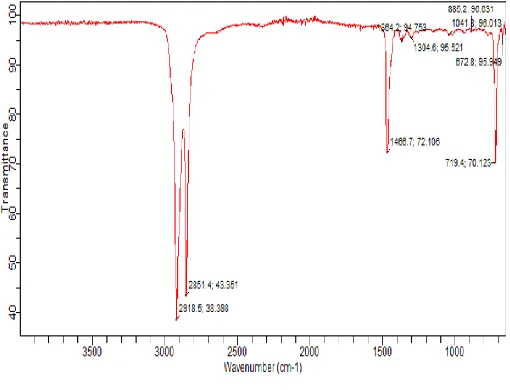
The infrared spectrum of COC in the range of 400–4000 cm−1 is shown in fig 2. COC is copolymer of ethylene
and norbornene, the absorbed absorption peaks at 2924 and 2868 cm−1 are attributed to –CH
2– asymmetric stretching, – CH2– symmetric stretching. IR peak exhibited at 1459 cm−1 corresponds to bending bending
vibration mode of – CH2 group and peak at 16540 and 2365 cm−1 is associated with –C=C and -C≡C- respectively,
and the peak around 700-900 cm−1 which can be assignted
Fig. 1. IR spectrum of LLDPE (L100C0)
Infrared spectra of LLDPE/COC blends
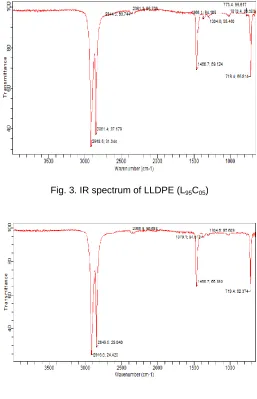
The infrared spectra of LLDPE/COC blends are shown in fig 3-6. IR spectra of LLPE/COC blends show the characteristic bands of both LLDPE and COC. All blends show peaks ranging from 2940–2868 cm−1, which
correspond to the -CH stretching mode and a peak at 1466 cm−1,which correspond to the -CH bending mode. It
is also observed that the intensity of absorption peak at 1019 cm−1 which is related to norbornene units ring
deformation vibration for increases as COC content rises in the LLDPE/COC blends; these are in good conformity with formerly reported results [23, 28].
Fig. 2. IR spectrum of COC (L0C100)
Fig. 3. IR spectrum of LLDPE (L95C05)
Fig. 4. IR spectrum of LLDPE (L90C10)
Fig. 6. IR spectrum of LLDPE (L80C20)
3.2 X-ray diffraction characterization
The XRD patterns of LLDPE and COC and LLDPE/COC blends are shown in fig 7 and 8 respectively. It can be seen that LLDPE and COC shows the characteristic diffraction peaks of a semi-crystalline and amorphous structure respectively, while the LLDPE/COC blend shows a reduction in the intensity of the diffraction peaks as shown in fig 8, which suggests the crystallinity of the LLDPE was slightly decreased by addition of COC. This is attributed to the influence of the more amorphous COC in the blend [27]. LLDPE is characterized by 2θ peaks at 18.9°, 21.23° and 23.4°. COC is characterized by a broad peak because at 2θ = 17.16°, which is similar to the observation reported by other researchers [23]. Full widths at half maximum (FWHM) and particle size are calculated from origin pro software reported in table 2. The incorporation of COC into LLDPE slightly changed the crystal structure of LLDPE as evident from the obtained XRD data. The 2θ peaks at 18.9°, 21.23° and 23.4° of virgin LLDPE shifted to 19.0°, 21.3° and 23.6°, respectively and also after addition of 5-20% COC the amorphous peak around 17.7° is visible in LLDPE/COC blends at lower intensity which is not seen in pure LLDPE. The shifting of 2θ peaks of LLDPE can be attributed to the presence of COC chains in the blend material. The crystalline structure of LLDPE does not affect much after addition of up to 20% COC, which is confirmed by the DSC analysis of LLDPE/COC blends [18].
0 10 20 30 40 50 60 70 80 90
0 10000 20000 30000 40000 50000 60000
Int
en
sity
2 Theta
L100C0
L0C100
Fig. 7. XRD graph of LLDPE and COC.
10 20 30 40 50 60 70 80
Int
en
sity
2 Theta
L0C100 L80C20 L85C15 L90C10 L95C05 L100C0
Fig. 8. XRD graph of LLDPE/COC blends.
Table 2: XRD data obtained from graph of LLDPE, COC and
LLDPE/COC blends. Blend
Ratio
2Theta FWHM Particle size (nm)
L100C0 21.2360 0.5076 15.92
23.4881 0.6731 12.05
28.4773 0.2796 29.31
L95C05 21.3671 0.5190 15.58
23.6536 0.6468 12.55
28.5391 0.3411 24.03
L90C10 21.2641 0.5231 15.45
23.5486 0.6251 12.98
28.4264 0.4106 19.95
L85C15 21.0816 0.5068 15.94
23.3754 0.6452 12.57
L80C20 21.2941 0.4764 16.96
23.5975 0.6090 13.32
28.4524 0.327 25.08
4
CONCLUSIONS
FTIR spectroscopy and X-ray scattering are used to study effect of COC on LLDPE blends. FTIR and XRD are useful to study LLDPE/COC blends, since the physical properties of blends are affected by the structures of molecular chains, which can help out in predicting their physical and mechanical properties. The FTIR spectra of all blends exhibit bands, whose vibrational frequencies are observed to be same to the bands observed for 100% LLDPE. The FTIR spectrum of blends shows change in some of the band positions and vary in the intensities of some bands compared with 100% LLDPE. Incorporation of COC slightly reduced the crystallinity of LLDPE phase in the blends. This kind of study has proven to be very useful in understanding and interpreting the relationship between the IR spectroscopy and X-Ray diffraction of COC, LLDPE and their blends. It is possible to take advantage of both the materials like high modulus and thermal stability of COC in combination with wide use, low-cost and processability of LLDPE which are important factors to be considered for packaging application.
ACKNOWLEDGEMENT
The authors would like to thank TOPAS Advanced Polymers for kind supply of COC and FCIPT, Gadhinagar, India for providing their facilities for characterization of XRD of polymer blends.
REFERENCES
[1] T. Bressmann, Polymer Blends Handbook, vol. 70, no. 3. 2003.
[2] M. J. Folkes and P. S. Hope, Polymer Blends and Alloys. Springer, Dordrecht, 1993.
[3] Karlheinz Hausmann and Yves M Trouilhet, “Multilayer film comprising cyclic olefin copolymer,” US20140370278A1, 2014.
[4] K. Schweitzer,
“White,sealable,thermoformable,biaxially
oriented and coextruded polyester film containing a cycloolefin copolymer,method for producing the same and the use thereof,” US20030170479, 2003. [5] Janet W. Rivett, “Cycloolefinic copolymer for high
modulus film,” US007365130B2, 2008.
[6] J. M. L. III, “Transparent thermoplastic blend of a cycloolefin copolymer and a thermoplastic polyurethane,” 20050070665A1, 2005.
[7] Domasius Nwabunma and Thein Kyu, Polyolefin Blends. John Wiley & Sons, Inc., 2008.
[8] A. K.Mikitaev, M. K. Ligidov, and G. E. Zaikov, Polymers, Polymer Blends, Polymer Composites and Filled Polymers: Synthesis, properties and applications. Nova Science Publishers, Inc., 2006. [9] H. A. Khonakdar, U. Wagenknecht, S. H. Jafari, R.
Hässler, and H. Eslami, “Dynamic mechanical
properties and morphology of
polyethylene/ethylene vinyl acetate copolymer blends,” Adv. Polym. Technol., vol. 23, no. 4, pp. 307–315, 2004.
[10] A. Gopanna et al., “Investigation of mechanical,
dynamic mechanical, rheological and
morphological properties of blends based on polypropylene (PP) and cyclic olefin copolymer (COC),” Eur. Polym. J., vol. 108, pp. 439–451, 2018. [11] H. A. Khonakdar, S. H. Jafari, and M. N. Hesabi, “Miscibility analysis, viscoelastic properties and morphology of cyclic olefin copolymer/polyolefin elastomer (COC/POE) blends,” Compos. Part B Eng., vol. 69, pp. 111–119, 2015.
[12] A. Durmus, M. B. Alanalp, and S. Aydin, “Investigation of morphological, rheological, and
mechanical properties of cyclic olefin
copolymer/poly(ethylene-co-vinyl acetate) blend films,” J. Plast. Film Sheeting, vol. 34, no. 2, pp. 140–159, 2018.
[13] P. Doshev, D. Tomova, A. Wutzler, “Morphology and Mechanical Properties of Reactive and Non-Reactive COC/EOC Blends,” J. Polym. Eng., vol. 25, no. 5, pp. 375–392, 2011.
[14] L. Fambri, J. Kolarik, E. Pasqualini, A. Penati, and
A. Pegoretti, “Rheological study on
polypropylene/cydoolefin copolymer blends,” Macromol. Symp., vol. 263, no. 1, pp. 114–120, 2008.
[15] F. Al-Attar, M. Alsamhan, A. Al-Banna, and J. Samuel, “Thermal, Mechanical and Rheological Properties of Low Density/Linear Low Density Polyethylene Blend for Packing Application,” J. Mater. Sci. Chem. Eng., vol. 06, no. 01, pp. 32–38, 2018.
[16] J. . Gulmine, P. . Janissek, H. . Heise, and L. Akcelrud, “Polyethylene characterization by FTIR,” Polym. Test., vol. 21, no. 5, pp. 557–563, 2002.
[17] M. Sahli, C. Roques-Carmes, R. Duffait, and C. K. Malek, “Study of the Rheological Properties of Poly(methylmethacrylate) (PMMA) and Cyclo-Olefin-Copolymer (COC) to Optimize the
Hot-Embossing Process,” Multi-material Micro
Manuf., no. C, pp. 1–4, 2005.
copolymer blends,” Int. J. Res. Eng. Appl. Manag., no. 11, pp. 259–263, 2019.
[19] S. Taglialatela Scafati et al., “Modulation of Barrier Properties of Monolayer Films from
Blends of Polyethylene with
Ethylene-co-Norbornene,” J. ofAppliedPolymer Sci., vol. 121, pp. 3020–3027, 2011.
[20] U. Riaz and S. M. Ashraf, Characterization of Polymer Blends with FTIR Spectroscopy, vol. 9783527331. Wiley VCH Verlag GmbH & Co. KGaA, 2015.
[21] Sabu Thomas, Yves Grohens, P Jyotishkumar, Characterization of Polymer Blends: Miscibility, Morphology and Interfaces. Wiley VCH Verlag GmbH & Co. KGaA, 2014.
[22] H. S. Kaufman, J J Falcetta, Introduction to polymer science and technology: An SPE text book. Wiley Interscience, New York, 1978.
[23] A. Gopanna, R. N. Mandapati, S. P. Thomas, K. Rajan, and M. Chavali, “Fourier transform
infrared spectroscopy (FTIR), Raman
spectroscopy and wide-angle X-ray scattering (WAXS) of polypropylene (PP)/cyclic olefin copolymer (COC) blends for qualitative and quantitative analysis,” Polym. Bull., no. 0123456789, 2018.
[24] Marlene Jane Cran and Stephen W Bigger, “Quantitative Analysis of Polyethylene Blends by Fourier Transform Infrared Spectroscopy,” Appl. Spectrosc., vol. 57, no. 8, pp. 928–932, 2003. [25] J. Forsyth et al., “Influence of the polymer
microstructure on the thermal properties of cycloolefin copolymers with high norbornene contents,” Macromol. Chem. Phys., vol. 202, no. 5, pp. 614–620, 2001.
[26] N. B. Colthup, L. H. Daly, and S. E. Wiberley, Introduction to Infrared and Raman Spectroscopy (Third Edition). 1990.
[27] S. Sánchez-Valdes et al., “Influence of modified polyethylene compatibilizer on filler dispersion and flammability characteristics of linear low density polyethylene/cyclo olefin copolymer blends containing flame retardant combinations,” J. Adhes. Sci. Technol., vol. 32, no. 14, pp. 1560– 1577, 2018.
![Table 1. Main absorptions of LLDPE in the IR region and their assignment [16].](https://thumb-us.123doks.com/thumbv2/123dok_us/8630796.1420504/3.612.328.560.342.494/table-main-absorptions-lldpe-ir-region-assignment.webp)