Learning Algorithms for Keyphrase Extraction
Peter D. Turney
Institute for Information Technology National Research Council of Canada
Ottawa, Ontario, Canada, K1A 0R6 [email protected]
Phone: 613-993-8564 Fax: 613-952-7151
Abstract
Many academic journals ask their authors to provide a list of about five to fifteen keywords,
to appear on the first page of each article. Since these key words are often phrases of two or
more words, we prefer to call them keyphrases. There is a wide variety of tasks for which
keyphrases are useful, as we discuss in this paper. We approach the problem of automatically
extracting keyphrases from text as a supervised learning task. We treat a document as a set of
phrases, which the learning algorithm must learn to classify as positive or negative examples
of keyphrases. Our first set of experiments applies the C4.5 decision tree induction algorithm
to this learning task. We evaluate the performance of nine different configurations of C4.5.
The second set of experiments applies the GenEx algorithm to the task. We developed the
GenEx algorithm specifically for automatically extracting keyphrases from text. The
experi-mental results support the claim that a custom-designed algorithm (GenEx), incorporating
specialized procedural domain knowledge, can generate better keyphrases than a
general-purpose algorithm (C4.5). Subjective human evaluation of the keyphrases generated by
Extractor suggests that about 80% of the keyphrases are acceptable to human readers. This
level of performance should be satisfactory for a wide variety of applications.
Learning Algorithms for Keyphrase Extraction
1. Introduction
Many journals ask their authors to provide a list of keywords for their articles. We call these
keyphrases, rather than keywords, because they are often phrases of two or more words,
rather than single words. We define a keyphrase list as a short list of phrases (typically five to
fifteen noun phrases) that capture the main topics discussed in a given document. This paper
is concerned with the automatic extraction of keyphrases from text.
Keyphrases are meant to serve multiple goals. For example, (1) when they are printed on
the first page of a journal article, the goal is summarization. They enable the reader to
quickly determine whether the given article is in the reader’s fields of interest. (2) When they
are printed in the cumulative index for a journal, the goal is indexing. They enable the reader
to quickly find a relevant article when the reader has a specific need. (3) When a search
engine form has a field labelled keywords, the goal is to enable the reader to make the search
more precise. A search for documents that match a given query term in the keyword field will
yield a smaller, higher quality list of hits than a search for the same term in the full text of the
documents. Keyphrases can serve these diverse goals and others, because the goals share the
requirement for a short list of phrases that captures the main topics of the documents.
We define automatic keyphrase extraction as the automatic selection of important,
topi-cal phrases from within the body of a document. Automatic keyphrase extraction is a special
case of the more general task of automatic keyphrase generation, in which the generated
phrases do not necessarily appear in the body of the given document. Section 2 discusses
cri-teria for measuring the performance of automatic keyphrase extraction algorithms. In the
experiments in this paper, we measure the performance by comparing machine-generated
keyphrases with human-generated keyphrases. In our document collections, an average of
about 75% of the author’s keyphrases appear somewhere in the body of the corresponding
phrases that match up to 75% of the author’s keyphrases.
There is a need for tools that can automatically create keyphrases. Although keyphrases
are very useful, only a small minority of the many documents that are available on-line today
have keyphrases. There are already some commercial software products that use automatic
keyphrase extraction algorithms. For example, Microsoft uses automatic keyphrase
extrac-tion in Word 97, to fill the Keywords field in the document metadata template (metadata is
meta-information for document management).1 Verity uses automatic keyphrase extraction
in Search 97, their search engine product line. In Search 97, keyphrases are highlighted in
bold to facilitate skimming through a list of search results.2 Tetranet uses automatic
key-phrase extraction in their Metabot product, which is designed for maintaining metadata for
web pages. Tetranet also uses automatic keyphrase extraction in their Wisebot product,
which builds an index for a web site.3
Although the applications for keyphrases mentioned above share the requirement for a
short list of phrases that captures the main topics of the documents, the precise size of the list
will vary, depending on the particular application and the inclinations of the users. Therefore
the algorithms that we discuss allow the users to specify the desired number of phrases.
We discuss related work by other researchers in Section 3. The most closely related work
involves the problem of automatic index generation (Fagan, 1987; Salton, 1988; Ginsberg,
1993; Nakagawa, 1997; Leung and Kan, 1997). One difference between keyphrase extraction
1. To access the metadata template in Word 97, select File and then Properties. To automatically fill the Keywords
field, select Tools and then AutoSummarize. (This is not obvious from the Word 97 documentation.) Microsoft
and Word 97 are trademarks or registered trademarks of Microsoft Corporation.
2. Microsoft and Verity use proprietary techniques for keyphrase extraction. It appears that their techniques do
not involve machine learning. Verity and Search 97 are trademarks or registered trademarks of Verity Inc.
3. Tetranet has licensed our keyphrase extraction software for use in their products. Tetranet, Metabot, and
Wise-bot are trademarks or registered trademarks of Tetranet Software. For experimental comparisons of Word 97
and index generation is that, although keyphrases may be used in an index, keyphrases have
other applications, beyond indexing. Another difference between a keyphrase list and an
index is length. Because a keyphrase list is relatively short, it must contain only the most
important, topical phrases for a given document. Because an index is relatively long, it can
contain many less important, less topical phrases. Also, a keyphrase list can be read and
judged in seconds, but an index might never be read in its entirety. Automatic keyphrase
extraction is thus a more demanding task than automatic index generation.
Keyphrase extraction is also distinct from information extraction, the task that has been
studied in depth in the Message Understanding Conferences (MUC-3, 1991; MUC-4, 1992;
MUC-5, 1993; MUC-6, 1995). Information extraction involves extracting specific types of
task-dependent information. For example, given a collection of news reports on terrorist
attacks, information extraction involves finding specific kinds of information, such as the
name of the terrorist organization, the names of the victims, and the type of incident (e.g.,
kidnapping, murder, bombing). In contrast, keyphrase extraction is not specific. The goal in
keyphrase extraction is to produce topical phrases, for any type of factual, prosaic document.
We approach automatic keyphrase extraction as a supervised learning task. We treat a
document as a set of phrases, which must be classified as either positive or negative
ples of keyphrases. This is the classical machine learning problem of learning from
exam-ples. In Section 5, we describe how we apply the C4.5 decision tree induction algorithm to
this task (Quinlan, 1993). There are several unusual aspects to this classification problem.
For example, the positive examples constitute only 0.2% to 2.4% of the total number of
examples. C4.5 is typically applied to more balanced class distributions.
The experiments in this paper use five collections of documents, with a combined total of
652 documents. The collections are presented in Section 4. In our first set of experiments
(Section 6), we evaluate nine different ways to apply C4.5. In preliminary experiments with
(Breiman, 1996a, 1996b; Quinlan, 1996). Bagging works by generating many different
deci-sion trees and allowing them to vote on the classification of each example. We experimented
with different numbers of trees and different techniques for sampling the training data. The
experiments support the hypothesis that bagging improves the performance of C4.5 when
applied to automatic keyphrase extraction.
During our experiments with C4.5, we came to believe that a specialized algorithm,
developed specifically for learning to extract keyphrases, might achieve better results than a
general-purpose learning algorithm, such as C4.5. Section 7 introduces the GenEx algorithm.
GenEx is a hybrid of the Genitor steady-state genetic algorithm (Whitley, 1989) and the
Extractor parameterized keyphrase extraction algorithm (Turney, 1997, 1999).4 Extractor
works by assigning a numerical score to the phrases in the input document. The final output
of Extractor is essentially a list of the highest scoring phrases. The behaviour of the scoring
function is determined by a dozen numerical parameters. Genitor tunes the setting of these
parameters, to maximize the performance of Extractor on a given set of training examples.
The second set of experiments (Section 8) supports the hypothesis that a specialized
algorithm (GenEx) can generate better keyphrases than a general-purpose algorithm (C4.5).
Both algorithms incorporate significant amounts of domain knowledge, but we avoided
embedding specialized procedural knowledge in our application of C4.5. It appears that some
degree of specialized procedural knowledge is necessary for automatic keyphrase extraction.
The third experiment (Section 9) looks at subjective human evaluation of the quality of
the keyphrases produced by GenEx. On average, about 80% of the automatically generated
keyphrases are judged to be acceptable and about 60% are judged to be good.
Section 10 discusses the experimental results and Section 11 presents our plans for future
work. We conclude (in Section 12) that GenEx is performing at a level that is suitable for
4. Extractor is an Official Mark of the National Research Council of Canada. Patent applications have been
many practical applications.
2. Measuring the Performance of Keyphrase Extraction Algorithms
We measure the performance of keyphrase extraction algorithms by the number of matches
between the machine-generated phrases and the human-generated phrases. A handmade
key-phrase matches a machine-generated keykey-phrase when they correspond to the same sequence
of stems. A stem is what remains when we remove the suffix from a word. By this definition,
“neural networks” matches “neural network”, but it does not match “networks”. The order in
the sequence is important, so “helicopter skiing” does not match “skiing helicopter”.
The Porter (1980) and Lovins (1968) stemming algorithms are the two most popular
algorithms for stemming English words. Both algorithms use heuristic rules to remove or
transform English suffixes. The Lovins stemmer is more aggressive than the Porter stemmer.
That is, the Lovins stemmer is more likely to recognize that two words share the same stem,
but it is also more likely to incorrectly map two distinct words to the same stem (Krovetz,
1993). We have found that aggressive stemming is better for keyphrase extraction than
con-servative stemming. In our experiments, we have used an aggressive stemming algorithm that
we call the Iterated Lovins stemmer. The algorithm repeatedly applies the Lovins stemmer,
until the word stops changing. Iterating in this manner will necessarily increase (or leave
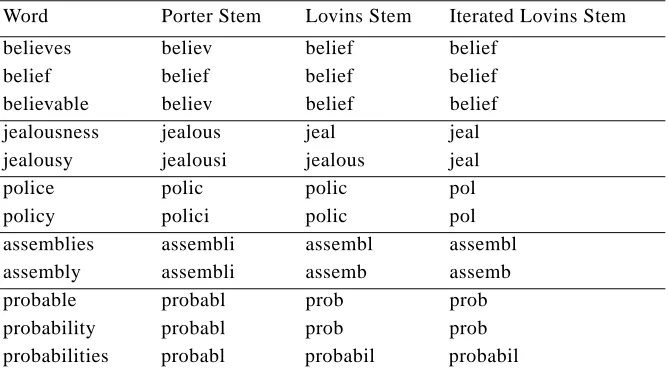
unchanged) the aggressiveness of any stemmer. Table 1 shows some examples of the
behav-iour of the three stemming algorithms.5
We may view keyphrase extraction as a classification problem. The task is to classify
5. We used an implementation of the Porter (1980) stemming algorithm written in Perl, by Jim Richardson, at the
University of Sydney, Australia. This implementation includes some extensions to Porter’s original algorithm,
to handle British spelling. It is available at http://www.maths.usyd.edu.au:8000/jimr.html. For the Lovins
(1968) stemming algorithm, we used an implementation written in C, by Linh Huynh. This implementation is
part of the MG (Managing Gigabytes) search engine, which was developed by a group of people in Australia
each word or phrase in the document into one of two categories: either it is a keyphrase or it
is not a keyphrase. We evaluate automatic keyphrase extraction by the degree to which its
classifications correspond to human-generated classifications. Our performance measure is
precision (the number of matches divided by the number of machine-generated keyphrases),
using a variety of cut-offs for the number of machine-generated keyphrases.
3. Related Work
Although there are several papers that discuss automatically extracting important phrases, as
far as we know, we are the first to treat this problem as supervised learning from examples.
Krulwich and Burkey (1996) use heuristics to extract keyphrases from a document. The
heu-ristics are based on syntactic clues, such as the use of italics, the presence of phrases in
sec-tion headers, and the use of acronyms. Their motivasec-tion is to produce phrases for use as
features when automatically classifying documents. Their algorithm tends to produce a
rela-tively large list of phrases, with low precision. Muñoz (1996) uses an unsupervised learning
algorithm to discover two-word keyphrases. The algorithm is based on Adaptive Resonance
Theory (ART) neural networks. Muñoz’s algorithm tends to produce a large list of phrases,
with low precision. Also, the algorithm is not applicable to one-word or more-than-two-word
keyphrases. Steier and Belew (1993) use the mutual information statistic to discover
two-Table 1: Samples of the behaviour of three different stemming algorithms.
Word Porter Stem Lovins Stem Iterated Lovins Stem
believes believ belief belief
belief belief belief belief
believable believ belief belief jealousness jealous jeal jeal jealousy jealousi jealous jeal
police polic polic pol
policy polici polic pol
assemblies assembli assembl assembl assembly assembli assemb assemb
probable probabl prob prob
word keyphrases. This approach has the same limitations as Muñoz (1996), when considered
as a keyphrase extraction algorithm: it produces a low precision list of two-word phrases.
In the time since this paper was submitted for publication, Frank et al. (1999) have
implemented a system, Kea, which builds on our work (Turney, 1997, 1999). It treats
key-phrase extraction as a supervised learning problem, but it uses a Bayesian approach instead
of a genetic algorithm approach. Their experiments indicate that Kea and GenEx have
statis-tically equivalent levels of performance. The same group (Gutwin et al., 1999) has evaluated
Kea as a component in a new kind of search engine, Keyphind, designed specially to support
browsing. Their experiments suggest that certain kinds of tasks are much easier with
Keyph-ind than with conventional search engines. The KeyphKeyph-ind interface is somewhat similar to
the interface of Tetranet’s Wisebot.
Several papers explore the task of producing a summary of a document by extracting key
sentences from the document (Luhn, 1958; Edmundson, 1969; Marsh et al., 1984; Paice,
1990; Paice and Jones, 1993; Johnson et al., 1993; Salton et al., 1994; Kupiec et al., 1995;
Brandow et al., 1995; Jang and Myaeng, 1997). This task is similar to the task of keyphrase
extraction, but it is more difficult. The extracted sentences often lack cohesion because
ana-phoric references are not resolved (Johnson et al., 1993; Brandow et al., 1995). Anaphors are
pronouns (e.g., “it”, “they”), definite noun phrases (e.g., “the car”), and demonstratives (e.g.,
“this”, “these”) that refer to previously discussed concepts. When a sentence is extracted out
of the context of its neighbouring sentences, it may be impossible or very difficult for the
reader of the summary to determine the referents of the anaphors. Johnson et al. (1993)
attempt to automatically resolve anaphors, but their system tends to produce overly long
summaries. Keyphrase extraction avoids this problem because anaphors (by their nature) are
not keyphrases. Also, a list of keyphrases has no structure; unlike a list of sentences, a list of
keyphrases can be randomly permuted without significant consequences.
are based on manually derived heuristics. The heuristics tend to be effective for the intended
domain, but they often do not generalize well to a new domain. Extending the heuristics to a
new domain involves a significant amount of manual work. A few of the papers describe
learning algorithms, which can be trained by supplying documents with associated target
summaries (Kupiec et al., 1995; Jang and Myaeng, 1997). Learning algorithms can be
extended to new domains with less work than algorithms that use manually derived
heuris-tics. However, there is still some manual work involved, because the training summaries
must be composed of sentences that appear in the document, which means that standard
author-supplied abstracts are not suitable. An advantage of keyphrase extraction is that
stan-dard author-supplied keyphrases are suitable for training a learning algorithm, because the
majority of such keyphrases appear in the bodies of the corresponding documents.
Another body of related work addresses the task of information extraction. An
informa-tion extracinforma-tion system seeks specific informainforma-tion in a document, according to predefined
template. The template is specific to a given topic area. For example, if the topic area is news
reports of terrorist attacks, the template might specify that the information extraction system
should identify (i) the terrorist organization involved in the attack, (ii) the victims of the
attack, (iii) the type of attack (kidnapping, murder, etc.), and other information of this type.
ARPA has sponsored a series of Message Understanding Conferences (3, 1991;
MUC-4, 1992; MUC-5, 1993; MUC-6, 1995), where information extraction systems are evaluated
with corpora in various topic areas, including terrorist attacks and corporate mergers.
Most information extraction systems are manually built for a single topic area, which
requires a large amount of expert labour. The highest performance at the Fifth Message
Understanding Conference (MUC-5, 1993) was achieved at the cost of two years of intense
programming effort. However, recent work has demonstrated that a learning algorithm can
perform as well as a manually constructed system (Soderland and Lehnert, 1994). Soderland
informa-tion extracinforma-tion system. In Soderland and Lehnert’s (1994) system, each slot in a template is
handled by a group of decision trees that have been trained specially for that slot. The
deci-sion trees are based on syntactical features of the text, such as the presence of certain words.
Information extraction and keyphrase extraction are at opposite ends of a continuum that
ranges from detailed, specific, and domain-dependent (information extraction) to condensed,
general, and domain-independent (keyphrase extraction). The different ends of this
contin-uum require substantially different algorithms. However, there are intermediate points on
this continuum. An example is the task of identifying corporate names in business news. This
task was introduced in the Sixth Message Understanding Conference (MUC-6, 1995), where
it was called the Named Entity Recognition task. The best system used hand-crafted
linguis-tic rules to recognize named entities (Krupka, 1995).
Other related work addresses the problem of automatically creating an index (Sparck
Jones, 1973; Field, 1975; Fagan, 1987; Salton, 1988; Croft et al., 1991; Ginsberg, 1993;
Nakagawa, 1997; Leung and Kan, 1997). Leung and Kan (1997) provide a good survey of
this work. There are two general classes of indexes: indexes that are intended for human
readers to browse (often called back-of-book indexes) and indexes that are intended for use
with information retrieval software (search engine indexes). Search engine indexes are not
suitable for human browsing, since they usually index every occurrence of every word
(excluding stop words) in the document collection. Back-of-book indexes tend to be much
smaller, since they index only important occurrences of interesting words and phrases. The
older work on automatically creating an index (Sparck Jones, 1973; Field, 1975; Fagan,
1987) is concerned with building search engine indexes, not with building back-of-book
indexes (Salton, 1988; Nakagawa, 1997; Leung and Kan, 1997).
Since we are interested in keyphrases for human browsing, back-of-book indexes are
more relevant than search engine indexes. Leung and Kan (1997) address the problem of
statisti-cal model for each index term in the controlled vocabulary. The statististatisti-cal model attempts to
capture the syntactic properties that distinguish documents for which the given index term is
appropriate from documents for which it is inappropriate. Their results are interesting, but
the use of a controlled vocabulary makes it difficult to compare their work with the
algo-rithms we examine here. It is also worth noting that a list of controlled index terms must
grow every year, as the body of literature grows, so Leung and Kan’s (1997) software would
need to be continuously trained.
Nakagawa (1997) automatically extracts simple and compound nouns from technical
manuals, to create back-of-book indexes. Each compound noun is scored using a formula
that is based on the frequency of its component nouns in the given document. In his
experi-ments, Nakagawa (1997) evaluates his algorithm by comparing human-generated indexes to
machine-generated indexes. However, Nakagawa’s (1997) human-generated indexes were
generated with the assistance of his algorithm, which tends to bias the results.
One feature that distinguishes a back-of-book index from a keyphrase list is length. As
Nakagawa (1997) observes, a document is typically assigned keyphrases, but a
back-of-book index typically contains index terms. Also, keyphrases are usually
intended to cover the whole document, but index terms are intended to cover only a small
part of a document. Another distinguishing feature is that a sophisticated back-of-book index
is not simply an alphabetical list of terms. There is often a hierarchical structure, where a
major index term is followed by an indented list of related minor index terms.
4. The Corpora
The experiments in this paper are based on five different document collections. For each
document, there is a target set of keyphrases, generated by hand. Some basic statistics for
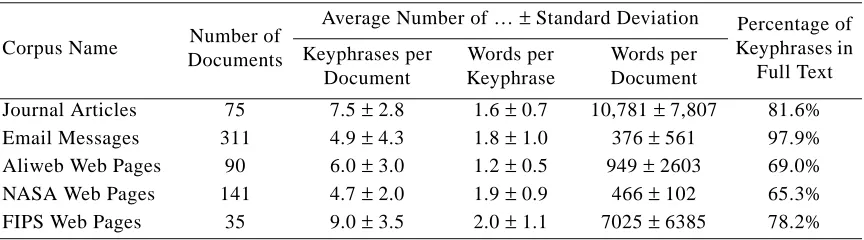
the five corpora are presented in Table 2.
For the Journal Articles corpus, we selected 75 journal articles from five different
jour-nals. Three of the journals are about cognition (Psycoloquy, The Neuroscientist, Behavioral 100∼101
& Brain Sciences Preprint Archive), one is about the hotel industry (Journal of the
Interna-tional Academy of Hospitality Research), and one is about chemistry (Journal of
Computer-Aided Molecular Design). The full text of every article is available on the web. The authors
supplied keyphrases for their articles. For the Email Messages corpus, we collected 311
email messages from six NRC employees. A university student created the keyphrases for the
messages. For the Aliweb corpus, we collected 90 web pages using the Aliweb search
engine, a public search engine provided by NEXOR.6 Aliweb has web-based fill-in form,
with a field for keyphrases, where people may enter URLs to add to Aliweb. The keyphrases
are stored in the Aliweb index, along with the URLs. For the NASA corpus, we collected 141
web pages from NASA’s Langley Research Center.7 Each page includes a list of keyphrases.
For the FIPS corpus, we gathered 35 web pages from the US government’s Federal
Informa-tion Processing Standards (FIPS).8 Each document includes a list of keyphrases.
We would like our learning algorithms to be able to perform well even when the testing
data are significantly different from the training data. In a real-world application, it would be
inconvenient if the learning algorithm required re-training for each new type of document.
Therefore our experiments do not use a random split of the documents into training and
test-ing sets. Instead, we designed the experiments to test the ability of the learntest-ing algorithms to
Table 2: Some statistics for each of the five collections.
Corpus Name Number of Documents
Average Number of … ± Standard Deviation Percentage of Keyphrases in
Full Text Keyphrases per
Document
Words per Keyphrase
Words per Document
Journal Articles 75 7.5 ± 2.8 1.6 ± 0.7 10,781 ± 7,807 81.6% Email Messages 311 4.9 ± 4.3 1.8 ± 1.0 376 ± 561 97.9% Aliweb Web Pages 90 6.0 ± 3.0 1.2 ± 0.5 949 ± 2603 69.0% NASA Web Pages 141 4.7 ± 2.0 1.9 ± 0.9 466 ± 102 65.3% FIPS Web Pages 35 9.0 ± 3.5 2.0 ± 1.1 7025 ± 6385 78.2%
6. The URL is http://www.nexor.com/public/aliweb/search/doc/form.html.
7. Available at http://tag-www.larc.nasa.gov/tops/tops_text.html.
generalize to new data.
In our preliminary experiments, we found that the main factor influencing generalization
was the average length of the documents in the training set, compared to the testing set. In a
real-world application, it would be reasonable to have two different learned models, one for
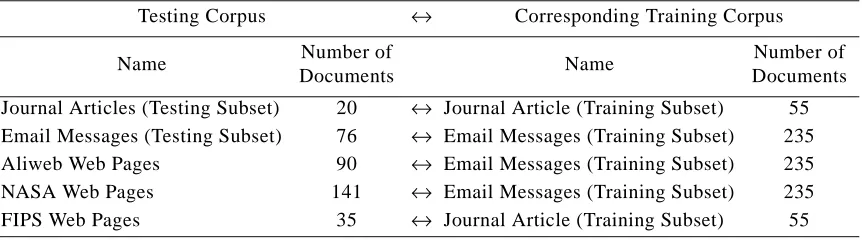
short documents and one for long documents. As Table 3 shows, we selected part of the
Jour-nal Article corpus to train the learning algorithms to handle long documents and part of the
Email Message corpus to train the learning algorithms to handle short documents. During
testing, we used the training corpus that was most similar to the given testing corpus, with
respect to document lengths.
The method for applying C4.5 to keyphrase extraction (Section 5) and the GenEx
algo-rithm (Section 7) were developed using only the training subsets of the Journal Article and
Email Message corpora (Table 3). The other three corpora were only acquired after the
com-pletion of the design of the method for applying C4.5 and the design of the GenEx algorithm.
This practice ensures that there is no risk that C4.5 and GenEx have been tuned to the testing
data.
5. Applying C4.5 to Keyphrase Extraction
In the first set of experiments, we used the C4.5 decision tree induction algorithm (Quinlan,
1993) to classify phrases as positive or negative examples of keyphrases. In this section, we
describe the feature vectors, the settings we used for C4.5’s parameters, the bagging
proce-Table 3: The correspondence between testing and training data.
Testing Corpus ↔ Corresponding Training Corpus
Name Number of
Documents Name
Number of Documents
dure, and the method for sampling the training data.
The task of supervised learning is to learn how to assign cases (or examples) to classes.
For keyphrase extraction, a case is a candidate phrase, which we wish to classify as a positive
or negative example of a keyphrase. We classify a case by examining its features. A feature
can be any property of a case that is relevant for determining the class of the case. C4.5 can
handle real-valued features, integer-valued features, and features with values that range over
an arbitrary, fixed set of symbols. C4.5 takes as input a set of training data, in which cases
are represented as feature vectors. In the training data, a teacher must assign a class to each
feature vector (hence supervised learning). C4.5 generates as output a decision tree that
mod-els the relationships among the features and the classes (Quinlan, 1993).
A decision tree is a rooted tree in which the internal vertices are labelled with tests on
feature values and the leaf vertices are labelled with classes. The edges that leave an internal
vertex are labelled with the possible outcomes of the test associated with that vertex. For
example, a feature might be, “the number of words in the given phrase,” and a test on a
fea-ture value might be, “the number of words in the given phrase is less than two,” which can
have the outcomes “true” or “false”. A case is classified by beginning at the root of the tree
and following a path to a leaf in the tree, based on the values of the features of the case. The
label on the leaf is the predicted class for the given case.
We converted the documents into sets of feature vectors by first making a list of all
phrases of one, two, or three consecutive non-stop words that appear in a given document,
with no intervening punctuation. We used the Iterated Lovins stemmer to find the stemmed
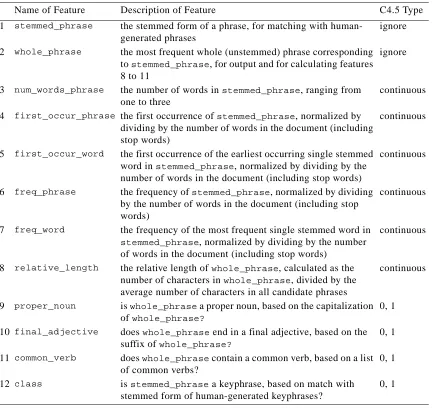
form of each of these phrases. For each unique stemmed phrase, we generated a feature
vec-tor, as described in Table 4.
C4.5 has access to nine features (features 3 to 11) when building a decision tree. The
leaves of the tree predict class (feature 12). When a decision tree predicts that the class
phrase is suitable for output for a human reader. We used the stemmed form of the phrase,
stemmed_phrase, for evaluating the performance of the tree. In our preliminary
experi-ments, we evaluated 110 different features, before we settled on the features in Table 4.
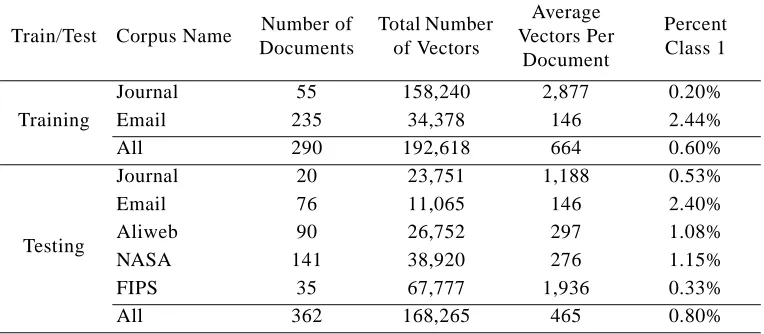
Table 5 shows the number of feature vectors that were generated for each corpus. In total,
we had more than 192,000 vectors for training and more than 168,000 vectors for testing.
The large majority of these vectors were negative examples of keyphrases (class 0).
In a real-world application, the user would want to specify the desired number of output
keyphrases for a given document. However, a standard decision tree does not let the user
con-Table 4: A description of the feature vectors used by C4.5.
Name of Feature Description of Feature C4.5 Type
1 stemmed_phrase the stemmed form of a phrase, for matching with human-generated phrases
ignore
2 whole_phrase the most frequent whole (unstemmed) phrase corresponding to stemmed_phrase, for output and for calculating features 8 to 11
ignore
3 num_words_phrase the number of words in stemmed_phrase, ranging from one to three
continuous
4 first_occur_phrase the first occurrence of stemmed_phrase, normalized by dividing by the number of words in the document (including stop words)
continuous
5 first_occur_word the first occurrence of the earliest occurring single stemmed word in stemmed_phrase, normalized by dividing by the number of words in the document (including stop words)
continuous
6 freq_phrase the frequency of stemmed_phrase, normalized by dividing by the number of words in the document (including stop words)
continuous
7 freq_word the frequency of the most frequent single stemmed word in
stemmed_phrase, normalized by dividing by the number of words in the document (including stop words)
continuous
8 relative_length the relative length of whole_phrase, calculated as the number of characters in whole_phrase, divided by the average number of characters in all candidate phrases
continuous
9 proper_noun is whole_phrase a proper noun, based on the capitalization of whole_phrase?
0, 1
10 final_adjective does whole_phrase end in a final adjective, based on the suffix of whole_phrase?
0, 1
11 common_verb does whole_phrase contain a common verb, based on a list of common verbs?
0, 1
12 class is stemmed_phrase a keyphrase, based on match with stemmed form of human-generated keyphrases?
trol the number of feature vectors that are classified as belonging in class 1. Therefore we ran
C4.5 with the -p option, which generates soft-threshold decision trees (Carter and Catlett,
1987; Quinlan, 1987, 1990, 1993). Soft-threshold decision trees can generate a probability
estimate for the class of each vector. For a given document, if the user specifies that K
key-phrases are desired, then we select the K vectors that have the highest estimated probability
of being in class 1.
In addition to the -p option, we also used -c100 and -m1 (Quinlan, 1993). These two
options maximize the bushiness of the trees. In our preliminary experiments, we found that
these parameter settings appear to work well when used in conjunction with bagging.
Bag-ging involves generating many different decision trees and allowing them to vote on the
clas-sification of each example (Breiman, 1996a, 1996b; Quinlan, 1996). In general, decision tree
induction algorithms have low bias but high variance. Bagging multiple trees tends to
improve performance by reducing variance. Bagging appears to have relatively little impact
on bias.
Because we used soft-threshold decision trees, we combined their probability estimates
by averaging them, instead of voting. In preliminary experiments with the training
docu-ments, we obtained good results by bagging 50 decision trees. Adding more trees had no
sig-nificant effect.
Table 5: The number of feature vectors for each corpus.
Train/Test Corpus Name Number of Documents
Total Number of Vectors
Average Vectors Per
Document
Percent Class 1
Training
Journal 55 158,240 2,877 0.20%
Email 235 34,378 146 2.44%
All 290 192,618 664 0.60%
Testing
Journal 20 23,751 1,188 0.53%
Email 76 11,065 146 2.40%
Aliweb 90 26,752 297 1.08%
NASA 141 38,920 276 1.15%
FIPS 35 67,777 1,936 0.33%
The standard approach to bagging is to randomly sample the training data, using
sam-pling with replacement (Breiman, 1996a, 1996b; Quinlan, 1996). In preliminary experiments
with the training data, we achieved good performance by training each of the 50 decision
trees with a random sample of 1% of the training data.
The standard approach to bagging is to ignore the class when sampling, so the
distribu-tion of classes in the sample tends to correspond to the distribudistribu-tion in the training data as a
whole. In Table 5, we see that the positive examples constitute only 0.2% to 2.4% of the total
number of examples. To compensate for this, we modified the random sampling procedure so
that 50% of the sampled examples were in class 0 and the other 50% were in class 1. This
appeared to improve performance in preliminary experiments on the training data. This
strat-egy is called stratified sampling (Deming, 1978; Buntine, 1989; Catlett, 1991; Kubat et al.,
1998). Kubat et al. (1998) found that stratified sampling significantly improved the
perfor-mance of C4.5 on highly skewed data, but Catlett (1991) reported mixed results.
Boosting is another popular technique for combining multiple decision trees (Freund and
Schapire, 1996; Quinlan, 1996; Maclin and Opitz, 1997). We chose to use bagging instead of
boosting, because the modifications to bagging that we use here (averaging soft-threshold
decision trees and stratified sampling) are simpler to apply to the bagging algorithm than to
the more complicated boosting algorithm. We believe that analogous modifications would be
required for boosting to perform well on this task.
6. Experiment 1: Learning to Extract Keyphrases with C4.5
This section presents four experiments with C4.5. In Experiment 1A, we establish a baseline
for the performance of C4.5, using the configuration described in Section 5. We bag 50 trees,
generated by randomly sampling 1% of the training data, with equal numbers of samples
from the two classes (keyphrase and non-keyphrase). In Experiment 1B, we vary the number
of trees. In Experiment 1C, we vary the ratio of the classes. In Experiment 1D, we vary the
In the baseline configuration of C4.5, we bag 50 trees, where each tree is trained on a
random sample of 1% of the training data, with equal samples from both classes. The
perfor-mance is measured by the average precision for each corpus, when the desired number of
phrases is set to 5, 7, 9, 11, 13, and 15. The average precision for a corpus is the sum of the
average precision for each document, divided by the number of documents. The precision for
an individual document is the number of matches between the human-generated keyphrases
and the machine-generated keyphrases, divided by the desired number of phrases. Matches
are determined using the Iterated Lovins stemmer.
Figure 1 shows the baseline performance of C4.5 at various cut-offs for the desired
num-ber of extracted keyphrases. The plots show the precision for the testing data only. It appears
that the e-mail model generalizes relatively well to the Aliweb and NASA corpora, but the
journal model does not generalize well to the FIPS corpus (see Table 3).9
9. The increasing slope of the curve for the FIPS corpus appears to be a statistical anomaly. Figure 5 shows a
flat-ter slope for FIPS in Experiment 1C, in which we modify the stratified sampling procedure, although the slope
is still somewhat unusual.
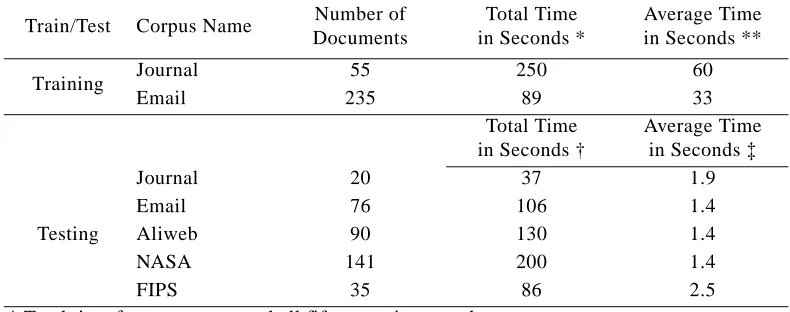
Table 6 shows the time required to train and test the baseline configuration of C4.5. The
time includes generating the feature vectors and randomly sampling the vectors.10
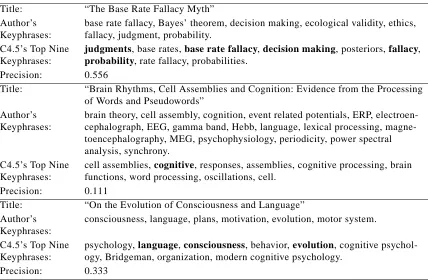
Table 7 shows the phrases selected by the baseline configuration of C4.5 for three
arti-cles from the journal article testing subset. In these three examples, the desired number of
phrases is set to nine. The phrases in bold match the author’s phrases, according to the
Iter-ated Lovins stemming algorithm.11
Experiment 1B tests the hypothesis that bagging improves the performance of C4.5 on
the task of automatic keyphrase extraction. Figure 2 shows the precision when the desired
number of phrases is set to 5, 7, 9, 11, 13, and 15. The number of trees is set to 1, 25, and 50.
Table 6: Experiment 1A: Training and testing time for the baseline configuration of C4.5.
Train/Test Corpus Name Number of Documents
Total Time in Seconds *
Average Time in Seconds **
Training Journal 55 250 60
Email 235 89 33
Total Time in Seconds †
Average Time in Seconds ‡
Testing
Journal 20 37 1.9
Email 76 106 1.4
Aliweb 90 130 1.4
NASA 141 200 1.4
FIPS 35 86 2.5
* Total time for one corpus and all fifty trees in seconds. ** Average time for one corpus and one tree in seconds. † Total time for one corpus and all fifty trees in seconds. ‡ Average time for one document and all fifty trees in seconds.
10. The decision tree routines were written by Quinlan (1993). We wrote the feature vector generation routines
and the random sampling routines. The code was carefully written for speed. All of the code was written in C
and executed on a Pentium II 233 running Windows NT 4.0.
11. The duplication of “probability” and “probabilities” in C4.5’s keyphrases for the first document is due to the
limitations of the Iterated Lovins stemming algorithm (see Table 1). Usually duplication of this kind is
elimi-nated during the formation of the feature vectors (see Section 5), since there is only one vector for each unique
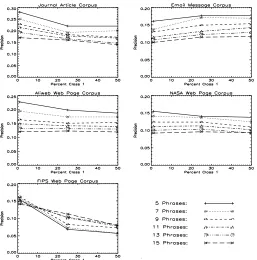
For four of the corpora, the precision tends to rise as the number of trees increases. The
exception is the FIPS corpus. As we noted for Experiment 1A, C4.5 has difficulty in
general-izing from the journal article training data to the FIPS testing data.
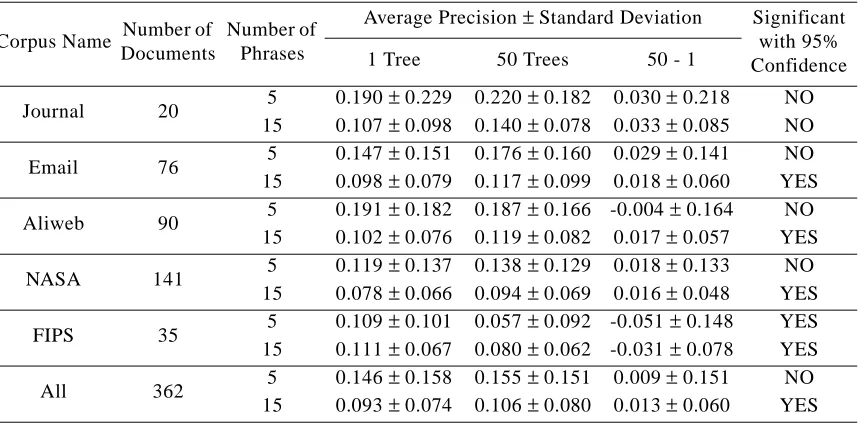
In Table 8, we test the significance of this rising trend, using a paired t-test (Fraser, 1976;
Feelders and Verkooijen, 1995). The table shows that, when we look at the five testing
col-lections together, 50 trees are significantly more precise than 1 tree, when the desired
num-ber of phrases is set to 15. The only case in which 50 trees are significantly worse than 1 tree
is with the FIPS collection.
Experiment 1C tests the hypothesis that stratified sampling (Deming, 1978; Buntine,
1989; Catlett, 1991; Kubat et al., 1998) can help C4.5 handle the skewed class distribution.
Figure 3 shows the precision when the percentage of examples in class 1 (positive examples
of keyphrases) is set to 1%, 25%, and 50%. For at least three of the corpora, precision tends
to fall as the percentage increases.
Table 7: Experiment 1A: Examples of the selected phrases for three articles.
Title: “The Base Rate Fallacy Myth” Author’s
Keyphrases:
base rate fallacy, Bayes’ theorem, decision making, ecological validity, ethics, fallacy, judgment, probability.
C4.5’s Top Nine Keyphrases:
judgments, base rates, base rate fallacy, decision making, posteriors, fallacy, probability, rate fallacy, probabilities.
Precision: 0.556
Title: “Brain Rhythms, Cell Assemblies and Cognition: Evidence from the Processing of Words and Pseudowords”
Author’s Keyphrases:
brain theory, cell assembly, cognition, event related potentials, ERP, electroen-cephalograph, EEG, gamma band, Hebb, language, lexical processing, magne-toencephalography, MEG, psychophysiology, periodicity, power spectral analysis, synchrony.
C4.5’s Top Nine Keyphrases:
cell assemblies, cognitive, responses, assemblies, cognitive processing, brain functions, word processing, oscillations, cell.
Precision: 0.111
Title: “On the Evolution of Consciousness and Language” Author’s
Keyphrases:
consciousness, language, plans, motivation, evolution, motor system.
C4.5’s Top Nine Keyphrases:
psychology, language, consciousness, behavior, evolution, cognitive psychol-ogy, Bridgeman, organization, modern cognitive psychology.
Table 8: Experiment 1B: A comparison of 50 trees with 1 tree.
Corpus Name Number of Documents
Number of Phrases
Average Precision ± Standard Deviation Significant with 95% Confidence 1 Tree 50 Trees 50 - 1
Journal 20 5 0.190 ± 0.229 0.220 ± 0.182 0.030 ± 0.218 NO 15 0.107 ± 0.098 0.140 ± 0.078 0.033 ± 0.085 NO
Email 76 5 0.147 ± 0.151 0.176 ± 0.160 0.029 ± 0.141 NO 15 0.098 ± 0.079 0.117 ± 0.099 0.018 ± 0.060 YES
Aliweb 90 5 0.191 ± 0.182 0.187 ± 0.166 -0.004 ± 0.164 NO 15 0.102 ± 0.076 0.119 ± 0.082 0.017 ± 0.057 YES
NASA 141 5 0.119 ± 0.137 0.138 ± 0.129 0.018 ± 0.133 NO 15 0.078 ± 0.066 0.094 ± 0.069 0.016 ± 0.048 YES
FIPS 35 5 0.109 ± 0.101 0.057 ± 0.092 -0.051 ± 0.148 YES 15 0.111 ± 0.067 0.080 ± 0.062 -0.031 ± 0.078 YES
Table 9 shows that, when we look at the five testing collections together, there is a
signif-icant drop in precision when 50% of the samples are positive examples, compared to 1%.
Only the email collection appears to benefit from balanced sampling of the classes. We must
Table 9: Experiment 1C: A comparison of 1% positive examples with 50% positive examples.
Corpus Name Number of Documents
Number of Phrases
Average Precision ± Standard Deviation Significant with 95% Confidence 1% Class 1 50% Class 1 50 - 1
Journal 20 5 0.280 ± 0.255 0.220 ± 0.182 -0.060 ± 0.216 NO 15 0.170 ± 0.113 0.140 ± 0.078 -0.030 ± 0.103 NO
Email 76 5 0.161 ± 0.160 0.176 ± 0.160 0.016 ± 0.145 NO 15 0.100 ± 0.081 0.117 ± 0.099 0.017 ± 0.055 YES
Aliweb 90 5 0.227 ± 0.190 0.187 ± 0.166 -0.040 ± 0.135 YES 15 0.120 ± 0.074 0.119 ± 0.082 -0.001 ± 0.048 NO
NASA 141 5 0.155 ± 0.159 0.138 ± 0.129 -0.017 ± 0.138 NO 15 0.092 ± 0.068 0.094 ± 0.069 0.001 ± 0.045 NO
FIPS 35 5 0.154 ± 0.162 0.057 ± 0.092 -0.097 ± 0.184 YES 15 0.141 ± 0.066 0.080 ± 0.062 -0.061 ± 0.063 YES
reject the hypothesis that stratified sampling (Deming, 1978; Buntine, 1989; Catlett, 1991;
Kubat et al., 1998) is useful for our data. Although our preliminary experiments with the
training data suggested that stratified sampling would be beneficial, the hypothesis is not
supported by the testing data.
Experiment 1D tests the hypothesis that sampling 1% of the training data results in better
precision than larger samples. Figure 4 shows the precision when the sample size is 1%,
25%, and 50%. For three of the copora, increasing the sample size tends to decrease the
pre-cision. The exceptions are the email message corpus and the FIPS web page corpus.
In Table 10, we test the significance of this trend, using a paired t-test. The table shows
that, when we look at the five testing collections together, a 1% sample rate yields better
pre-cision than a 50% sample rate, when the desired number of phrases is set to 15. This supports
the hypothesis that a relatively small sample size is better for bagging than a large sample.
This is expected, since bagging works best when the combined models are heterogeneous
(Breiman, 1996a, 1996b; Quinlan, 1996). Increasing the sample size tends to make the
mod-els more homogenous.
7. GenEx: A Hybrid Genetic Algorithm for Keyphrase Extraction
We have experimented with many ways of applying C4.5 to automatic keyphrase extraction.
The preceding section presented a few of these experiments. During the course of our
exper-imentation, we came to believe that a tailor-made algorithm for learning to extract
key-phrases might be able to achieve better precision than a general-purpose learning algorithm
such as C4.5. As we discuss in Section 10, the main insight that we gained from working
with C4.5 was that we might achieve better performance in this domain if we could find a
way to embed specialized procedural domain knowledge into our keyphrase extraction
algo-rithm. This motivated us to develop the GenEx algoalgo-rithm.
GenEx has two components, the Genitor genetic algorithm (Whitley, 1989) and the
Extractor keyphrase extraction algorithm (Turney, 1997, 1999). Extractor takes a document
as input and produces a list of keyphrases as output. Extractor has twelve parameters that
determine how it processes the input text. In GenEx, the parameters of Extractor are tuned by
Table 10: Experiment 1D: A comparison of 1% sample rate with 50% sample rate.
Corpus Name Number of Documents
Number of Phrases
Average Precision ± Standard Deviation Significant with 95% Confidence 1%
Sample Rate
50%
Sample Rate 50 - 1
Journal 20 5 0.220 ± 0.182 0.160 ± 0.139 -0.060 ± 0.131 NO 15 0.140 ± 0.078 0.140 ± 0.094 0.000 ± 0.061 NO
Email 76 5 0.176 ± 0.160 0.187 ± 0.161 0.011 ± 0.146 NO 15 0.117 ± 0.099 0.113 ± 0.102 -0.004 ± 0.062 NO
Aliweb 90 5 0.187 ± 0.166 0.153 ± 0.144 -0.033 ± 0.168 NO 15 0.119 ± 0.082 0.094 ± 0.071 -0.025 ± 0.064 YES
NASA 141 5 0.138 ± 0.129 0.126 ± 0.136 -0.011 ± 0.143 NO 15 0.094 ± 0.069 0.079 ± 0.057 -0.014 ± 0.055 YES
FIPS 35 5 0.057 ± 0.092 0.091 ± 0.112 0.034 ± 0.133 NO 15 0.080 ± 0.062 0.099 ± 0.059 0.019 ± 0.050 YES
the Genitor genetic algorithm (Whitley, 1989), to maximize performance (fitness) on training
data. Genitor is used to tune Extractor, but Genitor is no longer needed once the training
pro-cess is complete. When we know the best parameter values, we can discard Genitor. Thus the
learning system is called GenEx (Genitor plus Extractor) and the trained system is called
Extractor (GenEx minus Genitor).
7.1 Extractor
What follows is a conceptual description of the Extractor algorithm. For clarity, we describe
Extractor at an abstract level that ignores efficiency considerations. That is, the actual
Extractor software is essentially an efficient implementation of the following algorithm.12 In
the following, the twelve parameters appear in small capitals (see Table 11 for a list of the
parameters). There are ten steps to the Extractor algorithm:
1. Find Single Stems: Make a list of all of the words in the input text. Drop words with less
than three characters. Drop stop words, using a given stop word list. Convert all
remain-ing words to lower case. Stem the words by truncatremain-ing them at STEM_LENGTH characters.
The advantages of this simple form of stemming (stemming by truncation) are speed and
flexibility. Stemming by truncation is much faster than either the Lovins (1968) or Porter
(1980) stemming algorithms. The aggressiveness of the stemming can be adjusted by
chang-ing STEM_LENGTH. This gives Genitor control over the level of aggressiveness.
2. Score Single Stems: For each unique stem, count how often the stem appears in the text
and note when it first appears. If the stem “evolut” first appears in the word “Evolution”,
and “Evolution” first appears as the tenth word in the text, then the first appearance of
“evolut” is said to be in position 10. Assign a score to each stem. The score is the number
of times the stem appears in the text, multiplied by a factor. If the stem first appears
12. Extractor is written in C. A demonstration version of Extractor is available at http://extractor.iit.nrc.ca/. The
before FIRST_LOW_THRESH, then multiply the frequency by FIRST_LOW_FACTOR. If the
stem first appears after FIRST_HIGH_THRESH, then multiply the frequency by
FIRST_HIGH_FACTOR.
Typically FIRST_LOW_FACTOR is greater than one and FIRST_HIGH_FACTOR is less than one.
Thus, early, frequent stems receive a high score and late, rare stems receive a low score. This
gives Genitor control over the weight of early occurrence versus the weight of frequency.
3. Select Top Single Stems: Rank the stems in order of decreasing score and make a list of
the top NUM_WORKING single stems.
Cutting the list at NUM_WORKING, as opposed to allowing the list to have an arbitrary length,
improves the efficiency of Extractor. It also acts as a filter for eliminating lower quality
stems.
4. Find Stem Phrases: Make a list of all phrases in the input text. A phrase is defined as a
sequence of one, two, or three words that appear consecutively in the text, with no
inter-vening stop words or punctuation. Stem each phrase by truncating each word in the
phrase at STEM_LENGTH characters.
In our corpora, phrases of four or more words are relatively rare. Therefore Extractor only
considers phrases of one, two, or three words.
5. Score Stem Phrases: For each stem phrase, count how often the stem phrase appears in
the text and note when it first appears. Assign a score to each phrase, exactly as in step 2,
using the parameters FIRST_LOW_FACTOR, FIRST_LOW_THRESH, FIRST_HIGH_FACTOR, and
FIRST_HIGH_THRESH. Then make an adjustment to each score, based on the number of
stems in the phrase. If there is only one stem in the phrase, do nothing. If there are two
stems in the phrase, multiply the score by FACTOR_TWO_ONE. If there are three stems in
the phrase, multiply the score by FACTOR_THREE_ONE.
adjust-ment will increase the score of longer phrases. A phrase of two or three stems is necessarily
never more frequent than the most frequent single stem contained in the phrase. The factors
FACTOR_TWO_ONE and FACTOR_THREE_ONE are designed to boost the score of longer
phrases, to compensate for the fact that longer phrases are expected to otherwise have lower
scores than shorter phrases.
6. Expand Single Stems: For each stem in the list of the top NUM_WORKING single stems,
find the highest scoring stem phrase of one, two, or three stems that contains the given
single stem. The result is a list of NUM_WORKING stem phrases. Keep this list ordered by
the scores calculated in step 2.
Now that the single stems have been expanded to stem phrases, we no longer need the scores
that were calculated in step 5. That is, the score for a stem phrase (step 5) is now replaced by
the score for its corresponding single stem (step 2). The reason is that the adjustments to the
score that were introduced in step 5 are useful for expanding the single stems to stem
phrases, but they are not useful for comparing or ranking stem phrases.
7. Drop Duplicates: The list of the top NUM_WORKING stem phrases may contain
dupli-cates. For example, two single stems may expand to the same two-word stem phrase.
Delete duplicates from the ranked list of NUM_WORKING stem phrases, preserving the
highest ranked phrase.
For example, suppose that the stem “evolu” (e.g., “evolution” truncated at five characters)
appears in the fifth position in the list of the top NUM_WORKING single stems and “psych”
(e.g., “psychology” truncated at five characters) appears in the tenth position. When the
sin-gle stems are expanded to stem phrases, we might find that “evolu psych” (e.g.,
“evolution-ary psychology” truncated at five characters) appears in the fifth and tenth positions in the
list of stem phrases. In this case, we delete the phrase in the tenth position. If there are
dupli-cates, then the list now has fewer than NUM_WORKING stem phrases.
corre-sponding whole phrase in the input text. For example, if “evolutionary psychology”
appears ten times in the text and “evolutionary psychologist” appears three times, then
“evolutionary psychology” is the more frequent corresponding whole phrase for the stem
phrase “evolu psych”. When counting the frequency of whole phrases, if a phrase has an
ending that indicates a possible adjective, then the frequency for that whole phrase is set
to zero. An ending such as “al”, “ic”, “ible”, etc., indicates a possible adjective.
Adjec-tives in the middle of a phrase (for example, the second word in a three-word phrase) are
acceptable; only phrases that end in adjectives are penalized. Also, if a phrase contains a
verb, the frequency for that phrase is set to zero. To check for verbs, we use a list of
com-mon verbs. A word that might be either a noun or a verb is included in this list only when
it is much more common for the word to appear as a verb than as a noun.
For example, suppose the input text contains “manage”, “managerial”, and “management”. If
STEM_LENGTH is, say, five, the stem “manag” will be expanded to “management” (a noun),
because the frequency of “managerial” will be set to zero (because it is an adjective, ending
in “al”) and the frequency of “manage” will be set to zero (because it is a verb, appearing in
the list of common verbs). Although “manage” and “managerial” would not be output, their
presence in the input text helps to boost the score of the stem “manag” (as measured in
step 2), and thereby increase the likelihood that “management” will be output.
9. Add Capitals: For each of the whole phrases (phrases with suffixes added), find the best
capitalization, where best is defined as follows. For each word in a phrase, find the
talization with the least number of capitals. For a one-word phrase, this is the best
capi-talization. For a two-word or three-word phrase, this is the best capitalization, unless the
capitalization is inconsistent. The capitalization is said to be inconsistent when one of
the words has the capitalization pattern of a proper noun but another of the words does
not appear to be a proper noun (e.g., “Turing test”). When the capitalization is
lowest number of capitals (e.g., “Turing Test”). If it cannot be made consistent, use the
inconsistent capitalization. If it can be made consistent, use the consistent capitalization.
For example, given the phrase “psychological association”, the word “association” might
appear in the text only as “Association”, whereas the word “psychological” might appear in
the text as “PSYCHOLOGICAL”, “Psychological”, and “psychological”. Using the least
number of capitals, we get “psychological Association”, which is inconsistent. However, it
can be made consistent, as “Psychological Association”.
10. Final Output: We now have an ordered list of mixed-case (upper and lower case, if
appropriate) phrases with suffixes added. The list is ordered by the scores calculated in
step 2. That is, the score of each whole phrase is based on the score of the highest scoring
single stem that appears in the phrase. The length of the list is at most NUM_WORKING,
and is likely less, due to step 7. We now form the final output list, which will have at
most NUM_PHRASES phrases. We go through the list of phrases in order, starting with the
top-ranked phrase, and output each phrase that passes the following tests, until either
NUM_PHRASES phrases have been output or we reach the end of the list. The tests are (1)
the phrase should not have the capitalization of a proper noun, unless the flag
SUPPRESS_PROPER is set to 0 (if 0 then allow proper nouns; if 1 then suppress proper
nouns); (2) the phrase should not have an ending that indicates a possible adjective; (3)
the phrase should be longer than MIN_LENGTH_LOW_RANK, where the length is measured
by the ratio of the number of characters in the candidate phrase to the number of
charac-ters in the average phrase, where the average is calculated for all phrases in the input text
that consist of one to three consecutive non-stop words; (4) if the phrase is shorter than
MIN_LENGTH_LOW_RANK, it may still be acceptable, if its rank in the list of candidate
phrases is better than (closer to the top of the list than) MIN_RANK_LOW_LENGTH; (5) if
the phrase fails both tests (3) and (4), it may still be acceptable, if its capitalization
words that are most commonly used as verbs; (7) the phrase should not match any
phrases in a given list of stop phrases (where “match” means equal strings, ignoring case,
but including suffixes).
That is, a phrase must pass tests (1), (2), (6), (7), and at least one of tests (3), (4), and (5).
Although our experimental procedure does not consider capitalization or suffixes when
comparing machine-generated keyphrases to human-generated keyphrases, steps 8 and 9 are
still useful, because some of the screening tests in step 10 are based on capitalization and
suffixes. Of course, steps 8 and 9 are essential when the output is for human readers.
7.2 Genitor
A genetic algorithm may be viewed as a method for optimizing a string of bits, using
tech-niques that are inspired by biological evolution. A genetic algorithm works with a set of bit
strings, called a population of individuals. The initial population is usually randomly
gener-ated. New individuals (new bit strings) are created by randomly changing existing
individu-als (this operation is called mutation) and by combining substrings from parents to make new
children (this operation is called crossover). Each individual is assigned a score (called its
fitness) based on some measure of the quality of the bit string, with respect to a given task.
Fitter individuals get to have more children than less fit individuals. As the genetic algorithm
runs, new individuals tend to be increasingly fit, up to some asymptote.
Genitor is a steady-state genetic algorithm (Whitley, 1989), in contrast to many other
genetic algorithms, such as Genesis (Grefenstette 1983, 1986), which are generational.13 A
generational genetic algorithm updates its entire population in one batch, resulting in a
sequence of distinct generations. A steady-state genetic algorithm updates its population one
individual at a time, resulting in a continuously changing population, with no distinct
gener-ations. Typically a new individual replaces the least fit individual in the current population.
Whitley (1989) suggests that steady-state genetic algorithms tend to be more aggressive
(they have greater selective pressure) than generational genetic algorithms.
7.3 GenEx
The parameters in Extractor are set using the standard machine learning paradigm of
super-vised learning. The algorithm is tuned with a dataset, consisting of documents paired with
target lists of keyphrases. The dataset is divided into training and testing subsets. The
learn-ing process involves adjustlearn-ing the parameters to maximize the match between the output of
Extractor and the target keyphrase lists, using the training data. The success of the learning
process is measured by examining the match using the testing data.
We assume that the user sets the value of NUM_PHRASES, the desired number of phrases,
to a value between five and fifteen. We then set NUM_WORKING to . The
remaining ten parameters are set by Genitor. Genitor uses a binary string of 72 bits to
repre-sent the ten parameters, as shown in Table 11. We run Genitor with a population size of 50
for 1050 trials (these are default settings). Each trial consists of running Extractor with the
parameter settings specified in the given binary string, processing the entire training set. The
fitness measure for the binary string is based on the average precision for the whole training
set. The final output of Genitor is the highest scoring binary string. Ties are broken by
choos-ing the earlier strchoos-ing.
We first tried to use the average precision on the training set as the fitness measure, but
GenEx discovered that it could achieve high average precision by adjusting the parameters so
that less than NUM_PHRASES phrases were output. This is not desirable, so we modified the
fitness measure to penalize GenEx when less than NUM_PHRASES phrases were output:
(1)
(2)
(3)
(4)
5⋅NUM_PHRASES
total_matches = total number of matches between GenEx and human
total_machine_phrases = total number of phrases output by GenEx
precision = total_matches ⁄ total_machine_phrases
(5)
(6)
(7)
The penalty factor varies between 0 and 1. It has no effect (i.e., it is 1) when the number of
phrases output by GenEx equals the desired number of phrases. The penalty grows (i.e., it
approaches 0) with the square of the gap between the desired number of phrases and the
actual number of phrases. Preliminary experiments on the training data confirmed that this
fitness measure led GenEx to find parameter values with high average precision while
ensur-ing that NUM_PHRASES phrases were output.
Since STEM_LENGTH is modified by Genitor during the GenEx learning process, the
fit-ness measure used by Genitor is not based on stemming by truncation. If the fitfit-ness measure
were based on stemming by truncation, a change in STEM_LENGTH would change the
appar-ent fitness, even if the actual output keyphrase list remained constant. Therefore fitness is
measured with the Iterated Lovins stemmer.
We ran Genitor with a Selection Bias of 2.0 and a Mutation Rate of 0.2. These are the
Table 11: The twelve parameters of Extractor, with types and ranges.
Parameter
Number Parameter Name
Parameter
Type Parameter Range Number of Bits
1 NUM_PHRASES * integer [5, 15] 0 *
2 NUM_WORKING † integer [25, 75] 0 †
3 FACTOR_TWO_ONE real [1, 3] 8
4 FACTOR_THREE_ONE real [1, 5] 8
5 MIN_LENGTH_LOW_RANK real [0.3, 3.0] 8
6 MIN_RANK_LOW_LENGTH integer [1, 20] 5
7 FIRST_LOW_THRESH integer [1, 1000] 10
8 FIRST_HIGH_THRESH integer [1, 4000] 12
9 FIRST_LOW_FACTOR real [1, 15] 8
10 FIRST_HIGH_FACTOR real [0.01, 1.0] 8
11 STEM_LENGTH integer [1, 10] 4
12 SUPPRESS_PROPER boolean [0, 1] 1
Total Number of Bits in Binary String: 72 * This parameter is set by the user to the desired value.
† This parameter is set to five times NUM_PHRASES.
total_desired = num_docs⋅NUM_PHRASES
default settings for Genitor. We used the Adaptive Mutation operator and the Reduced
Surro-gate Crossover operator (Whitley, 1989). Adaptive Mutation determines the appropriate level
of mutation for a child according to the hamming distance between its two parents; the less
the difference, the higher the mutation rate. Reduced Surrogate Crossover first identifies all
positions in which the parent strings differ. Crossover points are only allowed to occur in
these positions.
A comparison of Extractor with the feature vectors we used with C4.5 shows that GenEx
and C4.5 are learning with essentially the same feature sets. The two algorithms have access
to the same information, but they learn different kinds of models of keyphrases. Here are
some of the more significant differences between GenEx and C4.5 (as we have used it here):
1. Given a set of phrases with a shared single-word stem (for example, the set of phrases
{“learning”, “machine learning”, “learnability”} shares the single-word stem “learn”),
GenEx tends to choose the best member of the set, rather than choosing the whole set.
GenEx first identifies the shared single-word stem (steps 1 to 3) and then looks for the
best representative phrase in the set (steps 4 to 6). C4.5 tends to choose several members
from the set, if it chooses any of them.14
2. GenEx can adjust the aggressiveness of the stemming, by adjusting STEM_LENGTH. C4.5
must take the stems that are given in the training data.15
3. C4.5 is designed to yield high accuracy. GenEx is designed to yield high precision for a
given NUM_PHRASES. High precision does not necessarily correspond to high accuracy.
4. C4.5 uses the same model (the same set of decision trees) for all values of
14. It would be possible to add a post-processing step that winnows the phrases selected by C4.5, but this would
be a step down the path that leads from the general-purpose C4.5 algorithm to the custom-made GenEx
algo-rithm. See the discussion in Section 10.
15. Again, it would be possible to adjust the stemming procedure externally, by cross-validation, but this is
NUM_PHRASES. With C4.5, We select the top NUM_PHRASES most probable feature
vec-tors, but our estimate of probability is not sensitive to the value of NUM_PHRASES. On the
other hand, Genitor tunes Extractor differently for each desired value of NUM_PHRASES.
5. GenEx might output less than the desired number of phrases, NUM_PHRASES, but C4.5 (as
we use it here) always generates exactly NUM_PHRASES phrases. Therefore, in the
follow-ing experiments, performance is measured by the average precision, where precision is
defined by (8), not by (9). Equation (8) ensures that GenEx cannot spuriously boost its
score by generating fewer phrases than the user requests.16
(8)
(9)
8. Experiment 2: Learning to Extract Keyphrases with GenEx
This set of experiments compares GenEx to C4.5. In Figure 5, we compare GenEx to both
the baseline configuration of C4.5 (Experiment 1A) and the best configuration of C4.5
(Experiment 1C). It is not quite fair to GenEx to use the best configuration of C4.5, because
we only know that it is the best by looking at the testing data, but GenEx does not have the
advantage of any information from the testing data. However, the performance of GenEx is
good enough that we can afford to be generous to C4.5.
Figure 5 shows the average precision on each testing corpus, with the desired number of
phrases set to 5, 7, 9, 11, 13, and 15. In Table 12, we test the significance of the difference
between GenEx and the best configuration of C4.5. The table shows that, when we look at
the five testing collections together, GenEx is significantly more precise. There is no case in
which the performance of GenEx is below the performance of C4.5.
Table 13 shows the training and testing time for GenEx. For ease of comparison, we have
16. If GenEx does generate fewer than NUM_PHRASES phrases, then we could randomly select further phrases
until we have NUM_PHRASES phrases. Thus (8) does not misrepresent the performance of GenEx. Note that we
do not use the fitness measure (7) to evaluate the performance of GenEx.
precision = number of matches ⁄ desired number of machine-generated phrases
reproduced the comparable times from Table 6. Unlike C4.5, GenEx was trained separately
for each of the six values of NUM_PHRASES, 5, 7, 9, 11, 13, and 15. In comparison with C4.5, Table 12: A comparison of GenEx (Experiment 2) with C4.5 (Experiment 1C).
Corpus Name Number of Documents
Number of Phrases
Average Precision ± Standard Deviation Significant with 95% Confidence GenEx C4.5 (1C) GenEx - C4.5
Journal 20 5 0.290 ± 0.247 0.280 ± 0.255 0.010 ± 0.137 NO 15 0.177 ± 0.130 0.170 ± 0.113 0.007 ± 0.061 NO
Email 76 5 0.234 ± 0.205 0.161 ± 0.160 0.074 ± 0.166 YES 15 0.122 ± 0.105 0.100 ± 0.081 0.022 ± 0.073 YES
Aliweb 90 5 0.264 ± 0.177 0.227 ± 0.190 0.038 ± 0.185 NO 15 0.122 ± 0.077 0.120 ± 0.074 0.002 ± 0.077 NO
NASA 141 5 0.206 ± 0.172 0.155 ± 0.159 0.051 ± 0.136 YES 15 0.118 ± 0.080 0.092 ± 0.068 0.026 ± 0.068 YES
FIPS 35 5 0.286 ± 0.170 0.154 ± 0.162 0.131 ± 0.222 YES 15 0.164 ± 0.078 0.141 ± 0.066 0.023 ± 0.081 NO