Themed Section: Science and Technology
An implementation of Object Tracking using Modified Mean
Shift Algorithm
Piyali Deb1, Shubhangini Ugale2
Department of Electronics and Comm. Engg / G. H. R.A.E.T., Nagpur, India
ABSTRACT
Visual object tracking is a challenging problem in computer vision. To achieve the goal of object tracking we need to obtain a feature vector which is capable of identifying the object to be tracked despite of presence of translation in the view field, at the minimum.The change in scale of the object due to motion along the perpendicular to the line of sight adds to its complexity. In this work we have be able to implement an object tracking system using the MATLAB environment. The system uses the mean shift algorithm, which is based on color channel histogram analysis and the algorithm is modified that it includes the object texture information using the LBP operator. We have been able to enhance the object tracking capability of the system.
I.
INTRODUCTION
The real-time target tracking is a hot topic in computer vision application, which is widely used in the fields such as intelligent transportation, military surveillance, medical diagnosis, intelligent home, human-computer interaction and so on. The essence of target tracking is to determine the target position in image frames and then to associate front and rear frames for obtaining the target trajectory. The tracking algorithm should be able to adapt to a wide variety of complex environment, such as illumination changes, background interference and target occlusion. A popular algorithm in moving target tracking area is Mean Shift (MS) method [1], which receives the widespread attention with its low computational complexity and real-time performance.
Object detection is one of the most important tasks of computer vision and as such has received considerable atten- tion from the research community. Typically object detectors identify one or more bounding boxes in the image containing an object and associate a category label to it. These detectors are specific for
each class of objects, and for certain domains exist a vast literature of specialized methods, such as face detection [9] and pedestrian detection [11]. In recent years the objectness measure, that quantifies how likely an image window is containing an object of any class [2], has become popular [3], [8] . The popularity of objectness proposal methods lies in the fact that they can be used as a pre-processing step for object detection to speed up specific object detectors.
related to cascade methods which perform a preliminary fast, although inaccurate, classification to discard the vast majority of unpromising proposals. Reducing the search space of object bounding boxes has also the advantage of reducing the false positive rate of the object detector.
The great majority of methods for objectness proposal have dealt with images, while approaches to video objectness proposal are oriented toward segmentation in supervoxels , deriving objectness measures from the “tubes” of superpixels that form them . This process is often computation- ally expensive and requires to process the whole video.
II.
LITERATURE REVIEW
JI Xiaoyan, QU Shiru in their work“A Target Tracking Algorithm Based on Mean Shift with Feature Fusion” have proposed an improved Mean Shift tracking algorithm based on texture and color feature fusion.. Experimental results show that the proposed algorithm is more robust and more adaptable than the classic Mean Shift and Particle Filter methods in complex environment, such as the similar background colors, rapid illumination changes and full occlusion.
K. V sriharsha et al in their work “Dynamic scene analysis using Kalman filter and mean shift tracking algorithms” have presented a work which is about locating a moving object (or multiple objects) over a time using a stationary camera and associating it in consecutive video frames. In this perspective, a video captured by digital camera is used for motion analysis. In the first stage of experiment background subtraction and frame differencing algorithms are used for object detection and its motion is estimated by associating the centroid of the moving object in each differenced frame. . In the second stage of experiment same algorithm is chosen for object detection but motion of each
best estimate is made by combining the knowledge of prediction and correction mechanisms that were incorporated as part of Kalman filter design. The idea of combining Kalman filter theory and mean shift theory has given a direction in bringing out the efficient and reliable tracking results in case of partial occlusion.
Songmin Jia in his work tilted as “Improved Target Tracking Based on Spatio-Temporal Learning
has proposed a template- matching algorithm is an efficient and fast detection algorithm that find the maximum probability point in the image that similar to the template. In order to decrease the calculating time, the search region is not the whole image but the context region of STC tracking method. What’s more, after tracking and detecting we update the scale parameter to adapt the change of the target’s appearance. Finally, experimental results demonstrate that the tracking method has improved the robustness of tracking.
On the basis of literature review carried out we observe that Visual object tracking is a challenging problem in computer vision. A feature vector is required that identifies the object to be tracked such that the tracking system is able to track the object in the presence of translation in the view field, at the minimum. An added complexity to the problem is change in scale of the object due to motion along the perpendicular to the line of sight. A currently intractable problem with object tracking is rotation of the object perpendicular to the plane of the visual field, so our study will be limited to two dimensional visual fields.
The aim of their work is to implement an object tracking system using the MATLAB environment. The algorithm to be used is the mean shift algorithm, which is based on color channel histogram analysis. The mean shift algorithm is modified so as to include object texture information using the LBP operator. This will enhance the object tracking capability of the system. This will be accomplished in the following way:
1. Implementation of mean shift algorithm using MATLAB.
2. Implementation of local binary pattern algorithm using MATLAB.
3. Conversion of video feed to frames.
4. Determination of mean shift feature vector and LBP feature vector.
5. All the above will be combined into the final object tracking system.
6. Validation of the system using open source datasets available online.
7. Analysis of system performance and comparison with benchmarks available in the literature.
III. PROPOSED METHODOLOGY
Figure 1. Overall Approach
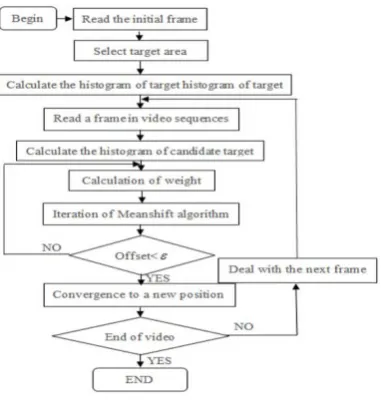
Figure 2. Detailed Flow Diagram
3.1 Mean Shift Tracking
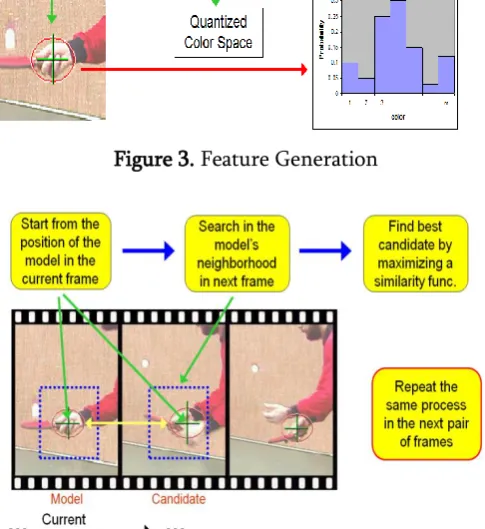
Figure 3. Feature Generation
Figure 4. Mean Shift Action
3.2 LBP Texture Feature
Texture is a visual feature revealing homogeneous phenomenon in image, which reflects the spatial structure of the target with independent on the color or brightness, and has the characteristics of rotational invariance and strong noise immunity. Gray level co-occurrence matrix method and Gabor filtering method are more commonly used among various methods of target texture extraction, both of which have the disadvantages of high computational complexity and much redundant information of extracted texture features. In summary, the LBP operator is chosen to extract texture feature in their paper with fast computation, low complexity and gray-scale invariance.
LBP operator works by the means of thresholding pixels in the neighborhood of the pixel and considering the result as a binary number, then the LBP value is obtained with the binary number converted to a decimal number.
Figure 5. LBP Calculation
3.3 Target Occlusion
The target will be lost with classic MS tracking algorithm since Bhattacharyya coefficient dramatically reduces when the target is completely occluded. Kalman filter is used to solve this problem as the prediction compensation of occluded target. It is feasible to assume that the target is uniform motion during full occlusion since the acquisition time interval of video is very short. The moving parameters of the target can be predicted by Kalman filter. When the target appears again, MS tracking algorithm based on feature fusion works continuously.
IV. RESULT AND DISCUSSION
Figure 6. The overall execution flow
Figure 7. The input video
Figure 8. The Extracted frames from the input video
Object detection is the process of finding instances of real-world objects such as faces, bicycles, and
buildings in images or videos. Object
detection algorithms typically use extracted features and learning algorithms to recognize instances of an
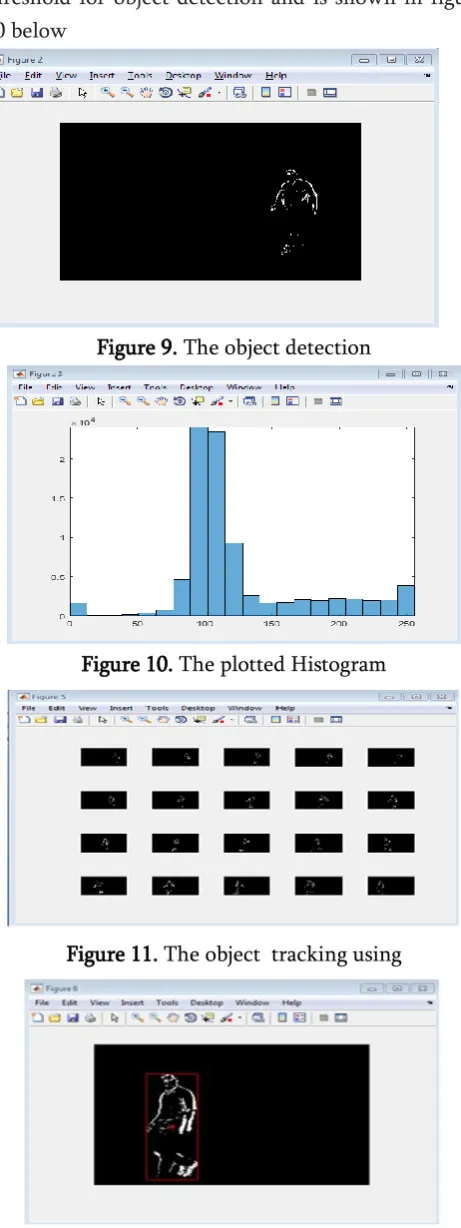
object category. Figure 9 below gives the detected object. Plotting the histogram helps in finding the threshold for object detection and is shown in figure 10 below
Figure 9. The object detection
Figure 10. The plotted Histogram
Figure 11. The object tracking using
Motion estimation and tracking are key activities in many computer vision applications, including activity recognition, traffic monitoring, automotive safety, and surveillance Tracking is the process of locating a moving object or multiple objects over time in a video stream which is shown in figure 4.5 and the figure 4.5 shows the tracked object using mean shift algorithm
V.
CONCLUSION
We come to a conclusion that visual object tracking is a challenging problem in computer vision. To achieve the goal of object tracking they need to obtain a feature vector which is capable of identifying the object to be tracked despite of presence of translation in the view field, at the minimum.
We also observe that the change in scale of the object due to motion along the perpendicular to the line of sight adds to its complexity. In their work we have been able to implement an object tracking system using the MATLAB environment. The system uses the mean shift algorithm, which is based on color channel histogram analysis and the algorithm is modified that it includes the object texture information using the LBP operator.We have been able to enhance the object tracking capability of the system.
VI. REFERENCES
[1]. D Comaniciu, V Ramesh, P Meer, Kernel-based object tracking, Pattern Analysis and Machine Intelligence, IEEE Transactions on, 2003, 25(5): 564-577.
[2]. D Comaniciu, V Ramesh, P Meer, Real-time tracking of non-rigid objects using mean shift. IEEE Conference on, 2000:142-149.
[3]. H Liu, Z Yu, H Zha, et al. Robust human tracking based on multi-cue integration and
mean-shift. Pattern Recognition Letters, 2009, 30(9): 827-837.
[4]. H Wang, C Liu, L Xu, et al. Multiple feature fusion for tracking of moving objects in video surveillance Computational Intelligence and Security, 2008. CIS'08 International Conference on. IEEE, 2008, 1: 554-559.
[5]. R T Collins, Y Liu, M Leordeanu, Online selection of discriminative tracking features. Pattern Analysis and Machine Intelligence, IEEE Transactions on, 2005, 27(10) 1631-1643. [6]. Y Dia, W Wei, Y Lin, An improved Mean-shift
tracking algorithm based on color and texture feature. Journal of Zhejiang University (Engineering Science), 2012, 46(2) 212-217. [7]. T Ojala, M Pietikäinen, D Harwood, A
comparative study of texture measures with classification based on featured distributions. Pattern recognition, 1996, 29(1): 51-59.
[8]. T Ojala, M Pietikainen, et al. Multiresolution gray-scale and rotation invariant texture classification with local binary patterns. Pattern Analysis and Machine Intelligence, IEEE Transactions on, 2002,24(7): 971-987.
[9]. G Bishop, G Welch, An introduction to the kalman filter Proc of SIGGRAPH, Course, 2001, 8(27599-23175): 41.
[10]. Object Tracking Using Meanshift Algorithm Combined with Kalman Filter on Robotic Fish International Symposium on Knowledge Acquisition and Modeling (KAM 2015)
[11]. Spatio-Temporal Closed-Loop Object Detection Leonardo Galteri, Lorenzo Seidenari, Marco Bertini, and Alberto Del Bimbo, Member, IEEE IEEE TRANSACTIONS ON IMAGE PROCESSING 2017 ISBN 1057-7149