Building And Performance
Validating Of Adult
Pedestrian Finite Element Head Model To
Evaluate The Car Hood Design
Hatam Mahmood Samaka, Faris Tarlochan
Abstract: Car - Pedestrian accidents cause a loss of thousands of lives annually in addition to injuries. Therefore, pedestrian protection is one of the important issue in the design of friendly cars. This study shows the performance of finite element head model (FEM) to study and foretelling the extent of injury that occurs at pedestrian accidents and tests the design of the front of vehicle according to European Enhanced Vehicle-Safety Committee (EEVC WG17) regulations of bonnet test. The FE models are powerful tools and effective method to understand how to reduce the sever ity of the fatalities of injuries in road pedestrian collision incidents. In this study, the finite element head model impactor has been built by using Soldworks program and simulated the impact process in LS-DYNA program to examine the four engine-hoods have been designed. All of the hood plates and inner hood panel were considered. Head Injury Criterion (HIC), internal energy time history generated in the head and hood, displacement occurred in the hood i nner panel and weights of the complete hood are investigated. The results of the study concluded that modification of headform des ign of the car hood contributes in achieving low HIC and lead to a pedestrian friendly car. The results show that the structural design of the inner hood panel is one of the key factors affecting the design and specifications of car hood.
Index Terms: Pedestrian protection, Head injuries, EEVC 17group, Adult Head FEM, Sport Utility Vehicle, Friendly cars design, Hood inner plat e. ————————————————————
Introduction
Earlier, research studies of pedestrian protection were dependent on true incidents occurred, these recorded accidents used as a base statistical data, there was a lack of reference information about how to reduce the effect of car collision with pedestrians. The high collision number of pedestrian with vehicles has drawn considerable attention to many researchers in USA. Since 1977, the debates and studies were concentrated on how to protect pedestrians and reduce the effect of collision impact by vehicles because of the growing number of deaths and severed injuries occurred each year in the world [1]. Reference information to a car – pedestrians collision tests and the ways of protection are mainly depends at certain real models of cars and dummies these results from the tests are used as a reliable standard for comparison and verification. For the last twenty years, finite - element models are used instead of the real models and the groups of EEVC ―European Enhanced Vehicle-Safety Committee‖ and IHRA ―International Harmonized Research Activities Working Group‖ are the pioneers who establish the standards in the field of identification tests and validation of models. They carried out investigations on pedestrian head models adult and child and the fatal head injury of pedestrians [2, 3, and 4]. Currently the pedestrian protection at accidents considers one of the most important challenges in automotive industry everywhere in the world due to the large number records of death, and severe injuries occurred for the pedestrians in road accidents [5].
Figure (1) presents a comparison of worldwide percentages of fatalities in pedestrians at road collision [5]. In EU alone, over 40,000 road users die, and around 3.5 million persons injure every year. Moreover, the total annual cost of medical treatment estimates to be about 160 million Euros [1]. In fact, about a quarter of the road accidents victims are pedestrians [6], the majority of these deaths causes by head injury [3, 4].
Fig. 1: comparison of worldwide percentages of fatalities in Pedestrians at road collision [5]
————————————————
Hatam Mahmood Samaka, Master Degree, University of Technology – Iraq, Uniten University – Malaysia.
E-mail: [email protected]
Figure 2 reveals head injury percentages at fatal and nonfatal accidents; however, the probability of head impact with car hood is the highest compared to other parts on the car as shown in figure 3.
The main purpose of research studies within the field of pedestrian protection aims to reduce the head injury and endeavor to design of a friendly car through the design of an appropriate engine hood using a simulate testing system depends on head finite element (FE) models ―for adult and child‖ impacts with hood. These models are developed according to the requirements of the automotive industry market recommended in these countries and the world and with accordance to EEVC WG17, IHRA /ISO, ACEA, and MLIT Japan of pedestrian safety [8, 9, and 10]. The current study is employed LS-DYNA program - finite element’s code depends on Part–Mortem Human Subject (PMHS) data and the Head Injury Criterion (HIC), which is the standard for the value of severity of injury ―standard value of HIC < 1000‖ and calculated from the acceleration history formula,
Where (t1) and (t2) are the initial and final impact instants in
seconds, (t2 – t1) ≤ 0.15 sec, and (a) the acceleration of the
head (G), t2 and t1 takes to give a maximum value for HIC.
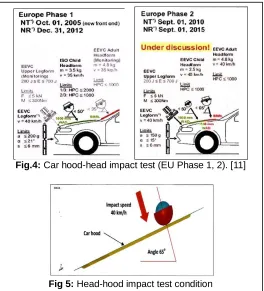
The study is focused on adult pedestrian head protection Europe phase two figure 4, absorption space of the collision energy, and the mechanism of impact formation. Studying the head acceleration waveform and calculation of HIC and adoption of the best type of hood used for the test also investigated following the standard requirements and recommendations of Euro-NCAP ―NATIONAL PEDESTRIAN SAFETY ACTION PLAN‖ adult pedestrian head test figure 5, phase two.
Description of Adult Impactors
Based on EEVC/WG17 requirements the adult impactor should be rigid with spherical shape wrapped by vinyl skin, the global diameter is 165 ± 1; total mass should be 4.8 ± 0.1 kg, figure 6 and the accelerometer should be in the centre of gravity of the head. The tests, which carried out by this impactor for validation, should be dynamic according to EEVC/WG17 statute and the velocity was 40 km/h. [12, 13]
Test Procedure
The tested model is suspended by 2.0m wire so that free movement is secured as shown in figure 7, the certified impactor which is a rigid cylindrical body made from aluminium material with mass of 1.0±0.01kg and 70±1mm diameter moved and impacted to head impactor in horizontal line at velocity of 10 ± 0.1(m/s)[8].
Fig. 2: head injury percentages at fatal and nonfatal accidents [7]
Fig. 3: Percentage of car parts impact with Pedestrian at accident [7]
Fig.4: Car hood-head impact test (EU Phase 1, 2). [11]
Fig 5: Head-hood impact test condition
Finite Element Model (FEM) Impactor Building
The model employed for this study is built by using Soldworks program and simulated the impact process in LS-DYNA program; the FE head model consists of two parts; aluminum sphere and wrapping Vinyl skin as shown in figure 8, a and b. Aluminum sphere established with 7000 nodes, 8mm average element size, solid linear element and elastic rigid body. Wrapping Vinyl skin established with 980 nodes, 8mm average element size, and linear viscoelastic material as depicted in figures a, b and table 1. The cylinder is used as a rigid certified impactor established with 8mm solid elements size nodes and linear elastic material, the angle used for the test between the headform and the aluminum impactor is 30o and impact the hood in the centre of 150mm from the bonnet rear reference line (BRL).
The selected materials used in the model are based on: 1. Material properties from metallurgy books on websites
[14, pages 10,11]
2. Previous studies and practical tests in the area
Headform Validation
The FE headform model was validated according to the standards instructions of EEVC WG17 REPORTS IMPROVED TEST METHODS and European New Car Assessment
Programme (Euro NCAP) regulation [11, 16] to use it in the head - hood impact analysis.
Head Form Impact Test
This test was donning according to EEVC WG17 regulation to find the headform resultant acceleration at the centre of the model.
Figure 9 (a) reveals that the maximum acceleration in head impact simulation is 350G, which is within the recommended range between 337.5G and 412.5G according to EEVCWG17. These results are in agreement with the standard result.
Headform drop test
This test was donning according to Euro NCAP regulation to find the headform resultant acceleration for the headform drop test at the C.G of the model.
Structure of Hood and its Modification
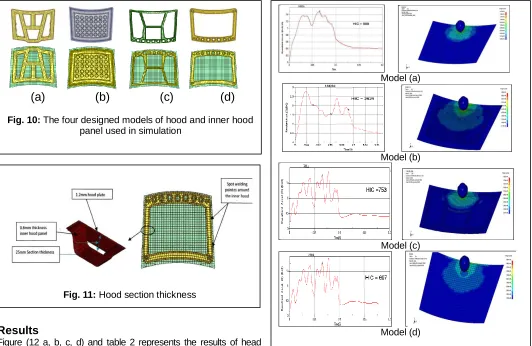
Car hood consists of two parts; outer plate and under plate structure ―inner hood panel.‖ In this study, the inner plate is modified using four different designs; the specification of the hoods ―inner hood panel and outer plate‖ is elastic material, low carbon steel with mass density (R.O) 7.80e-06 kg/mm2 , Young modulus (E) 20e+04 N/mm2 and Poisson’s ratio (PR) 0.31. [15] The dimensions of the hood plate are 1200mm width and 1000mm long, with 1.2mm thickness, the inner plate thickness is 0.6mm with section space of 25mm as shown in figures 10, 11. In this study, the four hoods structure modifications are examined by adult headform impacting the hood in the centre of 150mm from the bonnet rear reference line (BRL). All of the hood plates and inner hood panel were considered.
Fig.7: Headform setup impactor[8]
(a)
(b)
Fig. 8: Adult headformTable 1: Headform, No. of elements and nodes
Part name
No. Of
Elements
No. Of
Nodes
skin
980
971
Sphere
7000
7351
Cylindrical
impactor
256
369
Fig. 9: The adult head simulation result (acceleration curve)
Results
Figure (12 a, b, c, d) and table 2 represents the results of head injury criterion, acceleration time history of headform, internal energy time history generated in the head and hood with the FE analytical results (Von Mises Stress) at 0.5 second from beginning to termination are summarized in table (2). This results for four models of inner plate with fixing to mechanical specifications and thickness of the hood inner and outer plate. However, the influence of the thickness has been outside the scope of this study.
The displacement contours of the four hoods panel are shown in figure 13; the value of displacement is varying according to the design procedure and gives an indication about the deflection which occurs in the hood after the impact. The value should be minimized to avoid the contact between the pedestrian head and top of the engine, which causing a sudden increase in the head acceleration leads to increase in HIC.
(a) (b) (c) (d)
Fig. 10: The four designed models of hood and inner hood panel used in simulation
Fig. 11: Hood section thickness
Model (a)
Model (b)
Model (c)
Model (d)
Fig. 12: Hood type’s simulation data using modify headform (The acceleration curve) and analytical result (Von Mises
Stress)
Discussion of Results
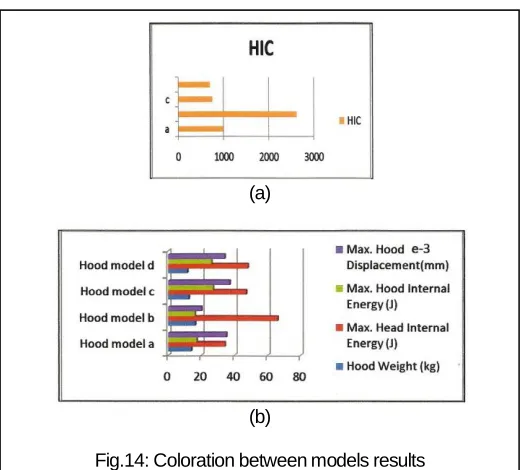
From figure 14a, the value of the HIC and impact internal energy in the head is varying; it depends on design of the hood panel. Model (b) has the maximal value, and model (d) has the minimal. The interpretation of these results is; if the inner hood is completely covering the upper plate that makes the hood stiffer and thus lack of deformation occurs in the hood and increases the head acceleration when collision is taken place, and it’s not empowered the distribution of impact energy therefore, the head internal energy will be maximum figure 14b.
For the same reason in case of the model (b), the vulnerability area concentrated in the impact point beside the bonnet rear reference line (BRL). It is not uniformly distributed leading to a higher value of HIC with this model comparing with the inner panel models "c, d" where the vulnerability area is distributed in broader area and almost covered the entire area of the hood figure 13c, d which lead to a regular collision energy distribution. From table 2 there is no significance change in the mass per unit area of the four hoods. Based on the above results and discussion model (d) can be considered as the best design shape among the other models.
C
ONCLUSIONSimulation model for the adult head developed by using LS-DYNA and based on specifications of EEVC WG17 for generation and validation of the headform model. The reduction of head injury effect on adult pedestrian requires car hood design with low HIC. According to FEM simulation test results, modifying of the headform design of the car hood contribute in achieving low HIC and lead to the pedestrian friendly car. The structural design of the inner hood panel is one of the key factors affecting the design and specifications of car hood.
R
EFERENCES[1]. Marina Annarumma, Alessandro Naddeo, Michele Pappalardo, ―New child/Adult Head Impactor Modelling For Pedestrian Test Simulation, According to EEVC WG17 Protocol-REL. 2002, Using FEM Explicit Codes‖.
[2]. IHRA/PA/200, ―International Harmonized Research Activities Pedestrian Safety Working Group 2001 report‖
[3]. Matsui,L, et al ―Development of JAMA-JARI Pedestrian Child and Adult Head-Form Impactors‖ ESV, 2003,
[4]. Matsui, Y, et al ―Durability over time of skin used for JAMA-JARI head-form impactor measured by bio-fidelity certification testing‖, ESV, 2005
[5]. RSA, NATIONAL PEDESTRIAN SAFETY ACTION PLAN, 2010-2012, Road Safety Authority.
[6]. Shah, B, Sturt, R, ―Effect of pedestrian protection on styling and engineering of vehicles‖, IMechE, 2002
[7]. J. Takahashi, H. Koyama, R. Shida and K. Uzawa, Hongo, Bunkyo-ku, ―PROPOSAL OF CFRTP AUTOMOBILE BONNET FOR PEDESTRIAN SAFETY‖, Tokyo 113-8656, JAPAN, The University of Tokyo, Inc. (since 2008/4/1)7-3-1
[8]. EEVC WG17 report ―Improved test methods to evaluate pedestrian protection afforded by passenger cars‖, Dec 1998
[9]. Matsui, Y, Takabayashi, M, et al ―Characteristics of 3.5kg pedestrian head-form impactor prototypes developed by JAMA-JARI and ACEA-TNO‖, international journal of crash worthiness, 2005 vol 10, 2
[10]. EEVC WG 10 report, ―Frontal surfaces in the event of impact with a vulnerable road user‖, Nov 1994
[11]. EEVC Working Group 17 Report IMPROVED TEST METHODS TO EVALUATE PEDESTRIAN PROTECTION AFFORDED BY PASSENGER CARS (December 1998 with September 2002 updates). Report obtained from EEVC web site - www.eevc.org
[12]. A. Masoumi, Mohammad Hassan Shojaeefard, Amir Najibi ―Comparison of steel, aluminum and composite bonnet in terms of pedestrianhead impact‖, December 2011, Pages 1371–1380
Fig. 13: Displacement contours of the four hoods panel
(a)
(b)
[13]. Technical Feasibility Study on EEVC/WG17Pedestrian Subsystem Test, 18 June, 2004 Japan Automobile Research Institute
[14]. MATERIAL DATA BOOK 2003, 3 Editions, Cambridge University Engineering Department
![Figure (1) presents a comparison of worldwide percentages of fatalities in pedestrians at road collision [5]](https://thumb-us.123doks.com/thumbv2/123dok_us/9111856.1445574/1.612.313.583.389.696/figure-presents-comparison-worldwide-percentages-fatalities-pedestrians-collision.webp)
![Fig.7: Headform setup impactor[8]](https://thumb-us.123doks.com/thumbv2/123dok_us/9111856.1445574/3.612.59.248.60.230/fig-headform-setup-impactor.webp)